


 Welcome & FAQs
  Table of Senate polls
 Senate graphs
 Senate averages
 Tipping-point-state
 Congress: retirements
 Governors' races
 Icons for bloggers
 Data galore


• Trump Visits Wasilla
• Democrats Deploy Their Secret Weapon: Obama
• Trump Is Still Planning to Rig the 2030 Census
• Ossoff Goes Full Sherman
• Turek and Hinson Attack Each Other in Final Debate
• Collins and Jackson Also Had a Heated Debate Tuesday
• In 3 Weeks, 35 States Will Choose Who Runs Their Elections
• Voters Have a Chance to Strengthen Democracy in Missouri and Montana
• Today's Senate Polls
Top House Republicans Have Abandoned All Hope
Top congressional Republicans have privately told Politico reporters that holding the House is a lost cause. Five leaders said the situation is dire and that the House has all but slipped away and it is too late to fix the situation. One of them said that they were trying to save as many seats as possible, but it won't be enough. A senior House Republican said that Donald Trump was not helping them. He said: "President Trump has made this election all about himself. Now we have to survive that political storm." Another Republican said he expected the Democrats to pick up about 10 seats, including seats in Iowa, New Jersey, Nebraska and elsewhere.
Republicans are under extreme pressure in the lower Midwest, which is normally Republican. House (and Senate) races in Iowa, Nebraska, Kansas and other nearby states have highly contested races, something they normally don't experience. This is largely due to farmers who are angry with Trump for his actions that have cut off their markets (the trade war) and raised their fuel and fertilizer prices (the Iran War). Also, Trump's campaigning appears to be backfiring, energizing Democrats more than Republicans.
No one is expecting an October surprise. This year the surprise could be that there is no surprise. Surprise! Republican House members now realize that they are on their own and increasingly many are breaking with Trump on various issues, such as Trump's violating the sanctions bill—that he himself signed in September—by buying diesel from Russia. Not all Republicans are as in love with godless communism as Trump is. It takes some time to acquire the taste for it. Mike Rogers in Michigan and Sen. Dan Sullivan (R-AK) are the latest to break with him. Trump seems to be gritting his teeth and not firing back—unless Republicans attack him directly. If someone says the diesel deal is bad, Trump could blame the deal on Stephen Miller, Susie Wiles or the Diesel Fairy and not himself.
As the House looks grimmer and grimmer by the day, Republicans are in triage mode. The NRCC and NRC are abandoning campaigns they think are hopeless. They have given up on defending Republican Reps. Mariannette Miller-Meeks (IA), Monica De La Cruz (TX), and Tom Kean (NJ). They have also abandoned attempts to unseat Democratic Reps. Henry Cuellar (D-TX), Kristen Rivet (D-MI) and Greg Landsman (D-OH). The money reserved for these districts can now flow to races that might yet be saved. More triage is expected in the next week or two.
An especially big problem is Latino-heavy districts. Many Latinos broke ranks and voted for Trump in 2024. A large number of them are now discouraged and are expected to revert to their normal voting patterns, which means voting for Democrats. Even in the face of mid-cycle gerrymandering, a number of these districts are in play now. Here are the Texas districts:
| District | Candidate | Latino % | 2020 Result | 2024 Result |
| TX-28 | Henry Cuellar (D) | 87% | Biden +10 | Trump +10 |
| TX-15 | Monica De La Cruz (R) | 75% | Trump +2 | Trump +18 |
| TX-34 | Vicente Gonzalez (D) | 72% | Biden +3 | Trump +10 |
| TX-23 | Open | 55% | Trump +7 | Trump +15 |
| TX-35 | Open | 52% | Trump +2 | Trump +10 |
| TX-09 | Open | 51% | Trump +8 | Trump +20 |
It is possible 2026 could be worse than 2020 for the Republicans with some, maybe all, of these districts going blue, turning the recent gerrymander into a dummymander.
In Florida there is potentially also a problem in Latino-heavy districts, again despite the recent gerrymander. Here are some of the problematic districts where an incumbent has to be defended or where hopes of knocking off a Democrat are fading:
| District | Candidate | Latino % | 2020 Result | 2024 Result |
| FL-27 | Maria Salazar (R) | 71% | Trump +0.2 | Trump +15 |
| FL-09 | Darren Soto (D) | 34% | Trump +7 | Trump +18 |
| FL-22 | (Open) | 27% | Biden +3 | Trump +11 |
| FL-25 | Jared Moskowitz (D) | 26% | Biden +5 | Trump +9 |
Even in some districts with few Latinos, Republicans are worried. The Democrats' great red whale is Brian Fitzpatrick (R-PA), who represents a D+1 district in suburban Philadelphia. Democrats have been after him for years, but he keeps defying the PVI. They think gas prices will get him this time. And there are more like him. (V)
Trump Visits Wasilla
As we have repeatedly noted, Donald Trump is getting desperate and doing things he would not normally do, including many things he hates. On Tuesday he visited Alaska, which is a long ways from D.C. He went to Wasilla, Sarah Palin's hometown. Trump held a rally there but didn't say whether he could see Russia. Or whether he waved at his buddy Vladimir P.
Trump went to Alaska to campaign for Sen. Dan Sullivan (R-AK), who is trailing Mary Peltola (D) in the polls. Trump felt his presence would help Sullivan, who attended Trump's rally, something some other Republicans have avoided. Trump talked for 90 minutes. He pardoned two Alaskans convicted of violating the Clean Air Act, mocked Canada, which has a 1,500-mile border with Alaska, derided transgender people and immigrants, and denigrated what he calls "Dumocrats." Trump also told people to vote for Rep. Nick Begich (R-AK). He endorsed fiery Trumpist Bernadette Wilson, who is running for governor and called on the other two Republicans in the race, Dave Bronson and Treg Taylor, to drop out. In addition, he reiterated that if the Republicans keep control of Congress, he would send every American a check for $5,000. Finally, he said no one has done more for Alaska than Donald J. Trump. He told the audience to pretend he is on the ballot.
Not everyone agreed. There were protests outside the rally as the protesters were trying to draw attention to how Trump's policies, especially the trade war and the Iran War, have hurt Alaskans. Eric Croft, chairman of the Alaska Democratic Party, was at the protests and said: "It's chickensh** for Trump to come up, bypass perfectly good, big auditoriums in Anchorage, with probably double the amount of space." Trump's track record endorsing people in Alaska is not great, even though he carried the state himself three times. In 2022, he backed Kelly Tshibaka, who challenged Sen. Lisa Murkowski (R-AK) and lost. He also backed Palin, who lost a House race to Peltola.
The mere fact that Trump, who likes to sleep in his own bed every night, would undertake an 8-hour trip to deep-red Alaska to help bail out a senator he barely knows shows how worried he is about the Senate. He is probably also a little bit concerned about the gubernatorial race there, but much less than the Senate one. On Monday, the Cook Political Report changed its rating on the former, saying it now leans toward former state Rep. Jonathan Kreiss-Tomkins (D), even with ranked-choice voting, because some voters don't bother to mark second and third choices, thus exhausting their ballots on the second and third rounds. (V)
Democrats Deploy Their Secret Weapon: Obama
It took a while, but Democrats finally got Barack Obama, who remains popular among Democrats (unlike the other former Democratic president), to ramp up his efforts to help Democrats during the final 3 weeks of this cycle. Obama is raising money, cutting ads, and hitting the trail, all of which he is very good at. This is likely to energize Democrats more than Republicans since many Democrats (especially Black ones) still revere him, while Republicans have latched onto more recent targets to hate.
His message has been that many races are on a razor's edge and that Democrats need to step up and vote, donate, and help campaign. He has repeatedly warned Democrats that although some polling looks good for them now, it is not a done deal until the last vote has been counted. So far this cycle, Obama has raised $14 million for party committees. Candidates for whom he has cut an ad or made an endorsement this week include Keisha Lance Bottoms in Georgia, David Crowley in Wisconsin, and Deb Haaland in New Mexico. All these are people of color. But he has also helped white candidates, including Troy Jackson in Maine and Jon Ossoff in Georgia. On Friday, the DNC launched a six-figure ad buy featuring Obama telling voters to get involved.
His next campaign stop will be Michigan, where he will campaign for both Jocelyn Benson, who is running for governor, and Abdul El-Sayed, who is running for the Senate. El-Sayed is far to the left of Benson, and Obama joked that leading the Party is a pain in the butt because it holds such a wide range of ideological views. But he is campaigning for all of them anyway. This is what a team player does.
Maybe Obama is just what the doctor ordered. A recent NBC poll showed 43% of voters would be more likely to support candidates Obama endorses and 37% would be less likely. In contrast, 30% would be more likely to support a candidate Donald Trump endorses and 52% would be less likely. Obama is still the Democrats' best surrogate and he is out there meeting the moment now. Trump is the Republicans' worst surrogate, but he is out there, too. (V)
Trump Is Still Planning to Rig the 2030 Census
Donald Trump doesn't care that much about the Republican Party, per se, but does understand that if the Democrats get the trifecta in 2028 and keep it in 2032, they will have time to undo much of what he did. He also dimly understands that if there were free and fair elections everywhere, Republicans, in their current configuration, would rarely win the White House and control Congress. So his strategy for dealing with that is to rig the rules to favor the Republicans.
One particular bee he has in his bonnet is the census. Art. I, Sec. 2, Clause 3 of the Constitution calls for a census every 10 years to apportion seats in the House. Later, the Fourteenth Amendment clarified that. Sec. 2 of the Fourteenth Amendment begins:
Representatives shall be apportioned among the several States according to their respective numbers, counting the whole number of persons in each State, excluding Indians not taxed. [Our emphasis]
The Amendment specifies counting persons. Note that it does not say to count citizens. The founders knew the differences between persons and citizens very well. They used "citizens" in the Constitution seven times when they meant "citizens." Trump believes that immigrants are not persons and thus should not be counted. Specifically, he wants the 2030 census to omit from the count any immigrants who are not green card holders, even though this clearly goes against the verbiage in the Fourteenth Amendment. If he were to get his way, that would reduce the House representation and electoral votes of states with many immigrants, including students on visas, people with temporary protected status, refugees, asylum seekers and undocumented aliens. This is clearly a political goal of his to reduce the political power of blue states.
This is not the first time Trump has barked up this tree. In 2019, in Dept. of Commerce v. New York, the Supreme Court ruled 5-4 that the Census Bureau could not add a question to the 2020 census about citizenship because that doesn't matter for apportioning House seats. But he is back at it.
Civil rights groups and others are going to fight this tooth and nail—again. In addition to its clear unconstitutionality, they fear it will cause some immigrants to refuse to fill out the census form, leading to an undercount. This will affect not only House representation and electoral votes but also how federal money is distributed, since many programs send money to states based on their populations, as determined by the census.
Democrats are fully aware of the consequences of the proposed rule change. Sen. Andy Kim (D-NJ) said: "An accurate census count is at the very foundation of ensuring equal representation across our country and delivering federal funds where they're needed most. The Census is enshrined in our Constitution and not up for political debate." The counting of persons, including noncitizens, has been the standard practice since the first census in 1790.
Of course, as usual, Trump gets the details wrong. One analysis of the effects of Trump's proposal is that Texas and Florida, which have many immigrants, would each lose a House seat whereas Minnesota, Oregon, and Ohio would each gain a seat.
Also a factor here is that even if Trump gets the rule through, the next president will be inaugurated on Jan. 20, 2029, a year before the census starts. If need be, the next president could order the rules changed. That might slow down the process, but the census need only be conducted sometime in 2030. It is usually done in the spring, but Congress could change the law so that as long as it is completed by Dec. 31, 2030, no foul. (V)
Ossoff Goes Full Sherman
No, we don't mean that Sen. Jon Ossoff (D-GA) marched through Georgia, burning and pillaging everything in his path. We are referring to what happened when Ossoff and Rep. Mike Collins (R-GA) debated again on Tuesday. It was nasty. With early voting already underway, Ossoff is leading by about 10 points, so Collins needed to shake things up. But the most significant part of the debate wasn't about some policy issue they disagree on. It was about Ossoff's future. When asked if he pledged to serve a full term if elected, Ossoff said: "Yes, I will. I have zero interest in running for president. I'm not running for president. I'm running for reelection to the Senate." That sounds very definitive. If he were to run anyway, this would come back to haunt him. Sure, he could say: "I had no plans to run and I didn't want to run but so many people told me only I could save the country, so I jumped in." Still, under these circumstances, most politicians would hedge their bets and say something like: "I haven't thought about 2028 for one second. All my energy is on my reelection campaign. In politics, you never know what the future will hold," and leave it at that. He didn't.
If someone promises to serve a full term and then reneges, is that curtains for him? Maybe ask Barack Obama. In Jan. 2006, he promised that he would not run for president or vice president in 2008. Then he broke his promise. How did that work out?
Ossoff's full Sherman wasn't the only interesting takeaway from the debate, though. When the moderators asked Collins who won the 2020 presidential election, he refused to give a straight answer. He merely said that Joe Biden entered the Oval Office. He didn't say whether that was legitimate or not. Ossoff continued to press Collins on that during the debate.
The candidates also clashed over Jeffrey Epstein. Collins said that billionaire Reid Hoffman paid for some of Ossoff's ads, and since Trump ordered an investigation of Hoffman (a major Democratic donor), somehow Ossoff must be tied to Epstein, which Ossoff vigorously denied. Ossoff came back attacking Collins for voting to cover up the Epstein files because Trump's name comes up there repeatedly.
Ossoff also said that judicial reform is needed, including binding ethics rules for the Supreme Court. And he didn't rule out expanding the Court. (V)
Turek and Hinson Attack Each Other in Final Debate
Also on Tuesday was a heated debate in Des Moines between Senate candidates state Rep. Josh Turek (D) and Rep. Ashley Hinson (R-IA). Unlike the debate in Georgia, this one actually matters because the Iowa race is a toss-up, not a blow-out like the one unfolding in Georgia.
Hinson actually criticized Donald Trump on the diesel deal. She noted that diesel prices are killing farmers, but giving money to Russia isn't the proper way to get prices down. She also broke with Trump on the war in Iran but that didn't get her off the hook. In fact, Turek blamed her for the high prices, noting that she voted against multiple House resolutions to end the war. He also hit her hard on corruption, saying corrupt politicians like her are looking out for billionaires and not for the people of Iowa. He has attacked her high personal net worth—between $2 million and $8 million—arguing it makes her part of the problem, not part of the solution.
Hinson attacked Turek for missing many votes in the state House. He said that was due to his campaigning in all of Iowa's 99 counties (the full Grassley) and holding hundreds of town halls to meet Iowans and hear them out.
No debate these days would be complete without transgender politics showing up. However, it fizzled as both of them agree that people assigned male at birth should not compete on female sports teams. However, Turek said that athletic governing bodies should make the rules, not Congress.
Toward the end, both were getting antsy and traded potshots, attacks, talking points, and accusations of lying. The polls show that it is very close. (V)
Collins and Jackson Also Had a Heated Debate Tuesday
The debate between Sen. Susan Collins (R-ME) and challenger Troy Jackson was also nasty. In this hyperpartisan environment, how could it be otherwise? It was the third of four scheduled debates.
Collins' main pitch is that due to her long seniority, she has a lot of power in the Senate. She currently chairs the Appropriations Committee. She said she used it to bring home the bacon to Maine, a poor rural state. Jackson countered by saying she used her power to enable Donald Trump, nominally opposing him only when she was sure her vote wasn't actually needed.
At one point, Collins brought up the issue of fraud in Medicare and Medicaid. Jackson came back by reminding her and the voters that last year, the FBI shut down an investigation about fraud allegedly perpetrated by one of Collins' big donors. Collins didn't like that much. She said he was impugning her integrity. He said he didn't claim she was guilty, but that the FBI was certainly investigating until Trump shut it all down.
Iran was a big issue. Jackson blamed the surge in prices on the Iran war and on her for not stopping it. She said there weren't enough votes in the Senate to stop it. He said that is an excellent argument for having more Democrats in the Senate.
Diesel isn't a big issue in Maine because Maine's farms don't use massive equipment like farms in the Midwest. Most are small family farms that grow berries, raise chickens, provide dairy products, and tap maple syrup. However, home heating oil is used to heat half the homes in cold Maine and is a very big issue. Heating oil is chemically very similar to #2 diesel and its price has soared along with diesel. Jackson blamed Collins for the price jump.
Health care was also a contentious issue. Jackson said that Collins supported cuts to health care funding by being the deciding vote on a procedural roll call that could have blocked it. On the actual vote, she voted no and objected to the exact way he phrased his attack on her. To be precise, he should have said: "When she had the power to block the cuts she decided not to use that power, and later when her vote didn't matter, she voted against the cuts." He didn't because voters don't understand "process" stuff. They argued about the semantics of that. Collins said that Jackson couldn't tell Medicare from Medicaid and he was very offended, saying: "Senator Collins is not going to stand there and school me on what I know."
Another point of contention was campaign finance. Jackson accused Collins of taking donations from almost 100 billionaires and their wives. She didn't deny that but accused him of hiding his donors because he didn't file an FEC report in July. That is true, but it is because he wasn't in the race July 1 and only joined it after Graham Platner dropped out, so her charge is very misleading. He has filed all the reports he was required to file. He said he will release his report on Thursday, which is the date it is due.
In short, it is clear that each candidate really despises and does not respect the other. Each one tried to get under the other's skin and generally succeeded. Considering that Collins makes a big fuss about her bipartisanship fetish, this tends to work against her. (V)
In 3 Weeks, 35 States Will Choose Who Runs Their Elections
There is lots of attention to the Senate races, and some attention to House races and a few gubernatorial races. What is flying completely under the radar are the 35 races that will determine (directly or indirectly) who will run state elections in the future. It didn't used to matter who ran elections since the secretaries of state or other officials generally did their jobs in quiet, low-key ways. Now with Republicans trying to rig election rules and voter rolls in many ways and refusing to accept Republican defeats, election administration has become very contentious and it matters a lot who is doing the job.
Here is a map showing which states are (directly or indirectly) choosing a new elections chief in November. In most of the states, the voters elect a secretary of state to run elections. In a few, they will elect a governor or other official who will appoint the election chief:
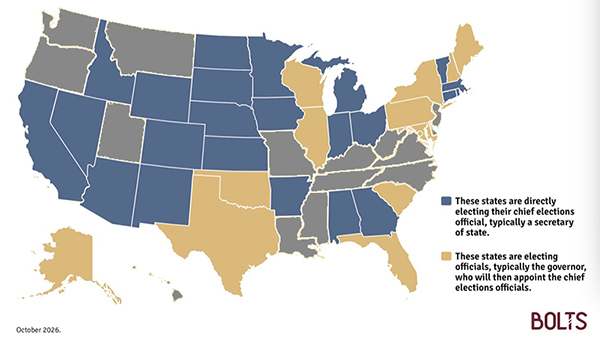
Actually running the elections is only one part of the job. There are also fault lines on mail-in ballots, sharing data with the feds, early voting, ballot measures and other issues. Secretaries of state in the swing states of Nevada, Arizona, Michigan, Georgia and New Hampshire will be tasked with certifying the 2028 presidential election, which could be controversial. Here is a brief rundown of all the states:
- Alabama: SoS Wes Allen wants another term even after pulling out of a multistate project to catch cheaters.
- Alaska: The Lt. Gov. oversees elections and there is an open-seat ranked-choice election for the job.
- Arizona: Adrian Fontes (D) wants a second term; he opposes giving the feds voter data.
- Arkansas: State Sen. Kim Hammer (R), who filed a barrage of lawsuits blocking citizen initiatives, is the favorite.
- California: SoS Shirley Weber wants another term. Voter ID (Prop. 39) is a biggie here.
- Colorado: It is Amanda Gonzalez (D) vs. James Wiley (R). She is for in-person voting in jails for eligible voters.
- Connecticut: SoS Stephanie Thomas (D) wants a 2nd term and has butted heads with Trump over elections.
- Florida: The governor appoints the SoS. The current SoS, Cord Byrd, refuses to say Joe Biden won in 2020.
- Georgia: Penny Reynolds Brown (D) is opposing Tim Fleming (R), who wants to nix most mail-in voting.
- Idaho: Phil McGrane (R) wants a second term so he can tighten voting rules.
- Illinois: Elections are run by an eight-person bipartisan board appointed by the governor.
- Indiana: Sen. Jim Banks' former staffer Max Engling (R) is running against Beau Bayh (D).
- Iowa: Paul Pate (R) wants a 4th term to keep restricting voter access. He will probably beat Ryan Peterman (D).
- Kansas: Pat Proctor (R), the favorite, wants to ban all early voting and counting of late ballots.
- Maine: The legislature appoints the SoS and current SoS Shenna Bellows (D) is available for another term.
- Maryland: The governor nominates the SoS, who must be confirmed by the state Senate.
- Massachusetts: Bill Galvin (D) is unopposed in his run for a ninth term.
- Michigan: Lt. Gov. Garlin Gilchrist (D) is up against election denier Anthony Forlini (R).
- Minnesota: SoS Steve Simon (D) wants another term. He has refused to share data with the feds.
- Nebraska: SoS Bob Evnen (R) lost his primary to someone even more right-wing, Scott Peterson (R).
- Nevada: SoS Cisco Aguilar (D) is facing Jim Marchant (R), who wants to decimate the voter rolls.
- New Hampshire: The legislature picked David Scanlan (R) in 2024. He supports restricting voting and will keep it up if picked again.
- New Mexico: Amanda López Askin (D) will fight the feds if she beats anti-reformer Ramona Goolsby for the open seat.
- New York: Elections are run by the bipartisan Board of Elections, whose members are appointed by the governor.
- North Dakota: SoS Michael Howe (R) opposes voting rights for Native Americans and will likely get a 2nd term.
- Ohio: Trumpy Robert Sprague (R) wants to combat "fraud;" Allison Russo (D) says Ohio elections are safe.
- Oklahoma: The governor appoints the members of the Board of Elections.
- Pennsylvania: Gov. Josh Shapiro (D) appointed SoS Al Schmidt (R) who opposes Trump, and will probably keep his job if Shapiro wins.
- Rhode Island: SoS Gregg Amore (D) is running unopposed.
- South Carolina: The governor appoints the five-member State Election Commission.
- South Dakota: Election denier SoS Monae Johnson (R) was defeated by an even crazier Republican, Heather Baxter, who will crush Terrence Davis (D).
- Texas: The governor appoints the SoS subject to confirmation by the state Senate.
- Vermont: SoS Sarah Copeland Hanzas (D) faces election denier H. Brooke Paige (R) for the third time.
- Washington D.C.: A three-person board appointed by the mayor and confirmed by the city council runs elections.
- Wisconsin: A six-member bipartisan board appointed by the governor and legislature runs elections.
- Wyoming: Non-Trumpy Robert Short (R), who says there is no fraud, faces Bryan McCarty (D) for the open seat.
As you can see, election administration is much more contentious than it used to be. (V)
Voters Have a Chance to Strengthen Democracy in Missouri and Montana
Measures on the ballots in Missouri and Montana will strengthen direct citizen democracy if they pass. In Missouri, the measure is called Amendment 6; in Montana, it is called CI-133. This is a rejoinder to the many attempts by state legislatures to thwart citizen initiatives. Their view is: The people have no business making laws. We have a monopoly on that.
In both states, ballot measures have protected abortion and legalized marijuana, something the Republican-controlled and highly gerrymandered state legislatures wildly oppose. So naturally the legislatures want to silence the people. They just get in the way of governing. Dani Hess, a spokesperson for the group that organized the Montana initiative on initiatives, said: "People are really frustrated with the government right now, and it is a really important time to protect the ways that voters can have a more direct say on the laws that impact their lives."
Montana has allowed citizen initiatives since 1906, but the new initiative would amend the state's Declaration of Rights to add a clause stating: "The people have a fundamental right to exercise their powers of initiative and referendum." The Missouri Amendment 6 would add to the state Constitution wording that the "rights of initiative and referendum set forth in this Constitution are fundamental rights."
In addition to making the initiative process a fundamental right, the initiatives have other provisions. The Missouri one states that the legislature cannot roll back an initiative unless that law gets an 80% superduper majority, and even then, it has to go to the voters for approval. This matters. For example, Missouri voters approved a paid sick leave reform and then the legislature erased it. Under the proposed amendment, the legislature's vote would have failed. The Montana initiative has provisions to prevent the state AG from stalling or killing initiatives he doesn't happen to like.
These changes would give popular initiatives the highest level of constitutional protection. Initiative campaigns could then use this to challenge state hurdles, antagonistic attorneys general, and restrictive laws. Courts are expected to be very skeptical about anything that impinges on a fundamental right and the specific provisions will also hinder state officials who don't like some proposed measure. (V)
Today's Senate Polls
It looks like Iowa, Maine, and Texas are going to be agonizingly close. All of them could go either way. It is going to be a rough 3 weeks going into the election as candidates grasp at every straw to get an edge. (V)
| State | Democrat | D % | Republican | R % | Start | End | Pollster |
| Iowa | Josh Turek | 47% | Ashley Hinson | 46% | Oct 06 | Oct 12 | YouGov |
| Iowa | Josh Turek | 48% | Ashley Hinson | 45% | Oct 08 | Oct 11 | Marist Coll. |
| Maine | Troy Jackson | 49% | Susan Collins* | 47% | Oct 08 | Oct 11 | Suffolk U. |
| Minnesota | Peggy Flanagan | 45% | Michele Tafoya | 42% | Oct 08 | Oct 12 | SurveyUSA |
| Mississippi | Scott Colom | 48% | Cindy Hyde-Smith* | 52% | Oct 12 | Oct 14 | Wedgewood Polls |
| Rhode Island | Jack Reed* | 59% | Raymond McKay | 25% | Oct 08 | Oct 11 | Emerson Coll. |
| Texas | James Talarico | 47% | Ken Paxton | 45% | Oct 08 | Oct 11 | Marist Coll. |
| Texas | James Talarico | 50% | Ken Paxton | 47% | Sep 25 | Oct 05 | U. of Texas |
* Denotes incumbent
Previous report Next report
If you wish to contact us, please use one of these addresses. For the first two, please include your initials and city.
- questions@electoral-vote.com For questions about politics, civics, history, etc. to be answered on a Saturday
- comments@electoral-vote.com For "letters to the editor" for possible publication on a Sunday
- corrections@electoral-vote.com To tell us about typos or factual errors we should fix
- items@electoral-vote.com For general suggestions, ideas, etc.
- Guidelines for questions (Saturdays) and letters (Sundays)
To download a poster about the site to hang up, please click here.
Email a link to a friend.
---The Votemaster and Zenger
Oct14 Democrats Are Making Money Moves
Oct14 Political Bytes, National Edition: Gonna Party Like It's 1699
Oct14 Local Bytes: How to Not Start Foreign Wars
Oct14 Today's Senate Polls
Oct13 Trump Appeasement Syndrome, Part I: Cassidy Hutchinson
Oct13 Trump Appeasement Syndrome, Part II: Ilhan Omar and Lisa Cook
Oct13 Trump Doubles Down on the $5,000 Checks
Oct13 The Texas Senate Race Has Become a Soap Opera
Oct13 Boy, We Really Hate This Question
Oct13 Today's Senate Polls
Oct12 Everyone Is Furious about the Diesel Deal
Oct12 The Ship Has Sailed
Oct12 A Catastrophic House Scenario for Republicans Is a Real Possibility
Oct12 Federal Judge Tells Trump He Cannot Access State Voter Data
Oct12 Early Voting in Ohio Looks Good for Democrats
Oct12 Trump Has a New Press Secretary
Oct12 If Democrats Win the Senate, Schumer Will Have a Big Problem
Oct12 AOC Is Carefully Weighing Her 2028 Options
Oct11 Sunday Q&A
Oct10 Bankhead Keeps Campaigning in Montana
Oct10 Today's Senate Polls
Oct09 Hegseth Plans to Broadcast Firing Squad Execution
Oct09 TrumpWatch 2026: This Is What Happens When a Country Has a Corrupt Leader
Oct09 The Senate: Candidates Try to Pop Each Other's Bubbles
Oct09 Legal Bytes: Hearn Beats the Rap
Oct09 I Read the News Today, Oh Boy: Happy Birthday, John Rock
Oct09 This Week in Schadenfreude: Artist Captures the Soul of Donald Trump
Oct09 This Week in Freudenfreude: Some Folk in Canada Aren't Taking This Lying Down
Oct09 Today's Senate Polls
Oct08 Senators Warn Trump: You Went Too Far--on Immigration
Oct08 The House Freedom Caucus Will Change in January, but How?
Oct08 Too Little Too Late
Oct08 Who Really Lives in California?
Oct08 The States Also Matter
Oct08 The FCC Is Considering a Rule Change
Oct08 Today's Senate Polls
Oct07 Collins, Jackson Debate
Oct07 Two Republican Ex-Governors Endorse Democrat in Kansas Senate Race
Oct07 Let's Take a Quick Look at Early Voting
Oct07 When It's Not the SAVE Act, It's the SAVE Database
Oct07 Following Up, Part I: The $90 "Checks"
Oct07 Following Up, Part II: The Threat Against California
Oct07 Today's Senate Polls
Oct06 Donald Trump Is Getting Desperate, Part I: Policy
Oct06 Donald Trump Is Getting Desperate, Part II: Petulance
Oct06 SCOTUS Is Back at It
Oct06 Political Bytes, National Edition: Kind of Blue
Oct06 Today's Senate Polls
Oct05 Democrats Are Rethinking Their Mail-in-Voting Strategy

