


 Welcome & FAQs
  Table of Senate polls
 Senate graphs
 Senate averages
 Tipping-point-state
 Congress: retirements
 Governors' races
 Icons for bloggers
 Data galore


• Trump May Pardon Everyone in His Administration
• What If the Polls Are Off?
• Low-Information Voters Are Souring on Trump
• Republicans Are Split on Ramaswamy's Despicable Ad
• Here Are the House Races to Watch
• Is the Religious Left Rising?
• Local Bytes: The Last Frontier, and Beyond
• Brazil Is a Lula Lemon for Trump...
• ...While We Wait to See if He Gets the Yahu He Wants In Israel
Early Voting Is Way Up Compared to 2022
Most people get 15 minutes of fame per lifetime. Political science Prof. Michael McDonald, of the University of Florida, gets it every 2 years, as his speciality is tracking early voting. He is reporting 12.0 million in-person early votes and 13.6 million mail-in ballots returned so far. Here is his best guess at the demographics. Note that some states don't register voters by party and/or don't break down voters by all categories. On the left is the breakdown by party, where the data are available. This chart is for AZ, AR, CA, CO, CT, DE, FL, ID, IA, KS, KY, LA, ME, MD, NE, NV, NJ, NM, NC, OK, OR, PA, RI, SD, UT, WV, and WY. On the right is the breakdown by age. Slightly more women than men have voted so far.
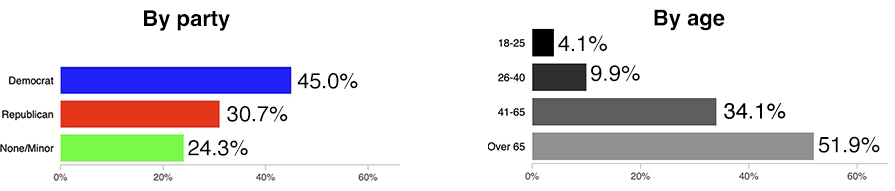
Early voting is up considerably compared to 2022. There were 15 million votes in at this point in 2022. In Kansas, early voting is up 69%, in Maine, it is up 41%, and in Iowa, it is up 24%. Everywhere the pattern is similar. Democrats and independents are engaged, Republicans are not. Of course, Republicans tend to prefer voting on Election Day, so don't draw too many conclusions yet. That said, McDonald believes that Democrats are fired up to vote and Republicans are less so. This is what the polls show and McDonald thinks they are correct on that point.
One thing about early voting is that votes cast before Election Day are locked in and can't be affected by events that happen after they voted. Democrats are pulling ahead in the generic House poll and votes being cast now are going to reflect that, no matter how much money Donald Trump promises voters this week for a Republican sweep. Here is the generic poll this year. The lightly shaded blue and red areas around the dark lines represent the margins of error:
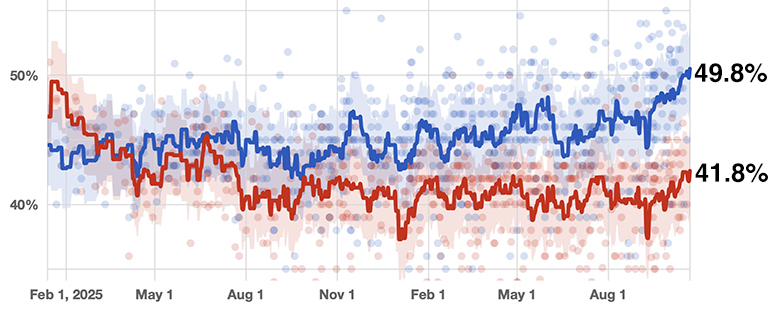
According to Decision Desk, the current generic poll is at D+8. If that holds, the Democrats will pick up 10-20 House seats, maybe more.
Often, as we get close to Election Day, partisans who have been yelling: "I'm not going to vote for [party] because mumble mumble" tend to come home, engage in the ancient "holding of the nose" ritual, and vote anyway. We may be seeing some of that now, especially among Republicans who dislike how Donald Trump has handled the economy and the trade and Iran wars, but hate the Democrats even more because they think the Democrats have lost their minds. Senior Democrats are tempering their expectations of how big a House majority they might win. They see races in the Midwest, a key Colorado seat (CO-08), and elsewhere are getting closer. Some of them don't think they will hit 235 seats, as they did after the 2018 midterms. Both parties think that the deluge of last-minute Republican money might be playing a role here. But, as you know, in politics, a week is a long time, and we have just over a week to go. (V)
Trump May Pardon Everyone in His Administration
Two sources have told The Washington Sun that White House attorneys are working on mass pardons for many junior officials in the White House, especially those working on sensitive topics, including deportations, war, or trade. This activity revved up after Sen. Elissa Slotkin (D-MI) said earlier this month that potential investigations should make young people think twice about accepting a job in the administration. Conservative organizations, including the Heritage Foundation and American Moment, have been lobbying for Pardons for All.
Presumably it is a foregone conclusion that all the senior officials will be pardoned, as well as all of Trump's family and presumably himself as well. Pardons for billionaires and major donors are also on the agenda. There could possibly be thousands of pardons, probably by the autopen that Republicans have said makes the signature invalid.
One thing that should be noted here is that a pardon does not block a congressional committee from subpoenaing someone to testify. In fact, it makes it worse. Someone who has been pardoned for a particular crime (or all crimes) can no longer invoke the Fifth Amendment to avoid self-incrimination because the pardon eliminates the possibility of being indicted. Of course, the timing matters. If Congress issues a subpoena for someone in Feb. 2027, a possible pardon that might arrive on Jan. 20, 2029 at 11 a.m. still allows the person to plead the Fifth until 2029.
Clemency expert Prof. Mark Osler of the University of St. Thomas School of Law said: "It's a despoilment of what is supposed to be a tool for mercy and national reconciliation being used as a battlefield tool in political wars." Liz Oyer, the pardon attorney under Joe Biden, said: "Preemptive pardons of everyone in the administration, or even of a significant number of administration officials, would be incredibly damaging because they would effectively place the executive branch outside the reach of the law."
Could these pardons be challenged? Sure, a future Democratic AG could say:
The intent of the pardon power is to correct miscarriages of justice. That means people who were incorrectly convicted due to some error in the judicial process. It was not meant to pardon people who haven't even been indicted. Consequently, I don't believe advance pardons are valid and will prosecute people who have committed crimes, even if they have an advance pardon. When these cases get to the Supreme Court, the Court can rule on them.
The AG could suggest, as a thought experiment, that people consider a president who said: "I will pardon anyone who assassinates a Supreme Court justice I don't like!" Would such a pardon be valid? Presidential pardons cover federal crimes but also D.C. crimes (because it is a federal territory), so there would be no way to indict someone on "state" charges for a crime committed in the District.
Republicans are already (preemptively) declaring that anyone who is unhappy at this policy should point the finger at Joe Biden, because he started it. Actually, Gerald Ford started it by pardoning Richard Nixon for various and unspecified crimes. That said, Biden certainly accelerated it with his preemptive pardons of his family and high-ranking members of his administration. When he did so at the time, we took the view that he had no choice, because otherwise these people would have been subject to years' worth of sham investigations, hearings, court filings, etc. That prediction, which was not exactly difficult to make, has de facto proven correct. The administration has pursued spurious vendetta investigations against James Comey, Jack Smith, Letitia James, Rep. Ilhan Omar (DFL-MN), the reflecting pool "vandal," etc. Can you imagine what Todd Blanche, the fellow cosplaying as AG, would do if he had a juicy target like Hunter Biden or Anthony Fauci?
We also wrote at the time that Biden and his team knew full well that they were greasing up the slippery slope, and that Trump would take this and run with it. Clearly he is planning to do so. It is equally clear, however, that presidential administrations cannot operate with no fear of legal consequences because they know they'll be pardoned for all offenses on the last day of the president's term. One can only hope that, as with something like gerrymandering, the flaws in the system have become so apparent that it will lead to bipartisan support for significant reform. That said, gerrymandering can be fixed by an act of Congress. The pardon power might well take a constitutional amendment. But maybe not. Suppose Congress passed a law stating that pardons can be granted only to people who have already been convicted of some crime and then only for that specific crime. If the Supreme Court upheld the law the first time it was tested, that might also do the job. (V & Z)
What If the Polls Are Off?
Nate Silver has a rule: "Always account for the possibility of systematic polling errors." What he means is that it is possible that the polls could be off by, say, 3 points in all states due to some systematic error (e.g. "shy" Republicans) and all the errors are in the same direction. Pollsters are obviously aware of this problem, but how they deal with it is another matter. Aggregators and model makers (like Silver) also need to address this.
His FLIPR model currently predicts a 54D, 46R Senate. He also tested a model in which the Democrats underperform the polls by 2 points. If that happens, the Iowa and Kansas seats stay Republican but Democrats (barely) flip Maine and Texas, leading to a Senate that is 52D, 48R. Next he assumed the Democrats underperform the polls by 3 points. Under those conditions, Republicans hold Maine and Texas and the Senate is 50-50, giving J.D. Vance some actual work voting in the Senate. This scenario also gives Sen. Lisa Murkowski (R-AK) a lot of power. If Democrats underperform the polls by 4 points, Republicans win Alaska and Michigan, leading to a 48D, 52R Senate.
But there are other factors to consider, including candidate quality. That holds especially for Maine, where Sen. Susan Collins (R-ME) is one tough old bird who can defy national trends, and Texas, where Ken Paxton is personally so toxic that he could lose even if there is no blue wave.
We have done a small stress-test experiment ourselves. Starting with today's map we can look at what happens if the Democrats overperform the polls by 3, 2, or 1 points and also if the Republicans overperform the polls by 1, 2, or 3 points. Here are the results. In each cell, the Democratic score is given first.
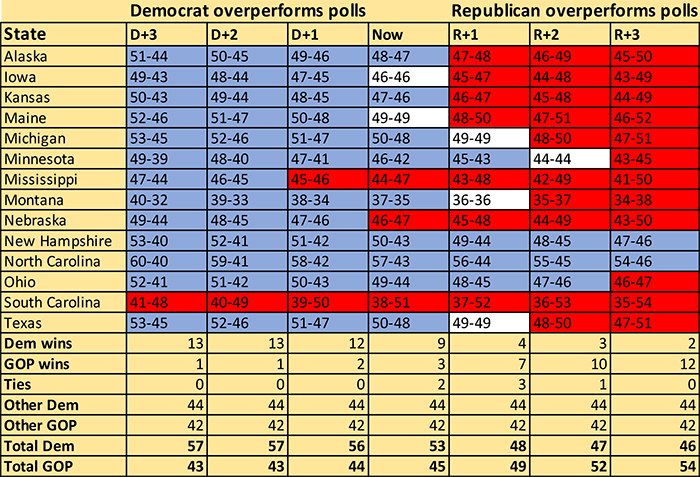
The "Now" column is the current map, except in this experiment we are counting Seth Bodnar (MT) and Dan Osborn (NE) as likely to caucus with the Democrats. So although the map scores Bodnar as a tie (because he hasn't said which party he will caucus with), it is very likely he will caucus with the Democrats, just as Sen. Angus King (I-ME) does.
As you read across the table in any row from left to right, the Democratic score decreases by 1 point in each column and the Republican score increases by 1 in each column. The D+3 column shows what happens if the Democrats overperform the current map by 3 points in every one of the states listed. Then the Democrats get 57 seats. The R+3 column shows the results if the Republicans overperform the map by 3 points. Then the Democrats get 46 seats.
As you read across the table in any row except South Carolina, at D+3, it is blue. Then as you move to the right, Democratic performance drops and the blue becomes white and then red or in some cases, like 46-45 fliiping to 45-46, directly from blue to red. Once it has hit red, moving farther to the right, it never goes blue again. When the "Total Dem" and "Total GOP" numbers in the bottom two rows do not add up to 100, that is due to predicted ties (white cells). Of course there can't be a real tie, but if the polling rounded to integers is 46-46, we have scored it as a tie.
Given a plausible polling error of up to 3 points and the likelihood that all the errors are in the same direction, the Democrats could end up with anywhere from 46 to 57 seats in the Senate. (V)
Low-Information Voters Are Souring on Trump
Speaking of experiments, the guy who was Nate Silver after Nate Silver stopped being Nate Silver, namely G. Elliott Morris, commissioned a Verasight poll to examine how low-information Trump voters are feeling. He (wisely) did not start off with the question: "Are you a low-information voter?" Instead he started off with two questions:
- Which party has the most members in the U.S. Senate?
- Which party has the most members in the U.S. House of Representatives?
A respondent who got both right was considered a "high-information voter," and one who missed one or both was labeled a "low-information voter." It's not a high bar, but many respondents failed. In baseball, batting .500 would put Ted Williams to shame, but not here. About 25% of 2024 Trump voters and 22% of 2024 Harris voters got at least one wrong. JVL of The Bulwark constantly comments about the intelligence level of the American public by citing a survey Lay's did of people who buy Lay's potato chips. Forty percent of Lay's actual customers did not know that potato chips are made from—you guessed it—potatoes. The company then redesigned the packaging to show potatoes on it to educate its customers. Anyhow, Morris also asked who they voted for in 2024. He did not ask about potatoes.
Using these three questions, Morris had a known pool of low-information Trump voters and a known pool of high-information Trump voters. He also asked them whether they approved or disapproved of Donald Trump and computed the net score. He then compared the current results with the same poll questions he asked in February. Here are the results, with the low-information voters on the bottom:
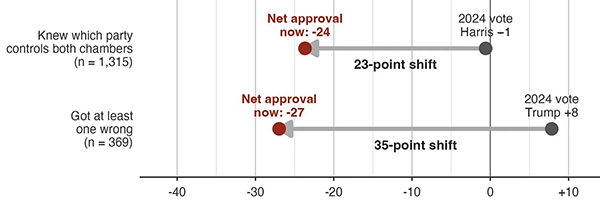
The high-information Trump voters have soured on Trump by 23 points since February, while the low-information ones have soured 50% more, with a shift of 35 points. And remember, it was the low-information voters who powered Trump's victory in 2024. They now dislike Trump even more than the high-information voters do.
Morris also asked the generic House ballot question in both February and October. The high-information voters are now D+7 (a 6-point shift). The low-information voters are now D+12 (a 20-point shift). This means the low-information voters have shifted much more strongly than the high-information voters. Or, more crudely, the less you know about politics, the more likely you are to be a Democrat. It is not intuitive, but did you expect more from people who don't know what potato chips are made from?
The survey asked about 13 policy issues as well. On every one of them, the low-information voters dislike Trump more than the high-information voters. On prices, for example, the low-information voters are net -24 for Trump but the high-information ones are +4 for Trump. The pattern holds for everything else as well. Also, only 35% of the low-information voters say that Trump cares about people like them (vs. 60% of the high-information voters).
Maybe this is just anti-incumbent bias. Hard to say. Morris has a warning for the Democrats, though. If Democrats can't deliver in the next two years, the low-information voters are likely to swing back again. Excuses like: "We passed a whole bunch of bills to lower prices but Trump vetoed them all" won't cut it because these voters don't understand how government works. That's life. (V)
Republicans Are Split on Ramaswamy's Despicable Ad
We've now written a lot about Vivek Ramaswamy's (R) ad, in which Amy Acton's (D) mother, Donna Arthur—who stood by when her lover raped her daughter repeatedly for almost 2 years starting when she was 10 years old—claimed that Acton is a liar. After the lover was indicted by a grand jury for the rapes, Arthur and lover fled to Pennsylvania and lived there as fugitives from justice until he died in 2004. Arthur claimed that Acton has lied her whole life—something Arthur couldn't actually know since her kids were taken from her and lived with their biological father after the incident and Arthur never saw Acton after that. And the mother is not without sin, having been convicted of animal cruelty and theft. A woman who would let her lover rape her own daughter and then stay with him after he was indicted for it, who was convicted of crimes herself, and who would make a shameless ad about her own daughter (whom she has not seen or spoken to in 48 years) is probably not the most reliable witness. Some people are even suggesting that perhaps some money changed hands at the time Arthur cut the ad.
The fact is that decency does not have a long and robust history in the Republican Party, going back to at least June 9, 1954, when Army lawyer Joseph Welch asked Sen. Joe McCarthy: "Have you no sense of decency, sir, at long last?" McCarthy didn't and neither does Ramaswamy when there is a governorship at stake. But some Republicans do.
Gov. Mike DeWine (R-OH) called the ad "deeply, deeply troubling" and "just plain wrong." Sen. Jon Husted (R-OH), who is in a tough race himself, said he would not have run the ad. Rep. Ashley Hinson (R-IA), who is in a tight Senate race in Iowa, said it should come off the air.
Even Scott Jennings, who is CNN's house shill for Donald Trump, said: "What you're talking about here is Amy Acton's mother is basically saying, 'I don't trust 12-year-old Amy Acton, who was quite possibly raped in my own home, to be governor.' It's a ludicrous sort of argument that they're making." But even worse (from his point of view), the morality aside, it's bad politics. Jennings: "This is probably the worst politics you could imagine, and it's bringing a lot of attention to Amy Acton's story, her narrative." Jennings went on to say: "One of Ramaswamy's key candidate deficiencies is likability. Not certain this is doing anything to help that. It was a problem for him in the '24 presidential primary, and it's a problem for him in this governor's race." That's Ramaswamy's real sin: a tin ear.
On Friday, Ramaswamy's hand-picked running mate, state Sen. Rob McColley (R), said the campaign did not believe Dr. Acton was lying about her childhood abuse.
The ad has divided Republicans like no other. Donald Trump and J.D. Vance have cheered Ramaswamy and the ad on. To them, all's fair in war and politics, including using the rape of a 10-year-old girl for partisan politics. On his social media site for sexual assaulters, Trump bleated: "Vivek should keep it up."
Acton's campaign spokeswoman, Addie Bullock, said of the ad: "Ramaswamy will do anything, including embrace child sex predators, to get what he wants." Bullock blew it. She had a perfect opening and didn't say: "How come Republicans always side with the child sexual predators, from Epstein to Ramaswamy? Why are they always on the wrong side?" This would tie Ramaswamy to Epstein, however tenuously, and force him to react, just making it more newsworthy and him even less likable.
As soon as the ad came out, Sarah Longwell, publisher of The Bulwark, did what she always does when something dreadful happens: She conducted a focus group. This one was of Trump voters. She reported that all the voters were repulsed by the ad. Many said they would just not vote for governor but a few said they would vote for Ramaswamy despite the ad because they hated Acton for restricting their freedom during the COVID-19 pandemic when she was Ohio's health director. Almost no one said they would now vote for Acton. Still, if enough Trump voters leave that box blank, it will help Acton.
On Saturday, Barack Obama campaigned in Ohio for Acton. Before he got on stage, Acton spoke to the crowd and said: "Decency still matters. Mr. Ramaswamy, you are not just out of touch, you are out for yourself and you are a danger to my state. Apparently there is no low to which you won't stoop." Then Obama took the stage and said of Ramaswamy: "In recent days, we've seen there is no line he will not cross, no low he will not sink to. There's a decency we should expect out of our public officials. And I don't know what's happened where the standards of behavior are so low that somebody could run an ad like that." Obama also noted that Acton has spoken movingly about her painful childhood and all the abuse, neglect, and homelessness she experienced as a child.
The Cook Political Report quickly understood that the last week of the campaign would not be about illegal immigrants sneaking over the border and then teleporting to Ohio or even J.D. Vance commenting on how Haitians just love sweet-and-sour dog. It would be about how the Republicans are split and how Acton was abused as a child, survived, and became a doctor so she could help people. The Report wrote: "It's an inescapable law of politics: Money can only propel a campaign so far when its candidate's flaws act as an anchor." The race is now rated "lean Democratic." When it is over, it will be interesting to see the crosstabs of the exit polls to see how big the gender gap was. (V)
Here Are the House Races to Watch
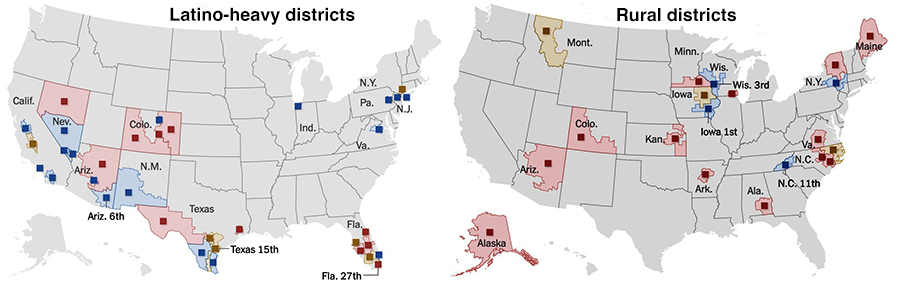
No two of the 435 House races are identical. Demographics, geography, local issues, candidate quality and partisan lean always play a role. Nevertheless, there are two groups of voters that could play a decisive role in determining which party controls the House, and by how much. These are Latinos and rural voters. The New York Times has a good article examining which districts are going to be affected by how they vote.
Here are maps showing districts to watch, with competitive Latino-heavy districts on the left and competitive rural districts on the right. In the Times map, the districts are interactive, so mousing over a district pops up an information box about it. Except for CO-03 (Jeff Hurd, R, PVI of R+5), which is on the Western Slope and AZ-02 (Eli Crane, R, PVI of R+7), which covers most of the state, there isn't much overlap between the two demographics.
The situation keeps deteriorating for Republicans. Since the end of September, the Cook Political Report has shifted 63 districts toward the Democrats. Now, 12 of the toss-up districts are held by Republicans and only 5 by Democrats. History shows that swing districts tend to swing the same way, so a split close to 50-50 is an unlikely outcome.
The problem for the Republicans is that Latinos are furious about ICE sweeping Latinos, including some American citizens, off the streets and locking them in gulags for deportation. Farmers are furious about high prices for diesel and fertilizer and the loss of foreign markets due to Trump's trade war. If both groups swing hard toward the Democrats, it could be a bloodbath for the Republicans.
On Election Night, there are seven districts in South Florida to watch to see how Latinos are voting. Although Florida Latinos are Cuban American and South-American American and western ones are Mexican American, a huge shift toward the Democrats in South Florida could be a bellwether for more of the same when results from the West start coming in two hours later. Especially since Cuban Americans tend to lean more Republican than Mexican Americans.
Similarly, the very rural ME-02 and the three rural districts in eastern North Carolina will be closely watched. Democratic wins in NC-03 (R+6) and NC-13 (R+8) will spell big trouble for the Republicans all over the Midwest. Of course, the reverse is also true. If Republicans hold steady in the East they will also probably hold steady in the Midwest. (V)
Is the Religious Left Rising?
We all know about the religious right, the people who believe Jesus said: "If anyone slaps you on the right cheek, kick them in the groin as hard as you can." But is there a religious left? And if so, does it matter? The answer to the first question is "yes" and on Nov. 4th, we will find out about the second one.
Two center-left Christian pastors are running for the Senate in deep-red states: James Talarico in Texas and Adam Hamilton in Kansas. Texas hasn't sent a Democrat to the Senate since roughly when Methuselah was in short pants and the last time Kansas did so, Herbert Hoover was sitting in the White House. But both Talarico and Hamilton are within shouting distance of winning. In fact, Talarico has actually had small leads in most polls. If both of them win, together with Sen. Raphael Warnock (D-GA), senior pastor of the Ebenezer Baptist Church, and Sen. James Lankford (R-OK), a Southern Baptist minister, they can form a pastor caucus.
But more importantly, even a win by Talarico and a really close loss by Hamilton could show Democrats how to win in red states: Run Christian ministers who talk about Jesus' message, something ministers are usually pretty good at. Instead of talking about how they support some government anti-poverty program, they should talk about Jesus' attitude toward the poor. Although there is no record of how Jesus felt about whatever Medicaid was called back then, his empathy for the man with leprosy and the woman who had been bleeding for 12 years is clearly stated in the Gospels. Run on that. He was OK with taxes, had a few thoughts about rich people's odds of getting into heaven, and he took some action in the temple relating to the financial services industry of his time. Run on that. His ministry was not xenophobic, but rather compassionate, merciful, and welcoming of outcasts. Run on that. There's actually not a lot of space between the program of Sen. Bernie Sanders (I-VT) and that of Yeshua ben Yosef (I-Nazareth).
Debating a Democratic minister, it will be tough for a Republican to get away with saying: "What the hell do you know about Jesus?" In a debate, the minister could throw in quotes from the Bible to make points. That might well fly in red states, coming from an expert. And there are more than a few Republicans who pretend to be Biblical but are not. A few well-timed questions could really hoist some of the phonies by their petards. For example, a pastor-candidate could ask: "I am having trouble understanding how my opponent can reconcile his vote to cut school lunch programs with the instructions Jesus gave us in Luke 18:16. Perhaps he can explain?"
The Senate isn't the only office Christian ministers are running for. Iowa state Sen. Sarah Trone Garriott (D) is a Lutheran minister running against Rep. Zach Nunn (R-IA) in IA-03. Iowa state Rep. Lindsay James (D), a Presbyterian minister, is running in IA-02, the seat Rep. Ashley Hinson (R-IA) vacated to run for the Senate. Both Garriott and James are in their 40s. The districts are R+2 and R+4, respectively. With Rob Sand (D) running away with it in the gubernatorial race, he could have coattails that extend to both of the women, as well as to Senate candidate Josh Turek (D). In any event, in a week, we will get some useful information on whether this is a viable path for Democrats in red states going forward. (V)
Local Bytes: The Last Frontier, and Beyond
We're a week away from Election Day. For that reason, we plan to run some Local Bytes every day this week. Today, we start with some comments on the nonsense in Alaska:
L.L in Boston, MA, writes: I am somewhat surprised that you didn't mention an additional factor that makes the Department of Justice's Alaska lawsuit less credible. Namely, Alaska has ranked-choice voting. In this case, the Republican Dan Sullivan is a real contender for the position. The unaligned Dan Sullivan is not. Ranked-choice voting means that a confused voter can vote for both Dan Sullivans. Assuming he ranks the two Dans Sullivan 1 and 2, the vote will eventually end up with the correct Dan Sullivan.
D.R. in Chicago, IL, writes: The biggest problem I see with the administration's efforts to sow doubt in the Alaska Senate election is the way the names appear on the ballots themselves, which you can view here:
Sullivan, Daniel J. Jr.
Sullivan, Dan S. (Registered Republican) IncumbentThis does not strike me as confusing.
My sense is that this easily-understood fact of the matter, if widely enough disseminated, will do more to defuse the administration's propaganda efforts than any mountain of legal technicalities.
B.W. in Los Angeles, CA, writes: The first thing I thought of when I read about the Alaska/DoJ suit: publicity stunt to educate low-information Alaska voters about the two Dan Sullivans (Dans Sullivan?).
Trump has always been more of a carnival barker/Internet troll than a statesman, and he's pretty adept at magnetizing attention. He also never met a scam he didn't like.
If the goal was to bait essentially all media into raising awareness of a potential confusing ballot issue (as I suspect it was), and to do so on the government's dime, without diverting any campaign funds, then "mission accomplished."
I don't think it's giving him too much credit to say he must know the suit is unwinnable. But that's irrelevant. Voters for the incumbent Dan Sullivan are now better-educated, and outraged liberals did all the work. Must be delicious from his perspective.
E.F. in Baltimore, MD, writes: Even if Donald Trump & Co. are correct—that the other Dan Sullivan is a spoiler candidacy intended to siphon votes from the "real" Dan Sullivan—SO WHAT? It's perfectly legal, and has happened multiple times over the last 250 years. The DoJ's lawsuit, on the other hand, IS illegal, insofar as it's essentially political advertising intended to educate the Alaskan electorate as to the "correct" candidate, paid for with government funds.
D.V. in Columbus, OH, writes: I just dropped off my Ohio absentee ballot today in Franklin County. Wasn't able to get a true read of a voting line because there's no early voting today and the Board of Elections was closed, but quite a few women dropped off ballots before and after me. I was the only male in sight. Somewhat typical of Franklin County to be sure, but still noteworthy.
I am also able to comment on at least one bellwether county from the post on Monday, as I spent a notable amount of time around my former residence of Delaware County, OH. this past week. Of all the various roads that I drove on while visiting both my parents and my in-laws, I feel like I saw vastly more signs for Sherrod Brown and Amy Acton, and far fewer signs for Vivek Ramaswamy. While I don't want to say that's an omen just yet, I will be very curious to see how the county breaks as a whole.
Interestingly, I never saw a single sign for Sen. Jon Husted (R-OH) next to the signs for Ramaswamy, whereas Brown and Acton were very often a combo. My guess is that Husted is much more unpopular due to the various scandals hanging around his neck, but that's just a guess. I also think he is much more desperate for full-throated support in general, given how many mailers I have received from him. I just pulled out a whopping FIVE mailers from him out of my mailbox at once, and there were at least a couple dozen more in the past month. I know that incumbent candidates typically get much more of an advantage when it comes to mailers, but I have never received this many from any candidate for office in a single election year that I can remember. Not from Gov. Mike DeWine (R-OH) when he was running for reelection in 2022, not from Sherrod Brown when he was still in office before 2024, nor any of their challengers during those years either. I definitely smell desperation in the air from the Husted campaign. We'll have to see how it plays out on the 3rd.
R.E.M. in Brooklyn, NY, writes: "Vivek Ramaswarmy"? Did you mean to suggest that his nature is to swarm? If so, I'm not making the connection. I'd go with "Ramasmarmy" instead.
M.J. in Oakdale, MN, writes: R.H.D. in Webster asked: "How in God's name is Minnesota's Senate race so close?"
Speaking from my own perspective in Minnesota, (V) & (Z) have some of it right that the "fraud" issue is hurting Lt. Gov. Peggy Flanagan (DFL), but my view is that it's more a question of candidate quality. I think she'd be in trouble even without the Trumped-up "scandal."
Winning for the DFL in Minnesota has traditionally called for support from the Metro area, and at least a good showing from the Iron Range. However, the collapse of the mining industry has those voters looking for who to blame... and the easiest target are environmentalists. Flanagan, an Ojibwe tribe member ("identity politics"—strike 1 for out-staters) has been a very vocal environmental protector (strike 2). Being tied to the Tim Walz governorship is simply strike 3.
Add in that Flanagan is, honestly, not very charismatic and wasn't very visible during Walz's two terms. Meanwhile, Michele Tafoya has over a decade of TV exposure as a sideline reporter for the Vikings (and other teams, but who cares about them).
Flanagan should still win (fingers crossed), due to anger over Operation Metro Storm, but folks outside Minnesota need to recognize that the ICE raids primarily affected the metro area, and nearly half of our electorate doesn't live there. Most of those voters actually approve of the raids.
T.G. in St Paul, MN, writes: Possibly worth noting: Mississippi is one of three states that holds a runoff in the event no candidate achieves a 50%+1 vote majority in the general election. Current polls show a third candidate with a possible 6% share of the vote. I don't know how Mississippians will actually feel about their vote once they step into the booth, or how that 6% might be redistributed in a runoff, but it seems like something that the "pundits" aren't tracking.
R.L.D. in Sundance, WY, writes: It's been an interesting election season around here and I have thoughts on the current state of affairs.
First, I do live in Wyoming, but I still have ties to South Dakota (the state line is only 20 miles away) so I am going to give my impressions of both states.
Second, don't bet a lot of money on Republicans losing statewide races in either state. That time has not come. But there is a change in the works. In South Dakota, the Republican primary for governor nearly nominated a full-on kook and when it came time for the runoff, South Dakotans got their act together and chose the lesser kook. The Senate race is closer than anybody would have had any reason to expect even a year ago. In Wyoming, at the statewide and legislative level, Freedom Caucusers nearly universally lost. And I'm not sure how well the two exceptions, Harriet Hageman for Senate and Chuck Gray for U.S. House, test the rule. Hageman is our sitting representative going for a promotion to the Senate. The U.S. House race was split 10 ways and Gray won with only 25% of the vote.
Third, even the most conservative people I talk to are upset and they know who's responsible. There is still a contingent who would never vote for a Democrat under any circumstances, but that's not to say that they won't stay home, or vote third-party. There is a vocal minority who are upset that Eric Barlow won the governor nomination and the Constitution Party Candidate is getting attention from those people. If the rational Republicans continue to make their wishes known, I do think there's a strong chance the GOP as we know it today splinters. And during primary season, it was fascinating to see Trump's name disappear from the discourse.
Fourth, once the primary was over, there was no political advertising for Wyoming races on my TV. Until last night, that is, when I saw a new ad from Chuck Gray. I know he has internal polling, which makes me wonder why he's bothering to spend any money at this stage of the game. Like I said, my advice is not to bet on him losing this election, but I can't imagine why he alone would be spending any new money on this race unless he thinks there's a chance he might lose. It'll be worth watching.
Finally, I have been gone from Texas for 5 years now, but I still get campaign texts. I always let them know that asking me to vote illegally is a crime itself under Texas law, but it doesn't seem to help. But the pro-Paxton PACs are really telegraphing their desperation. They even tried to tie James Talarico (D) to Jeffrey Epstein, which I thought was a pretty ballsy (or ovariesy) move. The hypocrisy of that and other cans of worms they are willing to open is mind-boggling. That race and several others have gone all-in and then some on "energizing the base" and have made no efforts whatsoever to try to broaden that base in any way. Which is where they've been for the past 20 years. I don't see the long term benefit in driving away anyone who is not fully Kool-aid-ed up but that does seem to be their only strategy.
If readers have a report on local races (Senate, House, etc.), please send them to comments@electoral-vote.com. (Z)
Brazil Is a Lula Lemon for Trump...
Donald Trump loves him some strongman. He appears to have an affinity for a strong man, as well, but that is not what this item is about. The President was a big fan of former Brazilian President Jair Bolsonaro, who modeled himself on Trump in nearly every way. That includes committing lots of potentially criminal acts. Bolsonaro's problem was that Brazil, in contrast to some countries, will actually prosecute crooked former presidents. He is currently serving a long sentence—at home, at the moment, but he's supposed to return to the hoosegow once his health improves.
No matter. There's more than one Bolsonaro out there. And so, in this weekend's presidential runoff election in Brazil, the voters had a choice between giving President Luiz Inácio Lula da Silva, aka Lula, another term or replacing him with Flávio Bolsonaro, son of Jair. It was close, but despite the generally rightward trend in Latin America, and the fact that most polls gave the challenger a slight lead, Lula won a fourth term, 51.8% to 48.2%.
The loser quickly demonstrated that he has his old man's copy of the Trump playbook (and we don't mean The Art of the Deal). He has vowed to file a lawsuit challenging the results, and to take it all the way to Brazil's Supreme Court. We are not particularly knowledgeable about how the Brazilian political system works, but we suspect that courts there are reluctant to wade into elections like that. And it's not like this is a Florida 2000 situation. The result was close but it wasn't that close. In the end, Bolsonaro lost by nearly 4.5 million votes of nearly 130 million cast.
Meanwhile, Trump did not get the candidate he wanted and, in Lula, he is left with a left winger who has been highly critical of the administration and who does not have any interest in partnering with Trump. Oh well, at least Trump still has Javier Milei in Argentina, through at least October of next year. (Z)
...While We Wait to See if He Gets the Yahu He Wants In Israel
Tomorrow, there will be another foreign election, one of even greater consequence, that will put Trumpist governance to the test. That would be in Israel, where voters will get their first chance since the October 7 attacks to weigh in on the government of Benjamin Netanyahu.
Trump and Netanyahu have a complicated relationship, one that becomes more fraught, or less so, depending on the extent to which Netanyahu is doing what Trump wants, and Trump is doing what Netanyahu wants. That said, the PM needs the President right now, and the President knows that if there's a new PM, that PM will be less pliable than Netanyahu is. U.S. presidents are really supposed to stay out of foreign politics, for the obvious reason that backing the wrong candidate can lead to a strained relationship with that nation if the other guy wins. But since when does Trump care about appropriate behavior? So, he gave Netanyahu a full-throated endorsement. Netanyahu said it wasn't enough, and he'd sure like Trump to say more (the PM even suggested some talking points). So, Trump delivered a second endorsement yesterday.
When the Knesset dissolved back in July, Netanyahu's coalition was even more tenuous than the one led by Speaker Mike Johnson (R-LA). The PM and his allies controlled 60 of the 120 seats, the opposition had 59, and one member was unaffiliated. Obviously, even a slight shift in public opinion could mark the end of Netanyahu's time as prime minister.
Because of the way the Israeli system works, polls do little to help predict whether that will be Netanyahu's fate. Multiple dozens of political parties have thrown their hats and their kippahs and their keffiyehs into the ring, and under the rules governing this election, it takes 3.25% of the vote to claim a seat in the Knesset. On the other end, no individual party has ever claimed enough seats to form a government by itself, and that is certainly not going to change this year. Roughly speaking, the Netanyahu bloc appears to have about 48 seats in hand, while the anti-Netanyahu bloc appears to have about 54 seats. So, there are going to be some serious negotiations with whatever smaller parties clear the 3.25% threshold.
It is probable that the largest party in the new Knesset will be the Yashar Party, led by Netanyahu rival Gadi Eisenkot. That means that if there's a new PM, Eisenkot is the likeliest candidate. However, there are no guarantees here; even if Eisenkot is able to put together a 61-seat bloc, he might have to power-share, or accede to some other person as PM. It is also very possible, having happened several times in recent memory, that nobody is able to put together a 61-seat bloc, and Israelis will have to head to the polls again early next year. (Z)
Previous report Next report
If you wish to contact us, please use one of these addresses. For the first two, please include your initials and city.
- questions@electoral-vote.com For questions about politics, civics, history, etc. to be answered on a Saturday
- comments@electoral-vote.com For "letters to the editor" for possible publication on a Sunday
- corrections@electoral-vote.com To tell us about typos or factual errors we should fix
- items@electoral-vote.com For general suggestions, ideas, etc.
- Guidelines for questions (Saturdays) and letters (Sundays)
To download a poster about the site to hang up, please click here.
Email a link to a friend.
---The Votemaster and Zenger
Oct24 Trump Files Suit in Alaska
Oct24 Today's Senate Polls
Oct23 Polling, Part I: Another Pollster Goes Up in Smoke
Oct23 Polling, Part II: With Experience Comes Wisdom
Oct23 Legal News: Republicans Go for Broke on Voter Suppression
Oct23 Political Bytes, National Edition: Basic Human Decency Really Is Alien to Trump
Oct23 I Read the News Today, Oh Boy: Lusitania Survivor Frank "Lucky" Tower Wasn't So Lucky
Oct23 This Week in Schadenfreude: Trump Is No Longer FIFA's Top Gun
Oct23 This Week in Freudenfreude: Hopefully This Cheers up Acton, Omar
Oct23 Today's Senate Polls
Oct22 Apocalypse Now
Oct22 Three Election Raters Move Races Mostly Toward the Democrats
Oct22 Dummymander Time?
Oct22 Mike Bloomberg Has Donated $80 Million to the Democrats
Oct22 Could 2026 Be a Harbinger?
Oct22 Some Data on North Carolina Early Voting
Oct22 Dems on House Oversight Committee Are Making Their Lists and Checking Them Twice
Oct22 Today's Senate Polls
Oct21 Believe Women?
Oct21 Today's Desperation News, Part I: The French Connection
Oct21 Today's Desperation News, Part II: Fighting Voter "Fraud"
Oct21 Today's Desperation News, Part III: Fighting Government "Fraud"
Oct21 Today's Senate Polls
Oct20 Trump Continues to Try to Buy the People's Votes with the People's Money
Oct20 The Truman Show
Oct20 Congressional Democrats' To-Do List
Oct20 Trump Learns about Dirty Pool, British-Style
Oct20 JB Pritzker Is In
Oct20 Local Bytes: Ranked-Choice Voting
Oct20 Today's Senate Polls
Oct19 Trump Waives Sanctions on Russia
Oct19 Tax Cuts Don't Cut It
Oct19 What to Watch on Election Night
Oct19 Texas is Tight
Oct19 It Is a Mixed Bag on Senate Fundraising
Oct19 Raphael Warnock Is Campaigning Hard--in Mississippi
Oct19 Let the Blame Game Commence
Oct19 The Year 2027 Will Be a Miserable One for Congressional Leaders
Oct19 Shapiro All but Officially Revs Up His Presidential Engine
Oct19 Today's Senate Polls
Oct17 Katie, We Hardly Knew Ye
Oct17 Saturday Q&A
Oct17 Today's Senate Polls
Oct16 TrumpWatch 2026: Democrats Have a Rich Bounty from Which to Choose
Oct16 All Politics Is Local, Part I: Fourth and Final Maine Senate Debate Is in the Books
Oct16 All Politics Is Local, Part II: Another Legal Victory for California Will Soon Be upon Us
Oct16 All Politics Is Local, Part III: We Continue to Monitor the Texas Senate Race
Oct16 I Read the News Today, Oh Boy: The Utah Jazz
Oct16 This Week in Schadenfreude: Trump Administration Rocked by Battles of Titanic Proportions

