
Previous | Next | Senate races | Menu
New polls:
Dem pickups: (None)
GOP pickups: (None)
New Immigration Policy: Refugees Are Welcome
If they are white, that is. At one point, Donald Trump wanted to ban all immigration, but now he has softened. Today's immigration policy (but maybe not tomorrow's) is to admit 7,500 people/year. However, 7,000 of the slots are reserved for Afrikaners—white South Africans who speak Afrikaans, which is kind of 18th-century-kindergarten Dutch. Trump sees them as refugees because they come from a Black-majority country. The other 500 slots will be used for white, English-speaking Christian people from other countries who feel they are being persecuted. For example, someone who drew some flak for being a Holocaust denier or for supporting the neo-Nazi AfD in Germany would qualify as being persecuted. Needless to say, people from sh**hole countries are not welcome.
The basic idea is to import white people and deport brown people. In other words, MAWA.
This policy contrasts with the admissions policy of the Biden administration, where people from war-torn countries got priority. Also, the immigration cap in the last year of the Biden administration was 125,000 refugees, with the Democratic Republic of the Congo and Afghanistan being the top two suppliers of refugees.
But the Trump administration couldn't even get this right. For example, apparently in its haste to admit the white Afrikaners, some bureaucrat reserved 50 seats on a commercial flight from South Africa to the U.S., went through the list of Afrikaners who had applied for asylum, picked 50, and told them to go to the airport. Only 3 did. The others wanted to do silly things like sell their houses and businesses, buy enough suitcases, pack, etc. first.
Normally, refugees have already sold or lost everything they had and indeed can get on the next available flight at any time of the day or night. But these people weren't refugees in the usual sense. They were normal people who just wanted to move to the U.S. So far, only 400 Afrikaners have been resettled, and many of them are having trouble finding jobs, as 18th-century-kindergarten Dutch is not widely spoken in the U.S. They are also discovering that the cost of living is much higher in the U.S. than in South Africa. Charl Kleinhaus, a South African farmer who was sent to Buffalo but quickly moved to South Dakota, got into a bit of hot water for an interview in which he said his biggest problem in the U.S. was the lack of help: "There's no kitchen lady you call to sweep the house, or clean the house, or stuff like that. You do the work yourself." Back home, white folks had lots of Black servants to do all the work. Moving was kind of a step backwards for him. (V)
Trump Is Finally Beginning to Get Serious about Rare Earths
Apparently, many CEOs from companies whose products are crucially dependent on rare earths have talked to Donald Trump and made it clear to him that if China cuts off the supply of rare earths, that would be a disaster for them, in some cases ending their companies. Rare earths are neither rare nor earths. Here is the periodic table. You might have seen it in high school chemistry class, but nobody ever talked about the rare earths because metals and noble gases were much more interesting. Here it is:
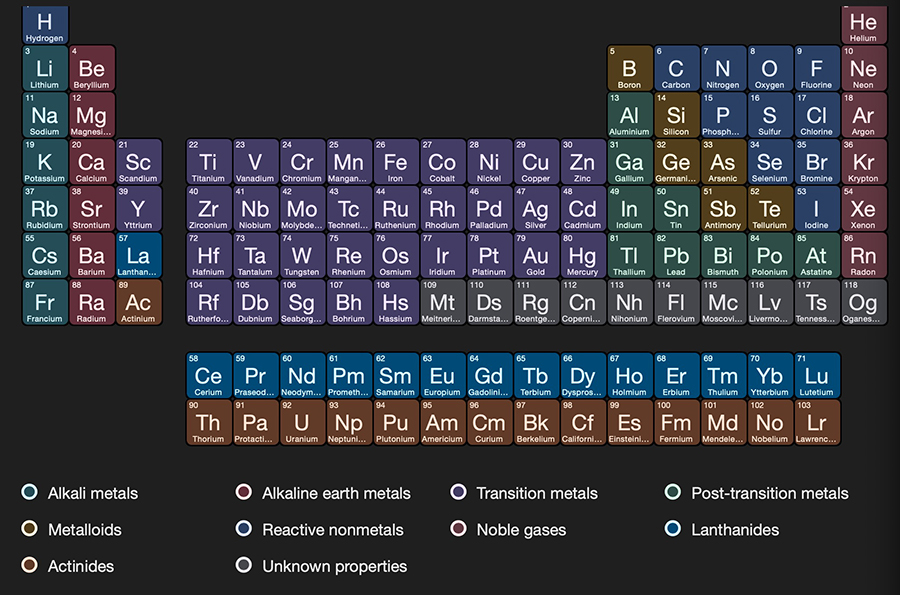
You never saw the periodic table in a political blog before? Always a first time for everything. Look at the 6th row. Note there is a gap between element 57 (lanthanum) and element 72 (hafnium). That is where the rare earths go. They are shown in the turquoise row below the main part of the table. They are lumped together because as you move across the periodic table from left to right, they fill their inner shells rather than their outer shells. This makes them chemically similar to one another, which also makes them hard to separate.
They all have some strange properties, including being magnetic but resistant to heat (which makes them useful in jet engines and motors) and luminescent (which makes them useful in electronic displays). They are also used in wind turbines, electric cars, semiconductors and other advanced products due to their specific properties.
Needless to say, Trump couldn't tell the periodic table from the kitchen table, but he does understand that China has a near monopoly on some weird sh** that American industry needs badly. On Monday, Australian Prime Minister Anthony Albanese visited the White House and patiently explained a few things to Trump. First, rare earths aren't rare at all. They have some rare properties, but they are not scarce in the earth's crust. Second, Australia has large deposits of them and would be happy to sell them to America.
The problem is that refining them is difficult, capital intensive and polluting. Albanese apparently convinced Trump, who announced an investment of billions of dollars in Australia to extract and refine the rare earths. The first U.S. mining company to suggest that the next batch of $TRUMP coins be made of terbium will probably get the contract (unless some other company proposes renaming terbium "trumpium" because it is so valuable). The deal with Australia is a very good idea, but it is not a short-term fix. Building the mines, refineries and factories will take years and parts need to be sourced from places other than China. Still, you have to start somewhere and the deal with Australia is a start. The U.S. also has some good deposits in California (the Mountain Pass Mine) and Wyoming (the Brook Mine), but no refining capability. Creating some, in addition to the Australia deal, would also be a good idea. (V)
Sununu Is Running for the Senate
No, not that Sununu. He's running for president. His brother. It's sometimes hard to tell all these Sununus apart, though.
Chris Sununu is the former four-term governor of New Hampshire (but note, the term is 2 years in New Hampshire, so he was in only 8 years). He has a bachelors in civil and environmental engineering from MIT, attended the NYU Tisch School of the Arts studying film, and then worked in wastewater treatment and resort management before getting into politics. John Sununu, Chris' older brother, also went to MIT then got an MBA from Harvard and worked for the guy who invented the Segway before getting into politics, where he served three terms in the House and one in the Senate. How come the Sununus are so political? Maybe because Dad, who has three degrees from MIT (his Ph.D. thesis was entitled: "Flow of a High Temperature, Variable Viscosity Fluid at Low Reynolds Number"), was a three-term governor of New Hampshire. Got it? As an aside, Rep. Thomas Massie (R-KY) also went to MIT, where he was on a team that designed solar-powered racing cars. Now he wants to ferret out pedophiles. Other MIT graduates write political blogs. It's an odd place.
In case you are curious where the name "Sununu" comes from, the Sununu family were Greek Orthodox Christians from Lebanon with some ancestors from Greece, Jerusalem, and El Salvador.
John Jr., is not going to have one of those famous "candidate quality" problems. He is thoroughly vetted and is widely known throughout the Granite State, although people could be excused if they can't keep track of which Sununu is running for which office. With Sen. Jeanne Shaheen (D-NH) retiring, there is an open seat in New Hampshire and Sununu is the (almost) ideal candidate for the Republicans. He is a moderate in a swing state, the Sununu name is well known (even if people aren't sure which is which), and the Democratic candidate, Rep. Chris Pappas (D-NH), is well-known in only half the state.
Nevertheless, Sununu is far from a shoo-in. Former Massachusetts senator Scott Brown is also running for the GOP nomination on the grounds that Massachusetts is really part of Greater New Hampshire. He has also reinvented himself as a Trumpist. When Sununu entered the race, Carpetbagger Brown issued a statement saying: "Anyone who thinks that a never Trump, corporate lobbyist who hasn't won an election in a quarter century will resonate with today's GOP primary voters is living in a different universe." It will be an interesting primary, to say the least. (V)
Nancy Pelosi Might Retire
Rep. Nancy Pelosi (D-CA) is 85. She was one of the most powerful House speakers in history. She had the wisdom to turn over the Democratic leadership in the House to the next generation while she was still at the top of her game. Now she is a backbencher representing San Francisco. She has said she will make an important announcement next month, after the vote on Prop. 50 in California. Her focus now is entirely on Yes on 50, so the Democrats can capture the House. An announcement before the election would distract from that.
It is widely assumed that she will announce her retirement after this term. She knows very well what happened to former senator (and close friend) Dianne Feinstein. Also, she is really in politics for the Democratic Party, not for personal glory. She got this from her father, who was mayor of Baltimore and later congressman from Maryland and her older brother, Thomas, who followed in Dad's footsteps and was also mayor of Baltimore. We seem to have a lot on dynastic politics today. Sorry about that.
If Pelosi calls it quits, she is likely to endorse San Francisco County Supervisor Connie Chan, with whom she is close. That will give Chan a small edge in the D+36 district. Pelosi's district, CA-11, is tied with GA-05 (downtown Atlanta) as the second-most Democratic district in the country, after PA-03 (Philadelphia), which is D+40. The most Republican district in the country is the R+33 AL-04 district in the northwest part of Alabama, which Donald Trump carried by 67 points. CA-11 is one of the very few districts where a candidate cannot be too progressive to win.
If Pelosi bows out, Chan is not a sure-fire bet though. A lot of Northern California Democrats understand that getting elected in CA-11 is a lifetime job. State Sen. Scott Wiener (D) is one of them and is already readying his campaign. If Pelosi drops out, the dam will break and there will be a lot of candidates, each one claiming to be leftier and more Trump-hating than the others.
If Pelosi retires, the Democratic primary will be a big battleground, but not the only one. The race for governor is also a biggie. Already in are former secretary of HHS Xavier Becerra, Lt. Gov. Eleni Kounalakis (D-CA), former Rep. Katie Porter, former L.A. mayor Antonio Villaraigosa and a few others. Sen. Alex Padilla (D-CA) might run and so might billionaire Tom Steyer. It will be brutal. (V)
Hundreds of Bills Denying Science Are Pending in State Legislatures
In the Chinese Zodiac, this is the year of the snake. They have a point, but the year of the wacko might be better. Or maybe the year of the conspiracy theorist. A study by the AP over all 50 states showed that there are over 400 bills to repeal science pending in state legislatures. It is not as bad as Indiana almost (implicitly) defining π to be 4, but is even more insidious. If the Indiana state Senate had passed the House bill 246, no one would have died (except maybe from laughing). By contrast, the current batch of state bills could kill thousands of people. A few dozen have already passed. They would embed numerous conspiracy theories into state law.
Many of the anti-science bills attack public-health protections, like milk safety, fluoridation, and vaccines. The
bills are being pushed by people with a close association to Quack-in-Chief Secretary of HHS Robert Kennedy Jr.
Some of these lobbyists are selling harmful "wellness" products, like raw milk, to unsuspecting and naive consumers. The
profit margin on raw milk is 10x more than regular pasteurized milk, but it can contain harmful bacteria that would
otherwise be killed in the pasteurization process. Sellers call it "real milk" and claim it can treat asthma, allergies,
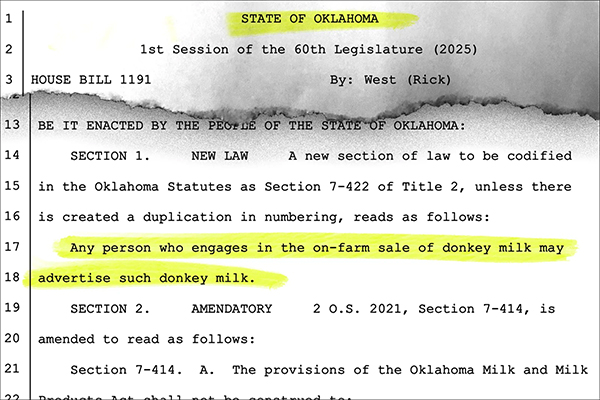
and eczema, none of which is true. Some of the legislation goes even further off the rails. For example, Oklahoma H.D.
1191 would authorize the sale and advertising of raw donkey milk:
Another area where anti-science bills are pending is water fluoridation. There is a large amount of evidence that putting fluorides in water not only prevents tooth decay but also has other health benefits. This is obvious to the untrained eye. Ask a teenager to open his or her mouth and you will see few, if any, fillings. Now try that with a septuagenarian and you will see many fillings. This difference is due to years of fluoridation. As far as we know, the American Dental Association is not lobbying to repeal fluoridation laws, even though that would greatly increase business for dentists. Florida and Utah have already banned fluoridation.
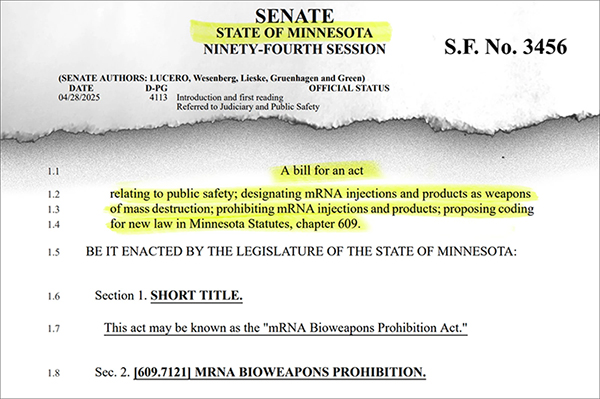
The majority of the bills, over 350 of them, try to impede or get rid of vaccinations one way or another. They have different approaches, including revoking mandatory vaccinations for entering school, barring discrimination against unvaccinated people, creating the criminal offense of "vaccine harm," requiring blood banks to test for evidence of vaccination, and instituting a 48-hour waiting period to get a vaccination after being warned about them. Two bills in Minnesota designate vaccinations as "weapons of mass destruction." How about bill S.F. No. 3456?
Many of the bills are in progress, but at least 26 anti-vaccine laws have passed in 11 states this year. Most of them were flogged by groups closely associated with Kennedy. They all believe mandatory vaccination is bad public health policy and inhibits their freedom. This is a well-organized and well-funded movement. It is not a couple of cranky parents making a fuss.
For those readers who aren't members of The Bulwark, podcasters Jonathan V. Last (JVL) and Sarah Longwell are often at odds over vaccines. JVL is rooting for children in red states that are eliminating mandatory vaccinations for school children to die of measles and polio so their parents will get the full Trump experience. After all, that is what they voted for, so they are entitled to it. Longwell doesn't want innocent children to get sick and die because their parents are morons. (V)
Pennsylvania Will Be a House Battleground Next Year
There are a number of House districts in California and New York that will be bitterly fought over in the midterms. Much has been written about them. However, Pennsylvania has flown under the radar, even though it has three competitive districts, all occupied by Republicans. Let's take a look.
Here are the Pennsylvania districts in the range R+5 to D+5.
| District | Incumbent | PVI | 2024 Margin | Location |
| PA-08 | Rob Bresnahan (R) | R+4 | 1.62% | Northeast PA (Scranton, Wilkes-Barre) |
| PA-10 | Scott Perry (R) | R+3 | 1.26% | Central PA (Harrisburg) |
| PA-07 | Ryan MacKenzie (R) | R+1 | 1.00% | Lehigh Valley (Allentown, Bethlehem) |
| PA-01 | Brian Fitzpatrick (R) | D+1 | 12.80% | Philadelphia suburbs |
| PA-17 | Chris Deluzio (D) | D+3 | 7.76% | Pittsburgh suburbs |
In all the 2024 races, the Republican benefited from Donald Trump's coattails. That option won't be available in 2026 and voters who turned out primarily to vote for Trump may not turn out next year. On the other hand, the popular governor, Josh Shapiro (D-PA), will be on the ballot, and marginal Democrats who like him may turn out specifically to vote for him.
- PA-08 (Bresnahan): This one is stuffed with white working-class voters, who are now
Republicans. It used to be a coal-mining district and the demand for its main product is not doing so well. The race
could end up hinging on something typically not on the radar for that kind of voter: insider trading. Bresnahan has
reported over 600 individual stock trades this year. For someone with a full-time job, that seems like a lot of
attention to the stock market. People are wondering if he has been trading based on inside information. Reporters have
asked him why he can't just pause trading. He said then he would go broke. That is pure B.S. He could buy an ETF for the
S&P 500 and then leave it on autopilot. The Democratic establishment wants the candidate to be Scranton Mayor Paige
Cognetti. Her slogan is "Paige against the machine," which will focus on corruption and put Bresnahan's stock trades
front and center. Nevertheless, she will have a primary to get through first.
- PA-10 (Perry): Scott Perry used to be chairman of the House Freedom Caucus. The district
used to be redder, but a court ordered it redistricted in 2018 and it is now competitive. Perry is considered one of the
most vulnerable Republicans in the country. His strong arguments to get rid of the ACA and its subsidies will be a big
issue. In 2024, Perry beat former news anchor Janelle Stelson by 5,133 votes and she is back for a rematch, but without
Trump on the ticket this time. However, she has competition from another Democrat, progressive Dauphin County
Commissioner Justin Douglas. The governor and Democratic establishment are backing Stelson.
- PA-07 (MacKenzie): This is a true toss-up. Democrat Susan Wild held it for three terms until losing narrowly to MacKenzie. He will be a top target for the Democrats. Local Democrats understand that. Five of them have filed to run in the primary. They are state firefighters' union president Bob Brooks, former federal prosecutor Ryan Crosswell, Northampton County Executive Lamont McClure, utility company director Carol Obando-Derstine and Lehigh County Controller Mark Pinsley. Brooks will have support from union leaders and members. He is also likely to be Shapiro's favorite. Obando-Derstine has the support of Wild, the Congressional Hispanic Caucus, and EMILY's List. Despite this, she has not been a strong fundraiser so far. Incumbent MacKenzie is an even worse fundraiser, not a good place to be in a potential blue wave, but the cycle is young and outside money will probably (try to) come to his rescue.
The other two incumbents in the table, Fitzpatrick and Deluzio are personally popular, so despite the close PVIs, the election results weren't close at all last time, and they are considered safe. The battles will be in the other three districts.
In a blue wave, the Democrats could pick up as many as three seats in Pennsylvania, which will go a ways toward canceling some of the gerrymandering going on. (V)
Former French President Was Convicted of Criminal Conspiracy and Is Now in Prison
In countries that still have the rule of law, when the president or prime minister commits crimes, he gets indicted, convicted, and imprisoned (or executed). This has happened hundreds of times in world history. The most recent example is former French president Nicolas Sarkozy, who started his 5-year prison term on Tuesday.
He is the sixth French leader to be convicted on criminal charges. The most recent convicted French president before him was Jacques Chirac, who was sentenced in 2011 for corruption. Other European countries that have imprisoned their leaders for criminal behavior include Austria, Bulgaria, Croatia, Estonia, Finland, Germany, Hungary, Norway, Poland, Romania and Slovakia, among others. It is also common in Africa, Asia, North America, and South America. The only time the United States has done something like this was the imprisonment of Jefferson Davis after the Civil War. In any event, a country imprisoning or convicting a former leader is surprisingly common, probably because some of the people who want to become national leaders are quite corrupt.
If you checked out the first link in this item and it looks vaguely familiar, you have a good memory. We used it on June 12 in an item about the former president of Argentina, Cristina Fernández de Kirchner, who was convicted of corruption and lost all her appeals. Convicting corrupt former presidents is quite common around the world in countries with a functioning legal system.
Sarkozy claims he is innocent, but the courts ruled otherwise. He said that one of the three books he is allowed to bring to prison with him is The Count of Monte Cristo, in which the hero escapes an island prison before seeking revenge. He also said he packed some sweaters because the prison is cold. He will serve in the VIP section of La Santé prison, for his own safety. He will spend most of his time alone in his cell and not have contact with other prisoners. He will get 1 hour a day in the prison yard, alone. His family will be allowed to visit three times a week. Americans could possibly learn something from France, where they have some pretty firm ideas on how to deal with corrupt leaders, and some VERY firm ideas on how to deal with kings. (V)
There's Something Happening Here: The No Kings Protests, Part V
Speaking of kings, here are six more reader reports from the weekend:
Z.L. in Somerville, MA, writes: If protest organizers were aiming for a freedom-festival atmosphere, here in Boston they succeeded. Many great signs and costumes, both traditional and inflatable. Due to claustrophobia, I hang back from the organized programming, but I was glad to see many people being creatively angry. There was also a lot of joy in the air. I loved watching two inflatable axolotls dance with a child in the Frog Pond area. I saw some right-wingers with cameras and flags trying to intimidate people and start fights. They failed impressively.

I really hope you are right that we are a democracy under temporary occupation. Personally, I think that vision of America's past is not super accurate, but I agree it's dramatically worse right now. Too many people have been irreversibly harmed already. My identity also sits directly in the crosshairs of the current administration. I hope I survive to see a better day. More importantly, I hope the nation survives to see a better day, even if I don't make it. My current favorite protest sign (which I brought to the common yesterday) says People are NOT Disposable. I choose hope, and I will keep showing up for it as long as I can.
A.C. in Kingston, MA, writes: Boston definitely felt more like a rally than a protest. Mayor Michelle Wu and state AG Andrea Campbell, among many others, spoke, there was a band, a choir, and several solo musicians, and the atmosphere overall was very positive. (It didn't hurt that the weather was absolutely perfect.)

I was torn between staying local (and Plymouth had a HUGE turnout) and heading into town, and I'm glad I went in. I needed the energy from my group and the crowd to remind me how many of us there are.
A.S. in Black Mountain, NC, writes: Three times more patriots than at the June gathering—about 1,500 this time in this very small town in a very red district:

K.H. in Albuquerque, NM, writes: The "protest frogs" in New Mexico are a bit different than the ones in Portland...

Based on a drone overflight video and thanks to the tools at MapChecking, we estimate crowd sizes from 17,000-28,500 in Albuquerque (metro pop. 916,000). Some on social media claim 30,000, but having been there, I'd go with somewhere around 23,000.
Even the low-end estimate greatly exceeds any previous protest in the Duke City, excepting perhaps the Pueblo Revolt in 1680. Meanwhile, the local newspaper's headline meekly said, "'No Kings' rally draws thousands to Downtown Albuquerque."
F.H. in Pacific Grove, CA, writes: Protest in Monterey, CA. Couldn't find an official count, but I'd say 1,000 people minimum. John Lennon made a rare public appearance:

E.M. in Watertown, WI, writes:

Another set tomorrow, of course. (Z)
Previous | Next
Main page for smartphones