
Previous | Next | Senate races | Menu
New polls:
Dem pickups: (None)
GOP pickups: (None)
There Are Many Unanswered Questions about the Shutdown
The government is now partially shut down. This brings up a whole list of questions. Here are five of the major ones:
- How Long Will It Last?:
Shutdowns have varied from 1 day to 34 days. Here is a list of shutdowns since Jimmy Carter was
president (a slightly more expansive list than we discussed yesterday, as yesterday's list was limited
to shutdowns that included furloughs):
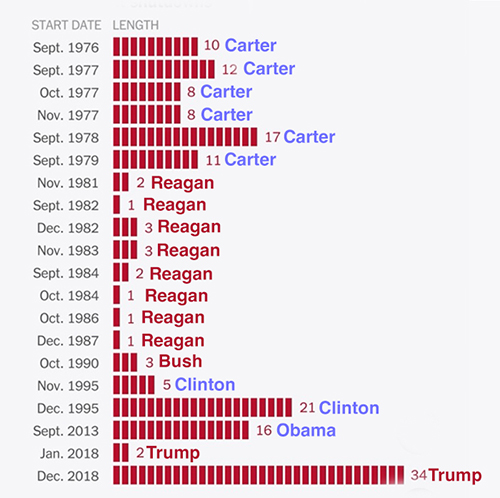
How long the shutdown will last depends on the pollsters. If either side feels that public opinion is against it and getting worse, that side will want to end the thing somehow rather than bleeding to death. One way out could be to punt: pass a short-term continuing resolution. But what then?
Everything else aside, Donald Trump is extremely stubborn and hates to give in. But Democrats cannot be seen caving to him. This is not a situation conducive to compromise.
In the past, a "gang of four" or a "gang of six" or some other number got together and made the sausage. But now, there are almost no moderates to work together in a gang. Maybe a gang of two: Sen. Susan Collins (R-ME) and Sen. John Fetterman (D-PA)? Except their own parties might reject whatever sausage they make since most senators are beholden to their own bases, and not to independents.
In 2018, during a shutdown, Collins played peacemaker. Her office became known as "Switzerland" (i.e., neutral territory). Then-Sen. Heidi Heitkamp (D-ND) gave her a gift of an African "talking stick." Only the person holding the stick was allowed to talk. Everyone else had to shut up. It got passed around and it worked. Now, almost nothing could work. If you gave Sen. Josh Hawley (R-MO) or Sen. Adam Schiff (D-CA) a stick, they'd probably just use it to thrash someone on the other side.
- Will Either Side Cave?: One big problem is the health-care subsidies. Democrats have
drawn their line in the sand here. The subsidies are not cheap—estimates are $350 billion for 10 years. If they
expire on Dec. 31, however, 4 million people will lose their health coverage and millions more will see their premiums
skyrocket and may decide to drop insurance. This will force premiums up for everyone else. Republicans absolutely do not want to increase the deficit and Democrats
absolutely do not want to deprive millions of people of health care. Senate Majority Leader John Thune (R-SD) suggested
that he could possibly agree to keeping the subsidies if the deal included getting rid of waste, fraud, and abuse. But
in reality, there isn't much of that. There are precious few doctors with $1,000 stethoscopes. The only way to cut the
bill is to deny health care to many people.
Another thing the Democrats are insisting on—but not talking about because it is very inside baseball—is impoundment and recission. They want Congress to control the power of the purse. It is perhaps a revolutionary idea, but it is actually in the words of the Constitution: Congress alone has the power to decide how to raise revenue and how to spend it. The president's job is to carry out Congress' instructions, no more no less. Using impoundment and recission, Trump has simply refused to spend money Congress has appropriated. For Democrats, this is a hill to die on, but they can't talk about it because it is too arcane. But Speaker Mike Johnson (R-LA) and Senate Majority Leader John Thune (R-SD) most certainly understand it. They are the worst kind of cowards, though, because what the Democrats want is not only constitutional, it would also increase their own power. What kind of politician is scared to death to do something that is not only legal but mandatory and would also increase their own power? Only a Coward First Class.
Previous long shutdowns have had mixed results. The Nov. 1995 and Dec. 1996 shutdowns (27 days total) pitted Bill Clinton against Newt Gingrich and Bob Dole. The New York Times compared the Republicans to Napoleon's march on Moscow—a hopeless overreach. The narrative became the nasty Republicans wreaking havoc on federal workers and the public. One point for POTUS.
The Oct. 2013 shutdown lasted 16 days. It was about Obamacare. Sen. Ted Cruz (R-TX) and Rep. Mark Meadows (R-NC) wanted to cut the program. Obama, not so much. The public didn't want to cut or gut it. Another point for POTUS.
The Dec. 2018 shutdown was the mother of all shutdowns. It lasted 34 days. It was during the lame duck session of Congress just after the elephant had gotten his ears pinned back with a loss of 42 seats but before the Democrats took over. Donald Trump demanded money for his wall and Democrats said, uh, no. In the end, Trump didn't get his wall. Final score here, POTUS 2, COTUS 1. Of course, the final score is also Blue Team 3, Red Team 0.
- How Far Will Trump Go Firing Workers?: Trump has threatened to fire federal workers, not
just temporarily furlough them. No president has ever done this because it is illegal (Pendleton Act, and all that).
Will he actually do it? How many? Firing tens of thousands of federal workers, many of whom live in Virginia and can
vote in the gubernatorial election next month, is uncharted territory. If Trump really did it, it would affect many
programs. It might not be so easy for Trump to make sure all the firings hurt only Democrats because many departments do
many things. Gutting the Dept. of Agriculture would hit SNAP (food stamps) but also farmers.
- Which Government Services Will Be Most Affected?: By Monday, many federal employees will
be furloughed and some may be fired. More firings could come later. In any event, most government programs require people
to carry them out and if the people are gone, the services will not be rendered. Trump has a lot of latitude here and
OMB Director Russell Vought is dead set on making Democratic constituencies feel most of the pain. October SNAP benefits
will be paid, but November ones could be delayed. National Parks will remain open but there will be no services. The
National Flood Insurance Program won't accept new customers or renewals of policies—right in the middle of hurricane
season. Air traffic should not be affected, but in the past, air traffic controllers have called in sick.
The principle here is: No pay, no work.
That wreaked havoc with airports and flights. Same for TSA security checkpoint workers. That could
snarl air traffic enormously.
- Who Gets the Blame?: Initial polling says the Republicans will get the blame, but that could change easily. If Trump acts like a man possessed rather than a dealmaker, independents could turn against him. A lot depends on the public's understanding of what the shutdown is all about. If the public comes to think the shutdown is about protecting health care, that could work for the Democrats. If the stock market drops or a recession looms, that could also affect public opinion.
What the end game is, is impossible to say. If we had to guess, we'd say the two sides will agree to a short continuing resolution, but that will just reopen the government without resolving the underlying problem, and there is still no agreement on the appropriations process. (V)
Another Sector Is Worried about Trump
Donald Trump has already intimidated media companies, law firms, and universities into submission to his will. He is working on sports teams, as we described at length on Tuesday. Now lobbyists think it is their turn.
Federal lobbyists exist to get favors from the government for their clients. It is basically legal bribery. The only difference from regular garden-variety bribery is that the bribe goes into the congress critters' campaign account instead of his or her personal bank account. For small favors, getting a congressman to insert a line in a spreadsheet in the budget might not be difficult and might fly under the radar. Congress critters don't cost much. But for anything big, Trump is going to see it and ask what's in it for him. This makes the lobby shops very unwilling to incur his wrath.
All of them have noticed that Microsoft is now Trump's enemy because it hired former Deputy Attorney General Lisa Monaco, who led the prosecution of Trump for stealing classified documents and storing them in his bathroom. That's a real insult to the classified documents. They deserved to be stored in the grand dining room. When the lobby shops are looking to hire someone, the first question the shop now asks is: "What Republican can we hire?" The second is: "Is he MAGA enough?" Moderate Republicans are not welcome.
The problem is that lobby shops have traditionally been nonpartisan, which is to say, opportunistic. They have contacts with both Democrats and Republicans and will work for any client who wants to hire them. Now, some of them are having to hire very MAGA Republicans to please Trump and get access to him. The trouble is if a Democrat is elected president in 2028, no company will want to hire them because the president and other Democrats will see them as the devil's spawn. That means hire MAGA people now and you may get satisfied clients until Jan. 20, 2029, but then the company will be out of business if a Democrat wins. Don't hire MAGA people now then forget about any major customers starting immediately. It means that henceforth, lobby shops will have to be partisan and will continue to exist only as long as their party is in power. Getting rid of the lobbyists might not actually be a bad thing, but would probably just mean every time the White House changed parties, a new batch of lobby firms would start up from scratch.
The situation is similar for pollsters, but not as bad. No Democratic politician would ever consider hiring Fabrizio Ward (Trump's pollster) and no Republican would ever hire David Binder (Kamala Harris' pollster). Most political pollsters work for either Republicans or Democrats, but not both. This is why many of the nonpartisan polls published are from small colleges: They are not looking to be hired by candidates. The commercial pollsters are. That is their bread and butter. Also for pollsters, in most races, there is a Democrat running and a Republican running. It doesn't matter who the incumbent is. Both candidates need a pollster, so there is always work, no matter who the president is. That is no longer true for lobbyists. (V)
The EU Wants to Spend Frozen Rubles to Buy Ukraine EUROPEAN Weapons
Donald Trump, that stable genius, thought of a way to turn the war in Ukraine into a profit center: Have U.S. allies
buy American weapons and then give them to Ukraine. Brilliant. Only the Europeans thought of
something else:
European Commission President Ursula von der Leyen wants to take the €140 billion in frozen Russian assets in
European banks and use it to buy weapons made in Europe and give them to Ukraine, to boost the European defense
war industry. Germany's Leopard tank is world-class, as is the Eurofighter Typhoon, built by a European consortium. The
Typhoon is a little older than the F-35, but is less finicky, more robust, and not as dependent on the GPS working
perfectly. The F-35 is stealthier than the Typhoon with current radars, though. But Russia doesn't have any F-35s, so
that doesn't matter. And women are allowed to fly Typhoons. Here is a
fully loaded Typhoon.
It can fly at 65,000 feet and hit Mach 2.35 if the pilot is in a hurry. It is not terribly user friendly:

Technically, Ukraine would buy the weapons from the European companies with loaned money (at zero interest), but everyone knows Ukraine is not going to be repaying the loan anytime soon and that is fine with European leaders.
There are a couple of issues here, though. First, Hungary and Slovakia are pro-Russia, so a workaround is needed. So, Ukraine has to agree to spend all the money on European weapons, rather than rebuilding its badly damaged infrastructure. Consequently, this is not a done deal quite yet, but it is getting closer. Negotiations are ongoing. The EU finance ministers will meet in Luxembourg on Oct. 10 to discuss "creative financial engineering." Still, this seems to be largely on track and there is no easy way for Trump to block it. He can't use the Army to attack Europe if the Army is tied up invading America, as he told the generals and admirals it would be on Tuesday. (V)
A Key Cybersecurity Law Has Expired
While Secretary of Defense Pete Hegseth is busy trying to win World War I again by making sure our guys have bigger biceps than the Germans, World War III (or the lead-up to it) is likely to feature drones, UAVs (like the Patriot, Reaper, and Global Hawk), and fierce battles in cyberspace. For the latter, coordination between the private sector and government will be crucial. A law called CISA (Cybersecurity and Information Sharing Act) is much more crucial for the military than generals doing pull-ups or investing in new razors. It was passed by Congress in 2015 for 10 years and it expired on Tuesday. Because everyone is focused on the shutdown, Congress has not renewed it, even though there is bipartisan support for doing so.
What the law does is allow private companies to monitor information systems for information about hostile powers (and terrorists) and authorizes them to turn the information over to the government without fear of lawsuits. It also allows them to coordinate their activities in this area without running into antitrust lawsuits from the government. Additionally, it puts some limits on which government information can be obtained through FOIA lawsuits.
The renewal bill is cosponsored by Sens. Gary Peters (D-MI) and Mike Rounds (R-SD). It is currently being held up by the chairman of the Homeland Security Committee, Sen. Rand Paul (R-KY), who wants certain changes to it. Since companies are no longer exempt from antitrust prosecution if they work together on national security, they are all going to abruptly stop it, wrecking systems and relationships that have worked fairly well for 10 years. Even senators from Kentucky ought to know that malign foreign actors have large teams of people whose job is to hack U.S. government and private computer systems and that speed is of the essence in containing them. If, for example, Google discovers and thwarts a hack, it would normally be willing to alert Microsoft, Facebook, Amazon, Apple, Oracle, and other tech companies, but not if that could result in lawsuits against Google. CISA prevents that.
Cybersecurity is an ever-moving target, and if Paul feels CISA needs updating, that is fine, certainly in the area of protecting civil liberties. Various experts have proposed fixing bugs in the law (e.g., see here), but doing nothing is not a good idea. (V)
Judge Swats Down Another Improperly-Appointed U.S. Attorney
U.S. attorneys must be approved by the Senate, and sometimes Donald Trump wants to appoint a U.S. attorney who is so unqualified that he realizes the Senate might not play ball. This leads him to resort to trickery to make an appointment, but the courts aren't easily fooled. He appointed his former personal attorney, Alina Habba, as temporary U.S. attorney for New Jersey in April. She served the maximum 120 days for a temporary appointment. Meanwhile, the Senate had not confirmed her permanently, possibly because she had no prosecutorial experience at all and was fully prepared to just go after his political enemies. Even for the cowards in the Senate, sometimes Trump pushes the envelope too far. Trump tried a trick to give her more time, but the judge ruled that she was not the lawful U.S. attorney after July 1, meaning all the documents she signed after that date were invalid.
So what did Trump learn from this incident? Nothing. He tried it again, this time in Nevada, with the same result. In March, Trump appointed Sigal Chattah interim U.S. attorney for Nevada. Just before the 120-day time limit was about to kick in, Trump tried another trick to let her continue as acting U.S. attorney. The law specifies that when a U.S. attorney's position is vacant, the first assistant U.S. attorney automatically becomes the acting U.S. attorney. So Trump had AG Pam Bondi appoint Chattah as first assistant U.S. attorney. Four criminals sued claiming Chattah's actions in their cases didn't count because she was not a duly appointed U.S. attorney.
On Tuesday. U.S. District judge David Campbell, a George W. Bush appointee who was confirmed by the Senate 92-0, ruled that the purpose of the law was to prevent precisely this kind of shenanigans, since the first assistant is almost always a career prosecutor and not a political appointee. Basically, the same result as in Habba's case, although the nature of the trick was slightly different in the two cases.
Why didn't the Senate simply confirm Chattah? Maybe because over 100 federal and state judges wrote this letter strongly opposing her confirmation. Why? Maybe it was because in her 2022 campaign for Nevada AG she said her opponent, Aaron Ford, who is Black, "should be hanging from a f**king crane." Perhaps it was her social media posts saying that Fulton County D.A. Fani Willis, who is also Black, is "so ghetto." Of course it could have been her comparison of Jewish members of Congress to Nazi collaborators. Maybe all of this and more. In any case, Nevada does not yet have a properly confirmed U.S. Attorney.
As noted above, Campbell was appointed by George W. Bush yet was confirmed by the Senate with no dissenting votes. He is a conservative, but perfectly competent. But Trump doesn't want U.S. Attorneys whose loyalty is to the Constitution. He wants U.S. Attorneys whose only loyalty is to him, and who will prosecute people he orders them to prosecute, whether or not they have committed a crime. These nominees tend not to sit well with the Senate. (V)
It Is Hopeless
The federal government doesn't function—even when is technically open. Everyone knows this. A feeling of hopelessness abounds. People who were alive in the 1960s may remember that as a time of great hope, when all problems could be solved and even the moon was in reach. Not so anymore. A new Times/Siena College poll shows the hopelessness numerically.
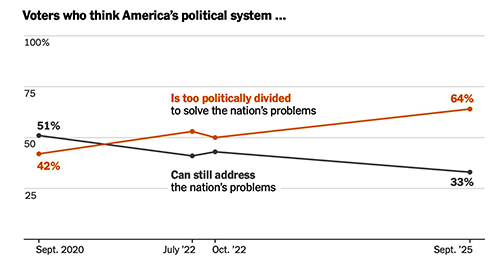
Almost two-thirds of the country think that the nation's problems are unsolvable. This is a steep rise over the last 5 years, as polarization has grown. Years ago, people differed on say, tax policy or foreign policy, but people saw other party's voters as Americans first and the enemy second, if at all. Now each party has a complete package for you. If you are pro-abortion, pro-immigration, pro-vaccination, pro-taxing the rich, pro-Medicaid, pro-Green New Deal, pro-gun control, pro-gay rights, but against trans girls playing in girls sports, you are the enemy for Democrats. It's all or nothing. Republicans are the same way, but reversed.
It's even worse in some ways. Forty-one percent of likely voters disagreed with the statement: "The U.S. is a democratic country." It is unthinkable that a poll 50 years ago would have anywhere near this number disagreeing.
Will this ever change? We don't know for sure, but in 1860, it looked like the problem of slavery could never be solved. It was, but the hard way. What might give some people (but not all people) hope, is demographic change. In 10 years, all the kids now 8-17 will be eligible to vote. Young people are notoriously more optimistic than old people. They see possibilities that old people reject as impossible because they know they didn't work in the past. Young people don't know this, so they try to accomplish them anyway and sometimes succeed.
In particular, young people tend to skew Democratic on the whole, despite Donald Trump's making inroads with young Black men and young Latinos. We think that is largely because they like Trump's machismo and don't especially like Black women in positions of leadership. We are not so sure that Trump's machismo transfers easily to people like J.D. Vance, Ron DeSantis, Gov. Brian Kemp (R-GA), or Gov. Glenn Youngkin (R-GA), the next generation of Republican leaders. If young people revert back to the norm of being Democrats, the 50-50 balance the country is now in could become 55-45 in 10 years giving the Democrats a working majority and allowing them to try out their ideas. Maybe the voters will like these ideas, maybe they won't, but it could be a different world than having a total stalemate all the time. There are already signs that young voters and Black voters are souring on Trump himself, let alone potential successors. We are not predicting this. Stuff happens. But it is a possibility. (V)
Republican Congressman David Schweikert Will Not Run for Reelection
Rep. David Schweikert (R-AZ) wants to trade that title for Gov. David Schweikert (R-AZ). It is not an out-of-the-box idea. He is the 11th member of the House who is running for governor (or ran for governor and lost the primary, in the case of Josh Gottheimer). There are 30 House members who have decided not to run for reelection next year, but one of them is not like most of the others: Schweikert. Here is the list of soon-to-be retirees:
| Representative | Party | District | PVI | Reason for retirement |
| John Rose | Republican | TN-06 | R+17 | He is running for governor of Tennessee |
| Morgan Luttrell | Republican | TX-08 | R+16 | He has had enough |
| Randy Feenstra | Republican | IA-04 | R+15 | He is running for governor of Iowa |
| Dusty Johnson | Republican | SD-AL | R+15 | He is running for governor of South Dakota |
| Byron Donalds | Republican | FL-19 | R+13 | He is running for governor of Florida |
| Mike McCaul | Republican | TX-10 | R+12 | He wants to use his national security expertise to make more money |
| Mike Collins | Republican | GA-10 | R+11 | He is running to challenge Jon Ossoff |
| Ralph Norman | Republican | SC-05 | R+11 | He is running for governor of South Carolina |
| Chip Roy | Republican | TX-21 | R+11 | He is running for Texas attorney general |
| Andy Biggs | Republican | AZ-11 | R+10 | He is running for governor of Arizona |
| Buddy Carter | Republican | GA-01 | R+8 | He is running to challenge Jon Ossoff. |
| Andy Barr | Republican | KY-06 | R+7 | His is running for Mitch McConnell's open Senate Seat |
| Nancy Mace | Republican | SC-01 | R+6 | She is running for governor of South Carolina |
| Ashley Hinson | Republican | IA-02 | R+4 | She is running for Joni Ernst's open Senate seat |
| John James | Republican | MI-10 | R+3 | He is running for governor of Michigan |
| David Schweikert | Republican | AZ-01 | R+1 | His is running for governor of Arizona |
| Chris Pappas | Democratic | NH-01 | D+2 | He is running for Jeanne Shaheen's open Senate |
| Josh Gottheimer | Democratic | NJ-05 | D+2 | He ran for governor of New Jersey and lost the primary |
| Angie Craig | Democratic | MN-02 | D+3 | She is running for Tina Smith's open Senate seat |
| Don Bacon | Republican | NE-02 | D+3 | He doesn't agree with Trump on much and it would be a tough fight |
| Mikie Sherrill | Democratic | NJ-11 | D+5 | She is running for governor of New Jersey and won the primary |
| Raja Krishnamoorthi | Democratic | IL-08 | D+5 | He is running for Dick Durbin's open Senate seat |
| Haley Stevens | Democratic | MI-11 | D+9 | She is running for Gary Peters open Senate seat |
| Robin Kelly | Democratic | IL-02 | D+18 | She is running for Dick Durbin's Senate seat |
| Jan Schakowsky | Democratic | IL-09 | D+19 | She is 81 and retiring from politics |
| Lloyd Doggett | Democratic | TX-37 | D+26 | Redistricting put him in with a much younger Democrat |
| Jerry Nadler | Democratic | NY-12 | R+33 | He is way past his best-by date |
| Danny Davis | Democratic | IL-07 | D+34 | He is 83 and has had enough |
| Dwight Evans | Democratic | PA-03 | D+40 | He had a stroke last year and is retiring at 71 |
As you can see, most of the retirees are in safe districts that will not flip next year. Maybe John Rose will be elected governor of Tennessee next year, maybe not, but there is no way that TN-06 is going to send a Democrat to Congress. Districts in the range R+4 to D+4 are swing districts and can go either way. An R+4 district with an open seat could elect a Democrat if the Democrat is exceptionally good or the Republican is exceptionally bad or there is a huge blue wave. What you don't see in the above table is an EVEN district. And until now there was no R+1 or D+1 district. Now there is: Schweikert's district, AZ-01, which is Scottsdale and North Phoenix. This is a true tossup and probably the Democrats' best pickup opportunity. Don Bacon's NE-02 district looks easier, but Nebraska Republicans are actively busy redrawing the map to fix that bug. Arizona Republicans can't do that because the map is drawn by an independent commission. Besides, the governor is a Democrat.
Schweikert is no shoo-in for the GOP nomination for governor, either, so he is taking a risk running. Hard-right Rep. Andy Biggs (R-AZ) also has gubernatorial visions, as does Karrin Taylor Robson, who is slightly less far to the right than Biggs. In addition, Biggs has the support of Arizona resident Erika Kirk.
With or without Schweikert's retirement, a bunch of Democrats have lined up to run for the nomination. Among them is emergency room physician Amish Shah, who ran for the seat in 2024 and lost to Schweikert by only 16,572 votes (3.8%). In a good year for Democrats, he would be a very strong candidate, but first he has to win the primary. (V)
2026 Will Have Yet Another Barnburner State Supreme Court Justice Race in Wisconsin
Wisconsin Supreme Court races seem to attract a lot of national attention and money. In 2023, liberal judge Janet Protasiewicz beat former Wisconsin Supreme Court Justice Daniel Kelly in a knock-down, drag-out race by 11 points. A total of $51 million was spent on it, making it the most expensive Supreme Court race in history.
Two years later, in April 2025, another Wisconsin Supreme Court race cost $90 million, a new record. Of this amount, $25 million came from Elon Musk. His candidate, Waukesha County Judge Brad Schimel, lost to Dane County Judge Susan Crawford by 10 points. Musk seemed miffed by the fact that for $25 million he wasn't even able to buy a Supreme Court seat in a medium-sized state. This wasn't a California Senate race or something important like that, after all. Just a measly Supreme Court seat, one of seven in the state. What do you need to buy one of them these days? $100 million? Talk about inflation.
Here we go again. In April, there will be another Wisconsin Supreme Court race. Conservative Wisconsin Appeals Court Judge Maria Lazar announced her run yesterday. Liberal Appeals Court Judge Chris Taylor is also in. This one will probably top $100 million.
It is an open-seat race because Justice Rebecca Bradley is throwing in the towel at 54. Here are some of the statements she has made in the past:
- Heterosexual sex is very healthy in a loving relationship; homosexual sex, however, kills.
- One will be better off contracting AIDS than developing cancer, because those afflicted with the politically correct disease will get all the funding.
- How sad that the lives of degenerate drug addicts and queers are valued more than the innocent lives of more prevalent ailments.
- The stay-at-home orders during the pandemic are no different from the Japanese internment during WW II.
She has also compared abortion to "the time in history when Jews were treated as nonhumans and tortured and killed." Actually she wanted another 10-year term and was initially "in," but her fundraising was anemic and she saw that she couldn't win, so she gave up and dropped out.
Of the six justices not up in 2026, four are liberals and two are conservatives. If a liberal wins this race, this will cement the liberals' majority more firmly at 5-2. In 2026, Justice Annette Ziegler, a conservative, is up. Flipping that one, too, could give the Court a liberal majority for years to come. Here are the current justices, with Bradley on the left. See anything unusual here?

If you said the Court is majority blonde, you nailed it. (V)
DeSantis Gives Trump Land in Downtown Miami for His Presidential Library
Donald Trump wants a presidential library. Seems odd for someone who never reads books. Maybe he will order his presidential library foundation to buy 50,000 copies of The Art of the Deal at retail and fill the library with them. That way any visitor wanting to read it can get a copy without waiting. No matter what, the library has to go somewhere and in an attempt to make amends with Trump, Gov. Ron DeSantis (R-FL) has "arranged" for Miami Dade college to donate a parking lot in downtown Miami to the Trump Presidential Library Foundation. The college paid $24 million for the land in 2004 and wanted to use it for expansion since it has 47,000 students, the most of any college in Florida.
Eric Trump promised that it would be the greatest presidential library ever built. Florida AG James Uthmeier (R) said: "President Trump has a great story to tell. As Miami becomes capital of the world in many respects, I think it will be a great location." Miami Mayor Francis Suarez (R) said the library would "cement Miami's role as a gateway for ideas, culture and leadership that shape the future and allow Miami to take its rightful place as a truly great global city." Apparently everyone expects it to be a big tourist attraction, maybe even bigger than Disneyworld, the Kennedy Space Center, and the Everglades combined. And that's even with no alligators, aniamatronic or otherwise.
The Foundation already has tens of millions of dollars that Trump extorted from Meta and from the settlement with ABC News. Trump has said that the gold-plated 747 from Qatar may go in the library later. But that will probably be after Trump's death because he will surely want to fly around in it after he leaves office.
On the other hand, the plan drew immediate criticism from many of Miami's Cuban Americans because it is right next to the iconic Freedom Tower, the building in the foreground below.
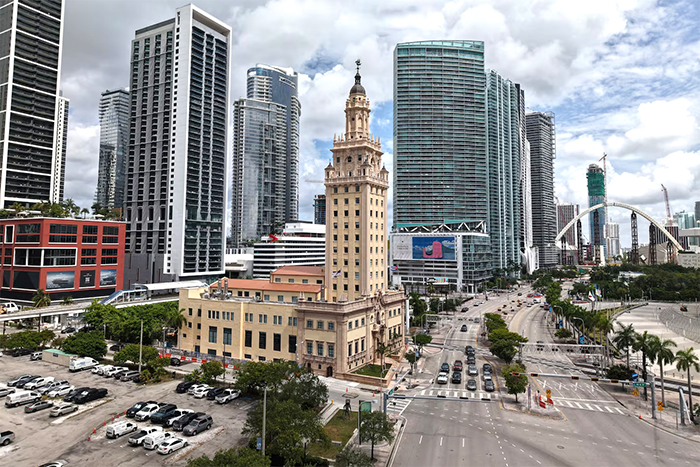
Many Floridians regard the Freedom Tower as the "Ellis Island of the South" because more than 400,000 refugees from Cuba were processed there starting in 1962. For many of them, it is holy ground. To build a library next to it dedicated to a president who hates refugees is sacrilegious. Ana Sofia Pelaez, executive directory of the Miami Freedom Project, said: "I can't think of any two narratives that are any more in opposition than the one of the humanity that the Freedom Tower is a symbol for, and how this president has spoken about immigrants and immigration." (V)
Congress Does Not Function but Some State Legislatures Do
The job of any legislature is to pass legislation—you know, laws. Congress is basically incapable of it, even when one party holds the trifecta. Many members introduce bills but they go nowhere. Here is a comparison of Congress vs. the state legislatures:
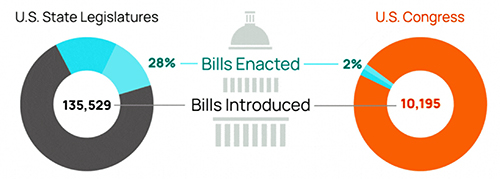
The states with the largest number of bills passed last year were Texas (3,242), New York (2,301), Virginia (1,738), Tennessee (2,057) and Georgia (1,720). Some states had a very high enactment rate as a percentage of bills introduced. The leaders here are Colorado (74%), Louisiana (69%), Virginia (61%), Georgia (60%) and Utah (60%). Note that in all except Virginia, one party holds the trifecta. Nevertheless, in some states where there is a trifecta, the passage rate is very low, especially Missouri at 0.9% and Massachusetts at the very bottom of the list at a dismal 0.1%. Why anyone would want to serve in the Massachusetts legislature is beyond us, since even Congress makes it look good and that is not easy. So while Congress does nothing, the real action these days is in the states, and that tends to fly below the radar. (V)
Trump Administration Is Working to Disenfranchise Another Group of U.S. Citizens
If a U.S. citizen living abroad has a child abroad, in almost all cases that person is a U.S. citizen, even if one parent is not a citizen. A case that comes to mind is Sen. Ted Cruz (R-TX), who was born in Canada but thought he was a natural-born citizen so he could run for president in 2016. Also, John McCain was born on a U.S. military base in the Panama Canal Zone and ran for president.
Nevertheless, Republicans are now trying to disenfranchise some U.S. citizens who live abroad. Their reasoning is simple: They think the majority of the nearly 3 million U.S. citizens living abroad are Democrats, even though no one really knows since it is difficult to do a random survey of them. The Republicans are specifically going after U.S. citizens who were born abroad to one or two U.S. citizen parents but have never lived in the U.S. Since they are citizens they have a right to vote in federal elections, but where? Current law says in the state where their parents most recently lived.
Last year, the RNC challenged the votes of U.S. citizens abroad who had never lived in the U.S. in Michigan and North Carolina. In Michigan, the judge was disgusted and threw the case out. In North Carolina, the GOP candidate for a seat on the North Carolina Supreme Court pushed hard on this. A state court ruled that citizens who voted in North Carolina but never lived there could vote only in federal elections, not state ones. While the group affected is small and only in one state and only for state elections, the RNC is hoping to expand the ruling.
North Carolina state Rep. Hugh Blackwell (R) has filed a bill to deprive all non-resident North Carolinians from voting in all elections. If successful, it would create a class of U.S. citizens who can't vote. This has never happened to white males before. In Congress, Rep. Abe Hamadeh (R-AZ) has introduced a bill to require overseas voters to prove they have a U.S. residence in order to vote. This would take Blackwell's bill and go national.
Part of the motivation from the Republicans' push is the shift in demographics of Americans abroad. It used to be primarily military. A recent estimate now shows that in 2024, 40% of overseas voters are service personnel or their families. That makes it easier for Republicans. Still, Democrats can say: "A large minority of Americans overseas are soldiers there to defend our freedom and Republicans want to forbid their adult children from voting? What are they fighting for, anyway?"
Hamadeh's bill may prove a bridge too far (and will probably be filibustered in the Senate unless it is tucked into a bigger bill), so Republicans have a Plan B: Require overseas voters to prove their citizenship when registering. But making people send photocopies of their passports to some state offices opens all kinds of security issues and could lead to identity theft. This may cause some eligible voters to not register. Yet another point of contention is the slow mail. Voters in some countries can post their ballot 2 weeks before the election and have it arrive after Election Day. Many blue states offer a grace period for ballots postmarked before Election Day, even if they arrive later. Red states generally do not. The battle is likely to continue. (V)
Previous | Next
Main page for smartphones