
Previous | Next | Senate races | Menu
New polls:
Dem pickups: (None)
GOP pickups: (None)
Happy Thanksgiving to you and yours!
National Guard Troops Shot in Washington
Late yesterday, two members of the National Guard, who were patrolling the streets of Washington, DC, were shot just blocks from the White House. They were taken to the hospital, where they are listed in critical condition.
At the moment, not much is known about the shooter, who is apparently not cooperating with the police. It has been reported that he is 29 and an immigrant from Afghanistan. Several people who should be in the know, including Mayor Muriel Bowser, said it appears to have been a "targeted" shooting. We don't quite know what that means in this context. Was the shooter determined to shoot some National Guard troops? If so, is that really "targeted"? Or, was he determined to shoot these particular National Guard troops, perhaps because of a past encounter? Or, was he determined to shoot these particular people, and their National Guard status was just incidental?
In any event, even though there is much that ostensibly remains unknown, Donald Trump has nonetheless decided he has what he needs to be able to reach firm conclusions (Hint: The only detail he needs is "Afghanistan," though "immigrant" is sort of a bonus). Anyhow, Trump delivered a statement in which he: (1) bragged about how successful his occupation of D.C. has been, (2) referred to the shooting as an "act of evil" and an "act of terror," (3) referred to the shooter as an "animal," (4) said that this illustrates "the single greatest national security threat facing our nation," (5) claimed that the Biden administration allowed 20 million unvetted foreign nationals into the U.S., and (6) announced that all Afghans in the U.S. would be placed under scrutiny, with consideration for possible deportation, and that all immigration to the U.S. from Afghanistan is now halted.
In short, Trump thinks he has a winner here, and he wants to squeeze it for all it's worth. Since there is much that is unknown, we don't feel certain of too many things. However, we can say that it's pretty unusual for news stories that break on one side of the Thanksgiving holiday to linger until the other side of the holiday. We can also say that if Donald Trump had not deployed the National Guard to Washington, the two victims almost certainly wouldn't be lying in a hospital bed right now, fighting for their lives.
For these reasons, we think it unlikely that Trump has struck political gold here. The likeliest result here is that this story fades pretty quickly, especially given how much craziness this administration pumps out. Less likely, but still possible, is that the story rebounds on Trump, and he gets some (or all) of the blame, particularly if one or both of the wounded soldiers end up succumbing to their injuries. (Z)
Trump and His Allies Escape Again
Fulton County D.A. Fani Willis had a pretty good case against Donald Trump and 18 co-conspirators who tried to overturn the election results in Georgia. She demonstrated that love is not only blind, but also stupid, when she hired her boyfriend to handle the case, even though he had no experience as a prosecutor. In the end, both of them were thrown off the case and the leader of the state prosecutor's council, Peter Skandalakis, appointed himself to take over because he couldn't find anyone else willing to take on such a sprawling prosecution.
Skandalakis has now examined the case and decided to drop it altogether. Judge Scott McAfee accepted his decision and dismissed the case in its entirety.
Skandalakis justified his decision in ways that stretches credulity to the breaking point and beyond. He said one interpretation of the phone call Trump made to Georgia Secretary of State Brad Raffensperger, asking him to find another 11,780 votes, is that Trump was making a mafia-style threat to Raffensperger. Another is that Trump was merely politely inquiring if there might be 11,780 votes lying around on floor that people had missed and he was simply asking Raffensperger to take a look-see. In a circumstance like this, Skandalakis said that the benefit of the doubt goes to the defendant. Raffensperger, however, wrote a book about his experience in 2021 and he had no doubt whatsoever about the meaning of the "request." He wrote in the book: "The president was asking me to do something that I knew was wrong and I was not going to do that."
Skandalakis said that part of the problem was the Supreme Court's decision to grant presidents absolute immunity for acts falling within their constitutional authority. While threatening election officials and assembling slates of fake electors is not specifically named in the Constitution as a duty of the president, Skandalakis felt that Trump would appeal everything in the case based on that and it would go on for years. He said that bringing the case before a jury in Georgia in 2029, 2030, or 2031 would not serve the citizens of Georgia. So, in the end, the Georgia case ended up being a moneymaker for Trump. He took the mugshot of him scowling while being booked at the Fulton County jail and put it on coffee mugs and other items and sold them to supporters. It is not exactly the same as being handed a lemon and then making lemonade, but we are in that ballpark.
It didn't have to be like this. It was not realistic to prosecute Trump while he was president, but Skandalakis could have removed Trump from the case and prosecuted the other 18 defendants indicted for racketeering. He simply decided not to, even though many of the legal complications would have gone away if the other 18 were prosecuted without Trump.
Cases were brought against the conspirators in four states originally. Now Georgia is gone. What about the other three? In Michigan, the judge threw out the case against the fake electors, saying they were basically stooges who had been recruited to agree to be fake electors and couldn't possibly have known what they were doing was illegal. After all, people ask you to be a fake elector all the time. For example, we've been asked three times just this week. Case dismissed.
The Nevada case was caught up in a jurisdictional dispute until last week. Nevada AG Aaron Ford brought the case up in Las Vegas because that is where the conspiracy took place. The defendants claimed that the case should have been brought in Carson City, which is where they signed the fake certificates. Last week, the Nevada Supreme Court ruled that Ford was correct in bringing the case in Clark County and it may continue there.
In Arizona, the case against 18 defendants, some of whom are cooperating with Arizona AG Kris Mayes, is ongoing. This case involves Rudy Giuliani, Mark Meadows, John Eastman, the fake electors and others, but not Trump. In May 2025, Judge Sam Myers ordered the case back to the grand jury because according to him, Mayes did not thoroughly describe the Electoral Count Act (which the defendants were alleged to have violated) to the grand jury. Mayes disagrees and has appealed to the state Supreme Court and asked it to void the judge's ruling. She is waiting for a decision.
From our perspective, and that of many other people, court cases should not take 5-10 years. This is beyond absurd. William Gladstone was right: Justice delayed is justice denied. When someone is indicted by a grand jury, they have a constitutional right to a speedy trial, not one 8 years later. The way things work now, cases go on until one side has worn out the other or everybody involved has died. That is not how the justice system is supposed to work. (V)
Trump Does Not Want to Extend the ACA Subsidies
Sometimes we wonder whether Donald Trump is on the red team or the blue team. This does not happen often, but sometimes. When reporters asked the President if he wants to extend the subsidies for Obamacare (aka, the ACA), he said: "I'd rather not. Somebody said I want to extend them for 2 years. I don't want to extend them for 2 years. I'd rather not extend them at all."
We can't believe this. It boggles our mind. It's not that we have trouble accepting the concept that Trump doesn't give a hoot about people not getting medical care. That is easy to accept. He genuinely and truly does not care about another person on earth except himself (possibly with the exception of his sweetie, Ivanka). What we can't believe is that he just wrote the script for Democrats' midterm ad, and it is a doozy.
If Trump really gets his way—and that is not certain, because Republicans in Congress do understand the stakes here—health insurance premiums will spike for millions of people. How will Democrats explain this to people? They will say "Donald Trump decided to kill the subsidies that kept your health insurance costs down." Maybe there is video of him saying this, we're not sure. That would make it even worse. People are already very angry about inflation, and a huge spike in health insurance premiums will come at exactly the wrong time and Trump will get the full blame. Goodbye House. Goodbye Senate. Hello one or more impeachments.
Trump has talked about a Plan B: Sending voters checks for $2,000. But as we noted on Monday, Republicans in Congress are not enthusiastic about this idea. They are more likely to draft a bill extending the subsidies with some unpleasant restrictions and hope to get it through Congress and get Trump to sign it.
In any event, Trump openly saying he doesn't want to extend the subsidies is a political own-goal. Even if some bill gets through but premiums rise anyway for other reasons, Democrats could still use Trump's remark against him. Many voters don't follow the ins and outs of how the sausage is made. With a bit of careful wording, they could make ads that show Trump saying that he is against subsidies and then show clips of people being shocked when they see their premiums followed by something like a voiceover "Words have consequences," which is true, even if the three parts of the ad aren't exactly connected. (V)
J.D. Vance Hates Turkey
Yesterday, Vice President J.D. Vance visited Fort Campbell in Kentucky, home base of the famed 101st Airborne Division. Naturally, he gave a little rah-rah speech. However, he could not control himself, and so went off the rah-rah script for a couple of minutes, to launch into an extended harangue about... turkey.
Vance started with some audience participation, asking the assembled soldiery "Who really likes—be honest with yourself—who really likes turkey?" This is a very good public speaking strategy, as it gets people involved and keeps up their interest level. However, after a bunch of people raised their hands, Vance had this to say:
You're all full of shit. Everybody who raised your hands. Think about it. And here's how I know that every single one of you who raised your hand is lying to me. How many times do you roast an 18-pound turkey just randomly? Just, you know, a nice summer afternoon, we're gonna go get an 18-pound turkey. Nobody does it because turkey doesn't actually taste that good.
But on Thanksgiving, on the most American holiday... we're gonna cook a turkey, by God, because that's what Americans do. We cook this gigantic American bird, and we do all kinds of crazy things to make it taste good.
Vance also added that, for his part, he's going to be deep-frying the family turkey this year.
We write this story up for one reason: It's yet another reminder that he is SO BAD at this. Look, we get the bit. Say something a little edgy, subvert expectations, get some laughs, yada, yada, yada. It's right out of the Jerry Seinfeld playbook. But Vance made it very awkward by telegraphing what was coming, with the whole "be honest with yourself" part. That makes the audience anxious, because that makes them unsure if they are supposed to raise their hands or not, and whether or not a particular choice will make them look stupid.
Further, this particular bit only works if you pick on something where a lot of people have said "Wait, why DO we eat that?" For example, it would work with Necco wafers, or Brussels sprouts, or cow tongue. But turkey? We would bet the percentage of people who like turkey is considerably greater than the percentage who dislike it. Plus, going after turkey on the day before Thanksgiving? That's like ranting about how stupid fireworks are on July 3, or trashing Halloween costumes on October 30. Bad timing, man. And that's before we consider that by the time Vance had decided to treat the crowd to his comedy stylings, he already knew about the National Guard shootings.
For some politicians, the "I'm a regular guy" vibe comes naturally. Think Ronald Reagan, Bill Clinton, or Barack Obama. For others, it's a bit of a struggle. And for a few, it's an ENORMOUS struggle. Vance, in service of his enormous ambition, wants so very badly to be relatable. But the gap between "how hard he's trying" and "how well he's succeeding" is as large as it has been for any politician since Richard Nixon. Of course, Nixon managed to get himself elected nonetheless, because of his strengths in other areas. As we have written many times, including earlier this week, we don't think Vance's chances of doing the same are as good. (Z)
Poll: Tennessee Special Election Might Be Close
Last June, Mark Green (R) announced that was going to retire from the House as soon as Donald Trump's BBB passed. It passed and on July 20, Green resigned from Congress. He didn't have to. He graduated from West Point, graduated from the Army Ranger School, graduated from medical school, and served as a flight surgeon, with a tour in Afghanistan and two in Iraq. He took part in the operation that captured Saddam Hussein and personally interrogated him for 6 hours. He was given a chestful of medals for his service. After his honorable discharge in 2006, he ran for a seat in the Tennessee state Senate and won. His crowning achievement was eliminating the state's income tax. He is also outspokenly anti-trans and anti-Muslim. In 2018, he ran for Congress in TN-07 and won. It sounds like the kind of backstory that would keep him in the House until: (1) he was elected to the Senate or (2) he died, which might take a while since he is only 61. But he left because he found another job that pays better than the $174,000 pittance a House member gets. Public service is fine, but enough is enough.
Consequently, a special election was called to fill his seat. Gov. Bill Lee (R-TN) decided that Dec. 2 was better than Election Day. Here is a map of TN-07:
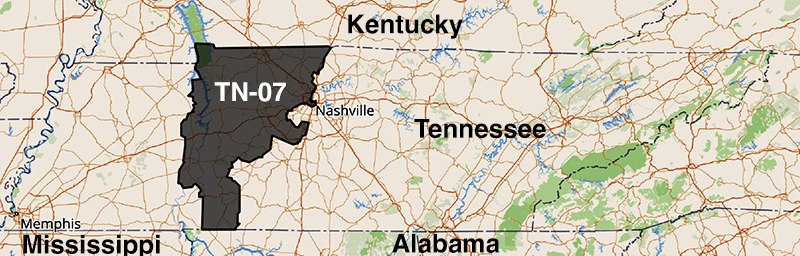
The R+10 district is 69% white, 16% Black, and 7% Latino. It has urban, suburban, and rural areas. It includes some of Nashville's suburbs, but is mostly rural. It is full of conservative churches. Donald Trump won the district by 20 points; Green won his 2024 election by 21½ points.
So, nothing to see here? The Republican will win the special election in a rout and we will move on? Maybe not. Buoyed by the results nationwide on Election Day this year and previous special elections, Democrats have poured a lot of money into the special election, forcing the Republicans to do likewise. Here are the results of the previous four special elections for the House so far this year:
| Date | CD | 2024 House | 2025 Special | Difference |
| Apr. 1 | FL-01 | R+32 | R+15 | D+17 |
| Apr. 1 | FL-06 | R+33 | R+14 | D+19 |
| Sept. 9 | VA-11 | D+34 | D+50 | D+16 |
| Sept. 23 | AZ-07 | D+27 | D+39 | D+12 |
| Dec. 2 | TN-07 | R+21 | ? | ? |
The four special elections averaged D+16, in red districts and blue ones. If The Democrats can pull off a 16-point gain above the R+10 lean of the district, they have a shot. Green won by 21½ points in 2024, but he was a long-time incumbent. This is an open-seat race.
The winner of the Republican primary in TN-07 was Matt Van Epps, a former commissioner in the Tennessee Dept. of General Services. The winner of the Democratic primary was state Rep. Aftyn Behn. Here they are:
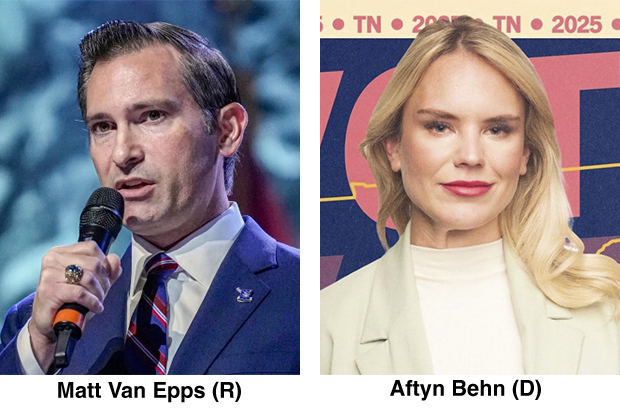
Is this talk of a competitive election just theoretical? Nope. Emerson College just ran a poll of the race and Van Epps is ahead 48% to 46% with 5% undecided. It looks a bit like a horse race. Young people who already voted supported Behn 56% to 42%, whereas Van Epps took seniors 51% to 37%. Women favored Behn and men favored Van Epps.
But there is more. Behn shot herself in the foot in 2020 when she said on a podcast: "I hate this city," meaning Nashville. She also said: "I hate the bachelorettes, I hate the pedal taverns, I hate country music. I hate all the things that make Nashville apparently an 'IT CITY.'" No doubt clips of that podcast are going to be all over TV this week. Hating Nashville might actually be a plus in the rural areas, but hating country music will not be.
If Behn loses by a small amount, say 5 points, despite both the redness of the district and her own personal liabilities, it will show that the trend of Democrats doing well even in red areas is continuing. Republicans will be nervous. If Behn actually wins it, Republicans are going to freak out nationwide. (V)
Democrats Are Going to Spend Over $10 Million to Expand Their Coalition
Democrats are not only active in the TN-07 special election. They are also engaging in an eight-digit campaign called "Our Power, Our Country," to win back voters of color and rural voters they lost in 2024. DCCC Chair Suzan DelBene (D-WA) is leading the charge. She is attacking Republicans on health care, gerrymandering, tariffs, and Medicaid, issues that play well in many rural areas. She knows this from the election results in New Jersey and Virginia, where the Democratic gubernatorial candidates greatly overperformed the 2024 House candidates in rural areas and urban Latino areas.
DelBene said that the DCCC already has a full-time staffer who will focus on working with community leaders in rural districts that are potentially in play. She said that populist economic policies, like anti-monopoly, antitrust, pro-union, and investment-in-infrastructure, play well in rural areas, and she wants to exploit these things to the max.
It won't be easy, though, since 69% of the voters in rural areas across the country voted for Donald Trump in 2024. To some extent, that is because Democrats simply never show up to make the case that Republicans hate them and never do anything for them. When Democrats show up and note that Republican policies are likely to make the only hospital in their county close, the voters listen. But the Democrats have to show up. Also, in Senate and other statewide races, losing a rural district by 5,000 fewer votes just as valuable as gaining 5,000 votes in some urban districts of equal population. And it may be easier to do, since the urban areas are already so blue.
Nicolas Jacobs, a political scientist at Colby College in Maine, said that Democrats have not only dismissed rural voters, they have actively pushed them away when they abandoned their 50-state strategy. He said going after rural voters might not pay off for 5-10 years, but many of them could eventually be won over on economic grounds and that won't happen until they start making the effort.
To make the point that rural areas are not inherently Republican, compare the 1964 presidential results by county with those of 2024.
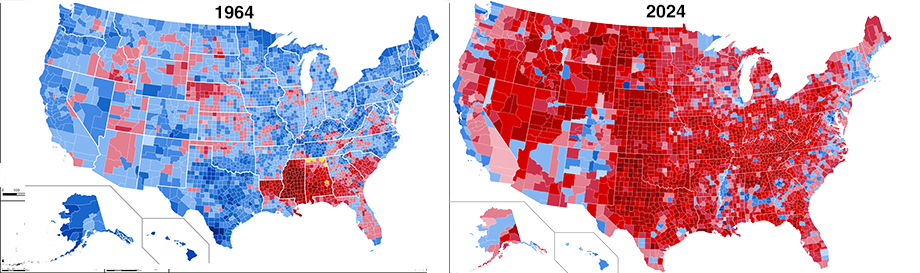
Outside of the deep South, where race dominated everything, Democrats did pretty well in most rural counties in 1964. They could do so again if they actually went there and talked about how the government could help people with health care, jobs, broadband Internet, and more, but it would take time, effort, and actually doing things when they had the chance. (V)
Another Poll Shows Trump Is Losing Latinos
Many times, we have brought up the topic of Latinos changing their minds since Nov. 2024, but it is very important, so we are going to keep bring it up, as there is increasing evidence that the effect is widespread. Donald Trump's victory was powered in substantial part by the votes of Latino men, especially marginal low-propensity voters. If they are souring on the Republicans big time, that is going to have repercussions in 2026 and 2028.
A new Pew Research poll of more than 5,000 Latinos nationwide taken in October shows that 70% disapprove of Trump, with 55% strongly disapproving of him. Even among Latinos who voted for Trump, he is down 12 points. On the economy, 78% say that it is only fair or poor, with 61% saying Trump has made it worse. On immigration, 71% disapprove.
A general summation of how Latinos feel about Trump is given below. This is the answer to the question of whether Trump's policies have been helpful or harmful to Latinos:
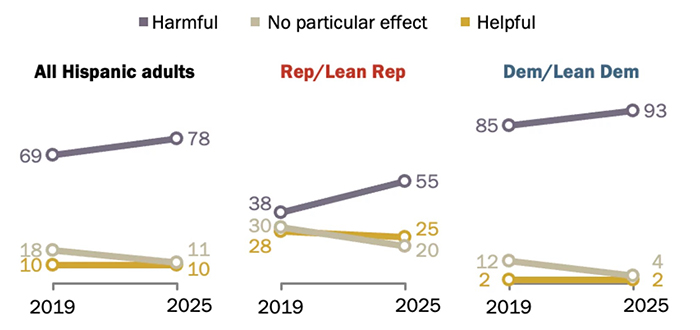
What is interesting here is not so much that virtually every Democratic Latino thinks Trump has been harmful, but that 55% of Republicans now think that and only 25% think they Trump has been helpful. (V)
Ivanka Trump Lives in Nigeria
It is no secret that many of the accounts of eX-Twitter and other social media sites are fake. In particular, accounts that purport to be from Americans are often from people in distant countries who are not Americans. Last Saturday. eX-Twitter rolled out a new feature that could expose some of the fakes. It allows readers to see where an account is actually based.
Reporters are already digging. One of them discovered that the account from Ivanka Trump, which has over 1 million followers, isn't from the president's daughter. It is from a different "Ivanka Trump," who lives in Nigeria. People who thought it was the one who lives in Florida will be surprised if they discover this, which they can easily do now. Other accounts from people who claimed to be true American patriots turn out to be from people in Pakistan, Thailand, Turkey, and elsewhere.
Many accounts are highly political. It appears that foreign actors posing as Americans have been illegally interfering in American elections, possibly for years. Making this visible is only a start, though. Another thing the algorithms that recommend content could do is prioritize content that actually originated from the reader's country (unless the reader specifically asked not to do so). Users should also be able to limit content that they see to be from a specific country or countries and ban content from specific countries. Yet another step would be for the platforms to make a very serious effort to determine which users are humans and which are bots.
One big problem is determining where a user actually is. In many cases, the sending computer's IP address gives that away. If you visit WhatIsMyIPAddress.com it will tell you where it thinks you are. However, by using a VPN (Virtual Private Network), you can hide your true IP address. Turn on your VPN, if you have one, point it to some place on a different continent, and try WhatIsMyIPAddress.com again.
However, VPNs can be defeated with some effort. Each of the larger VPN companies has at most a few hundred VPN servers around the world. It is not hard for ex-Twitter, Facebook, etc. to compile a list of all of them and simply block all connections from them. In all, there probably aren't more than 10,000 VPN servers in use. That might not work 100% of the time, but blocking all the VPN servers from the 50 biggest VPN companies would be a start. (V)
Democrats Are Considering Ranked-Choice Voting for Primaries
The DNC knows that the there will probably be a couple of dozen candidates running for president in 2028, and it needs to find a way to arrange primaries to make sure the candidate chosen is a strong candidate in the general election. One bug in the system has been mostly fixed: caucuses. In 2016, Sen. Bernie Sanders (I-VT) discovered and utilized this bug extensively. His campaign realized that many of the deep red states, where there are hardly any Democrats, used very sparsely attended caucuses to elect their delegates to the Democratic National Convention. So he sent people to states like Idaho, North Dakota, Oklahoma, Utah, and Wyoming to get a few thousand supporters to the caucuses there. He won all of them. Headlines like: "Sanders sweeps the Arizona, Idaho, and Utah caucuses" gave the impression of more support than there really was because the number of people who turned out there was rather small. It was a clever strategy and we credit Bernie for using it, but caucuses are not a good way to pick the nominee with the best chance of winning the general election. Caucuses famously appeal to True Believers and high-information voters, and general elections attract mostly people who do NOT fit those descriptions.
The system used for years, with Iowa and New Hampshire going first, didn't work so well and the attempt to put South Carolina first is going nowhere because states set the primary dates and South Carolina is not especially interested in helping the Democrats. So the DNC is looking at new ways of running primaries. One of them is ranked-choice voting (RCV). Rep. Jamie Raskin (D-MD), Democratic pollster Celinda Lake, and others have pitched that. The idea is that would make life tough for extremist candidates since with a large field, getting second-place votes would be important and extremist candidates are unlikely to get any second place votes.
Some progressives are pushing the idea because New York City uses ranked-choice primaries and Zohran Mamdani won, so ipso facto, ranked-choice primaries mean progressives win. There is some truth to that, because if two centrists are running, they could split the vote. Currently, in many states, delegates are selected by proportional representation, so if two progressive candidates are on the ballot, there could be progressive delegates pledged to two different candidates at the convention, possibly leading to floor fights. Ranked-choice voting coupled with winner-take-all-the-delegates per state would probably speed up candidate selection and result in a candidate acceptable to many party members.
The reception at the DNC has been mixed. Some members like it, but others think it would be too difficult for some voters, slow down voting, and drag the primary out for months instead of leading to a quick selection of the candidate.
Last year, Colorado, Idaho, Nevada, and Oregon all had RCV initiatives on the ballot and all of them lost.
Getting a majority of the 450 DNC members on board won't be so easy. Then the hard part would begin. States run primaries, so their laws would have to be changed to accommodate them. Republicans strongly oppose RCV, so changing the election laws would be limited to states where the Democrats have the trifecta. There are 15 of them, so the movement could start there. (V)
What Will NATO v3.0 Look Like?
As a practical matter, since 1945, the U.S. has been the most powerful nation in the world and it got what it wanted nearly all the time. It was also the most respected nation for most of the world. When the U.S. needed help with something, such as driving Saddam Hussein out of Kuwait, much of the world pitched in and helped. Donald Trump has casually thrown that all away. The rest of the world has noticed and is preparing to deal with a world in which the U.S. is a rogue nation, rather than a respected leader and partner.
The Halifax International Security Forum is an annual meeting of political, military, and security leaders intent on strengthening democracy. These days, relations between the U.S. and Canada, Europe, and Asian democracies are all strained. Trump didn't even send any representatives although a few senators showed up on their own.
This situation is leading European and Canadian leaders to start thinking about what their security arrangements would be without the U.S., say NATO v3.0 (NATO v2.0 was the post-Cold War version in which Eastern European countries joined). Would Germany and maybe even Poland build their own nuclear weapons? Would there be closer military integration among members? Will members manufacture and buy weapons from each other rather from the U.S.? Will there be greater cooperation between European democracies and Asian ones? These are all topics of discussion now and could lead to a world in which the U.S. is no longer the most important player, and maybe not even a member of some future political, economic, and military alliances.
Just as one example, if Canada, members of the European Union, the U.K., Japan, South Korea, Australia, and maybe a few others formed a free-trade zone and focused on buying and selling from each other, that would be a huge market. That bloc could also negotiate deals with China, leaving the U.S. out. It could shape the world in ways detrimental to the U.S. It is hard to think of a historical example in which the most powerful country in the world threw a fit and voluntarily threw away all of its soft power and in the long run, potentially much of its economic power. But that's what we might have today. Make America Great Again? (V)
Brazil Is Sending a Former President to Prison
The U.S. isn't the only country that has dealt with a rogue president. But some of the others deal with them differently. Former president of Brazil Jair Bolsonaro lost reelection and then hatched a plot to have his supporters attack government buildings on Jan. 8, 2023, and kill the new president, vice president, and chief justice of the Supreme Court. It didn't work and Bolsonaro was arrested and put on trial in May 2025. He was convicted and sentenced to 27 years in prison for plotting a coup. On Tuesday, the Supreme Court of Brazil upheld his conviction, ruled that no more appeals were allowed, and ordered him to start his prison sentence. He was already in police custody Tuesday because earlier he was caught trying to remove his ankle monitor when he was under house arrest pending the appeal.
Like Ghislaine Maxwell, Bolsonaro will get VIP treatment in prison. His 130-square-foot cell has a bed, a desk, a bathroom, a TV, air conditioning, and free access to his doctors and lawyers. Nevertheless, he can't leave for the next 27 years, except in a coffin (he is 70 and claims to be in poor health). In a separate decision, he was earlier barred from running for any public office until 2030. (V)
Thanksgiving Games: Easy As Pie, Part I
Since yesterday's post didn't happen, we thought we'd add a little extra oomph to this one with some fun and games. Maybe it will be a useful distraction for a few readers who need a respite from drunken Uncle Bob and his rants about how these immigrants are ruining America.
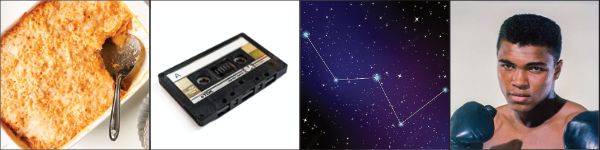
We've already done a presidents + Thanksgiving trivia quiz, and there are only so many reasonable questions available for something like that, so we decided to go in a different direction. We have put together ten sets of four pictures, like this:

The first picture, in each set, is something that is associated with Thanksgiving. As a set, the four pictures point at a theme or commonality of some sort. For example, shown here are a pie, an idol, a dream and an idiot. All of those can be paired with the word "American" (i.e., "American Pie," American idol, the American Dream, and "American Idiot").
Note that there are many different kinds of themes here, that the theme may rely on a different meaning of the word indicated, and that some pictures may suggest multiple words, some of which are not needed. For example if we had done one with a picture of Plymouth Rock, we might also have given pictures of Gerald Ford, of Chevy Chase, and of a mustang horse, resulting in a theme of "cars" (i.e., Plymouth, Ford, Chevy, Mustang).
And with that out of the way, here are the 10 sets:
Number 1:
Number 2:

Number 3:

Number 4:

Number 5:

Number 6:

Number 7:

Number 8:

Number 9:

Number 10:

If you'd like to take your best shot, click here to submit your responses (please get them in by 10:00 PT tonight). We'll have the answers, and the top 20 finishers, tomorrow. Some of them are tricky, so we're not expecting many perfect scores. (Z)
Previous | Next
Main page for smartphones