
Previous | Next | Senate races | Menu
New polls:
Dem pickups: (None)
GOP pickups: (None)
Minister of Information Bari Weiss Is Earning Her Paycheck
One of the primary jobs for the commissioners of the various sports leagues (particularly the NFL) is to be among the highest-paid heels in the world. They do and say the unpopular things that need to be done and said to advance the interests of the business, allowing the fat cats (the owners) to keep their hands basically clean.
It could not have been clearer that Bari Weiss was hired to perform a similar role at CBS. She does not have the qualifications to be running a major newsroom (or even a minor one). And her politics are too well known for her to be credible as a fair and impartial journalist or editor. However, she has enough of a "just calling balls and strikes" image (even if it's not justified) that the Ellison family, who are the new owners of CBS, are hopeful that she can do their partisan bidding and yet give everything a veneer of legitimacy. At very least, if the editorial decisions appear to be coming from her, then that is one step removed from the Ellisons, and two steps removed from their good buddy Donald Trump.
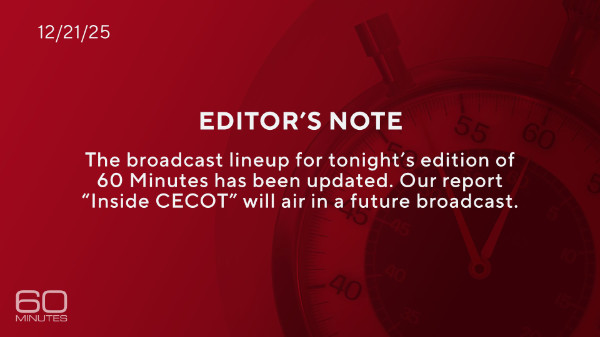
The Ellisons' investment paid dividends this weekend—sort of. The staff of 60 Minutes put together a 14-minute piece entitled "Inside CECOT," about the folks who were abruptly (and illegally) deported to El Salvador, and the conditions they faced there. Well aware of the current political context, the piece went through the usual editorial process five times, and was thoroughly vetted by CBS lawyers. A promo was posted on CBS' website. And then, about 2½ hours before it was set to air, the segment was dropped. The promo was replaced with this notice:
Maybe they will indeed show the segment on a future broadcast. Maybe that will be right after the episode where they report on the details of Donald Trump's plan to replace Obamacare. Or the episode where they cover the full, complete, and unredacted release of the Epstein files by the Department of Justice.
The last-minute decision was made, of course, by Weiss. Or, at very least, Weiss claims that she made the decision. She explained herself to staffers on a Monday morning conference call:
I held a 60 Minutes story because it was not ready. While the story presented powerful testimony of torture at CECOT, it did not advance the ball—the Times and other outlets have previously done similar work. The public knows that Venezuelans have been subjected to horrific treatment at this prison. To run a story on this subject two months later, we need to do more. And this is 60 Minutes. We need to be able to get the principals on the record and on camera.
Yes, what would a bunch of journalists know about what makes a good news story. Thank goodness there was an op-ed writer there to set them straight!
As readers can presumably tell from our sarcastic tone, Weiss' explanation does not pass the smell test. It is the height of ivory-tower elitism to claim that if the New York Times has covered a story, there's nothing more to be said. A Times story might reach a million people or so (10% of the subscriber base is a GREAT success); 60 Minutes averages 8 million viewers. And that is before we talk about the differences between reading a story (maybe with pictures) and seeing it in video form. Even if the 60 Minutes piece covered only well-worn territory (dubious), it did so in a different way, and for a different audience. It most certainly would have "advance(d) the ball."
It is also not remotely believable that the White House was not asked to comment, or to have someone sit for an interview. There is no doubt that if Donald Trump, or Steven Miller, or DHS Secretary Kristi Noem had been made available, the 60 Minutes staff would have been on that like white on rice. (Z) worked for a newspaper for many years, and the moment he heard Weiss' claims, he had absolutely no doubt whatsoever that the White House refused requests for comment. It is Journalism 101 that you ask, and it is Journalism 101 that the answer is often "no." That is, itself, a form of comment (and keep reading).
Finally, 60 Minutes is CBS' flagship news program. In fact, it might be THE flagship news program of American television (the only real competitor, we would say, is Meet the Press). Was Weiss, the so-called editor-in-chief of CBS News, really in the dark about the rundown of this week's show until just a couple of hours before airtime? If so, she's incompetent. But if incompetence was all that was going on, then she probably wouldn't have known until after the broadcast. No, the timeline comports a lot better with something like this: Weiss learned of the story when the promo was uploaded to the website on Friday (if not before), she gave a heads-up to the Ellisons on Saturday, and the Ellisons ordered her to kill it. That is what we suspect really happened.
We are not the only ones who are not buying what Weiss is selling. The lead reporter on the CECOT piece is Sharyn Alfonsi, who sent out a memo to the 60 Minutes staff yesterday:
News Team,
Thank you for the notes and texts. I apologize for not reaching out earlier.
I learned on Saturday that Bari Weiss spiked our story, INSIDE CECOT, which was supposed to air tonight. We (Ori and I) asked for a call to discuss her decision. She did not afford us that courtesy/opportunity.
Our story was screened five times and cleared by both CBS attorneys and Standards and Practices. It is factually correct. In my view, pulling it now—after every rigorous internal check has been met is not an editorial decision, it is a political one.
We requested responses to questions and/or interviews with DHS, the White House, and the State Department. Government silence is a statement, not a VETO. Their refusal to be interviewed is a tactical maneuver designed to kill the story.
If the administration's refusal to participate becomes a valid reason to spike a story, we have effectively handed them a "kill switch" for any reporting they find inconvenient.
If the standard for airing a story becomes "the government must agree to be interviewed," then the government effectively gains control over the 60 Minutes broadcast. We go from an investigative powerhouse to a stenographer for the state.
These men risked their lives to speak with us. We have a moral and professional obligation to the sources who entrusted us with their stories. Abandoning them now is a betrayal of the most basic tenet of journalism: giving voice to the voiceless.
CBS spiked the Jeffrey Wigand interview due to legal concerns, nearly destroying the credibility of this broadcast. It took years to recover from that "low point." By pulling this story to shield an administration, we are repeating that history, but for political optics rather than legal ones.
We have been promoting this story on social media for days. Our viewers are expecting it. When it fails to air without a credible explanation, the public will correctly identify this as corporate censorship. We are trading 50 years of "Gold Standard" reputation for a single week of political quiet.
I care too much about this broadcast to watch it be dismantled without a fight.
Alfonsi clearly knows her stuff, and clearly has a steel spine. Whether she will still have a job a week from now is a different question.
Meanwhile, note again what we wrote at the top of this item: "The Ellisons' investment paid dividends this weekend—sort of." It is true that the story was killed, and may well never reach CBS' airwaves, at least in the United States. However, nobody believes Weiss is calling journalistic balls and strikes, and the credibility of 60 Minutes and of CBS News has taken a giant hit, from which it will certainly not recover as long as she's on the payroll. If the goal is to create a mainstream propaganda operation—a highly dubious proposition—then that effort is clearly failing.
On top of that, we continue to marvel that nobody in these right-wing circles seems to have heard of the Streisand Effect. Heck, at least three decades before there was a Streisand Effect, the Ronald Reagan administration knew that when 60 Minutes was going to do a critical piece, the best thing to do was to make sure it included some footage of Reagan looking dapper, to let the piece run, and then to wait for any negative effects to dissipate, which they tended to do quickly. Now, not only have Weiss and the Ellisons dealt a massive blow to their right-wing media project, they've also given this story vastly more exposure that it otherwise would have gotten, since every outlet is now writing about both CECOT and Weiss' lack of scruples. And it's not like they were even able to completely slay the segment. It ran on CBS outlets in Canada and in other nations, and can easily be found on multiple platforms.
In short, the Fourth Estate is more resilient than the Ellisons, and their highly paid ventriloquist dummy, realized. Maybe if the Ellison family had hired an actual journalist to be their lapdog, they would have gotten at least slightly better results. But probably not. (Z)
Grift, Ego, or Revenge?, Part I: Wind Farms
Most readers will be familiar with the Little Rock Nine, the nonet of Black students who presented themselves at Little Rock Central High School in Little Rock, AR, and endeavored to be enrolled, per the Supreme Court's decision in Brown v. Board of Education (1954). The principal of the school, along with Gov. Orval Faubus (D-AR), said "no." Then, President Dwight D. Eisenhower got involved, and said "yes." We all know who won that little argument.
Note again that the Brown decision was announced in 1954. The Little Rock Nine endeavored to enroll, and did enroll, in 1957. This is not coincidental. See, 1956 was an election year, and Dwight D. Eisenhower could not run for reelection with an "integrationist" label hanging around his neck. By 1957, though, he was done running for office, and had a bit more room to maneuver. Even then, he thought long and hard about how to handle Little Rock, because he was concerned about the well-being of the Republican Party, and the Republicans who were going to face voters in 1958 and 1960.
Donald Trump is similar to Ike in one way, and not terribly similar in another (over and above "five stars" vs. "bone spurs"). Trump is also a lame duck who appears to have accepted that he'll never run for the White House again, which means he doesn't really have to care about politics very much, or at all. The difference is that Ike continued to care about his party, even if his personal fortunes were no longer on the line. Donald Trump, by all indications, does not care anymore about his party, or about politics.
This, by the way, is not an easy thing for us to accept. During Trump v1.0, we joined many, many other politics-watchers in trying to discern what the larger/long-term plan was. Eventually, we had to accept that rarely, if ever, is there a larger/long-term plan, and that Trump and his underlings do not play 3-D chess. This time around, we concede the lack of long-term vision, but have continued to search for the short-term political calculations. For example, to take just one story from last week: "What, and how much, does Donald Trump expect to gain politically from putting up a bunch of childish plaques about Joe Biden and Barack Obama in the White House?"
We have thought about it over the weekend, influenced by some of the many letters we got (and ran), and we are finding it hard to avoid that Trump is, perhaps uniquely in American political history, a post-politics president. It looks clear to us, at this point, that his top three agenda items are these, in some order:
- Grift: With Trump, money has always been tops. He has always had plenty of it, and yet he's
never had enough of it. He'll do anything to make a buck, no matter how pathetic, no matter how unethical. He knows that
even if he crosses the line, he can always use his army of lawyers to bail himself out. And if that fails, he's always
been able to negotiate a settlement. With the presidency, he gains the additional insurance policies of the pardon
power, and of executive and legislative branches that have no interest in holding him accountable.
- Ego: Trump is a malignant narcissist. We don't like to make that a core element of our
analysis, because it's very judgmental and because he's never been formally examined or diagnosed. However, we
were also trained in graduate school to follow the evidence. Trump's niece Mary, who is a psychologist, and has come as
close to examining him as anyone can (since he won't sit for actual therapy sessions), says he's a malignant narcissist.
The letters this weekend make the same point. And the evidence is just too great to ignore at this point. In particular,
the "making it all about me" response to the death of Rob Reiner. Can someone send out that message, and THEN double
down when they are called on it, and NOT be a malignant narcissist? We don't think so.
- Revenge: Trump takes great pleasure in exacting revenge against those who have "wronged" him. Even his chief of staff says so, and we see absolutely no reason to think Susie Wiles is wrong. The unusual thing about Trump, beyond the fact that his need for revenge is so profound as to be pathological, is that he clearly prefers point totals over shooting percentage. By that, we mean that he and his underlings pursue longshot efforts at revenge (see Comey, James; James, Leticia) even if they are likely to fail in high-profile fashion. Most other revenge-seekers limit themselves to high-percentage plays, but not Trump.
Going forward, then, as we try to make sense of what Trump does, the first questions we are going to have to ask are: (1) "Is this a grift?", (2) "Is this about his ego?" and (3) "Is this about revenge?"
Even when Trump interests himself in politics, it is probably an aspect of these other things, more likely than not. Going back to Eisenhower for a moment, he really wanted to see Republicans do well in the 1958 midterms, because that meant more ability to get legislation passed, and it meant that Ike would leave his party on a sound footing. Trump doesn't give a damn about legislation (and political capital), since he got the BBB, and now he prefers to govern by executive order. And Trump doesn't give a damn about the Republicans once he's out of office; he's not really a Republican, anyhow; he's a MAGAian who merely latched onto the more convenient major party, since only major parties can win presidential elections.
What we are saying is that when Trump ponders the midterms, he's not thinking about anything other than himself. He would prefer that it not be a blue wave, but only because that will be a poke in his own eye. He would prefer that Democrats not gain a majority in the House, but only because he doesn't want the embarrassment of being impeached a third time. The "politics," in this case, aren't really politics, they're just a different expression of his ego. He simply does not care about the things that other presidents, even lame duck presidents, care about. Hence: post-political president.
That brings us to one of the big stories of yesterday. When the week began, there were five offshore wind farms under construction, in various places along the East Coast. As of today, there are none, as the administration announced it was suspending all of the leases for the projects. Previously, the White House had threatened to suspend leases for projects that had not yet commenced, but now it is ALL projects. That includes one (Vineyard Wind) that is already generating electricity. Secretary of the Interior Doug Burgum offered an "explanation" on eX-Twitter:
Due to national security concerns identified by @DeptofWar, @Interior is PAUSING leases for 5 expensive, unreliable, heavily subsidized offshore wind farms!
ONE natural gas pipeline supplies as much energy as these 5 projects COMBINED. @POTUS is bringing common sense back to energy policy & putting security FIRST!
Uh, huh. We suppose it would be one thing if the things weren't already built, but it's hard to argue that facilities that are nearly complete (and again, one of them is complete enough to be generating electricity) are too heavily subsidized to be worthwhile. And, as per usual, the administration offers little explanation/evidence as to why these projects are security risks—citing radar interference—or what makes them unreliable. The gas pipeline thing, even if true (and "true" depends on specifics that Burgum does not provide), overlooks the fact that wind is renewable and very clean; natural gas is not.
Whatever happened here, it has little to do with politics. What we mean is that Trump promised to cut energy costs when he ran for president (all three times). People are now hammering him on failing to deliver on that promise. Cutting off a source of energy (one that can co-exist perfectly well with other sources, as needed), and to do so just as winter has arrived? That makes absolutely no sense from a political standpoint. And if you doubt our assessment, well, even many Republicans are hopping mad.
But wait, there's more. In Congress, both Democrats and Republicans have been working on a deal to speed up energy and infrastructure projects—basically, the Republicans want fewer regulations, while the Democrats want some money for renewables and more eco-friendly transportation. Progress was being made until yesterday. Now, the Democrats have walked away from the negotiating table, quite rightly observing that you can't promise to support renewables and then cut such projects off at the knees before they come online. Since at least half a dozen Democratic votes are needed to get a bill through the Senate, there will be no bill, and so no new sources of non-wind energy as long as the leases remain suspended. Very impolitic for the White House.
So, what's really going on? In terms of the three categories we lay out above, we suspect two are in play here. The first is revenge. Trump has hated wind energy for years, ever since he fought (and lost) a battle to keep a wind farm from being built next to his golf course in Scotland. He believes that the turbines ruined the view, and thus made the course no fun to play. We're not golfers, but if the only thing that made your course fun to play in the first place was a lack of wind turbines nearby, maybe it's not that great a course. Anyhow, beyond the fact that Trump hates wind, and loves breaking wind, he also hates Joe Biden. And the now-shuttered wind farms were all made possible by Biden's BBB. So, Trump gets to lash out at two bugaboos for the price of one.
The other possible motivation here is grift. Trump got a lot of money from oil producers during the campaign (famously inviting them to Mar-a-Lago for a shakedown dinner), and he and many members of his administration are in bed with Big Oil. They may well believe, rightly or wrongly, that the less wind energy the country has, the more valuable oil will be. Also more valuable: nuclear power (see below).
In any event, the decision makes no sense from a political standpoint, and we're just not going to tie ourselves into knots, trying to pretend otherwise. (Z)
Grift, Ego, or Revenge?, Part II: Nuclear Fusion
And now we get to something that is 100% grift. And although it's unbelievably egregious, it's basically flown under the radar. Last week, Trump Media & Technology Group (TMTG) and TAE Technologies, Inc. (TAE) announced a merger. TMTG owns the low-energy social media platform, "Truth" Social. TAE is a leading company in the area of fusion power, and says it plans to have one fusion-reaction plant online soon, and a whole bunch more in upcoming years.
What does a poorly trafficked social media site have to do with nuclear energy? Absolutely nothing. To understand what happened, however, all you have to do is look at the balance sheet. The merger is valued at $6 billion, with more than $5 billion of that value coming from TAE. In the combined company, each side will own 50% of the stock. That means that TMTG shareholders (and the stock trades, or at least traded, under the symbol DJT) basically got $2 billion+ in free money for signing on the dotted line. Trump himself got north of $500 million.
What did TAE get for their money? You probably don't need us to tell you, but just in case, building fusion plants is something of a regulatory nightmare. It's also something that might attract some government investment. Now, for the bargain price of $2 billion, the company has made certain that the most powerful person in the federal government is deeply invested (literally and figuratively) in their success. One can expect regulatory barriers to fall faster than Trump's approval rating. And it would not be too surprising if, in 6 months, Burgum announces the "exciting news" that TAE has received a grant of $1 billion, or $2 billion, or maybe $10 billion. So, this is a great investment for them.
It is also, to put it another way, a big, fat bribe. Not only does the nation's leader now have a vested interest in promoting one power source, using any means at his disposal, he also has a vested interest in stymieing other power sources—like, say, wind. In a just world, he'd already be facing articles of impeachment. But this is not a just world, and this is not even his first large-scale grift. The various crypto schemes were just as bad, and they've produced no legal or political consequences for him at all. It's hard to imagine that this grift will turn out any differently. The only silver lining, such as it is, is that maybe the fusion plants actually work out, and Trump inadvertently helps create a new and advantageous form of energy. But if so, that will be an inadvertent side-effect, and certainly not one of the President's goals. (Z)
Grift, Ego, or Revenge?, Part III: "Trump-Class" Battleships
And now, an item that is clearly about Donald Trump's ego. The President has long carped about the Navy's ships, and his primary complaint is that they are... ugly. After all, most of them have been at sea for a while, and so there's some rust, and some worn paint, and some barnacles, and the like. So, as he did during Trump v1.0, he is going to try to overhaul the fleet. Last week, the Navy announced construction of a new class of frigates, and yesterday Trump himself announced the construction of a new class of battleships and a new class of aircraft carriers.
The President offered very little detail about the aircraft carriers, but he had much to say about the battleships. For example, he revealed that the first ship in the new class will be the U.S.S. Defiant (have they been showing Star Trek: Deep Space Nine reruns at Mar-a-Lago?), and that it would be ready for duty in 2½ years. He also said that the new ships will be "100 times more powerful than any battleship ever built," which we assume uses the same math as his claim that prescription drug prices would drop by 400%, 500%, 600%. Trump noted that the battleships would be the centerpiece of a new "Golden Fleet" (he didn't say actual gold decorations would be used, but you have to assume they will be). Oh, and he also mentioned that the new class of ships would be known as the Trump-class. Maybe, just maybe, that is why he's so interested in them.
One wonders if Pete Hegseth or someone else has been reading a book about the Navy at the turn of the 20th century. That was when battleships were the king of warships (before being displaced by aircraft carriers in World War II, and then arguably by smaller, more maneuverable ships in the last 20-30 years). Further, in 1907, then-president Theodore Roosevelt, in a display of American power and penis size, dispatched a fleet of 16 battleships known as the Great White Fleet to sail around the globe. They were known by that name because they were painted white (though also because they were promoting the superiority of the white race, even if that wasn't stated openly). It can't be a coincidence that Trump's battleship fleet is going to be known as the Golden Fleet, can it? Certainly, while the color of the ships may be different than in TR's time, the other parts of the mission are exactly the same.
We also assume that everyone, except Trump, knows that any class of ships is named after the first ship of that class. So, if these ships come to fruition (and the ones from Trump v1.0 did not, so don't assume anything) these are going to be Defiant-class ships. We also assume everyone, except Trump, knows that no ship is ever completed on schedule, and that when this one is done (again, if it ever is), his presidency will be over, or nearly so. And, at that point, everyone will just use the correct convention, and call them Defiant-class. Clearly, the people in Trump's orbit have realized that puffing up his ego is their job right now, and that it doesn't especially matter if "Trump-class" or "The Donald J. Trump and John F. Kennedy Memorial Center for the Performing Arts" or "Trump Accounts" or "The Arc de Trump" have very little chance of keeping his name beyond January 20, 2029. (Z)
Trump's Policies Claim a High-Profile Victim
What is the most iconic hard liquor brand in the United States? We would say that Jack Daniel's is probably #1, but not far behind is Jim Beam. Certainly, Jim Beam is iconic enough that consumers, both domestic and foreign, instantly recognize it as an American brand (even if the current owner, Suntory, is actually Japanese). Yesterday, citing "tariff uncertainty," Suntory announced that it would halt all production at its main Kentucky facility for the entirety of 2026.
There is an auxiliary facility in Kentucky, so some production will continue. And, of course, bourbon has to be aged, so there's a large supply currently in reserve (16 million barrels, a record total). The Jim Beam tours for tourists will also continue. However, around 1,000 people will be out of work as of January 1. Also, once a production facility ceases operation, it sometimes does not start up again. Or, if it does, it re-starts in some other place. By law, "bourbon" must be made in the U.S. to be labeled as such. But it doesn't have to be made in Kentucky. Plus, one can imagine that a slight name change might be adjudged to be "worth it." Kobe beef has to come from Japan, but there are plenty of people in the U.S. selling Kobe-style beef. Is Kentucky-bourbon-style whiskey an impossibility? Maybe not.
Although Suntory blamed the tariffs, we have to imagine that's only part of the equation. The main non-domestic purchaser of bourbon is Canada, and these days, American products are pretty unpopular there. This is partly due to the tariffs, but it's mostly due to the shabby way that Donald Trump has treated the folks in the Great White North. It must surely be the case that the decline in sales, coupled with the record volume of reserves, is what really drove this decision.
We do not imagine that the Trump administration will lift so much as a finger to try to improve the situation. First, Trump is an adherent of the big, swinging di** school of negotiation, and is not going to be shamed into concessions, particularly from foreigners, and more particularly from foreigners who are not white. Beyond that, most presidents would be at least somewhat worried about the pain that will be inflicted on Kentuckians, either out of a basic sense of decency, or out of fear for the political repercussions, or both. Well, Trump doesn't have a basic sense of decency (see Reiner, Rob — tragic death of), and he does not seem to care much about politics these days (see above). What he DOES care about these days is revenge (again, see above). And you can make a pretty good case that Trump's three least-favorite Republicans (or, maybe three of the top five) are Kentuckians: Sens. Mitch McConnell and Rand Paul, and Rep. Thomas Massie. So, Trump will probably enjoy fiddling while Kentucky burns. (Z)
He Did It... Conway
Politics, as they say, makes strange bedfellows. And there was a pretty high-profile reminder of that yesterday, as George Conway—ex-husband of Kellyanne, former (?) Republican, former (?) member of the Lincoln Project, and high-profile Never Trumper—officially announced that he's running for the seat being vacated by Rep. Jerrold Nadler (D-NY). And, as Conway has hinted in the past few weeks, he's running as... a Democrat.
Barring (unlikely at this late date) redistricting, the district, NY-12, is D+33. That makes clear why Conway has to run as a member of the blue team. A couple of times before Rep. Elise Stefanik (R-NY) gave up her bid for the governorship, we wrote that we did not understand what the theory of her candidacy was, because MAGA + New York State is a bad combo. We certainly understand the theory of Conway's campaign. Yes, Democratic voters tend to prefer actual Democrats, as opposed to Johnny-come-lately Democrats. On the other hand, Democrats really hate Donald Trump, and there aren't too many leaders of the Trump resistance more visible than Conway. So, maybe he gets some votes from blue teamers. On top of that, independent voters are somewhat less concerned with partisan identification, most of them hate Trump, too, and most of them prefer moderate candidates. Meanwhile, Republicans in the district are largely not MAGA, and they might prefer to vote for a barely-Democrat who can win, as opposed to an actual Republican who will go down in flames.
We would not like Conway's chances if this was, say, a three-person race, with one other Democrat and one Republican. We definitely would not like his chances if he had to face off against a Democratic incumbent. But Nadler is retiring, and the race to succeed him has turned into a feeding frenzy, with 11 other Democrats (most notably Kennedy offspring Jack Schlossberg), 3 Republicans and 3 independents having declared. And don't forget that New York has fusion voting, so that someone can be a candidate of the Democratic Party and also, say, the Working Families Party. Anyhow, it is conceivable that if Conway can pick up a few votes from this faction, and a few votes from that faction, and a few votes from that faction, that might be enough to eke out a plurality, particularly if a fractured electorate means that it only takes 20% of the votes to claim that plurality. And whatever Democrat survives the primary, well... D+33 district.
Conway says he's had pollsters poll the race, and that it's possible for him to win. That may not be the likeliest outcome, but it does seem at least plausible, to us. At very least, as an official candidate for office, Conway gets a bigger platform, and will make more appearances on TV and radio where he can rail against Trump. Truth be told, that might be the actual prize he's after. (Z)
Twelve Days of Christmas... Games, Part X: Putting the 'S' in N-O-E-L
The last three games in the series are meant to require some amount of time to do well, because we're planning to go dark for a week, from Monday the 29th to Sunday the 4th. The games will give at least some readers something to entertain themselves during that week. Meanwhile, we'll be able to work on some technical things we need to do, and also get a breather.
Today's game is pretty simple, and gets a GIANT assist from Mike Wilks, the artist responsible for one of (Z)'s favorite books, The Ultimate Alphabet. Each page in the book is devoted to one letter of the alphabet, and contains somewhere between 100 (or so) and 1,000 (or so) things that start with that letter. Here is the page for 'S':

The game today is to name as many things as you can that: (1) Appear in the drawing, (2) start with the letter 'S' and (3) suggest, in some way, the holidays, cold weather, etc. For example, the page in the book for the letter 'E' has, among other things, an Eskimo Dog (dog breed from cold parts of the world), the flag of Estonia (a very cold country), and an elf (works for Santa), among many other answers that would be appropriate.
For this one, it works best if you send your answers, via e-mail, to comments@electoral-vote.com. That way, you can open up a document or a blank e-mail, and work on your list at your leisure. We do encourage creativity, and do feel free to add an explanation for answers that might require an argument to qualify. There are at least 100 answers, in our judgment, and readers will surely add more that we missed. Also, note that you can click on the image above to see a much larger version. Happy hunting! (Z)
Previous | Next
Main page for smartphones