
Previous | Next | Senate races | Menu
New polls:
Dem pickups: (None)
GOP pickups: (None)
Susie Wiles Says the Quiet Part out Loud... Over and Over and Over
When we read that Donald Trump's chief of staff, Susie Wiles, was sitting for an interview with Vanity Fair, several questions leapt to mind: (1) "What is the administration's goal, here?"; (2) "Why Vanity Fair, of all outlets?" and (3) "Why is the notoriously in-the-shadows Wiles talking to ANYONE?"
Now that the interview has been published, we still have those questions. And we also have a fourth one: Did NOBODY in the administration think about these things? Wiles sat for hours and hours of interview time across 11 sessions, and the interview (split into two parts) is accompanied by heavily posed photos of not only Wiles, but also J.D. Vance, Secretary of State Marco Rubio, White House Press Secretary Karoline Leavitt, Deputy Chief of Staff James Blair, social media guru Dan Scavino, and Underboss Stephen Miller. This was not an offhand remark at a press conference; it was a high-investment engagement, and one that key members of the administration were clearly aware of.
And actually, let's pause on the images for a second, because they are... pretty bizarre. For example, this is the image that leads off the first part of the interview:
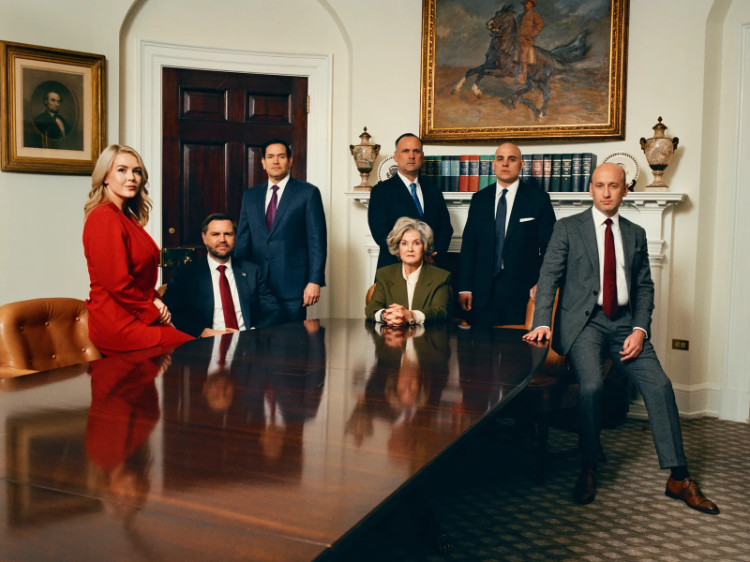
What kind of picture did they think they were taking here? It looks like a promo for a reboot of Dynasty or maybe Billions.
There are also "environment" shots of every person shown here. Here is the one for Karoline Leavitt:
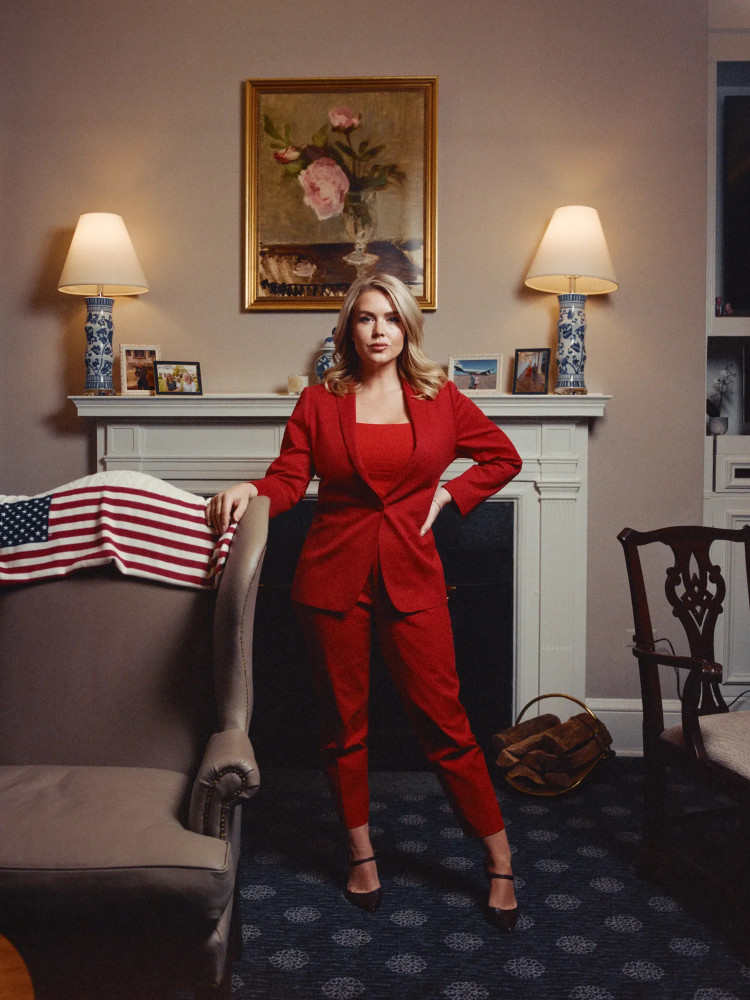
There are plenty of people online who know way more about photography than (Z) does (but maybe not more than V does) who have plenty of Photography 101 questions about this image. For example, why is her suit so crumpled—why wasn't it smoothed out? Why is the empty chair pointing forward; is she waiting for the return of the lord of the manor? What's with the American flag towel? And what are those lamps doing there? They clearly don't fit on the mantle, which is why their lampshades are askew from pressing up against the wall. The other "environment" photos, particularly the one of Vance standing next to a light switch, the one that highlights Miller's gut, and the one that shows off Rubio's ass, are just as bad.
The articles also contain extreme close-ups of each of the photo subjects. Here are, in order, Wiles, Rubio, Leavitt, Vance and Miller:
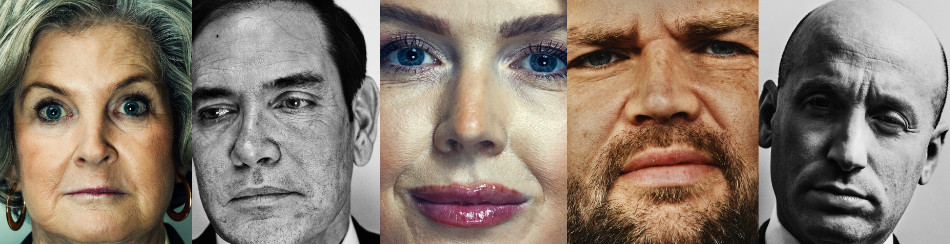
It's hard to say which one is the worst. And before you say, "Well, Karoline Leavitt's shot isn't so bad," know that people who know about these things, and have looked at the full-size version, say you can see where a plastic surgeon injected filler into her lips. In any event, the photos are so very unflattering that there is much speculation that Vanity Fair, or at least the magazine's photo staff, deliberately tried to make these people look bad. That seems very, very plausible to us.
And now, the actual interview, which was a real ripsnorter. If you want to read it, the two parts are here and here. You have to have a subscription, though the magazine is using this opportunity to sell a year's worth of access for $12 (plus you get a free tote!).
Here are the 10 most notable things Wiles said, in our view (and note that it was NOT easy to keep it to 10):
- Trump the Alcoholic: This might be the item that's getting the most play of anything in
the interview. Wiles notes that while Trump really is a teetotaler, he's got an "alcoholic's personality," by which she
means he is confident to the point of recklessness. In other words, the ship of state is being steered by a drunk
driver. Good to know, we suppose.
- Venezuela: Wiles asserted that everything that the administration has done on the
Venezuela front is legal, and that when it comes to getting Congress' permission, Trump & Co. "Don't need it yet."
She says that will change if the U.S. makes an attack on land. This interpretation of events runs contrary to the
messaging that is coming from the White House, which says that it can do whatever it wants without checking with
Congress. This interpretation is also going to come as news to anyone who has served in the Navy, the Marines or the
Coast Guard—that it doesn't count as war until it's on land.
Wiles also said the purpose behind the strikes is to take down Nicolás Maduro, not to stop drug trafficking. This also runs contrary to the White House's messaging. - Office Politics: Wiles said some rather unflattering things about various members of the
inner circle. She asserted that J.D. Vance only became a Trumper for political reasons, but that he's been a conspiracy
theorist for at least a decade. She described Russell Vought as a "a right-wing absolute zealot." She said that Elon
Musk is an "odd, odd duck." Wiles later tried to clean this up by presenting herself as something of a mother hen
presiding over a bunch of "junkyard dogs" (in her words).
- Epstein Mobilier: Wiles also tossed "Attorney General" Pam Bondi under the bus a bit,
decreeing that Bondi completely misjudged the Epstein situation, and that it may cost the administration significantly.
She also said it was a mistake by Trump to link Bill Clinton to the whole thing, and the President should not have done
so. She also conceded that Trump DID pal around with Epstein, but said that it's not a big deal, because they were both
"young, single playboys."
- Immigration: Wiles also acknowledged significant errors on the immigration enforcement
front, including that the government should not have gotten involved with Kilmar Abrego Garcia, and that it certainly
should not have deported a 4-year-old cancer patient.
- Tariffs: Wiles said the process of implementing tariffs was haphazard, and that since
they've been in place, "it's been more painful than I expected." Yep, who could have foreseen this, besides, you know...
everyone.
- Misogyny: Perhaps some Americans find this administration to be a bit misogynistic? If so,
that is the fault of... women. Wiles asserts that Trump always punches back when attacked, and said that these days, it
tends to be women doing the punching. Ipso facto, they started it.
- Enemies of the State: Wiles tells Vanity Fair that "I don't think he wakes up
thinking about retribution. But when there's an opportunity, he will go for it." This strikes us as a distinction
without much of a difference. It also strikes us as an out-and-out falsehood; look at Trump's late-night social media
messages, and it's clear he's thinking about revenge morning, noon, and night. Wiles did concede that the prosecutions
of Letitia James and James Comey "might be vindictive." We suspect that observation might just come up at trial, if
these things ever get before a jury (which, admittedly, is unlikely).
- Third Term: In Wiles' view, Trump cannot run for a third term, and does not intend to do
so. She says that he hints at that possibility because it's "driving people crazy," which is fun for him.
- Job Description: Historically, the chief of staff is something of a double firewall. They insulate the president from most of the crap that people might bring to him, and they also serve as a check on the president themselves, as one of the people (and maybe the only person) who can say "Mr. President, you might want to rethink that." In the interview, Wiles makes clear she has no interest in the second part of that, and that she thinks her only job is to enable Trump in whatever he wants to do.
Clearly, Wiles said WAY more than she was supposed to say. You can tell, because she and the White House went into damage-control mode as soon as the magazine hit the newsstands (assuming they even have newsstands anymore). Wiles, for her part, got on Twitter to decree:
The article published early this morning is a disingenuously framed hit piece on me and the finest President, White House staff, and Cabinet in history.
Significant context was disregarded and much of what I, and others, said about the team and the President was left out of the story. I assume, after reading it, that this was done to paint an overwhelmingly chaotic and negative narrative about the President and our team.
The truth is the Trump White House has already accomplished more in eleven months than any other President has accomplished in eight years and that is due to the unmatched leadership and vision of President Trump, for whom I have been honored to work for the better part of a decade.
None of this will stop our relentless pursuit of Making America Great Again!
Leavitt basically parroted this during her daily press conference, and Trump did the same later in the day, even agreeing about the "alcoholic personality" part. All of this is nonsense, of course. First, if you sit for 11 hours of interviews, the magazine is not going to print every word, or even most words. By definition, this is an exercise in taking things out of context. The only question is whether that was done in a dishonest manner.
Now certainly it is possible that the magazine misrepresented what Wiles said. After all, the photos the staff chose definitely make a statement. However, while Wiles, et al., made many claims about the magazine's reporting, nobody denied that she said the words she was quoted as saying. Nobody offered up any explanation as to how more "context" would have led to a different, or better, understanding. In the absence of that, then it's all just hot air from an administration that's angry it got embarrassed.
And that leads us back to the basic questions we started with: What the heck happened here? What did the administration hope to accomplish with this? And how did they end up with something that went so badly off the rails, from their perspective? The only thing we can say with some confidence is that this was a notoriously undisciplined operation during Trump's first term. Then, for the first 10 months of Trump v2.0, it was shockingly disciplined, almost at Obama levels. Now, based on this and other recent incidents, it looks like the disicpline is breaking down again.
Beyond that, we're at something of a loss. There is a school of thought out there that the dam is about to break, and Wiles is the first rat to jump off the ship. That is the point of view taken by Anthony Scaramucci and by Rep. Marjorie Taylor Greene (R-GA), among others. The problem here is that while Wiles said a lot of impolitic things, she does not come off as someone who thinks their time is short, or someone who has soured on Trump. By all indications, she's still a hardcore loyalist, and she's still a trusted insider.
Another idea that's out there is that Wiles knows that history (and maybe the courts) will judge the Trump administration harshly, and she basically wants to get "It wasn't me!" out there, on the record. This also seems like a reach to us. Neither history nor the legal system will take much note of a single interview, done for a non-hard-news publication.
Our best guess, though we don't feel great about it, is that Wiles has spent most of her career in the shadows, and this was a chance to be the star for once. And when someone is getting the star treatment, especially for the first time, they tend to overdo it. They don't want the fun to end, so they say a lot of stuff, to keep the ball rolling, and to keep the recorder running. Anyhow, if correct, this would explain why she accepted the interview offer in the first place, and why she was willing to pose for whatever damn photos Vanity Fair asked for, and why she developed the worst case of verbal diarrhea this side of Donald Trump at a Trump rally.
The other thing we are sure about, beyond the crumbling discipline, is that the White House has once again played things foolishly. The administration should have acted as if there was nothing to see here, and that reading the interview was no more interesting than reading the white pages. But they freaked out, which sends the message that there's some fire behind that smoke. As a result, one or two of Wiles' quotes probably will see the light of day again sometime next year, either coming from a reporter after something like an invasion of Venezuela, or maybe in a Democratic campaign ad or two. (Z)
Trump Speaks
Yesterday, in the midst of the many sh**storms that always seem to subsume this White House, Donald Trump whipped out his way-smaller-than-Elon's... social media platform to make this announcement:
My Fellow Americans: I will be giving an ADDRESS TO THE NATION tomorrow night, LIVE FROM THE WHITE HOUSE, at 9 P.M. EST. I look forward to "seeing" you then. It has been a great year for our Country, and THE BEST IS YET TO COME!
PRESIDENT DONALD J. TRUMP
For some reason, he did not thank us for our attention to this matter.
Certainly, the framing makes it seem like he's planning to announce some sort of new initiative or plan. Something about jobs, perhaps, or health care, or inflation or something like that. If he does do that, then the next question will be: Is this new proposal anything of substance? And the answer will almost certainly be "no." He's got a habit of announcing vague initiatives that don't mean anything (recall the myriad "Infrastructure Weeks"), or that are entirely impractical and have no hope of getting through Congress.
Alternatively, this might be a messaging speech where he spends his time telling everyone that all is well and that the economy is doing great. There are certainly some voters out there who take whatever Trump says as gospel, but they are already on board with him. It is improbable that anyone else will be swayed, since they know full well that their paycheck isn't going as far these days.
Trump could also talk about his plans for Venezuela, which have just taken an aggressive step forward with his announcement that he's ordering a blockade of all "sanctioned" Venezuelan tankers, on the basis that the government of Venezuela is a "terrorist regime." When we wrote about the seizure of the first tanker, we wrote that it was "more legal" than the attacks on the fishing boats. Our intent was to make clear that the fishing boats remain more of an Achilles' heel than that tanker. Many readers were nonetheless unhappy, taking the view that we wrote (or at least implied) that the seizure of the tanker was legal. That was not our intent. In any event, we have little understanding of how an expanded campaign of tanker seizures comports with American or international law, other than the law of "might makes right." Perhaps Trump will be explaining his reasoning.
It is also possible this is a damage-control speech. We doubt he's planning to apologize for the Rob Reiner comments, but he could have a few things to say about the Susie Wiles interview (see above). He might also be trying to lay the groundwork for the Epstein files release, which is supposed to happen Friday. You know, get it out there that the files are "fake news" before the files themselves are out there.
It is equally possible that the speech is a distraction from the Epstein files (or any of the other myriad scandals unfolding right now), and that he's going to try to change the narrative going into the weekend.
Much will be revealed in the first 30 seconds, or so, of the speech. If he's sitting, he's probably reading from a teleprompter. And if that is the case, he will give a monotone, glassy-eyed performance of a message that was likely written for him by Stephen Miller or Marco Rubio or someone like that. If he's standing, and in particular if he's not looking at a teleprompter, then it's shoot-from-the-hip time, and literally anything is possible. As readers can see above, it's scheduled for 9:00 p.m. ET tonight; we presume the major news stations will carry it, and that Fox will have it, too. If you want to watch online, here is the CSPAN feed. (Z)
Vance Spoke
Yesterday, J.D. Vance was in Pennsylvania, where he gave a speech in which he acknowledged that the economy is rough, and that the administration is definitely working on it. He promised that better times are ahead.
We only mention this because it looks to be the opening scene of a very interesting ballet that is going to unfold over the next couple of years. Vance is one of the phoniest people in American politics, but he's not stupid. He knows that voters are very unhappy right now, and they are likely to throw the bums out in 2026, and very likely to do so in 2028, too.
Vance also knows that his only real hope of overcoming that, barring something unexpected like a terrorist attack and a rally-round-the-flag effect, is to somehow be a "change" candidate, and to create some distance between himself and an unpopular presidential administration. He watched what his predecessor did, in not creating enough distance, and how that worked out for her at the polls.
Finally, Vance knows that Joe Biden might have grumbled a little bit if Kamala Harris took a position adversarial to his, but that Biden was not likely to seek revenge against his VP. Further, Biden did not have the power to snap his fingers and command a majority of Democratic voters not to vote for Harris. Donald Trump most certainly DOES seek revenge against those he perceives to have insulted him, and he most certainly CAN snap his fingers and make a Republican candidate radioactive to a giant segment of the base.
We have yet to see all that much evidence that Vance, as a politician, is up for the unbelievably delicate and difficult task before him. He got elected senator on the power of Peter Thiel's money and influence, and kissing Trump's hindquarters. He got elected VP using the same playbook. For the next, and last, promotion, it's going to be a very different kettle of fish. Maybe the chameleon-like Vance can pull it off, though we certainly wouldn't bet on him. For more on this subject, just ask President Pence. (Z)
Some Good Numbers for the Democrats
It is still nearly a year until the next general election, so any numbers we mention right now must be taken with at least a dozen grains of salt. When we get to May of next year, then we'll be able to write... well, that it's still 6 months to the election, so any numbers we mention must be taken with at least half a dozen grains of salt. But once we hit mid-August or so? Then we're cooking with gas.
Anyhow, PBS/NPR/Marist has just released their latest, and it's full of holiday tidings for the blue team. The topline number is this: On the generic House ballot, 55% of respondents favor "the Democrat" and 41% favor "the Republican." That's a 14-point spread, the biggest Marist has recorded since 2017, right before a blue wave election. And the movement toward the Democrats is driven mostly by independents, who break more than 2-to-1 for the blue team (61% to 28%).
The pollster also asked which issue should be the government's top priority right now. Far and away, the top issue was lowering prices (57%). The careful reader will notice that is the issue that Democrats have been hammering on, to the exclusion of nearly all else, for the last 6 months. At the same time, Israel and Gaza, which was so salient last year, and which split the Democratic Party, has nearly dropped off the radar (6%). Trump's overall signature issue, immigration, is at 16%. And Trump's issue du jour, drug trafficking, barely has a pulse, at 4%. Trump and the Republicans could try to recalibrate, but that's not how he works, generally speaking. And it's not too easy for other Republican politicians to carve out different messaging from a sitting president. Further, even if Trump and the Republicans do change course, they may have already lost the narrative on affordability to the Democrats.
There's one other number from the poll worth noting, before we move on. Marist has Trump's approval rating at 39%, with 56% disapproving. That's 17 points underwater, obviously, but it's also mid-range for him, at least at the moment. What we mean is that, depending on the pollster, he's between about 36% and about 42% right now (with a couple of lower outliers and a couple of higher outliers). What this suggests is that the sample for the Marist poll was not especially Trumpy or anti-Trumpy, and so its topline numbers are likely not out of whack.
Meanwhile, Politico commissioned some focus groups in New Jersey and Virginia, to find out why Govs.-elect Mikie Sherrill (D-NJ) and Abigail Spanberger (D-VA) won with such ease. The particular focus of the focus groups was voters who previously voted for Donald Trump, but who backed one of the two Democrats in November of this year. And the findings were that the Trump-jumpers were influenced by three things: (1) the candidates talked about kitchen-table issues, (2) the candidates avoided negativity and finger-pointing at the Republicans and (3) the candidates avoided association with the more lefty elements of the party, and in particular association with stances on social issues and immigration that are unpopular with anyone on the center or the right of the political spectrum.
In short, a general 2026 playbook for the Democrats has emerged, and it's backed by proof-of-concept in New Jersey, Virginia, Georgia, and other places. Will Democrats be able to stay on script, though? Readers may not know this, but this is a party that is not known for its disciplined messaging. That said, there are a lot of voters out there who are desperate to rein Donald Trump in, as much as is possible, at all costs. And our preliminary gut feel is that the lefty voters who really, really care about social justice are breathing deeply, and (once again) resigning themselves to the notion that this is not going to be the election for that. Before you can plausibly move forward with social justice, you first have to put a stop to the social injustice that is all around these days.
There was one other bit of data yesterday that is good news for the Democrats, albeit in a Machiavellian way, such that no Democratic officeholder would dare say anything publicly. However, the net loss of blue-collar jobs this year is up to 65,000 positions. This is due to the construction sector being flat, and the mining, transportation and manufacturing sectors all shrinking. Those sectors are the four most significant utilizers of blue-collar labor.
Overall, unemployment is up to 4.6%, which is as high as it's been since the pandemic. Before that, the last time it hit 4.6% was in 2017. Maybe all of this is partly Trump's fault, and maybe it's not. After all, we've written at least 100 times that some old-school blue-collar industries (e.g., coal mining) are headed the way of the dodo, and it's only a matter of time. That said, Trump made lots of big promises to blue-collar workers. And if he's not delivering—and the numbers say he's not—that will dovetail nicely with Democratic messaging along the lines of "We're the ones who will fix the economy, and here's how."
As we note at the start of this item, it's a long time until next year's elections. But all of these numbers should definitely have the GOP nervous. Then, consider this question: What, exactly, is likely to happen next year that is going to improve upon these trendlines? The answer to that question—or, perhaps more accurately, the lack of an answer—should have Republicans sweating bullets. (Z)
Twelve Days of Christmas... Games, Part VII: We Are the World
We have decided that having both answers and new games on the same day is a bit too much. So, we're going to post the rest of the games, Monday through Thursday, until we're up to 12. Then we'll post the remaining 11 sets of answers and winners. That will put us into January, but that's OK.
For today's game, we've got pictures of Hanukkah celebrations around the world, divided into two sets of eight. For the first set, you have to identify the U.S. city that is shown. For the second set, you have to identify the (non-U.S.) country that is shown. There are details in each that tell the tale, though in some cases they are subtle. The very last photo is particularly tough (but doable). If you wish to use Google to research details, that's OK, but please don't use Google's image search engine.
And with that explainer out of the way, here we go with the U.S. cities:
1. What U.S. city is this?

2. What U.S. city is this?

3. What U.S. city is this?

4. What U.S. city is this?

5. What U.S. city is this?

6. What U.S. city is this?

7. What U.S. city is this?

8. What U.S. city is this?

And now the countries:
9. What country is this?

10. What country is this?

11. What country is this?

12. What country is this?

13. What country is this?

14. What country is this?

15. What country is this?

16. What country is this?

Submit your guesses here! (Z)
Previous | Next
Main page for smartphones