
Previous | Next | Senate races | Menu
New polls:
Dem pickups: (None)
GOP pickups: (None)
Election Results
As we discussed Monday, some bellwether elections were scheduled for yesterday. How did they go?
- TN-07 special election
When Mark Green suddenly departed Congress for greener (well, probably not greener, but
better-paying) pastures, he left behind a vacant House seat. A special election for it in TN-07 was
held yesterday. Although the district is R+10, both parties poured vast amounts of money into it.
The Democrat was Aftyn Behn and the Republican was Mark Van Epps.
Van Epps won 54% to 45%, roughly consistent with the R+10 partisan lean of the district. However, the Republicans had to spend millions of dollars to get that result. Speaker Mike Johnson made a personal appearance Monday and made a live phone call to Donald Trump during the rally. This is a district Trump won by 22 points in 2024, so clearly Trump's personality does not transfer to other Republicans, an ominous sign for 2026. Neither does Green's; he won the district by 21 points in 2024. Here is a graphic comparing the five special congressional elections this year with the 2024 elections.
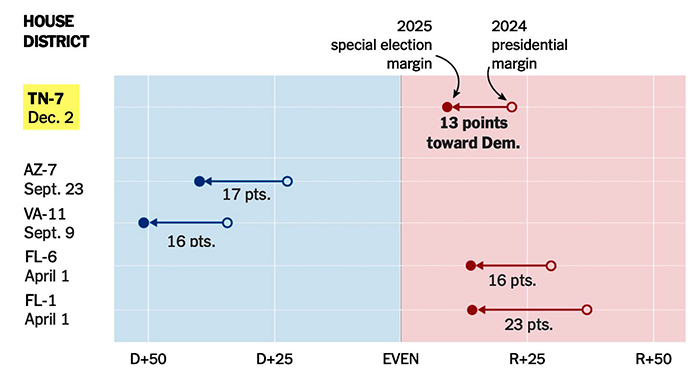
As you can see, the TN-07 election was roughly consistent with the four previous special elections in 2025, with Democrats outperforming 2024 by a dozen points or more. This was the worst improvement of the lot, but there is probably a reason for that: Democrats still haven't gotten the memo that there isn't one House election. There are 435 of them, each one unique in its own way. Behn is a fiery activist. She even called herself a radical, something the Republicans repeated over and over. To make it worse, Rep. Alexandria Ocasio-Cortez showed up and campaigned for her. We are not sure whether Behn or Van Epps invited her, but Middle Tennessee is not Seattle or San Francisco, so she probably helped Van Epps. Democrats need to understand that in a D+10 district, AOC is a great help, but not in an R+10 district. Bill Clinton might have helped more since it is hard to label him as a radical and he is kind of from the neighborhood.
- Georgia mayoral races
There were three runoffs for mayor in Georgia yesterday, in Roswell, Sandy Springs, and South
Fulton.
In Roswell, Democrat Mary Robinchaux ousted the Republican incumbent mayor Kurt Wilson
53% to 47%.
Roswell is a small town in Fulton County; a clear win over an incumbent is a sign.
In Sandy Springs, Georgia's seventh most populous city, it went the other way. Long-time mayor Rusty Paul (R) got his fourth term over challenger Dontaye Carter (D) 69% to 31%. Sandy Springs is 54% white and 18% Black. Paul is white, Carter is Black, and Georgia is in the South.
South Fulton is a new city, having incorporated itself in 2016. It is in metro Atlanta and is 90% Black. It elected its third mayor in 9 years, with Carmelitha Gumbs beating incumbent Khalid Kamau. Both are Black Democrats and the campaign issues were largely local.
- Atlanta city council
There were also runoffs for city council seats in Atlanta, with moderates endorsed by Mayor Andre
Dickens running against progressives endorsed by the Democratic Socialists of America.
Both of the moderates, Thomas Worthy and Wayne Martin, won their seats. Democrats who thought that
Zohran Mamdani's victory in New York City is a harbinger of Democratic Socialists winning everywhere
may have to dial that back a notch.
It
wasn't close.
Worthy won 59% to 42% and Martin won 58% to 42%.
- Jersey City mayor
There was an interesting runoff for mayor in Jersey City yesterday, with former governor Jim
McGreevey, who resigned in a sex scandal, trying to reinvent himself as a big city mayor.
Sound familiar?
Results are familiar, too, McGreevey was
slaughtered
by councilman James Solomon, by a 2 to 1 margin.
There was a young vs. old component here, as in NYC, since Solomon is 41 and McGreevey is 68.
The message here seems to be that clean young progressives can beat moderate old sleazeballs trying to get back in the game after resigning in
disgrace. America is not totally broken.
Jersey City is the second most populous city in New Jersey and is on track to pass Newark for the top position within a decade.
The city council results were not available when we went to press.
The executive summary is that candidates who are a good match for their electorate win and those who are not, lose. Young progressives have a base in some places, but those places are few and far between. Moderates who are slightly left of center tend to do well in a lot of places. The appeal of DSA candidates is limited. Disgusting old sleazeballs have no real base of their own and get only the votes of people who can't stand the other guy even more. (V)
Democrats May Luck Out on Health Care--Against Their Will
Politics is an odd profession. Sometimes you win when you lose. That's generally not true in sports, business, and other professions. The Democrats fought to have ACA health-care subsidies extended and even allowed the government to shut down over them. One of the conditions for ending the shutdown was that there would be a vote on them. That vote is scheduled for next week and there is currently no momentum for any bipartisan plan to actually solve the problem. If there is no agreement and the vote is along party lines, subsidies will lapse and premiums will spike for about 20 million Americans.
Much of the problem is due to a split within the Senate GOP conference. Some hard-line Republican senators hate the ACA, have always hated it, always will hate it, and want it to go away. They see killing the subsidies as a good first step. On the other hand, senators from swing states understand the consequences for them of killing the subsidies and don't want to go down with the ship.
On top of this, there is a brewing battle over abortion. Current law bans the use of federal funds for performing abortions. Subsidies are federal funds. Some Republicans want to spell out that any health care insurance that benefited from a federal subsidy may not cover abortions. Democrats will not accept this.
Of course, these things often go down to the wire, sometimes beyond it. There have been times when the (analog) clocks in Congress were unplugged at 11:59, so members could claim the deal they made in the wee hours of the next morning was made before the clock struck midnight. But so far, the parties are far apart. Each party is concocting a plan in secrecy, but 60 votes are needed to advance a plan, so unless seven Democrats jump ship and support the Republican plan or 13 Republicans go for the Democrats' plan, no bill will advance.
The ironic thing here is that failure would be a win for the Democrats, although no Democrat would dare say that out loud. It is all about stove touching. With Republicans in control of Congress and the White House, if no deal is made and insurance premiums spike, Republicans are going to get the lion's share of the blame and the Democrats will have a potent issue for the midterms. Of course, millions of people will get hurt if there is no deal, and Democrats actually do care about their constituents, so in the end, they might cave. Republicans have repeatedly shown that they don't care if their constituents are hurt by their policies—for example, farmers being hurt by tariffs.
Donald Trump could come running to the rescue at the last minute, but so far he hasn't put his cards on the table. Most likely he doesn't understand health care beyond "Obamacare bad." In the past, he has touted Health Savings Accounts, but that basically amounts to people putting their own money in a special kind of bank account to pay for future health care expenses. That approach would not be popular with voters or politicians.
Of course, at the very last minute, there is always that beloved "kick the can down the road" trick. That would extend the subsidies for a few months while Congress bickers over what to do. It wouldn't be the first time. (V)
Republicans Are Playing Catch-up on Affordability
Last year, "inflation" was the keyword in the elections. It seems that word has run its course. Now the magic word is "affordability." Democrats got the message as soon as Zohran Mamdani won the NYC Democratic primary. Republicans didn't think affordability was a big deal. But all of a sudden they have gotten the memo. Here is a graph showing the relative number of times "affordability" appeared in congressional e-mails since Jan. 2024.
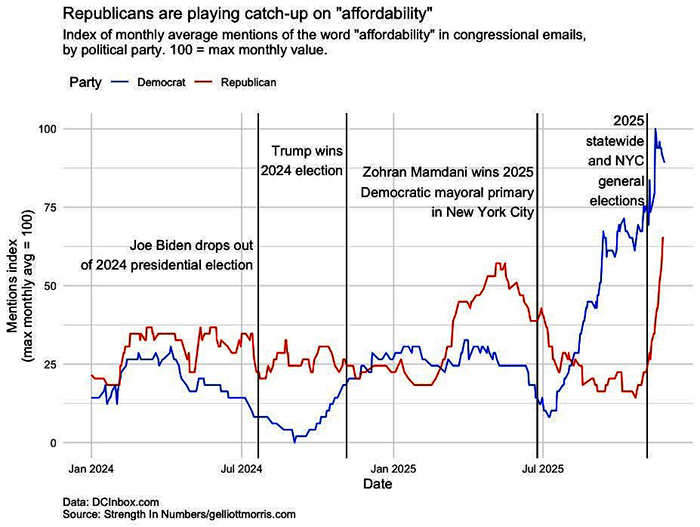
The jump among Democrats after the NYC primary is 7x, which is astounding. It is almost as though they were paying attention. Among Republicans, usage continued trending downward until the general election, and then, whoosh—there is hardly an e-mail without that word now. Clearly, discussions of affordability are going to be a big thing in the primaries and general elections next year.
The job of catching up won't be made easier for Republicans by their president. He has said "affordability" is a con job and doesn't mean anything to anyone. Watch:
But voters think it means something (e.g., "I can't afford things because prices are too high"). If Republicans say "affordability" is an issue, they risk angering Trump. If they don't talk about it, the voters will hear about it only from Democrats.
Also, what any candidate says matters. Voters want to hear more from candidates than: "I support affordability." They are going to want to hear what the candidates are planning to do about the problem. One piece of low-hanging fruit for Democrats is to blame high prices on Trump's tariffs and promise to vote to repeal the tariffs and restore the power to levy tariffs to Congress alone. Another thing Democrats can do is to talk about raising the minimum wage. While that doesn't lower prices, if you are making more money, things become more affordable. Republicans will have to be creative in coming up with answers. One possibility is to talk about how Donald Trump wants to lower interest rates. But Democrats can counter that by saying lowering interest rates will release the dreaded inflation demon from its cave. (V)
The Government Is Subsidizing Billionaire Ranchers to Help Ruin the Environment
A new report from ProPublica sheds light on the use of public land for private profit. It is long-standing public policy to allow cattle to graze on public land. The original idea was to help small ranchers eke out an existence under difficult conditions. That's not how it works in practice, though, and Donald Trump and his team want to make it worse.
For example, ProPublica found that rancher Stan Kroenke has a permit to graze his cattle on public land. For this, he pays about 15% of the grazing fees he would have to pay a private landowner in the area. He can also get cheap crop insurance, disaster insurance, funding for fences, and compensation for livestock lost to predators, and other benefits that actual private ranchers don't get. He doesn't really need this help since he is worth $20 billion and owns parts of multiple sports teams. This is not an isolated case. About 10% of the ranchers with federal grazing permits control over half of all federal grazing land. The 10% own two-thirds of the livestock eating for free on public lands. Before Kroenke bought the ranch, it was owned by a series of hobby ranchers who used it for multimillion-dollar tax deductions.
In June, J.D. Vance flew to Butte, MT, and then was taken by an SUV motorcade to a sprawling cattle operation outside of Yellowstone National Park. There he met the owner of the Beaverhead Ranch, a man you may have heard of: Rupert Murdoch. Murdoch bought the ranch from billionaire Koch brother Charles Koch for $200 million. There, Murdoch grazes cattle on 340,000 acres of land, two-thirds of which is public. Murdoch paid the government $25,000 last year to graze his cattle on the public land. That is 95% below market rates. There are more examples.
So a handful of wealthy ranchers are raising a lot of beef on Uncle Sam's dime. At least that increases the nation's meat supply, right? Yes. Although there is plenty of private land they could use for grazing, they would have to pay market rates. However, because grazing fees are so low, they have too many head of cattle on the land, which is leading to erosion and degradation of the land. Overgrazing is part of what caused the great dust bowls of the 1930s, when large pieces of land in the Great Plains became useless and ranchers there were forced to move.
In addition, there are mining companies that hold grazing permits for land around their open-pit mines. This allows them to participate in programs that give them credits they can sell to offset their environmental impacts. It is very complicated, but the mining companies understand the rules and how to profit from them. Copper-mining companies like Freeport-McMoRan, Hudbay Minerals and Rio Tinto all run big cattle operations in Arizona, and not because they want to sell beef to McDonald's.
Is Secretary of the Interior Doug Burgum aware of how public land is being used? Absolutely. He is a huge fan of it and wants to open up much more federal land for private exploitation. He said: "That's the balance sheet of America. If we were a company, they would look at us and say, 'Wow, you are really restricting your balance sheet.'" So he sees public land not as something to be preserved for future generations of Americans; he sees it as a balance sheet that is not being exploited enough.
The above is only a small summary of what ProPublica found during its investigation. In reality, it is much worse. (V)
Florida Will Redistrict as Soon as the Supreme Court Gives It the Green Light
While Indiana is hesitating about regerrymandering its congressional map, Gov. Ron DeSantis (R-FL) is champing at the bit. However, he is waiting for a signal from the Supreme Court that breaking up districts centered around cities with large Black populations is legal. Currently, the Florida House delegation is 8D, 20R. However, five of the eight Democratic-held districts lie in the range of PVI D+2 to D+5. With creative mapmaking, all of these could fall. Maybe even FL-10, which is the district of Rep. Maxwell Frost (D-FL), and is D+13. It covers almost all of Orlando. It could be divvied up among all the adjacent red districts. Then there would be only two remaining majority Democratic districts, FL-20, which is D+22 and represented by Sheila Cherfilus-McCormick (D-FL), and FL-24, which is D+18 and represented by Frederica Wilson (D-FL). FL-20 is in southeast Florida (Ft. Lauderdale area); FL-24 is North Miami, Little Haiti, and Miami Beach. Here is the current map:
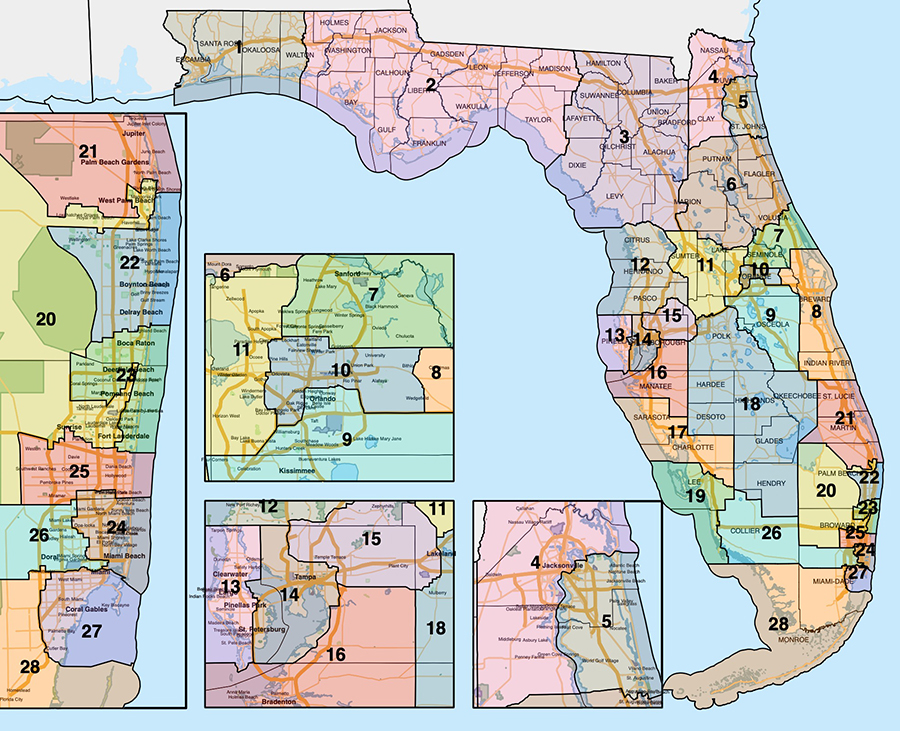
The current map is already heavily gerrymandered, but done in a subtle way, without any obvious salamanders or cartoon characters. It does respect many county boundaries, but not all. It has plenty of new opportunities for serious seat stealing.
The chairman of the Florida Republican Party, Evan Power, said that he expects the new map to deliver three to five new Republican seats. Virginia is expected to draw a new map in January, which could flip two, maybe three seats from red to blue. Illinois could produce a map that nets the Democrats two seats. The idea of voters picking their politicians rather than the other way around is as dead as the dodo.
Could all this rigging be an issue in 2026? Maybe, but unlikely. Voters care about the price of eggs and electricity, not procedural issues. Besides, both sides are now doing it. But you never know. In general, voters don't like gerrymandering and it is exceedingly extreme now. If the Democrats get the trifecta at some point, fixing this could be popular.
What DeSantis is waiting for is a decision of the Supreme Court on whether the Voting Rights Act is itself an unconstitutional racial gerrymander. In preparation for a favorable decision (for Republicans), he has called the legislature back into session in January to enact a new map. To make this work, though, he would need a decision from the Court this year. The Court has not given a timeline about when to expect a decision. However, the justices read the newspapers and know that the Republicans want a speedy decision. (V)
The Pardon Is the Purest Form of Raw Power
Most forms of power granted by the Constitution have some check on them. Congress can pass bills, but the president can veto them. The president can nominate judges, but the Senate can refuse to confirm them. The Supreme Court routinely strikes down laws (although it has no explicit constitutional authority to do so), but Congress can limit the Court's appellate jurisdiction, and so on.
But one power has no counterbalance: the pardon power. There is a fragment of one sentence in the Constitution about it. Art. I, Sec. 2 contains this sentence fragment listing the powers of the president: "he shall have Power to grant Reprieves and Pardons for Offences against the United States, except in Cases of Impeachment." That's it. This power was clearly an afterthought, added to allow the president to rectify a situation when justice went awry. But Donald Trump has turned it into a major tool to encourage everyone around him to put loyalty to him above loyalty to the law.
The most recent example of Trump's use of the pardon power as a tool to enforce loyalty was his pardon of the former president of Honduras, Juan Orlando Hernández, who was convicted last year of conspiring with cartels to pave a cocaine superhighway into the U.S. He was sentenced to 45 years. He claimed to have been persecuted by the Biden-Harris administration, and that was enough to spring him. When issuing the pardon, Trump forgot to mention that the lead prosecutor at the SDNY was Emil Bove. Trump liked Bove's work so much that he appointed him to a federal judgeship.
Hernández is by no means the only high-profile criminal Trump has pardoned. It has become a veritable assembly line of Trump-friendly criminals. Here are some more:
- Rudy Giuliani: This pardon is somewhat symbolic because Trump's former lawyer Giuliani
was never charged with a federal crime in conjunction with Trump trying to steal the 2020 election. Still, it (probably)
means he can never be charged with a crime in that context, although the Supreme Court has never dealt with a pardon
issued before an indictment. Still, it sends a message to everyone that if you work to help Trump commit a crime he will
pardon you if he can. Giuliani may yet go on trial in Arizona, though, and that is beyond the reach of a presidential
pardon.
- Mark Meadows: Everything that applies to Giuliani also applies to Trump's one-time chief
of staff Meadows.
- "George Santos": The disgraced congressman was convicted of defrauding donors and also
lying to the House. He was given a 7-year sentence, but Trump sprang him from prison after 3 months.
- Ross Ulbricht: He was sometimes called "Dread Pirate Roberts," but whatever name he used,
he founded the black-market website Silk Road that was used to facilitate all manner of drug transactions, money
laundering, and other criminal activities. He was convicted and sentenced to life plus 40 years and a fine of over $180
million. He was Trump's kind of guy, so he got a pardon.
- Paul Walczak: The former nursing home executive went to prison for tax-related crimes.
Then Trump held a $1-million-per-person fundraising dinner with rubber chicken at Mar-a-Lago. Walczak couldn't
attend—as he was a guest of Uncle Sam at a different big house. Instead, his mom showed up at Mar-a-Lago and
magically, less than a month later, Paul was a free man.
- Changpeng Zhao: The billionaire founder of the crypto giant Binance pleaded guilty to money laundering. Fortunately, his crypto empire has ties to Trump's crypto empire. That magic did it, and Zhao was pardoned, despite having admitted his guilt in court.
These are only a handful. There were many more, not to mention the 1,500 people convicted of crimes related to the coup attempt after the 2020 election. (V)
Brooke Rollins Threatens to Withhold SNAP Benefits from Uncooperative Blue States
At the cabinet meeting yesterday, Secretary of Agriculture Brooke Rollins said she would withhold SNAP benefits from people in those states that are refusing to give her the names and immigration status of people who receive SNAP benefits. Nothing in the law gives her or anyone else the authority to unilaterally cut off money to states because they refuse to comply with a directive that may or may not even be legal. But the law has never been a barrier in this administration. On the other hand, using people as pawns is a favorite trick.
So far, 29 "red" states have complied but 21 "blue" states have not. California, Minnesota, and New York are among the states that have refused. As usual, this is just grandstanding. A flyer from the USDA discusses fraud. It says there are 261,770 authorized retailers who accept EBT cards. The Dept. conducted 16,587 investigations. It fined 561 of them. That is 0.2% and does not scream massive retailer fraud. This doesn't speak to how much individual fraud there is, but there is no evidence that it is much bigger than retailer fraud. In any event, states are already required to make sure that everyone applying for an EBT card is legally entitled to it. There is no need (or legal authority) for Rollins to redo their efforts.
This does speak to a favorite technique used by the administration though: blackmail. Some group is threatened with the loss of funds to which they are legally entitled if they don't agree to some conditions that no law requires them to agree to. It's pretty shady, though it will work less and less well the closer we get to January 20, 2029. (V)
Companies Are Suing for Refunds If Supreme Court Strikes Down Tariffs
Companies are feeling which way the wind is blowing and a number of them expect the Supreme Court to rule that Donald Trump had no authority to levy the tariffs they have already paid. A number of them are preparing to sue to get the money they paid in tariffs back if the Court tosses the tariffs. One big one, Costco, just filed for a full refund for monies unlawfully collected from it. If the tariffs are ruled illegal, it has a strong case. It is being represented in court by Crowell & Moring, which apparently hasn't been cowed by Trump.
Trump claimed that the International Emergency Economic Powers Act (IEEPA) gave him the power to levy tariffs on his own despite the facts that: (1) there is no emergency and (2) tariffs are not listed among the powers the president gets if the act is invoked. The Court heard oral arguments last month, but a ruling could come as late as June 2026.
Trump has announced (multiple) big plans for all the money being raised including a $2,000 check for everyone. If he has to give all the money back, there go his big plans. Of course, the Court could make some crazy ruling like "The tariffs were illegal but it is too complicated to give the money back, so tough luck." (V)
Mandela Barnes Is Running for Governor of Wisconsin
Although Gov. Tony Evers (D-WI) is not term-limited, Evers has decided not to run for a third term (unlike his neighbor, Gov. Tim Walz, DFL-MN, who is running for a third term). This decision opened a feeding frenzy in Wisconsin; about a dozen people are in so far and the night is young. The most recent entrant is former Lt. Gov. Mandela Barnes of Wisconsin, who wants a promotion to governor. He took a bit of a side trip in 2022 when he ran for the Senate and lost. That exercise has some ramifications for his gubernatorial run next year.
None of the candidates so far are especially well known or strong, so Barnes' entry will make a splash, even though the current lieutenant governor, Sara Rodriguez (D-WI), is already in. Barnes is Black and progressive, so that will excite part of the Democratic base. His problem is that in 2022 he ran against Sen. Ron Johnson (R-WI), who at first loudly proclaimed he would stay for only two terms, then ran for a third one and won. So Barnes wasn't able to beat an open and obvious liar. Many Democrats are now wondering how strong a general election candidate he really is in such an evenly divided state. The Milwaukee Courier, a Black-owned newspaper, ran an editorial in October entitled: "We Can't Afford to Lose in 2026—And We Can't Risk Another Mandela Barnes Loss." Not a great endorsement from one of the loudest Black voices in the state.
Barnes also has some advantages over his numerous rivals for the nomination. He is better known than most and has something of a national fundraising network. However, Senate races always pull in much more money than gubernatorial races because the former have national significance. So it is not yet clear if people who donated to him in 2022 because they hated Johnson will write him checks this time.
The state Democratic Party is already hard at work raising money. State law allows unlimited donations to the state parties, which can spend the money as they wish. This would help Barnes in the general election, but not in the primary. There he is on his own. (V)
Previous | Next
Main page for smartphones