
Previous | Next | Senate races | Menu
New polls:
Dem pickups: (None)
GOP pickups: (None)
Trump Caves
Yesterday morning commenced the first day of the full-blown trade war, with all the planned tariffs. Then, yesterday afternoon, Trump suddenly raised the tariffs on China to 125% and paused most of the others. This stuff changes minute by minute. It's hard to keep track.
The big question is: Why did he pause most of the tariffs? Our best guess is that it was due to the combination of the stock market rout and pressure from Republicans in Congress and donors, which made him weak in the knees. The even bigger question is: Is this just a(nother) pause or are all the tariffs now canceled except for China?
If Trump ends up canceling the tariffs without getting anything in return, it is hard to see how he can claim victory. Democrats will pound him for doing nothing to bring back manufacturing jobs or stop Heard Island (no people, just penguins) and Liechtenstein (small number of people, but no penguins) from victimizing the U.S. Then we are basically back to the status quo ante, with nothing gained except more expensive iPhones and other stuff made in China, as well as some amount of damage to the relationship between the U.S. and its trading partners.
Let us examine how the various players are reacting (although, again, this can change by the minute):
- Other countries:
Before Trump paused all the tariffs, the European Union and China
levied
tariffs on $150 billion worth of American exports. The Chinese tariff is 84%, which will devastate U.S. farmers if it
stands. The U.S. exports about $145 billion worth of products, largely agricultural, to China every year. The E.U.
tariffs also hit agriculture. That is no accident, as both the Chinese and the Europeans know that inflicting pain on
farmers also inflicts pain on a couple dozen Republican senators. Since Trump has lifted or reduced some of the other
tariffs, the E.U. may also pull back soon. China is very unlikely to back down unless he does. And maybe not even then.
While the Europeans are certainly worried about the EU-targeted tariffs, they are also watching the U.S.-China situation with trepidation. The Chinese economy is set up to produce vast amounts of stuff for export. If they can't sell those goods in the U.S. due to the tariffs, there is a good chance they will try to dump them in Europe at bargain prices, thus destroying many European companies. The E.U. won't tolerate that. But it hasn't formulated a plan to deal with it yet.
- Republicans: The tariffs were extremely unpopular with Republican donors, members of
Congress, and even Republican podcasters. This may be the reason Trump caved. At the inauguration on Jan. 20, many
billionaires were front and center. With the stock market crash, many of them
lost
billions or tens of billions of dollars. You might think that someone who was worth $100 billion and is now worth $80
billion would say: "I am happy to have $80 billion. That is good money." But that is not how it works. They were furious
and surely told Trump what they thought about his tariffs.
Then there are the Republican donors. This is not what they paid for. They paid for a big tax cut for rich people and less regulation of their businesses. They didn't sign up for market chaos. They also surely let Trump know what they thought of his plans and probably told him not to expect any donations to Republican candidates until he got rid of the tariffs.
Republican senators facing reelection were also none too happy. They saw a recession coming up and they knew the voters, especially farmers hit hard and people with 401(k) plans that are collapsing, would blame them. Sen. Thom Tillis (R-NC), probably the most vulnerable Republican senator in 2026, had a little discussion with U.S. Trade Representative Jamieson Greer about the economy. Tillis said: "Whose throat do I get to choke if this proves to be wrong?" He is especially angry because North Carolina has attracted many foreign firms to do manufacturing in the state, but they are dependent on steel and other materials from China. If the tariffs on China stick, those firms are up a tree. Sen. James Lankford (R-OK) said that a company in his state had spent millions of dollars moving its parts production from China to Vietnam, and... Bam! Vietnam was also hit with a high tariff. What should the company do now? Will the tariffs come back in 90 days? Companies can't invest in this climate. Sen. John Kennedy (R-LA) said: "It's not fun. I don't like it. I like it when the market goes up."
Other senators complained that the tariffs would hit retirees on fixed incomes hard and many of these voted for Trump and are angry with him as they see their 401(k)s plummet. This is not what they voted for.
Even podcasters and commentators Joe Rogan, Dave Portnoy, and Ben Shapiro are angry with Trump. Rogan said that tariffs on Canada were "stupid." He also referred to deportations as "horrific." Portnoy said that he lost $20 million in stocks and crypto in the past few days. He was not happy. Surely many of his listeners have also lost $20 million in 3 days and can feel his pain. Shapiro said: "The idea that this [the tariffs] is inherently good and makes the American economy strong is wrongheaded. It's untrue. The idea that it is going to result in massive re-shoring of manufacturing is also untrue." Together these three and their ilk have large audiences who may have conveyed their thoughts to their elected officials.
- Democrats: Being the "out" party has the big disadvantage that you have no influence on
policy. But it also has a huge advantage. The in-party is constantly at war with itself over what policies to carry out.
The out-party has it easy. All it has to do is
oppose the in-party.
It is very easy to get agreement on that, even if different people attack different things the other guys are doing.
That doesn't matter.
Democrats from Rust Belt states like tariffs (but not stock market meltdowns), whereas Democrats from blue states like free trade. But even those from the Rust Belt are complaining that Trump is doing it entirely the wrong way. All of them are focusing on Trump's extremism. Even Sen. John Fetterman (D-PA), who has been cozying up to Trump, has something to say: "I'll never understand or support the constant punching our allies in the mouth."
If Democrats are smart, they will attack the pause, saying: "What about bringing manufacturing jobs home? Have you forgotten about that? We haven't."
- Trump: On Tuesday, Trump
promised
new tariffs on pharmaceuticals. Is that gone now? Temporarily? Permanently? Who knows?
For companies in that business, what are they supposed to do? Sit around and wait for 90 days before
making any decisions on anything?
One quote that had been circulating in the media is one from an anonymous White House official: "He [Trump] is at the peak of just not giving a f**k anymore." That really freaked out the markets. Is that obsolete now? Or not?
- Companies: Many companies are (still) caught in a vise, especially if they manufacture
products in China or
import a lot of stuff from there, because China is still subject to crushing tariffs. As one example,
consider
Apple's situation. It makes iPhones, iPads, and some Macs in China, which is now subject to a 125% tariff. How many
iPhones will Apple sell at $2,250? Probably a lot fewer than at $1,000. For people whose 401(k) is tied up in an S&P
500 ETF, 8% of their future is tied up in Apple stock, even though they may not realize that.
Apple simply cannot move its production from China. It has made massive investments in machinery, processes and people over a quarter of a century. That would take another quarter of a century to roll back. Besides, America doesn't have the manufacturing expertise to make many of the parts needed and even if it did, the price would soar. One firm, Wedbush Securities, estimated that if an iPhone could be made in the U.S. (which Apple doubts is possible), it would cost $3,500.
Apple isn't the only company with a China problem. Walmart doesn't make much in China, but it buys products from thousands of Chinese companies. If all those prices more than double due to tariffs, Walmart shoppers will not be happy campers. What can Trump do? He could make some deal on paper in which China agreed to buy 10% more soybeans in return for Trump dropping the tariffs. Trump is not likely to get a much better deal because President Xi Jinping doesn't have to worry about elections next year or senators or podcasters giving him a hard time. He can just wait it out until Trump folds. And fold he will, probably with some "fake" deal to allow him to save face with low-information voters.
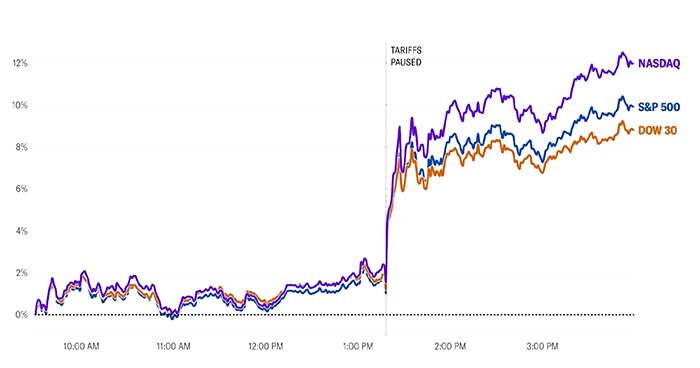
- Financial markets: The markets are spooked by all the tariff stuff. They dropped about
15% over 3 days, then the Dow went up nearly 3,000 points yesterday on the news that the tariffs have been paused. Here
is what happened after the pause was announced:
But now the bond market is going crazy. The 10-year treasury bond, which is a benchmark for a lot of debt, is in turmoil. It was under a 4% yield last week and jumped to 4.74% yesterday. This happens when the price of the bond, which is determined by the number of buy and sell orders, goes down, since the value at maturity is fixed. Treasuries' yields go up when people are dumping them (because you can buy them cheaper but the value at maturity is the same). That is a sign of nervousness. German bonds also dropped, as did gold. Investors have no idea what is next.
- Ordinary Americans: A new
Reuters/Ipsos poll
taken last weekend shows that 73% of Americans believe prices for "the items you buy every day" will go up in the next 6
months. There is a word for that, something like inflammable, influencer, influenza, inflatable, or something like
that. It slipped our minds for the moment.
In particular, 77% expect electronics to go up, 73% expect cars to go up, 72% expect appliances to go up, and 70% expect fresh produce to go up. When people expect prices to go up, they tend not to empty their bank accounts on big purchases because they know they may need the money soon. This causes consumer spending to drop. When people buy less, companies lay off workers. This often leads to a recession.
All in all, it is a mess and we will have to see how it plays out. If the tariffs don't come back, then the worst may have been avoided, but Democrats can then pounce on "So you aren't going to bring back manufacturing jobs like you promised? We can do that." When reporters ask "How?" they can say they will use tariffs, but very carefully targeted, along with subsidies to crucial industries. The latter was Joe Biden's approach, especially with the CHIPS Act. (V)
The Votes Aren't There
Last weekend, in the middle of the night, the Senate passed a budget resolution telling the various committees how much they had to cut from their budgets. It was up to the committees to decide how to do it. Getting that resolution through the House is not a done deal for a simple reason: The votes aren't there. Basically, the Freedom Caucus wants much deeper cuts and has said it won't vote for the Senate resolution. This puts Speaker Mike Johnson (R-LA) in a bind. Donald Trump wants a big win—even more since he had to put his tail between his legs and slink off home to lick his wounds on the tariffs. He really needs this now and may lobby for it hard.
Yesterday, Johnson planned to bring the bill to the floor of the House. He hoped that the pressure that maneuver created, coupled with some whipping from Trump, would get 'er done. But despite more whipping than an Indiana Jones movie, the Speaker just couldn't get to the promised land, and so he canceled the vote. Johnson implied that it was only a few members who torpedoed the thing. Others in Congress say it was more like 30 members. We tend to believe the latter, especially since Johnson is now talking about the House just coming up with its own bill. If he was actually as close as he suggested, he wouldn't be using "back to the drawing board" verbiage.
But if the House tries to craft its own bill, it won't be easy. Republicans from high-tax blue states want the SALT cap greatly raised, but that will increase the deficit, which is anathema to the Freedom Caucus. And even if Johnson pulls off a miracle and gets a bill through the House, the Senate will never accept it. There will have to be a conference committee, which will have a huge problem on its hands because nobody is in the mood to compromise. (V & Z)
Poll: Trump Voters Do NOT Want to Gut Medicaid
Co-President Elon Musk wants to gut Medicaid. He finds it wasteful. After all, he has never used it in his entire life and neither have any of his so-called friends. Given his desire to slash federal spending, he has to go after at least one among Medicaid, Medicare, Social Security, or defense, because that's where the money is. He probably thinks Medicaid is the least popular of the bunch so he can get away with it.
The voters think otherwise. Republican pollster Bob Ward ran a poll on this. Two-thirds of swing voters opposed slashing Medicaid. Ward said: "There's really not a political appetite out there to go after Medicaid to pay for tax cuts. Medicaid has touched so many families that people have made up their minds about what they don't want to see cut." Musk and many Republicans think that Medicaid goes to poor Black Democrats in cities. Actually, most of the money goes to poor white Republicans in rural areas. The voters who get Medicaid know that very well.
Ward tested the Democrats' likely attack: Do you want to cut Medicaid to pay for tax cuts that benefit billionaires? The answer was a resounding "No." People are happy about rooting out fraud, waste, and abuse, but not if that cuts Medicaid. This is going to be a problem when passing a budget. (V)
Trump Attacks Two More Universities
Donald Trump sees most relationships in terms of money. And when he is the one controlling the money, he sees it as a weapon. One to be used aggressively. He hates elite universities, even though he graduated from one of them (Penn). He sees them as a spawning ground for woke elites and as cultural power centers that need to be crushed like bugs under his heel.
Last week Trump (illegally) suspended dozens of research grants to Princeton University worth $210 million (after halting $400 million to Columbia University earlier). Last Friday, he announced an (illegal) freeze on $510 million in grants to Brown University, on some trumped-up excuse. Again, we are talking about breaching contracts the universities ALREADY signed with the government long ago. Trump's view is: "Oh yeah? What are you going to do about it?" Losing so much money would be such a disaster for the universities that they just cave rather than spend years fighting in court, even if their lawyers tell their presidents that the law is on their side (which is different from the Supreme Court being on their side).
Now Trump is back at it. He unilaterally froze $1 billion in funding to Cornell University and $790 million in funding to Northwestern University. This time, he didn't even bother making up an excuse. The reason is to punish "elites," even though his cabinet is stuffed with them. But they are rich elites. He sees rich elites as good and academic elites as woke enemies of the state. It is not clear how much of his base makes this distinction, though. If a Democrat is sworn in as president on Jan. 20, 2029, there might just be a few civil suits from universities against Trump for the damages they have suffered from his illegal actions. While the Supreme Court granted presidents broad immunity from criminal charges, it didn't grant presidents any immunity from civil suits as a result of illegal actions on their part.
Trump hasn't hit Harvard yet, but is considering it. Harvard has such a large endowment ($53 billion) that it could probably make up for the shortfall in grants out of the endowment while the case played out in courts. The only university with a bit of leverage over Trump is Penn. It could revoke his degree. That would violate all its own rules, but since Jan. 20, rules and laws are only for fools. (V)
The Democratic Party Is Starting to Renew Itself from Within
Most leaders in the Democratic Party are old and started their careers decades ago when politics was more civil and presidents tried to obey the law most of the time. Ronald Reagan and former House Speaker Tip O'Neill didn't agree on many policy issues but could have a friendly drink together after work. Many young Democrats completely reject the idea of working with the Republicans. Their model is Lord Randolph Churchill's famous remark: "The duty of the opposition is to oppose." They want Senate Democrats to use every tool at their disposal, including filibustering every bill and resolution, placing holds on every motion to proceed, and generally bringing the Senate to a grinding halt. Young Democrats fault their elders for not getting it that politics is now a blood sport fought to the death.
This view is now manifesting itself with young Democrats challenging older established ones in primaries, the way Rep. Alexandria Ocasio-Cortez (D-NY) did to Joe Crowley in 2018. They want to turn the 2026 Democratic primaries into a referendum on age and complacency.
For example, Jake Rakov—a former staffer to Rep. Brad Sherman (D-CA), a 70-year old 15-term incumbent from Sherman Oaks (naturally)—is challenging his old boss in a primary in his D+17 district. Progressive YouTuber Kat Abughazaleh (26) is challenging Rep. Jan Schakowsky (D-IL). Schakowsky is 80 and has been in the House for 26 years. Saikat Chakrabarti, AOC's 39-year-old former chief of staff, is challenging Rep. Nancy Pelosi (D-CA), saying: "We are living in a totally different America than the one she knew when she entered politics 45 years ago." George Hornedo, a 34-year-old TikToker, is primarying 8-term Rep. Andre Carson (D-IN).
These are just a few of the younger Democrats who regard incumbents as scared and feeble. If Republicans are going to break laws and go to the mat on everything, these Democrats see the way to fight back is to use every bit of parliamentary and extra-parliamentary power they have got to throw sand in the gears and stop the machine. Compared to them, Sen. Bernie Sanders (I-VT) is a Blue Dog.
Rebecca Katz, a long-time Democratic consultant, said she expects more challenges and retirements in the months ahead. The base is angry and wants a fight. That anger was visible when an estimated 5 million people showed up at Hands Off! protests and members of the House have been besieged at town halls recently. Many of them are demanding that Senate Minority Leader Chuck Schumer (D-NY) step aside for a younger leader with more fight in him, like Sen. Chris Murphy (D-CT) or Sen. Cory Booker (D-NJ).
Generational change is not limited to the House. Mallory McMorrow (38) is running for the open Senate seat in Michigan currently occupied by the retiring Sen. Gary Peters (D-MI), who is 66. In New Hampshire, Rep. Chris Pappas, who is 44, is running for the seat of retiring Sen. Jeanne Shaheen (D-NH), who is 78.
The battles aren't always left vs. moderate or Democrat vs. Republican. They are between people who think the system can be reformed and those who think it has to be rebuilt from scratch. It is going to be an interesting year or two. (V)
Let the Pronoun Wars Begin
Donald Trump is waging war on DEI and trans people, so it is hardly surprising that his press secretary, Karoline Leavitt, a gen-Zer herself, is now waging war on... pronouns. Strunk and White famously observed that you should write with nouns and verbs. Little did they know that someday pronouns would be the hottest part of speech.
Leavitt said yesterday: "As a matter of policy, we do not respond to reporters with pronouns in their bios." If a reporter's bio says: "I work for NBC," they will apparently be excommunicated. After all, "I" is the first-person singular pronoun. Can't do that.
She is not the only one waging a war on those innocent little words. Katie Miller, a senior DOGEy, sent out an e-mail with the text: "As a matter of policy, I don't respond to people who use pronouns in their signatures as it shows they ignore scientific realities and therefore ignore facts." White House Communications Director Steve Cheung also chimed in: "If The New York Times spent the same amount of time actually reporting the truth as they do being obsessed with pronouns, maybe they would be a half-decent publication."
Matt Berg, who works for Crooked Media, which runs Pod Save America, normally does not have pronouns in his e-mail signature. As an experiment, he added "he/his" and asked Miller a question about Ukraine. The answer was nearly identical to Cheung's response.
Trump has also banned federal employees from putting pronouns in their e-mail signatures. Thank goodness he's spending his time and energy on the things that really matter to Americans. Well, at least when he's not golfing, that is. (V)
The Nickel Has Dropped
Democrats are waiting for former North Carolina governor Roy Cooper to get into the Senate race and challenge Thom Tillis. So far, Cooper is mum. He doesn't have to jump in so fast, as he is well known and as soon as he is in, the money will flow like water. This has created a vacuum, and politics abhors a vacuum, so former representative Wiley Nickel, who was gerrymandered out of a seat mid-decade, has decided to fill it. He is running for the Senate. His decision might speed up Cooper's decision, but not necessarily, as Cooper surely knows he could beat Nickel in the March 2026 primary easily. Here is Nickel's introductory video.
We are not impressed at all. It is very jumpy, with no clip lasting more than a couple of seconds. It is all over the map, covering every possible Democratic topic. It doesn't hold a candle to Mallory McMorrow's intro video, which doesn't cut between scenes so fast and most importantly, has a number of clips in which she speaks her mind directly to the camera. Of course, in a week it will be forgotten, but it is important to see if any money rolls in. If most Democrats are waiting for Cooper, it might not.
Nickel is a lawyer and was a state senator before being elected to Congress. His campaign platform is clear: Blame Tillis for every bad thing Donald Trump has done. That may resonate with Democrats, but it doesn't explain: Why Nickel? Why not wait for Cooper? Of course, if Cooper takes a pass (to run for president in 2028), then Nickel might do well. (V)
Ossoff Raises $11 Million in Q1
The 2026 race the Democrats are most worried about is Georgia, where Sen. Jon Ossoff (D-GA) is up for reelection. Unlike in 2020, when now-Sen. Raphael Warnock (D-GA) was also on the ballot—which brought many Black voters to the polls—Ossoff might have to do this on his own this time. Rep. Lucy McBath (D-GA) is running for governor and could pull Black voters to the polls, but she has suspended her campaign to take care of her husband, who had a setback after his cancer surgery. If term-limited Gov. Brian Kemp (R-GA) jumps in, Ossoff could have a serious problem. But Kemp, like Gov. Andy Beshear (D-KY) and Roy Cooper, has presidential ambitions, so he might not run for the Senate.
All that said, Ossoff is good at raising money. He just announced that he pulled in $11 million in Q1 2025. That is an all-time record for a Senate reelection campaign in the first quarter of an off-year. It won't be anywhere close to enough. The race will probably cost hundreds of millions of dollars. But breaking an all-time record is a very good start.
The average donation was $32, coming from 260,000 donors, with over 155,000 being first-time donors. The money came from 156 of the state's 159 counties. Once the race starts in earnest, money will pour in from Democrats all over the country. One thing the Q1 haul could do though is scare off challengers from both parties. The only Georgians who could raise the kind of money Ossoff will raise are Kemp and Rep. Marjorie Taylor Greene (R-GA). However, she is surely not going to jump in unless Kemp makes it clear that he is out, and even then she might know she is toxic to many voters. She is inflammatory, but she seems to have a good ear for what Republican voters like to hear. (V)
The Blue Dot Lives On
Nebraska and Maine are the only two states that allocate their electoral votes by congressional district. The winner of each district gets 1 EV. The statewide winner gets 2 additional EVs. The Democratic presidential candidate often wins NE-02. On maps, it is a blue dot centered on Omaha. Republicans in the (unicameral) state legislature are champing at the bit to get rid of the split system and go to winner-take-all. This would give the Republicans an extra electoral vote. What's not to like?
Well, first, if Nebraska did it, Maine would, too, canceling out the gain. Second, NE-02 is competitive, so presidential candidates do visit the state. If winner-take-all were instituted, Nebraskans would never see a presidential candidate again. Nevertheless, politicians tend to think short term, so Republicans keep trying to go to winner-take-all. However, the Nebraska legislature is actually the state Senate since it was bicameral until the state House was abolished in the 1930s to save money. Unlike some of the other state Senates, filibusters are allowed and the Democrats filibustered the bill. Two Republican senators broke with their party and the Republicans failed to invoke cloture. Then they gave up and the bill died.
One of the senators who refused to vote for cloture was Merv Riepe of Ralston. His district is roughly half Democrats and half Republicans. He told his party that winner-take-all is a poison pill in his district and if he voted for it, that would be the end of his Senate career. He wasn't prepared to give it up, especially since it wouldn't even help the GOP when Maine also goes to winner-take-all as a response.
The other vote to keep the current system was from Sen. Dave Wordekemper, a freshman lawmaker whose district is partly in NE-02. He also said local sentiment is strongly against changing the law. Republicans have been trying to rub out the blue dot for 35 years, but they keep failing because while they have a majority, they need a supermajority of 33 of the 49 seats to overcome a filibuster, and they have trouble climbing that hill. (V)
Members of Congress Don't Even Care about Their Own Security
Venmo is an app that makes paying people fun. When you pay a friend to split dinner or something, you can celebrate the payment. Many people have a list of friends that is public. Even when they shouldn't. For example, members of Congress and many Trump administration officials and nominees.
It took Mark Alfred, who is basically a student intern at Notus, 5 minutes to locate a dozen members of Congress on Venmo. Then, in a few more days, he tracked down 50 current lawmakers, 20 former members of Congress, and over three dozen current members of the Executive Branch. Among the many people Alfred found were Transportation Secretary Sean Duffy, trade adviser Peter Navarro, U.S. Attorney for NJ Alina Habba, Stephen Miller, and Karoline Leavitt.
This is not good. First, a public list of Venmo friends and transactions could expose more of your private life than is wise for a public official. For example, Rep. Steve Womack (R-AR) uses Venmo to pay off losing bets, which he called "donations." A lot. Does he really want his constituents and others to know he has a gambling habit? Rep. Jen Kiggans (R-VA) paid her housekeeper—and gave her full name and address. Maybe not a great idea, especially if the housekeeper was not in the country legally.
Another problem is that a criminal who collected a list of people a representative knows could try to use that for blackmail or make a spearphishing attempt to scam the representative by making a request look like it came from a friend. And beyond the shady stuff, does a member of Congress want everyone to know that some lobbyist is his or her friend? Also, some of the friends were reporters. When some reporter has a scoop from an "anonymous source," knowing whose Venmo list(s) the reporter is on may make it easier to determine the source of the scoop.
All this raises the question of whether people who aren't even able to protect their own security are able to defend national security. (V)
Previous | Next
Main page for smartphones