


 Welcome & FAQs
  Table of Senate polls
 Senate graphs
 Tipping-point-state
 Congress: retirements
 Governor's races
 Icons for bloggers
 Data galore


• DoJ Will Send Monitors to Intimidate Voters in California and New Jersey
• Kamala Harris Hints That She is Ready to Run for President Again
• Blinded by the Light
• Virginia Is Starting to Mimic California
• Trump Is Slipping Badly with Latino and Black Voters
• In the Trump Era, Republicans Have Done Poorly in Swing-State Senate Races
• The Gentrification of the Democratic Party Is Not Sustainable
The TACO Trip
Donald Trump is on a week-long tour of Asia. He will visit Malaysia, Japan and South Korea. The highlight of the trip will be a meeting with Chinese President Xi Jinping on Thursday. The trip is mostly about trade and tariffs. In Kuala Lumpur, the Malaysian capital, Trump met leaders from a number of Asian countries. One achievement was an agreement to coordinate on unfair trade practices in order to penalize Chinese entities. It seems to mean that if the U.S. puts sanctions on some Chinese company, the other Asian countries would respect it. This is sort of a watered-down version of the Trans-Pacific Partnership Barack Obama worked out 10 years ago to get the other Asian countries to help rein in China. Trump immediately killed it in 2017. In return for agreeing to do Trump's bidding now, the countries get a bargain-rate tariff of only 19% on all their exports to the U.S.
In addition, Malaysia agreed to invest $70 billion in the U.S. over the next 10 years. This could include 3 years of planning and then, when Trump is no longer in office, ditching the rest of it. One somewhat more concrete promise was from Thailand to buy 80 Boeing aircraft worth $19 billion. This might be an actual achievement, since Thai Airways has both Boeing and Airbus planes and this deal could make the fleet more Boeing-heavy. There was also a vague non-binding deal on some minerals.
One item missing from his discussions with Asian leaders is the sticky bit about rules of origin. China tries to evade U.S. tariffs by shipping all the parts for some product to, say, Thailand or Malaysia, putting them together there, and shipping the final product to the U.S. as a Thai or Malaysian product, thus escaping the tariff on Chinese products. Making rules about "where" a product is from is extremely technical and detailed and, as you may have heard, "technical and detailed" is not Trump's thing. Nevertheless, without a clear and enforceable definition of "origin," China can effectively transship Chinese products via other Asian countries and escape tariffs. Nothing Trump did makes any progress whatsoever on reducing China's role as the world's factory or helping American manufacturers.
The next stop is Japan, where Trump will meet Japan's new prime minister, Sanae Takaichi, the first-ever female prime minister of Japan. Trump doesn't like female leaders, as he thinks they are weak. It should go swimmingly. He wants her to agree to invest hundreds of billions of dollars in the U.S. In reality, no Japanese prime minister can force Toyota or Sony or Panasonic to build a factory in the U.S. They do that when it makes business sense for them. Again, they could spend 3 years looking for land, maybe buying a parcel, begin getting permits, and after three years if it makes no business sense, just forget the whole thing. But now every leader in the world knows that all Trump wants is a "win," something he can brag about. Whether it actually happens later is of no interest to him. When he was an actual businessman, he wasn't like this. If he made a deal to build a hotel, apartment building or office building, he actually expected it to be built as specified in the contract. On the other hand, Trump was very pleased to know Takaichi plans to buy some Ford F-150 trucks. He said "She has good taste. That's a hot truck."
After Japan, it is South Korea, where Trump will meet Xi Jinping. Secretary of the Treasury Scott Bessent has said there is a framework for a plan in place. It is very vague, but it appears that after all the huffing and puffing, Donald Trump has dropped his threat of 100% tariffs on China and achieved... the status quo ante. China will again allow the export of rare earths (for another year) and again buy American soybeans. Basically, Trump's great achievement is restoring the situation as it was before he started huffing and puffing. But his new deal with China does nothing to impede China's upward march to become the world's dominant economic power. William Shakespeare wasn't thinking about Trump's approach to China when he wrote "It is a tale told by an idiot, full of sound and fury, signifying nothing," but when the shoe fits...
This is not Xi's first rodeo. He thinks long term. He knows if he gives Trump the illusion of some kind of "win" now, Trump will be happy and not worry about the details, even if nothing changes in the end. There is no reason for Xi to make any serious concessions on anything if he can get away with agreeing to buy a few million tons of American soybeans. Why should he? Trump should have threatened China with something he was prepared to actually do to get serious concessions from Xi, but he didn't. Trump is simply not used to negotiating with people who are as strong as he is, who hold many cards, and who have a very different idea of what a good deal might be. Also, Xi is well briefed by his experts and understands the details in many areas, which Trump does not. It is doubtful that Trump will get much of substance from Xi, just a nice photo-op and some soybean sales. But with a bit of luck, he can convince American farmers that he is a genius for saving them from the destruction brought on by his own poorly thought-out plans. (V)
DoJ Will Send Monitors to Intimidate Voters in California and New Jersey
The DoJ is going to send election monitors to California and New Jersey on Election Day. That is a week from tomorrow. Time flies like an arrow (in contrast, fruit flies like a banana). The official reason to send DoJ monitors to election sites is mumble mumble, but the real and obvious reason is to intimidate voters. Those states are perfectly capable of running their own elections. The requests for "help" didn't come from the governors of those states, but from Republican officials in those states.
Democrats blasted the decision. New Jersey AG Matt Platkin said the move was "highly inappropriate" and also said the DoJ has not even attempted to give a legitimate reason for showing up. A spokesman for Gov. Gavin Newsom (D-CA) said that the DoJ has no standing at all to interfere in the California election this year because there are no federal races on the ballot in 2025, just a state initiative. Newsom said: "Deploying these federal forces appears to be an intimidation tactic meant for one thing: suppress the vote."
This stunt appears to be a dry run for Nov. 3, 2026, when Donald Trump might send heavily armed National Guard troops to carefully selected polling places to demand voters show them proof of citizenship before letting them in the building.
One problem for the DoJ's intimidation program though is that most Californians now vote by mail. This means there will be relatively few voters to intimidate at the polling places on Election Day.
Nevertheless, all Democratic governors should be expecting armed federal troops in polling places in heavily Democratic precincts next year. They should be preparing for it. There are several steps they can take. First, if they have the trifecta, change state laws to make voting by mail easier and for a longer period, advertise how easy vote-by-mail is, and encourage everyone to vote by mail. They should also create a system by which voters can verify online that their absentee ballot was received and counted. California already has this and could help other states implement the same system. Voter intimidation is much less effective if nobody shows up to vote in person. But for voters who want to vote in person, allow early in-person voting from 6 a.m. to 9 p.m., and for the 30 days prior to the election.
Second, states could print up millions of cards explaining voters' rights and begin distributing them next summer. Have English and Spanish versions (and other languages, as appropriate). Among other things, the cards could note that neither federal nor state law requires voters to have proof of citizenship to vote and that interfering with a voter is a federal crime punishable by time in prison. Many states have similar laws. Voters should be encouraged to take these cards to their polling place and show them to anyone asking for ID. Poll workers should also have a pile of them available.
A third thing a state could do is enlist and train thousands of volunteers to stand outside polling places to watch for any troops or federal officials who are questioning voters on the way in. When a volunteer sees that happening, the volunteer could hand the guardsman or guardswoman one of the cards, start making a video recording, and then cite the relevant statutes while filming and saying "At your trial, you won't be able to say you didn't know that voter intimidation is a federal crime." Remember, the person doing the intimidation is probably not a grizzled police officer with 30 years on the beat. It is more likely a scared 19-year-old kid who signed up for the National Guard to make a few bucks and play with big guns.
A fourth thing a state can do is enlist and train hundreds of volunteer lawyers to be available on call to answer questions about voting, preferably with a centralized 1-800-xxx-yyyy phone number. The state could also require a poster outside each polling place summarizing the laws prohibiting intimidating voters. It should also say "If someone is intimidating you, call 1-800-xxx-yyyy toll-free for help."
The Brennan Center for Justice has a good guide to laws about intimidating voters and election workers. It is not too early to begin thinking about this for 2026. (V)
Kamala Harris Hints That She is Ready to Run for President Again
On Saturday, when the BBC asked Kamala Harris about a presidential run, she said: "I have lived my entire career as a life of service and it's in my bones." When specifically asked if she could be the first woman in charge of the White House, she said: "possibly." No quotes from William Tecumseh Sherman here.
Yup. It is a tough job but somebody has to do it. Harris is willing to sacrifice everything and run again. What a patriotic person. The country is surely grateful.
Except she's out of her mind if she thinks she can even get the Democratic nomination. Democrats are desperate to win and she is the only candidate who has lost a presidential election. Democrats need to win more white voters and running a Black woman who has already lost once probably isn't the key when a dozen or more perfectly capable white guys are going to be running.
What's her base? Black women? Probably not, because they know if she runs again and loses again, the Democrats will not nominate another Black woman for at least a generation. Latinos? She'll have to convince them that she will do more for them than an actual Latino, like Sen. Ruben Gallego (D-AZ). Working-class white men? Are you kidding? Will progressives pick Harris over AOC? No, if they had choice, but it's moot because AOC is not going to run for president. She is a strong favorite to knock off Sen. Chuck Schumer (D-NY) for the Senate and she surely has seen those polls. She's young and can easily run from the Senate in 2032 or 2036. Govs. Gavin Newsom (D-CA) and Josh Shapiro (D-PA) are probably progressive enough for the lefties and might actually be able to win the general election, which really matters this time. Shapiro will have the edge over Newsom with them because he is from the biggest swing state and close to Wisconsin and Michigan. He could get independent votes and actually win. Gay people? Not if Pete Buttigieg runs. Moderate white men? With Gov. Andy Beshear (D-KY) and Roy Cooper available, they are not going to vote for Harris in the primary. She has no base.
There is also a more technical issue: delegates. Primaries are about winning delegates and California has the motherlode. So she'll clean up on Super Tuesday? Uh, no. There is going to be another candidate from California in the race. Best case is she splits the California delegates evenly. More likely Newsom, who is out there taunting Trump all day long, gets the lion's share of the California delegates. Harris is kidding herself if she thinks she has a chance. She should have run for governor of California. That was a very winnable race. But keep reading. (V)
Blinded by the Light
The founding parents thought Congress would be the most important part of the federal government. That is why it is described in Article I of the Constitution. And they further thought the People's House would be the driving force, making the speaker of the House the only government official specifically referenced in the Constitution other than the president and vice president. And indeed, there have been powerful speakers, especially Joe Cannon and Sam Rayburn. The Senate was there to calm the passions of the House. Its leader isn't even named in the Constitution. In the Founders' view, Speaker Mike Johnson would be an abject failure, since he is doing his level best to marginalize Congress, the House, and even his own power. Putting the House under the thumb of the president definitely was not the game plan.
The presidency has become so powerful in recent years, especially now, that the Executive Branch—and specifically, what is left of the White House—is now the most powerful part of the government, although the Supreme Court is a close second. Is it then surprising that so many ambitious politicians dream of being president now? What surprises us about them is that so many of them turn down excellent chances to obtain high positions for a small chance at becoming president. This speaks to probability theory not being well taught in high school. (V) is not a gambler and would never buy a ticket where there was only one prize of $1.8 billion, but might be tempted by a lottery with 1 million winners of $1,800 each. The total payout is the same, but the chances of winning are a whole lot bigger. Politicians don't think like that. In other professions, people can think big but are often willing to accept something other than the top prize. If a junior vice president at a firm with a gross revenue of $200 billion is offered a job as CEO of a company with a gross revenue of $50 billion, he or she will probably take it rather than holding out for the unlikely event of making it to the top without switching companies. It is not as "good" as being CEO of a $200 billion firm, but it is still pretty important. Politicians aren't like that. Let's look at some examples (in alphabetical order):
- Gov. Andy Beshear (D-KY): Sen. Mitch McTurtle (R-KY) is retiring. Beshear has won
statewide elections three times in Kentucky and is term limited and out of a job in Dec. 2027. In most cases, a popular
sitting governor with a history of winning statewide who ran for an open Senate seat would be the favorite, no matter
how red or blue the state was. After all, having won statewide three times ends the "electability" discussion right
there. But no, Beshear is eyeing the big chair, not a lifetime job in the Senate. Beshear is only 47, so in 20 years he
would be 67 and possibly chairman of a powerful committee, a job he might be able to hold for another 20 years. But the
small chance of being elected president in 2028 is too great to resist.
- Pete Buttigieg: The 2020 presidential candidate was formerly mayor of a town of 100,000
in Indiana but he sees himself as presidential material. He moved to Michigan where his husband is from. Next year there
are open seats for both governor of Michigan and senator for Michigan. He is not interested in either job, even though
he would probably be the favorite in either race. Running as a gay man for president is going to be problematic, and
he is smart enough to know that. Being gay is not an obstacle to being governor (see Polis, Jared) or senator (see
Baldwin, Tammy). Still, he is hypnotized into trying to get a job that he almost certainly won't get rather than accept
one of two other important jobs where he would be the favorite.
- Gov. Ron DeSantis (R-FL): We know DeSantis wants to be president so badly he can taste
it. He ran in 2024 and was wiped out. He has a tin ear that no hearing aid can fix. There is no open Senate seat in
Florida in 2026, but Sen. Ashley Moody (R-FL) is up in a special election because he appointed her after Marco Rubio
resigned. Appointed senators don't have a great track record and DeSantis could have decided to run against her in the
primary and would probably have won. But he is deluding himself into thinking a 2.4% chance of winning the top job
(according to the betting site Paddy Power) is better than probably even odds of being elected to the Senate.
- Rep. Marjorie Taylor Greene (R-GA): This one is different from all the others. MTG is not
openly semi-campaigning for president. Nevertheless, she is one of the best known Republican politicians in the country,
and is probably better tuned in to what MAGA voters want than any other elected Republican, with no exceptions. Georgia
has an open seat for governor next year but she declined to enter that race. Maybe she doesn't actually like governing.
Fine, but the most vulnerable Democrat in the Senate, Jon Ossoff (D-GA), is up next year, so she could have run for the
Republican nomination, where she would probably have been the favorite. Again, no. She is apparently keeping her powder
dry for a potential shot at the national ticket in 2028, possibly even Vance/Greene '28.
- Kamala Harris: See the item above. She would definitely be the favorite for governor of
California, but she has been bitten by the presidential bug. Paddy Power has her chances of being elected president at
1.5%, even lower than DeSantis'. The governorship of the most populous and richest state in the country was likely
hers for the taking, but she is only interested in the job she probably can't have.
- Gov. Brian Kemp (R-GA): Same as MTG, except his chances at getting the Republican
nomination are greater than hers. Unlike MTG, Kemp can't run for governor in 2026 because he is term limited, but if he
went for the nomination to oppose Ossoff, he would be a shoo-in to get the nomination and probably have an even chance
to win the Senate seat in reddish-purple Georgia. But no. He's got Potomac fever, even though he lives 600 miles from
the Potomac.
- Gov. J.B. Pritzker (D-IL): As fate would have it, Sen. Dick Durbin (D-IL) is retiring, so
running for his seat would be the obvious move for the popular sitting governor of Illinois. He would almost be a
shoo-in for the Senate in deep-blue Illinois. While he is currently popular with Democrats, he doesn't have much
charisma and the lane for "biggest Trump hater in town" has been grabbed by the governor of California. He seems a very
unlikely winner. Paddy Power has him at 2.9%.
- Chris Sununu: As a popular four-term former governor of New Hampshire, he would have been
the overwhelming favorite to get the GOP nomination for the open Senate seat in the Granite State and the favorite
against Rep. Chris Pappas (D-NH) in the general election. But he passed, in the hope of making it to the White House.
What's his base nationally? Normie Republicans? No Democrat will vote for him and many MAGA Republicans might sit it out
rather than vote for him. But nope, he's not willing to accept a mere Senate seat. Better to lose the GOP nomination
than win a Senate seat.
- Gov. Glenn Youngkin (R-VA): This one is the most rational of all the above. There is a
Senate race in Virginia in 2026, but it is against Sen. Mark Warner (D-VA), who would be a strong opponent. Youngkin
would be a complete shoo-in to get the Republican nomination, but beating Warner would not be so easy. Still, for a
Republican who is not MAGA to get the GOP presidential nomination will also not be easy. At least Youngkin seems to have
made a rational decision, since winning the alternative race would have been an uphill battle.
In case you are curious who the top five in the Paddy Power list are, they are J.D. Vance (30.8%), Gavin Newsom (20%), AOC (7.7%), Gov. Josh Shapiro (4.8%), and Donald Trump Jr. (3.8%). But these odds primarily reflect name recognition at the moment. (V)
Virginia Is Starting to Mimic California
Donald Trump's plan to gerrymander a win in the 2026 election is not working entirely as planned. California is holding a referendum next week, Proposition 50, which would redraw the map to roughly balance out what Texas did. Now Virginia is trying to pull a similar maneuver.
In Virginia, it is a bit more complicated because, like California, it has an independent redistricting commission. However, to get rid of it, the legislature must approve the change in two consecutive sessions. Democrats narrowly control both chambers now and are likely to continue their control of the House of Delegates after next week's elections, when all 51 Democrats and all 49 Republicans are up. The state Senate, where the Democrats have a 21-19 majority, is not up this year.
If the legislature passes the bill it is now working on in this session, it could vote on it again in the next session, as early as January, and then put a constitutional amendment before the voters early next year. No gubernatorial signature required. With a bit of help from Dave's Redistricting app, the Democrats could conceivably pick up as many as three House seats in Virginia. The current map is 6D, 5R, but with some creativity, 9D, 2R might be doable.
The net result of all this sturm und drang could be that the Republicans end up netting maybe 1-3 seats nationwide. But make the voters absolutely hair-tearing furious. They hate this stuff. This could give the next Democratic trifecta the cover it needs to end gerrymandering once and for all by having Congress decide how the maps are drawn. This could be by independent commissions in every state, by having all representatives elected statewide by proportional representation, or something else. Since Republicans control more maps than Democrats do, getting rid of all gerrymandering would help the Democrats. We don't know how this will play out in the next 4 years, but as we have noted before, be careful what you wish for. (V)
Trump Is Slipping Badly with Latino and Black Voters
Donald Trump's win in 2024 was largely powered by (young) Latino and (young) Black voters who were turned off by Kamala Harris and decided to give Trump a shot, especially since he promised to lower prices. The Latinos, at least, have learned their lesson. A recent AP/NORC poll has Trump's approval among Latinos at 25% and his disapproval at 65%. At the start of Trump v2.0, the numbers were 44% approve and 53% disapprove. That's a big hit and we are only 10 months in.
Another poll, from Ipsos, gives a similar result. Among other things, the pollster asked people if they felt like a stranger in their own country. Almost half did, with more than half of Black and Latino respondents saying so:
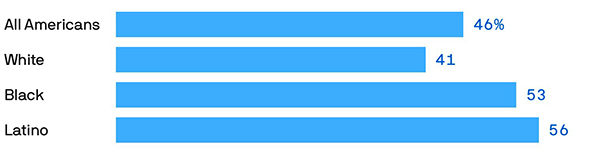
It is hard to imagine people who feel alienated in Trump's America turning out en masse for his party next year. On the "direction of the country" question, 84% of Black and 70% of Latino respondents are dissatisfied with the country's direction. In this poll, Trump's approval is slightly better among Latinos than in the NORC poll—30% vs 25%—but that is not so great. Among Black people, Trump's approval is a dismal 16%. Both groups overwhelmingly disapprove of how Trump is handling immigration and deportations. Also, over half of both groups say their personal economic situation has gotten worse this year. (V)
In the Trump Era, Republicans Have Done Poorly in Swing-State Senate Races
In the majority of states, it is possible to predict the winner of a Senate election before the voting even starts. The major exceptions are the SSS (Seven Swing States). These are Arizona, Georgia, Michigan, Nevada, North Carolina, Pennsylvania, and Wisconsin. In those states, in theory, Senate races can go either way. However, something odd is going on there. Since Donald Trump took office in 2017, there have been 21 Senate elections in these swing states. You might expect that since they are swing states, one party would have won around 11 and the other would have won around 10. That is not the case. The Democrats have won 17 and the Republicans have won 4. And in the 4 years with Senate elections post 2016, Trump has been on the ballot in half of them. Still the Republicans are batting only .190 here. Does this have implications for 2026? It might.
Here are the Senate races in the swing states for 2018, 2020, 2022, and 2024:
| Year | State | Democrat | Dem. Pct. | Republican | Rep. Pct | Winner |
| 2018 | Arizona | Krysten Sinema (D) | 50% | Martha McSally (R) | 48% | Democrat |
| 2018 | Michigan | Debbie Stabenow (D) | 52% | John James (R) | 46% | Democrat |
| 2018 | Nevada | Jacky Rosen (D) | 50% | Dean Heller (R) | 45% | Democrat |
| 2018 | Pennsylvania | Bob Casey Jr. (D) | 56% | Lou Barletta (R) | 43% | Democrat |
| 2018 | Wisconsin | Tammy Baldwin (D) | 56% | Leah Vukmir (R) | 45% | Democrat |
| 2020 | Arizona | Mark Kelly (D) | 51% | Martha McSally (R) | 49% | Democrat |
| 2020 | Georgia | Jon Ossoff (D) | 51% | David Perdue (R) | 49% | Democrat |
| 2020 | Georgia | Raphael Warnock (D) | 51% | Kelly Loeffler (R) | 49% | Democrat |
| 2020 | Michigan | Gary Peters (D) | 50% | John James (R) | 48% | Democrat |
| 2020 | North Carolina | Cal Cunningham (D) | 47% | Thom Tillis (R) | 49% | Republican |
| 2022 | Arizona | Mark Kelly (D) | 51% | Blake Masters (R) | 47% | Democrat |
| 2022 | Georgia | Raphael Warnock (D) | 51% | Herschel Walker (R) | 49% | Democrat |
| 2022 | Nevada | Catherine Cortez Masto (D) | 49% | Adam Laxalt (R) | 48% | Democrat |
| 2022 | North Carolina | Cheri Beasley (D) | 47% | Ted Budd (R) | 51% | Republican |
| 2022 | Pennsylvania | John Fetterman (D) | 51% | Mehmet Oz (R) | 46% | Democrat |
| 2022 | Wisconsin | Mandela Barnes (D) | 49% | Ron Johnson (R) | 50% | Republican |
| 2024 | Arizona | Ruben Gallego (D) | 50% | Kari Lake (R) | 48% | Democrat |
| 2024 | Michigan | Elissa Slotkin (D) | 49% | Mike Rogers (R) | 48% | Democrat |
| 2024 | Nevada | Jacky Rosen (D) | 48% | Sam Brown (R) | 46% | Democrat |
| 2024 | Pennsylvania | Bob Casey Jr. (D) | 49% | David McCormick (R) | 49% | Republican |
| 2024 | Wisconsin | Tammy Baldwin | 49% | Eric Hovde (R) | 48% | Democrat |
Do these results tell us much about 2026? As luck would have it, four of the swing states (Arizona, Nevada, Pennsylvania, and Wisconsin) don't have a Senate election next year. Three of them do, namely Georgia, Michigan and North Carolina. Of these, the latter two are open-seat races, which make them even more competitive. Three Republicans are running for the nomination in Georgia, so general-election polling doesn't mean much yet. Still, incumbent Jon Ossoff is ahead of all three of them so far. That could obviously change when he gets an actual opponent. Still, it is tough to beat an incumbent and midterms are generally painful for the president's party.
In Michigan, so far the only serious Republican who is in is Mike Rogers, who ran in 2024 and lost. The Democrats have two candidates battling it out, state Sen. Mallory McMorrow and Rep. Haley Stevens. Most initial polling has Stevens beating Rogers but Rogers beating McMorrow. Still, the margins are small and it's early in the cycle.
In North Carolina, the race is set. It is former governor Roy Cooper vs. former RNC Chairman Michael Whatley. Whatley has never run for public office before, and starting in a race against a guy who has won statewide six times in a row is probably not the ideal way to commence a Senate career. There have been six polls of the race so far, and Cooper has substantial leads in five, with one July poll showing a tie. (V)
The Gentrification of the Democratic Party Is Not Sustainable
Since the Great Depression, rich people have tended to vote Republican and poor people tended to vote Democratic. FDR was a big hit with Democratic voters but not so much with Republican voters. This held as late as 2008, then the Great Switcheroo happened: Higher-income voters became Democrats and lower-income voters became Republicans. These two graphics, 2008 on the left and 2024 on the right, make this point clear:
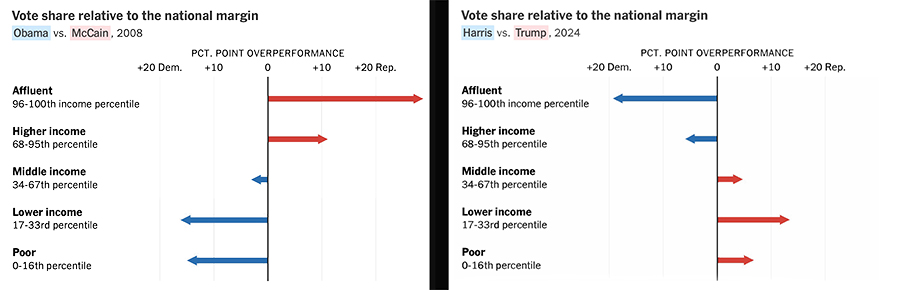
The Democrats have traded poor voters for rich voters. This is a mixed blessing. Rich voters can and do donate more to the party and are very reliable voters. On the other hand, there are fewer of them than poor voters. Electorally, that is not good. Why has this happened?
In part, at least, affluent voters aren't worried about having their money run out before the next payday. This gives them the luxury of worrying about things like climate change, women's rights, social justice and who should use which bathroom. Lower-income voters are focused on having enough money to pay the rent next month. As Democrats have come to focus much more on the things affluent voters care about, they are attracting more of them and driving away lower-income voters. Blue-team politicians see this and pander more to the concerns of upper-income voters. In this way, the Democratic Party has become gentrified. In 2023, the median income in Democratic House districts was $81,000, vs. $69,000 in Republican districts. FDR would be horrified. Hell, Lyndon Johnson would be horrified.
Unfortunately for the Democrats, this is not sustainable because there aren't enough high-income voters to win national elections. But it is worse than that. High-income voters tend to cluster in a small number of big coastal cities. Lower-income voters are spread over many House districts. Some of the issues the Democrats choose to fight for reflect this. For example, the SALT cap is something people making well over $100K in high-tax blue states care about, but working-class people don't. Fighting to raise or eliminate the SALT cap is not a winning issue for Democrats nationally.
As has been pointed out many times by now, Democrats need to focus on issues that working-class voters, especially men, care about: jobs and prices. This doesn't mean they have to stop being Democrats. Some of their pet projects can be salvaged. For example, downplay the climate effects of The Green New Deal and focus on jobs created by manufacturing, installing, and maintaining the equipment needed to use solar, wind, and other renewable energy sources. Sell it as a blue-collar jobs program. Ditto broadband Internet in rural areas. Talk about rebooting dying small towns.
Republicans talk about lowering prices but do nothing about it. Democrats could announce their new secret formula for pushing prices down. It's called "competition." Propose a new antitrust law that would break up big companies simply because they own > 10% of their market. Then the pieces created by the breakups would have to compete with one another for people's business. That would be a force to keep prices in check and it is a simple enough idea that voters could understand it easily. There are plenty of other examples of things Democrats actually want to do that could be retooled to be attractive to working-class voters, but this would require getting rid of all the consultants and hiring completely new ones. It requires a whole new mentality. (V)
If you wish to contact us, please use one of these addresses. For the first two, please include your initials and city.
- questions@electoral-vote.com For questions about politics, civics, history, etc. to be answered on a Saturday
- comments@electoral-vote.com For "letters to the editor" for possible publication on a Sunday
- corrections@electoral-vote.com To tell us about typos or factual errors we should fix
- items@electoral-vote.com For general suggestions, ideas, etc.
To download a poster about the site to hang up, please click here.
Email a link to a friend.
---The Votemaster and Zenger
Oct25 Saturday Q&A
Oct25 Reader Question of the Week: Student Counsel, Part III
Oct24 Trade Wars: Trump Throws Tantrum, Decides to Cut Off Negotiations with Canada
Oct24 The White House: Ballroom Donor List Will Make Your Toes Curl
Oct24 NYC Mayor's Race: Birds of a Feather Flock Together?
Oct24 There's Something Happening Here: The No Kings Protests, Part VI
Oct24 I Read the News Today, Oh Boy: FDR's Brush with Death
Oct24 This Week in Schadenfreude: Censorship, Ohio Style
Oct24 This Week in Freudenfreude: Iowa Students Tell Book Banners to Buzz Off
Oct23 New Immigration Policy: Refugees Are Welcome
Oct23 Trump Is Finally Beginning to Get Serious about Rare Earths
Oct23 Sununu Is Running for the Senate
Oct23 Nancy Pelosi Might Retire
Oct23 Hundreds of Bills Denying Science Are Pending in State Legislatures
Oct23 Pennsylvania Will Be a House Battleground Next Year
Oct23 Former French President Was Convicted of Criminal Conspiracy and Is Now in Prison
Oct23 There's Something Happening Here: The No Kings Protests, Part V
Oct22 Federal Government Shutdown Enters Week 4
Oct22 Arizona Sues Johnson
Oct22 The Peace in Gaza Is Shaky
Oct22 Only the Best People, Part I: The Department of Justice
Oct22 Only the Best People, Part II: Everyone Else
Oct22 Putting the "Con" in Conservative, Part III: That's a Nice Government You've Got There...
Oct22 There's Something Happening Here: The No Kings Protests, Part IV
Oct21 Putting the "Con" in Conservative, Part I: Kristi Noem
Oct21 Putting the "Con" in Conservative, Part II: Trump Is Going to Create a Space for His Balls, Damn It
Oct21 Another Trump Nominee Is about to Bite the Dust...
Oct21 And, in Related News, Tommy Tuberville Is an Out-and-Out Bigot
Oct21 New York City Mayoral Race Is Getting Closer... but Not THAT Close
Oct21 There's Something Happening Here: The No Kings Protests, Part III
Oct20 Dates That Could Affect the Shutdown
Oct20 Trump Wants to Weaponize the IRS
Oct20 Vought Cancels Billions of Dollars of Projects in Blue States
Oct20 China Is Not Gaza
Oct20 Charlie Cook Doesn't Think Cartography Will Save the Republicans
Oct20 Lindsey Halligan Is Firing Experienced Prosecutors in Virginia
Oct20 Trump Pre-Endorses Challenger to Massie
Oct20 There's Something Happening Here: The No Kings Protests, Part II
Oct19 There's Something Happening Here: The No Kings Protests, Part I
Oct17 Enemies of the State, Part I: John Bolton Indicted
Oct17 Enemies of the State, Part II: The Oval Office vs. Venezuela
Oct17 The Voting Rights Act: Are You Sure It's Not Necessary, John Roberts (and Company)?
Oct17 I Read the News Today, Oh Boy: The W.C. Fields Memorial Electric String Band
Oct17 This Week in Schadenfreude: Four Universities Have Now Told Trump He Can Take His Proposal and Shove It
Oct17 This Week in Freudenfreude: No Kings Protestors Refuse to Bow Before the Throne
Oct16 Supreme Court Seems Poised to Gut What Is Left of the Voting Rights Act
Oct16 Federal Judge Temporarily Blocks Layoffs
Oct16 Democratic and Republican Voters See the Parties Very Differently
Oct16 Gallup Poll: Tax the Rich

