


 Welcome & FAQs
  Table of Senate polls
 Senate graphs
 Tipping-point-state
 Congress: retirements
 Governor's races
 Icons for bloggers
 Data galore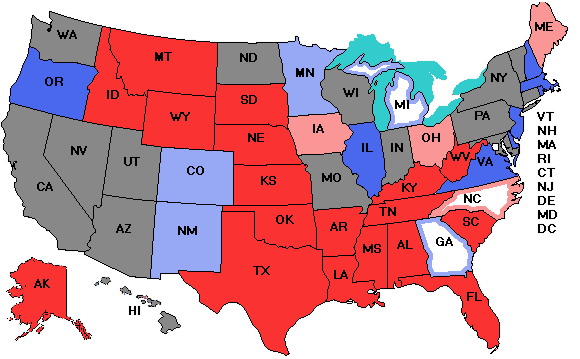


• Trump Is Unhappy with HIS Judges
• Americans Will Not Vote for a Woman for President
• Americans Are NOT Moving to Get Away from the Other Party
• Democrats Running for the Senate Are Pulling in Big Bucks
• Rep. Wesley Hunt (R-TX) Is Making the Texas Senate Primary Worse for Republicans
• Yes on Proposition 50 Is Leading, but It Is Not a Landslide
• Johnson Claims His Refusal to Swear in Adelita Grijalva Not Related to Epstein
James Comey Appeared in Court Yesterday
Donald Trump and James Comey have a turbulent history, to say the least. Unlike Trump, Comey is a lifelong Republican. As FBI director, he was relatively unknown until July 5, 2016, when he held a press conference announcing that Hillary Clinton's use of a private e-mail server was stupid and careless but she didn't violate any actual statutes, so she couldn't be prosecuted. It is absolutely unheard of for the FBI to make an announcement like this when no charges are being brought. Trump was angry that Clinton wasn't being indicted and Clinton was angry that he held a press conference about her when she hadn't committed any crimes. Being sloppy is not a crime. Then, 11 days before the election, Comey came back and said: "We found more e-mails." Nate Silver thought this announcement probably cost Clinton the election. Two days before the election (after early voting was underway in many states), Comey said there was nothing important in any of the new e-mails. One might think Trump would suddenly decide that Comey was his new best friend. But Trump doesn't have friends.
After Trump was sworn in as president, the two continued to meet regularly. Trump told him that he expected loyalty. Instead, in March of 2017, Comey announced that he was investigating whether the Trump campaign worked with anyone in Russia during the campaign, something that would be illegal. A few weeks later, Comey was at the FBI's Los Angeles office when he saw a headline on TV: COMEY FIRED.
It was downhill between Trump and Comey from there on. Comey testified before Congress on June 8, 2017, and said what he had to say. Still, the Republicans called him back to testify again on Sept. 30, 2020, even after he had been a private citizen for 3 years. The Republicans were clearly out to get Comey, on Trump's orders. On account of the pandemic, Comey testified from his home in Virginia.
During that hearing, Sen. Ted Cruz (R-TX) asked Comey if he had leaked information about the Russia probe or authorized anyone else to do so. In a somewhat roundabout way, Comey said no. The DoJ considers this statement to be a lie, and that lie to Congress forms the basis of its indictment of Comey. He is also charged with obstructing Congress (by lying to it).
Yesterday, Comey pleaded not guilty and asked for a trial by jury. If convicted, he could get 5 years in prison and a fine of $250,000. Judge Michael Nachmanoff, a Joe Biden appointee, set a trial date of Jan 5.
The fact that Comey testified from his home in 2020 (in Virginia) is now important. Trump asked the (interim) U.S. attorney for the eastern district of Virginia, Erik Siebert, to indict Comey. He refused and Trump forced him to resign. Trump then appointed his personal lawyer, Lindsey Halligan, an insurance lawyer with no experience as a prosecutor, to replace Siebert. She signed the indictment alone. Normally, the assistant U.S. attorney who actually did the work cosigns it. Clearly, no assistant U.S. attorney in the office was willing to stick his or her neck out.
The prosecution is going to base its case on a claim that Comey authorized Columbia law Professor Daniel Richman, a friend of Comey's, to leak the information. The only problem here is that Richman has already said Comey did not authorize him to leak anything. It could be hard to convince a jury beyond a reasonable doubt that Comey told Richman to leak the information if under oath Richman says Comey gave him no such instructions. To win the case, Halligan has to prove to the jury that Comey told Richman or someone else to leak. If she can't produce someone who testifies that Comey told him or her to leak, there is no case. This is why Siebert didn't want to indict Comey. He knew he would lose in court.
The prosecution also went through all of Comey's old e-mails to find evidence of leaking and couldn't find anything. Comey is asking the judge to throw the whole case out because there is no evidence he lied to Congress. It is up to the judge to decide whether the case should go forward. He could just throw it out as baseless, or even as a malicious prosecution.
The defense has a two-pronged strategy. First, there is no actual evidence that Comey authorized anyone to leak, so when he told Congress he didn't authorize anyone, he was telling the truth. If he was telling the truth, there is no case. Second, the defense will challenge whether Halligan was legally the U.S. attorney when she signed the indictment. This is very weedy but legally important. Simplified, Siebert was an interim U.S. Attorney and was never confirmed by the Senate. After his 120-day term expired, Trump had no authority to appoint Halligan as a new interim, but he did it anyway. The judge could rule that since Halligan was not duly appointed, everything she signed is null and void. Trump can't start all over again because the statute of limitations for Comey's alleged crimes just expired.
Does Trump care? A conviction would be the icing on the cake, but his real goals in prosecuting Comey are: (1) feeling good, (2) distracting the media from the Epstein files, and (3) forcing Comey to spend a lot of money on lawyers. Of course, if the judge tosses the case in November, there go (1) and (2). We don't know if Comey has tried to raise funds for (3), but we suspect if he did, he would be quite successful at covering his attorneys' fees. (V)
Trump Is Unhappy with HIS Judges
One of the nicest things about being president is you get to appoint judges who will then rule for you when you are sued. Or, at least, that is what Donald Trump thinks. When that doesn't work as expected, he is miffed. Well, it hasn't happened and he is miffed.
At the district court level, Trump has had numerous setbacks from HIS judges. How dare they! Ingrates. When he tried to use the National Guard in Oregon, HIS judge, Karin Immergut, wrote: "This is a nation of Constitutional law, not martial law." Law 1, Trump 0.
She is not the only one. When Trump tried to use the Alien Enemies Act to deport Venezuelan nationals, Trump-appointed U.S. District Judge Fernando Rodriguez Jr. ruled that "unlawful." Another Trump appointee, John Holcomb, ruled that even deportees are entitled to due process and a hearing. Trump also wanted to deport Daniel Lozano Camargo despite his being protected by a settlement agreement. Trump-appointed Judge Stephanie Gallagher said: Nope. That's Law 4, Trump 0.
Trump has also expanded detention for immigrants facing deportation, even if they have been in the U.S. for years. Trump-appointed judges Dominic Lanza (Arizona), Rebecca Jennings (Kentucky), and Kyle Dudek (Florida) have all ruled that he can't just lock up people without a hearing before a judge. Law 7, Trump 0.
Trump's first reaction is to blame HIS judges. Some of them are pushing back. U.S. District Judge Thomas Cullen of Maryland said: "This concerted effort by the Executive to smear and impugn individual judges who rule against it is both unprecedented and unfortunate." Then he rejected Trump's administrative lawsuit as defective. Law 8, Trump 0.
District Judge Dabney Friedrich, another Trump appointee, has shot Trump down multiple times, including on (1) how Trump has used the Jan. 6 pardons to cover unrelated crimes and (2) impounding funds. A Rhode Island District Judge, Mary McElroy, also appointed by Trump, blocked Trump from taking $233 million in FEMA grants from blue states, saying this was just punishment for their not doing his bidding and there is no legal basis for canceling the grants. Law 11, Trump 0.
So how is Trump taking all this? Badly. Although during his campaigns he said he would hire only the best people, now he has changed his tune. Guess he isn't a very good judge of character, especially when it comes to judging judges' character. No, wait! He thought of some other way to deflect the blame. It is the fault of the Heritage Foundation for giving him bad advice. That's it, all these horrible decisions are the fault of the Heritage Foundation. Case closed. (V)
Americans Will Not Vote for a Woman for President
A new American University poll shows that many voters, male and female, want more women in politics... just not as president. They think women get more done than men. Sounds like a recipe for more women to run for governor. Governors are expected to get stuff done. Senators just bloviate. Presidents, however, need to be tough and voters don't think women are tough. Pity the Democrats can't bring back Maggie Thatcher and run her. She was tough as nails. Oh wait, she was not a natural-born citizen. Also, she was a Tory.
Nearly 20% of the voters said they knew someone who would not vote for a woman for president, independent of the quality of the woman. Pollsters know that when they ask a question like "Would you ever vote for a woman for president?" everyone says "yes" because they perceive "no" to be an unacceptable answer. This is why pollsters sometimes rephrase it as "Do you know someone who would never vote for a woman for president?" It gives the respondent cover. Of course, it also dilutes the answer, because in some cases the respondent would but knows someone else who would not, and in some cases it is the respondent who is the refusenik. Still, a lot of voters are not ready for a woman president.
The breakdown is a bit surprising. It is not only old men who are anti-woman. A quarter of women under 50 and one-fifth of men under 50 would not vote for a qualified woman for president. This new data point says something about why Kamala Harris lost and it wasn't just because the campaign was so short and possibly not because she is Black (although the pollster didn't ask if the person would refuse to vote for any Black candidate).
Why are so many voters anti-woman? Well, one-third of all voters listen to "bro culture" podcasts. If we assume that relatively few women listen to them, then probably half of all young men listen to Joe Rogan or some other bro. Of those who do, four in five believe the podcasts affected the election, although that is just a guess, of course. Still, the decline of the mainstream media and rise of the bro podcasts could well be a factor in making men averse to voting for a woman for president. (V)
Americans Are NOT Moving to Get Away from the Other Party
Yes, America is becoming sorted by partisanship, but that is not by design. That is, when someone moves, it is not primarily to be in a blue sea or a red sea, depending on their political views. There are other factors at work. Additionally, the incentives that towns, cities, and states are offering to attract more residents are all wrong (and overly expensive). The data show that the conventional wisdom about moving and politics needs some updating.
About 9% of Americans move every year, a larger percentage than Europeans or Asians. It is thought that this high rate is good for the economy. It means if there are jobs somewhere, people are willing to uproot themselves and go there. In more static economies, people will stay put and the jobs will go unfilled. Nevertheless, even Americans draw the line at moving out of state. Only 2% do that in a given year.
The data show that 41% of movers preferred suburbs, 30% preferred rural areas, 16% percent preferred small cities, and only 13% preferred large metros. Some of these preferences are no doubt due to the fact that increasingly many jobs can be done from home, in which case all that is needed is a fast Internet connection. Suburbs and small towns often have that now, and even some rural areas do as well.
These two maps show the change over time. Remember, most counties are suburban or rural. The 100 biggest cities occupy roughly 100 of the 3,100 or so counties (New York City occupies five counties, but that is very unusual). This means that 3,000 counties don't have big cities in them. The map on the left shows inbound movement 2010-2013 for all counties. The map on the right shows inbound movement for 2020-2023:
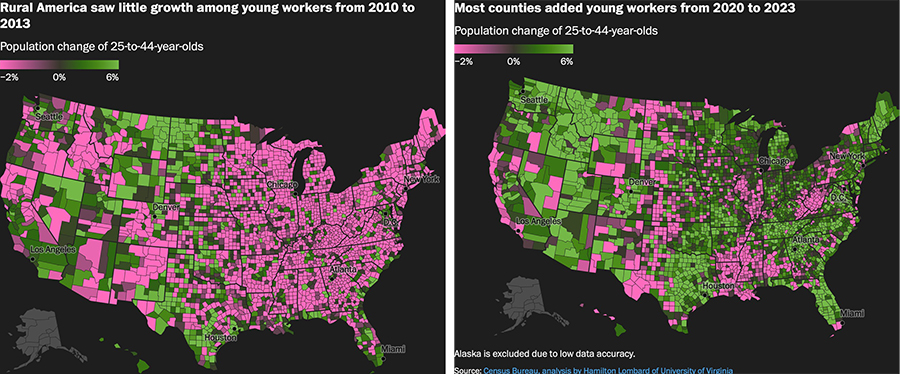
As you can see, in 2010-2013, virtually every county in the eastern half of the country lost young workers. In the later period, much of that loss was reversed, except for Appalachia and the deep South. Also in the West, losses were greatly reduced excepting the (expensive) California coast. Washington, Oregon, Idaho, and western Montana have completely turned around. These are blue areas and red areas.
When asked why they are moving, the top reasons were cost of living and housing, then safety, housing availability, short commutes, friendly locals and quality health care. Far behind are nightlife, the arts, culture and the "cool factor." Political and social fit and diversity are at the bottom. These views need to be taken with some salt, though. If movers think that Podunk County Hospital beats the UCSF or UCLA Medical Centers or Johns Hopkins, all we can say is that we hope they don't get sick.
Many dying cities and states are trying to attract more people by offering subsidies to companies to move there. Politicians are always trying to outbid each other by offering bigger and bigger tax breaks, which hollows out the local finances. And if that is not bad enough, the data show this approach isn't very good. One study showed that the boost to state and local tax receipts was 10x bigger from individual relocations than from corporate subsidies. Individual relocators tend to be above average in income and they start spending money and paying taxes the day they move in. Offering a huge break to some company to build a new plant there doesn't start delivering for several years at best. A better approach is for cities and states to advertise in ways to reach individuals, not companies, and extol their low cost of living, affordable housing, and less red tape to start a small business. We ran a letter earlier this year about a case study in which a small town pulled itself up from the bottom, not by offering a big tax break to some big company to build a plant there. That is just a race to the bottom.
The most interesting part of the Big Move is how it affects elections. If high-education, relatively affluent people leave big cities for the suburbs and rural areas, that reduces the size, and thus political clout, of the big cities. But it also increases the clout of the suburban and rural areas. In some suburban areas, a small push will move a House district (and maybe a couple of state Senate districts) from red to blue. The net effect is hard to estimate.
The 2030 census is expected to show a loss of population (and thus House seats) in the blue states of the Northeast and Midwest. This is bad news for the Democrats. On the other hand, those people have to go somewhere. If enough of them go to North Carolina, Georgia, and Arizona, those states could turn blue, just as the once-deep-red Virginia has. All we can say now is that change is afoot. (V)
Democrats Running for the Senate Are Pulling in Big Bucks
Roy Cooper (D) pulled in almost $15 million for his Senate campaign in the first 65 days of his campaign. That is a record for a Senate challenger in his or her first quarter. More than 90% of the donations were $100 or less, so Cooper can go back to the well again and again. Also significant is that Cooper pulled in more than double what his opponent, Michael Whatley (R), pulled in. That is not much of a surprise. The folksy Cooper has run statewide six times and won every race. His name is universally known in North Carolina, not to mention well-known nationwide among Democratic donors. Whatley has never run for public office before and is going to need multiple billionaires to prop him up.
The Republicans' usual strategy of finding one minor thing their opponent did or said ("But her e-mail server!" or "Gender-confirmation surgery for prisoners!") and trying to make the entire campaign about that doesn't work well against people who have been in statewide public office for decades and are very well known. It especially won't work well when the Republican is a total unknown and the Democrat is universally known. The Republicans' only hope is to goose Republican turnout enormously and suppress Democrat turnout. The latter may not be so easy with the governor and secretary of state both being Democrats, though.
Sen. Jon Ossoff (D-GA) isn't doing so badly in the money department either. He raised more than $12 million in Q3 2024. He had 233,000 contributors with an average donation of $36. Nearly 93% of the donations were $100 or less, meaning he can also go back to the well again and again. He has $21 million in the bank now.
In addition to a lot of money, he doesn't have a primary opponent. On the Republican side, two sitting Congressmen, Buddy Carter and Mike Collins, are battling it out, along with a football coach from Tennessee, Derek Dooley. If you look at the map above, you see that Tennessee has a short border with Georgia, so someone from Tennessee is merely carpetbagger-lite. The football guy has an important endorsement, though: Gov. Brian Kemp (R-GA). Donald Trump hasn't endorsed yet but when he does, it is very unlikely to be Dooley. This means as it heats up, Trump and Kemp will be helping different guys. That never helps party unity much, especially against an incumbent with a lot of money in his campaign account. Initial polling has Ossoff beating all three Republicans, but that can change once one of them is the nominee. (V)
Rep. Wesley Hunt (R-TX) Is Making the Texas Senate Primary Worse for Republicans
Wesley Hunt, who represents an R+10 district in the West Houston suburbs, has jumped into the already messy Republican Senate primary in Texas. We have no idea what he has been smoking, but if he thinks he can win a Senate race in Texas, it must be strong stuff. The last time Texas had a Black senator was... well, never. Nevertheless, his entry into the already nasty primary between Sen. John Cornyn (R-TX) and Texas AG Ken Paxton (R) could be significant.
Here's the problem: There are some voters who don't like Cornyn very much and think Paxton is crazy, so they are looking for a way to send them both a message. That way could be voting for Hunt. A recent three-way poll had Cornyn at 32%, Paxton at 31%, and Hunt at 17%. Assuming the remaining 20% splits over the three candidates and no one gets all of it, no candidate will hit the 50% mark in the March 3, 2026, primary. That means there will be a runoff in May. As a consequence, the top two candidates, Cornyn and Paxton, will be shooting at each other harder and more directly for an extra two months. A bitter ideological and personal fight for 2 months can't help the party much.
On the Democratic side there are only two serious candidates, Colin Allred, who lost to Ted Cruz last time, and James Talarico, a state representative. Former astronaut Terry Virts is also running, but seems less likely to get enough support to force a runoff on the Democratic side. If either Allred or Talarico wins outright in March while the Republicans are still slinging mud at each other, that gives the winner more time to campaign for the general election and raise general-election money. (V)
Yes on Proposition 50 Is Leading, but It Is Not a Landslide
Proposition 50 is the initiative in California to override the map drawn by the independent commission and use a highly gerrymandered map that would probably result in the Democrats picking up five House seats, thus countering the Texas gerrymandering. Voting is already underway in California.
A recent poll commissioned by the Cook Political Report shows 47% of California adults are for Prop. 50, while 34% are against it. Among registered voters, the "yes" vote is 50% and the "no" vote is 35%. All it needs to pass is a simple majority.
Cook also tested three messages from each side to see which was more convincing. The "Yes on 50" messages tested were:
- This levels the playing field against Republican gerrymandering in other states.
- This is a temporary measure that preserves our commitment to fair redistricting in the long-term.
- California needs more Democratic seats to check Trump's power in Congress.
They also tested three "No on 50" messages:
- This undermines the voter approved independent redistricting commission.
- Politicians shouldn't draw their own district lines.
- This sets a dangerous precedent for partisan manipulation of district boundaries.
The "definitely yes on 50" voters found all three pro-50 arguments very convincing (94%, 92%, and 92%, respectively). Interestingly enough, the "definitely no on 50" voters did not find the "vote no" arguments all that convincing (44%, 38%, and 50%, respectively). So the no-voters will vote no, but aren't really convinced by the public arguments for their side. Among undecided voters, the strongest argument was politicians shouldn't draw their own district lines (34%). Second was checking Trump's power (18%). Third was it is a dangerous precedent (10%).
If the poll is accurate and holds until November, the measure will pass and California will probably get five new Democratic representatives. (V)
Johnson Claims His Refusal to Swear in Adelita Grijalva Not Related to Epstein
Sometimes the overt lying becomes so obvious that it is hard to imagine how the liar avoids giggling while doing it, but somehow Speaker Mike Johnson (R-LA) is up to the task. Everyone who is paying attention knows very well that he is refusing to swear in Rep.-elect Adelita Grijalva (D-AZ) because she will be the 218th signature on the discharge petition introduced by Rep. Thomas Massie (R-KY). Once she signs, the House will have to vote on a resolution to force the Department of Justice to release all the Epstein files. The truly incredible hypocrisy here is that Johnson is saying that his refusal is not at all related to her signature on the petition. Sure, Mike. He claims it is because the House has been having a series of pro forma sessions and members can't be sworn in during pro forma sessions. It isn't that he is disputing her election. He already has an office for her with her name on it. Look:
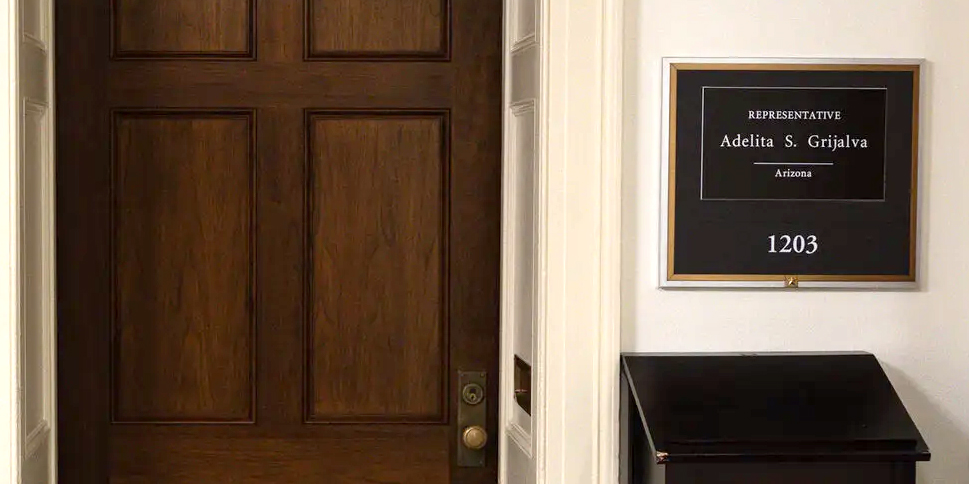
That means Johnson knows full well that Grijalva is duly elected, and entitled to her seat.
Now here is the hypocrisy part. Members of Congress have been sworn in during pro forma sessions before. The last occasion was on April 2 of this year, with a pair of Republicans who won special elections. Back on April 2, the Speaker of the House was—let us check our notes—Mike Johnson.
So, Johnson has no legal, moral, or other objection to swearing in winners of special elections during pro forma sessions. He's just not willing to do it now. The Speaker has tried to deflect blame by claiming that the real villain here is the Democrats, and that if they would just reopen the government, he'd be delighted to swear Grijalva in. There's so much spin there, you might need to go right now and take a dramamine.
Johnson's game plan is prayer. Lots of it. Praying the problem goes away. He knows that holding a vote will put the Epstein files back front and center. It will also put Republican representatives in a bind. If they vote yes, Donald Trump will be furious with them. If they vote no, their constituents will be furious with them. So the solution is telling baldfaced lies in public and in private praying his little head off that God makes this problem go away somehow. Of course, even the Lord needs help sometimes, so just in case this is one of those instances, Johnson is also putting the full-court press on the three non-Massie Republicans that have signed the petition. Rep. Marjorie Taylor Greene (R-GA), for one, says that it's the most pressure she's ever been subject to during her time in the House.
The problem, assuming the prayer and the pressure don't work, is that all this obfuscating is making it look like Trump/the Republicans have something to hide. In the case of Dick Nixon, the cover-up was worse than the original crime. Here, the (alleged) original crime is pretty bad, and the cover-up is making it look even more shady. And even if Johnson does somehow triumph and kill the discharge petition, it's not like this is going to go away. Reporters and town hall attendees and other folks will ask about it on a daily basis, all the way through next November. One might argue that it's better to just rip the band-aid off and stop screwing around. (V & Z)
If you wish to contact us, please use one of these addresses. For the first two, please include your initials and city.
- questions@electoral-vote.com For questions about politics, civics, history, etc. to be answered on a Saturday
- comments@electoral-vote.com For "letters to the editor" for possible publication on a Sunday
- corrections@electoral-vote.com To tell us about typos or factual errors we should fix
- items@electoral-vote.com For general suggestions, ideas, etc.
To download a poster about the site to hang up, please click here.
Email a link to a friend.
---The Votemaster and Zenger
Oct08 Bari Weiss Named CBS News' Editor-in-Chief
Oct08 Don't Think Republicans Have a Monopoly on Performative Anti-antisemitism
Oct08 Bondi Answers to Only One Person
Oct08 Matchup Set for TN-07 Special Election
Oct08 The Case of the Missing Aviatrix
Oct07 And the Shutdown Goes On...
Oct07 Virginia Is Certainly Giving Louisiana, New Jersey a Run for their Money
Oct07 Utah May Soon Have New Congressional Maps
Oct07 H-1B Visas? It's Complicated
Oct07 Of Course MAGA Doesn't Actually Care about Antisemitism
Oct06 Newsom Understands the Incentive Structure
Oct06 Another Appeals Court Has Ruled That the Words in the Constitution Actually Matter
Oct06 Judge Gives Georgia 2 Weeks to Replace Fani Willis
Oct06 Apple Caves
Oct06 Project 2029
Oct06 Now Democrats Have a Candidate Quality Problem
Oct06 The Supreme Court is Back in Town
Oct05 Sunday Mailbag
Oct04 Saturday Q&A
Oct04 Reader Question of the Week: Student Counsel, Part I
Oct03 Shutdown: Nobody Knows What the Future Holds
Oct03 Lots of Abortion News this Week
Oct03 Legal News: Is the Supreme Court Getting Ready to Give Trump a Big L?
Oct03 I Read the News Today, Oh Boy: Julius Caesar Was a Prodigy
Oct03 This Week in Schadenfreude: Superintendent Steps Down, Presumably Because He's an Ol' Dirty Bastard
Oct03 This Week in Freudenfreude: Bad Bunny Knows How to Play The Game
Oct02 There Are Many Unanswered Questions about the Shutdown
Oct02 Another Sector Is Worried about Trump
Oct02 The EU Wants to Spend Frozen Rubles to Buy Ukraine EUROPEAN Weapons
Oct02 A Key Cybersecurity Law Has Expired
Oct02 Judge Swats Down Another Improperly-Appointed U.S. Attorney
Oct02 It Is Hopeless
Oct02 Republican Congressman David Schweikert Will Not Run for Reelection
Oct02 2026 Will Have Yet Another Barnburner State Supreme Court Justice Race in Wisconsin
Oct02 DeSantis Gives Trump Land in Downtown Miami for His Presidential Library
Oct02 Congress Does Not Function but Some State Legislatures Do
Oct02 Trump Administration Is Working to Disenfranchise Another Group of U.S. Citizens
Oct01 The Government Is Shut Down
Oct01 Trump, Hegseth Attempt to Stage Rally at Nuremberg... er, Quantico
Oct01 Judge Delivers Scorching Rebuke to Trump
Oct01 Antoni's Goose Is Cooked
Oct01 Johnson Is Dragging His Feet with Grijalva
Sep30 Get Ready for a Shutdown
Sep30 Day of the Long Knives?
Sep30 Trump Wants to Ruin Sports, Part I: The WNBA
Sep30 Trump Wants to Ruin Sports, Part II: The World Cup
Sep30 Trump Wants to Ruin Sports, Part III: The Ryder Cup
Sep30 Trump Wants to Ruin Sports, Part IV: Electronic Arts
Sep29 The Blame Game Is Starting

