


 Welcome & FAQs
  Table of Senate polls
 Senate graphs
 Tipping-point-state
 Congress: retirements
 Governor's races
 Icons for bloggers
 Data galore


• Reader Question of the Week: Student Counsel, Part I
Saturday Q&A
For anyone who is still working on the headline theme, we will note that we really wanted to use "Kurupt" in a headline, because it's so on-point, but the unorthodox spelling would have been too obvious.
We got a lot of shutdown questions this week—surprise!
Current Events
D.H. in Boulder, CO, asks: There is a very strong theme circulating in MSNBC coverage (Jen Psaki) and a smaller amount on CNN that Trump is truly out of touch. As in SERIOUSLY out of touch, and he doesn't understand the implications for his management of the major issues we are currently dealing with. I know that we can't diagnose dementia from afar, but is it possible that health is a more imminent issue than we may have thought? Does this go way beyond the cheese falling off the cracker?
(Z) answers: It is certainly possible that his health is worse than is publicly known. In fact, we may have moved from "possible" territory into (or at least near) "probable" territory.
The first problem here is that Trump and/or the people around him might not know if there's a problem or, if they do, they might not know how bad it is. The Joe Biden example illustrated, at least a bit, what can happen in these situations, where people fool themselves into thinking "it's not so bad." Trump, in particular, is clearly someone who would prefer to live in ignorance rather than to confront hard truths. So, for example, he might very well avoid seeing a neurologist, even if the need is painfully clear. Or, he might find a neurologist who will tell him what he wants to hear.
The second problem here is that the system is just not set up to deal with this particular kind of crisis, despite multiple attempts to address the problem. Woodrow Wilson was clearly not fit to lead for his last couple of years in office, but he still stayed in power. There are numerous other presidents who might have been in the same boat for some portion of their terms—Franklin Pierce, Calvin Coolidge, Ronald Reagan, Biden, etc. And yet, they all remained until the end.
It is true the Democrats could try to make a big stink, but they probably wouldn't get anywhere. "The president is crazy" or "the president is unwell" or the like have been used so many times by so many people whose party was out of power that such claims have become like the boy who cried wolf.
S.S. in West Hollywood, CA, asks: Can you give us a little more insight into Donald Trump's Cabinet? What I really want to know is if there's any chance there are enough Cabinet members who are still decent enough people (for billionaires) that they may not actually want to see America/the Constitution/democracy replaced with King Trump and that when he does something so extreme and distasteful and hateful that they might possibly maybe use the Twenty-Fifth Amendment to remove him? Perhaps Peter Thiel is working behind the scenes to get his boy (VP Vance) into the big chair?
(Z) answers: Donald Trump's current Cabinet is, almost by definition, made up of people who are: (1) sycophants and (2) opportunists. Pretty much all of them fall into both categories.
His very first Cabinet, before all the heads started rolling, might well have had a majority that was willing to put country ahead of Trump. But that was a bug, not a feature, and so Trump was careful this time to pick people who had no path to fame and/or influence EXCEPT through him. James Mattis, for example, had a brilliant career, and will never want for opportunities no matter how long he wants to work. Not so for Tulsi Gabbard, Pete Hegseth, etc., for whom Trump represents their only shot at relevance. They will pucker up as often, and as long, as they need to in order to remain in The Donald's good graces.
That said, they are all opportunists, too. They have their agendas, and Trump allows them to pursue those agendas, in part because he's silenced Congress, and in part because he's very hands-off, and largely doesn't give a damn what happens with most parts of the government. No other president, Democratic or Republican, would give Cabinet officers so much room to do whatever the hell they want.
Under these circumstances, the Cabinet members are almost certainly better off with Trump in the Oval Office. The less competent he gets, the better off they are, because that means even less oversight. It is at least possible that somehow, some way, J.D. Vance quietly convinces a majority of them that he will be even BETTER for them than Trump was. But this is a long shot, more likely to be a movie script than a real thing.
I can only see two ways that Trump is removed from office prematurely, and they both involve Congress exercising its prerogative under the Twenty-Fifth Amendment to remove him. The first of those is that somehow, some way, Epstein-related evidence comes out that shows beyond all doubt that Trump knew about or (even more so) participated in sex with underage victims. The second is that Trump has a public performance as bad as, or worse than, the Biden debate fiasco, making it all but impossible for the White House staff to claim that all is well.
N.M.D. in Duluth, MN, asks: While it is pretty clear that the president is unfit for the office, it also worries me about what might happen if he was removed from office before his term is up.
If Trump was removed, is it possible that we might find ourselves, as a country, in an even worse situation? Those who take over may be more capable of wreaking havoc than Trump himself has been. The remainder of his term might be more dangerous and without the buffoonery that is contributing to decline in Trump's approval ratings.
I mean, isn't an incompetent fascist better than competent fascists at the helm?(Z) answers: Unknown, until it happens. But, and we have written this before, we do not believe anyone but Trump can command the MAGA base. That means that nobody else can intimidate Congress the way Trump can. And that means that some other would-be fascist is not going to be in a position to avoid pushback and oversight the way Trump has.
In short, we think a President Vance, though more competent, would be less harmful than Trump.
J.L. in Mountain View, CA, asks: My understanding is that, per Wikipedia, "Prior to 1980, federal funding gaps caused by the expiration of appropriations legislation did not lead to government shutdowns... because it was believed that Congress did not intend the cessation of government services under these circumstances," and that Jimmy Carter's AG, Benjamin Civiletti, issued an opinion in 1980 saying that this was a violation of the 1884 Antideficiency Act, and agencies had to shut down. However, your item on Thursday listed several pre-1980 shutdowns. Am I wrong and what is the history there?
Also, if something like this happened, what prevents there from being a fourth way to end this shutdown (in addition to the ones you mention Friday): AG Pam Bondi issues a finding that Civiletti was wrong and the government (or whatever part the president likes) can continue operating (and paying people)?(Z) answers: The pre-1980 events were technically shutdowns, in that there was a gap during which the government was unfunded. However, the government was still functioning, and largely open for business. It would probably be more helpful to call these incidents "slowdowns," since the agencies kept operating, but did look for ways to temporarily reduce outlays (e.g., no janitorial work) until a budget was in place.
It is true that shutdowns, in the current sense—with some services being discontinued, and some sizable number of employees being furloughed—began only after Civiletti issued his opinion. And even then, his guidance was followed sometimes and ignored sometimes for the first decade or so. It wasn't until the Clinton years that the lack of a budget meant there would definitely be a shutdown.
This administration is more than willing to ride roughshod over the rules, in service of its goals. So, Bondi could indeed declare that Civiletti erred, and that the government can keep operating at full steam. There are two things that might give the administration pause, though. The first is that it would set a precedent that future Democratic administrations could also use, thus rendering the threat of a shutdown effectively meaningless. Since Republicans use shutdowns as a weapon more often than Democrats do, that would be a net loss for the red team.
Admittedly, Trump probably does not care about that, since he doesn't give a damn what happens to the Republicans after Jan. 20, 2029. However, the other issue is a version of the Vietnam problem that Richard Nixon faced in 1970 or so. He wanted to withdraw from the War, but he had the problem that people would say, "Wait a minute. If this was possible, or was the plan, all along, why did you let American soldiers die for 2-3 extra years?" Similarly, if Trump claims he has the power to unilaterally end the shutdown, and does it after 3 weeks, there will be some very angry people (say, farmers) who want to know why he waited, and made them suffer, for no good reason.
J.H. in Boston, MA, asks: Regarding Donald Trump's threat to start firing large swaths of the federal workforce en masse, you write that maybe he hasn't started because he's getting his ducks in a row, or maybe he is getting pushback from Republicans in Congress.
It's been pretty obvious to me that it was a bluff, for the simple reason that he already fired as much of the federal workforce as he could possibly manage under the DOGE shenanigans, so much so that many departments had to go begging fired workers to come back because they couldn't function. The apocalyptic Project 2025 scenario that he's threatening? He already did it. He can't fire more without hurting himself.
I mean, maybe there are large parts of the workforce that were untouched or at least, still have substantial workforces left, and I'm not considering, so that there is some threat there. If so, please tell us what they are. It's not Education. It's not USAID. They're already gone. He's not gonna fire ICE or the military. Who is even left that he could fire?(Z) answers: The work of DOGE was not grounded in anything more than fantasy, and had no real basis in evidence. So, I cannot approach this question from the vantage point of "Who can Trump afford to fire and still keep the government operational?" because this administration clearly does not think along those lines.
What I CAN tell you is which departments will have the highest percentage of employees furloughed. That would seem to indicate which departments/employees this White House values the least:
Department Furloughed Staff Pct. of Total Staff EPA 13,432 89% Education 2,117 87% Commerce 34,711 81% Labor 9,792 76% HUD 4,359 71% State 16,651 62% Energy 8,105 59% Interior 30,996 53% Agriculture 42,256 49% Defense (Civilians) 334,904 45% HHS 32,460 41%
That's every executive department that will have at least 40% of its staff furloughed, and it's also every executive department that will have a total of 15,000 furloughs or more. I don't know how many people Russ Vought will try to fire, but however many it is, most of them are represented somewhere on this table, I'd say.
S.G. in Durham, NC, asks: (V) wrote: "For Democrats, [impoundments and recissions] is a hill to die on, but they can't talk about it because it is too arcane." I'm pretty sure (Z) wrote something similar. Is it really that hard to explain that any deal the Democrats agree to means nothing as long as the Republicans have a way to call "backsies" on it later?
(Z) answers: The first problem is that if something sounds simple, but absurd, it becomes much harder to explain why it's really true, and not an exaggeration. You could tell people that the problem is that the Democrats don't want Trump to be able to change his mind after a budget has been approved by Congress, and many of them will say "C'mon. He can't do that." Then you have to explain how he can do that, even if he's not supposed to be able to.
Second, the more items you add to the "reasons we're doing this" list, the less emphasis you can place on any one. It is almost certainly best to pick the simplest one, and the one that people care most about, and understand the most easily, to be the one that you use as your focal point/slogan.
E.W. in Skaneateles, NY, asks: What are your thoughts on this article from Jonathan V. Last at The Bulwark, essentially arguing that Democrats are doing the Republicans a favor by fighting against their unpopular ideas?
Illustrative quote: "Expiring ACA subsidies and Medicaid cuts are the two best things Democrats have going for them! Trump and Republicans did those things! Let voters experience them!"
Trump seems determined to inflict the pain exclusively on Democrats, but as you pointed out, that's not really possible.
Can Democrats "win" by losing?(Z) answers:Consider:
- Option A: Fight for [THING X], lose, watch [THING X] go down the drain
- Option B: Stand aside, let the majority do what they want, watch [THING X] go down the drain
A political party is far better off with Option A than Option B. If they choose Option B, they are effectively collaborators, and share in the responsibility for whatever harm has been done.
So, Last is correct that the Democrats could win by losing. However, that is not an argument against trying to win.
J.M. in Anaheim, CA, asks: On my commute, NPR had an interview with Rep. Dusty Johnson (R-SD) on the subject of shutdowns. He has co-authored a bill, "The Eliminate Shutdowns Act," that triggers an automatic two-week CR if a "normal" appropriation bill hasn't been passed. This doesn't sound like horrible governance to me—Democrats would not be able to increase the size of social programs, and Republicans would not be able to increase the military, or decrease other spending. What is the wise opinion of the Electoral-Vote.com staff?
(Z) answers: In general, with legislation proposed by members of Congress, you should think about the question: "Is this actually good governance, or is it designed to help the sponsor's own party?" Sometimes it's one, sometimes it's the other, sometimes it's both. With the modern GOP—and I dislike writing this, but it is what it is—it's more likely than not the legislation is designed to advance partisan goals.
I don't know for sure what Johnson's motivations are, but I can easily game out the most abusive scenario that would be possible under this legislation: [PARTY A] has the trifecta and passes a budget in line with its agenda. While that budget is in effect, an election is held, and [PARTY B] gains the trifecta. From that point forward, [PARTY A] refuses to discuss the budget at all, and blocks any attempt to adopt a new budget. Rinse and repeat. In that way, the budget of [PRESIDENT FROM PARTY A] could be extended for years after they were out of office. Indeed, it would be possible to have only budgets from [PARTY A] forever, since they could just block every budget until they have the trifecta again.
D.P. in Oakland, CA, asks: Assuming that Russell Vought is the most effective executive that we've had in the White House in living memory and that he came in the back door, not via citizens' votes, who is the Democrats' Russell Vought, someone who might get in riding coattails and be able to ruthlessly put all the pieces back together again, even better than before?
(Z) answers: So, we're looking for someone who is not an elected official, but who has connections to the Democratic establishment, is quite liberal (since Vought is quite conservative), and is effective at getting things done? That would seem to be the profile, yes?
If so, then the best answer would appear to be Lina Khan, who ran the Federal Trade Commission for Joe Biden for nearly 4 years. She's brilliant, she's effective, she's good at building consensus, she's a lefty's lefty, and she knows the federal budget in particular and macroeconomics in general.
R.B. in San Francisco, CA, asks: As a newly furloughed federal worker, I felt I had the time to write in and ask: Do you think Sen. Ted 'Fled' Cruz (R-TX) will face any kind of consequences for his comments about protecting child molesters? I honestly could not believe when I saw it live as we watched the budget vote, but he did in fact say that America should come together to protect pedophiles. Even by Republican standards there has to be some sort of recognition, right?
(Z) answers: For those who are unfamiliar with this story, Cruz was participating in a hearing this week, and decreed: "How about we all come together and say, 'let's stop murders?' How about we all come together and say 'let's stop rape?' How about we all come together and say 'let's stop attacking pedophiles.'"
He is not going to face censure, or any other consequences, because it was clearly a mistake. He presumably meant to say "let's stop PROTECTING pedophiles." That said, he has certainly been the subject of much mockery, especially from people who suggest it might have been a Freudian slip, revealing a bit more of the Senator's mindset than he intended. Anyone who would like to see an example of the mockery, here's what The Late Show with Stephen Colbert did with the footage:
I.R. in Zurich, Switzerland, asks: I have a question about that batsh**-crazy event at Quantico: What is Pete Hegseth's deal with beards???
I mean, with his other grievances—women, diversity, fitness, etc.—I get where he's coming from, however wrong and misguided most of it is. But beards? Some of the fiercest warriors in history had beards. Vikings anyone?
So is there anything I'm missing?(Z) answers: You're right that Americans today, on the whole, associate beards with masculinity. There's even been research that politicians with beards tend to attract more support from men (because: "macho") but that is offset, and then some, by the votes they lose from women (because: "someone that hypermasculine is probably anti-choice, anti-woman, etc."). Sorry, J.D. Vance.
Hegseth kind of reminds me of Worf from Star Trek. Having grown up among humans, he doesn't actually know very well how Klingons behave. Instead, based on research and on limited contact with the culture, he creates an image of how he THINKS Klingons behave, and then follows it to the point of fanaticism. Similarly, despite having been an American man and a soldier, Hegseth has some very odd ideas about both American masculinity and about soldierhood that... are not very mainstream, let's say. And while the Secretary seems to value masculinity, it's his weird version of that notion, and in his version, beards are clearly not manly.
I don't know exactly why Hegseth hates beards so much, but I have two pretty good theories. The first is that for some men (mostly men of the mid-20th century, but Hegseth is a throwback in a lot of ways), mustaches and beards are symbols of the counterculture and of rebellion. This is why Major League Baseball had a de facto "no facial hair" policy until well into the 1970s (a policy that the Yankees maintained until February of this year). It's why Walt Disney did not allow employees at his theme park to wear facial hair. And so forth. So, Hegseth might hate beards because he thinks they are pinko.
The second theory involves Hegseth being, well, a fascist (or, at least, an aspiring fascist). Fascists value uniformity, as every person is a cog in the machine. Further, fascists value a particular, traditional conception of the human body. For Benito Mussolini, for example, that ideal was expressed in the statues created by classical Romans. As you might have noticed, nearly all Roman statues are clean-shaven. So, most fascists were clean-shaven. (Also, fascists did not associate facial hair with hippies, but they did associate it with monarchialism, and so hated it for that reason).
R.N. in Redmond, WA, asks: I haven't seen much commentary about this recent news story from CNN, which points out that Donald Trump is basically screwing American soybean farmers by propping up his right wing friend Javier Milei in Argentina with U.S. tax dollars.
I would think that Democrats would be filling the airwaves in farm states and elsewhere with this type of information. Why don't the Democrats seize these kinds of opportunities? Electoral-Vote.com regularly points out various situations that Democrats should be advertising to show how poorly we are being governed. Do Democrats not have operatives on the lookout for using this kind of screw up by the administration?(Z) answers: Yesterday, I wrote this: "It is unbelievable how much worthy-of-our-attention news there is on a daily basis these days. So much so that it's basically impossible to keep up, and we have a massive backlog of stuff we've been trying to get to, without much success so far."
All week long, I have been trying to get to an item that would have a headline like "CorruptionWatch 2025," and would run down all the corrupt stuff from just the last week or so, including the Argentina story. But there is just SO. MUCH. STUFF. Hopefully next week.
Anyhow, other outlets—even those much bigger than we are—undoubtedly have the same problem. There's only so much time, and so much space. Same thing with political operatives. We've seen plenty of stories about the Milei situation, but they are competing with the shutdown, and with the reproductive stuff we wrote about yesterday, and Trump making plans to invade Portland, and the nutty Quantico speeches, and the Comey indictment, and Trump basically unilaterally declaring war on alleged Venezuelan drug lords, etc.
This is by design, of course. Phil Spector had the "Wall of Sound," and Trump has the "Wall of Whackadoodlery." This technique, honed during his first term, keeps people from paying too much attention to any one example of corrupt or unethical or hateful behavior. As a bonus, it also keeps Jeffrey Epstein out of the headlines, at least for now.
P.V. in Portland, OR, asks: Greetings from the rioting masses in Portland, Oregon.
I continue to be befuddled and frustrated that the national media is letting TCF confuse the issues so completely. Our fair city is not burning down, the streets are not overrun with criminals, and the ICE building is subject to mild and largely peaceful protests. This whole effort is clearly a distraction, and sadly it seems to be working.
Why can't the press and the public recognize that, once the rhetoric to release the Epstein files became too persistent and too heated, the nation's leading narcissist launched his series of threatened invasions? How gullible are people (seemingly endlessly when it comes to Mar-a-Lardo), and what will it take to get folks refocused on what he clearly cares most about—those yet-to-be-released files? Why can't everyone see that Portland is just a giant smokescreen of distraction?(Z) answers: As we note above, there are just too many things going on. We've had Portland on our radar since Trump started thumping his chest in that direction. But we're now up to three cities—Chicago, Memphis, and Portland—that he's threatened without actually doing much. We'll give a LOT of attention to Portland when and if he does invade (just like we did with L.A.), but until then, we're giving more pressing things (like the shutdown) priority. We have no choice but to do that kind of triage, and we know other outlets, even much bigger ones, have the same dilemma.
As to the Epstein cover-up, you can only write/say it so many times before everyone's heard it, and it turns into white noise. So, we don't always point it out, and we don't even point it out all that often, anymore. But we do sneak in brief references at least a couple or three times a week.
J.N. in Baltimore, MD, asks: Assuming Speaker Mike Johnson (R-LA) "gets around" to swearing in Democratic Rep.-elect Adelita Grijalva from Arizona, and the resolution passes, can Donald Trump simply order the Department of Justice not to release the Epstein files? There will be lawsuits, of course, but that would take a year, or more, to get to the Supreme Court where they could side with Trump and allow him to block any release. Is the release of the Epstein files ultimately a hopeless cause?
(Z) answers: This administration has no problem bending the rules left, right and sideways to avoid sharing information. Think of how long and hard Trump fought to keep his tax returns secret, even after he had promised to release them. And those largely didn't tell us anything we didn't already know, namely that he isn't that great at business, and he's a world-class tax dodger. If the Epstein files have information that's adverse to him, particularly if that information is MUCH more adverse than what's in the tax returns, Trump and his lackeys will move heaven and earth to keep that information under wraps.
That does not make the cause hopeless, however. If the pressure to release the files grows, then it will put Congressional Republicans between a rock and a hard place. And some of those GOP members who take Trump's side will pay the price at the ballot box, very likely returning a Democratic House (and maybe Senate) that will serve as a much more effective check on him.
Further, if Trump has been ordered to release the files, and refuses to do so, then someone else who has access and/or copies might be persuaded to step in and "fix" the problem. There could be a federal government mole. There are a couple of people, like a former sheriff in Florida, who say they have some of the materials. There's the Epstein estate. There may even be Russian officials who have some of the stuff.
J.A. in Monterey, CA, asks: Given The Convicted Felon (TCF)'s attempted meddling in the World Cup, as well as his anti-world policies, can FIFA change the 2026 World Cup to a different venue? Could they just change the knock-out stage?
(Z) answers: It's their tournament, they can do what they want. Mexico, Canada and the U.S. are already set to be co-hosts, so the games scheduled for the U.S. could just be moved to one of the other two nations, without too much disruption.
FIFA is not likely to do this, mind you, but it's within their power, if the leadership sees fit to do it.
Politics
M.P. in Leasburg, MO, asks: Curious to know if leaders of other nations regularly post despicable comments about human beings on social media outlets, or are our current president's actions a complete anomaly? I feel like the diplomacy and decorum we have always known and enjoyed from our presidents is now past tense. The lack of intellect being offered via the White House and Oval Office is astonishing. Please tell me that someday, order will be restored and this will all be a veritable bad dream. One, with time, we will all forget ever happened.
(Z) answers: For this to happen, three conditions basically have to be met: (1) You have to have a leader who rose to power on demagoguery—telling voters/supporters who to hate; (2) That leader has to have personal or political problems from which he needs to distract attention and (3) That leader must lack other effective ways to stifle criticism and dissent.
There are many leaders who check at least two of the boxes. For example, Xi Jinping has demagogic tendencies (e.g., the Uyghurs) and there are things in his country that are making many citizens unhappy. However, he has ways of controlling dissent, so he doesn't need cheap parlor tricks to distract people.
One person who checks all three boxes is Argentina's Javier Milei. And, guess what? He loves to use insults against his perceived enemies. He's lambasted various elements in Argentine society, and he's also gone after numerous foreign leaders, including Spanish Prime Minister Pedro Sánchez ("socialist scum"), Colombian President Gustavo Petro ("murdering terrorist"), Mexican President Andrés Manuel López Obrador ("ignorant" and leader of the "small-penis club") and Pope Francis ("imbecile who defends social justice"), among others. Hungary's Viktor Orbán is another who checks all three boxes, and he also likes to indulge in some cheap mudslinging. A couple of months ago, for example, he gave a major speech in which he referred to his opponents as "stinkbugs" who should be exterminated.
So, it's not common, but it's not unique to Trump, either.
The U.S. is likely to bounce back, eventually, because its government has proven very resilient. But Trump won't be forgotten, nor should he be. He should remain a cautionary tale for at least as long as Benedict Arnold has.
J.A. in Monterey, CA, asks: After reading about the latest escapades in Oklahoma, and how much the Superintendent got away with before the porn event, it made me wonder: Would any athlete take some sort of stand against practices such as these, voter suppression, or many other things? And could there be an effect? Let's say Shai Gilgeous-Alexander and Jalen Williams on the Oklahoma City Thunder asked for a trade due to Oklahoma's policies. That would be devastating to the Thunder and its fans. But do you think it would have an effect? Would a younger LeBron James saying he would never sign with a team in a state fostering voter suppression make a difference? Unfortunately, low-tax states that are more appealing to players (e.g., Kevin Durant wanting to play in Texas) tend to be states with such laws.
(Z) answers: Let's start with the tax thing. Where an athlete's home team is based does not matter as much as you might think, because they have to pay taxes in each location where they play (and thus, receive a salary). For example, by moving from Phoenix to Houston, Durant gets to go state-tax-free on 41 games in Texas, whereas previously it was 12 games in Texas. When you make as much as he does, that's still a chunk of change he's saving, but it really doesn't affect his bottom line THAT much.
We point this out because even if SGA or Jalen Williams or someone else forces a trade out of Oklahoma, they still have to play games there (as a member of a visiting team) and they still have to pay taxes there. It's just fewer games and less taxes. On top of that, many Americans get very, very angry at athletes who presume to protest (much less to force trades or other changes to their contracts) for political reasons. For these reasons, any athlete would be leery of taking a stand as aggressive as "trade me," no matter how strongly they felt it.
That's not to say it cannot happen, or that it hasn't happened. Most obviously, it's not a team sport, but Muhammad Ali refused to be drafted to fight in Vietnam, and so was unable to fight anywhere for a period of time, and was unable to fight in the U.S. for a longer period of time. Ali did not bring the war to an end by himself, of course, but his brave stand certainly helped turn public opinion against the war. It's even more effective when the action/boycotts are collective, as in all the events (such as NCAA Tournament games) that were canceled in response to North Carolina's bathroom bill.
D.H. in Portland, OR, asks: If the five poorest states—Mississippi, West Virginia, Louisiana, Arkansas, and Kentucky—were to see reason and elect Democratic governors and state representatives, could Democratic policies raise them out of the bottom ten states, or are the deficiencies of the states such that no party can fix the problem?
(Z) answers: I do an exercise in class where I ask students about the benefits of giving every person in Africa a laptop and an Internet connection. On the whole students think that would be a good thing, but then I point out that, for example, the giants in e-commerce (Amazon, Alibaba, etc.) are already entrenched. It is unlikely that an African rival would emerge to take them on, so the net result would be to cause capital to flow out of Africa. (The point of this exercise is to try to help understand the mindset of American imperialists in the late 19th century, who really thought they were doing good by bringing Christianity, Western culture, etc., to "backwards" nations.)
These very poor Southern states have cursed themselves with some very serious built-in liabilities, like poor infrastructure, an under-educated and under-skilled population, healthcare deserts, etc. Further, as with Africa and Amazon/Alibaba, the opportunity to be a major urban center and/or a major financial hub and/or a major tech hub has largely already been seized by other states.
I think that a significant change in policy, regardless of which party it comes from, could certainly produce some improvements in these states. But serious, long-lasting improvements would probably take generations. And even then, those states would probably lag behind their fellows who have a big head start, like California, New York and Texas.
Civics
P.R. in Arvada, CO, asks: I have a couple of questions about the 60 votes needed to pass a funding bill. They need 60 votes to break a filibuster, but I never hear who is doing the filibuster. Do you have a list of who is doing it or is there something else going on?
Also, is there the ability for the Republicans to pull some technical stunt where they can call a vote when a limited number of Democrats are present so they don't need the 60 votes needed?(Z) answers: Everybody uses the term "filibuster" all the time because people understand it, and the end result is the same. However, what's been happening with the budget bill is not actually a filibuster, and it's not actually invoked by any one particular member.
The Senate has a tradition of open debate, and for a long time, there were no limits—everyone got to speak until they were done speaking. During the World War I years, this became a source of frustration for Woodrow Wilson, who felt the need for some speed. So, he persuaded the Senate that they should allow 16 (or more) members to ask for cloture, and that if cloture was supported by enough members (two-thirds of members back then, three-fifths of members now) then it started the clock on bringing the matter to a final vote (no more than 30 hours after a successful cloture vote). The rules for cloture are now formalized as Rule XXIII of Senate procedure. So, what happened with the budget bill this week was not that some Democrat filibustered it, it's that there weren't 60 votes for cloture. That means that "unlimited debate" is still open.
When there is a filibuster, it means that a senator has dragged things out, so as to delay or prevent a cloture vote. It does not actually happen this way all that often, as the cloture rules usually achieve the same goal. And when it does happen, the term "hold" is often used in place of "filibuster." For example, when Sen. Tommy Tuberville (R-AL) stopped hundreds of officers from being confirmed to their new rank/appointment, he was filibustering, but everyone called it a hold.
What this means is that when someone calls for a change to (or the elimination of) the filibuster, what they really mean, in most cases, is a change to the cloture rules.
The Republicans could try to pull a stunt where they hold a vote without the Democrats present, but it would not be easy to pull off, since sessions have to be scheduled and announced, and votes have to be allocated a set amount of time (20-30 minutes, usually). If the Republicans tried to schedule a session for 3:00 a.m. on a Saturday, Democrats would know what was up. And if the Republicans tried to sneak a vote through on a normal day, while the Senate was in session, but the gallery was largely empty, Democratic aides would warn the Democratic senators, and the senators would hustle over from their offices.
The other problem with this is that it wouldn't just be the nuclear option, it would be the thermonuclear option. And it would invite tit-for-tat the next time the blue team is running the show.
F.R. in Evergreen, CO, asks: My American history is a little shaky; all I remember is our high school coach telling us that pretty soon the government would be telling us how many children we could have. If the Supreme Court enthusiastically supports Donald Trump, which seems quite likely, I am wondering what can happen legally to those designated the enemy within, presumably including all Democrats. Could they be rounded up and forced to live in Oklahoma, as the Native Americans were? Could federal pensions be canceled? Could assets be seized? Is it time to get out of Dodge?
(Z) answers: First, governments have a monopoly on the legal use of force. If governments choose to abuse that, anything is possible.
Second, the U.S. is unusually hostile to those who have been declared criminals. Slavery is still legal in the United States... if you are a convict. And if you can be enslaved because you have been deemed a criminal, than pretty much anything else is on the table, too.
That said, part of my lecture on Japanese internment includes the observation that Japanese Americans in the Western United States were interned, so they could not help the Japanese Empire attack the U.S., while Japanese Americans in Hawaii, the place that was actually attacked by Japan, largely were not. That was because it was not practical for the 50% of Hawaiians who were not Japanese to imprison the 50% of Hawaiians who were. Republicans make up about 34% of the U.S. population today, MAGA less than that, and the military/federal law enforcement (many of whom aren't Republican or aren't MAGA) even less than that. You can do the math as to how well it would work if the White House suddenly tried to criminalize tens of millions of Americans on the basis of their political party.
J.C. in Honolulu, HI, asks: I have a quick question and maybe I am a little rusty on what I learned in civics class.
News outlets are reporting that Gov. Wes Moore (D-MD) is hesitant to redistrict Maryland due in part to "a provision in the state Constitution that states: 'Each legislative district shall consist of adjoining territory, be compact in form, and of substantially equal population.' It is possible that the courts could strike down a new map."
When the U.S. Supreme Court ruled that congressional districts can be drawn based on political parties' preferences, does this ruling trump the Maryland Constitution? Or any other state constitution, for that matter?(Z) answers: The Supreme Court rules (mostly) on federal law and federal matters. So, their ruling addressed the question of whether the problematic districts were a violation of the Voting Rights Act of 1965. Maryland courts, of course, rule on state law. State law cannot contradict federal law, but it can certainly add additional rules and regulations over and above federal law.
Usually, the Supreme Court does not get involved in these matters. The two exceptions: (1) when the state law MIGHT violate federal law, and (2) when a case involves a question that is a matter of both state AND federal law.
Anonymous in Montreal, QC, Canada, asks: I've been reading about people being fired because of comments they made regarding Charlie Kirk's death, but one question remains unanswered: Aren't there any Labor Standards Acts in the U.S.? Certainly in most (if not all) Western countries, you can't fire an employee because of comments regarding a topic that has nothing to do with their job and has zero impact on their job. How can employers in the U.S., especially private employers, simply fire employees at will if they disagree with an opinion they express? At that point, can an employer fire an employee who cheers for a sports team the employer dislikes? This doesn't seem a civil rights issue, but a very simple labor law issue—I don't get why the media treat this as normal, that an employer can just fire people without any reason.
(Z) answers: Oh, sweet summer child, with your very European way of thinking about these things.
If there is a western, industralized democracy that is more hostile to laborers than the United States, we don't know what country that might be. And every U.S. state has at-will employment, which means that employees can be terminated for nearly any reason, or for no reason at all. A person can be fired because they wear the wrong color tie, or they are a Lakers fan, or they cut their hair too short, or they show up for work a minute late, or they show up for work a minute early, or they posted a picture of their cat playing the piano to Facebook, or their employer just doesn't like the cut of their jib.
The only state that is kind of an exception is Montana, because they require a "good cause" for termination. That doesn't mean too much, though, because it's pretty squishy, and pretty much every employer can concoct a "good cause," even if it is not truthful. It is also illegal, in all 50 states, to fire someone based on their membership in a protected class (e.g., on the basis of their race or their religion). However, those cases are usually tough to prove, too.
Beyond that, if a business has a policies and procedures manual, they are legally required to follow it. So, there can be some company-specific protections for labor, depending on the company. Also, workers who have a contract, either individual, or collectively bargained, have additional job security, and are usually much harder to terminate.
D.E. in Lancaster, PA, asks: I'm embarrassed that I'm having to ask this, what with having grown up in a military town, but what is the correct way to salute in the armed services? I always thought that the hand is horizontal, thumb tucked in, over the right eyebrow. Lately though, I've seen slanted salutes, and this week I saw a photograph of someone who does much bellyaching about being a "Warrior" but his hand was perpendicular on the right side of his face, like it was a horse blinder (maybe there was a bottle of liquor he was trying to avoid). So which one is correct?
To those who are about to answer... I salute you!(Z) answers: See what I wrote above about Hegseth and Worf. You would think the Secretary of Defense, as a veteran himself, would know how to salute, but not so much, it seems. Though that might well be some sort of weird power play, with the message "I will slouch on my salutes to four-star generals because I am the Secretary of Defense, and I can get away with it."
Every branch of the service has a document that provides guidelines for a proper salute. The Navy's for example, is here. It includes a pretty picture, so even Marines understand what to do:
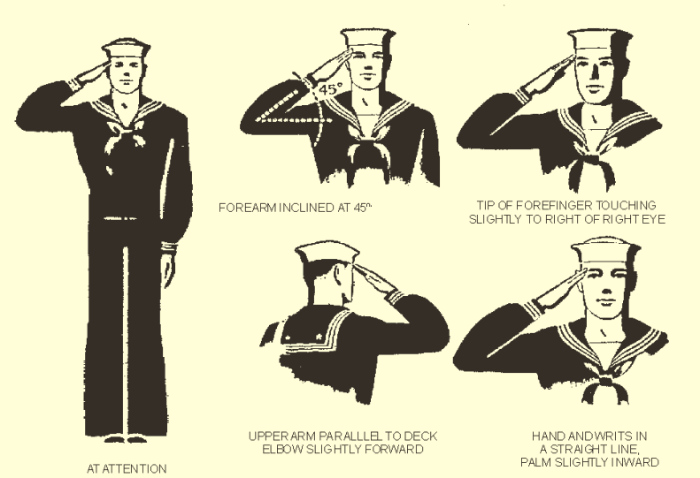
We kid, we kid. That said, if any Marine is upset, don't forget I live at 1060 W. Addison St. in Chicago.
Anyhow, there is no "other variant" used by civilians, or used by different branches of the service, or used by retired personnel.
History
R.R. in Wiesbaden, Germany, asks: The Washington Post's Jason Willick has a piece about Thomas Jefferson seeking and directing the prosecution of his political rival, Aaron Burr, sort of a precedent of Trump's current pursuit of charges against the individuals on his list of enemies. Could the staff historian weigh in on the discussion?
(Z) answers: I read the piece and... eh. Sure, the contours are vaguely similar, but that was well over 200 years ago. The past is a foreign country, as they say, and the relevance to today is dubious, at best.
And there are certainly examples, all of them more recent, of presidents who did get away with putting political rivals in prison. Abraham Lincoln and Clement Vallandigham. Woodrow Wilson and Eugene V. Debs. George H.W. Bush and Manuel Noriega. Some of these were more justified than others, but in any case, let's not imagine that Jefferson-Burr is the only precedent, or the most relevant precedent, here.
M.B. in Pittsburgh, PA, asks: Your recent criticism of Prager University made me question my use of one of their videos in my ninth-grade English classes in preparation for reading a novel about the Civil War. Though I don't live in the South, it isn't rare to see Confederate flags in Pennsylvania, especially outside of Pittsburgh and Philly, so I feel it's my duty to dispel misconceptions about the reasons for the Civil War, especially since the novel says that it "wasn't initially about slavery."
I also need to consider entertainment value, and the video is simple and well-produced—perfect for Gen Z-ers. We also discuss the ethos of the speaker, who is a history professor at West Point, and contrast his authority with bloggers and podcasters.
But do you consider the information to be accurate? And if so, do you think it's still problematic to give them a platform? Or can you recommend something else just as succinct and watchable?(Z) answers: By all indications, that professor, who was then Col. Ty Seidule, and is now Brig. Gen. Ty Seidule (ret.), knows his stuff and isn't being driven by a partisan agenda. He was chosen to serve, for example, on the commission that picked new names for military bases named after Confederates. That's instructive. I suspect he did work for Prager on the theory that someone else would do it if he didn't, and would do a more partisan/amateurish job. I have friends/colleagues who have agreed to be talking heads for this documentary or that TV program just to make sure that the production company didn't use someone incompetent.
Anyhow, I watched the video, and it's perfectly fine, and is short enough and engaging enough to be well-suited to the purpose for which you are using it. If Gen. Seidule were to call me up and ask for notes, I would give him a couple: (1) You might want to do more to make clear there were 11 Confederate states in total, who left in two waves (Before Sumter and After Sumter), and (2) You might want to do more to explain that the North was motivated by several concerns related to slavery, that the morality of the institution was only one of those, and NOT the biggest one. In other words, make clear that the motivations of the people of the North back then were different than they would be if the same situation were to occur today.
An interesting note is that Gen. Seidule apparently prefers to wear Civil War-style shoulder straps with his rank insignia. He's wearing them in the video, but it's not just an "I'm talking about the Civil War today" thing, because he is also wearing them in his official U.S. Army portrait. I thought it might be a West Point thing, but the other members of the History Department faculty wear regular, modern rank insignia.
A.G. in Scranton, PA, asks: Like many who have an interest in the Civil War, I find myself asking those million "What if?" questions that probably every Southern (or dipsh**, present-day Northerner) Lost Cause apologist has brooded over, drank a jug o' shine cussin' 'bout, and probably committed at least three hate crimes because of since Robert E. Lee's gentlemanly surrender to a generous, albeit disheveled, Ulysses S. Grant at Appomattox.
I know that butterflies have wings and that they flap them around a lot, and had General Thomas J. "Stonewall" Jackson survived his wounds from a nervous sentry at Chancellorsville, there's no reason to believe that events would have unfolded in such a way that Lee and the Army of Virginia would have still ended up at Gettysburg with everything else the same. The Confederates are on the low ground, the Union is up on the high ground atop Seminary Ridge, those dribs and drabs of units coming up to the line off a hot and dusty march, a bunch of petty generals who simply refused to follow orders, J.E.B. Stuart and his cavalry not doing his primary job of reconnaissance, all at the same time Grant was about to finally take Vicksburg.
But, if it did happen that way: Do you think General Jackson would have succeeded where General James Longstreet (a most trusted advisor of Lee) had failed and been able to convince General Lee—seemingly gripped with a myopia of some sort or beset by an almost religious fervor over those 3 days—not to fight at Gettysburg?
What do you think Lee's course of action would have been had Jackson been able to convince him not to fight at Gettysburg?(Z) answers: It is not probable that Jackson could have talked Lee out of moving northward in summer of 1863, or that he would have tried to do so. They were both convinced that the suffering of the war needed to be visited on the North, and that they would have to be the ones to do it. That is a view that made a heck of a lot more sense in 1862 (an election year, when Lee invaded Maryland) than in 1863 (not an election year, and when Lee was already running somewhat short on supplies and manpower, even before invading Pennsylvania).
Is it also not probable that Jackson would have talked Lee out of fighting at Gettysburg, primarily because that wasn't really a decision that Lee made. The battle started basically spontaneously, when elements from the two armies happened to encounter each other, and then everyone else came running. That said, if Jackson had been there, and if he'd gotten there pretty quickly, he surely would have been more aggressive than Richard Ewell, and would have taken Culp's Hill. That would mean that the Confederates would have held the high ground that otherwise ended up serving as the northern anchor of the Union line. Under such a circumstance, the Confederacy might well have won the battle.
However, even taking Culp's Hill and winning the battle would not likely have done much to change the fate of the Confederacy. Lee's invasion of the North could not have lasted much longer, due to the aforementioned shortages of manpower and supplies (even with the Rebels "living off the land"). Meanwhile, the folks who say "If only Jackson had lived through the end of the war" are conveniently forgetting that his ultra-aggressive, high-risk approach was only well suited to facing an overly cautious opponent like George McClellan. Eventually (namely in spring of 1864), Grant came east and started running the show. Grant was most certainly not overly cautious, and if Jackson had tried his signature stunts against USG, then he (Jackson) and his army would have been ripped apart from stem to stern.
S.N. in Sparks, NV, asks: When I saw the photo of ICE agents parading down a Chicago street, I thought of the Ku Klux Klan. Judge William Young compared ICE to the KKK recently. Do you think this comparison will gain widespread traction?
(Z) answers: Probably not, for two reasons.
The first is that various individuals and factions have compared their political opponents to Nazis, fascists, the KKK, communists, Marxists, etc., so many times that these lines of attack have lost salience, and most people kind of ignore them, even if they are apt.
The second is that the ICE guys aren't really all that similar to the modern Klan—the yahoos who put on sheets and burn crosses and wave Confederate flags, and so forth. What they are actually similar to is the first iteration of the KKK, back in the 1870s, who put on the masks to hide their identity/avoid potential legal trouble, and who actively traveled around looking for people of color to harass and intimidate. Most people don't know much (or anything) about the original Klan. And so, they won't likely appreciate the salience of Judge Young's comparison, and won't latch onto it.
R.M. in Pensacola, FL, asks: Modern polling didn't really become something until the 1950s (anyone remember "Dewey defeats Truman"?).
However, I'm curious as to what the approval rating of the Nazi party was within Germany from 1933 to 1945.
Clearly, it was high enough to take power in 1933. I also have to presume that at the end of World War II, the support for the party was in the single digits, maybe in the teens.
But what about in between? How much support did they have from the general public in Germany during their 12-year run in power?(Z) answers: This question is unanswerable, unfortunately.
Adolf Hitler did not have majority support when he first gained power. The German Reichstag was pretty much designed to be balkanized, and Hitler rose to the second-highest position in the German government (chancellor) not because of his broad support, but because President Paul von Hindenburg was trying to shore up his right flank, and appointed Hitler to try to make nice with the fascists. From there, it was just a matter of: (1) waiting for the aged and ailing Hindenburg to die and (2) taking advantage of a weak government where an assertive faction could seize near-permanent control, even if they were a minority.
Once the Nazis seized power, well, they still were not in the majority. In fact, there was never a time that more than 11 or 12% of the German population was an official member of the Party. This fact is often held out as meaningful; as evidence that it doesn't take much for a government to be destabilized and overthrown.
However, focusing on how small a percentage of the German public actually became Nazis presents a false picture. First, part of the reason that the Nazis were able to gain power was the aforementioned badly designed government, which is not paralleled in most other nations (and is not paralleled in the U.S., despite the weaknesses in the U.S. system). On top of that, many, many Germans joined Nazi-affiliated groups, like the German Labor Front (23 million people), National Socialist People's Welfare (13 million) and Nazi Youth (9 million). Also, it actually got somewhat difficult to join the Nazi Party proper, because many Nazi leaders were fanatics, and fanatics tend to demand purity tests of various sorts.
Even adding up the membership of the Nazi Party and its auxiliaries does not give an accurate picture, however. Some Germans joined the Party, or one of the auxiliaries, because it was necessary to maintain their business careers. Others joined because they were legally required to do so (for example, the future Pope Benedict XVI was compelled, by law, to join the Nazi Youth).
If polling had existed back then, it wouldn't have helped much. Telling ANYONE you weren't 100% on board with the Führer was an excellent way to end up with a one-way ticket to Dachau. So, even if we had polls, they would not be reliable in any way.
Fun Stuff
M.C. in Glasgow, Scotland, asks: (Z) mentioned Big Secrets, by William Poundstone. Are there any modern books that are anywhere near as good as that was?
(Z) answers: Not really, as Poundstone is, and has always been, something of a unicorn.
To the extent that kind of information is being produced today, it's not usually in book form, it's in podcast form. HowStuffWorks (and its various affiliated podcasts) covers some of the same ground, and so too do Ologies, The Hacker Mind and even Freakonomics and its affiliated podcasts.
Also, Poundstone is still active, and is still producing books that are at least complementary to Big Secrets. The ones on the Prisoner's Dilemma and on the hiring process at Google are both quite good.
W.G. in Salem, OR, asks: F.H. In St. Paul asked what you would consider to be the first rock and roll song? Your answer was "Rocket 88." While the genre had many early contributors, I submit that the very first rock song recording is Goree Carter's 1949 release of "Rock Awhile." Recorded almost 2 years earlier than "Rocket 88" and with an overdriven guitar and licks that Chuck Berry would use years later, it was a ground breaker.
A.J. in Baltimore, MD, asks: My pick for the first rock song is "Strange Things Happening Every Day" by Sister Rosetta Tharpe. It does have an electric guitar and predates "Rocket 88" by about 7 years.
Why does (Z) disagree that this is a rock song?J.C. in Fez, Morocco, asks: My mum was born in '42. She has always thought the first rock song—that she knew of—was "Rock Around the Clock" by Bill Haley and His Comets. She recalls hearing it on the radio on the bus... and they just kept on playing it, over and over, the entire bus ride. The students couldn't get enough of it.
(Z) answers: OK, I gave a simplified answer last week. Here's a more proper answer.
If I did not say this already, in my U.S. history survey class, I have a lecture on rock and roll. It starts with a discussion of double entendres, explaining what they are (with examples), and noting that, before it was a term for a style of music, "rock and roll" (and also "rock," and also "roll") was Black, urban slang for "fu**." Consequently, while "rock and roll" may not be a double entendre today, it was in the 1950s and 1960s.
Next up is the part about the roots of the genre. I start by doing a demonstration, where I ask the students, roughly two rows of them per question, to suggest: (1) a sub-genre of rock and roll (like punk or alternative) (2) a common theme of rock songs (like love or drugs), (3) an instrument used in rock songs beyond drums or electric guitar (like piano or flute) and (4) an element of rock performance (like costumes or destroying instruments). The point here is that rock is a very broad genre incorporating many diverse elements.
I then note that because it's so diverse, there is no way to come up with a strict definition, and that anyone who has tried has seen far more people object than agree. All I can do is point out some of the key elements that were part of the recipe of rock and roll and when they came into existence, like country music (1910s), blues (1920s), the electric guitar (1940s), and a generation of young people who were unusually well-heeled and unusually rebellious (the Baby Boomers; 1940s). That is followed by a list of common elements of rock songs, to wit: (1) electric guitar, (2) backbeat, and (3) a rebellious, commonly sexual, message, often accomplished through double entendre.
The next part of the presentation is on the first rock song. I note that if there was a universal, agreed upon definition, then all we'd have to do is find the first song that meets that definition. But we cannot do that, and so there are hundreds of songs that various people have put forward as "the first rock song." That said, the two most commonly named candidates are "Rocket '88" (1951) and "Rock around the Clock" (1955).
At that point, I play a portion of each song, and discuss with them why each might be a rock song. "Rocket '88" has the backbeat and the raunchy double entendre, but lacks the electric guitar. "Rock around the Clock" (1955) has the backbeat, the double entendre, and the electric guitar. It also makes specific reference to "rock." And it was the first identifiably rock and roll song to be a major commercial hit.
The conclusion of this whole conversation, before moving on to racism and how it shaped rock and roll, is this: "'Rock around the Clock' is clearly a rock and roll song. So, the genre must have existed by 1955, when that song was released. It may have existed earlier, depending on your exact sense/definition of a rock song. But it couldn't have existed much earlier than 1945 or so, because the key elements weren't all in existence yet. So, rock must have emerged sometime between the early-to-mid 1940s and 1955."
Thus, if I am going to give a quick answer to the question of "What is the first rock song?", the best answer I have, in my view, is "Rocket '88." But the REAL answer, if I explain things properly, is "There is no clear answer, it's a matter of judgment as to which song made between 1940 and 1955 first cleared the bar, and everyone's judgment is a little different."
P.S. in Marion, IA, asks: Like (Z), I'm an alumnus and fan of one of the Big Ten's "have nots." Why is college football so popular despite being so incredibly broken compared to pro sports in the U.S.? In Europe, it's Real Madrid, Barcelona, PSG, Bayern, Manchester United, etc., basically writing the rules to enrich themselves while everyone else fights for the scraps. In college football, just replace those big clubs with Alabama, Georgia, Ohio State and Oregon.
Is it possible that college football kind of collapses on itself when fans and alumni from 90% of FBS schools realize they have no chance?(Z) answers: Well, there are a couple of hundred Division I Football Bowl Subdivision schools. And even if we limit ourselves to the four major conferences plus the key independents (e.g., Notre Dame), there are still close to 100 schools. So, most college football fans have surely reconciled themselves to the notion, long ago, that they are not likely to see a championship for their team in their lifetime, and have contented themselves with winning their rivalry game, or their homecoming game, or the occasional game against a high-ranked opponent.
However, thanks to NIL and the transfer portal, we are getting dangerously close to the old Seinfeld observation, about how you're largely just rooting for laundry. It's hard to get invested in coaches or players anymore, because any or all of them could be gone next season. On top of that, the televised product is now spread across well over a dozen platforms. At a certain point, if you make it both less rewarding, and more difficult, to be a fan, then some fans are going to take a lesson from that. For these reasons, although I could see it going either way, I think the weight of the evidence points to the significant decline of college football.
Gallimaufry
D.E. in Fremont, CA, asks: As the parent of an aspiring high school teacher, and having just watched the gut-wrenching Netflix series Adolescence, I was encouraged and a bit relieved to read (Z)'s statement: "I refuse to accept the premise that students have 'deteriorated.' They are just different than they were 10 years ago..."
I hope a solid majority of teachers see it that way! But it raises a question in my mind: What do you see as the biggest challenge for teachers trying to equip young minds to thrive in this new world of social media, AI and the multitude—but also inseverable interdependence—of "tribes" around the world?(Z) answers: Trying to help them understand the difference between using these products as tools, and using them as a crutch. Google and Grok and ChatGPT and the like seem SOOOO good, and they are SOOO easy, that there is a tendency to overrely on them. It does not help that, presumably due to reduced school budgets, teachers are willing to hand off some of the work of teaching to the computer brains.
The emotional and psychological impact of social media, etc., is profound and often negative. However, dealing with that is probably beyond the purview of a teacher, and more the responsibility of the parents.
S.C. in Mountain View, CA, asks: Now that B.J. in Arlington has opened the door to wars of religion, I have to ask (V), big-endian or little-endian? (And no, this is not a reference to Gulliver's Travels.)
(V) answers: I am Apple all the way because MacOS is basically FreeBSD (Berkeley UNIX) with a bit more polish on top. My main computer is an M2 Mac Pro (because the M4 Mac Pro isn't here yet). My secondary computer is an M4 MacBook. I also have a big iPad, a little iPad, and two iPhone 7s, which is the moral equivalent of an iPhone 14, but more fault tolerant. All the M chips are little endian.
Technically, I do own a modern HP Pavilion notebook with an x64 chip (also little endian). I use it only when being called up to serve as computer repairman for a friend and I want to have a working Windows 11 computer with me in case I need it.
The last time I was in the big endian world was in the 1990s, when I ran a research project in which we had a 19" rack with 32 68030 SBCs for running our research operating system, Amoeba, effectively pioneering cloud computing a decade or so before it hit the big time.
For people who aren't into the endian wars, be thankful. Your time is better spent fighting over more important stuff like Emacs vs. vi or GPL vs. the Berkeley license.
K.R. in Austin, TX, asks: I've been looking for work, and I've recently learned about a new role called "AI Trainer" that sounds interesting and possibly a good match for my background and skills.
Do you know anything about what an AI trainer is? Can you offer any insight or advice about that role?(Z) answers: Basically, you look at the outputs of the AI and tell it where it screwed up, so it screws up less in the future.
If you're looking for a short- or medium-term gig, you could certainly do worse. If you are looking for a career, well, the first thing the computer brains will replace, as soon as it is practicable, is the AI trainers.
T.V. in Portland, OR, asks: I have had the same e-mail account since 2007, but I am going to be giving it up because it has become totally saturated with spam and junk e-mails. Between my Inbox and Junk folders, I probably get 150 e-mails or more per day. Many appear to be phishing ploys. I am now starting to use a new gmail account. What can I do to not end up in the same boat with the new account in a few years? Is it better to unsubscribe or does that simply tell the sender it is still a live e-mail, so they can turn around and sell the e-mail to some other spammer?
(V) answers: Get a burner email address, say peter384619@gmail.com or eddie58375@yahoo.com or something like that. Whenever making a donation to anything, use that e-mail address because they will be back for more later. Whenever you don't know or trust the other party and are not interested in hearing from them again, use that e-mail. Once every 6 months, log into that account, click on "Select all" and then "Delete All." Then logout. Don't even look at what is there. I often have hundreds of e-mails on my burner account.
As to unsubscribing, if the sender is a legitimate organization that wants money but is probably honest—say, the Red Cross or your alma mater—it is probably safe to click on unsubscribe. If you don't trust the sender, don't click because it tells them this is a live address. But going forward, all the mail from organizations you don't want to hear from again will go to Peter or Eddie and you can blindly delete them en masse twice a year.
(Z) answers: I am less disciplined about clearing out my burner account, and so it currently has 43,417 messages in it. Oh, well. That's a relatively small drop in the bucket; across all accounts and local folders (e.g., saved messages), I have well over 1.5 million e-mails.
I just wanted to add two things to (V)'s observations. The first is that you should do whatever you can to avoid your new e-mail address from actually ending up on the Internet. Once it's there, the webcrawlers will find it, and then it's Spamalot. Otherwise, the only way you can be discovered is by people who send e-mails to peter0000001@gmail.com, peter0000002@gmail.com, peter0000003@gmail.com, and then figure out which ones don't bounce back. There are far fewer people doing it that way than are doing it through webcrawling.
Second, it can be an interesting exercise, when you do sign up for something spammy, to use an identifying detail that lets you track who sold your e-mail to whom. Most commonly, I use my alleged "middle initials" for this tracking. My real middle initial is "G," but one time, for example, I decided to send some annoyed feedback to Rep. Dan Crenshaw (R-TX), and I did so with the middle initials D.C. That allowed me to figure out that the sleazy bastard sold my e-mail address to at least four different real estate speculators, three different car dealerships, a BBQ restaurant, and several other Texas concerns, in addition to a whole bunch of right-wing groups.
B.B. in Avon, CT, asks: You keep using "recission." My sources all say that "rescission" is preferred, with some saying that "recission" is OK (barely), but most saying that it is not a real word. Some say that "recision" is a word. Do you have backing for your usage that is stronger than anything I've seen? Note that the base word is "rescind," not "recind." Regardless, every time I see "recission" I have a nails-on-the-blackboard moment.
(Z) answers: Broadly speaking, we follow AP style. And AP style is governed by a number of general precepts, among them: (1) try to use the most common version of a word/name, and (2) try to use the shortest version of a word/name. The latter is because AP style was created for, and still exists for, newspapers, where space is at a premium.
With the word you cite, your version and our version are both correct, and both are recognized by the Oxford English Dictionary, which is the definitive work on the English language. When we had to decide which to use, the two precepts listed above were in conflict, and so we had to choose which precept to prioritize. A few weeks ago, I had an e-mail conversation with (V) and with (A), who acts as our de facto copy chief, and we chose to prioritize precept #2, and use the shorter, albeit less common, version of the word.
F.B. in Santa Monica, CA, asks: Do you think anyone caught your Spin̈al Tap joke in Friday's posting?
(Z) answers: We never know, especially when it's subtle like that. That said, we do like to have a few that not everyone will catch (or that most people won't catch), which serve as an easter egg for those who DO catch the joke.
Reader Question of the Week: Student Counsel, Part I
Here is the question we put before readers last week:
S.H. in Duluth, MN, asks: After reading the responses to the reader question of the week from M.R. in Lowell, I was wondering if I could get the other side of it. I'm a young student who has just started my first semester of university this fall, studying earth science. I was wondering if I could get any advice or suggestions about things I could be doing in college, or stuff that I should avoid doing.
And here some of the answers we got in response:
J.L. in Chicago, IL: I can offer three pieces of advice, one of which I am stealing from someone else because I like and agree with it:
- Talk to smart people who disagree with you.
- Get deeply involved in some sort of activity (and probably less deeply involved in others). There is a decent chance you will not find it immediately and it will be something that has not even occurred to you yet.
- Don't let classes get in the way of your college education. (This is the stolen one.) Obviously, that does not mean blow off your studies altogether.
C.L. in Boulder, CO: Generic advice for S.H. in Duluth and all college students:
- First week of classes: Go to LOTS of classes, more than you would sign up for. Go to different sections of the same course—Spanish 101, for instance—to see which one you'd most like to take. My husband did this and was always busy the first week, trying out multiple homework sets. I didn't figure this out until years later, but I used the idea to sign up for an 8:00 a.m. class (which had seats available), but actually sitting in the (officially full) 9:00 a.m. class because I had to drop kids off at school during the 8:00 a.m. time slot.
- Look into the popular courses. They are popular for a reason. One course on Human Sexuality was always packed, and the professor strongly recommended taking the course pass/fail, saying it was very hard to get an A. (Probably doesn't look great to have a C- in Human Sexuality on your transcript, and pass/fail takes a lot of pressure off the students and the professor.) An art history course was offered Monday through Thursday, but I had a M/W/F course, so I discreetly attended the large lecture class every Tuesday and Thursday except when there was an exam. I watched the slides and listened to the docent—er, teacher—explain the art we were seeing.
- Go to campus events featuring notable visitors. You can schedule studying anytime, but special visitors are a one-time event. Back in the day, the speakers were not necessarily recorded for wider viewing like today, so this advice may be less relevant now, but the in-person interaction with other attendees will never be replicated on Zoom.
- Get off campus regularly so you don't live in a bubble. Get a part-time job off campus or follow your passion and join an off-campus organization and offer to be the campus liaison. You'll make contacts which could help you with your future career.
- Get to know your professors, but don't hog their time. In a large lecture class, such a task can be hard, so you might want to pick and choose which professors to approach during office hours.
- Dorm living: Make a map of your dorm with all the rooms and who lives in each. I wish I had done this all 4 years. My freshman dorm is having a Zoom reunion on Saturday, and we started to recreate a map, but why wait?
- Social parties: I felt very liberated when I realized that I didn't need to meet everyone at a party, and that, if I had one good conversation, then it was a good event. This philosophy has served me well ever since. Exception: If you are hosting a party, then you should talk to everyone. Also, if you are living off campus and hosting a party, please tell your non-student neighbors that you plan to have a party. They will be so impressed and grateful that you are reaching out to them and introducing yourself. They will be much more likely to call you at the number you give them to tell you the party is too loud than to call the police to give you a noise violation.
Specific counsel for S.H. in Duluth: I know someone who has a second home in Duluth and might be looking to rent it to people who will keep it well-maintained. Ask (V) and (Z) for my contact info if you want to find out more.
C.M. in Raymond, NH: Try to enjoy yourself. If you are not having fun in college, you are probably doing something wrong.
Your classes are important, especially if you are planning to continue in earth science with a graduate degree. However, if you are not having fun, you are either doing something wrong or you are in the wrong place.
I had undiagnosed ADD, put everything off until the last minute, and barely escaped with an undergraduate degree. But I rarely use my classwork in my career; I use the experience I had in my student job (tech support for the university), my leadership work in student organizations (and watching my predecessors in those roles).
So, make sure you are getting your class work done (and if you are having trouble, try to find out why—maybe you also have an undiagnosed condition). But don't neglect the other benefits that being present, in person, with other like-minded people bring.
B.B. in St. Louis, MO: I'll start by listing things to avoid in college:
- Alcohol
- Cigarettes
- Firearms—statistics show the person you are most likely to kill is yourself
- Infinite Time Sinks—several students in the class ahead of mine at Caltech were forced to drop back a year because they discovered Dungeons & Dragons.
- All-nighters—your efficiency will go down and your error rate will rise after midnight. Do not make the mistake of thinking that coffee (or, even worse, Adderall or Ritalin) will help you compensate.
Things to do:
- Get a good basic knowledge of food preparation. This is NOT the same as learning recipes. Setting up good eating habits early in life will be a tremendous boon to you when you get older, and baking brownies is usually a good way to make new friends.
- When studying math and sciences, actually learn the material and don't just memorize the formulas.
- Take Physical Education courses. You may not be interested in competitive sports, but exercise is good for your heart and if you are lucky, you may find offerings in martial arts, folk dancing, yoga or tai chi.
- Participate in at least one extra-curricular activity. Theater and Glee Club are good because they are non-competitive, but choose your own. I am partial to board games because they are all about choosing strategies to maximize outcomes using incomplete information, which is essentially what life is all about. You go with what appeals to you.
- Learn to breathe. I mean properly, from the diaphragm. You are in for an exciting time ahead and it helps to have at least one tool available to help you slow down and calm yourself.
Perhaps you can write back to Electoral-Vote.com periodically to let us know how you are doing.
G.M. in Arlington VA: S.H. is already ahead of the curve, as they know what they're studying. Not everyone goes to college knowing what they want to do. As such, they will find a great variety of people, some of whom will be good to hang out with and some not so good. Find the ones who are most simpatico to you, in terms of studying, sports, alcohol, drugs, sex and so on.
J.O. in Williamsburg, MA: I went back to school at the age of 34 courtesy of my employer—a great opportunity that led to getting my third degree. I learned:
- Be on time or a bit early for every class so you can get the best seat.
- Make some friends in each class, in case you need to miss and can get their notes.
- Make an opportunity to interact with each instructor early on to show interest and become a person, not a vague face in the room.
- Get ready every day for the possibility of a pop quiz.
- But try not to stress out—enjoy the experience—it will be different from the rest of your life!
J.B. in Hutto, TX: You are attending college to get a degree in earth science, but that's not all. If you do it right, your college education can be so much more than a job-training program. These years, more than any other time in your life, are when you should be forming yourself into a well-rounded human being with a fully developed mind. Don't throw away the opportunity.
Haunt the library. Attend talks given by guest lecturers. Whenever possible, take classes that interest you, even if they are not required by your degree plan. In particular, I'd urge you to read the classics. Don't look at the English course requirements in your degree plan as a burden, but as an opportunity. Read Homer, Virgil, Dante, Shakespeare and all the rest of them. If your professor requires you to read only excerpts, read the entire works. This is hard work, but it's supposed to be, as anything worth having should be difficult.
To sum up, reject the modern urge to be a hyper-specialist and instead embrace the old Renaissance ideal of the universal man.
G.G. in Johannesburg, South Africa: I'm an academic-professional (one foot in industry, one foot in academia), and am currently running a stream of degree programs within our School. I'm not specifying which field because it doesn't really matter for what I'm about to say. Here's what about 15 years of experience teaching in three different countries can offer as advice to a new student:
- Structure your time like a professional. This means making time for everything you want to do (not just for schoolwork), but it also means not sacrificing schoolwork when there are other things in your life. Being a student is not about absorbing content, it is about learning how to function as a thoughtful, productive member of a decent society. Don't rationalize absences by thinking the course is insignificant, or less important, or that so-and-so is a lousy teacher (there will be some of those). Those are things you will also have to deal with in a professional career. Get used to it.
- Read the damn syllabus. It is a contract between the professor and you, and is crafted the way it is for good reasons. I sometimes slip a sentence into the middle of some mundane clause of the syllabus that tells students how to earn extra credit. In most years only about 5% of the class notices it and does the task, which means 95% didn't bother to read it. Somewhere between 60% and 90% of the job of most academics (research, course prep, grading, industry liaising, admin, general cat-herding, etc.) is invisible to most students, especially undergrads. Because of that, I do not have the time to be a personal tutor, so I really do not appreciate having to tell students things that have already been clearly presented just because they weren't paying attention or didn't bother to read.
- That notwithstanding, seek help when you need it. No one judges you or thinks you're dumb because something just doesn't click. Rather, it shows an eagerness to learn, which is the whole point. Having said that: refer back to Point 1. I get upwards of 200 e-mails a day, so don't be offended if a professor doesn't respond immediately. Don't assume your professors are always available; we are not. Plan what you need in advance as much as possible.
- Transparently acknowledge how you use AI, if and when you use it, every time, even if your professors don't ask for it. Demonstrate how you engage with it critically. I just finished grading 82 papers, of which probably 90% of them were partially or mostly AI-generated, without acknowledgment, in contradiction to the clear guidelines offered in the syllabus (see Point 2). The plagiarizing is problematic, but what is even more irritating is having students who assume academics are too tech-backwards or too stupid to recognize what is going on, or who are exploiting loopholes about "provability" because they can probably get away with it. It's dishonest, and is behavior that would get you fired from any well-managed future employer.
- Adding Points 1-4 together, remember that you will someday need letters of recommendation from some of your professors. We are happy to give them if: (1) We actually know who the student is, (2) The student has shown a respectful attitude and (3) We've seen the student actively learning. "Actively learning" could mean someone who started out getting straight As continuing to excel year after year, or it could mean someone who started out getting Ds and ended up getting a C+ or a B-. Grades are indicative measurements to help you see where you stand and reflect on it at a particular moment in time; they are not endorsements of your worth. My most trusted and productive academic colleague is someone who finished her Masters degree with a C- average; my most useless colleague was a straight-A student. Learning is a journey you have to be willing to go on. In 10 years no one will ask about your GPA, but they will ask about your character and overall attitude.
- Take advantage of everything the university has to offer, even if it has nothing to do with your field of study. It is unlikely you will ever again have such easy access to elective courses, public lectures from top-flight thinkers or professionals, support programs to help learn whatever new software there is to learn, free concerts from a School of Music, talks about the cosmos in a planetarium, free gym access, etc.
L.C. in Brookline, MA: Here are some recommendations for people entering college in this ever-worsening time for education, made with the consideration that the college part of your life is not in a vacuum, and that much of what I was able to get by with will no longer work in today's increasingly hostile conditions, for which no lasting relief is in sight.
Don't use mind-altering drugs, whether legal or illegal, and as much as possible, avoid those who use them. These substances make you stupid. You are in school to learn. Doing things that make you stupid will make this more difficult or impossible. Not only that, this is extremely inconsiderate and damaging to others who are in college to learn, particularly when the substances are smoked or vaped and thereby directly affect others. I didn't use any of these substances, but I had to suffer the effects of many other peoples' use of them. And you will have enough challenges to see truth, imposed by our worsening social environment, without impairing your judgment yourself. And in line with the next item, you will save a great amount of money by not using such substances.
Beware of hidden costs and other traps in any financial aid you get. These can come back to bite you later, and not all that much later, and once they bite, they will not unclench their jaws. Use college to learn how to be frugal. Even check whether your college offers instruction in personal financial awareness.
Don't believe people (including counselors) who tell you that grades don't matter for the future. They do. The sad truth of the matter is that you will have to balance true desire to learn against the possibility that taking the classes that teach the most may punish you for your learning by giving you lower grades. Also beware of the professors that tend to act as if their class is the only one you are taking—if you have multiple professors doing this at the same time, you will be in a world of hurt. Related to this, if you do have problems with your grades, but you manage to get better later on, it is worth putting a year between finishing college and applying to post-college schools or positions, to have the benefit of your better later grades.
On the other hand, when a teacher does make an honest effort to teach, take them up on it without delay. I learned (actually back in high school) that you really don't want to let these rare gems slip by.
The classes that I did best in were generally the ones in which I did the least work.
Beware that conditions have become permanently much more hostile towards education and science than when I was in college, which was early to mid 1980s, although the trend in that direction was already visible. Make sure you have a backup plan in case your chosen field of study turns out to be a dead end for your future employment prospects. I was and am now in science (life science, specifically microbiology), but in the unlikely event I ever manage to have children, I would not in good conscience be able to recommend a career in science to them. Learn how to pick up skills, so that you have the most options available.
Also beware that conditions have become permanently much more hostile towards freedom of speech than when I was in college (although the trend was already visible). Be careful what you sign onto in the way of protest letters and petitions. Make sure you read the whole document you are signing onto, and think through its implications—even those that could stem from insufficiently precise wording—no matter how good the cause appears to be. This does not mean to refrain from taking any risks, but in opposing those who have shown great creativity in weaponizing different facets of justice against each other, we have to be right all of the time, while they only have to be right once. For an example, see the weaponization of protests against Israel's war on Gaza and the ensuing charges of antisemitism against those protesting against this (and universities hosting them) for an especially prominent recent example—you don't want to sign onto something that makes you an unwitting legitimate or even close-to-legitimate target for charges of antisemitism (or whatever else is being weaponized against freedom of speech and protest).
Related to the above, learn critical thinking for the purpose of discerning when what official sources are saying may not be true. This has always been important, but now it will become ever more difficult as media and the universities themselves are forced to bow to the forces of totalitarianism—or worse yet, make the choice to do so themselves. We are heading into a future that George Orwell warned us about. Use college to prepare yourself for this while you can.
B.R. in Berwyn, PA: I will give you the same advice I gave my kids, both of whom went to large universities with a broad range of programs:
Every semester, take at least one course that is totally outside your major or your career plan. You can always pick up more chemistry or math or geoscience later in grad school. But there will never be another time in your life when you will have both the time and the opportunity to explore literature, music, philosophy, languages, history, theatre, ethics, science or anything else.My kids took me at my word and ended up doing courses in Jazz Composition, Comedy Improv, Opera, Hindi, Impressionist Art History, Justice, Disney Music Appreciation, Field Ecology, Behavioral Economics, Astronomy of the Universe, Ethics of Climate Change, Modern American Political Campaigns (co-taught by campaign directors from both parties), Greek and Roman Mythology, and Human Genetics and Society, along with their core studies in Business, Computer Science, and Government.
I believe that what they discovered was that college is richest when you treat it as a chance to grow a lifelong love of learning.
And since you also asked about what to avoid, I will also share the four simple rules I offered my kids:
- I'm not telling you not to drink. I'm telling you never to drive a car after a drink, or get into a car with a driver who has had a drink.
- I'm not telling you not to have sex. I'm telling you never to have sex without a condom.
- I'm not telling you never to have pot. I'm telling you never to take harder stuff you need to ingest, snort, or shoot yourself.
- And if you are in trouble at 2:00 a.m., no matter how bad it is, call your parents. There is nobody else who will drop everything to be there immediately.
Since we did teacher e-mails for 4 weeks, and since the teacher/student e-mails have a fair bit of practical value, we are going to do the student e-mails for another week, maybe a couple more weeks. Then we'll be back to having a new question every week.
There is still time to submit suggestions for students to comments@electoral-vote.com, preferably with subject line "Student Counsel"!
If you wish to contact us, please use one of these addresses. For the first two, please include your initials and city.
- questions@electoral-vote.com For questions about politics, civics, history, etc. to be answered on a Saturday
- comments@electoral-vote.com For "letters to the editor" for possible publication on a Sunday
- corrections@electoral-vote.com To tell us about typos or factual errors we should fix
- items@electoral-vote.com For general suggestions, ideas, etc.
To download a poster about the site to hang up, please click here.
Email a link to a friend.
---The Votemaster and Zenger
Oct03 Lots of Abortion News this Week
Oct03 Legal News: Is the Supreme Court Getting Ready to Give Trump a Big L?
Oct03 I Read the News Today, Oh Boy: Julius Caesar Was a Prodigy
Oct03 This Week in Schadenfreude: Superintendent Steps Down, Presumably Because He's an Ol' Dirty Bastard
Oct03 This Week in Freudenfreude: Bad Bunny Knows How to Play The Game
Oct02 There Are Many Unanswered Questions about the Shutdown
Oct02 Another Sector Is Worried about Trump
Oct02 The EU Wants to Spend Frozen Rubles to Buy Ukraine EUROPEAN Weapons
Oct02 A Key Cybersecurity Law Has Expired
Oct02 Judge Swats Down Another Improperly-Appointed U.S. Attorney
Oct02 It Is Hopeless
Oct02 Republican Congressman David Schweikert Will Not Run for Reelection
Oct02 2026 Will Have Yet Another Barnburner State Supreme Court Justice Race in Wisconsin
Oct02 DeSantis Gives Trump Land in Downtown Miami for His Presidential Library
Oct02 Congress Does Not Function but Some State Legislatures Do
Oct02 Trump Administration Is Working to Disenfranchise Another Group of U.S. Citizens
Oct01 The Government Is Shut Down
Oct01 Trump, Hegseth Attempt to Stage Rally at Nuremberg... er, Quantico
Oct01 Judge Delivers Scorching Rebuke to Trump
Oct01 Antoni's Goose Is Cooked
Oct01 Johnson Is Dragging His Feet with Grijalva
Sep30 Get Ready for a Shutdown
Sep30 Day of the Long Knives?
Sep30 Trump Wants to Ruin Sports, Part I: The WNBA
Sep30 Trump Wants to Ruin Sports, Part II: The World Cup
Sep30 Trump Wants to Ruin Sports, Part III: The Ryder Cup
Sep30 Trump Wants to Ruin Sports, Part IV: Electronic Arts
Sep29 The Blame Game Is Starting
Sep29 Adams Quits Race
Sep29 Trump Wants to Run Another Company
Sep29 Who Controls the Past Controls the Future
Sep29 Texas and Missouri Have Drawn New Maps but Maryland is Dawdling
Sep29 Americans--Even Republicans--Do Not Want Government to Block Dissenting Speech
Sep29 Other Countries Have Better Election Laws
Sep29 Giuliani Settles Defamation Lawsuit with Dominion Voting Systems
Sep28 Sunday Mailbag
Sep27 Saturday Q&A
Sep27 Reader Question of the Week: Teaching Assistance, Part IV
Sep26 Legal News, Part I: A Legal System Under Suspicion?
Sep26 Legal News, Part II: The Power of One Person... to Screw Things Up
Sep26 Military News: Is Pete Hegseth about to Commit High Crimes and Misdemeanors?
Sep26 The Economy: Trump Takes Steps to Make Sure Shutdown Has a Deep Impact
Sep26 I Read the News Today, Oh Boy: "The Battle Hymn of the Republic" (aka "Glory, Glory Hallelujah!")
Sep26 This Week in Schadenfreude: Jimmy Kimmel Unleashed
Sep26 This Week in Freudenfreude: It's "The Shawshank Redemption," Redux
Sep25 Could a Shutdown Really Happen?
Sep25 Voters Think the Country is on the Wrong Track
Sep25 Democratic Group Is Going after House Republicans on Tariffs and Prices
Sep25 There Are No Paper Bears

