


 Welcome & FAQs
  Table of Senate polls
 Senate graphs
 Tipping-point-state
 Congress: retirements
 Governor's races
 Icons for bloggers
 Data galore


• We Hope Donald Trump Stocked up on Soap
• The 2025 Election: Post Mortem, Part VII--What Is the Lesson of Prop. 50? (aka, Gerrymandering, Part I)
• Gerrymandering, Part II: It Could Be a Sleeper Issue Next Year and Beyond
• Gerrymandering, Part III: Republicans Are Losing
• Gerrymandering, Part IV: Democrats Gone Wild?
Quite a few readers e-mailed in to let us know why the Internet was broken yesterday. Cloudflare,
which provides a great many websites with defenses against malicious attacks,
was down.
It is not probable that anyone will make a public announcement, but one wonders if some sites were compromised while
their protective shield was offline.
In any event, all we can say is this: Thanks, Obama.
They Stabbed It with Their Steely Knives, But They Just Can't Kill the Beast
Yesterday, 527 members of Congress voted to demand the Epstein materials from the Trump administration. One member voted against. And so, the bill sponsored by Reps. Thomas Massie (R-KY) and Ro Khanna (D-CA) will soon be on its way to the White House. Donald Trump has said he'll sign it, and you can count on him to do so. After all, he is a man of impeccable integrity who would never go back on his word.
The person who kept the vote from being unanimous was Rep. Clay Higgins (R-LA). He quickly took to eX-Twitter to explain himself:
I have been a principled "NO" on this bill from the beginning. What was wrong with the bill three months ago is still wrong today. It abandons 250 years of criminal justice procedure in America. As written, this bill reveals and injures thousands of innocent people — witnesses, people who provided alibis, family members, etc. If enacted in its current form, this type of broad reveal of criminal investigative files, released to a rabid media, will absolutely result in innocent people being hurt. Not by my vote. The Oversight Committee is conducting a thorough investigation that has already released well over 60,000 pages of documents from the Epstein case. That effort will continue in a manner that provides all due protections for innocent Americans. If the Senate amends the bill to properly address privacy of victims and other Americans, who are named but not criminally implicated, then I will vote for that bill when it comes back to the House.
Maybe that is the God's honest truth. That said, Higgins is a politician who built his entire career on his image as a law-and-order former cop, but who has a track record of playing fast and loose with both laws and order, at least on occasion. We are at least somewhat suspicious that either: (1) He saw an opportunity to be the "one guy" who stood with Trump, in hopes of securing whatever rewards that might bring, or (2) He is trying to take the lead in the messaging that we suspect is forthcoming from the GOP (more on that in a moment).
The Senate vote, meanwhile, was by unanimous consent, at the request/instigation of Senate Minority Leader Chuck Schumer (D-NY). Technically, that kept any of the members of the upper chamber from having to formally go on record with their votes. Oh, and this whole thing has acquired such an aura of inevitability that the Senate's approval came before they actually had the final House bill in hand. Whenever Speaker Mike Johnson (R-LA) finishes the paperwork, then it will go to the Senate for a rubber stamp or an official seal or a gold star or whatever happens when a bill is formally passed, and then it's on to the White House.
Yesterday, we offered up our theories as to why Donald Trump (and Speaker Mike Johnson, R-LA, for that matter) surrendered so thoroughly, and changed course so dramatically. Would anyone like to see some reader theories? We thought you might:
A.F. in Seattle, WA, writes: I read your list of theories as to why Trump has decided to publicly call for the release of the Epstein files, now that it's basically inevitable that they'd be coming out in any case. As far as I can tell, Trump is pulling from his own Ukraine playbook. Recall that in September of 2019, when it became clear that a transcript of Trump's extortionate call with Zelenskyy—the existence of which was revealed to Congressional Democrats by a sloppily-covered-up whistleblower report—was going to be made public one way or another, Trump actually chose to release the transcript himself. That allowed him to do his usual gaslighting routine of pretending it was a "perfect phone call," which certainly many of his followers continue to believe. There was no real plan beyond that—he wasn't actually able to alter the transcript or stop its release (and, indeed, it led directly to his first impeachment).
J.D.M. in Portland, OR, writes: The list of potential explanations missed the most probable explanation: The Orange Menace is psychologically incapable of admitting defeat (see January 6th, long trail of actively denied quality-problem candidates, etc.), so the only option remaining is to say it was all his idea in the first place. You yourselves have observed many times The Orange Menace can't even manage a game of mental checkers, let alone any-dimensional chess. "Avoid looking like a loser today, lie about tomorrow" perfectly fits his MO.
J.B. in Bend, OR, writes: Before the election last year, a friend of mine (Trump supporter) said "I'm not a big Trump guy, but what bothers me about Harris is that she has no backbone." I immediately observed that Trump always backs down when he's confronted. To which my friend wrinkled his brow and said "you think so?" And I replied: "Always."
Well, here we are just over a year later and the epithet "TACO" has been proven correct over and over again.
You offered several possible reasons why Trump suddenly changed his position on the House vote to release the files, but the most obvious one is that he knew he was going to lose (bigly) and he backed down just like he always does.
C.D. in Lexington, KY, writes: You mentioned several good reasons why Trump pivoted to releasing the Epstein files. My pet theory (with, admittedly, no basis in fact) is that it was simply a delaying game all along.
If he can delay until he's out of office or dead and people stop caring—great! If not, the longer he delays, the more he can hand-wave away anything that comes up (text, pictures, video) as an AI creation. People are already starting to believe less of what they read and see because AI-generated content is so common, and there's no reason to think that trend won't continue.
D.E. in Lancaster, PA, writes: He's in the "Fu** It" phase—Trump got some really bad terminal news from the doctors regarding his health. Since he believes the universe will cease to exist after he dies, he's basically saying "I don't care. What's the worst they can do? I'll be dead before they can even take me to trial. And I have my old insurrection plans lying around somewhere that I can dust off before they can impeach me. I'm going to take every single one of them down before I go, too!" A cornered animal always acts very erratically.
K.B. in Philadelphia, PA, writes: When I heard that Trump had said "It is really a Democrat problem. The Democrats were Epstein's friends, all of them," I thought that he was playing the victim card again. I offer my Theory 7 to the six published on Tuesday: When Trump instructs DOJ to redact victim names from the Epstein files, he'll have them be as broad as possible in removing the names and context for Republicans involved with Epstein while being equally careful to preserve the names and context of Democrats involved.
Such creative redactions won't survive, of course, if another source of the material is available, such as from the Epstein estate or Congressional committees that already have a large tranche of documents.
D.H. in Mashpee, MA, writes: It seems that another—and more likely—possibility for Trump's switch on releasing the Epstein files: He's already directed his Justice Department to investigate Democrats mentioned in the files. Now, he could say that he'd like to release the files, but, unfortunately, he can't because an active investigation is underway (which could take as long as he wants the Justice Department to take). Et voila! Every Republican is off the hook, just like magic.
K.H. in Ypsilanti, MI, writes: Another possibility on why Trump did a 180 on the Epstein files bill. He said that if it passes, the House Oversight Committee can have any files "they're legally entitled to." This strongly suggests he's going to try to withhold some files as being exempted by privacy, national security, fair trial, etc. considerations despite the congressional legislation and will continue to fight it out in court, where he's had great success in running out the clock on things.
C.F. in Waltham, MA, writes: None of your theories can be correct, because they all involve Trump actually releasing some form of the Epstein files which he can tell AG Pam Bondi to do right now, and get to any of the goals you list far more quickly. My theory is much simpler: Have all Republicans sign on to the vote (including Trump) so no Republican is part of the PPP (Pedophile Protection Program) and then have Pam Bondi reject it on the basis that it is now an "ongoing investigation" (announced, at least for Democrats, last week) and could prevent the arrest and conviction of the pedophiles in the papers. She is blamed (not Trump) and they are now doing something noble to make sure that actual criminals can be indicted and sent to jail.
E.C.F. in Somerville, MA, writes: "I can't release some of the Epstein Files because they're part of an ongoing investigation" is the new "I can't release my taxes because they're under audit."
We think that the last several letters probably have the right of it, at least in large part. It is inconceivable that the Trump White House is going to release material that is detrimental, or even potentially detrimental, to Trump. There is going to be SOME scheme to keep the information hidden. Perhaps Bondi will claim there is an investigation going on, and she can only release 5% of the material. Perhaps, once the files are turned over to the Republican members of Congress (which is what the Massie bill actually calls for), they will follow some version of the argument made by Clay Higgins, and will declare that they simply must redact vast amounts of information so as to protect the innocent.
The question is whether such ultimately empty gestures are actually enough to calm the storm and to satisfy the MAGA crowd. Recall that this matter already got so far out of hand that it not only caused Congressional Republicans to defy Trump, but to do so almost unanimously. The administration has not been able to slay this beast with half-measures and sleight-of-hand so far; it's hard to see why that would change now. (Z)
We Hope Donald Trump Stocked up on Soap
Why do we hope that, you may ask? Why, because of all the ballwashing that Donald Trump did for Saudi Crown Prince Mohammad bin Salman yesterday. Yes, that's a pretty vulgar way to put it. But it's a vulgar situation overall, so we feel OK about our choice of phrase.
MbS visited the White House yesterday for his latest face-to-face meeting with Trump. The administration pulled out all the stops, with the Marine Band playing tunes, and a flyover from some F-35s, and all other bells and whistles. And then they got down to talking turkey. The Saudis want U.S. military hardware, and Trump was pleased to agree to that, committing to the sale of 300 American tanks and an as-yet-unspecified number of the F-35s.
Now, a skilled negotiator—someone who is experienced in the art of the deal, for example—would have used those tanks and planes to gain leverage over the Saudis. In particular, the U.S. wants that nation to normalize relations with Israel. That could have been a condition of the weapons sale, but it is not. Trump himself said the Kingdom of Saudi Arabia will get the materiel with "no strings attached."
As a bonus, Trump also delivered a little spin, free of charge. Talking to reporters, the President made two claims about the murder of Jamal Khashoggi, a murder that the CIA concluded in 2018 was ordered personally by MbS. First, Trump said that, "Things happened, but [MbS] knew nothing about it, and we can leave it at that." Then, the President followed up by implying that Khashoggi basically got what he deserved: "You're mentioning somebody that was extremely controversial. A lot of people didn't like that gentleman that you're talking about." As the cherry on top of the sundae, Trump also suggested that the Saudi government had no connection to the 9/11 attacks, despite copious evidence to the contrary.
Trump did get something out of the talks, we should note. MbS had already committed to investing $600 billion in the United States, and yesterday he upped that figure to $1 trillion. The entire annual GDP of Saudi Arabia is $1.2 trillion, which should give some useful indication as to how likely it is that the Saudis will deliver on that promise. Does Trump really believe that money is coming down the pike? Is he that delusional? Or does he know it's a load of camel manure, but he repeats it nonetheless because it's a good talking point? We honestly don't know, at this point.
The investment won't be $1 trillion, but suppose it is $300 billion spread over 10 years. What does "investment" mean, actually? Is MbS going to build a giant factory to build camel saddles in the U.S. and employ thousands of workers? Not likely. What he might do is buy up American companies in whole or in part. For example, suppose he bought a controlling interest in Ford or General Motors or both. Then he could use his power on the board of directors to have the company get out of the electric car business and focus primarily on big gas-guzzling SUVs. Alternatively, he could buy up U.S. chip manufacturing companies in order to get at their process technology and trade secrets in order to develop Saudi companies to compete with them. He could give big grants to top universities to open campuses in Saudi Arabia to train the next generation of Saudi engineers in order to diversify his economy. There are many ways he could "invest" that money to the benefit of Saudi Arabia and to the detriment of the U.S. Trump probably hasn't even thought of what MbS could buy with a few hundred billion dollars. We suspect MbS is already thinking about what is on his shopping list. The investment could easily end up being a huge net negative for the U.S. by giving Saudi Arabia a powerful influence in key parts of the U.S. economy.
Whatever is going through his head when it comes to the $1 trillion, what Trump really cares about is his family's own personal financial interests. And the most concrete thing he secured yesterday was the Saudis' ongoing commitment to the $2 billion investment fund they have put in the hands of First Son-in-Law Jared Kushner. It's really a brilliant investment by MbS & Co. Even if Kushner, who is not exactly the world's most talented businessman, loses some giant chunk of the investment, the Saudis have paid a relative pittance to have the government of the United States in their hip pockets (assuming thawbs have pockets). Meanwhile, Kushner and family get to pocket the exorbitant, way-above-the-industry-norm management fees they "negotiated" with the Saudi government. Everybody wins. Well, except for the American people, of course. But who cares about them? (Z)
The 2025 Election: Post Mortem, Part VII--What Is the Lesson of Prop. 50? (aka, Gerrymandering, Part I)
Guess what? Today is Gerrymandering Day! Now, now, try to contain your excitement. Actually, yesterday was supposed to be Gerrymandering Day, but then the Internet crapped the bed. This turns out to be fortuitous, however, because there was actually some pretty big news yesterday (see "Gerrymandering, Part III").
Democratic politicians have always operated on the principle that their voters want to play fair and would be very upset if they pushed the envelope to the limit. The 64% to 36% margin that Proposition 50 got in California ought to dispel any notion that Democratic voters' top priority is playing fair. It really could not be clearer that Democratic voters want to win any way that is legal, and that being "polite" or "fair" is not on the table anymore.
All eyes are now on Gov. J.B. Pritzker (D-IL). In terms of state law, he is in an ideal situation to do something dramatic. Illinois does not have an independent redistricting commission. The legislature, which has Democratic supermajorities in both chambers, draws the maps. The Supreme Court has explicitly said that partisan maps are allowed.
When the state legislature reconvenes in January, Pritzker could ask the Democratic leaders to go to town and simply eliminate the three Republican districts and make sure every representative was a Democrat. There is no legal barrier to that. Would the map be pretty? No, it would make Elbridge Gerry cry in his grave, but it would be legal. Democrats just played nice in the past. If Pritzker told the legislators, in private and in public, to redo the map to eliminate all the Republican seats, there is a good chance that not only would the vast majority of the Democrats nationwide applaud him, but it would cancel out one of the major selling points Gov. Gavin Newsom (D-CA) will have in the 2028 presidential primaries. Pritzker could then brag: "He eliminated five Republican seats. What a wimp. I eliminated every Republican seat."
Up until last Tuesday, pundits and talking heads would have said: "Tsk tsk. Don't do it. The voters will punish you for pushing the envelope." Now it is abundantly clear that Democrats are not interested in being Mr. Nice Guy or Ms. Nice Gal anymore. They prioritize winning. It will be interesting to see if Pritzker got the message. That said, keep reading. (V)
Gerrymandering, Part II: It Could Be a Sleeper Issue Next Year and Beyond
The voters hate gerrymandering. Numerous polls have shown that. For example, this one from Noble Predictive Insights shows that 84% of registered voters think how the district maps are drawn is important for the health of democracy and 77% want independent commissions to draw the maps.
Or, to approach the question in a different way, consider this comment sent in after the election by reader J.H. in Boston, MA:
You write how big a victory the Proposition 50 win is for Gov. Gavin Newsom, which it surely is. It is also a big win for the big-D Democratic Party, whose position seems as weak as it's ever been in my lifetime right now. And it was necessary to stop the complete takeover by MAGA. You can't fight a war where one side unilaterally disarms and the other doesn't. So don't get me wrong, I'm glad it passed.
But I don't agree with all the jubilation and celebration I'm seeing online about this win. And I don't agree with people calling Arnold Schwarzenegger a POS for opposing it. It's a loss for small-d democratic government, and a loss for good governance. It's opening the floodgates for other states to respond in kind, it's an escalation in the gerrymandering arms race, and it won't stop here. Proponents made a lot of noise about how it's only temporary, but like, that's only if Texas and the rest somehow reverses their gerrymanders, which I don't see happening. I expect doubling down. Then California is going to need another constitutional amendment just to keep the status quo, and there will be enormous national pressure to ensure they do.
We shouldn't be celebrating this victory, we should be mourning it, while still acknowledging its necessity. This is going to end with a much less democratic system. And you can't really claim to be the "pro defense of democracy" party while doing antidemocratic moves justified by "well, the other party is worse." Where does it end? Maybe congressional delegations become winner-take-all, like the Electoral College already is (in all but two states).
We think J.H. is right in several ways, to wit: (1) gerrymandering is very anti-democratic, but (2) most voters see it as less bad than the current alternatives (i.e. to let MAGA trample all over the Constitution), and (3) we're watching the start of an arms race. If you think gerrymandering is everywhere now, just wait until the Supreme Court guts what's left of the Voting Rights Act in a few weeks, and then every state in the South tries to carve up all the minority-majority districts in their state. That is not guaranteed to work, because if a state is 70% white Republican and 30% Black Democrat, and 30% of the whites want to send a message about gerrymandering, Democratic candidates could actually win some of the new districts. Still, arms races are not always rational.
At the very least, the ensuing gerrymanderfest will get a lot of attention. If the Democrats win the House in 2026, they could pass a bill banning gerrymandering in one way or another, but it probably won't get through the Senate and if it does, Donald Trump will veto it. This is due to simple math. Here is a map showing which states have trifectas:
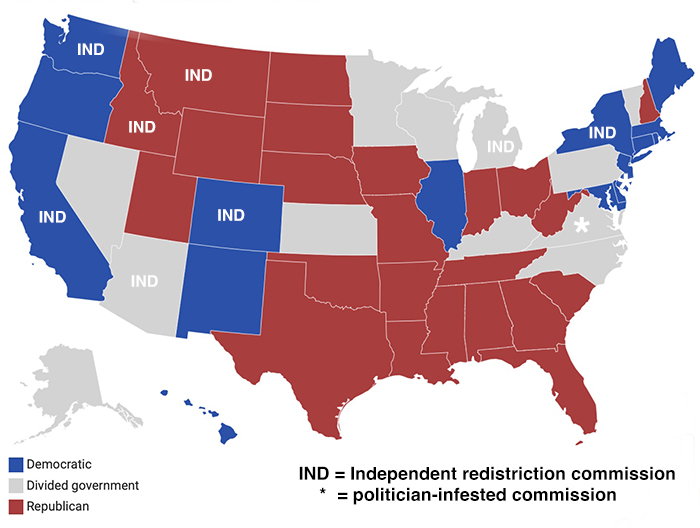
There are 23 Republican trifectas and 15 Democratic trifectas, so the Republicans have more opportunity to gerrymander the maps. But it is even worse than that. Of the nine states with truly independent redistricting commissions, four are (large) blue states (California, Washington, Colorado, and New York) plus Hawaii. Only two are red states, and low-population ones at that (Idaho and Montana). Arizona and Michigan have independent commissions but mixed state control. So not only do the Democrats have fewer states to gerrymander, but they have voluntarily given up that weapon in five of them. As a consequence, Republicans have little interest in getting rid of gerrymandering. Still, if a Democratic House passes a bill to end gerrymandering and a Republican Senate or Republican president kills it, that could be a potent issue in 2028. You never know.
If the House (or later both chambers) passes a bill requiring independent commissions, the devil is in the details. How can a law ensure that the commission is truly independent? For example, if the bill stated that the largest and second-largest parties in the state Senate and state House/Assembly each nominated one member of the commission and the governor nominated the fifth member, the commission would draw a wildly gerrymandered map favoring the governor's party. This would be worse than worthless, since it would have the aura of independence without any actual independence.
This is not to say that it can't be done, but the details matter. Suppose that the four legislative leaders each got to pick two members and that was it. An eight-member commission. To ensure a neutral map, throw in a rule requiring a three-quarters majority (six members) to get the map approved. What would happen if they couldn't agree? The law could state that until they agreed, there could be no House elections and no members seated. So the state would be punished for unwillingness to draw a fair map. Would that do the job? No. Suppose the California Republicans refused to compromise and California had no representation in the House. From the perspective of California voters, this is a bad deal, but from the perspective of the national Republican Party, this is a very good deal because even a fair map of California (as was the one drawn up in 2021) would result in a lot of Democrats being elected. Better no representatives than a bunch of Democrats.
Of course, Texas and Florida Democrats would also balk, so those states wouldn't have any representatives either. Rinse and repeat in every state. In the end, the House would have six members, from Alaska, Delaware, North Dakota, South Dakota, Vermont, and Wyoming, since those states have only one representative so there is no map and no need for a commission.
Is there a better way? In this super partisan era, only maybe. One way would be the above eight-member commission, but with a panel of judges hiring a special mapmaster in the case of a deadlock. Even then, though, most judges were appointed by a president or governor. Would the Texas Supreme Court, with seven Republican appointees, really pick a truly neutral special master? We're not so sure. So, how do the states that have independent commissions do it now? Let's take a look at a few of them.
- California: The commission is made up of private citizens who volunteer to be on it.
There is an ARP (Applicant Review Panel) consisting of three licensed senior auditors—one Democrat, one
Republican, and one independent—that
manages the process.
Citizens who have had the same partisan registration for the past 5 years are eligible to try unless they held public
office, were staff to officeholders, were consultants to officeholders, were lobbyists, made substantial donations to
candidates, or did a few other things in the past 10 years. Everyone in the pool must fill out a detailed form, write an
essay, and submit letters of recommendation.
ARP staff conduct background checks and social media scans. Of those left after that vetting, 40 Democrats, 40 Republicans, and 40 independents are chosen at random for 90-minute interviews. After the interviews, the ARP whittles each pool down to 20 finalists. Then each legislative leader gets two strikes per pool. If they are all utilized, there will be 12 finalists in each of the three pools. Thereafter, the state auditor randomly selects three Democrats, three Republicans, and two independents for the initial eight. These eight then select the final six from the finalist pools as single slates. Once the commission is in place, it and its staff draw the maps, subject to state and federal laws, compactness, contiguity, and keeping communities of interest together.
What happens next is up to the commission. It is impossible for a committee to draw a map. Remember, a camel is a horse designed by an independent commission. Different members can each propose a map. Staff can propose maps. Commissioners can ask academic experts to draw maps. Or whatever they want. Then they pick a map. The system is pretty good, but is not bulletproof, though, because the ARP has a lot of power and if it is biased it can use its power to weaken one side or the other—for example, by eliminating people who actually understand map-drawing from one party's cohort but not the other's.
- Arizona: The process is quite different here. The state Commission on Appellate Court
Appointments solicits nominations from the public and
picks
10 Democrats, 10 Republicans and five independents as the candidate pool. As in California, people involved in partisan
politics one way or another are excluded, but the look-back window is only 3 years (vs. 10 years in California). The
Appellate Commission consists of 10 public members and five attorney members. They are appointed by the governor and
confirmed by the state Senate. There is a loophole, of course, since a partisan Republican could register to vote as a
Democrat and then try to get on the redistricting commission as a Democratic member.
Once the pool of 25 candidates is chosen, the leaders of the state House and Senate each pick one person from the pool for the commission, leading to two Democrats and two Republicans. Together, these four select an independent as chair from the pool of five the Appellate Commission drew up. These five members and their staff draw the maps. The process doesn't have nearly as many guardrails as the California one, though.
- Colorado: A panel of retired judges chooses members of the redistricting commission. It
consists of four Democrats, four Republicans, and four independents. To have a map approved, there needs to be eight
votes for it and two of the eight votes must come from the independent members of the commission. As in the other
states, there are
rules
about obeying all laws, being compact, and preserving communities of interest and political units, like cities and
counties. The commission is also instructed to produce as many competitive districts as it reasonably can. The final map
is submitted to the Colorado Supreme Court, which must approve it unless it finds that the commission abused its
discretionary powers.
- Montana: The majority and minority leaders of the legislature each appoint one member.
The four members choose a nonpartisan chair. If they cannot agree on one, the state Supreme Court chooses one. This
arrangement basically gives the chair all the real power. Each party can make its best map and then the chair picks one.
Of course in Montana, the stakes are low, since no matter how you slice the state in two, Republicans are favored to win
both districts. Still, the formula is not a good one.
- New York: There is a 10-member commission. The majority and minority leaders of the state
legislature each appoint two members. Together these members select two more members, both of whom must be registered as
independent voters in New York State.
- Washington: The majority and minority leaders of the state legislature each choose one member of the commission. Together, these four members choose a nonvoting chair. Since it takes a majority to pass a map, at least one member of each party must agree with the map. Although this system is better than the Montana one, it is much less robust than the California system. For example, if the bribe were large enough and well disguised enough, would one of the legislative leaders pick a member who might approve a skewed map?
If you are looking for an overview of redistricting, here is a good one.
Of the various schemes, California's is probably the most difficult to game since random draws are used in the process and the initial pool is very large. The worst schemes are those in which each legislative leader picks one member and they pick a fifth member, with voting fifth members the worst of all.
In all the schemes, the possibility exists that a commission member could be bribed into accepting a biased map. The best defense against that would be to require unanimous consent to accept a map, or at least a supermajority. This is especially effective if the commission is fairly large, such that multiple members would have to be approached with offers, with the danger that the approachee might rat on the person offering the bribe. (V)
Gerrymandering, Part III: Republicans Are Losing
As we note above, the outcome of the Supreme Court's hearing on the Voting Rights Act could give red-state gerrymandering efforts a real shot in the arm. At the moment, however, things are not going so well for GOP gerrymandering efforts.
To start with, as we noted last week, the push to redistrict Kansas has stalled because legislators there are afraid the voters will punish them for trying to rig the election. This news is not as bad for the Republicans as it could be, since there's only one Democrat in the state's House delegation, and since they're not actually going to lose a seat—they're just not going to gain one.
Nearly the same is true in Indiana, excepting that there are two Democrats in the delegation instead of one (with one of those seats vulnerable and the other bulletproof). Donald Trump ordered the Indiana legislature to change the D+1 district of Rep. Frank Mrvan (D-IN) to make it hard for him to hold on. Indiana Republicans, having been given their marching orders, started the process there. Then, on the Friday before last, state Senate President Pro Tem Rodric Bray (R) made an announcement after taking a test vote in private. He said: "Today, I'm announcing there are not enough votes to move that idea forward, and the Senate will not reconvene in December." In January, the legislature could try again, but that seems unlikely. The period for candidates to file to run is Jan. 7 to Feb. 6. Candidates can't file if they don't know what the districts look like, so it appears Indiana won't redistrict.
And then there is Utah, where the news gets worse for the Republicans (and, thus, better for the Democrats). Judge Dianna Gibson threw out the map the Republican-controlled legislature drew at first and chose a different one. In the new map, Salt Lake County is not split up over all four districts, as in the current one. Instead, it is left together. In the precincts in the new UT-01 district, Kamala Harris would have won by 24 points. Here are the current map and the new map, side by side:
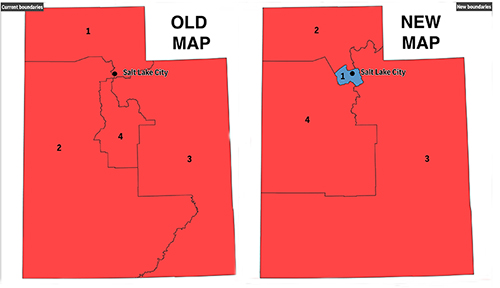
Of course, you can't beat somebody with nobody, but the Utah Democratic party has somebody. It is former Utah congressman Ben McAdams, who just announced his candidacy. He beat Mia Love (R) in what was then UT-04 in the Democratic wave of 2018, but lost in 2020. He served as mayor of Salt Lake County for 6 years, so he is very well known in the district and has a good chance of winning in such a blue district. Reportedly, if the Republicans can't find a way to be rid of the new map, then Rep. Burgess Owens (R-UT) will fall on his sword, so as to avoid an incumbent-Republican-on-incumbent-Republican primary in one of the three remaining districts (all of them red, obviously). Owens is only serving his third term in the House, but he's 74, so he can't feel too bad about retiring. In any event, in contrast to Indiana and Kansas, where the status quo will hold, the Republican setback in Utah is likely to result in the loss of a seat.
And finally, there is the big news that broke yesterday. A three-judge panel of the U.S. District Court in El Paso has issued a preliminary injunction prohibiting Texas from using the new legislative map drawn by the GOP to give itself an additional five seats in Congress. In a 2-1 ruling, the Court found that the map is racially discriminatory and that the Congressional election must be held under the 2021 map, which was drawn after the 2020 census. As if anticipating the case would be quickly appealed to the Supreme Court, the opinion, written by a Donald Trump appointee, Judge Jeffrey Brown, begins with a quote from Chief Justice John Roberts: "The way to stop discrimination on the basis of race is to stop discriminating on the basis of race." This case will put that concept to the test for the Supreme Court, to which Texas has already applied for an emergency stay.
According to the opinion, Trump initially asked Texas to redraw its map to create five additional Republican seats, but he got a cool response to the request to draw lines on purely partisan grounds. Then, on July 7, 2025, Harmeet Dhillon, Trump's former personal lawyer turned head of the Department of Justice's Civil Rights Division, got involved and told Texas that their current districts were race-based and, therefore, unconstitutional and had to be redrawn to avoid legal action. The DoJ letter targeted only non-white-majority districts, which the Court found was a race-based threat. The new 2025 map was drawn to address the DoJ's allegations and, thus, was based solely on race. In fact, in press conferences, the Governor admitted that the map was created to eliminate "coalition districts"—districts that are majority non-white but where no one race predominates—and create districts that are majority Latino.
The Court found that the DoJ letter, which was "challenging to unpack... because it contains so many factual, legal, and typographical errors," was simply wrong on the law. According to the Court, "Indeed, even attorneys employed by the Texas Attorney General—who professes to be a political ally of the Trump Administration—describe the DoJ letter as 'legally unsound,' 'baseless,' 'erroneous,' 'ham-fisted,' and 'a mess.'" Instead, the Court ruled that the 2021 map, which contains coalition districts, passes constitutional muster and should continue to be used.
The opinion also found that there was still time before the candidate filing deadline to revert to the 2021 map and that any disruption is the Texas legislature's fault for waiting so long to redraw the map. "The Legislature—not the Court—redrew Texas's congressional map weeks before precinct-chair and candidate-filing periods opened. The State chose to 'toy with its election laws close to' the 2026 congressional election, though that is certainly its prerogative." Judge David Guaderrama, a Barack Obama appointee, joined the opinion. A dissent is to be filed later by a Ronald Reagan appointee, Judge Jerry Smith.
Needless to say, it will be very interesting to see how the Supreme Court handles Texas' appeal. The case is largely based on the Fourteenth and Fifteenth amendments prohibiting racial gerrymandering, and not so much on the Voting Rights Act. The Court's opinion came after a 9-day hearing where voluminous evidence was introduced. Of course, the Supreme Court tends to discount the facts of a case when it wants to rule a certain way and needs to do so quickly. But given that it has an important election law case already on its regular docket, it's plausible that it won't want to wade into this hornet's nest as well. Since this is just a preliminary injunction, it's also possible the Supreme Court could issue a stay on its shadow docket and claim that it's just maintaining the status quo until the case is further along. Of course, that would mean a win for Trump, since the district court would not have time to rule on the merits before the 2026 election is underway. Stay tuned.
When we heard about the ruling out of Texas, we were reminded of the old Dean Martin song "Ain't That a Kick in the Head." If the district court's ruling holds, then the net result of Gov. Greg Abbott's (R-TX) machinations will have been to gain nothing for the GOP, while also providing the impetus for California's Prop. 50, and the +5 Democratic seats it's expected to net. That would certainly be a kick in... well, some part of Abbott's anatomy. (V, L and Z)
P.S.: Yes, that is indeed the first time we have an item that three of us each wrote a part of.
Gerrymandering, Part IV: Democrats Gone Wild?
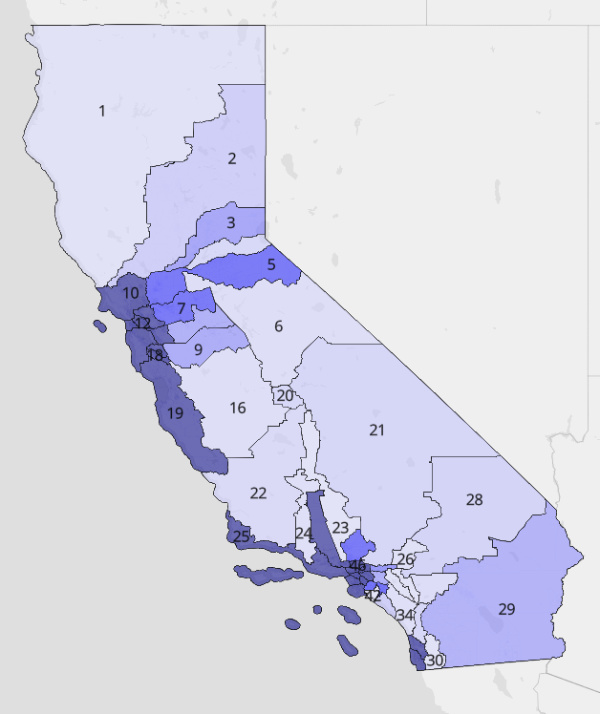
We thought we would try out a little thought exercise. Let us imagine a world where redistricting turns into a true arms race, and EVERY blue state decides to do whatever it can to maximize the number of Democrats it sends to the House. We reached out to reader and redistricting-website-guru A.B. in Wendell, NC, who did yeowomanlike work in helping us to visualize a strongly blue-gerrymandered world.
We are going to start with states that already have a Democratic trifecta. Note that we are assuming that, for purposes of our thought exercise, if there are any laws or other barriers in the way of a gerrymander, those laws/barriers will be set aside, like what just happened in California. At worst, there might be some delay to allow for an initiative to be put before the voters to remove the barrier. We are also assuming a target date of 2028, since many states would not be able to get new maps in place by 2026.
Here is the rundown of Democratic-trifecta states that could potentially become more blue-gerrymandered (excluded are the Democratic-trifecta states of Connecticut, Delaware, Hawaii, Maine, Massachusetts, New Mexico and Rhode Island, which already have 100% Democratic delegations). Click on the state name if you would like to see/tinker around with the map that A.B. came up with (and, in particular, to create some "Goofy kicking Donald Duck" districts, which A.B. avoided doing):
|
State: California Current delegation: 43D, 9R Gerrymandered delegation: 52D Net gain: +9D Riskiest gerrymandered district(s): CA-01 and CA-23, both 49.7% Democratic, 49.6% Republican |
 |
|
State: Colorado Current delegation: 4D, 4R Gerrymandered delegation: 7D, 1R Net gain: +3D Riskiest gerrymandered district(s): CO-01, 49.6% Democratic, 49.5% Republican |
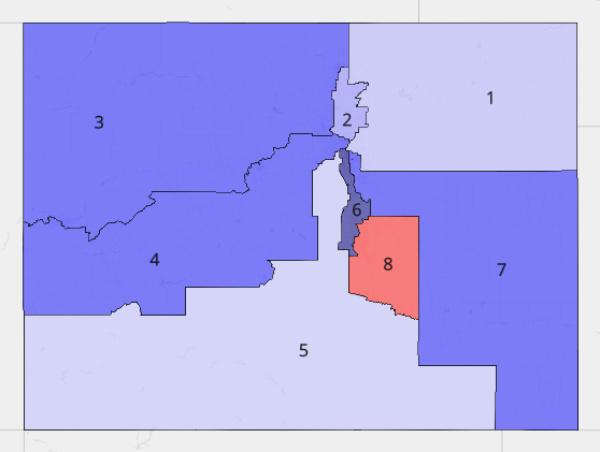 |
|
State: Illinois Current delegation: 14D, 3R Gerrymandered delegation: 15D, 2R Net gain: +1D Riskiest gerrymandered district(s): IL-01, 48.8% Democratic, 48.7% Republican; IL-03, 48.7% Democratic, 48.6% Republican |
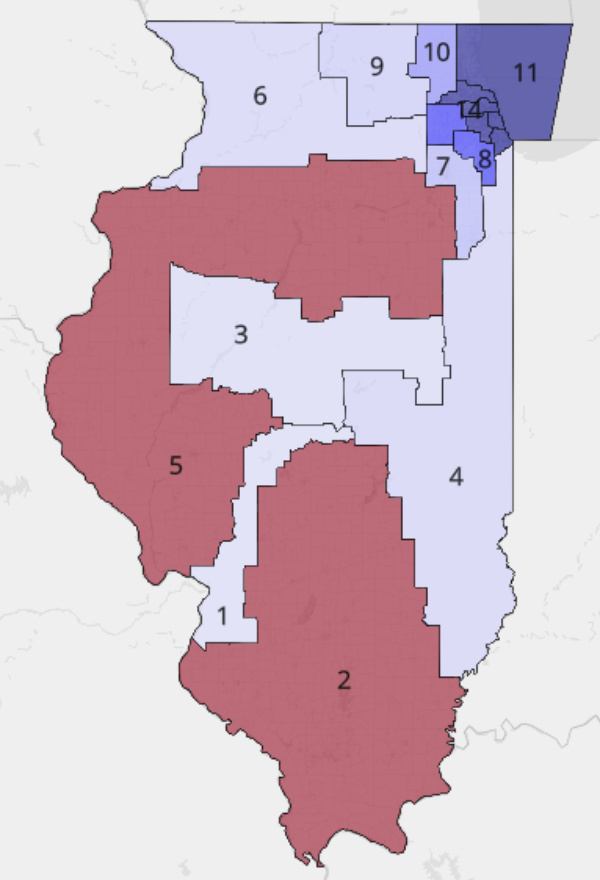 |
|
State: Maryland Current delegation: 7D, 1R Gerrymandered delegation: 8D Net gain: +1D Riskiest gerrymandered district(s): MD-01, 50.7% Democratic, 47.2% Republican |
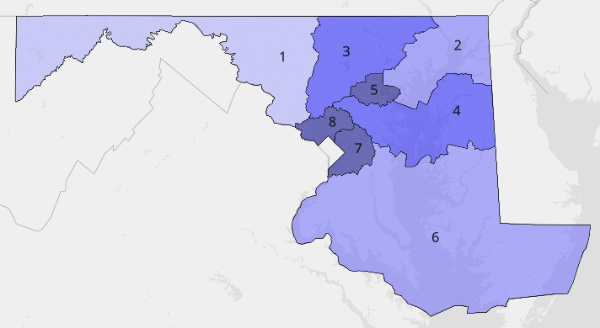 |
|
State: New Jersey Current delegation: 9D, 3R Gerrymandered delegation: 12D Net gain: +3D Riskiest gerrymandered district(s): NJ-11, 49.7% Democratic, 48.2% Republican |
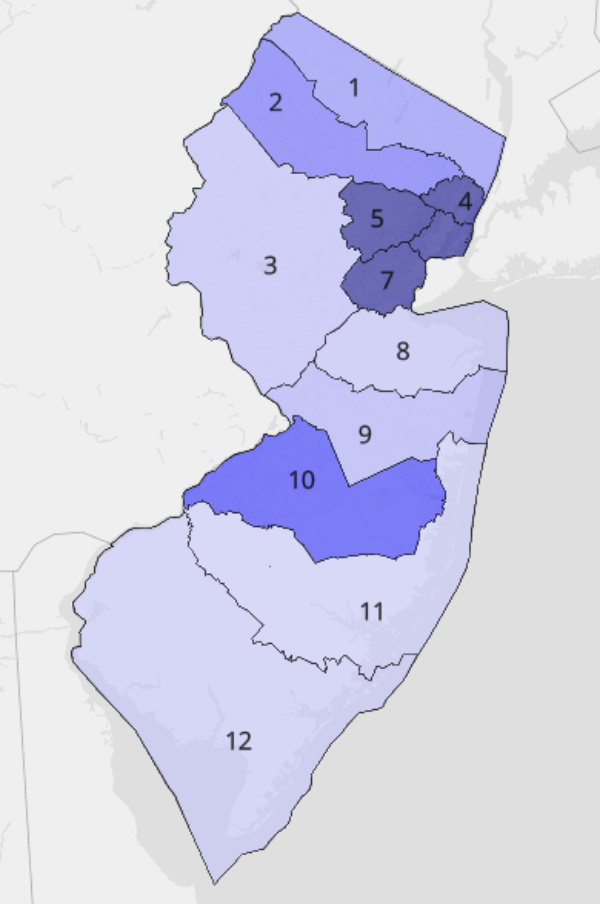 |
|
State: New York Current delegation: 19D, 7R Gerrymandered delegation: 22D, 4R Net gain: +3D Riskiest gerrymandered district(s): NY-08, 49.4% Democratic, 49.2% Republican |
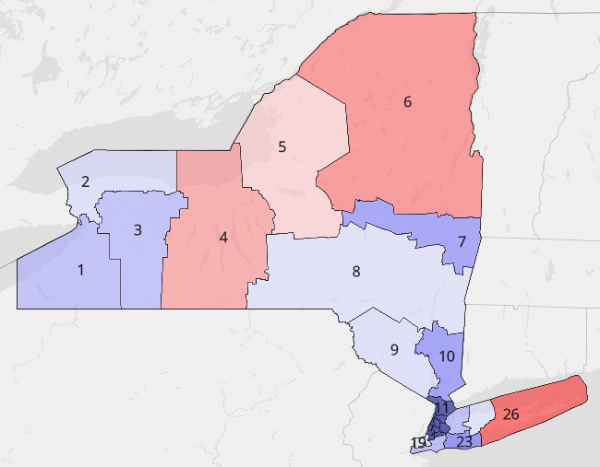 |
|
State: Oregon Current delegation: 5D, 1R Gerrymandered delegation: 6D Net gain: +1D Riskiest gerrymandered district(s): OR-03, 47.5% Democratic, 47.3% Republican |
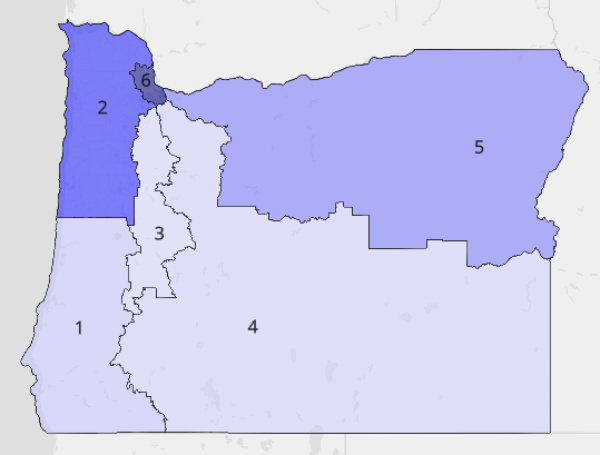 |
|
State: Virginia (as of January 2026) Current delegation: 6D, 5R Gerrymandered delegation: 9D, 2R Net gain: +3D Riskiest gerrymandered district(s): VA-03, 49.6% Democratic, 48.9% Republican |
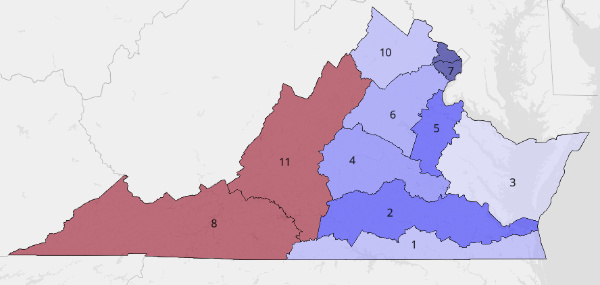 |
|
State: Washington Current delegation: 8D, 2R Gerrymandered delegation: 9D, 1R Net gain: +1D Riskiest gerrymandered district(s): WA-02, 49.5% Democratic, 49.4% Republican |
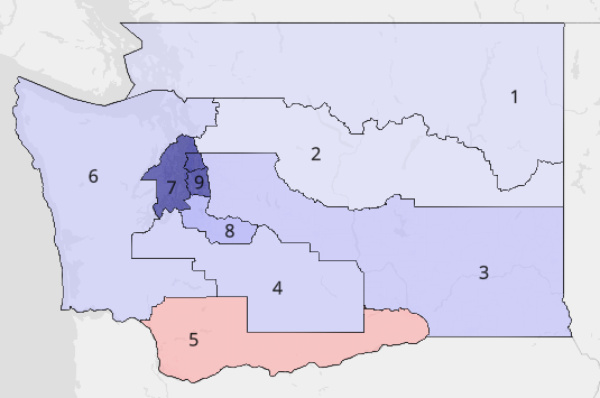 |
If all of this was to come to pass, then the Democrats could gain a total of 25 seats. That would, of course, come with the risk that even a fairly mild red-ripple year could prove disastrous.
And now, the states where the Democrats might possibly claim a trifecta in the next year (though it would take a blue monsoon, in some cases):
|
State: Arizona Needed for trifecta: 3 seats in the state Senate (up in 2026), 4 seats in the state House (up in 2026) Current delegation: 3D, 6R Gerrymandered delegation: 8D, 1R Net gain: +5D Riskiest gerrymandered district(s): AZ-03 and AZ-04, both 49.9% Democratic, 48.9% Republican |
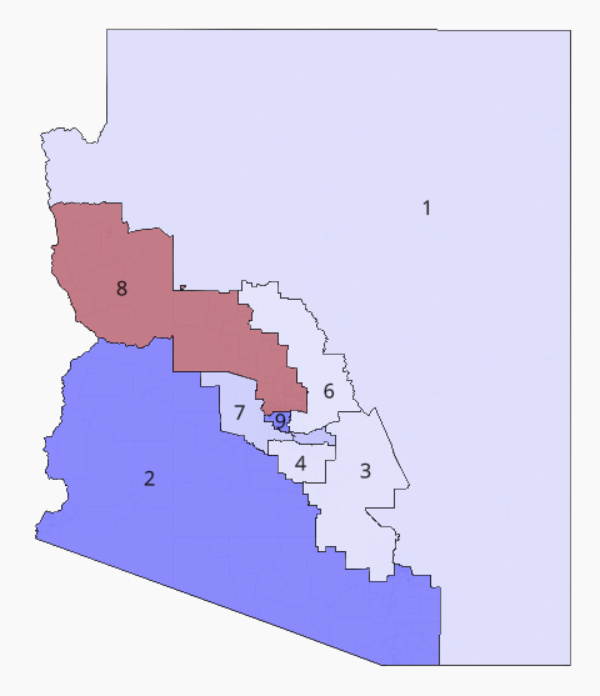 |
|
State: Michigan Needed for trifecta: 4 seats in the state House (up in 2026) Current delegation: 6D, 7R Gerrymandered delegation: 10D, 3R Net gain: +4D Riskiest gerrymandered district(s): MI-09, 49.4% Democratic, 47.8% Republican |
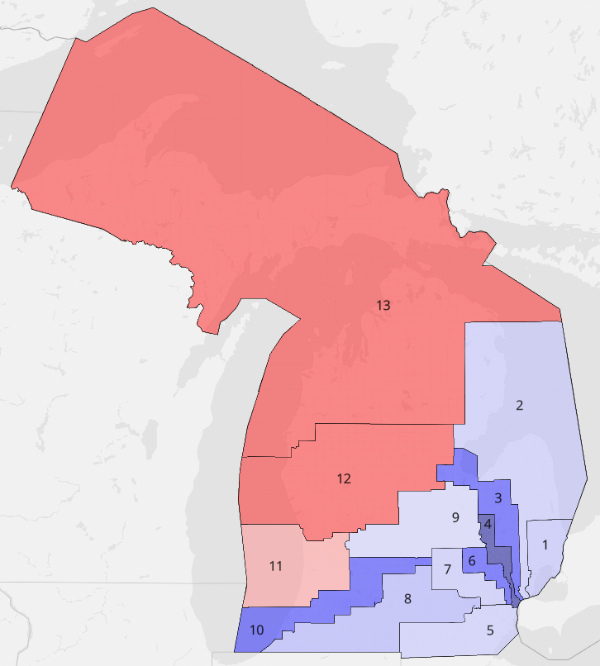 |
|
State: Minnesota Needed for trifecta: 2 seats in the state House (up in 2026, including two up in special elections in January) Current delegation: 4D, 4R Gerrymandered delegation: 7D, 1R Net gain: +3D Riskiest gerrymandered district(s): MN-02, 48.5% Democratic, 48.1% Republican |
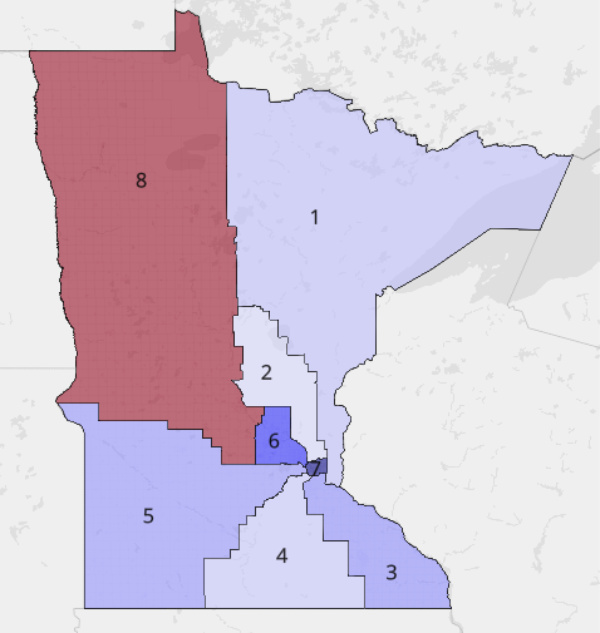 |
|
State: Nevada Needed for trifecta: The governorship (up in 2026) Current delegation: 3D, 1R Gerrymandered delegation: 4D Net gain: +1D Riskiest gerrymandered district(s): NV-02, 48.0% Democratic, 47.9% Republican |
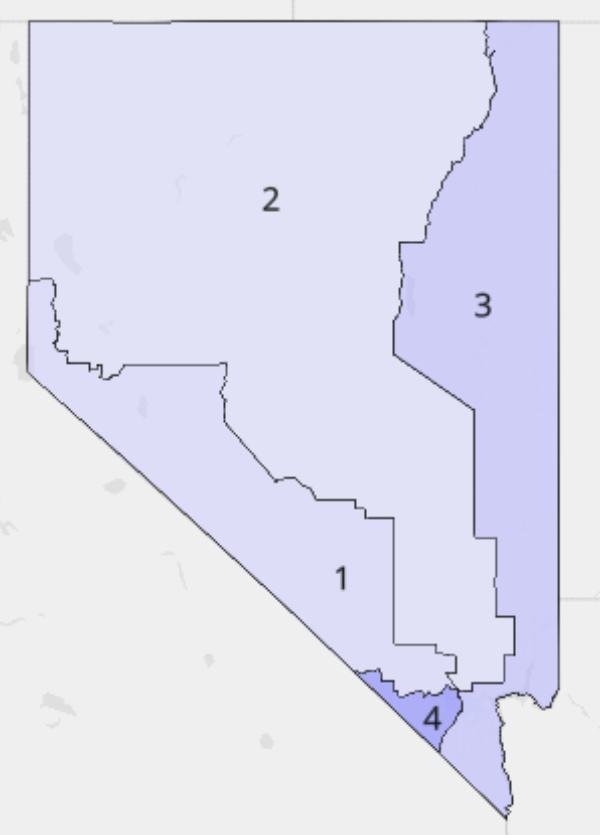 |
|
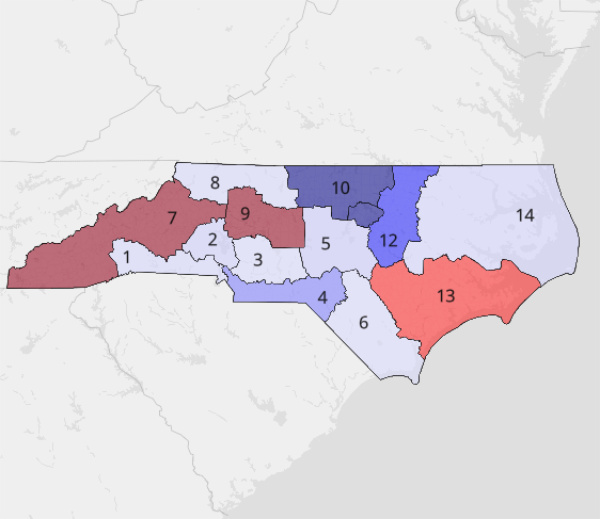
State: North Carolina Needed for trifecta: 6 seats in the state Senate (up in 2026), 12 seats in the state House (up in 2026) Current delegation: 4D, 10R Gerrymandered delegation: 11D, 3R Net gain: +7D Riskiest gerrymandered district(s): NC-03, 48.8% Democratic, 48.8% Republican (but with 1 more Democrat than Republicans; 176,623 to 176,622) |
 |
|
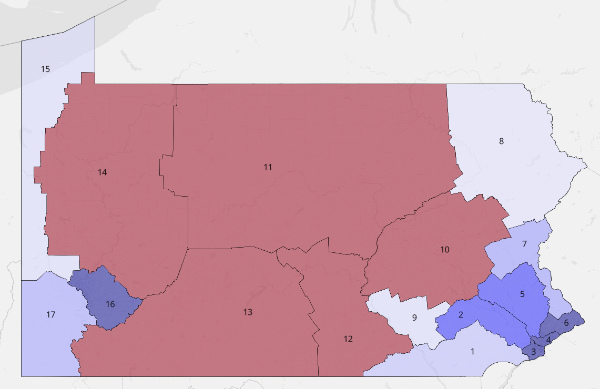
State: Pennsylvania Needed for trifecta: 3 seats in the state Senate (up in 2026) Current delegation: 7D, 10R Gerrymandered delegation: 12D, 5R Net gain: +5D Riskiest gerrymandered district(s): PA-08, 48.9% Democratic, 48.9% Republican (but with 101 more Democrats than Republicans; 163,383 to 163,282) |
 |
|
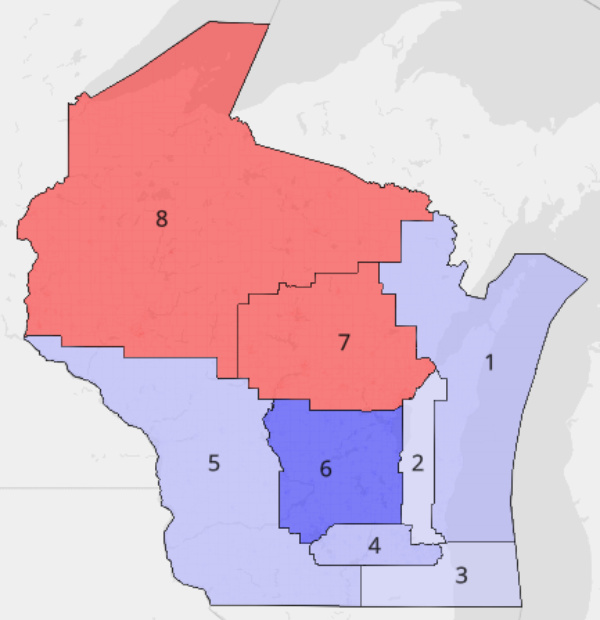
State: Wisconsin Needed for trifecta: 2 seats in the state Senate (up in 2026), 5 seats in the state House (up in 2026) Current delegation: 2D, 6R Gerrymandered delegation: 6D, 2R Net gain: +4D Riskiest gerrymandered district(s): WI-02, 50.2% Democratic, 48.9% Republican |
 |
If all these changes were to come to pass (not bloody likely), that would be +29 seats for the Democrats.
From this exercise, we would make five observations:
- Among the states that already have a Democratic trifecta, the biggest prize is... still California. However, that
would obviously require Gavin Newsom to go to the well again, which would be a tough sell.
- Among the other states that already have a Democratic trifecta, or soon will, Virginia and Colorado look to be the
most promising for the blue team, with New Jersey not far behind.
- On the other hand, while the governor + laws combo in Illinois might be well-suited to a more aggressive
gerrymander, the map is not. Central-western Illinois is basically East Iowa and East Missouri, while southern Illinois
is basically North Kentucky. Picking up more than one seat would require salamander-like district boundaries, and even
then, it might not be doable.
- The REAL prizes are the states that do not currently have Democratic trifectas, particularly Arizona, North
Carolina, and Pennsylvania. Democrats should be going all-in to flip the seats in the state legislatures they need to flip in order to take over
the legislatures in those places. That's not too likely in North Carolina, but the other two states are doable.
If you want to help out, you could toss some of your soon-to-be-obsolete-but-still-legal pennies over to the
DLCC,
which helps Democrats in state legislature races.
If you want to prevent this from happening, the
RSLC
will spend your donation to help elect Republicans to state legislatures.
- Looking at our hypothetical Pennsylvania map (or the actual Pennsylvania map), you can see what James Carville meant about the state being Pittsburgh and Philadelphia with Alabama in between (or, alternatively, what the state's residents mean when they call it "Pennsyltucky").
Not all of these states will indulge in gerrymandering shenanigans, though some of them will, either in the immediate future, or before the 2028 election. And, ironic as it is, supporters of democracy should be rooting for as aggressive an arms race as is possible, as that is the only thing that will give Congress the political capital necessary to enact gerrymandering legislation at the national level. (Z)
Previous report Next report
If you wish to contact us, please use one of these addresses. For the first two, please include your initials and city.
- questions@electoral-vote.com For questions about politics, civics, history, etc. to be answered on a Saturday
- comments@electoral-vote.com For "letters to the editor" for possible publication on a Sunday
- corrections@electoral-vote.com To tell us about typos or factual errors we should fix
- items@electoral-vote.com For general suggestions, ideas, etc.
To download a poster about the site to hang up, please click here.
Email a link to a friend.
---The Votemaster and Zenger
Nov18 America's Pennies Are Not Worth a Plug Nickel
Nov17 The Epstein Saga Continues
Nov17 Is MTG Running for Vice President?
Nov17 Latinos Are Back--to the Democrats
Nov17 Independents Are Souring on Trump
Nov17 Ruben Gallego Tries Out His Stump Speech
Nov17 The Next Special Election Could Give a Hint about the Midterms
Nov17 Democrats Have Their Boogeyman for 2026: RFK Jr.
Nov17 Fulton County D.A. Fani Willis Will Be Replaced by a Veteran Prosecutor
Nov17 Loomer Strikes Again
Nov16 Sunday Mailbag
Nov15 Saturday Q&A
Nov15 Reader Question of the Week: Leisure Where?, Part II
Nov14 Legal News: (Everything I Do) I Do It For You
Nov14 Hypocrisy Report: No One Needs To Know
Nov14 Today in Numismatics: A Penny More
Nov14 I Read the News Today, Oh Boy: Seasons in the Sun
Nov14 This Week in Schadenfreude: Working for the Weekend
Nov14 This Week in Freudenfreude: Thank U, Part I
Nov13 And So It Ends...
Nov13 Epstein's E-mails Show that Trump Knew about the Girls
Nov13 Running for Something
Nov13 Will 2026 Be a Rerun of 1894?
Nov13 Pushback on the Plains
Nov13 Supreme Court Will Handle Late-Ballot Case
Nov13 A Kennedy Is Running for Congress
Nov12 More on the (Imminent?) End of the Shutdown
Nov12 1 vs. 100
Nov12 News from the House
Nov11 The Bitch Is Back
Nov11 The 2025 Election: Post Mortem, Part VI--Trumponomics
Nov11 It's OK to Be Gay (Married), at Least for Now
Nov11 Bonnie Watson Coleman to Retire
Nov10 You Got to Know When to Hold 'Em, Know When to Fold 'Em
Nov10 The 2025 Election: Post Mortem, Part III--Blue Shift
Nov10 The 2025 Election: Post Mortem, Part IV--Democrats in a Quandary
Nov10 The 2025 Election: Post Mortem, Part V--Anti-Trans Can't Dance?
Nov10 Trump Is Giving Big Corporations a Huge Back-Door Tax Cut
Nov10 Republican Senators Are Very Nervous about Trump Going after Adam Schiff
Nov10 The Washington Post Is Losing It
Nov10 Stefanik Is Running for Governor of New York; House Democrats Are Cheering
Nov09 Sunday Mailbag
Nov08 Saturday Q&A
Nov08 Reader Question of the Week: Leisure Where?, Part I
Nov07 The 2025 Election: Post Mortem, Part II
Nov07 Into the Sunset: Nancy Pelosi, a Democratic Rock Star for Decades, Will Retire Next Year
Nov07 I Read the News Today, Oh Boy: Sign of the Times
Nov07 This Week in Schadenfreude: The Eyes are the Mirror of the Soul
Nov07 This Week in Freudenfreude: Carvd N Stone, Guardian of Good Vibes

