


 Welcome & FAQs
  Table of Senate polls
 Senate graphs
 Tipping-point-state
 Congress: retirements
 Governor's races
 Icons for bloggers
 Data galore


• Epstein's E-mails Show that Trump Knew about the Girls
• Running for Something
• Will 2026 Be a Rerun of 1894?
• Pushback on the Plains
• Supreme Court Will Handle Late-Ballot Case
• A Kennedy Is Running for Congress
And So It Ends...
It will take a while for everything to begin operating at full speed again, but the latest and longest federal government shutdown is over after 43 days.
By a vote of 222-209, the House approved the stopgap bill that had already passed the Senate. Six Democrats crossed the aisle to vote with nearly all the Republicans; those six are Henry Cuellar (TX-28; PVI of R+2), Donald Davis (NC-01; R+1), Marie Gluesenkamp Perez (WA-03; R+2), Jared Golden (ME-02; R+4), Adam Gray (CA-13; R+1) and Tom Suozzi (NY-03; EVEN). Perhaps readers will notice that those districts have something in common. That said, Jared Golden wasn't just playing politics, since he's retiring. It would seem all those times he crossed the aisle, it might have been genuine.
There were also two Republicans who crossed the aisle to vote with nearly all the Democrats. One of them was Thomas Massie (R-KY), who is an iconoclast, and usually joins his Senate colleague Rand Paul (R-KY) in voting against anything that involves spending any money at all. The other was Greg Steube (R-FL), who is quite MAGA, and who represents a district, FL-17, that is quite red at R+11. Unlike Massie and Paul, Steube is not a Libertarian who is just pretending to be a Republican in order to be able to win elections. His issue with the bill, in his own words:
After forcing the country to endure the longest government shutdown in history, the Senate's response is the furthest thing from a 'clean' CR. I could not in good conscience support a resolution that creates a self-indulgent legal provision for certain senators to enrich themselves by suing the Justice Department using taxpayer dollars. There is no reason the House should have been forced to eat this garbage to end the Schumer Shutdown.
Kudos to him for, by all indications, voting his conscience. We can see no obvious electoral benefit to rebelling like this, and his social media is now full of MAGA Republicans who are calling him a RINO, a traitor, a pedo, woke, a communist, a socialist, a fascist, a "false flag loser," a narcissist, a clown and a whole bunch of things we cannot print in a family-friendly blog (Hint: Most of those involve suggestions about Steube's sexual orientation, and the various activities he partakes in as part of that).
We're just spitballing here, but we are thinking that mayyyyybe these people just get out these insults anytime they are upset, even if the insults make no sense, and even if the person delivering the insult doesn't really understand what it means. To get a sense of the sort of folks we're talking about here, note also that some meaningful number of the critics declared that he's NEVER going to be able to win a U.S. Senate election next year, now that he's a pedotraitorinofascistwokecommieclown. We must admit we agree with this prediction, if not the pedotraitorinofascistwokecommieclown part of it, since he is a member of the House of Representatives, and is not running for the Senate.
Once the House had done its thing—and, by the way, that includes Rep. Adelita Grijalva (D-AZ) casting her very first vote, in what will surely be a treasured memory—the bill was hustled down Pennsylvania Avenue to the White House, where Donald Trump had stayed up past his bedtime to apply his signature. So the deal, as they say, is done.
Yesterday, we noted that while most pundits dumped on the Democrats for caving on the shutdown, a few thought it was the best move possible under the circumstances. After all, the Democrats had to deal with a Republican trifecta and a president who would revel in thousands of children dying of starvation, as long as they were Black or brown.
One of the more articulate defenses of what the Democrats did is from Jonathan V. Last (JVL) of The Bulwark. He made an ordered list of possible ways the funding battle could have been avoided or ended, with likely political consequences of each one, summarized below, from best case to worst case for the Democrats. For the record, JVL is not some hippy-dippy Democrat. He is a Republican and an observant Catholic who hates Donald Trump and wants to defend democracy.
- Democrats Win a Strategic Concession: The absolute best outcome would have been the
Democrats using public pressure to force the Republicans to make a strategic concession that changed the balance of
power. One possibility would be making D.C. a state. Another would be releasing all the Epstein files unredacted
except for blacking out the names of his victims. Another would be reining in the power of the president (e.g., on
declaring emergencies, making acting appointments, etc.). These things would be a drag on Trump going forward. Remember,
short of his dying in office, he is going to be president until Jan. 20, 2029, at noon D.C. time. Is getting structural
changes a fantasy? Probably, but a year ago, who would have thought he would demolish a third of the White House, put
Marines on the streets of Los Angeles, and accept a $400 million airplane with Congress quietly accepting that?
Impossible stuff happens.
- Republicans Repeal the Filibuster:
This would have been almost as good. The first thing is that it would have removed the cover Senate
Republicans use to avoid tough votes on Trump's nuttiest proposals. If Trump says he wants to give
everyone $2,000 or $10,000 or some other crazy number, Republican senators know this is an awful
idea that will increase the deficit. If they vote yes, actual conservatives around the country will
be furious but if they vote no, MAGA Nation will be furious. Their best strategy is to say: "It is
pointless to vote on it because the Democrats will filibuster it." Once the filibuster is gone, Trump
will send them a stream of horrible proposals they will actually have to vote on.
The second issue is that next time the Democrats get the trifecta, they will ram through a very long list of laws the Republicans really don't want, ranging from statehood for D.C. and Puerto Rico, the John Lewis Voting Rights Act, the For the People Act, making abortion legal and easy nationwide, banning gerrymandering, and much more. If the filibuster is in place when they next take power, the Democrats may not have the willpower to abolish it on their own.
- Democrats Win a Tactical Concession:
Something noteworthy, but smallish, like ICE agents being banned from wearing masks and maybe
required to wear a badge with their name and number visible at all times. Maybe agreeing not to
deploy the National Guard or federal troops anywhere in the country unless requested by a governor.
- Democrats Cave and Preserve the Status Quo:
That wouldn't be quite as bad as it sounds. By now, the issue of health care has been in the news
for weeks. People know where the Democrats stand and where the Republicans stand. Health care could
be the main issue in the midterms. If so, that would be a boon to the blue team. If you
think not, go review last week's elections again.
Also, the trend in Trump's approval since Sept. 30 hasn't been so great:
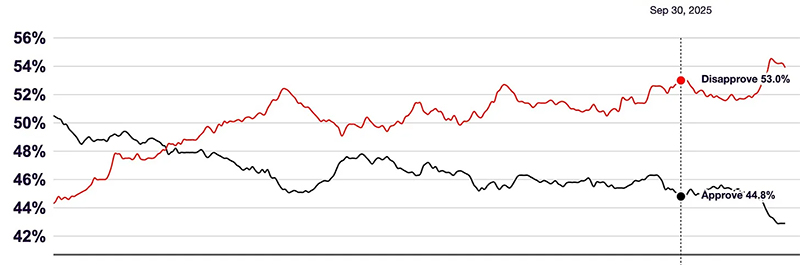
This option is roughly what actually happened.
- Democrats Roll Over Immediately and Avoid the Shutdown Completely: This would have been
even worse than fighting and then caving. It would have made the Democratic base furious. Fighting and then caving after
7 weeks at least showed some fight. Not even fighting at all would have been very demoralizing for Democratic voters.
- Democrats Get Everything They Asked For: Suppose the Republicans had been smarter and agreed to extend all the health insurance subsidies until Dec. 31, 2026. This would have been a victory so bad it would have made Pyrrhus of Epirus cry. It would have completely defanged the Democrats' 2026 argument that Republicans want to take away their health care. Trump would have crowed that he saved everyone's health care. What the Democrats were asking for was to undo the least popular thing the Republicans want. It would have saved Trump from destroying himself and his party. From a political viewpoint, the Democrats need to have the voters touch the stove. No party has ever gotten credit for preventing some bad thing from happening, especially not with voters who are barely aware of what is going on. It has to happen and they have to feel the pain before you can get credit for trying to prevent it, even if you fail.
Think about this from Trump's perspective. The BBB got him some things he wanted, but he needed some very big cuts to keep the deficit from exploding. Otherwise, the Freedom Caucus would have bolted. There are only so many big pots of money in the federal budget, though. Tackling defense would have generated too much blowback. Health care was big enough. But if he had been forced at the point of a gun to restore the health care money, Trump could have told the Freedom Caucus: "I tried to keep the deficit under control, but those nasty Democrats forced this on me. Not my fault."
Now, Trump and his party get to own the issue of rising health care costs. That includes Obamacare, which the Republicans could have done something about, but chose not to. It also includes non-Obamacare insurance, which is also going up, up, up in price. This is not an issue that was actually on the table during the shutdown, but voters don't tend to draw these distinctions. So, they could be very cranky by the time next November rolls around, and they've been paying premiums that are double-digit percentages, or even triple-digit percentages, higher for close to a year. (V & Z)
Epstein's E-mails Show that Trump Knew about the Girls
Yesterday, House Democrats dropped a bombshell in the form of some e-mails from Jeffrey Epstein. In one, he wrote: "Of course he [Trump] knew about the girls." In another, Epstein noted that Trump once spent hours at his house with one of Epstein's victims, later identified as Virginia Giuffre, who died by suicide earlier this year. In still another, Epstein remarked to Ghislaine Maxwell that it was amazing that no one had connected Trump to his sex-trafficking operation. That is likely about to change.
The timing couldn't be worse. Now that the shutdown news is going away, the media needs a new story to run with. Yesterday, Adelita Grijalva officially became the 218th House member to sign the discharge petition. The administration made a last-ditch effort to get one or more of the four Republicans who signed to unsign. It didn't work.
House rules require that discharge petitions "ripen" for 7 legislative days. Then the Speaker has to schedule a vote. Speaker Mike Johnson (R-LA) could maybe delay it to early December, but he has apparently decided to just rip the band-aid off. So, the vote is going to take place next week. All of the Democrats will vote for it, and so will Massie, of course. Presumably, the three Republican women who signed it (Lauren Boebert, CO; Nancy Mace, SC and Marjorie Taylor Greene, GA) will vote for it, too. That said, if any or all of that trio have second thoughts, it likely doesn't matter at this point. The moment that the 218th signature was applied, the petition was a done deal. Members can no longer remove their signatures. And, according to anonymous sources that talked to Politico, now that the die is cast, the dam is about to burst. "Dozens of Republicans," per that outlet's reporting, are expected to join the Democrats in voting "yea."
That said, don't get out your reading glasses yet. When the bill passes the House, as appears inevitable, then it will go to the Senate. Majority Leader John Thune (R-SD) doesn't have to schedule a vote if he doesn't want to (or Donald Trump orders him not to). If Thune does schedule a vote and it passes, then it goes to Trump for his signature. The chance of Trump's signing is approximately 0.00%.
Still, 6 months ago, it would have been hard to imagine the House voting on this measure, much less passing it by a large majority, as appears likely to happen. Donald Trump is a lame duck and, as last week's elections illustrated, electoral poison. It could be the senators do not want to make their lives even harder next year by taking a huge political hit, just to protect Trump's fee-fees. There may also be some Republican senators who would love to see Trump get what's coming to him (ahem, Mitch McConnell, R-KY). So, it's at least possible that there are eventually enough Republican senators to force the bill to be brought to the floor, to invoke cloture, and maybe even to override a presidential veto. It's not likely, but again, the vote that is going to happen in the House next week was not likely either, until it was.
Even if the Massie bill goes into the circular file, however, there could still be more revelations to come. The Democrats on the House Oversight Committee said that the e-mails released yesterday were part of a collection of 23,000 pages of documents they had received from the lawyers in charge of Epstein's estate. There could be more damning information in the collection, or in documents that are still held by the estate. There are also other people and entities out there that have at least some of them, including, apparently, Alan Dershowitz. And the pressure from voters, including MAGA, is going to be intense. So, this roller-coaster ride almost certainly has at least a few more turns ahead. (V & Z)
Running for Something
The elections last week were a real eye-opener for some people, especially young progressives. They saw Zohran Mamdani—who, by conventional standards, was a three-term assemblyman well-qualified to be... a state senator—become the chief executive of an organization with 280,000 full-time employees and a budget of $110 billion. That amount of annual revenue is more than that of Target, Disney, FedEx or Albertsons. If NYC were a company, it would rank about 40th among U.S. companies by revenue.
Mamdani's real achievement was winning the primary against a number of higher-profile and/or more conventionally "qualified" candidates. Beating a widely despised scumbag running as an independent in the general election was considerably easier. Almost any generic Democrat could have done that. In fact, it is actually a rather poor showing. Mamdani's vote share of 50.4% pales in comparison with Kamala Harris' 68.1% share last year and Eric Adams' 67.0% share in the 2021 mayoral election. Two-thirds of New Yorkers are Democrats. Winning only half the vote against two extremely weak opponents is not something to write home about.
Nevertheless, inspired by Mamdani, more than 4,000 people just registered at Run for Something, an organization that helps young progressives who never before thought about running for public office to build a campaign and run for some office. The offices they are interested in running for are all over the map—local offices, state offices, Congress, and more. Some potential candidates already have some fame, like social media star Kat Abughazaleh, who is running for the House seat being vacated by Rep. Jan Schakowsky (D-IL). Others, like Courtney McClain, who is running to unseat Rep. William Timmons (R-SC), have never run for public office before and are not famous. They are surely thinking: "If a Muslim born in Uganda can be elected mayor of NYC, then in a blue wave next year, anything is possible."
This surge in interest isn't the first one, just the latest one. In June, when Mamdani won the primary, 10,000 people signed up with Run for Something. This doesn't mean that all 14,000 will in fact run for something (and many of them may be aiming for the same office). Signing up to get advice and a how-to-run manual is not the same as filing, raising money, hiring staff, mounting a real campaign, and catching on. But it shows there is a tremendous amount of energy being unleashed at the grassroots and some of the new sign-ups may indeed actually run and win. Remember, you can't beat someone with no one, and the Democrats' chronic problem for years has been finding people to contest all those downballot offices.
Olivia Julianna, a young Democratic strategist, warned that trying to clone Mamdani's campaign won't work. Rural South Carolina is not urban NYC. Mamdani didn't talk much about how Donald Trump's policies are hurting farmers, but McClain might well be advised to spend a lot of time talking about that to South Carolina farmers. However, one theme that many young candidates can use, regardless of geography and office, is that the country is on the wrong track and current leaders are failing the people. What do you have to lose trying someone who thinks things need to change and wants to do something different? It could be a powerful argument.
One thing Mamdani had going for him is that he was a Democratic Socialist (as well as a democratic socialist). The Democratic Socialists of America chapter in NYC is quite large and Mamdani got 50,000 volunteers to knock on 3 million doors. That strategy won't work in most places, but it might work in places where there are potentially many volunteers available (e.g., college towns) and for people already Internet famous and who can reach thousands or millions of people by posting an announcement video to some social media site. In any event, expect many more insurgent campaigns next year up and down the ballot. (V)
Will 2026 Be a Rerun of 1894?
Gerrymandering goes back to the days of Gov. Elbridge Gerry and his salamander-shaped legislative districts. It is an American tradition, although England's "rotten boroughs" might have provided an inspiration. It hasn't always worked out as planned.
Consider the 1894 election as a case study in what can go wrong. In Gerrymandering 101, you learn how to spread your voters over more districts, giving your side a small (or small-ish) majority in many districts instead of a large majority in fewer districts. The hard part is figuring out how small a majority you can get away with and still win. Sometimes politicians get too greedy and inadvertently create a dummymander.
Back in the 19th century, states changed their maps all the time, not just after the census. Between 1862 and 1896, in only one year were all the maps the same as in the previous cycle. Whenever a party took power in a state, it drew new maps. For example, in 1872, Republicans flipped 64 House seats, only to lose 94 seats in 1874.
Gerrymandered districts tend to be competitive. Why draw a district where 60% of the voters are on your side? Why not make it 55% or 53% and use the excess voters to help win some other district? In the late 19th century, something like 40% of House races were won by 5 points or less. After the 1890 census, Democrats didn't shore up their own incumbents. Instead they went for broke.
The year 1894 bears a striking resemblance to the current situation, except with the parties flipped. The Democrats had a president, Stephen Grover Cleveland, who had just won a second nonconsecutive term, tariffs were a hot issue, and the president sent federal troops to Chicago to quell a railroad strike (over the objections of the governor of Illinois). The economy was a big issue then as now.
The maps the Democrats had ever-so-carefully drawn after the 1890 census turned what would have been a mild setback into a bloodbath. For example, the map of Missouri gave the Democrats 13 of the 15 House seats in 1892. When their vote share dropped 6 points in 1894, they lost 8 of those seats. In New York, they went from 20 to 5 seats. Throughout the Northeast, they went from 44 House seats to 7. In the Midwest it was worse. They went from 44 seats to 4 seats. The Democrats lost everywhere outside the South. Nationally, the Democrats lost 114 of the 357 House seats (32%).
There was a depression in 1893, so Cleveland's party was going to be whacked no matter what, but the carefully drawn 1890 maps made it much worse. One calculation based on a more neutral map after the 1890 census showed that Democrats could have held their losses to 59 seats if they hadn't been so greedy. They simply made their margins too thin in order to get a small edge in multiple districts.
In the 20th century, things changed. Many states added provisions to their Constitutions banning mid-decade redistricting. Some banned all redistricting, even after a new census, which led to districts with huge population imbalances as cities grew in population and rural areas shrank. These laws were designed to keep political power in rural areas, even as they were no longer the majority.
Now we seem to be back to 1894, and there could be dummymanders in some states. If Democrats win big next year, people will look back and see two causes. First, the models were wrong. What redistricting apps do is use the precinct-level data from the previous House election to allow the manderer to move precincts in and out of districts to get the desired percentage. The implicit assumption is that precincts don't change their spots between elections. But it is already clear that many minority voters who supported Trump in 2024 are either going to support the Democrats in 2026 or not vote at all. Either way, giving yourself a 4-point margin in some district and then having 5% of your voters stay home could spell disaster.
Second, Democrats could be much more energized this time than last time. Few Democrats truly loved Kamala Harris in 2024, but many Democrats truly hate Donald Trump now. This could increase Democratic turnout over a normal midterm year. Combining aggressive midterm gerrymandering, bad models, energized Democrats, and a poor economy, 2026 could be as bad for Republicans as 1894 was for Democrats. OK, the GOP is probably not going to lose 114 seats, since there just aren't that many in-play districts (even if you assume a blue tsunami). But they could still suffer a huge loss, enough to put the House Republican Conference in the wilderness for several cycles (or more). (V)
Pushback on the Plains
Despite Donald Trump's order to Republican-controlled legislatures to gerrymander their maps to the max, not all states have snapped to attention and said: "Yes sir." For example, Kansas has a district, KS-03, in the suburbs of Kansas City (which is mostly in Missouri) that is D+2. It is represented by Sharice Davids (D-KS). Kansas is so red that it should be possible to draw all four districts red enough that they could withstand a blue wave, yet that is not happening. At least not now. The leaders of the legislature want to bring the legislature back into session right now to change the map, but a number of legislators are pushing back. They don't want to do it. As a punishment, the leadership has stripped some of those members who are resisting of their committee chairmanships.
Getting the legislature back into session is not a matter of the speaker and majority leaders sending out e-mails. Two-thirds of the representatives and two-thirds of the senators have to agree. Since no Democrat will agree, it doesn't take many dissenting Republicans to block a new session. At least 10 have refused to sign on so far.
One dissenting Republican, state Rep. Clarke Sanders, was told if he didn't sign on, he would get a call from Washington. He didn't sign on and indeed got the call. He spoke to a White House staffer for 30 minutes and explained that the voters don't like this kind of nonsense and it would give the Democrats "a club to beat us over the head with." Then Sanders got a call from Speaker of the Kansas House Daniel Hawkins informing him that he was being relieved as vice chairman of the Higher Education Budget Committee. He wasn't the only one. At least six Republicans lost their committee chairmanships or vice chairmanships for refusing to sign on.
Maybe redistricting will happen in January, when the legislature is back in regular session, but the breadth and depth of the opposition could make it an uphill climb. State Rep. Brett Fairchild (R) said this kind of stunt goes against what the founding fathers wanted. Besides, it could backfire in the future. Also, even if the arm-twisting succeeds, there is the problem of the expected veto from Gov. Laura Kelly (D-KS). That can be overridden, but if five House Republicans refuse to vote to override the veto, it won't be. Stay tuned, it is not a done deal yet. (V)
Supreme Court Will Handle Late-Ballot Case
Republicans are doing whatever they can to disenfranchise as many voters as they can. This drive is based on their possibly outdated view that marginal voters are Democrats. In 2024, there was some evidence to the contrary, but old ways die hard.
One old trick the Republicans often trot out is making voting-by-mail more difficult. A Mississippi state law allows absentee ballots that are postmarked before Election Day, but that arrive a few days later, to be counted. The RNC doesn't like this and brought a case, claiming that federal law describes "Election Day," so all ballots must be in then. U.S. District Judge Louis Guirola upheld the state law, ruling that the federal law was simply intended to prevent each state from setting its own Election Day, with published results from earlier states influencing voters in later states.
The RNC appealed to the U.S. Court of Appeals for the 5th Circuit, which reversed Guirola. The 5th Circuit declined to make an en banc ruling. Mississippi then appealed to the U.S. Supreme Court. Nineteen states and D.C. filed amici briefs supporting Mississippi. It is not too often that a plurality-Black state or territory, like D.C., comes out in support of Mississippi, which MLK Jr. himself described as the most racist state in the union. But politics makes strange bedfellows, sometimes. On Monday, in an unsigned order, the Supreme Court granted cert. This means that at least four justices think the case is important enough for the full Court to hear and rule on. Oral arguments are expected next year and a decision is likely in June. That would be early enough to affect ballots cast in the midterms that arrive after Election Day.
Of course, if voters would kindly cast their absentee ballots well before Election Day, this problem would not arise. But there are always people who cast their absentee ballots at the last minute, and then delays at the Post Office cause the ballots to arrive after Election Day. Well over a dozen states count absentee ballots arriving after Election Day if they are postmarked on time. A decision to have states simply throw out ballots arriving too late would be a major change in election procedures. Some states might respond to that by publicizing the need to mail ballots early. For example, they could print on the envelope, in large boldface type: "Please mail your ballot at least 10 days before Election Day to be sure it will arrive in time to be counted." Still, there are always stragglers. What we really don't know is which party's supporters will be harder hit if the Court rules for the RNC.
One issue that is sure to come up in the oral arguments is overseas voters, both military and civilian. International mail is extremely slow and getting worse. Airmail from Europe to the U.S. now routinely takes 3-4 weeks. From the Middle East, Africa and Asia, it is probably worse. This means if a ballot is mailed to an overseas voter 6 weeks before the election and the voter marks and sends it back the day it arrives, it may still arrive after Election Day. There are plenty of people who are OK with Black and brown people being deprived of their vote, and there are plenty of other people who are OK with Joe Sixpack being deprived of his vote, but there are not too many people who are keen on the idea of depriving active-duty soldiers of their vote, and that includes the nine justices. (V)
A Kennedy Is Running for Congress
When Rep. Jerry Nadler (D-NY) announced his last hurrah in September, that created a vacuum in midtown Manhattan in NY-12, a D+33 district. Given how high-profile such an election would be, it was bound to draw some pretty high-profile candidates. It just got one: John Bouvier Kennedy Schlossberg. If the names "Bouvier" and "Kennedy" sound familiar, it is because Jack, as he is known, is the son of President Kennedy's daughter, Caroline Kennedy. He is John F. Kennedy's only grandson.
Schlossberg is 32 and well-known on social media. He has a degree in history from Yale and a J.D. from Harvard Law School. He has written for numerous publications, including The New York Times, The Washington Post, Time, Politico, CNN and more. He has also been involved in Democratic politics for years. He also knows the district well, since that is where he was born, grew up, and went to primary and secondary school before heading to Yale.
He is being instantly compared to Zohran Mamdani, but with the advantages that he is the grandson of a beloved president, will have access to every Democratic donor on the planet, and is already reasonably well-known and accomplished in his own right. Here is his announcement video. It is an unconventional and powerful video.
Schlossberg is not a shoo-in, however. Assemblyman Micah Lasher has also announced and has been endorsed by Nadler. But for Democrats who mourn for the old days, the choice between President Kennedy's grandson who promises to fight Trump and a state assemblyman few have ever heard of... well, advantage Schlossberg. We haven't seen any "Kennedy for President '36" signs yet, but that is just because his name isn't Kennedy. (V)
Previous report Next report
If you wish to contact us, please use one of these addresses. For the first two, please include your initials and city.
- questions@electoral-vote.com For questions about politics, civics, history, etc. to be answered on a Saturday
- comments@electoral-vote.com For "letters to the editor" for possible publication on a Sunday
- corrections@electoral-vote.com To tell us about typos or factual errors we should fix
- items@electoral-vote.com For general suggestions, ideas, etc.
To download a poster about the site to hang up, please click here.
Email a link to a friend.
---The Votemaster and Zenger
Nov12 1 vs. 100
Nov12 News from the House
Nov11 The Bitch Is Back
Nov11 The 2025 Election: Post Mortem, Part VI--Trumponomics
Nov11 It's OK to Be Gay (Married), at Least for Now
Nov11 Bonnie Watson Coleman to Retire
Nov10 You Got to Know When to Hold 'Em, Know When to Fold 'Em
Nov10 The 2025 Election: Post Mortem, Part III--Blue Shift
Nov10 The 2025 Election: Post Mortem, Part IV--Democrats in a Quandary
Nov10 The 2025 Election: Post Mortem, Part V--Anti-Trans Can't Dance?
Nov10 Trump Is Giving Big Corporations a Huge Back-Door Tax Cut
Nov10 Republican Senators Are Very Nervous about Trump Going after Adam Schiff
Nov10 The Washington Post Is Losing It
Nov10 Stefanik Is Running for Governor of New York; House Democrats Are Cheering
Nov09 Sunday Mailbag
Nov08 Saturday Q&A
Nov08 Reader Question of the Week: Leisure Where?, Part I
Nov07 The 2025 Election: Post Mortem, Part II
Nov07 Into the Sunset: Nancy Pelosi, a Democratic Rock Star for Decades, Will Retire Next Year
Nov07 I Read the News Today, Oh Boy: Sign of the Times
Nov07 This Week in Schadenfreude: The Eyes are the Mirror of the Soul
Nov07 This Week in Freudenfreude: Carvd N Stone, Guardian of Good Vibes
Nov06 Some Media Takeaways from the Elections
Nov06 Supreme Court May Have Suddenly Discovered the Constitution
Nov06 Wes Moore Wants to Redistrict Maryland
Nov06 Democrats Could Win a House Seat in Utah...
Nov06 ...But Lose a House Seat in Maine
Nov06 This Woman May Put Her Thumb on the Scale
Nov06 Federal Agencies No Longer Help States and Local Governments with Cybersecurity
Nov06 Americans Blame Trump for Rising Prices
Nov05 The Red Team Is Feeling Blue
Nov05 Shutdown Politics: The Readership Speaks
Nov04 Dick Cheney Has Died
Nov04 Let Us Proposition You
Nov04 The Republicans Don't Know Jack...
Nov04 ...And the Case against Letitia James Might Collapse
Nov04 Chuy Garcia to Retire (or, This Is How They Do It in Chicago)
Nov04 There's Something Happening Here: The No Kings Protests, Part X
Nov03 Tomorrow Is Election Day
Nov03 The Poop Hits the Ventilator
Nov03 Socialism Comes to America
Nov03 Republicans Are Pushing Back on the Call to Nuke the Filibuster
Nov03 Americans Are Extremely Pessimistic about the Present and the Future
Nov03 JP Morgan Chase Told the Government about Fishy Transactions Involving Epstein
Nov03 Ohio Draws a New Congressional Map
Nov03 All Politics Is Now National
Nov02 Sunday Mailbag
Nov01 Saturday Q&A
Nov01 Reader Question of the Week: Student Counsel, Part IV

