


 Welcome & FAQs
  Table of Senate polls
 Senate graphs
 Tipping-point-state
 Congress: retirements
 Governor's races
 Icons for bloggers
 Data galore


• The Poop Hits the Ventilator
• Socialism Comes to America
• Republicans Are Pushing Back on the Call to Nuke the Filibuster
• Americans Are Extremely Pessimistic about the Present and the Future
• JP Morgan Chase Told the Government about Fishy Transactions Involving Epstein
• Ohio Draws a New Congressional Map
• All Politics Is Now National
Tomorrow Is Election Day
Tomorrow is Election Day and Donald Trump is on the ballot in many states. He is not a candidate in any specific race, but many races will hinge on how the voters feel about him more than how they feel about the names printed on the ballot. The results could also presage what will happen a year from today when voters in every state will get to chime in.
One big question is whether Trump voters are Republicans. Trump won in 2024 because a substantial number of young Black and Latino men who normally don't vote showed up to vote for Trump for a variety of reasons (prices are too high, he's tough, they don't like Black women, etc.). Will they show up in droves to vote for other Republicans or just revert to being nonvoters, as usual? The New Jersey and Virginia gubernatorial elections may be the best barometers of this. If the two Democratic candidates win in landslides, the answer will be a clear "no": The marginal Trump voters are not actually Republicans, they just like his personal style. If the Democrats lose or just squeak by, maybe there is a realignment going on.
A second question is whether Trump can drive turnout—for Democrats. Many Democrats hate Trump with the blazing heat of 1,000 suns. Will Democratic turnout go through the roof for other Democrats, to make a point? We will have a better idea Wednesday.
Quite a few states have noteworthy elections tomorrow. Let's take a look (in alphabetical order by state):
- California: As all of our loyal readers know, Californians will vote tomorrow on a
constitutional amendment, Proposition 50, to override the congressional map drawn by an independent commission and
replace it with one that will likely flip five Republican House seats. That will roughly cancel out what Texas already did.
The most recent
poll,
from the Public Policy Institute of California, shows Prop. 50 with a modest lead, 56% to 43%. The most likely reason
the gap isn't bigger is that some Democrats really don't like gerrymandering, even when it helps the blue team, so they
are voting "No."
One unusual development that may be a dry run for 2026 is that Trump is sending election monitors to California tointimidatewatch the voters. Gov. Gavin Newsom (D-CA) is not taking that lying down. It's his state, after all, not Trump's. He will send his own monitors to monitor the monitors. Newsom's monitors will carefully watch the federal ones and flag any for arrest if they violate California's election laws. This scenario could play out in many states in 2026, so we will see how it goes this time. The federal monitors may be disappointed, though, because many Californians—and most residents of Los Angeles—vote by mail, so there may not be that many voters at the polls tomorrow.
- Minnesota: The state Senate was originally 35DFL, 34R this session, but the death of one
Republican senator and the resignation of one DFL senator has left the upper chamber 34DFL, 33R. There are special
elections tomorrow for both vacant seats, representing SD-29 and SD-47. If the DFLer wins either one, the DFL will
retain control of the chamber. If the Republicans can win both of them, they will flip the chamber. The 29th is red and
the 47th is blue—still, you never know. The state House is tied at 67 each so even if the DFL can retain the
Senate, the House will block everything. But if one House Republican resigns or dies next year, the Democrats will have
the trifecta and the dam will burst, sending a flood of legislation to the desk of Gov. Tim Walz (DFL-MN).
- New Jersey: This one ought to be a no-brainer. New Jersey is a blue state, but Gov. Phil
Murphy (D-NJ) barely eked out a win in 2021. The Democratic candidate is Rep. Mikie Sherrill (D-NJ), a former Navy
helicopter pilot and former federal prosecutor; she's up against former assemblyman and perpetual candidate Jack
Ciattarelli, who is joined at the hip to Donald Trump. One advantage of that is that Trump is pouring millions of
dollars in the race to help Ciattarelli. A
Quinnipiac University poll
released late last week has Sherrill at 51%, Ciattarelli at 43% and 6% undecided. That is surprisingly close for such a
blue state when Democrats are so energized.
- New York: The election for mayor of New York City is the biggie here. A young and
inexperienced socialist Muslim, Zohran Mamdani, is running against highly experienced sleazeball Andrew Cuomo and
long-time vigilante Curtis Sliwa. Many New Yorkers are asking: "With 8 million people in the city, why can't we do
better than this?" But this is what it is. Whoever wins, millions of people will be very unhappy.
The New York Daily News lists five keys to deciding who will win this three-way race:
- Will conservatives reject Sliwa as hopeless and vote for Cuomo?
- Will Mamdani catch on with the older voters who have so far resisted him?
- Will Mike Bloomberg's big last-minute $5 million cash infusion help Cuomo?
- What will turnout be like and who will it help?
- Will Sliwa be a spoiler by taking enough votes from Cuomo to elect Mamdani?
The first and fifth items on that list seem to us to be the same, but maybe we are missing something.
The five most recent polls have Mamdani ahead of Cuomo by +7, +16, +16, +10, and +26, respectively, with Sliwa a distant third in the mid teens.
- Pennsylvania: The Pennsylvania Supreme Court currently has five Democratic appointees and
two Republican appointees. However, three of the Democratic appointees—Christine Donohue, Kevin Dougherty, and
David Wecht—are facing
retention elections.
These are straight up-or-down votes on whether to fire the justices or keep them for 10 more years (although Donohue,
now 72, will hit the mandatory retirement age in 2027). If all three justices are fired, the Court will be tied 2-2.
Then Gov. Josh Shapiro (D-PA) would make new appointments. However, they would have to be approved by a supermajority of
the Republican-controlled state Senate. That's not going to happen, and so the Court would be hamstrung until 2027 when
regular elections for the seats would happen. This could give the Republicans a path to controlling the Court before the
2028 elections. Republicans know this and have put real money into defeating the three justices. Needless to say, it is
likely they will all sink or they will all swim, since the question voters are answering isn't really "Is this person
doing a good job?" but "Does this person have the right letter next to his or her name?"
- Texas: Here we find the only federal election this year. When Rep. Sylvester Turner
(D-TX) died on March 5, 2025, he left behind a vacant seat. Gov. Greg Abbott (R-TX) just loves vacant seats—when
the previous rear end occupying the seat was blue. Consequently, he delayed the special election as long as he could.
TX-18 is in downtown Houston and is D+21, so one of the seven Democrats who filed will win, but probably only after a
runoff, since no candidate is likely to hit 50%. The leading candidates are state Rep. Jolanda Jones (D) and County Attorney for
Harris County Christian Menefee (D). Both are Black.
- Virginia:
Lots of action here. The gubernatorial race between former CIA agent and former Rep. Abigail Spanberger (D-VA) and Lt.
Gov. Winsome Earle-Sears (R-VA) is getting all the attention. In fact, Barack Obama campaigned for Spanberger and also
for Mikie Sherrill on Saturday. If both moderate women, each with a military or national security background, can win
landslide victories, that certainly sends a message to the Democrats about the kind of candidates they should recruit
next year. Recent polling has Spanberger up by
10 points
or
11 points.
National Republicans have abandoned Earle-Sears, so the only question is how big Spanberger's margin will be and whether
she will have coattails.
Coattails may be needed to save the Democratic AG candidate, state Rep. Jay Jones. Text messages he sent indicated that he jokingly said he wanted to kill the Republican speaker of the Virginia House of Delegates. Needless to say, this has become a scandal and Jones may need all the help he can get to win his election. One thing that could help him is that early voting started before the scandal broke so there could be many votes for him banked before it hit the news. Current polling has it as a tossup.
In Virginia, the candidates for the top two jobs do not run as a ticket. They are elected independently. State Sen. Ghazala Hashmi (D) is facing John Reid (R). Reid has his own scandal to deal with. His hobby is posting porn to social media sites. We haven't seen (or looked for) the images, but Reid is gay so we presume he has posted gay porn. If there is anything Virginians like less than straight porn it is probably gay porn. He's going to need a lot of coattails to pull this one off and Earle-Sears is not going to provide them.
Also important is that the entire House of Delegates is up. Right now, the Democrats control the House 51-49 and the Senate (which is not up this year) 21-19. If the Democrats can hold the House and Spanberger wins, as expected, the Democrats will hold the trifecta. If they get it, they have a large backlog of legislation that they will ram through quickly. Relevant here is that many federal employees live in Virginia, and they are hopping mad at being furloughed without pay. Who they blame could be critical in the state House races, as well as the others. Early voting has hit record levels in Virginia. Are these federal employees with nothing else to do? We don't know.
Besides Prop. 50 in California, there are numerous other local issues on the ballot around the country (bond issues, school board elections, etc.). We'll have a rundown of some of the biggies tomorrow. Still, the big story Wednesday could be: (1) Mamdani slaughters Cuomo but the moderate women barely make it or (2) Mamdani does worse than expected but the two moderate women crush their opponents. Or maybe neither of these. (V)
The Poop Hits the Ventilator
Two things quietly happened Saturday that could affect the shutdown—and the midterm elections: SNAP benefits (food stamps) won't be paid and enrollment for the ACA opened. The 42 million people who have EBT cards discovered Saturday that the cards were rejected if they tried to use them to buy food (unless they have some money left over from October, which 97% of beneficiaries do not).
However, on Friday, two federal judges ruled on cases brought by hungry SNAPpers. District Judge John McConnell, a Barack Obama appointee in Rhode Island, ruled that the administration must use the USDA contingency fund to pay out what it has. The administration argued that the $5 billion in that pot is for emergencies caused by nature, not emergencies caused by the administration. In a flood or hurricane, people get much hungrier than in a congressional shutdown, we guess.
In Massachusetts, U.S. District Judge Indira Talwani, also an Obama appointee, didn't go quite as far. Instead she politely asked the administration to use the emergency fund to at least pay out some money to the SNAP beneficiaries.
However, paying out some money would require changing the software that credits 42 million EBT accounts. Changing the software might not be easy, since the EBT cards are also used by the states and they have multiple private vendors involved in the system. Some of the state systems are decades old and poorly maintained. Getting this done in a few days would require burning a lot of midnight oil. Doing anything new that affects 42 million people across all 50 states and D.C. has to be carefully programmed, verified and tested thoroughly. And given that the administration doesn't want the payments to go out, it has the perfect cover story for delaying implementation of the court orders: We want to make sure we don't make any mistakes.
Donald Trump replied to both rulings by posting to his never-missed-a-meal social media site. He said he would ask his lawyer to ask the judges how to fund SNAP. He also said it could take days, or weeks, to get the machinery of government to start working. If you think Trump is doing this on purpose, well, keep reading.
We are not the only ones who noted what happened Saturday. So did Paul Krugman. He wrote an interesting column on this coincidence. It is entitled "Too Cruel Too Soon." Krugman's point is that Republicans hate SNAP and they also hate the ACA, although which they hate more is in dispute. Both programs take tax money from hardworking "real" Americans and lavish them on undeserving poor people. What could be less American than that? In case you have forgotten what you learned when you read the 900-page Project 2025 report, drastic cuts to both SNAP and the ACA subsidies are a key part of the program. Slashing both programs is very much what Republicans want. It is a lucky accident that both got hit the same day, but the long-term goal was to wipe out both programs.
Republicans fully understand that cutting programs like these will be extremely unpopular with the voters. This is why the BBB backloaded the changes to Medicaid—which will leave millions of people without health insurance—until after the midterms. But they weren't counting on both food and health care coming under fire before the midterms. While the cruelty is fully intentional, the timing is not. It just sort of happened now, when voters will get the chance in a year to register their approval or lack thereof. The current game plan is to blame the Democrats. It will be a tough fight. Generally, when something goes wrong in the country, people blame the president.
The other miscalculation the Republicans made (other than the timing), is who gets hit the hardest. Republicans have the misconception that shutting down SNAP and the ACA subsidies that make the plans affordable will mostly hurt poor Black people in big cities in blue states. Turns out that is not true. They mostly hit poor white people in rural areas of red states—in other words, the Republicans' own base. But urban legends die hard. They would hear about this if they held town halls, but most of them have abandoned meeting with their constituents, lest they get an earful.
So why don't Republicans use the $5 billion USDA emergency fund to pay partial SNAP benefits and look for more sources for the rest? It is a deeply cynical calculation. Many Republicans don't care if people go hungry (even their own voters) but they know Democrats do care. So they are using the SNAP beneficiaries as hostages. They could propose a stand-alone bill to fund SNAP separate from everything else and it would pass in a flash with bipartisan support. Why don't they do that?
Actually, the Republicans in the Senate HAVE proposed such a bill, with Sen. Josh Hawley (R-MO) as the main sponsor of the legislation. There is a competing bill from the Democrats, with the main difference being that the Democrats want to fund WIC in addition to SNAP and Republicans just want to fund SNAP. This could plausibly be worked out; even if the Republicans had to give in on WIC, that would produce less blowback than depriving 42 million people of their SNAP benefits. But Hawley, et al., aren't really pushing very hard, even though it should be pretty easy to hammer something out. Why the halfhearted effort?
Once you think about it, it is obvious. To pass a bill, Speaker Mike Johnson (R-LA) would have to call the House back in session. Then he would have to swear in Rep.-elect Adelita Grijalva (D-AZ), who would promptly be the 218th signature on the discharge petition, forcing the House to vote on a resolution demanding the DoJ to release all the Epstein files. This would make Donald Trump furious. "Republicans want children to go hungry in order to protect pedophiles" sounds like a campaign slogan to us, but we doubt the Democrats will use it.
The best-laid plans of rodents and humans, as carefully described in Project 2025, have gone off the rails. The idea was to mask the cruelty until after the midterms. Instead they are facing a nutrition crisis and a health care crisis well before the midterms. Will the Democrats make hay here?
In the immortal words of Sarah Palin "You betcha." Democrats don't have to emphasize SNAP now. The 42 million people whose EBT cards no longer work will see it themselves very fast. Instead, the Democrats are starting a nationwide blitz on health care, which is more subtle. People using the ACA won't notice that until they look at the 2026 plans, and not everyone will do that immediately. A top Democratic group is launching a six-digit ad campaign. Four hundred canvassing events are being held. Governors are holding press conferences. Town halls are being held. Many Democrats will show up for media appearances. Billboards are going up. The works.
Some of it will be quite sophisticated. Search ads will be run on Google targeted at people in swing states and districts searching for information on "ACA plans," "Obamacare plans," "health care plans," and the like. This is why Google is so rich. It is possible to use it to microtarget very finely like this. With a TV or newspaper ad, you can't focus specifically on people in certain zip codes looking to buy health insurance.
The Democratic gubernatorial candidates in New Jersey and Virginia are hammering on health care costs. They are blaming the Republicans for the sticker shock. It is an early test of what the blue team will do in 2026. The exit polls will show if health care was a big factor in people's votes. If so, there will be an all-hands-on-deck campaign in 2026 to inform voters that Republicans are causing their health care premiums to soar. This is one of the issues where the public actually trusts the Democrats more than the Republicans and they are going to make the most of it. (V)
Socialism Comes to America
Wednesday morning, if Zohran Mamdani wins in New York City, there will be much wringing of hands and rending of garments about how socialism is taking over and will ruin America. Dark days are ahead of us. That may be true, but the case study used will be wrong. Yes, Mamdani probably will create a new city job, Commissioner of Groceries, to run five supermarkets, but that is small (and probably moldy) potatoes. However, the place where socialism is thriving like never before is at the federal level, with the charge being led by Socialist-in-Chief Donald J. Trump.
Trump already had the government buy 10% of Intel. Remember, the classic definition of socialism is government ownership of the means of production. Socialist Trump went where no Democratic president ever dared to tread. This is not a good idea because the president can then pressure a company into making bad business decisions for political reasons. For example, if the president strongly favors some candidate in an important primary, he could go to the governor and say: "If you endorse my chosen candidate, I will get Intel to build a factory in your state." Intel may not need or want that factory and the workforce there may be all wrong for what the factory needs, so Intel may have to waste a couple of billion dollars on a useless factory it doesn't want and which makes no business sense. With capitalism, companies don't waste billions of dollars building factories they don't want.
Now there is a new case study that should be used to discuss the "evils" of socialism Wednesday morning. Trump has made a deal with the companies that own Westinghouse Electric, which builds nuclear reactors. They are Cameco, a Canadian mining and refining company that is the world's largest supplier of fuel for nuclear reactors, and Brookfield Asset Management, a Canadian-American global asset manager that buys up companies and actually runs them for the profits. Its ticker code is (naturally) BAM! The deal is complicated, but in short, the federal government will give Westinghouse Electric $80 billion to build a couple of nuclear reactors (to power all the data centers the tech companies need for AI). In return, if all goes well, in 2029, the U.S. government will get 20% of the shares of the company. It will then (partially) own the means of production in two key industries: chip manufacturing and energy production. Socialism in action! Compared to this scale, NYC owning five grocery stores is peanuts.
Here too, politics could interfere with good business decisions. Most people don't want to live near a nuclear reactor, particularly if they are old enough to remember the 2011 nuclear meltdown at the Fukushima reactor in Japan (which required the evacuation of 164,000 nearby residents), the 1986 disaster at Chernobyl in Ukraine (which caused an estimated $700 billion in damage) and the 1979 accident at Three Mile Island in Pennsylvania, the worst nuclear accident in American history. So Trump could take over Times Square by eminent domain and then order Westinghouse to build a nuclear reactor on the site. Take that, socialist New York! Of course, if there is an accident, the value of Trump Tower might go down a bit, but punishing New Yorkers for not voting for him would make it worthwhile. Needless to say, left to their own devices, Westinghouse's lawyers would insist on building all reactors in isolated areas to minimize the company's liability should something go wrong eventually.
So when you hear about the evils of socialism Wednesday morning, keep a keen eye out for the keyword "Westinghouse." But if you miss it, that is not necessarily an indication that you need to see an eye doctor. (V)
Republicans Are Pushing Back on the Call to Nuke the Filibuster
Donald Trump has a plan to end the shutdown: Nuke the Senate filibuster and pass the funding bills with no Democratic votes. Unusual for Trump, the plan is entirely plausible and could be done easily and for free.
But Senate Republicans have no interest at all in doing so. After Trump made his pitch to kill the filibuster, the official spokesman for Senate Majority Leader John Thune (R-SD) said: "Leader Thune's position on the importance of the legislative filibuster is unchanged."
Nobody gave a reason for thwarting Trump, but it wasn't necessary. Everyone knows. Republicans are afraid of losing the House in 2026 and the Senate and White House in 2028 after 4 tumultuous years of Trump's reign of terror. They know that if they abolish the filibuster now, then by roughly March 1, 2029, the Democrats will have admitted D.C. and maybe Puerto Rico as states, passed the "John Lewis Voting Rights Act" and "For the People Act," overhauled the Supreme Court, made abortion legal nationwide, and implemented a long laundry list of other things Republicans hate. If the GOP keeps the filibuster now, if and when Democrats get control, the Republicans can say: "Look, when we had the trifecta, we didn't abolish it. In all fairness, you shouldn't now either." It might work.
Even folks over in the House are getting into the act. Mike Johnson admitted that it was none of his business since he is not a senator. Nevertheless, he said: "The filibuster has traditionally been viewed as a very important safeguard. If the shoe was on the other foot, I don't think our team would like it." The first part of that is another falsehood. Traditionally, the filibuster was barely used. It's only been a "safeguard," if you accept that term, for about 30 years. Clearly, he's worried about 2028 as well. (V)
Americans Are Extremely Pessimistic about the Present and the Future
Politico commissioned a poll from Public First about how Americans feel about the country. The results are very disheartening. For starters, 49% of Americans think the country's best times are in the past vs. 41% who say they are in the future. However, this is very polarized, with Kamala Harris voters much more pessimistic than Donald Trump voters:

Slightly more than half of Harris voters (51%) say the U.S. is not a functioning democracy whereas a bare minimum of Trump voters (52%) say it is. We have never seen this question polled before, but we suspect that in the 1950s and 1960s, large majorities would say that it was a democracy. A solid majority of Harris voters (70%) say the quality of life in the U.S. is worse now than 5 years ago—during COVID, racial justice protests, and a contentious presidential election.
Additionally, 46% of Americans think the American dream is dead (vs. 26% who think it is alive). Among 18-24 year olds, 55% think it is dead (vs. 15% who think it is alive). It gets more optimistic with each successive age bracket, but even among seniors, "dead" beats "alive" 36% to 31%.
What is especially interesting is that 52% of adults say we need radical change (vs. 32% who want only small changes). With 18-24 year olds, it is 64% to 23% in favor of radical change. Seniors are about even. It is a sad picture. (V)
JP Morgan Chase Told the Government about Fishy Transactions Involving Epstein
There is a federal law requiring banks to turn over information about transactions they suspect might possibly be illegal. These are called SARs (Suspicious Activity Reports). Then it is up to the government to investigate to see if indeed any laws were broken.
The New York Times is now reporting that JP Morgan Chase flagged and reported 4,700 transactions, totaling over $1 billion, in and out of Jeffrey Epstein's account at Chase, from 2003 until his mysterious death in a prison cell in July 2019. Despite the treasure trove of information, the FBI—which is supposed to, you know, investigate—did nothing. There are a vast number of loose ends and clues in the SARs, including large transactions with two big Russian banks, Alfa Bank and Sberbank. While the SARs aren't the full Epstein files, a large number of names are named there.
Last Thursday, U.S. District Judge Jed Rakoff unsealed hundreds of pages of documents relating to the SARs in response to requests from the Times and WSJ. It will take a while for reporters to comb through them all and do whatever follow-ups they get interested in. One hallmark of Epstein's transactions was withdrawals of huge amounts of money in cash, far more than Epstein would have needed to go shopping. These could have been cash payoffs to the victims of his sex-trafficking empire, to keep the victims quiet.
Among other names listed in the unsealed files are millionaires Leon Black, co-founder of the private equity firm Apollo Global Management, hedge fund manager Glenn Dubin, lawyer Alan Dershowitz and retail tycoon Leslie Wexner.
This dump makes control of the House even more important than it was. If Democrats capture the House, they will have subpoena power. They can then force Chase to cough up records of every transaction Epstein ever did in the last 20 years of his life. With that information, they can begin issuing subpoenas to the people who sent money to Epstein and the people who got money from Epstein, at least those in the U.S.
For example, it is known that Black paid Epstein $158 million for "tax and estate planning." That is completely absurd. First, Epstein was neither an accountant nor a tax lawyer. In fact, he never even graduated from college. College dropouts cannot command $158 million for simply doing tax planning. Period. There are many high-end tax lawyers who are experts on tax planning who can surely do a better job and for less. Even if the lawyer spent 100 hours making a plan at $10,000/hr, that is only $1 million.
Inquiring minds want to know if Black was one of Epstein's "clients," who later discovered the hard way that Epstein's private island was full of hidden video cameras. If so, then maybe the $158 million transfer had nothing to do with tax planning. A Democratic House could subpoena Black, remind him of the perjury laws, and then ask, under oath, to please explain why he chose Epstein to do his tax planning for a fee 100x more than what any actual high-end tax lawyer would charge. The House could even try to subpoena the tax plan Epstein made. Armed with the documents Rakoff unsealed and subpoena power, House Democrats could probably piece together how Epstein made his money and from whom. Those 4,700 bank transactions could have many, many, many clues in them, both the inbound and outbound transactions. (V)
Ohio Draws a New Congressional Map
Ohio is the latest state to do a new midterm gerrymander. Texas, Missouri, and North Carolina have already done so and Indiana is working on it. If the Supreme Court puts the rest of the Voting Rights Act out of its misery, 5-10 states in the South will each eliminate all majority-Black districts in their states.
Ohio Democrats did escape the worst-case scenario, though. Two Democrats, Marcy Kaptur and Greg Landsman, saw their districts get redder, but not impossibly red. In a blue wave, they might survive. Here is an analysis of the old and new Ohio maps.
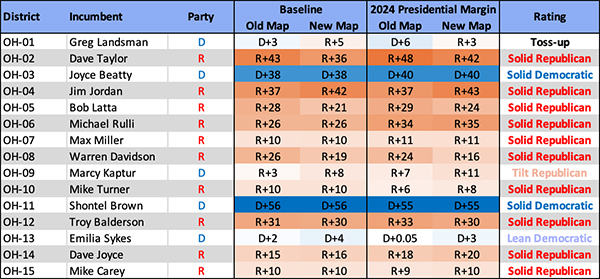
As the table above indicates, Landsman's district went from D+3 to R+5. That is an 8-point shift. But in a blue wave, an incumbent Democrat can win in an R+5 district. It is tough, but not impossible. Also, Landsman greatly overperformed last time, winning by 9 points. With an 8-point headwind, he might still pull it off by 1 point.
Kaptur's district went from R+3 to R+8. That will be a steep hill to climb, but she is well-known in much of the district and an experienced campaigner. In fact, she is the longest serving woman in congressional history. She was first elected in 1982, 43 years ago, and has won the seat 22 times in all. She knows her district pretty well and the voters there know her. Like Landsman, Kaptur is an overperformer. She ran 8 points ahead of Kamala Harris in 2024, winning by 1 point. Her personal brand is clearly worth a lot. In a blue wave, she might be able to hang on. On the other hand, Emilia Sykes got a break, going from D+2 district to a D+4 district, so she is a bit safer now.
Depending on whether Florida, Virginia and states in the deep South do midterm gerrymandering, the Republican gain from these stunts could be something in the range of 5-12 seats. On the other hand, in the latest NBC House generic poll, the Democrats are +8. Prior to this year's redistricting, there were 59 House Republicans in R+7 or bluer districts. All of those are potentially competitive in an election where Democrats get 50% of the House vote vs. 42% for the Republicans, as the NBC poll shows. The same poll shows that Americans blame the Republicans more than the Democrats for the shutdown 52% to 42%. (V)
All Politics Is Now National
Tip O'Neill famously said "All politics is local." Maybe then, but not now. All politics is national. One interesting way to demonstrate this is to compare the results of Senate races with presidential races in the same state. Here are scatterplots that do that. Each dot is one Senate race, with color indicating which party won it. The x-axis is the presidential margin. The y-axis is the Senate margin.
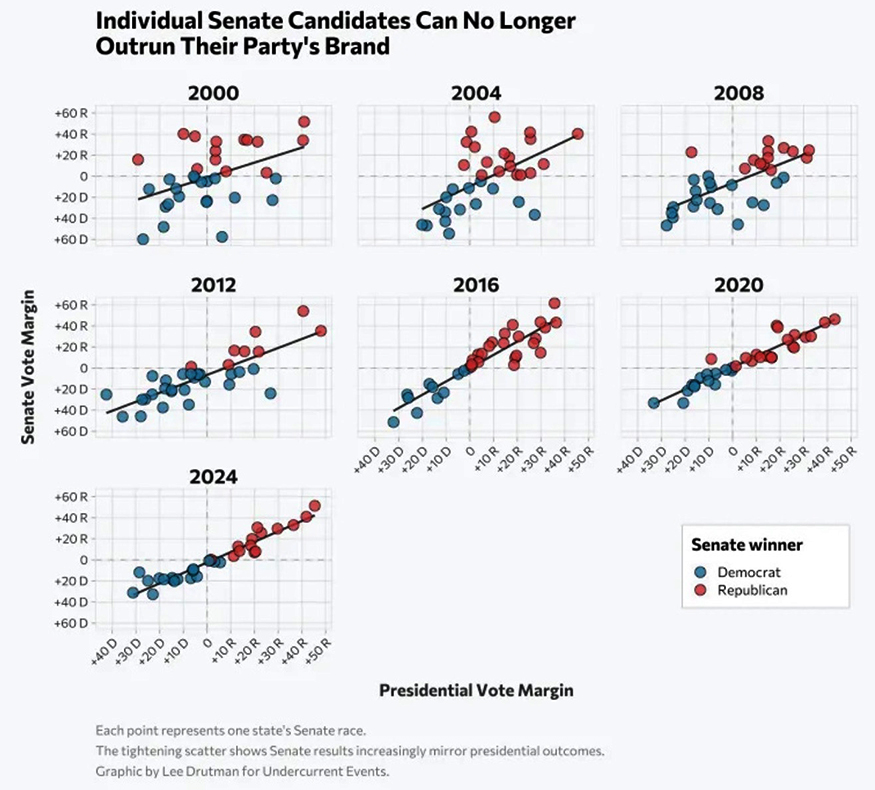
In 2000, it was all over the map. Democrats could win races in red states (blue dots in the lower-right quadrant). For example, Democrats won Senate races in Nebraska and North Dakota. Republicans could win Senate races in blue states (red dots in the upper left quadrant). For example, Republicans won Senate races in Delaware and Rhode Island. But in 2024, the correlation between Senate races and presidential races was 0.91. If the Democratic presidential candidate won a state by a margin of [X], the Democratic Senate candidate also won the state by a margin close to [X], and vice versa. Once in a while in a swing state, a truly bad candidate could underperform, but that was rare. In 2024, in 30 of the 33 Senate races (90%), the same party won both the Senate race and the electoral votes. The only exceptions were four swing states in which the presidential margin was very small and the Democrat won in a Trump state: Arizona, Nevada, Wisconsin and Michigan. In the first three, the Republican Senate candidate had a major candidate-quality problem. Only in the open-seat Michigan race did a normal Democrat beat a normal Republican in a state Trump won, and then she won by only 0.34%.
House races are just as linear as Senate races. Democrats rarely won in Trump districts and Republicans rarely won in districts Kamala Harris won.
G. Elliott Morris has the observation that asking if a candidate is moderate or progressive is the wrong question. Since the image of the Democratic Party among Republicans is frozen in amber ("all they care about are gay and trans people"), the only way for a Democrat to win in a red state is to put a lot of distance between his or her positions and the national party's.
A recent poll shows that working-class voters describe the Democrats as "woke, weak and out-of-touch." The Democratic brand is clearly suffering and changing it won't be easy or fast.
In practice, this means candidates in red states must stake out positions that are anathema to the national party. Good luck with the primary, though. What many Democrats haven't figured out is that a pro-life, pro-coal, pro-gun, pro-filibuster Democratic senator from West Virginia is still better than a Republican senator from West Virginia, since such a Democratic senator will contribute to a Democratic majority, vote for most of the nominees of a Democratic president, and vote for noncontroversial bills like the Inflation Reduction Act and the CHIPS Act. Democrats hated Joe Manchin although he voted with the Democrats much of the time. Are they better off with Sen. Jim Justice (R-WV), who votes with the Democrats 0% of the time? (V)
If you wish to contact us, please use one of these addresses. For the first two, please include your initials and city.
- questions@electoral-vote.com For questions about politics, civics, history, etc. to be answered on a Saturday
- comments@electoral-vote.com For "letters to the editor" for possible publication on a Sunday
- corrections@electoral-vote.com To tell us about typos or factual errors we should fix
- items@electoral-vote.com For general suggestions, ideas, etc.
To download a poster about the site to hang up, please click here.
Email a link to a friend.
---The Votemaster and Zenger
Nov01 Saturday Q&A
Nov01 Reader Question of the Week: Student Counsel, Part IV
Oct31 Today in MAGA: Better Dead than Red?
Oct31 It's Up to You, New York: Will a Blue State Elect a MAGA Governor?
Oct31 Today in Dystopia: Putting the "New" in NewSpeak
Oct31 There's Something Happening Here: The No Kings Protests, Part IX
Oct31 I Read the News Today, Oh Boy: What Is Your Condition Right Now?
Oct31 This Week in Schadenfreude: Southern (Dakota) Man, Better Keep Your Head
Oct31 This Week in Freudenfreude: That's the (Holy) Spirit
Oct30 Trump Seems to Realize He Cannot Have a Third Term
Oct30 Judge Rules that U.S. Attorney in L.A. Was Not Legally Appointed
Oct30 Hegseth Moves to Fire Defense Workers
Oct30 The Fed, Flying Blind, Lowers Interest Rates
Oct30 Red States Are Champing at the Bit to Cut Up Majority-Minority Districts
Oct30 An Arizona Election Will Test Whether Turning Point USA Has Staying Power
Oct30 Cases against the Fake 2020 Electors Are Fizzling Out
Oct30 Dutch Election Was Held Yesterday
Oct29 Shutdown Update
Oct29 Some Senators Show Some Spine
Oct29 Israel Observes Ceasefire by Doing Some More Firing
Oct29 On Thin ICE, Part I: Greg Bovino
Oct29 On Thin ICE, Part II: The Purge
Oct29 Washington Post Approves of Trump's Gold-Encrusted Eyesore
Oct29 The Case of the Missing Teamster
Oct29 All in the Family
Oct29 There's Something Happening Here: The No Kings Protests, Part VIII
Oct28 Game of Shutdown Chess Continues
Oct28 Putting the "Con" in Conservative, Part IV: Pardon Me!
Oct28 Trump Had MRI, Cognitive Test
Oct28 Who Watches the Watchers
Oct28 A Bridge Too Far?
Oct28 There's Something Happening Here: The No Kings Protests, Part VII
Oct27 The TACO Trip
Oct27 DoJ Will Send Monitors to Intimidate Voters in California and New Jersey
Oct27 Kamala Harris Hints That She is Ready to Run for President Again
Oct27 Blinded by the Light
Oct27 Virginia Is Starting to Mimic California
Oct27 Trump Is Slipping Badly with Latino and Black Voters
Oct27 In the Trump Era, Republicans Have Done Poorly in Swing-State Senate Races
Oct27 The Gentrification of the Democratic Party Is Not Sustainable
Oct26 Sunday Mailbag
Oct25 Saturday Q&A
Oct25 Reader Question of the Week: Student Counsel, Part III
Oct24 Trade Wars: Trump Throws Tantrum, Decides to Cut Off Negotiations with Canada
Oct24 The White House: Ballroom Donor List Will Make Your Toes Curl
Oct24 NYC Mayor's Race: Birds of a Feather Flock Together?
Oct24 There's Something Happening Here: The No Kings Protests, Part VI
Oct24 I Read the News Today, Oh Boy: FDR's Brush with Death
Oct24 This Week in Schadenfreude: Censorship, Ohio Style

