


 Welcome & FAQs
  Table of Senate polls
 Senate graphs
 Tipping-point-state
 Congress: retirements
 Governor's races
 Icons for bloggers
 Data galore


• Trump Wants to Force the Rest of the World to Go Brown
• Libertarians Are Not Happy with the First Marxist President
• Blue States Are Discovering What Federalism Really Means
• The Republican Party Has Six Wings
• 2026 ≠ 2028
• Not All Law Firms Have Caved to Trump
• The Closest House Districts
• Congress Has a Geriatric Problem
• Thirty-One States Have an Election of Attorney General This Cycle
CDC Director Susan Monarez Will Be Fired Less Than a Month after Starting the Job
On July 31, Susan Monarez started her new job as director of the Centers for Disease Control. Multiple reports in The Washington Post, The New York Times, and CNN say that she is about to be fired for disagreeing with HHS Secretary Robert Kennedy Jr. on vaccine policy. She is a microbiologist and believes that vaccines save lives. He is a crackpot who believes that they cause autism, despite the only "evidence" being one article years ago that the journal later retracted, while the author had his medical license revoked for fraud. But for Kennedy, one retracted article written by a certified quack is good enough to change national vaccine policy.
During her tenure at CDC, Monarez was expected to run all her plans by the chief of staff at CDC and also HHS, which effectively means she wasn't the real director.
During his Senate confirmation, Kennedy told the senators he had an open mind about vaccines and would look at the scientific evidence about them. Of course, he had no such intention whatsoever, and the hearing was just a charade, as usual. He has already taken many actions to try to rid the country of vaccines, including firing large numbers of experts on the subject. But who needs experts when you have a conspiracy theory?
Monarez, like Fed governor Lisa Cook, has said she will not leave. She says that because she was confirmed by the Senate, she is an officer of the United States and serves at the pleasure of the president, not at the pleasure of a cabinet secretary, so Kennedy's firing her is unlawful. Of course, Trump quickly backed up Kennedy, but this one is undoubtedly headed to the Supreme Court sooner or later. She is being represented by top lawyer Abbe Lowell (see below).
Kennedy has said he will announce to the world what the cause of autism is in September. This will be great because doctors don't know, and will surely be listening carefully to the Secretary to finally learn the truth. (V)
Trump Wants to Force the Rest of the World to Go Brown
Donald Trump campaigned on a pledge to block the Green New Deal or anything like it. In the Trump administration, coal is king and oil is queen. He is probably fighting a losing battle in the U.S., because the economics of solar and wind power are already making it very competitive on strictly economic grounds. Utility companies know which way the wind is blowing (pun intended) and are not going to make investments of tens of millions of dollars in power plants that the next Democratic president may order them to shut down. So now, Trump is turning his attention to the rest of the world and is trying to force other countries to kill their solar and wind projects and burn more oil, gas, and coal.
As usual, his all-purpose tool for blackmailing other countries is threatening tariffs. The European Union agreed to buy $750 billion of American oil and gas over the next 3 years in order to get the tariff on E.U. products set to only 15%. South Korea agreed to buy $100 billion worth of U.S. liquefied gas. Japan agreed to invest $550 billion in U.S. energy infrastructure, part of which would be to ship oil and gas from Alaska to Asia. It is increasingly clear that Trump also intends to extort other countries into halting their transition to clean energy and force them to buy oil and gas from the U.S.
The one bright light here is that the U.S. does not have anywhere near the capacity to export all the oil and gas that countries have agreed to buy and building that infrastructure will take years. The other nations know this, and undoubtedly their promises were mostly smoke they are blowing up Trump's rear end. But damage will be done, as many countries will come to hate the U.S. for meddling in their domestic energy policies. Trump couldn't care less what they think about the U.S. or him as long as they promise to obey his orders and give him "wins."
Energy Secretary Chris Wright is on board with Trump. He told other countries that setting a net-zero emission target was a "sinister goal." (V)
Libertarians Are Not Happy with the First Marxist President
Scott Lincicome, the vice president of general economics and trade at the libertarian Cato Institute, has written an op-ed piece in The Washington Post about why Donald Trump forcing Intel to sell 10% of its shares is a very bad idea for the country. The U.S. government is now the largest shareholder in Intel, so the company will now have to take the political views of the current president into account when making business decisions. There are many ways for this to lead to bad decisions that hurt the company and the country. Here are a few of Lincicome's arguments:
- Lawsuits: The Dealmaker-in-Chief got a bargain. The government paid $20.47 per share
while Intel's market price was $24.80. This effectively dilutes the value of current investors' equity. Someone is sure
to sue, tying the company in legal knots for years. Company lawyers will have less time to sue competitors who are
infringing on Intel's patents and doing other damaging things. They didn't need this.
- Hiring: Will the company be under pressure to hire top level people, both tech and
executive, who are big public supporters of the president? Will it be afraid to hire public critics? Having to take
potential employees' politics into consideration will not lead to hiring the best people.
- Opening Factories: Will the company be under pressure to open new factories in states
favored by the president? Suppose Trump orders Intel to move its future Ohio factory to Florida because Trump made some
deal with Gov. Ron DeSantis (R-FL) and getting Intel to move its factory was part of the deal. Now suppose that Intel
can't fill key positions there because the best people refuse to move to a state that has effectively banned abortions.
Hiring third-rate people is never good for a company.
- Closing Factories: The flip side of that coin is closing the factories that produce
failing products that are losing money. If a factory making failing products is located in a state favored by the
president, the president could "veto" the closing, resulting in the company losing serious money in order to keep some
governor happy.
- Financial Management: Companies issue dividends and do stock splits and buybacks all the
time. The president could be sorely tempted to use Intel and other companies it owns as cash cows to cover the budget
deficit. Forcing them to pay out unsustainable dividends could cut their research investments and hurt the company long
term.
- Agility: In high-tech industries, CEOs need to move fast and make decisions faster. If
every major decision has to be approved by the president (especially one who knows exactly zero about the business the
company is in) it could certainly slow down decision making, even when time is of the essence.
- Contracting Bias: When giving out contracts, the president might decide that companies
that use Intel products should be favored over companies that use competing products. This could easily distort other
markets. If HP and Dell realize that they can't sell any notebook computers to the government unless they have Intel
Inside, they could be forced to make decisions about their products based on factors other than the quality and
price of the parts they buy. Not using the best available parts could lower the quality of their products and make them
more vulnerable to foreign competitors who use the best parts available.
- Bad Precedent: If this deal goes through and is not blocked by Congress or the courts,
what is to stop this president and future presidents from demanding shares (at below-market prices) from companies in other
industries? Suppose Trump demands stock in General Motors and orders it to stop producing electric cars (because his
oil-company donors don't like electric cars). How will this affect the worldwide competitive position of General Motors
when the rest of the world is going electric? And suppose the next president is a Democrat and in 2029 demands that GM
quickly rev up electric car production. Then in 2033, the new Republican president tells GM to stop making electric cars
and go back to gas. Can the company even survive under these conditions? Same problem in many other sectors.
- Investors: Will investors shun industries where the government plays a big (and
capricious) role or could soon play a big role? Will it be harder to get venture capital in a sector where the key
decisions are political rather than business-oriented? This completely skews the rest of the economy. Lessons from the
Soviet Union show that an economy run by the government doesn't always work so well.
Lincicome isn't the only one who sees bears on the road ahead. Sen. Thom Tillis (R-NC), who is now free to say what he thinks since he's a lame duck, said of the Intel deal: "I don't care if it's a dollar or a billion-dollar stake. That starts feeling like a semi state-owned enterprise à la CCCP [USSR in Russian]. I don't believe the U.S. government should be picking winners and losers." Sen. Rand Paul (R-KY) thinks it is a terrible idea. He said: "If socialism is government owning the means of production, wouldn't the government owning part of Intel be a step toward socialism?" Former Republican senator Jeff Flake applauded Paul and called for other senators to support him.
Mike Pence is unhappy with the U.S. government having "golden shares" in Nippon Steel. He also doesn't think Nvidia (and AMD) should be selling high-tech chips to China at all, even if the government gets a 15% cut. Pence said: "State-owned enterprise is not the American way. Free enterprise is the American way." Larry Kudlow, who was National Economic Council director in Trump v1.0, is "very, very uncomfortable" with the government taking 10% of Intel.
The conservative National Review published an editorial starting with this passage: "The federal government has a hard enough time doing the things it should do: securing the border, winning wars, collecting taxes, administering the capital city. It doesn't need to take on the difficult and nongovernmental task of turning around a struggling semiconductor company." It goes on to say that undoubtedly Trump is planning to interfere with how Intel is run, otherwise why would he want the government to own part of it?
Brian Darling, a Republican strategist and former Senate aide, said he is puzzled by Trump's decision because it is a major deviation from conservative economic principles. Silly Brian. Trump is not a conservative and has no principles.
Finally, the senator who wrote the CHIPS Act, Todd Young (R-IN), said the law was never intended to let the federal government take a major stake in Intel or any other major company.
Nevertheless, Intel may not be the last company the Marxist president wants a piece of. Secretary of Commerce Howard Lutnick revealed yesterday that Trump is thinking of having the government take an equity stake in Lockheed Martin. Lutnick said: "I mean, Lockheed Martin makes 97 percent of their revenue from the U.S. government. They are basically an arm of the U.S. government." If Trump did that, if would be extremely problematic. Many defense contracts are awarded based on competitive bidding. If Lockheed Martin and Boeing both bid for the same contract, Trump would undoubtedly favor his company. After Boeing had lost two or three bids under these conditions, it might well decide it has no future in the defense industry and just abandon that part of its business. That might give Lockheed Martin a monopoly in some areas and we all know how productive and efficient monopolies are. Why bother doing research or even producing a decent product if you know you are the only supplier? (V)
Blue States Are Discovering What Federalism Really Means
Red states have often praised "federalism" and "states rights" when that means they get to do things the federal government does not want them to do, like banning abortion or ignoring federal gun laws. Turns out it can work both ways. If the blue states got together—and they are starting to do so—they could throw quite a bit of sand in the gears of the federal government. Chris Armitage gives a short rundown of some of the things the states can do to hinder Uncle Sam.
First, enforcing federal law is largely done by the states. This has always been the case. The Fugitive Slave Act required free states to return escaped slaves to their "owners." Indeed, nationwide, 330 enslaved people were returned in the period 1780-1859, or about four per year, nationwide. For the most part, the free states refused to enforce federal law.
Noncooperation would take different forms now, of course. Some of it depends on infrastructure. California's Franchise Tax Board sends over $500 billion/year to the federal government. Suppose "personnel shortages" delayed those payments (indefinitely). New York sends $300 billion/year. Suppose "technical glitches" slowed that to a trickle. Illinois might suddenly have "compatibility issues" with the IRS system. These aren't numbers in Excel. This is the money that runs the federal government. In a month, the federal government couldn't pay its bills. Of course there would be lawsuits, but the Supreme Court can't make "software issues" go away with a ruling, especially when the governors are loudly proclaiming that they are trying to fix matters as soon as possible but they are having trouble finding qualified people to help.
The leverage is in the infrastructure. Most banks are state chartered. State banking regulators could announce that they are fighting money laundering by requiring "enhanced security reviews" on large transfers, such as those to the federal government. The SWIFT and ACH systems that process federal payments are in New York and would have to comply with state regulators.
The IRS can't function without state help. They need state tax records for audits, state DMV data for collections and state banking systems for processing. Suppose new state regulations required "random" requests go through a manual review process. When Trump bellowed, the 15 governors of the states where the Democrats have the trifecta could say: "We are upgrading our systems so they are compatible. We estimate the cost at $200 billion. If you helped out, it would go faster." Trump might cut payments to the states. If the economy tanks next year, guess who gets the blame? Republicans have weaponized bureaucratic obstruction for decades. It is not a secret how to do it. What it requires is that those 15 states work together. They are not as big as the federal government, but they are still very big if they work together. Interstate compacts are explicitly permitted in the Constitution and there have been many of them over the years.
There is much more. Medical licenses issued in red states? Sorry, not valid in blue states anymore. Graduates of red state medical schools who want to do residencies in blue states? Sorry, no space. Doctors, nurses, paramedics, physical therapists, midwives and other medical professionals who are refugees from red states could get special incentives and fast-track licensing if they move to blue states and work in areas that need them. Ditto for teachers and other desirable professionals. Encourage a major brain drain to get valuable professionals to leave the red states.
Of course, there will be lawsuits and Supreme Court decisions on all this. What could blue states do if courts rule against them? Be like Texas. When the courts ruled against the SB-8 bounty system on abortions, the state changed a few words and passed the law again. Rinse and repeat. If 15 states played this game, all with variants in their laws and procedures, each case would have to be fought separately and over and over. In the end, the courts would be overwhelmed and couldn't enforce anything against half the country. It's not making one dramatic stand. It's flooding the zone, passing laws that might be struck down, refusing to cooperate in any way, and throttling the infrastructure while simply not enforcing federal laws due to "personnel shortages" caused by governors' "decisions" to prioritize fighting street crime. (V)
The Republican Party Has Six Wings
Most things that fly have two or four wings. The modern Republican Party manages to fly even though it has six wings. The only reason it hasn't crashed and burned so far is the gravitational force of Donald Trump, which holds all the pieces together due to force of personality. Whether anyone else can pull that trick off when he has exited stage right remains to be seen.
The Washington Post has a nice rundown of the six-winged beast and who hangs out in each wing. Here is a brief summary:
- MAGA Populists: These are the true believers who powered Trump to two presidencies. They
are working class, anti-immigration, and against getting involved in foreign wars. They support tariffs, thinking that
will bring jobs home. They consume a lot of right-wing media (e.g., Fox). They hate the "elites" and "deep state" and
are angry that Trump is protecting them by not releasing the Epstein files. They are open to courting unions and raising
taxes on the rich. Leaders include J.D. Vance, Rep. Marjorie Taylor Greene (R-GA), and Steve Bannon.
- Traditional Republicans: Yup, they are not in ascendency at the moment, but they are
still around, especially at the state level. They are most definitely not interested in courting unions or raising taxes
on the rich. They support free markets and free trade, lower taxes on the rich, and smaller government (except the
military). They strongly oppose tariffs. They don't care much about the social issues, but they will just tag along to
stay in power. Projecting American power worldwide is fine with them. Leaders here are Gov. Glenn Youngkin (R-VA), Gov.
Brian Kemp (R-GA) and Senate Majority Leader John Thune (R-SD). Sen. Lindsey Graham (R-SC) also belongs in this bag but
to call him a leader is stretching the term to its breaking point.
- Small-government Conservatives and Fiscal Hawks:
These are the leftovers from the Tea Party Movement. Their big issue is the budget deficit.
They want balanced budgets or surpluses to pay down the federal debt.
Leaders here are Sens. Ted Cruz (R-TX), Rand Paul (R-KY) and Ron DeSantis.
Some people have forgotten, but DeSantis was a founding member of the Freedom Caucus.
- The Religious Right: It took Trump's political genius to win over this group. After all,
people who are deeply religious tend not to cling to church-avoiding,
twice-divorced sexual harassers who have affairs with porn stars while married to a former
nude model.
But Trump has them locked up, largely because while they spend Sunday praising Jesus, they spend the other 6 days of the
week hating gay people and trying to ban all abortions. Trump figured this out quickly and changed his positions to
accommodate them. It worked. His Supreme Court overturned Roe v. Wade, and for this they will be forever
grateful. Leaders include Speaker Mike Johnson (R-LA), Sen. James Lankford (R-OK), Republican strategist Ralph Reed, and
anti-abortion activist Marjorie Dannenfelser.
- Tech Right: Tech people used to be either leftist or libertarian, but Trump has brought
some of them into the fold. They care about AI, crypto, free speech, and getting the government to keep its dirty paws
off their wonderful platforms. They strongly favor allowing skilled immigrants from India and China into the country
because it allows them to depress salaries. Leaders include Elon Musk, Marc Andreessen, and David Sacks.
- MAHA and Former Democrats: These are former conservative Democrats who didn't like it
when, in their view, the Democrats went full-blown woke. Some fitness influencers and anti-Big Ag people are in this
wing. The leader is Robert Kennedy Jr., but former Democratic presidential candidate and possible Russian asset Tulsi
Gabbard also belongs here.
It is worth mentioning that the 2025 Republicans are not the first party to house multiple competing and mutually antagonistic factions. The 1932 Democratic coalition under Franklin Delano Roosevelt had very progressive professors at Harvard, racist rednecks in the South, prairie farmers in the Midwest, libertarian ranchers in the West, and businessmen in New York and Chicago. Each group hated all the others. It was FDR's genius that held it all together. His veep, Harry Truman, held it together for one more election (1948), then it fell apart and Dwight D. Eisenhower won in 1952. What happens to the Republican Party in the post-Trump era is a very good question to which we do not have a very good answer. (V)
2026 ≠ 2028
Politico interviewed Doug Sosnik, a former adviser to Bill Clinton and now a global political analyst, about the 2026 and 2028 elections. His take is that 2026 and 2028 could be quite different.
His first observation—and he is far from the only one making it—is that the most important determinant of how someone votes these days is educational level. His second observation is that most politicians are party regulars who gradually move up the ranks as time goes on, but a few are movement leaders first and politicians second. Donald Trump is a movement leader. So is Sen. Bernie Sanders (I-VT). Ronald Reagan was arguably also a movement leader.
The difference between the two is important. When people pull the lever for a regular politician, they are really expressing a preference for one of the parties. If the candidate died 3 months before the election and was replaced, all the votes would transfer smoothly to the new candidate. In contrast, votes for a movement leader don't transfer to other members of his party. If that candidate suddenly dies, his or her voters might vote for the other party or more likely not vote at all. The implication here is that try as he may, Trump will not be able to motivate all of his supporters to turn out in 2026 for Republican House candidates, because they are not actually Republicans. They are Trumpists. Presidential elections have a completely different dynamic.
A very big difference between 2026 and 2028 is turnout. Midterm turnout is always much lower than presidential turnout. Low-information voters are barely aware what is at stake and don't bother to vote in midterms. It used to be that college-educated voters were Republicans and they showed up for midterms. Now most of the college-educated voters are Democrats, they are angry, and they will certainly show up on Nov. 3, 2026. It is not a coincidence that the most highly educated states are mostly blue and the most lowly educated states are mostly red. That wasn't always the case. As late as 1996, Arkansas, Iowa, Kentucky, Louisiana, Missouri, Ohio, Tennessee, and West Virginia were poorly educated but blue. By 2000, that had started to change, in part because Al Gore was seen as a snobby intellectual who thought the spotted owl was more important than Joe Sixpack. Joe Sixpack didn't like that so much. Now the process is essentially complete. Here are the electoral vote maps for 1996 and 2000. In 1996, the less-educated states were still blue. By 2000, that was changing:
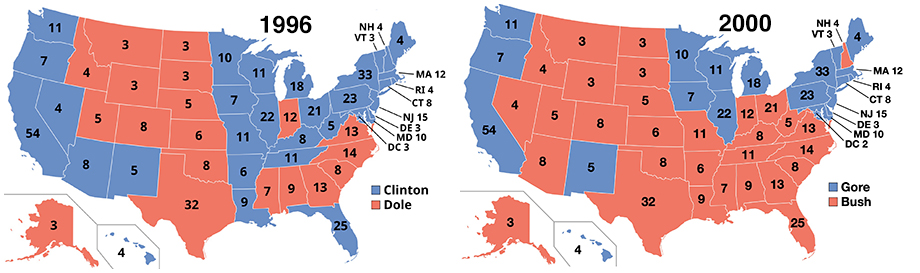
Extensive midterm gerrymandering may flip a few House seats toward the Republicans, but the underlying dynamics—an unfavorable electorate and Trump not on the ballot—are still there. Sosnik thinks this bodes well for Democrats next year.
When asked about how the Democrats can get their mojo back in 2028, Sosnik said the party has to do three things:
- Nominate someone with the temperament and vision to inspire the country.
- Do not take the bait on social issues where Democrats are outside the mainstream.
- Attract noncollege voters.
The most important fact here is that 60% of the voters do not have a 4-year college degree. If Democrats write them off as ignorant racist sexist yahoos, they are lost as a party. They have to come up with an agenda that a large number of noncollege voters see as working for them. Putting together that agenda and finding a candidate who can sell it are the challenges they are facing. Note that: "Not being Donald Trump" is not on the list. (V)
Not All Law Firms Have Caved to Trump
Many white-shoe law firms have caved to Donald Trump and agreed to do hundreds of millions of dollars worth of pro bono work for clients he chooses. It has not always worked out so well for them, though, with boycotts from clients and partners and associates leaving. Many recent law school graduates have not applied for jobs there.
On the other side, one very successful lawyer, Abbe Lowell, has now started his own firm specifically for defending people Trump is attacking. Fed governor Lisa Cook, whom Trump has tried to fire, hired him, as has NY AG Letitia James. Same with Miles Taylor, whom Trump singled out for investigation, and Mark Zaid, a D.C. attorney who had his security clearance yanked by Trump to get revenge on him. Margaret Donovan, who has worked with Lowell in the past, said: "He wants to take on a lot of fights." Lowell has a long list of senators and governors he has defended.
On a podcast at The Contrarian last week, Lowell said that his various cases have different facts, but there is a central theme that runs through all of them, "which is the full power of the federal government being pointed in the direction of individual people in the United States who happen to be adverse to this administration's policies or who have criticized them." No previous president has ever weaponized the entire federal government in order to destroy his critics. (V)
The Closest House Districts
There are multiple ways to measure how close a House district is. Charlie Cook's PVI is one. It uses the two most recent presidential elections as the inputs. Using the most recent House election is another way to do it. Election prognosticator Nathan Gonzales has a third way. It combines all federal and state election results over the past four election cycles to get the "expected" Democratic vote and the "expected" Republican vote. Because this metric goes back 8 years, it is slow to change, just as the PVI score is. One advantage over the PVI though is that it is adjusted after every midterm election, not just after presidential elections, so it adapts somewhat faster than the PVI score.
Here is Gonzales' list of the 10 closest districts, prior to the redistricting going on this year, sorted on how close they are. Needless to say, all of them are toss-ups next year and will get a vast amount of attention from both parties.
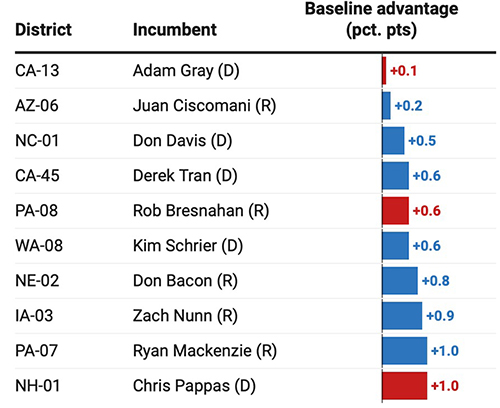
As you can see, all of them are within one point, so clearly they can go either way in any election. The Democrats have a tiny edge in seven of them and the Republicans in three, but that doesn't mean very much.
History shows that the 10 districts are not independent of one another, despite CA-13 and NH-01 being 2,600 miles apart. If the winds are blowing one way nationally, that will be felt in most districts. It was not a freak accident that Donald Trump won all seven swing states in 2024 and it is likely that all or most of these 10 districts will go to the same party in 2026. All it would take is something like a 2-point advantage in the national popular vote for the House to have all 10 go to the same party. Since each party now has five of the seats, a national advantage of 2 points would gain five seats here and additional seats with a slightly larger spread. In the most recent generic House poll, the Democrats are ahead by 8 points. But remember, Nov. 3, 2026, is 14 months from now and in politics, a week is a long time. Also, the current round of gerrymandering could change many districts. (V)
Congress Has a Geriatric Problem
The Democratic base is demanding blood—young blood—but many elderly Democrats in the House have no intention of riding off into the sunset. Republicans are not demanding that the oldsters move on (because that would imply the Oldster-in-Chief was past his best-by date), so they are certainly not leaving. The 75+ set is ready for another election, especially in very blue or very red districts where reelection is easy. They have long forgotten what happened to Dianne Feinstein.
Rep. Maxine Waters (D-CA) is 87. She said: "No matter what age you are, if you're in good shape and you can do what it takes in order to be involved in this kind of effort, then you should do it." Many people would strongly disagree. She was born before World War II started and has a different worldview from people born in the 1980s or later. She's running. Rep. Steny Hoyer (D-MD) is 86. He feels a "strong passion" for the job. Rep. Jim Clyburn (D-SC) is 85. He said his children are his motivation for staying in Congress. They are 56 and 63. Rosa DeLauro (D-CT) is 82. She loves being a congresswoman and has no plans to stop. Rep. Bonnie Watson Coleman (D-NJ) is 80. She is "fighting this injustice, fighting the cruelest administration I've ever seen, and trying to stand up for and protect as many rights of people that I can." Does she believe no 40-year-old could fight injustice? Rep. Lois Frankel (D-FL) is 77. She said: "People are so scared and so upset, and they want someone who knows what's going on. They want someone who's going to fight, and they trust me." She somehow assumes that people in their 30s, 40s, or 50s don't have a clue what is going on?
There are 50 members of Congress 75 or older who are up in 2026. Nearly 70% are running and 70% of those are Democrats, so the Democrats have a bigger geriatric problem than the Republicans. In fact, three House Democrats have died in office in 2025 so far: Sylvester Turner (70), Gerry Connolly (75), and Raúl Grijalva (77). Dying in the saddle seems to be a Democratic goal.
When then-DNC Vice Chairman David Hogg set up a PAC to primary older Democrats with younger Democrats, the DNC went bonkers. DNC Chair Ken Martin gave him an ultimatum: Kill your plans to primary old Democrats or give up your position here. Hogg chose the latter. Martin clearly doesn't see eye-to-eye with the base. The beat goes on. And on. And on. And on. And on. (V)
Thirty-One States Have an Election of Attorney General This Cycle
State AsG are the states' top cops. They handle state-level criminal and civil cases. When the president is not from their party, they often spend a lot of energy suing the administration. AsG are the most important state officials after the governors. There are 31 elections for AG this cycle. Larry Sabato's Crystal Ball has a rundown of all the races, summarized below. Of the 43 elected AsG (the other 7 are appointed), Republicans hold 24 to the Democrats' 19.
SAFE REPUBLICAN- Alabama: Open. AG Steve Marshall is running for the Senate. Whoever wins the GOP primary is in.
- Arkansas: AG Tim Griffin (R) is the prohibitive favorite.
- Florida: AG James Uthmeier (R) succeeded Ashley Moody when she left for the Senate. He should win easily.
- Idaho: AG Raúl Labrador (R) is safe if he runs but he might run for governor instead.
- Nebraska: AG Mike Hilgers (R) will win another term easily.
- North Dakota: AG Drew Wrigley (R) has ruffled some feathers but should be reelected without a battle.
- Oklahoma: Open. AG Genter Drummond is running for governor. The winner of the GOP primary gets the job.
- South Carolina: Open. AG Alan Wilson is running for governor. As Oklahoma goes, so goes South Carolina.
- South Dakota: Open. AG Marty Jackley is running for the U.S. House. Some Republican will win, count on it.
- Texas: Open. AG Ken Paxton is running for the Senate. Democrats simply don't win in Texas anymore.
- Iowa: AG Brenna Bird (R) is running for reelection in an increasingly red state and is the favorite.
- Kansas: AG Kris Kobach (R) is a fire-breathing right winger and is facing the same guy he barely beat in 2022.
- Ohio: Open. AG Dave Yost is term-limited. State auditor Keith Faber (R) is the favorite absent a blue wave.
- Georgia: Open. AG Chris Carr (R) is running for governor. Biden carried the state and both senators are Democrats. Miracles can happen.
- Arizona: Kris Mayes (D) won by only 280 votes in 2022. State Sen. Warren Petersen (R) is her likely opponent.
- Michigan: Open. Dana Nessel (D) is term-limited. Big multiway primaries on both sides are expected.
- Minnesota: Keith Ellison (DFL) might run for governor if Tim Walz retires. If not, another tough race for Ellison.
- Nevada: Open. AG Aaron Ford (D) is running for governor. His job is up for grabs in this swing state.
- Wisconsin: Josh Kaul (D) might run in the open gubernatorial race. Either way, it will be close.
- Virginia: AG Jason Miyares (R) is up in 2025. If Abigail Spanberger wins in a landslide, her coattails could help knock off Miyares.
- None
- California: Rob Bonta (D) is a lock for another term.
- Colorado: Open. AG Phil Weiser wants to be governor. Big primary for Dems, but the winner is safe.
- Connecticut: If Gov. Ned Lamont (D-CT) retires, AG William Tong (D) will run for gov, otherwise be reelected AG.
- Delaware: Kathy Jennings (D) shouldn't have a lot of trouble getting a third term.
- Illinois: No Republican holds statewide office, so Kwame Raoul (D) will get another term.
- Maryland: Anthony Brown (D) is a shoo-in for a second term.
- Massachusetts: Andrea Campbell (D) loves to fight Trump. End of story.
- New Mexico: Raúl Torrez (D) should coast easily to another term.
- New York: Donald Trump is targeting Letitia James (D), which will help her, not that she needs it.
- Rhode Island: Open. Peter Neronha is term-limited. There are many candidates but Rhode Island is very blue.
- Vermont: If Gov. Phil Scott (R-VT) retires, AG Charity Clark (D) will run for gov, otherwise get reelected easily.
One important note here is that all five of the toss-ups are Democrats. These are potential pickups for the Republicans. There isn't much low-hanging fruit for the blue team other than Miyares this year. Maybe Georgia next year, but that might depend on the Democrats nominating a Black person for governor to juice Black turnout. (V)
If you wish to contact us, please use one of these addresses. For the first two, please include your initials and city.
- questions@electoral-vote.com For questions about politics, civics, history, etc. to be answered on a Saturday
- comments@electoral-vote.com For "letters to the editor" for possible publication on a Sunday
- corrections@electoral-vote.com To tell us about typos or factual errors we should fix
- items@electoral-vote.com For general suggestions, ideas, etc.
To download a poster about the site to hang up, please click here.
Email a link to a friend.
---The Votemaster and Zenger
Aug27 Holding the Line, Part I: Judges Push Back on Trump's Legal Agenda
Aug27 Holding the Line, Part II: Judges Push Back on Voting Shenanigans
Aug27 California Gerrymander: Republicans Are Blowing It
Aug27 The Peter Principle on Steroids
Aug27 Our Long National Nightmare Is Over
Aug26 Fascism Watch, Part I: Trump "Fires" Fed Governor Lisa Cook
Aug26 Fascism Watch, Part II: Trump "Bans" Flag Burning
Aug26 Fascism Watch, Part III: The Brownshirtifying of the National Guard Continues
Aug26 Fascism Watch, Part IV: Trump Breaks Wind
Aug26 The Strangest Culture Wars Battle... Ever?
Aug25 Trump's Next Target: Big Cities
Aug25 Corporations Are Having to Pay the Piper--or Else
Aug25 Another Target Is the Fed
Aug25 The Calendar is on the Calendar Today
Aug25 Judge Nixes Alligator Alcatraz
Aug25 Could a Native American Decide Control of the Senate?
Aug25 Meet the New Swing Voter
Aug25 Fallout from the Habba Mess Is Here
Aug25 The Freedom Caucus Is Leaving Town
Aug25 Foreign Governments Are Using AI to Spread Disinformation
Aug24 Sunday Mailbag
Aug23 Corruption, Thy Name Is Trump
Aug23 Saturday Q&A
Aug23 Reader Question of the Week: Baby You're a Rich Man
Aug22 Legal News, Part I: Once Again, Donald Trump Is above the Law
Aug22 Legal News, Part II: Habba Suffers Major Setback
Aug22 Today in Gerrymandering: The Redistricting Derby Is Officially Underway
Aug22 Democratic Presidential Candidate of the Week, #29: Sen. Tammy Baldwin (D-WI)
Aug22 A Nation of Immigrants: Butchers and Bakers and Candlestick Makers
Aug22 I Read the News Today, Oh Boy: Don't Forget to Buckle Your Truss
Aug22 This Week in Schadenfreude: The British Know a Thing or Two about Petty Snubs
Aug22 This Week in Freudenfreude: Solar May Make up Half of U.S.' New Capacity in 2025
Aug21 Judge Refuses to Release Epstein Grand Jury Transcripts
Aug21 Newsom's Trolling Trump Is Getting Him Vast Attention
Aug21 Democrats Are Hemorrhaging Voters Nationwide
Aug21 How to Influence Trump
Aug21 Sooner or Later It's about the Grift
Aug21 Tulsi Gabbard Is Spending Her Time Punishing Democrats
Aug21 MAHA Meets MAGA
Aug21 U.S. Trans Woman's Request for Political Asylum Heard by Dutch Court
Aug20 For His Next Trick, Donald Trump Will Gargle Peanut Butter
Aug20 The Redistricting Wars Continue
Aug20 House Preparing to "Release" Epstein Files
Aug20 A Department of Justice Turned Upside-Down
Aug20 Candidate News: U.S. House
Aug20 A Nation of Immigrants: Pay It Forward
Aug19 Trump Meets with Zelenskyy and Friends
Aug19 Republicans Think Voters Flunked Civics 101
Aug19 Of Course Trump Has a Corporate Enemies List

