


 Welcome & FAQs
  Table of Senate polls
 Senate graphs
 Tipping-point-state
 Congress: retirements
 Governor's races
 Icons for bloggers
 Data galore


Sunday Mailbag
The question about national parks, several weeks ago, clearly struck a chord.
Politics: This Week in TrumpWorld
E.C.R. in Helsinki, Finland, writes: Here in Finland, and elsewhere in Europe, the upcoming summit in Alaska is cause for heartburn, hand-wringing and remonstrations to D.C. that Ukraine must be at the table. But the Ukraine war's presence on the agenda is, in fact, optional. Yes, the Ukraine war is bad, but so are the famine in Gaza and the conflict in Sudan and maybe the plight of the Rohingya, remember them?
So what one thing would make the summit between Trump and Putin a success? That's easy: renewing the New START treaty, which expires in 6 MONTHS, for 5 or, ideally, 10 more years. Even better would be to renew the INF treaty, but that would likely require a year of negotiations. And then there's the whole question of tactical nuclear weapons deployed on short range FPV or other drones (too short for the INF). That will take years to figure out, but by at least renewing New START now the discussion can begin.
The Biden administration complained after the start of the Ukraine war and the massive sanctions placed on Russia that the Russians were uninterested in continuing to engage with them on arms control and other topics. Whether that expectation was naive is beside the point. A summit between the world's two foremost nuclear powers is never a bad idea, and if any third country should be invited it would be China, but China's not yet at the level of nuclear deployment to warrant an invitation.
Readers need to realize that, as things stand, come March 2026, the number of deployed nuclear weapons will soar to 4,000 or more literally overnight. For example, the 400 U.S. Minuteman 3 missiles currently hold one warhead each, due to the treaty. But they were designed to hold 3 apiece so, within weeks the US could boost its deployed nuclear weapons by almost a thousand. Other systems on both sides can also be rapidly increased and, by this time next year, a full blown nuclear arms race could be underway. Compared with this, the specter of the Ukraine War continuing for another year is the lesser of two evils.
A.T. in Bloomington, IN, writes: You wrote, regarding the census: "Because of the manner in which Trump made the announcement, there is much that is not clear. To start, is he trying to conduct a new census, on a quicker timeline than would normally be the case? Or is he merely trying to change the rules for the next regular census?"
At the risk of reading too much into one of Trump's so-called "Truths," I interpreted his statement to mean that he was going to order a revised 2020 census. Not only would this fit with his endless obsession with relitigating that fateful year, but it would allow him to use the "information gained from the Presidential Election of 2024" in order to steal a few more House seats for the GOP in 2026.
A.V. in Cedar Falls, IA, writes: Trump isn't trying to organize or fund a new census. That would require money and effort. Just like everything in Trump style, he just wants to simply write his own numbers and make it so Democrats have as few seats as possible.
And, using your words, Congress will probably let him.
T.G. in Salem, OR, writes: Am I the only person who is absolutely confident that the "private patriots" who are footing the bill for the $200 million ballroom are just like "Mexico," who was going to pay for the Wall?
R.A.G. in Luverne, MN, writes: Speaking from experience, my hearing went out at the age that Donald Trump is now. I see many of my behaviors then being exhibited by TCF now—the head twisting, the neck stretching, the deer-in-the-headlights look and, especially, the left-field responses to misheard questions. His bad hearing is exacerbating what appears to be frontotemporal dementia and, as empathetic people, we need to show concern for his well being by starting a GoFundMe page so that he can afford to buy some decent hearing aids to ameliorate some of his suffering.
B.W.S. in Pleasant Valley, NY, writes: As a TV news production assistant in an earlier life, I can shed some light on Donald Trump's use of quotation marks in his social(?) media posts: It's an old teleprompter convention. Unlike cue cards, where you can noticeably increase the size of certain text, or draw outlines around the letters or underline them or whatever, prompting systems don't really have any good way of indicating inflection—which words a reader should emphasize. Even for those devices that might have been capable of displaying bold, underlines or italics, they all would have made the screen too busy and confusing. Quotation marks were an easy fix; every keyboard had them, they were relatively small and unobtrusive, but still hard to miss, couldn't be mistaken for anything else, and they had the added advantage of being portable to any other system in the world without patches.
So Trump, having been a media personality since time out of mind, just instinctively writes like everything is going to be on TV eventually. It's almost like a tragic, backwards version of The Truman Show.
T.S. in Seattle, WA, writes: You wrote about Donald Trump lying. I don't believe he lies the same way past politicians have lied.
I'd like to pose a possibility here: that Trump does not "lie," but instead he subscribes to a self-help system by which he can create reality by believing in it and speaking his views with conviction.
This is similar to the "prosperity gospels" or the book The Secret, which advocate for the idea.
Trump lives in a rarified world where, if he says "many people are saying X," there are tons of fawning sycophants around him who will go on TV and say X, which enables him to create reality. He also has tons of enablers and employees whose job it is to make his ramblings real. This is part of why he can never back down, why he uses sharpies or altered photos of a person's knuckles to make things he said in the past "true."
If this is correct, this would explain the key difference between him and someone like Marco Rubio, who lies but doesn't believe it.
J.L. in Albany, NY, writes: P.D.N. in Boardman writes to remind us that Trump has no complexity to him. He's stupid, clueless, and just follows whatever tiny thought pops into his head.
This is true, but I think it's important to realize that many of the people in Trump's administration (like Stephen Miller) DO have a plan. Whether it be Project 2025 or their own agenda, they have a goal in mind and are working hard to drag us to that position.
Working in their favor is that Trump is racist and filled with hate, so plans to, say, toss all immigrants or political opponents into concentration camps will be met with enthusiasm by the President.
The only things working against them, where Trump is concerned, is that Trump might blab the details too early (simple solution: Only tell him things you're doing in the short term) and he might chase random gripes/grudges (they'll just use these as distractions to push their plans forward).
So, yes, Trump has no plan, but at the same time there is a plan and Trump is being used by people whose brains are more intact (but no less evil) to push plans forward.
M.M. in San Diego, CA, writes: Thanks to (L) for the handy legal term ultra vires (made up and illegal). Describes everything this administration attempts, doesn't it?
G.R. in Carol Stream, IL, writes: Electoral-Vote.com should have a weekly feature: "How many warning signs for fascism did we trip this week?"
Politics: The Trade War
P.S. in Plano, TX, writes: You wrote: "It's Economics 101 that the costs of tariffs are borne mostly by consumers, not by producers. Anybody who has taken an econ class surely knows this."
From someone who completed three college-level economics classes, ending with Intermediate Microeconomics, that's not true. Which party bears the cost of the tariffs depends entirely on the elasticity of supply compared to the elasticity of demand in the market. Whichever party is more elastic "wins." In math terms, if D(p) is the demand function and S(p) is the supply function, then consumers pay more of the tariff cost if and only if:
|D'(p)| > |S'(p)|with the prime symbols indicating the first derivatives of the supply and demand functions and "| |" indicating absolute value. In layman terms, consumers pay more of the tariff cost if they are, as a group, more willing to stop buying the imported product than producers are willing to stop selling it, and producers pay more of the cost if the opposite is true.
Consumers are more likely to be less elastic than producers, and therefore pay more of the tariff cost, when the product is a necessity, like food or toilet paper, and be more elastic than producers, therefore paying less of the tariff cost, when the product is a discretionary luxury, like a high-end automobile. But we won't have to speculate about who's getting hit more for long: After the tariffs have been in effect for a while, we'll be able to see how much the price consumers are paying for imported goods has increased and compare it to how much the price producers are receiving for exported goods has decreased. The sum of (the absolute values of) those numbers multiplied by the number of goods sold equals the revenue from the tariff, and whichever number is bigger belongs to the party that got hit more.
G.A. in Santa Cruz, CA, writes: You have often wondered if there is any plan behind the Trump trade wars. Commerce Secretary Howard Lutnick just said the quiet part out loud. The goal is to eliminate income tax for all but the top 10% of earners and replace the lost income with tariffs. The numbers do not add up, but since when have Republicans worried about numbers? They can run in 2026 or 2028 on a platform of eliminating income tax. That will sound great to low-information voters who do not realize that tariffs are effectively a regressive sales tax that disproportionately impacts the lower/middle class. In this context, the goal is to collect as much revenue as possible from tariffs, which means make them absurdly high (which he is doing).
N.S. in Barrie, ON, Canada, writes: You wrote: "The notion that the trade war is a haphazard mess, with no clear underlying logic, is going to inform our conclusions from here out, so keep that in mind."
It is possible that actually having a "haphazard mess" is the underlying logic undergirding the tariff policy. In Donald Trump's mind, keeping everyone else "off balance" allows him to maintain control of the agenda and narrative. The "mess" also allows him to collect taxes, by way of the various tariffs, from the American public so he can pay for his large tax cuts for the rich. Many people believe his fiction that the other countries pay for the tariffs.
M.L. in Athens, OH, writes: Donald Trump's action on the economy, and so many other aspects of his job, reminds me of the Star Trek: The Next Generation episode "Allegiance." In that episode, Captain Picard is kidnapped by an alien race and replaced with a doppelganger who is running an experiment to understand human command structures. The imposter implements a series of increasingly bizarre actions to test the limits of the Enterprise crew's allegiance to its captain. The experiment culminates in the alien ordering the ship into a neutron star and the command crew mutinying. In the case of Trump's increasingly bizarre actions, the command crew (cabinet, House, Senate, SCOTUS) are saying 'Fu** yeah! Let's burn this mother down!'
I know that art is supposed to imitate life, but Jesus. Idiocracy wasn't meant to be a documentary.
Politics: The Epstein Files
C.K. in Jacksonville, FL, writes: A wise man once said that high minds talk about philosophy (like what type of government we should have), average minds talk about politics (like immigration or economic policy), and small minds talk about people (like Jeffrey Epstein). Those QAnon folks have long believed that Epstein is the key to saving the world from the Satanic cabal, because they can only understand talking about people. The 1/6 insurrection and its impact on this country don't even compute for them, but Epstein does. Who knew that Epstein would be the key to making a crack in the MAGA movement? In hindsight, Speaker Emerita Nancy Pelosi (D-CA) should have launched investigations into Epstein instead of Jan 6.
I do not believe that the QAnon folks will ever vote Democratic, because that would mean they were wrong. But perhaps they can be persuaded that they have been fooled because the Republicans are in the Satanic cabal, too. Trump, of course, is Satan's chosen one and, like Emperor Palpatine in Star Wars, has played both sides to advance Satan's agenda. I'm sure that QAnon folks love Star Wars and can understand that—Epstein bad, Palpatine bad, Trump bad. If those MAGA voters understand the Satanic "truth," then voting either Democrat or Republican is a vote for Satan. Then all those QAnon people will stop voting. That is a huge part of MAGA's electorate and good riddance.
J.D. in Concord, NH, writes: The New Hampshire State Capitol, located in downtown Concord, hosts protests of all kinds. "Nazis" are not an uncommon sight. These wannabe Nazis are always obnoxious and usually carry a large provocative sign of some sort. This week, the "Nazi" sign said "TRUMP LOVES EPSTEIN":
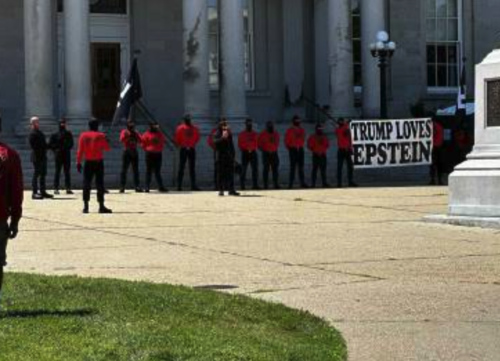
He's definitely losing his base...
H.D. in Baltimore, MD, writes: Please don't think that I am in any way defending Jeffrey Epstein, but it bothers me when you continually refer to him as a "pedophile." The use of this term is wrong. As far as anyone knows, he was not sexually attracted to girls prior to the onset of puberty, which is the definition of pedophilia. He was attracted to and trafficked teenage girls. Most of these were "underage"—that is, younger than 18 in the U.S., which is a legal term. Being underage and being a child is not the same thing. In most countries, the age of consent is much younger than 18, and in some cases (particularly in Europe) as young as 12. If every man in the world who is attracted to teenagers is a pedophile, then it would be very hard indeed to find a man who isn't. The key is to what extent a man acts on these desires, and to what extent anyone is exploited. Again, I'm not defending him, and he certainly deserved his fate.
Politics: The 2028 Democratic Field
J.E. in Gilbertsville, PA, writes: A quick read of your post about the 2028 Democratic candidates as seen from the right quickly shows that the right-wing has zero idea what "diverse" means. I'm pretty sure I speak for "my people" when I say it's not something a specific candidate has to have. Did the right-wing not notice we put up Joe Biden in 2020? Nothing diverse about that man, unless being Irish is making a comeback as a "minority." (Quotes used just because it's a silly notion.) Again, speaking for "my people," diverse is something we are looking for in the ticket, or in Congress, or in some other body of peoples. We just want the government to look like the electorate they represent. And I will never, ever, be convinced that's a bad thing.
I know those of us here are smart enough to know these things, but I had to say them out loud.
S.N. in Charlotte, NC, writes: I think you are spot on with your assessment that the writer at RedState overrelies on stereotypes and the assumption that Democrats "need" a diverse candidate. Quite the contrary, and I've had several discussions with fellow liberals (spread out nationally, BTW) who are actually afraid of the Democratic Party making the same mistake yet again in running another female and/or person of color, for fear of losing, again.
N.M. in West Chester, PA, writes: Wow, RedState really hates minorities. They're not even dog whistling anymore.
A.G. in Scranton, PA, writes: J.P.R. in Westminster asks: "In response to your RedState rundown on Democratic candidate prospects: I have also encountered a characterization of Rep. Alexandria Ocasio-Cortez as a 'fu**ing idiot' by a self-described 'small c' conservative (read non-MAGA) guy who I very much like and respect and who I frankly think should know better. Where do you believe this characterization might come from?"
A.G. in Scranton's answer: His ass.
Politics: Gerrymandering
M.M. in Centralia, IL, writes: I was in my twenties (many decades ago) when I came to the conclusion, "Republicans cheat," and when they can't cheat, they use subterfuge to change the rules in their favor.
So I am flummoxed why it has taken this long for the rest of the political world to understand this basic principle and to get serious about taking off the gloves and fighting back. Maybe it's because the cheating and rule-breaking is now so blatant and in-your-face, so sue me (literally)?
I dunno.
J.M. in Silver Spring, MD, writes: You wrote: "Other blue states that might try [to flip red seats to blue via gerrymandering] are Illinois, Maryland, New York and Wisconsin."
I'm sorry to tell you that the Old Line State is already gerrymandered. In Maryland, Democrats outnumber Republicans 2-to-1. So, you would expect a 6-2 or 5-3 split of our 8 congressmen. And it used to be 6-2. But, by statewide referendum, we put a gerrymander into place and flipped the red seat in the western Maryland panhandle blue to make it 7-1. That one red district (the Eastern Shore) belongs to, of all people, the infamous Andy Harris. His seat is quite safe for him and could never be otherwise.
T.M.M. in Odessa, MO, writes: There was a question from Indiana about Indiana being on the list for redistricting.
Indiana is a good example of a state in which, if the starting point is the current map, it is hard to reduce the minority party's representation further.
But that assumes that the starting point is the current map. If you are willing to start over from scratch and violate the traditional norms that most states follow (at least somewhat) of respecting communities of interest, and you do not have a problem with splitting up counties and cities, then it is much easier to do.
We have seen this done in Utah where, to avoid having even one competitive seat, every single one of the districts contains part of the Salt Lake City area. And this last cycle we saw it done in Tennessee where, to get an 8-1 split, the legislature divided Nashville between three districts.
There is some speculation that we may see something similar happen to Kansas City if Missouri decides to redistrict (aided by the fact that the Eighth Circuit, at least until the Supreme Court decides differently, will not allow anybody but the Trump Department of Injustice to challenge the district lines under the Voting Rights Act).
In Indiana, if you were willing to be very selective in line drawing, the First District only leans Democrat and is surrounded by two safe Republican Districts. While it might put those two seats at risk in a wave year, it would not be that hard to move Republican voters into the First and Democratic voters into the Second and Fourth although the shapes would definitely look much weirder than the current lines (which actually look rational on a map). It would be hard to make it a 9-0 map, but if you chopped up Indianapolis like Nashville, it might go 9-0 in a Republican wave year.
J.M. in Arvada, CO, writes: You wrote: "In fairness, the Democrats looking at Washington and licking their lips are guilty of the same error [in thinking a gerrymander is possible]." Thank you! As a Washington native, I keep seeing the Evergreen State brought up as a potential source of seats and wonder what people are thinking. Eastern Washington is conservative and those voters have to go somewhere. Unless you're going to turn Washington into a bunch of east-west horizontal districts spanning the state, or maybe a pinwheel radiating out from Seattle, there isn't a seat to be found.
Also, Go Hawks!
S.C. in Mountain View, CA, writes: In "Newsom Will Bet the Farm on Redistricting," (V) implies (with the sentence "That could be the moment that voters demand a constitutional amendment to do something about this") that it would take a constitutional amendment to end gerrymandering, either by mandating the use of independent redistricting commissions or mandating the use of proportional representation (PR) in each state. This is not true. Article I, Section 4, Clause 1 of the Constitution: says "Congress may at any time by Law make or alter [the] Regulations" established by states as to the "Times, Places and Manner of holding Elections for Senators and Representatives."
In particular, mandating that every state with more than one Representative use a proportional system to elect them would just require amending 2 USC 2c, as that is the law that requires states to use single-member districts to elect Representatives, and PR cannot be implemented if all you have are single-member districts. Protect Democracy has a good explanation of the various PR systems that could be used by states to elect their Representatives here.
(V) & (Z) respond: We made this very observation in last week's Q&A, though it is useful to reiterate the point. Our somewhat oblique suggestion of an amendment was based on the notion that anything that might be passed by a Democratic-controlled Congress could possibly be undone by a Republican-controlled Congress, while an amendment is considerably more permanent.
J.L. in Albany, NY, writes: Regarding the escalating War of the Gerrymanders, I can think of one way to defuse this whole thing: Change the Apportionment Act of 1929.
The House currently has 435 members. There's nothing in the Constitution that says it needs to be 435, though. This was set by the Apportionment Act of 1929. Another bill from Congress could change this.
Back in 1929, when this bill was passed, the number of people per representative was, at minimum, 22,765. Suppose we set the House to have N members per state, where N was the state's population divided by 22,765. Suddenly, California would have 1,733 members, Texas would have 1,375, New York would have 873, and so on. (Yes, I figured out the numbers. I'm a math geek!) The House would swell to almost 15,000 members. This would definitely need to be addressed, but most members could cast votes and attend meetings remotely until better accommodations are made.
The large number of representatives would make gerrymandering difficult to impossible. Even if you could squeeze out 5 more representatives from Texas, what difference would that make in a count of 15,000?
We could combine this with eliminating districts entirely. So Texas wouldn't have 1,375 districts. Instead, the Republican Party and Democratic Party would each produce a list of 1,375 candidates. If the Republicans won [X] seats, then the first [X] on their list would get seated. If the Democrats won [Y] seats, then they'd seat [Y] people.
The parties would need broad support across the state to get as many candidates seated as possible. Appealing to extreme views in "Small Town A" might mean the loss of far more votes in "More Moderate Town B."
L.L.G. in Thornton, CO, writes: In your item on redistricting, you mentioned the possibility of using statewide proportional representation to replace the current system that allows for gerrymandering. I lived in a country for 16 years that had such a system. It makes candidates 100% beholden to their party and 0% beholden to their voters. Writing to your representative would be futile. Once the election is over, the voters have essentially NO voice in the running of government. The minuses greatly outweigh the pluses in such a system. It would be a step backward for democracy.
I prefer a system where redistricting could only be done once every 10 years (after each census) and where any redistricting moves had to adhere to county boundaries.
M.C. in Drogheda, Ireland, writes: During Northern Ireland's existence as a semi-independent, self-governing state; gerrymandering was among the anti-democratic tools used to keep down the Catholic/Nationalist minority by the Protestant/Unonist majority.
Fifty years of naked sectarianism, injustice and suppression in Northern Ireland ended in 30 years of murderous violence.
Gerrymandering is an utter affront to democratic values; but more than that, robbing people of their rights to fair representation, beyond it being reprehensible, could be very dangerous under the right (or wrong) circumstances.
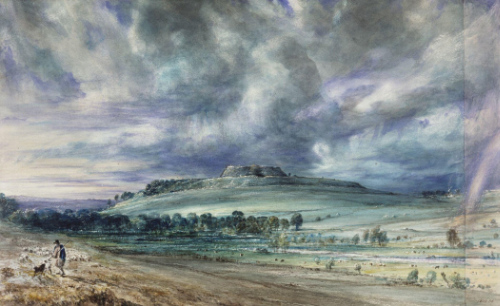
J.T. in San Bernardino, CA, writes: The question about how other countries have dealt with gerrymandering and redistricting reminded me of the "rotten boroughs" controversy in British history. The "rotten boroughs" were districts in the Parliament that were, based on historical precedent, entitled to representation even though there were maybe only a handful of people still living there. There were many of these, but Parliament finally abolished them in 1832, which seems pretty remarkable since many MPs who participated in that vote came from those boroughs. One imagines that the insistence of the U.S. founders on uniform districts may be related to the rotten boroughs.
Wikipedia uses this illustration by John Constable to accompany its article on the rotten boroughs. It's of Old Sarum, "an uninhabited hill which until 1832 elected two members to Parliament":
Politics: Cyberwarfare
D.S. in Newark, OH, writes: I am not an expert in cybersecurity. However, I happen to know someone who is. I sent him a copy of the letter from F.H. in St. Paul and this was his response:
State and local governments are not sitting idle. They're working closely with organizations like the Multi-State Information Sharing and Analysis Center (MS-ISAC), the Department of Homeland Security (DHS), and the Cybersecurity and Infrastructure Security Agency (CISA) to identify threats, conduct regular security assessments, and implement incident response plans. Many states have dedicated Chief Information Security Officers (CISOs) and have adopted frameworks such as NIST to guide their cybersecurity strategy.
There's a growing emphasis on public/private partnerships, tabletop exercises, and election-specific protections like voter registration system monitoring and air-gapped ballot processing systems.
While no system is perfect, the blanket claim that "we're not even trying" doesn't do justice to the professionals across the country who are working tirelessly to prevent exactly the kind of chaos F.H. in St. Paul is worried about.
Nearly every state now conducts regular risk-limiting audits, and many use paper ballots or voter-verified paper audit trails to ensure election integrity. Systems are also segmented from the Internet to prevent outside interference, and 45 states participate in the EI-ISAC (Elections Infrastructure Information Sharing and Analysis Center), which provides threat intel and real-time alerts.
States like Michigan, Ohio and Virginia have developed state-run cyber ranges and dedicated cyber reserve forces (like the Ohio Cyber Reserve) made up of trained civilian volunteers who assist in cyber incident response, particularly at the local level.
Over 40 states now have centralized cybersecurity governance with a state CISO responsible for developing standards, issuing guidance, and coordinating incident response. Many states have passed legislation requiring all public sector entities to report cyber incidents and comply with minimum cybersecurity controls.
Yes, the threat is real and persistent, but the notion that states are doing nothing about it simply doesn't hold up under scrutiny. That said, it's important to understand the governance structure. States like Ohio operate under a "home rule" model, which means local governments (cities and counties) maintain control over their own infrastructure, including IT. This limits the state's ability to mandate cybersecurity controls or manage local incident response directly. It's not about a lack of effort, it's a structural constraint. So while the federal government and many states are investing heavily in cybersecurity, the challenge often lies in coordination, funding gaps, and skill shortages at the local level, not indifference. Progress is happening, but like anything at this scale, it's uneven and ongoing.(V) & (Z) respond: Please convey our thanks to your friend.
Politics: Energy
J.G. in Farmington, CT, writes: Your item "Trump On the Wrong Side of the Issue, Part II: Energy" made me think of my experience adopting electric vehicles.
Back in October of 2023, we bought a Polestar 2. You posted my letter about it in January 2024.
We still have that car today and we added another: a Ford Mustang Mach-E. The experience has been, now with two EVs, almost universally positive. We've done long-distance drives and guess what? If you stop for a meal and plug in at a fast charger, the car's usually done charging before you're done eating (20-25 min or less)! The built-in nav finds available fast chargers for you, and will auto-calculate charging stops if you use it to trip-plan. About the only frustration has been that, sometimes, paying for the charge is confusing. The payments systems aren't as flawless as just swiping a credit card universally. In this regard we find Electrify America stations are the best experience. (Tesla Superchargers with a CCS to NACS adapter are hit or miss.)
We also found that, at least from Boston to Northern Virginia, rest areas and big convenience store/gas station chains like Wawa and Sheetz have been really good about having working fast chargers.
I'm struck by how inevitable widespread EV adoption now feels to me. A gas engine is a relic. We've held on to our 10-year-old minivan only because there aren't any electric minivans on the U.S. market that meet our requirements, but once Toyota or Honda makes one, replacement is a guarantee. Talking to our friends with children, we've learned that if there was an affordable (more on that in a moment) electric three-row SUV, many of them would consider switching too (the MSRP of a Volvo EX90 is over $81k). Insert suburban sports-mom/dad minivan vs. SUV memes and jokes here.
The main obstacle, of course, is cost, with infrastructure a close second. But I feel like there's inevitability there, too. People are going to vote with their wallets once prices come down, and they'll have to come down, because BYD is going to outcompete everyone overseas if they don't, no matter what trade barriers are thrown up. The cost differential is extreme between BYD models and everyone else. And these aren't bare-bones cars made out of Chinesium (i.e. poorly manufactured). They are loaded with all the typical features; according to auto research firms, domestic Chinese consumers desire just as many bells and whistles as American consumers. Product quality is apparently good enough to market in Europe, but I'd be happy to hear actual reviews from your readers. Bottom line, you look and BYD and Denza offerings can and will compete with EVs from Toyota, Honda, Tesla, GM and Ford. (Nissan, Stellantis and Jaguar Land Rover are dead men walking.)
The transition is underway. Ain't nothing the Trump-Vought-Miller axis can do about it.
C.F. in Waltham, MA, writes: I can't understand the elimination of all pollution regulations for cars. I remember when I was young being in tunnels, traffic jams, even just out driving on a hot, wind-free sunny day, and smelling those awful car fumes. I really hope that catalytic converters are not so costly (because they use palladium) that cheap cars get rid of them in most states. Why would anyone want to take that chance!?
Politics: Good Humor
M.S. in Canton, NY, writes: D.E. In Lancaster described Donald Trump's stroll on the White House roof as an "odd little constitutional." Considering the subject's record, shouldn't that be his "unconstitutional"?
M.B.T. in Bay Village, OH, writes: Donald Trump isn't just losing his marbles. He's losing all the ones he stole from the other little kids when he was growing up.
J.M. in Silver Spring, MD, writes: You wrote: "The blue team's Trump card, as it were, is results..."
Aha! I saw what you did there!
Seriously, as a tournament bridge player, I have recently had a number of folks, hearing "trump that" say, "Don't use that word!"
E.S. in Maine, NY, writes: You wrote: "Ezra Klein did a long interview with Will Sommer about why Donald Trump can't put the Epstein case to bed. It is very interesting. The short answer is: QAnon."
Almost snorted my coffee laughing.
Live by the QAnon, die by the QAnon? One can hope!
L.S. in Greensboro, NC, writes: OK, unlike a number of your posters, I've refrained from pointing out humorous comments of yours that made me fall out of my chair laughing. But I just couldn't resist this one about "Big Balls" getting beaten up in the presence of his "significant other": "it's not known if the incident caused her to deflate."
You've really topped yourselves this time. In a world filled with angst about the state of our nation, a laugh like this is priceless. Thank you!
All Politics Is Local
D.E. in Lancaster, PA, writes: Well, look who found their old Nazi uniform from their college days, and, by Goebbels, he can still fit in it. In his letter to the FBI urging them to seek out and arrest for potential crimes the Texas Democrats who absconded to Illinois in order to prevent a quorum in a vote to create an unprecedented gerrymandering of the Texas congressional districts, Sen. John Cornyn (R-TX) said this, "In a representative democracy, we resolve our differences by debating and voting, not by running away." I would add, "In representative democracies, one party doesn't threaten to arrest and lock up the other party for potential crimes. You only find those kind of jackboot moves in authoritarian and fascist regimes, jackass!"
Notice that his call to arrest is for potential crimes. Cornyn evens writes that the Democratic legislators "have committed potential criminal acts." Oh, so we're arresting people not for crimes they have done, or are in the tangible process of planning, but rather for what they might potentially do. Well, that didn't take even 8 months to go from functioning democracies with due process to Minority Report. For an ex-Texas judge and Attorney General, his lack of basic legal understanding is appalling.
Completely disingenuously, Cornyn, in his whiny little letter to FBI Director Kash Patel—who is way too busy shredding everything in the Epstein Files to be bothered with this nonsense—grabs his pearls and smelling salts as he trots out the survivors of the Kerrville floods of July 4 as the real Victims of the Democrats machinations. According to Cornyn, this special session was all about opening the proverbial floodgates of aid and financial help to those whose lives were devastated by the actual floods, if only those dastardly potential criminal Democrats hadn't done their dirty deeds. Except, that isn't true. Gov. Greg Abbott (R-TX) has publicly stated, on several occasions, that the purpose for him calling the Special Session was to tackle issues important to the Republican Party, namely making the abortion pill illegal and further gerrymandering his state. To his "credit," Abbott did say that if the special session can get to matters of flood relief after the main goals of abortion posturing and gerrymandering were accomplished, that would be an added benefit but if not... well, que será será. So Cornyn, did it give you a bit of the goose-step tinglies to use people trying to rebuild their lives from a catastrophic event that killed so many and left utter ruin in its wake, just so you could posture and strut in your schulterklappen and koppelschloss?
Proving the old adage about the broken clock, Cornyn did speak one brief bit of truth. He wrote to FBI Director Patel: "The FBI has tools to aid state law enforcement when parties cross state lines, including to avoid testifying or fleeing the scene of a crime." I want to acknowledge that at least Cornyn can admit that the Texas gerrymander shenanigans are the scene of the real crime, but, sadly, his words can more likely be attributed to poor word choice and general ineptitude.
Lastly, this is small potatoes compared to the other inanities in his letter, but it really grinds my gears. Why are the acts of the Texas legislature of any concern to this SS-Unterscharfurhrer, beyond the most abstract sense? Let me check Wikipedia. It says that John Cornyn Is a member of the U.S. Senate. The only way to gerrymander his "district" is for Texas to invade Oklahoma, preferably the parts that don't have Samsung's streaming services on their School Superintendent's lap top. Again, checking with the trusty old Wikipedia, Cornyn was never ever elected to the Texas state Legislature. If the egregious overreach by the Republicans enacts this gerrymander or not, it will affect the U.S. House of Representatives and not the Senate. I was under the impression that, due to the separation of powers, while possibly not illegal, the meddling in the affairs and makeup of the U.S. House by a member of the Senate was strictly verboten and considered bad form. But I guess, nowadays, everything is fair game. So if Kash Patel has a spare moment to devote to cracking down on purely-for-show political posturing that probably doesn't violate the letter of the law but definitely potentially in some part of the multiverse at least breaks the spirit of the law, may I suggest he look at Sen. John Cornyn, Texas-size a**hole?
K.R. in Austin, TX, writes: I write to my elected officials quite a bit. Senators often send back a standard letter stating their position on the issue I wrote about. The typical letters are far from personal, but they still are somewhat related to my comment and state the senator's official position.
Please read this letter from Sen. Ted Cruz (R-TX) and let me know if it says anything at all:
Thank you for contacting me with your views. Input from fellow Texans significantly informs my decision-making and empowers me to better represent our state.
As I represent Texas in the Senate, it is always helpful to hear from folks about what is on their minds. I believe that if someone from our great state is taking the time to write me then, more than likely, many more Texans have been thinking about the same issue, even if they have not written to share their thoughts. As such, by reaching out, you not only have shared your views but you have also represented the views of others which is a service to our community.
A lot of issues in Washington, D.C. are hotly contested and there are well-meaning groups on both sides. It is important in a representative democracy like ours that people have the ability to share their views passionately and respectfully with people, even with those who may hold opposing views. Thank you for joining the discussion in a way that reflects the best of our great country.
Thank you again for sharing your views with me. Please feel free to contact me in the future about any issue important to you or your family. It is an honor to serve you and the people of Texas.
For Liberty,
Ted Cruz
United States Senator(V) & (Z) respond: It certainly puts the (snake) "oil" in "boilerplate."
I Don't Believe in Jesus, I Just Believe in Me
D.C. in Portland, OR, writes: B.C. in Walpole makes a solid defense of religion and correctly identifies nationalism as a more potent catalyst for violence and war.
More generally, tribalism and the pursuit of power are the true drivers of conflict, with religion merely providing a cover story.
Personally, I am an igtheist, as the lack of a coherent definition for "God" makes pondering Their existence the original act of futility.
My faith is energy, the purist of all magic. Its existence gives us space (unless you believe in singularities) and its transformation gives us time.
Where that energy came from is a fascinating question, but all that matters is what we do with it.
N.L. in Mamaroneck, NY, writes: I am as atheist as one can be. I only expand on this inside my head because I learned early on that most believers cannot have a rational discussion about whether religion is real or not real. The social rules say that a religious person offering me prayers and blessings must be acceptable, but me saying: "Hey, let's discuss this God idea..." as if it is not a given truth, is an affront to the existence of those believers. It is not a talk that goes well. That makes sense, but it is annoying in how limiting it is. I've had discussions where I hear: "But the Bible says..." and I reply, "I do not believe in the Bible, so what else have you got...?" At that point, there is no way forward.
Older and wiser me has come to a different understanding. I still do not believe that there is some independent, actual deity out there, so that if a comet hit Earth and all humans were wiped out, there would be a grey-bearded, robed, omniscient and loving but jealous old man God who would give it another go with a new Adam and Eve on some other planet. I do not believe that creature "God" exists.
But I do believe that human beings created this idea of God and the mythology behind it, elevating the principles of morality and kindness and, well, goodness. This idea has been misused at times, but overall it's been a net positive because life is hard and people can be horrible. This very real belief has been powerful for countless people. I respect that. Apart from this letter, I keep my atheist arguments to myself because religion is actually real and important to a lot of people, even if it is an invention of human beings and God is not (to my belief) an entity that exists.
So, to reply to those who villainize religion, I see where you're coming from, but I cannot back your argument. God may not be real, but religion is, and the horrors done in religion's name are the horrors done by humans. How much worse would history be without the belief in religion to make people who are not inclined to do good at least try?
Caveat 1: I don't mean to preach, but here we go. As an atheist, I find it absurd that I would need to fear an afterlife in Hell to make me treat others well. I don't like to hurt people. I feel good if I help people. I don't need God or religion to make me like that. So maybe religion is not for me, it's for those who would otherwise do bad things? As we can see, there are plenty of those out there so yay for religion for attempting to rein them in.
Caveat 2: Some aspects of various religions can be seen as attempts to control and subjugate people. Yep. True. But that is abuse by those writing the rules. In the end, the problem here is people who are abusive, and they would be like this whether they had religion as their tool or anything else.
Blame people, not religion.
I See Dead People
D.M. in McLean, VA, writes: In your list of influential dead people, you put Jesus of Nazareth in his own category. What about the other people who are known to have existed and became the foundational character for an entire religion? Muhammad comes to mind right away. It is also likely that Siddhartha Gautama (a.k.a., "The Buddha") existed. You also have Kong Qiu (a.k.a., "Confucius"). If you go beyond major religions to offshoots and sects, such as the work of Joseph Smith (Mormonism), the list would likely become too long to list. Your first category would have been better titled along the lines of, "inspiration for an entire religion" with a few more examples.
(V) & (Z) respond: First, the question was about impact on the United States. Christianity has been orders of magnitude more impactful than any other religion. Second, the terms of the exercise were that the great majority of the person's impact had to come after they were dead. The only other religious figure we considered was Muhammad, but he was a major religious and military figure even while he was alive.
G.B. in Kailua, HI, writes: I read with interest your list of groups of past people that influenced our country. I see you put "the Matilda effect" (the diminishment of women's inputs and influences) in tenth and last place, making me wonder: did (V) & (Z) just do it again? If this is a rank ordering, I'd put that group squarely in the top of the middle-middle, because those diminishments have involved VERY significant scientific, literary, and social discoveries, creations and cultural changes, and they have gone on since the beginning of our republic.
(V) & (Z) respond: We thought carefully about the order in which the categories were presented. You know how, in films and TV shows, if a big star can't be top-billed because that slot is taken, they put them at the very end of the credits? Well...
D.B. in Fort Lauderdale, FL, writes: Thanks for the very thoughtful list of people who influenced American life more after their deaths than in their lives. Very well considered. However, in the "The Flashpoints" category, I think you may have (inadvertently) left off the most influential: Emmett Till.
(V) & (Z) respond: We actually meant to include him, and then forgot to go back and actually type the name.
We Shall Return
M.A.H. in Warren, MI, writes: The answers to the reader question about which places to visit in Europe with World War II connections were beautiful and heart-breaking.
Thank you very, very much to all who responded.
D.C.W. in Fredericksburg, TX, writes: In the item on European places to visit with connections to World War II and the Holocaust, all of the comments you ran were moving and educational. The comment from M.T. in Linköping, Sweden stood out to me. Reading about the ordinariness of Bełżec in Poland, and thinking how that could possibly be Anytown, USA, in our future, made me weep. Maybe it was just that the writer wrote about it so beautifully and hauntingly. But I could picture it so vividly. Knowing that it really did happen like that is disturbing, to say the least.
Thank you for running those responses to that question. That time in history is frightfully close to what we are looking at now, with the kidnappings and concentration/detention camps and persecuting of a class of people by our government. I hope we can turn this around and not have places for our descendants to "visit" to remember bad things.
A.G. in Scranton, PA, writes: R.R. in Pasadena wrote that the efforts of the Frank family and their compatriots were ultimately futile.
I reject that assertion, but do so gently, because R.R. clearly didn't mean to say anything that might be—in my opinion—entirely incorrect.
That effort to survive has given us one of the most important and enduring first-hand accounts of what it was to be a young person passing through an important time in their life during a terrible and momentous time in history.
"In spite of everything, I still believe that people are really good at heart," Anne Frank wrote.
A child being hunted by the agents of the regime that built and operated the world's only industrialized system of extermination, a mass production line of death that they wanted to murder her with... wrote that.
She knew, and Auschwitz, Ravensbruck, Chelmno, Treblinka, and Belzec were all still gassing people and burning their bodies when she wrote that about people.
A better, more generous, and more hopeful person than I.
B.C. in Manhattan Beach, CA, writes: In a response to the question of the week about places in Europe with a connection to the Holocaust, C.S. in Philadelphia appears to lament that Jewish areas in Rome and Venice are referred to as "ghettos."
While there is some uncertainty about the etymology of the word, it is generally agreed that the first use of the term "ghetto" was to refer to the section of Venice where Jews were allowed to live. The original usage seems to have been more akin to "quarter" or "area" (i.e., "Jewish quarter" or "Jewish area"). It is only later that the meaning was extended to other areas in which a particular social or ethnic group lived (or was confined), and even later when it came to mean an area that was economically disadvantaged (at the time the original Jewish ghetto in Venice was established, there was much discrimination against Jews, but the Jews were not necessarily poor; some were fairly prosperous).
The current meaning of the word would seem to make a reference to Venice's Jewish Ghetto as derogatory, but in the historical context, it is the proper term.
National Parks, Part III
C.J. in Boulder, CO, writes: Can we talk more about national parks? It just feels uplifting...
The comments about whether or not the rim of the Grand Canyon is sufficiently awe-inspiring bring to mind the problem of appreciating scale (as an earth scientist, I usually am fighting more about grasping the scale of time, but scales of space matter, too). The Grand Canyon, from the rim, is almost just a bunch of stripes with midday lighting. At sunrise and sunset you get shadows that help to guide your eye to sense the scale, but I've found that it is in hiking down that you really start to appreciate the scale of the place (if you do that, do remember you will have to hike back up). (If you really want a sense of the place, and I hesitate to point this out as it is a quiet corner of the park that cannot take much visitation, visit Toroweep.)
But most people really don't get Death Valley... which is deeper than the Grand Canyon and comparable in scale. You can be driving at 55 across the valley floor and nothing much is changing; you'd be clear out of most parks while still motoring on to your next stop in the Valley. It is huge. A geologist from Penn State would bring his class to Badwater and point across the valley at the Panamint Range and say that there was more relief on the alluvial fans (which get almost halfway up the range) coming off the Panamints than in the state of Pennsylvania. And while Grand Canyon partisans like to quote the "1.8 billion years of Earth history" in the canyon, nearly all of that is in fact missing (most of what you see adds up to about 250 million years); Death Valley has way more earth history, but is considerably more complex. (If you want a shot at appreciating it, Aguereberry Point is your lookout, then peer at the enormous tilted pile of sedimentary rock that makes up the east side of the Panamints and reflect that the equivalent stuff in the Grand Canyon is a small fraction of what is before you... not to mention what it takes to take a slab of rock of those dimensions and tilt it nearly upright).
Another aspect of appreciation is recognizing what you are seeing. Years ago, doing field work in Kings Canyon, I got to see the book the rangers at Cedar Grove (in the bottom of the canyon) kept of stupid tourist questions. The one that stuck with me was "So where is the canyon"? Yeah, polarity shift needed (and it is far deeper than the Grand Canyon, should that matter).
And keep in mind the light. That bland backlight over most of the day from the South Rim of the Grand Canyon diminishes the canyon. People queue up to get permits to watch sunrise from Haleakala on Maui; if the light is good it can be transcendent; if not, a wasted early wakeup. Here in my neck of the woods, Rocky Mountain National Park has some corners that are positively Bierstadt-ian... with the right light, but flatten into banality with bad light.
Some great vistas are not in parks at all. The Kern Canyon in the southern Sierra is enormous but utterly unappreciated (sadly, the great Needles lookout remains destroyed but you can get far enough out towards it to get a sense of the view). Something similar can be said for the Salt River canyon in Arizona. And Owens Valley, rimmed by 14,000' peaks on both sides, has one of the most impressive mountain walls on the west side that you will find anywhere (pro tip: Mazourka Peak if you really want to get the scale... and have the right wheels). A lot of these places allow for discovery—the most awe-inspiring thing can be the place you just happened upon by accident—which is often between the parks.
But what is essential for all these places is to let them sink in. And a great time for that is very early morning and just before sunset. Ideally in a place with no cell service and no TV and no radio... a silence many of us really crave these days.
B.C. in Phoenix, AZ, writes: As I read the responses of B.C. in Walpole and R.T. in Arlington to my contention that standing on the rim of the Grand Canyon would be one of the most awe-inspiring experiences of your life, I realized my mistake was conflating the rim tourist experience with the immersive backpacking experience. Until certain health issues intervened, for over 30 years, I backpacked all around Arizona and southern Utah.
Hiking for several days in the Grand Canyon is a veritable mystical experience. It may sound trite, but you actually do feel as if you are trespassing in a land of giants who are away visiting friends. I simply never got that feeling on multiday treks in Zion or Canyonlands. I think B.C. hinted at the reason for this by saying "I thought back and realized that the Grand Canyon was simply too awesome for my little brain to grasp." Yeah, when you are down in The Canyon, the bigness of it constantly reminds you of how puny you are. It is a humbling adventure that continues every time the trail curves around a canyon wall and The Canyon presents you with a view that says "Yup, I'm still here, and I'm still huge, and there's still more of me!"
R.T., I'm sorry that a weather event obscured a clear vision of the magic; perhaps you could return one day, take a walk down one of the shorter paths for an hour or so and experience some of the enchantment.
And B.C., I'm thinking the Grand Canyon Lodge will be rebuilt. After all, they rebuilt Notre-Dame de Paris, right? And as the narthex at the North Rim, The Lodge is certainly more important!
P.M. in Port Angeles, WA, writes: (V) & (Z) are absolutely correct about the park you are standing in. My hobby of collecting the state and national park quarters for over 20 years has shown that there are more wonders than anyone could possibly see in a lifetime. Several of the mentioned parks I have been fortunate enough to visit, and each one has its own spectacular aspects that leave the viewer awestruck.
There can be no best here; nature and our world are spectacular in every sense.
D.R. in Chicago, IL, writes: I have been to the Big Three (Grand Canyon, Yellowstone, and Yosemite) many times and have visited many other national parks. I agree with the comment by (V) & (Z) that the best is the one you are in. I lived for 3 years in Anaktuvuk Pass, AK, which is in the heart of the Gates of the Arctic National Park. It is one of the least visited parks, and I had the privilege of living there for 3 years—through all seasons. Anaktuvuk Pass is surrounded by six mountains, which over time I climbed along with my trusty dog, Ebony. My dog never ventured high in the mountains but faithfully waited as I continued my quest for the perfect view.
J.G. in Tenino, WA, writes: Re: "If you would like a reminder that Mother Nature doesn't give a fu** about you, and would just as soon see you dead," just walk outside in North Dakota on any given day in January, or Oklahoma in August. No need to go to a national park. Just head out after your morning coffee to do some chores.
The Sporting Life
R.T. in San Leandro, CA, writes: Just to add to your item about the first woman umpire in baseball, the Red Sox had an all-women team of announcers, camera operators, photographers, and field reporter this week at one of the Kansas City Royals games at Fenway.
Their guests were all women playing professional sports, along with women sports reporters.
The Red Sox have a couple of women announcer teams in their minor leagues as well.
They did a great job covering the game, by the way!
L.J.D. in Orlando, FL, writes: I applaud you for including Jen Pawol in your Freudenfreude piece. She has definitely earned it. As a fellow graduate of umpire academy, I wanted to correct a couple of things about your baseball rules, however. You are correct that if a fielder throws his glove at a ball and misses, it is nothing. However, the three-base award for making contact only applies if it is a BATTED ball. If it is a thrown ball, it is a two-base award. And it doesn't have to be a glove, the rule applies to any equipment detached from the fielder.
As for the old chestnut "ties go to the runner," you are correct that this is not in the MLB rulebook. However, the statement "the base 'belongs' to the defense until the moment that the runner takes possession, which requires arriving ahead of the ball" is similarly not in the rulebook. It is in the umpire's judgment as to what happened first, the fielder making the out or the runner acquiring the base.
J.G. in Louisville, KY, writes: On the subject of dildos being tossed at WNBA players: Not only is this behavior dangerous, it's also homophobic and misogynistic.
Another sports league—the Football Association in the UK and FIFA for world-wide football—have had to deal with objects thrown onto the pitch/field for a while now. Sanctions generally include some combination of:
- Bans against those identified as the throwers;
- Fines assessed against the thrower;
- Criminal charges against the thrower;
- Forcing teams to play in empty stadiums if they do not do enough to curtail this behavior;
- Fining teams for the same.
I doubt these crypto bros are regular WNBA spectators, so 4 and 5 seem harsh. But 1-3 will be necessary, and ideally the ban would include attendance at NBA games in addition to WNBA ones.
The only way to protect players is to come down hard against every idiot who endangers players (and fans) with their stupid, often hateful stunts.
K.R. in Austin, TX, writes: K.C. In West Islip asked why Native Americans might find some of the mascots offensive.
I think these images make the point:

Gallimaufry
D.C.W. in Fredericksburg, TX, writes: In your answer to B.J. in Arlington, you mentioned three TV shows that you thought could stand the test of time. I have to add M*A*S*H as in a class all its own. I recorded all the episodes on VCR back in the day and later acquired the full DVD set. Actually two of them, in case one had a bad DVD.
I exercise in my garage gym every day and play DVDs on a TV there. I have been through the series many, many times. I never cease to gain some new insight to something I previously missed. The writing is flawless. The acting is amazing. The subtext of the friendships, coping with war and hardships, and overall humanity of it continues to impress me. I could watch the whole series again many times and still enjoy and appreciate it more each time.
J.S. in The Hague, Netherlands, writes: Missing out in the "In 300-500 years, what films or filmmakers" question, I think, is John Williams.
Of course, one does not think about composers when asked about filmmakers, but I think his influence on the success of the movies he composed for is big enough to warrant an inclusion.
Q.M. in Manville, NJ, writes: As a librarian of almost 20 years (more if you include grad school) who has worked with digitization and preservation projects and trying to get older technology to work with newer technology, I just want to thank you for the shoutout to microfilm in last week's Q&A. Film lasts longer than most materials, and all you need is a light source and a magnifier to view them; try finding anywhere today that will accept your 3.5" floppy disks, if they're even still readable.
J.R. in Cambridge, MA, writes: Longboi eating a banana:
Final Words
D.Z. in Miami, FL, writes: John Arthur Spenkelink, before his 1979 execution in Florida: "Capital punishment means those without the capital get the punishment."
If you have suggestions for this feature, please send them along.
If you wish to contact us, please use one of these addresses. For the first two, please include your initials and city.
- questions@electoral-vote.com For questions about politics, civics, history, etc. to be answered on a Saturday
- comments@electoral-vote.com For "letters to the editor" for possible publication on a Sunday
- corrections@electoral-vote.com To tell us about typos or factual errors we should fix
- items@electoral-vote.com For general suggestions, ideas, etc.
To download a poster about the site to hang up, please click here.
Email a link to a friend.
---The Votemaster and Zenger
Aug09 Reader Question of the Week: We Shall Return
Aug08 Trumponomics: A Trade War, Based on Pretzel Logic
Aug08 L'Etat C'est Trump: Maybe Antifa Was on to Something
Aug08 I Read the News Today, Oh Boy: A Burger or a Wiener?
Aug08 This Week in Schadenfreude: Gabbard Getting Flak from All Sides
Aug08 This Week in Freudenfreude: Another Glass Ceiling Goes Kaput
Aug07 There Are Tapes
Aug07 Newsom Will Bet the Farm on Redistricting
Aug07 Trump's Tariffs Could Backfire in Numerous Ways
Aug07 Trump Is Now Underwater on All Major Issues
Aug07 Apple Is about to Make Polling Even More Difficult
Aug07 Democratic Presidential Field--As Viewed from the Right
Aug07 The Supreme Court May Kill Off the Rest of the Voting Rights Act
Aug07 Marsha Blackburn Is Running for Governor of Tennessee
Aug06 How Trump Is Alienating Republicans
Aug06 Epstein Isn't Going Away...
Aug06 ...But the DOGE E-mail Reports Are
Aug06 Israel Is Losing
Aug06 Making Criminals Great Again
Aug06 Never Forget: Budae Jjigae, Part II
Aug05 Trump On the Wrong Side of the Issue, Part I: The Texas Gerrymander
Aug05 Trump On the Wrong Side of the Issue, Part II: Energy
Aug05 What We Need Is a Distraction, Part I: Weaponizing the DoJ
Aug05 What We Need Is a Distraction, Part II: Strictly Ballroom
Aug05 Never Forget: Russian Roulette
Aug04 How Does QAnon Fit into the Epstein Case?
Aug04 Nine Questions about Epstein that Need Answering
Aug04 2028 Republican Candidates Are Split over Epstein Files
Aug04 Democrats Are Also Thinking about 2028
Aug04 Republicans Are Crushing Democrats on Money
Aug04 China Won't Roll over and Beg Like the E.U.
Aug04 The Senate Is Gone
Aug04 Is Texas about to Execute a Dummymander?
Aug04 Fed Governor Resigns
Aug04 Corporation for Public Broadcasting Is Forced to Shut Down
Aug03 Sunday Mailbag
Aug02 Trump Has A(nother) Meltdown
Aug02 Saturday Q&A
Aug02 Reader Question of the Week: The Better Angels
Aug01 Trade War: Today's the Day... Sort Of
Aug01 Redistricting, Part I: Texas Will Indeed Chase Every Last Seat
Aug01 Redistricting, Part II: But Red States Are Only Half the Story
Aug01 Never Forget: It Took 59 Years
Aug01 I Read the News Today, Oh Boy: Black Coffee
Aug01 This Week in Schadenfreude: White Whine
Aug01 This Week in Freudenfreude: Apparently, the Butler Didn't Do It
Jul31 Maxwell's Supreme Court Case Could Upend Everything
Jul31 Schumer Tries to Get the Epstein Files
Jul31 HACO?

