


 Welcome & FAQs
  Table of Senate polls
 Senate graphs
 Tipping-point-state
 Congress: retirements
 Governor's races
 Icons for bloggers
 Data galore


• Redistricting, Part I: Texas Will Indeed Chase Every Last Seat
• Redistricting, Part II: But Red States Are Only Half the Story
• Never Forget: It Took 59 Years
• I Read the News Today, Oh Boy: Black Coffee
• This Week in Schadenfreude: White Whine
• This Week in Freudenfreude: Apparently, the Butler Didn't Do It
Trade War: Today's the Day... Sort Of
It is August 1; any nation (or island full of penguins) that has not reached an updated trade deal with the Donald Trump administration by today is supposed to be subject to increased tariff rates, of at least 15%.
To that end, Trump signed a series of executive orders imposing tariffs ranging from 15% all the way up to 41%. It is hard to know exactly where the administration gets its numbers from—maybe AI—but the list of countries that will get hit the hardest is an eclectic one, and includes Syria, Myanmar, Laos, Iraq, Switzerland and Canada.
There are a number of caveats here, however:
- Although Trump said he would grant no extension to Mexico, unless a signed deal was in place, he nonetheless
gave a 90-day extension
to Mexico. ¿Trump siempre se gallinas?
- Also, trade with Canada and Mexico will still be governed, at least in part, by the United States-Mexico-Canada
Agreement. Figuring out exactly when the USMCA will, and will not, be in effect is roughly as easy as trying to
split an atom with a butter knife.
- While Trump may have signed the paperwork yesterday, he granted an extension to all nations to August 7, so they have one last opportunity to hammer out a deal. That's next Thursday.
In addition, Trump announced that the Philippines, Vietnam, Indonesia and South Korea have all agreed to "trade frameworks." The first three nations on that list will be subject to 19%-20% duties, while the Koreans will be subject to 15% duties. South Korea also agreed to invest $350 billion in the United States, allegedly in whatever manner Trump instructs, and also to purchase $100 billion in American liquefied natural gas. We assume that $450 billion in investments is about as solid as the $500 billion promised by Japan, or the $1.35 trillion promised by the E.U.
So, Trump didn't chicken out, exactly, but he also didn't NOT chicken out. We'll have to wait until next Thursday to see if another last-second reprieve is forthcoming. If not, then we'll get to watch what the stock and bond markets do over the next week or two, to see if Trump actually stays the course.
The various trade-related announcements were accompanied by two different forms of braggadocio from the Trump administration, particularly White House Press Secretary Karoline Leavitt. Knowing well that Trump loves to be seen as a figure of towering importance, Leavitt boasted that the administration is collecting tariff revenue at a record-breaking rate, with over $150 billion in receipts so far.
Now, think about that for a moment. Can you imagine any president, of any party, bragging that, for example, "The IRS has collected more income taxes from middle-class Americans this year than ever before, with over $150 billion since the start of the year!" Of course not, because taxation is pretty much the least popular governmental function, and nobody likes to think they are paying more than years (or generations) past.
It could not be more obvious that the Democrats will need to do a bit of civics education, and to get the (absolutely true) message out there that tariffs are a tax on American consumers, and NOT on foreign nations. This will be made rather easier if the impact of the tariffs is visible at the gas pump, the grocery store, the local Walmart, etc. "The Trump administration is taking money out of YOUR pocket at a record pace," a Democratic candidate for Congress might say. "And not only are they doing it, they bragged about how effectively they are doing it!"
Meanwhile, the other braggadocio came in the form of renewed calls for Trump to be awarded at least one, and ideally two, Nobel prizes. Leavitt first decreed that because Trump has "brokered, on average, about one peace deal or ceasefire per month during his six months in office," the time has come for him to receive a Nobel Peace Prize. She even listed them: Thailand and Cambodia, Israel and Iran, Rwanda and the Democratic Republic of the Congo, India and Pakistan, Serbia and Kosovo, and Egypt and Ethiopia. To get to six requires adopting a VERY loose definition of "peace deal." It also means giving Trump credit for some agreements, like the one between India and Pakistan, where the participating nations insist the President had nothing to do with the process. Meanwhile, Trump has not lived up to his promise to end the wars in Ukraine and Gaza, which have actually gotten worse during his time in office. So, he probably should not be waiting for a phone call from Oslo anytime soon.
The other Nobel that Trump is apparently entitled to is the... Nobel Memorial Prize for Economics. Leading the charge here is U.S. Trade Representative Peter Navarro, who decreed: "I'm thinking that, since he's basically taught the world trade economics, he might be up for the Nobel in economics." One can only hope that a guy who has a lot of influence over trade policy was just kissing up, and doesn't actually think this. First, Trump has not taught the world anything about trade economics, except maybe what not to do. Second, the Nobel for Economics is not the Nobel Peace Prize but for money-related stuff. It's a research award, much more in line with the Nobels for chemistry, physics and physiology.
Note that we give this much attention to the braggadocio because it's just more evidence that all this trade war stuff is not about economics, it's about PR, and "winning" news cycles. And we can very clearly see the plan for winning today's news cycle, and maybe tomorrow's, and maybe even next Thursday's. We still haven't figured out how Trump can possibly believe that harsher-than-Smoot-Hawley tariff rates can work out for him, long-term. Unless, of course, he's going to grant another postponement. And another. And another.
There is one other bit of news on the tariff front. Yesterday, the case that argues that Trump has no authority to impose these tariffs was heard by an en banc panel of the entire Federal Circuit Court of Appeals. And it was pretty clear that all the judges (eight Democratic appointees, three Republican appointees, and zero Trump appointees) are skeptical that Trump is acting within his lawful authority here. He is going to lose, and it might well be 11-0.
At that point, there will be an appeal to the Supreme Court. When that happens, there are really three questions. First, will SCOTUS take the case? Second, if they do, how will they rule? Third, if and when they rule, what ruling does Trump actually want? If SCOTUS declines the case, or if it takes the case and says he's overstepped his bounds, that might actually be his "out." He could rant and rave about the evil judges, and how they won't let him put "America First" via tariffs, and so give the base lots and lots of red meat... without actually bearing the costs of the tariffs.
We admit that we do not think it likely that Trump is actually hoping for the courts to bail him out. But we at least consider the possibility, because we're having such a hard time accepting that he, even with his less-than-keen grasp of macroeconomics and international trade, can't see the enormous risk he's taking with this trade war, and, along with that, the high likelihood of devastating downsides for him and his party. (Z)
Redistricting, Part I: Texas Will Indeed Chase Every Last Seat
As long as we are on the subject of taking big risks, the state of Texas has officially laid its cards on the table. When talk began to circulate, a couple of weeks ago, that the Lone Star State might try to re-gerrymander its maps, we pointed out that it's a very big roll of the dice, since: (1) the Texas maps are already gerrymandered six ways to Sunday; (2) nobody really knows if the Latino break towards Republicans in 2024 was actually toward the Republican Party, or was only toward Trump; (3) it's hard to know exactly how the population has changed since the 2020 census was conducted.
Still, Gov. Greg Abbott (R-TX) & Co. are moving forward. On Wednesday, Texas Republicans released a new map designed to allow the GOP to flip five House seats from blue to red. Here it is:
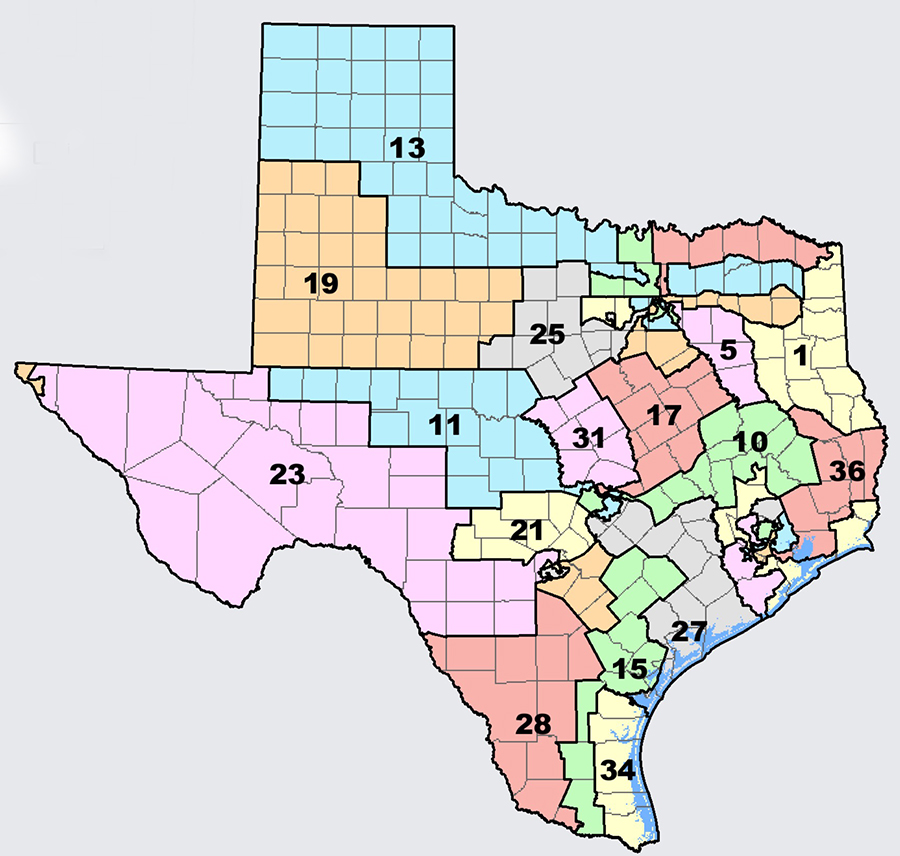
If you follow the link above, you can get a zoomable version of the map so you can see all the details if you want. Needless to say, when you get down to the street level, the new maps have very strange boundaries in some places as the mapmakers drew their maps to specifically include some precincts and exclude others. Here is a close-up of some of the mapmakers' handiwork:
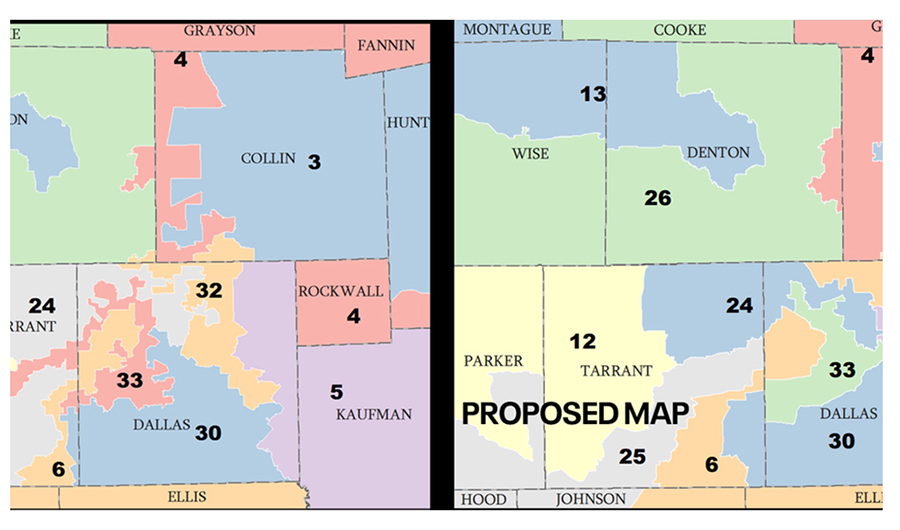
Here are the major changes:
| District | Old PVI | Incumbent | Changes |
| TX-09 | D+24 | Al Green (D) | Moves the district from South Houston to East Houston |
| TX-28 | R+2 | Henry Cuellar (D) | Removes San Antonio from the district |
| TX-32 | D+13 | Julie Johnson (D) | This Dallas area seat would include many new rural areas |
| TX-34 | EVEN | Vicente Gonzalez (D) | More Republicans packed into this Latino district |
| TX-35 | D+19 | Greg Casar (D) | It will now exclude Austin and include more of Bexar County |
Donald Trump carried all the new districts by double digits. The new map, if adopted, will set up a hotly contested primary between Democratic Reps. Lloyd Doggett and Greg Casar. Casar said: "Merging the 35th and 37th districts is an illegal voter suppression of Black and Latino Texans." The Supreme Court has ruled that while racial gerrymanders are illegal, partisan ones are hunky-dory. The map is built on the belief that Latinos have become more Republican, so it increases the number of Latino-majority districts. The Supreme Court is very unlikely to say giving Latinos more districts is an illegal racial gerrymander. The new map does not pit any Republican against another Republican.
Democratic voters who were removed from the five districts were stuffed in districts that were already very blue, on the theory that changing a D+30 district into a D+40 district won't hurt the Republicans at all. The current Texas congressional delegation is 25R, 13D.The new one could be 30R, 8D, if everything goes right.
But everything might not go right. As we have noted, when Democrats are removed from targeted districts they have to go somewhere. If they are stuffed into already blue districts, those districts will have to lose voters and they have to go somewhere, too. The net result is that some Republican districts will have to be watered down and, in a blue wave, Republican incumbents could lose their seats. Larry Sabato's Crystal Ball has already analyzed the new map. If every precinct votes in 2026 as it did in 2024, the Republicans would indeed win 30 seats. However, if every precinct voted as it did in the 2018 midterms—which was not a good year for Republicans—Republicans would win only 26 seats. Sabato also concluded that even in a blue wave, there is no practical way for Republicans to come out with fewer than the 25 seats they have now, and they have a very good shot at 26. There are also eight safe Democratic districts. This means that only four districts are at all competitive. These are mostly Latino-majority districts and how they go depends on whether Trump's gains with Latinos in 2024 stick.
There will be a committee meeting today to mark up the new map. If all the Democrats on the committee flee the state, they could hold up the process. They will be fined $500/day for not showing up for work, but they can't stay out of state indefinitely. The map could be changed a bit, but the Republicans feel that they have managed to keep their incumbents pretty safe. But again, the map presumes that each precinct will vote in 2026 as it did in 2024. If turnout is much less in 2026, especially among marginal voters who came out to vote specifically for Trump, there could be surprises.
Incidentally, Larry Sabato's Crystal Ball is not the only analysis out there. Sam Wang, of the Princeton Gerrymandering Project, produced an analysis before the new map was unveiled. He says that, under the right circumstances, as much as a dozen Republican-held seats could be put at risk. And a new poll from the DCCC finds that Texans overwhelmingly dislike the gerrymander plans, and that this could make Democrats more motivated to get out and vote. The point here is that there are many X-factors that are hard to predict, and that small changes in assumptions result in big differences in outcomes.
The Ohio legislature is also working on redrawing its map. The current delegation is 10R, 5D. There are two Democratic districts that are R+3 and D+3, respectively, that the Republicans could try to grab. Together these two gerrymanders could give the Republicans 7 new seats, although with the same footnote that, in a blue wave, some Republicans in formerly safe districts could drown.
There are a couple of other Republican-led states that are making some early noise about gerrymandering. Gov. Ron DeSantis (R-FL), who still sees a future for himself in national politics, has suggested he might try to squeeze another GOP seat or two out of his state. Florida, with its 20R, 8D delegation, is already more gerrymandered than Texas, and so would be assuming an even greater risk. Meanwhile, under pressure from the White House, there is also some discussion in Missouri about redrawing that state's maps. The problem is that the state's House delegation is already 6R, 2D, and very blue St. Louis (which is mostly located in MO-01) and very blue Kansas City (which is mostly located in MO-05) are on opposite sides of the state. So, it would not be easy to create just one Democratic district.
From the standpoint of a healthy democracy, the Republicans' maneuvering is very bad. As a country, the U.S. already does too much to quiet the voices of both the minority and minorities. Gerrymandering makes those problems even worse, and enables a situation where a state's House delegation is 20% or 30% or 40% more partisan than its electorate. From a tactical standpoint, however, the Republicans' thinking is fairly sound (certainly, more sound than Trump's tariff policy; see above). If the 2026 electorate is very similar to the 2024 electorate, then the Republicans would probably end up keeping the House, anyhow. If 2026 sees a mild blue wave, then securing a few extra seats could be just enough for Mike Johnson (R-LA) to keep his speaker's gavel. And if it's a big blue wave, up to and including a blue tsunami, then the Republicans will lose the House, gerrymander or no. And, as the last few years have shown, there isn't a whole lot of difference between being in the minority by a couple of seats, and being in the minority by 20 or 30 seats. So, there's something to be said, from a tactical standpoint, for squeezing the maps for all they're worth. (V & Z)
Redistricting, Part II: But Red States Are Only Half the Story
Of course, the advantage the Republicans gain from mid-decade map redraws could possibly be canceled out by Democratic counter-maneuvers. Once Greg Abbott and other red-state governors started bandying about plans to squeeze their state maps, several blue-state governors responded in kind. That includes the governors of New York and New Jersey. In addition, House Minority Leader Hakeem Jeffries (D-NY) and the DCCC are trying to persuade Minnesota and Washington to get in on the shenanigans, as well.
But the loudest blue-state talk about redrawing district maps is coming from Gov. Gavin Newsom (D-CA). Currently, California has an independent commission that draws the maps. But Newsom has options. The first of those is to call the legislature back into session to write an initiative to abolish the commission and to hand redistricting power back to the legislature. Then he could call a special election to vote on the initiative, and rally voters around the notion that Texas is trying to rig the election, so California should fight back. There is a decent chance it would pass. Then the Calimanderers would get to work drawing a new map before the filing deadline next year.
The alternative option involves a shorter timeline—and time is of the essence here—and would be a bit less radical. Newsom could call a special election for November, but instead of voting to get rid of the independent commission, Californians would vote only to get rid of the current maps, and to replace them with "better" maps from 2026 through the next census and redraw (in other words, the state would go back to independent-commission-drawn maps in 2032). This looks to be the option that Newsom prefers. First, because it means the process of drawing and approving new maps would end in November, as opposed to just starting in November (or, more likely, December or next January). Second, because the people of California favored an independent redistricting commission for a reason, and might not be too happy to see it go the way of the dodo. Framing this as a temporary move, to combat Trumpism, is more salable—you know, "desperate times call for desperate measures," and all that.
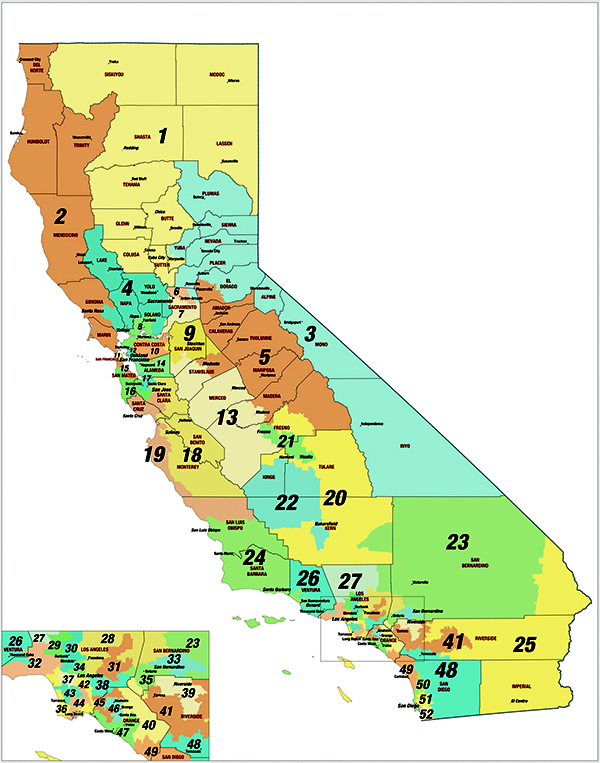
Here is the lay of the land for California's 52 House districts. The list of districts on the left is colored by who occupies the seat, not the PVI. The district map on the right below shows that the independent commission tried to keep counties together where possible, but sometimes that is not possible because districts must be close to equal in population:
|
|
This is a target-rich environment for the legislature. Four Republican seats, those occupied by Reps. Kevin Kiley, Ken Calvert, Young Kim, and David Valadao, could easily be made harder for the incumbents to hold by stuffing more Democrats in their districts. California has plenty of those. For example, David Valadao's R+1 CA-22 district could be made bluer by shedding some Republicans into Vincent Fong's R+15 CA-22 district on the east, and borrowing an equal number of Democrats from Salud Carbajal's D+13 CA-24 district on the west.
In addition, the three D+1 districts could be made bluer to protect the Democratic incumbents. With a bit of map-making skill, the legislature could pick up as many as four seats and protect three more. OK, that would result in strange-looking districts, but no stranger than some of the ones on the Texas map. If you want to try your hand at gerrymandering yourself, Dave's redistricting app is the tool for you.
When it comes to the war of the gerrymanders, it is generally accurate to say that the biggest obstacle the blue states face is political and legal, since the would-be gerrymanders are generally not legal under current state law, or are not acceptable to some Democratic state officials whose support would be necessary. The biggest obstacle the red states face is logistical; it's hard to gerrymander maps six-and-a-quarter ways to Sunday when they've already been gerrymandered six ways to Sunday. And both groups of states have the problem that if they guess wrong about their margins of error, they could end up giving away more seats than they gain. In other words, dummymander time. (V & Z)
Never Forget: It Took 59 Years
Today, a reminiscence from J.M. in Binghamton, NY:
Kenneth Montgomery was my dad's older brother, born in January of 1919. At some point after high school, Uncle Kenneth joined the Marines.
In the aftermath of Pearl Harbor, there was fear of a mainland invasion by the Japanese, either in Hawaii or on the west coast. President Franklin D. Roosevelt wanted reprisals against Japan ASAP, if only to lift morale. One of the resulting actions was the formation of the Marine Raiders, a small organization specializing in amphibious landings and guerrilla tactics. The Raiders were formed to emulate British commandos.
The members of the Marine Raiders were an elite force, hand-picked, so Uncle Kenneth must have done something impressive in the Marines to distinguish himself enough to even be considered. They wanted men who were physically fit, proficient with a wide variety of weapons, and who wanted to get out there and kill some Japanese soldiers.
They had 10 weeks of training in California at what is now Camp Pendleton, specializing in hand-to-hand combat with knives. And then, on May 8, 1942, the Raiders shipped out to Hawaii. It was a 9-day journey to Pearl Harbor. They passed through Battleship Row for extra motivation.
Their mission was to take the island of Makin from the Japanese, who had been occupying it since the start of the war. The planned raid was part of a strategy to divert the Japanese forces from Guadalcanal, where a much bigger force was preparing an invasion. They were to kill whatever Japanese soldiers were there, collect whatever intelligence they could, and get a victory for morale.
On August 8, the Raiders set off from Pearl Harbor for Makin Island in two submarines. After 9 days, they reached their destination before dawn. The enemy was waiting for them. The Japanese defense positions were centered around four machine gun nests and snipers in the tops of the palm trees. By 6:30 a.m., the Japanese and Raiders had become locked in combat. The battle was without any central control and it quickly became, in the words of one of the officers, "more or less a free-for-all, with every man trying to get his score of Japs before they ran out."
Radio operators were the snipers' first order of business. They were easy targets, with their shiny antennas overhead. Four of them were hit by machine gun fire and killed immediately, including PFC Kenneth Montgomery. He was 23 years old.
On Makin that day, 19 Americans were killed, though they were listed as Missing In Action. The survivors had no way to recover the bodies of the dead, and ended up paying a few of the island natives to bury them. And there they remained.
For the Marines, recovering their dead is a sacred duty. They consider bringing every man home one of the most important obligations of Semper Fidelis.
There was an unsuccessful attempt to recover the bodies after the war in 1949. But it wasn't until 50 years later, in 1999, after some intense lobbying by Veterans organizations of the surviving Marine Raiders Association, that the search resumed.
After several months, they were lucky enough to find one of the elderly natives who had helped bury the dead Marines in 1942, when he was a teenager. Once the remains were found, "Operation Due Regard" kicked in. The remains of all 19 men were located, some still with helmets and dog tags on.
The remains were flown back to Hawaii and repatriated in a formal ceremony on December 17, 1999, at Hickam Air Force Base. The remains were identified by the Army Central Identification Laboratory using DNA and historical military records. That process took about a year. Then they methodically located the next of kin for each of the 19 soldiers. They all had the option of having their fallen family member buried at Arlington National Cemetery.
On August 17, 2001, 59 years to the day after they died, 13 Marine Raiders, including PFC Kenneth Montgomery, were buried in the ceremony at Arlington. RIP, Uncle Kenneth.
Thank you, J.M.
We have decided to do this for one more week, and then we will move on to immigration stories. (Z)
I Read the News Today, Oh Boy: Black Coffee
Last week's clues: (1) "we were going to use a bookkeeper for this week's headline game, but then decided that would be overkill" and (2) "we'll tell you that it might help to watch one of those gum commercials from the 1980s." (Anyone who clicked through the link got a Doublemint gum commercial, featuring multiple sets of twins, from the year 1986.)
And the solution, courtesy of reader M.S. in Royal Oak, MI:
Thanks for reactivating my teenage brain cells with today's theme. Back in high school, I would listen to a local radio station here in Detroit and every evening during the songs, the hostess of the show, Candy Shannon, would ask a riddle, brain teaser, etc. and invite her listeners to call in with the answer. When you gave the hint "bookkeeper," that old neuron flashed, and I knew the answer. All of the headlines have a word with a pair of consecutive identical letters.And the reason that I knew this was that your clue "bookkeeper" was the answer to one of those riddles, as the only common word with THREE pairs of consecutive identical letters.
- The Epstein Files: Every Day, this Story Just Gets More Wild and Woolly
- States to White House: Extra Information on Voters Is Unneeded, Won't be Shared
- Candidate News: Who Will Succeed Tony Evers?
- Censorship Watch: Trump Is Made to Look Like a Buffoon
- This Week in Schadenfreude: The Appropriations Committee Did the First Lady No Favors
- This Week in Freudenfreude: Don't Judge a Man by His Tattoos
It was also the key to one of the (many) Encyclopedia Brown mysteries. Of course, "coffee," from this headline, also fits the pattern.
Here are the first 50 readers to get it right:
|
|
The 50th correct response was received at 6:04 a.m. PT on Friday.
For this week's theme, it relies on one word per headline, and it's in the category History (though some might say Monsters & Villains, which is a category in the 2002 Disney Films edition). The Never Forget headline is NOT part of it. For a hint, we'll say that we almost wrote headlines that included "Jackson," "Johnson," "Kennedy," "Washington," "McKinley" and "Taft." And if we had, despite what it seems, only one of the references would have been to a U.S. president.
If you have a guess, send it to comments@electoral-vote.com with subject line "August 1 Headlines." (Z)
This Week in Schadenfreude: White Whine
Let us start by getting this out of the way: Sen. Mike Lee (R-UT) is a giant jerk. Many of his colleagues write or say obnoxious things because they have to "own the libs" to keep their bases happy. Lee, by contrast, appears to do it primarily because he enjoys it.
When it comes to production of sh**-stirring social media content, there are few members of either chamber of Congress who can keep up with a Rep. Nancy Mace (R-SC) or a Rep. Marjorie Taylor Greene (R-SC). And the only member of the Senate who generally gives them a run for their money is Lee. He has three eX-Twitter accounts, for example. The two for his U.S. Senate office and for his campaign(s) are largely run by staff. The one that gets far and away the most attention, @BasedMikeLee, is reportedly produced almost entirely by the Senator himself, and is full of conspiracy theories, and propaganda and outright lies. In 2024, he posted messages to that account an average of 36 times per day. This year, it's jumped to 100 times per day. That's about one every 15 minutes, every day, all day. If we imagine he takes time to, say, sleep, eat, and shower, then it's roughly about one for every 7-8 minutes that he's not performing basic human maintenance.
To support our "giant jerk" observation, we will point out that it is the @BasedMikeLee account that had the reprehensible messages about the Minnesota lawmaker who was assassinated. For any readers who do not recall, or who did not follow, the story, Lee decided the assassination was an opportunity to score some political points. So, he posted some very crass comments to eX-Twitter, including "Nightmare on Waltz street" (a potshot at Gov. Tim Walz, DFL-MN, who was conspiratorially accused of having appointed the assassin to political office), and "this is what happens When Marxists don't get their way." It is in poor taste to post such things, even if they are true. And eventually, it became clear that Walz' connection to the shooter was so thin as to be nonexistent, and that the shooter was most certainly not a Marxist (he was basically a far-right anarchist). Even then, Lee left the tweets up, until he was confronted by the two senators from Minnesota, who told him that he needed to take the messages down.
That's the "giant jerk" part (and we could easily expand that section, if we thought it worthwhile). Now, the part about how this isn't primarily driven by red meat for his base. A huge chunk of the Utah population belongs to the LDS Church (between 42% and 64%, depending on whose numbers you believe), and an even huger chunk of the Utah Republican electorate (between 50% and 75%, again depending on whose numbers you believe) are LDS. And Lee's tweets have been so incendiary, and so contrary to the letter and the spirit of the religion, that Church leadership has told him that he should knock it off. Lee has declined to follow that advice. We would say that is pretty good evidence that Lee's often mean-spirited and dishonest tweets are NOT what many Utahns in general, and what many Utahn Republicans in particular, are clamoring for. He almost certainly costs himself more votes with his Twitter behavior than he gains.
And so, it is nice to hear that Lee finally got a little bit of comeuppance as a result of his Twitter behavior. Not a lot, mind you, but a little. See, Lee hates, hates, hates the Federal Reserve Bank, for a host of reasons, some of them more libertarian in nature, and some of them more conspiratorial in nature. The Senator also loves, loves, loves Donald Trump; sometimes, it seems, in a manner that may not be consistent with church doctrine (there are two different ways that could be true; we will let readers decide for themselves which is more on target). Anyhow, the Senator's hatred of the Fed and love of Donald Trump naturally mean that he regards Fed Chair Jerome Powell as Public Enemy #1.
Last week, Lee learned that Powell had resigned his post. As it had been at least 6 minutes since his last tweet, the Senator just could not wait to get on eX-Twitter to share the news, including Powell's letter of resignation:
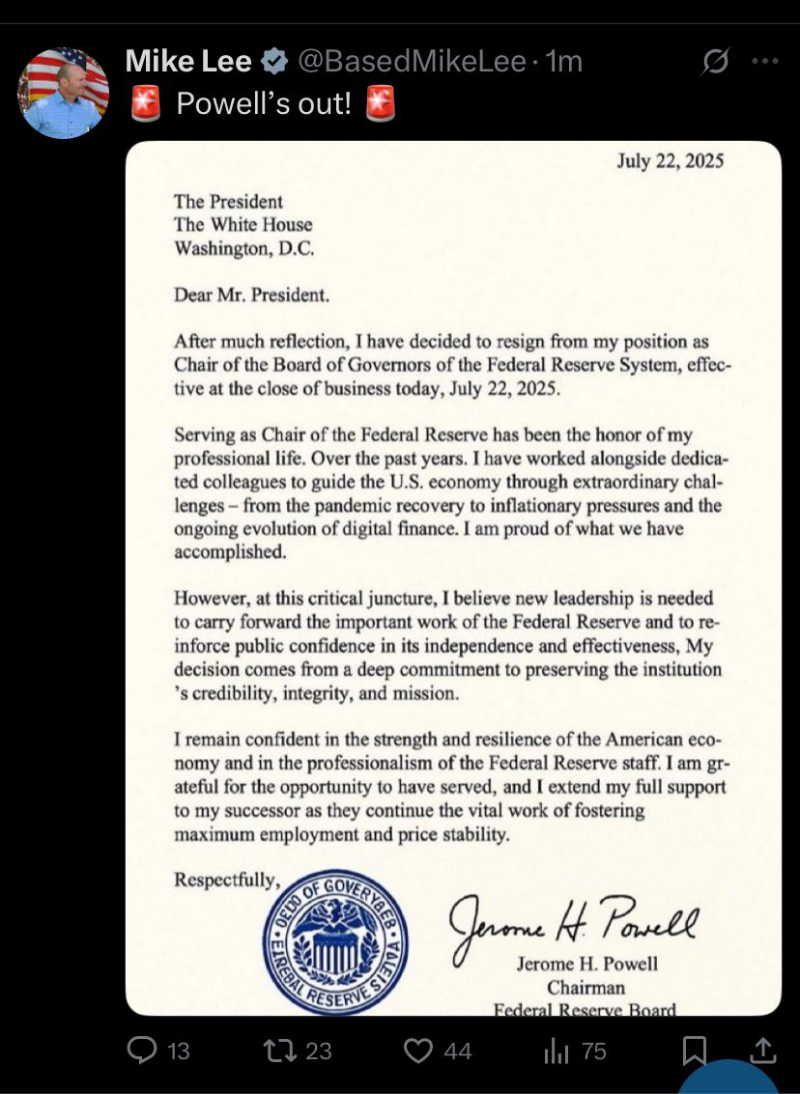
If you examine the letter for more than 2 seconds (as opposed to rushing to eX-Twitter to share it), you can see the failure to use proper formatting for a formal letter, the inappropriate word breaks, the misplaced apostrophes and other grammar errors and, perhaps most obviously, the train wreck of a supposed "Federal Reserve" seal. If you wanted to spend another 2 seconds, you could do some quick googling, and learn that Powell's signature does not look like that.
Yes, it was a fake. An obvious fake, clearly cooked up by some AI engine. And Lee fell for it, hook, line and sinker. So, he was subject to much derision on social media, including on his beloved eX-Twitter. There were also many pieces, like this one, pointing out how often he falls victim to misinformation, which in turn suggests he's either stupid, or dishonest, or both. Again, not a lot of comeuppance, but a little. And he certainly deserves it, particularly after that awful Minnesota stunt. (Z)
This Week in Freudenfreude: Apparently, the Butler Didn't Do It
This is not a feel-good item, but it is good news nonetheless. The folks who track crime statistics have been crunching the numbers, and report that homicides and nearly all other felony-level crimes are on a downward trend across the U.S. (the only exception is motor vehicle theft). Based on data taken from 42 major U.S. cities, the country is set to experience a record decline in homicides in 2025. That will break the mark set... in 2024, which broke the mark set... in 2023.
Why exactly was homicide up so much a few years ago? As you can see from the headline, it wasn't the butler. Or several butlers, even. The actual answer is not perfectly clear at this point, especially since the drop in homicides is extremely uneven, from Denver (the biggest drop, 40%) at one end of the spectrum to Little Rock, AR (a 39% increase), at the other. That said, the one factor that everyone agrees on is Colonel Mustard, in the Conservatory, with the Candlestick. No wait, that's not it. No, the one factor that everyone agrees on is that the pandemic was at least partly responsible for the uptick in violent crime, and so the recession of the pandemic is at least part of the reason for the decline.
This leads us to two observations. The first is that the pandemic was an earth-shaking event, not too far removed from a war, in terms of impact. And the full story will not be clear for many years, if not decades.
The second observation is that, anytime crime goes down, the politicians are very quick to take all the credit. This was, for example, Rudy Giuliani's entire calling card until 9/11 happened. And, truth be told, we're surprised Donald Trump hasn't already hopped on Truth Social to do some crowing. In any case, the story with crime is always complicated, and politicians always give themselves far more credit than they deserve. When and if Trump does take a victory lap, keep that in mind, with particular attention to the fact that the downward trend began well before his second term did.
Have a good weekend, all! (Z)
If you wish to contact us, please use one of these addresses. For the first two, please include your initials and city.
- questions@electoral-vote.com For questions about politics, civics, history, etc. to be answered on a Saturday
- comments@electoral-vote.com For "letters to the editor" for possible publication on a Sunday
- corrections@electoral-vote.com To tell us about typos or factual errors we should fix
- items@electoral-vote.com For general suggestions, ideas, etc.
To download a poster about the site to hang up, please click here.
Email a link to a friend.
---The Votemaster and Zenger
Jul31 Schumer Tries to Get the Epstein Files
Jul31 HACO?
Jul31 Two New Polls: Trump Is Deeply under Water
Jul31 Harris Is Out (Which Presumably Means She's In)
Jul31 You Can't Always Get What You Want
Jul31 Democrats Are Getting Slightly More Optimistic about 2026
Jul31 Twenty House Members Have Already Announced They Are Not Running in 2026
Jul31 Sherrill Is Leading Ciattarelli by 8 Points in New Jersey Gubernatorial Race
Jul31 Marjorie Taylor Greene Will Stay Put
Jul30 Trump's Trade Deals Don't Stand up to Scrutiny
Jul30 The Epstein Files: Maxwell Thinks She Has Leverage... and She Might Be Right
Jul30 Legal News, Part I: It's Now JUDGE Bove
Jul30 Legal News, Part II: CECOT
Jul30 Election News: U.S. Senate
Jul30 Never Forget: Scout's Honor
Jul29 What Is Trump's Gaza Policy?
Jul29 About That EU Trade Deal...
Jul29 The Epstein Files: Apparently, Ghislaine Maxwell Is the Real Victim Here
Jul29 Tone Deafness, Thy Name Is Ron DeSantis
Jul29 Never Forget: Budae Jjigae, Part I
Jul28 The Rosetta Stone Is in Florida
Jul28 The U.S. and E.U. Have a Trade Deal
Jul28 The Administration Has Fired 100 Immigration Judges
Jul28 Trump Has Found a Way around the Impoundment Act
Jul28 Trump Is Slipping with Independents
Jul28 Trump Has His Candidate for Thom Tillis' Senate Seat
Jul28 Trump Is Already Deeply Involved in the 2026 Congressional Races
Jul28 Jeanine Pirro's Nomination for U.S. Attorney for D.C. Advances
Jul28 Is the Washington Post in a Death Spiral?
Jul27 Sunday Mailbag
Jul26 Saturday Q&A
Jul26 Reader Question of the Week: Salud!
Jul25 The Epstein Files: Every Day, this Story Just Gets More Wild and Woolly
Jul25 States to White House: Extra Information on Voters Is Unneeded, Won't be Shared
Jul25 Candidate News: Who Will Succeed Tony Evers?
Jul25 Censorship Watch: Trump Is Made to Look Like a Buffoon
Jul25 Never Forget: Many Paths to Service
Jul25 I Read the News Today, Oh Boy: Ranger Rick (a.k.a. Rick Raccoon)
Jul25 This Week in Schadenfreude: The Appropriations Committee Did the First Lady No Favors
Jul25 This Week in Freudenfreude: Don't Judge a Man by His Tattoos
Jul24 POTUS Is Furious
Jul24 Democrats Are Struggling with a Possible Government Shutdown
Jul24 Bove's Nomination to the Third Circuit Clears a Key Hurdle
Jul24 Administration Removes Habba's Court-Appointed Successor
Jul24 Rand Paul Wants the Pardoned Anthony Fauci Charged with Something
Jul24 Big Law Caved but Little Law Didn't
Jul24 Virginia Is Beginning to Look Like a Disaster for Republicans
Jul23 Dead Men Tell No Tales, But a Live Woman Might Tell One or Two
Jul23 Today in Bending the Knee

