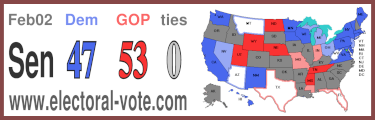
New Senate: DEM 49 GOP 51
New polls:
Dem pickups: (None)
GOP pickups: (None)
Previous | Next
Anthony Kennedy Is Retiring
Justice Anthony Kennedy, in many ways the most powerful person in the U.S. is hanging up his robe. In his announcement, Kennedy said it has been a privilege and an honor to serve in the federal judiciary for 43 years, 30 of them on the Supreme Court. Kennedy was appointed to the Supreme Court by Ronald Reagan and has been a swing vote on a great many cases.
The battle to replace him will be an epic confrontation, the likes of which the country has not seen in decades. The last time the appointment of a justice changed the ideological majority of the Court was George H.W. Bush's appointment of the conservative Clarence Thomas to replace the liberal Thurgood Marshall. If Donald Trump names a true-blue conservative, it could shift the balance of the Court appreciably to the right for a generation or more, meaning that even if the Democrats win the White House and Congress in the future, a Republican-controlled Supreme Court may invalidate much of what they do.
The Democrats will do everything in their power to block Trump's appointee, but "everything in their power" is not much, since Supreme Court nominations can no longer be filibustered, as of last year. They will certainly argue that Senate Majority Leader Mitch McConnell (R-KY) held up a vote on Barack Obama's nomination of Merrick Garland for a year, saying the people should weigh in on this first, so McConnell should also hold off on confirming Trump's nominee for a year so that the people can speak again. However, it took McConnell less than an hour after Kennedy's announcement to declare that he will hold a vote in the fall (likely so he can hold the feet of red-state Democrats running for re-election, like Joe Manchin and Heidi Heitkamp, to the fire). It's possible the Majority Leader could change his mind, and decide that waiting until after the election will allow the GOP to use the empty seat in order to get the base to the polls, but that currently appears unlikely. In either case, the Democrats' only real hope is that if Trump nominates a far right-wing candidate, that Sens. Susan Collins (ME) and Lisa Murkowski (AK) vote "no," but this is longest of long shots.
Earlier in his presidency, Trump released a list of possible justices he might consider. Most of them are conservative appellate judges, but there are also a few state supreme court justices and even Sen. Mike Lee (R-UT), who yesterday positively drooled at the chance to be on the Supreme Court. Trump didn't give any indication of when he would make the nomination.
Politically, the choice and confirmation of an extreme conservative will gin up the Democratic base more than the Republican base, which is likely to feel somewhat complacent with a huge victory. Democrats are all too aware that Justice Ruth Bader Ginsburg is 85 and has had cancer twice. If the Senate were in Republicans hands when she passes away or otherwise departs, the Republicans would have a lock on the Supreme Court for decades going forward. (V)
Is the Supreme Court Really Lost for the Democrats?
For the moment, the GOP—though it represents less than 30% of the country's registered voters—has a hammerlock on all three branches of the federal government. When it comes to the legislative and executive branches, that hammerlock is, at most, a short- or medium-term situation. The red team will eventually ebb out of power and the blue team will eventually flow into power, as is always the case with the two branches subject to the will of the voting public. In particular, the current bull market is probably approaching its end, and when it eventually tanks, it will take the economy with it. When the economy is in the toilet, the president gets blamed, even though presidents don't have that much effect on the economy (at least, if they avoid starting trade wars).
With the judiciary, of course, that is not true. And now that the 81-year-old Anthony Kennedy is likely to get swapped out with an arch-conservative in his forties or fifties, Democrats fear that SCOTUS is lost for the foreseeable future—very possibly decades, or generations. Is this correct, though? It certainly could be, but there are at least three scenarios in which that may not come to pass:
- John Roberts Becomes the New Kennedy: We should
note, first of all, that Kennedy—despite his reputation—has been
drifting rightward recently, and hasn't been much of a swing vote. To put a
finer point on it, there have been 19 decisions this term decided by a 5-4 vote,
and Kennedy sided with the liberals on exactly
zero
of them. He also made a point of retiring while a Republican was in the White
House, and the Republicans controlled the Senate, which makes it clear that it
was important to him to be replaced by a conservative. What it boils down to is
that Kennedy was not some sort of centrist or independent; he was a fairly reliable conservative
who was occasionally maverick-y. He was, in essence, the Supreme Court's answer
to Sen. John McCain (R-AZ).
The new swing justice—that is to say, the person who has four people to his right and four people to his left, politically—is Chief Justice John Roberts. Roberts, like Kennedy, has also been a conservative who occasionally goes maverick, most obviously in his vote to sustain Obamacare. As this analysis from FiveThirtyEight shows, the Chief Justice has been drifting slightly leftward, such that his votes are actually not all that distinguishable from Kennedy's in terms of their political slant. To put this another way, the current Supreme Court is made up of four reliable liberal votes, three reliable conservatives, and two conservatives who rebel on occasion. Kennedy's replacement is going to take that from 4/3/2 to 4/4/1, which is not actually all that big a change.
However, there is a pressure operating on Roberts as Chief Justice that did not particularly affect Kennedy. To explain, consider this comment, one among many such comments readers offered in response to the Washington Post story about Kennedy's retirement:It's bad enough that the Court has become so partisan. But to represent a minority that seeks to tyrannize the rest of us—that's appalling.
The point is that the current Court is developing a (well-deserved) reputation for being hyper-partisan. And part of the Chief Justice's job is to be an institutionalist—to serve as caretaker of the Court's reputation. Because SCOTUS has no enforcement apparatus of its own, it very much depends on its moral authority and on people's sense that it has integrity. On those occasions where it seemed to have become a bastion of partisan hacks—most obviously in the years following Dred Scott v. Sandford in 1856, but also on other occasions—the Court's power was severely diminished. Roberts surely realizes that it's happening again, and he's likely to think much longer and harder about some of those future 5-4 decisions, now that he knows for sure that he's the swing vote. Heck, if he sides with the liberals on just one 5-4 decision next term, that will be one more than Kennedy swung this term.
Since Bush v. Gore, the Court has overseen not only two "elections" of minority Presidents it has made so many terrible decisions—Citizens United, gutting the Voting Rights Act, approving of racist gerrymandering, approving of bigotry against gay people, approving of Trump's Islamophobia, threatening women's rights in favor of the religious rights of extremists—again— a bad misreading of the First Amendment...
Somehow the very idea of democracy is being rolled. The many are being terrorized by the few. And to be doing this with TWO tainted elections followed by the theft of a SCOTUS seat—This is just nuts. - Surprise Attrition: This is a little delicate, but
it is what it is, so we're just going to have to jump in with both feet. If Ruth
Bader Ginsburg's health does not hold for the next two years, and she is
compelled to leave the court, then things definitely get grim for the blue team,
since the GOP figures to control the Senate and the White House through 2020.
Once the next presidential election rolls around, however, things could change rapidly. The Senate map in that year very much favors the Democrats, and if Donald Trump remains as unpopular as he is, the blue team has a very solid chance to claim both houses of Congress and the White House. If that does come to pass, then Ginsburg would undoubtedly retire very quickly, and she would probably be followed by Stephen Breyer, who would be in his early eighties by then. If that duo leaves and is replaced by a Democratic president, then nothing changes, of course. But next up on the list would be Clarence Thomas, who will be 72 on Inauguration Day 2021, will have nearly 30 years' service on the Court, and has already hinted about retirement. Is he ready to throw in the towel in the next 24 months? It doesn't seem that way. But if he doesn't retire soon, is he prepared to hang on for four or eight more years, into his early eighties? Only he knows that, but the odds don't seem high.
And then, there's the really delicate part of this discussion. Keep in mind that Antonin Scalia's seat came open in the first place because he died unexpectedly. It's true that he wasn't exactly the picture of health. But it's also true that by 2023, there will be two conservative justices in their seventies (Thomas and Samuel Alito) and another in his high sixties (Roberts). Needless to say, it is far from guaranteed that all three will remain in perfect health. Indelicate to point out, perhaps, but it is what it is. - Democrats Decide to Play Some Hardball: This part of
the discussion must begin with an observation that Barack Obama badly misplayed his
hand with Merrick Garland. As New York magazine's Eric Levitz
points out,
a bolder choice—like, say, a young, progressive, black woman—would have put
enormous pressure on the GOP to hold a vote for fear of looking, well, racist. And even
if Mitch McConnell held the line, the possibility of a SCOTUS seat going to someone like that
might have gotten some more Democrats, particularly of the progressive stripe, to the polls
to hold their noses and vote for Hillary Clinton. Possibly even enough to swing the election.
After all, a net change of 77,000 votes in Michigan, Pennsylvania, and Wisconsin (out of 13.3 million cast in those states)
would have led to a second President Clinton.
By contrast, very few people are going to get excited about getting another middle-aged
white guy on the Court.
In this case, Obama was demonstrating—yet again—his firm belief that if he acted reasonably, the GOP would meet him halfway and act reasonably in return. But that is, to be blunt, not the MO of the modern-day Republican Party. They are, and have been for at least a decade, an "ends justifies the means" kind of organization. It may be that the Democrats are unwilling to respond in kind. On the other hand, maybe the blue team will decide that enough is enough, and that the time has come to fight fire with fire. Particularly if McConnell moves forward with his plans, and brazenly applies a very different set of rules for voting on a nominee when a Republican is in office than he did when a Democrat was on office.
At this point, it should be noted that the Constitution says virtually nothing about the Supreme Court. All it says, in fact, is that there will be a Supreme Court, and that the people who serve on it will get paid. Here's the entire passage from the Constitution (Art. III, Sec. 1):The judicial Power of the United States, shall be vested in one supreme Court, and in such inferior Courts as the Congress may from time to time ordain and establish. The Judges, both of the supreme and inferior Courts, shall hold their Offices during good Behavior, and shall, at stated Times, receive for their Services a Compensation which shall not be diminished during their Continuance in Office.
The actual structure of the Court, including the number of justices, etc., is set by statute, starting with the Judiciary Act of 1789 and then adjusted by several subsequent acts since.
The point here is that deciding the makeup of the Court is, without question, the province of the legislative branch. And that is where the Democrats' opportunity lies, if they decide to play a little dirty pool. The most obvious thing they could do is expand the number of justices on the Court to, say, 11. It's been done before, most recently in 1869, when the number was expanded from seven to nine. With that said, the last person who tried to pull this off was FDR, in 1937. And his "court-packing" plan, as it was called, backfired spectacularly. If one of the great political minds in American history couldn't swing it, that will undoubtedly make modern-day Democrats leery. On the other hand, they could say their plan was simply a response to the Republicans' refusing to let Merrick Garland even come up for a vote.
However, that is not necessarily the only option. A somewhat more subtle possibility would be for the Democrats to institute a mandatory retirement age for federal judges—say, 65 or 70. This is clearly legal—many federal jobs already have a mandatory retirement age, in fact. For example, FBI officers are done at 57 unless they get special dispensation, and even then they can be extended only to age 65 at the most. The blue team could even make a plausible argument that the Founding Parents never intended for judges to serve for 30 or 40 or 50 years, and that the law is a corrective to the much longer lifespans of our time as opposed to the 1780s.
It should be noted that these "hardball" scenarios assume a number of things. To start, that the Democrats are actually willing to play rough, and also that they gain control of both houses of Congress along with the presidency. Beyond that, however, it would almost certainly be necessary to eliminate the Senate filibuster. That is an option so "nuclear" that even the very Machiavellian Mitch McConnell has not gone there. Donald Trump has repeatedly instructed McConnell to kill the filibuster so the Republicans can ram through legislation with 50 votes and the help of President of the Senate Mike Pence. Just yesterday, McConnell explained why he hasn't done it: The votes aren't there. He also made it crystal clear why a certain number of Republican senators were not on board with eliminating the rule, saying that it protects the country from liberal policies when the Democrats are in power. He even said that had it not been for the filibuster, Barack Obama would have enacted socialized medicine. This is a complete lie, since Obama didn't even want to expand Medicare, let alone go for full-blown socialized medicine. Still, McConnell is aware that some day the Democrats might be back in power and he doesn't want to be in charge of a completely powerless minority when that happens.
The Democrats' argument is this: The filibuster is on life support, anyhow. So many of the norms of the Senate have been subverted in the last few years, from rubber-stamping clearly unqualified Cabinet nominees, to whittling down the filibuster power, to ending blue slips that some majority leader in the near future is eventually going to go nuclear. If the Democrats are truly going to play hardball, it might as well be them, so that they are the first to get the benefit. Particularly if the prize is as big and juicy as the Supreme Court.
So, those are the three scenarios that immediately leap to mind. Again, there's no question that the GOP's grip on the Supreme Court is very firm right now. But, as we are fond of pointing out, a week in politics is a lifetime. And the point here is that there's plenty of room for some big surprises in the next several years. (Z & V)
Supreme Court: Nonmembers Don't Have to Pay Union Dues
As an example of Anthony Kennedy's power, he voted with the four conservatives on the Supreme Court to rule that states may not require public employees who are not members of a union to pay fees to the union that represents them. This is a huge blow to the union movement and to the Democratic Party, as it will weaken unions enormously and reduce the amount of help they can give the Democrats during election campaigns.
The decision yesterday overturns a 1977 Supreme Court decision, Abood v. Detroit Board of Education, which said public-employee unions could force nonmembers to pay fees to cover the costs of negotiations with employers since the nonmembers were getting the benefits of union bargaining power. The Court generally doesn't like to overrule itself, because to have one group of justices say the Constitution means x and another group say it doesn't makes it sound like rulings are just the personal opinions of the current justices, which weakens the Court in the eyes of the public. Nevertheless, the opportunity to permanently hurt the Democratic Party was too good to pass up.
Donald Trump was ecstatic about the court's decision, specifically because it will hurt the Democrats badly:
Supreme Court rules in favor of non-union workers who are now, as an example, able to support a candidate of his or her choice without having those who control the Union deciding for them. Big loss for the coffers of the Democrats!
— Donald J. Trump (@realDonaldTrump) June 27, 2018
For once, he was completely on target. There is no way to spin this other than a huge victory for the Republicans, overshadowed only by the even bigger prize of another Trump-appointed Supreme Court justice. (V)
Immigration Bill Fails in the House
Donald Trump finally made crystal clear his support for the so-called "compromise" immigration bill, one that involved no reaching across the aisle whatsoever. He did so, naturally enough, via Twitter:
HOUSE REPUBLICANS SHOULD PASS THE STRONG BUT FAIR IMMIGRATION BILL, KNOWN AS GOODLATTE II, IN THEIR AFTERNOON VOTE TODAY, EVEN THOUGH THE DEMS WON’T LET IT PASS IN THE SENATE. PASSAGE WILL SHOW THAT WE WANT STRONG BORDERS & SECURITY WHILE THE DEMS WANT OPEN BORDERS = CRIME. WIN!
— Donald J. Trump (@realDonaldTrump) June 27, 2018
You know it's serious when it's in ALL CAPS.
Despite the last minute "support" from the President, the House strongly rejected the bill yesterday. The vote was 121 to 301. Every Democrat voted against it, as did dozens of Republicans who felt it represented amnesty to people who had broken the law by sneaking into the country illegally. It is also a defeat for Trump, of course, who badly wants an immigration bill, but never bothered to tell Congress what exactly he wants in his hypothetical bill. If he had done so, it might have passed. Many House Republicans are angry that Trump came to Capitol Hill early last week to talk about immigration (without giving any guidance about what he wanted) and then Friday tweeted that it would be better if there were no bill. That kind of inconsistency doesn't get you a lot of votes.
The failure of this bill (and last week's more punitive bill) exposed a huge rift within the Republican Party on immigration. The moderates are willing to let the 12 million or so undocumented immigrants already in the country stay and eventually become citizens in return for provisions designed to reduce the number of future immigrants, legal and illegal. The hardliners, however, see this as amnesty and they are absolutely 100% against it. Reconciling these viewpoints is not going to be easy. In fact, it's likely not going to be possible, especially without clear and consistent help from the other end of Pennsylvania Avenue. At this point, outgoing Speaker Paul Ryan (R-WI) is probably going to throw up his hands and not touch this hot potato again, leaving it to the next speaker to get burned trying. Although, in theory, the threat of a discharge petition still lingers, so we will see if he can actually dance around the subject until he leaves. (V)
Takeways from Tuesday Elections
The votes have been counted, so now it is time for the pundits to take over. Here are some takeaways:
New York Times- A landmark political moment in New York
- The threat to Nancy Pelosi
- Political gravity still exists, occasionally (ex-con Michael Grimm lost)
- Mitt Romney will be just fine
- Loser: The Democratic establishment (on account of Joe Crowley's loss)
- Loser: Con men (on account of Michael Grimm's loss)
- Loser: The Republican Party of Oklahoma (on account of Democrat Drew Edmondson's nomination)
- Winner: Liberals (on account of Ben Jealous and Jared Polis)
- Winner: Trump (on account of Henry McMaster in SC)
- Winner: Trump (on account of Mitt Romney's not trashing him during the campaign)
- Winner: Medical marijuana in Oklahoma
- Liberals roared back in NY-14 and Maryland
- It was a great night for President Trump
- This may be the end of the white ethnic party boss
- Where do House Democratic leaders go from here?
- The 2020 Democratic landscape gets some early definition
- It was a mixed night for the Democrats
- A shocker in Queens
- Donald Trump gets his men
- Senator Romney?
- Jealous prevails in Maryland
- Money helps (David Trone bought himself a Democratic nomination in MD-06 for $13 million)
- Trump effect continues (Henry McMaster in SC and Dan Donovan in NY won)
- GOP is having an identity battle
- Can Democrats mend fences?
- Crossing Trump is not always fatal (Larry Hogan in MD, Mitt Romney in UT won)
- The progressive left: A New York stunner, big Maryland victory
- Democratic establishment holds elsewhere
- White House has a good night
- But Trump's endorsement is still complicated
- In the year of the woman, Mary Jane is on the march
Everyone is shocked by Alexandria Ocasio-Cortez' amazing upset win over Rep. Joseph Crowley (D-NY), but some perspective might be useful. She got about 16,000 votes to Crowley's 12,000, but in 2016, 197,000 people cast votes in the NY-14 House race, of which 148,000 were for Crowley. To predict a national trend when a young Latina won over an old white man in a heavily Latino district in which only 11% of the district's Democratic voters bothered to show up is maybe a wee bit premature.
Dana Milbank made the interesting point that Ocasio-Cortez did the Democrats a big favor although they may not realize it quite yet. Joe Crowley was clearly in line to become the leader of the House Democrats (and potentially speaker) when Rep. Nancy Pelosi (D-CA) decides to call it quits. The Democrats' electorate is increasingly young, nonwhite, and female, and replacing Pelosi with an old white man might not rally the troops much. Now the election to watch very closely is whom the House Democrats choose to fill Crowley's #4 slot in the House leadership. While #2 (Steney Hoyer, 79) and #3 (Jim Clyburn, 77) would both love to become speaker some day, the election of a new #4 gives the Democrats a chance to put an exciting young person in the leadership. For example, they could put in a young person and go dynastic at the same time: Bobby Kennedy's grandson, Joe, is only 37 and represents MA-04 in the House. The Republicans already figured this youth thing out: Paul Ryan is 48.
Similarly, that an incumbent governor, Henry McMaster, got his party's nod, is not exactly something as rare as appearances of Halley's comet, despite the credit being given to Donald Trump for his amazing feat. And maybe the defeat of a convicted criminal in NY-11 doesn't mean that Donald Trump can also get his man elected in races where the opponent isn't a felon. A lot of pundits get much too excited about things they ought to know better about. (V)
Democrat Mikie Sherrill Leading in NJ-11
The retirement of Rep. Rodney Frelinghuysen (R-NJ) in NJ-11 has given the Democrats a prime pickup opportunity in precisely the kind of district they are targeting: White, well-educated, affluent, and suburban. It covers portions of Essex, Morris, Passaic, and Sussex counties in Northern New Jersey. The biggest towns are Hopatcong, Dover, Morristown, Madison, and Somerville. The Democratic candidate is Mikie Sherrill, a lawyer, Naval Academy graduate and former Navy pilot. The Republican candidate is Jay Webber, a Harvard-educated lawyer and member of the state assembly.
A new Monmouth University poll shows it to be a statistical tie, with Sherrill at 40% and Webber at 38% of all potential voters. When likely voter models are applied, Sherrill's lead increases to 6 points.
Modeling the election is going to be a huge problem for all pollsters going forward. It matters enormously if 32% of the voters are Democrats or 38%, and there is no way to know until an autopsy of the election is performed after the fact. The "enthusiasm gap" between the parties is especially important in open-seat races like this one, because most voters don't know much (if anything) about either of the candidates other than maybe that both went to top-flight universities.
The poll also found that the voters in NJ-11 are split on the new tax law, with 40% approving and 43% disapproving. However, 38% expect their own taxes to go up while only 19% think they will pay less this year. The district is also split on Donald Trump: 47% approve of him and 49% disapprove. This district is a veritable prototype of the kind of well-off Republican-leaning districts the Democrats must capture if they are to take back the House. (V)
Back to the main page