New Senate: DEM 49 GOP 51
New polls:
Dem pickups: (None)
GOP pickups: (None)
Previous | Next
Joe Crowley Gets Cantored
Five states held primaries and two held runoffs on Tuesday. Here are the major storylines, beginning with the shocker of the midterm season:
- Crowley Sent Packing: Rep. Joe Crowley (D-NY) is
the chair of the House Democratic Caucus, making him the #4 Democrat in the
lower chamber. He's also a ten-term congressman who has represented NY-14 for
the last three of those terms. All of that will come to an end in January of
next year because, in what was far and away the biggest story of Tuesday night,
he suffered an epic,
Eric Cantor-style
defeat,
losing
58% to 42% to an unknown challenger named Alexandria Ocasio-Cortez. She is 28
years old, a Latina, a self-described socialist, and a former organizer for Sen. Bernie
Sanders' (I-VT) presidential campaign.
Amazingly, Donald Trump promptly took credit for Crowley's loss, declaring on Twitter that the Congressman "should have been nicer, and more respectful, to his President!" Uh, huh. If the Donald thinks that Ocasio-Cortez will be more respectful, he's going to be in for a surprise, because she's not a fan, to say the least. And, if anything, Crowley's problem is that he was too nice to the President. Clearly, the D+29 district wanted someone willing to shake things up, and Crowley is not that person. Ocasio-Cortez also made the case, obviously quite successfully, that the 56-year-old, white congressman was out of touch with voters in his young-leaning, majority-minority district. She's also critical of establishment Democrats in general, arguing that they are too willing to focus on the gossip of the day at the expense of making progress on truly substantive issues.
Crowley's defeat has naturally raised fresh questions about the other high-ranking Democrats in the House, particularly Minority Leader Nancy Pelosi (CA). Thus far, Pelosi has successfully quashed all challengers to her throne. But she will be 79 in March of next year, and she's not popular with the younger and more progressive members of the base. She's already won her primary, and she's going to be reelected, so that's not an issue. However, the fall of Crowley is certainly going to encourage a serious challenge for the leadership from the left. And if some of the moderates join the progressives in deciding the time has come for a change, she could quickly be returned to the back benches.
Even more important than replacing one Democrat with another in a D+29 district is the lesson the Democrats take from Ocasio-Cortez' upset victory. At least two possibilites come to mind:
- Democrats should run truly progressive candidates who stand for change nationwide
- Democrats should match their candidates to the districts they represent
Ocasio-Cortez is clearly an excellent match for her district, which has a majority of people of color, mostly young ones. That Crowley survived there so long is, in retrospect, surprising. The $64,000 question is whether candidates like Ocasio-Cortez can win in an R+11 district like PA-18, which Donald Trump won by 20 points but which moderate Democrat Conor Lamb won in a special election this year. The future of the Democratic Party may hinge on which lesson the Democrats take away from the NY-14 primary.
- The Progressives Strike Back: Ocasio-Cortez wasn't
the only progressive to claim victory on Tuesday night; the left had a great
evening overall. Most notably, besides Ocasio-Cortez' upset win, the
Sanders-backed Ben Jealous claimed the Democratic nomination for governor in
Maryland, dispatching establishment candidate Rushern Baker 39% to 28%. Also, in
NY-24, Dana Balter crushed Juanita Perez Williams—whom the establishment
dug up at the last minute—63% to 37%.
In view of these victories, there is a theme already emerging in some quarters that the left wing of the Democratic Party is ascendant, and that the answer to the $64,000 question above is, "Democrats should run truly progressive candidates who stand for change nationwide." Let's not get ahead of ourselves. Ocasio-Cortez won in a deep blue district, and Jealous won in a solidly blue state (Maryland has a PVI of D+12). Nobody doubts that progressives can win in places like that, particularly if they run good campaigns, as Ocasio-Cortez and Jealous both did. While NY-24 is more purple (D+3), Perez Williams was a weak candidate who didn't run much of a campaign. The point is that we cannot generalize about the national climate solely from Tuesday's results, particularly since the great majority of progressive vs. moderate contests prior to Tuesday were settled in favor of the moderates (as were some of Tuesday's matchups, such as in CO-06, where the Sanders-backed Levi Tillemann's brilliant pepper spray-commercial did not help, as he got crushed by Jason Crow by a 2-to-1 margin). If progressive candidates pile up a few more successes, particularly in purple or light red districts, then it may be time to re-evaluate.
- Trump's Triumphs: Donald Trump threw his weight
behind two candidates who were on the ballot on Tuesday night, and both won. In
the case of NY-11, Trump's support of Rep. Dan Donovan (R) probably didn't
matter too much, since he is an incumbent, and he won by 28 points, 64% to 36%.
In the South Carolina governor's race, on the other hand, Trump might
have powered Gov. Henry McMaster (R) to renomination, since he defeated
challenger John Warren by just eight points, 54% to 46%. On the other hand,
maybe not, since McMaster is also an incumbent, and endorsements don't usually
have an eight-point impact. The President has already crowed about both wins on
Twitter, but we will need to see a few races where his candidate wins by 1 or 2
points before we can declare that he has any ability to affect the outcome of
elections with his endorsements (and his rallies).
- Who Will Bake the Inaugural Cake?: While at least
one baker in the state won't be happy about it, Rep. Jared Polis (D) easily landed
his party's nomination for governor in Colorado, taking 44.5% of the vote while
his nearest competitor got only 25%. Further, more than 100,000 more Democrats
than Republicans showed up to vote Tuesday, despite the fact that the GOP side
of the governor's contest was also competitive (and won by state treasurer
Walker Stapleton). This suggests that Polis is likely to be chosen as Gov. John
Hickenlooper's (D) replacement in November. If so, he'll be the first openly-gay
governor in United States history (though Gov. Kate Brown, D-OR, is
bisexual).
- The Senate? Yawn: For various reasons, it's
plausible for major upsets to happen in House races, as with Joe Crowley's
defeat. It's much harder for that to happen in a Senate race, as they are
statewide. And so it is that Tuesday's Senate contests offered virtually no
drama whatsoever. Kirsten Gillibrand (D-NY) was unopposed, Ben Cardin (D-MD)
took 80% of the vote and easily dispatched his challengers, including Chelsea
Manning, and Mitt Romney formally secured his party's nomination in Utah with
three quarters of the GOP vote. These folks also found out who their challengers
will be—Chele Farley, Tony Campbell, and Jenny Wilson,
respectively—but those folks are afterthoughts. Gillibrand, Cardin, and
Romney will all win easily in November. So will Sen. Roger Wicker (R-MS),
incidentally, who was not on the ballot Tuesday as he had already secured
renomination, but who found out that his victim...er, opponent, is going to be
state legislator David Baria.
The most interesting question that will emerge from Tuesday's Senate races, once the inevitable comes to pass in November, is: What will the relationship between Romney and Donald Trump be? Trump, for his part, is currently playing nice, and posted a tweet heartily congratulating the Massachusettsian...er, Utahn...on his victory. Undoubtedly, some Beehive State voters expect Romney to become the leader of the Trump resistance, while others want him to be a five-star general in the Trump militia. Given Romney's flip-floppy nature, both groups are likely to be disappointed. - Oklahoma Goes to Pot: Roughly 450,000 Republicans
showed up to vote in the Sooner State on Tuesday, compared to 400,000 Democrats.
That's a much narrower gap than normal, which means the race to succeed Gov.
Mary Fallin (R) might get interesting. The Democratic candidate there is going
to be former state AG Drew Edmondson, while the Republicans are going to have a
runoff between former Oklahoma City mayor Mick Cornett and Tulsa businessman
Kevin Stitt.
On the other hand, the November election might not be interesting at all if we find out that Democratic turnout was up only because legal marijuana was on the ballot, in the form of Oklahoma State Question 788. That measure passed easily, with 56% of the vote. One wonders if AG Jeff Sessions will note that the reddest state in the Union just legalized wacky tobaccy and will decide that his energies are best spent on other things. Pot has now been legalized on some level (either outright, or for medicinal purposes, or merely decriminalizing it) in 30 states.
And so there it is. There are going to be a lot of stories in the next few days about Crowley's defeat and exactly what it means. The next election is on June 30, when residents of TX-27 will be asked to choose between nine candidates who want to replace Republican Blake Farenthold, who resigned in disgrace. That one is almost certainly going to end up heading to a runoff. Meanwhile, the next non-special elections are on July 17, in Alabama (primary) and North Carolina (runoff). (Z)
Supreme Court Upholds Muslim Travel Ban v3.0
When the Supreme Court heard oral arguments about v3.0 of Donald Trump's Muslim travel ban (the case is formally known as Hawaii v. Trump), they asked a lot of questions about the statements he made on the subject, as both president and as candidate. SCOTUS watchers interpreted this as a sign that the Court planned to strike the travel ban down. This reminds us of how hard it is to read the tea leaves from oral arguments, since the Court actually upheld the ban, with a 5-4 vote along the usual partisan lines.
The majority opinion was written by Chief Justice John Roberts. Nobody is going to confuse him for Ernest Hemingway anytime soon, so it's not exactly a page turner, though the Washington Post has a helpful annotated version. Ultimately, the Court's decision turned on three key points:
- They reiterated, several times, that they are loath to encroach on executive
authority unless it's an absolute slam dunk.
- They determined that Trump's declarations about the travel ban, particularly
those uttered as a candidate, were not germane to determining his (and his
administration's) intent. So much for all the time they spent on that subject in
oral arguments. This part of the Court's finding, which effectively eviscerated
the plaintiff's case, immediately raised questions about the recently-decided
gay cake case (aka Masterpiece Cakeshop v. Colorado Civil Rights
Commission). In that case, the Court found that the pronouncements of
government officials were relevant to determining intent. Though the
cases are not identical, the discrepancy has some people wondering if
SCOTUS has one set of rules for Republicans and another for Democrats, or
perhaps one set for Christians and another for Muslims.
- Once the Court declared its intent to ignore Trump's public pronouncements, that meant that its decision was based entirely on the text of the travel ban. And looking strictly at the text, they found that it does not discriminate against Muslims. Central to this part of their finding was the observation that the countries affected by the ban constitute just 8% of the world's Muslim population. The justices wondered exactly how much of a Muslim ban it could be if 92% of the world's Muslims are not affected.
It took just minutes for Trump to take to Twitter to celebrate his victory:
SUPREME COURT UPHOLDS TRUMP TRAVEL BAN. Wow!
— Donald J. Trump (@realDonaldTrump) June 26, 2018
Notice that it is now the "Trump Travel Ban." Odds are good that it would not be the "Trump Travel Ban" if the ruling had gone in the other direction. In any case, the President is not one for reading, especially long, boring court decisions. If he had read it, however, he might have noted that the Court made clear its lack of enthusiasm for the ban. Most obviously, in this passage:
Plaintiffs argue that this President's words strike at fundamental standards of respect and tolerance, in violation of our constitutional tradition. But the issue before us is not whether to denounce the statements.
And in this one:
Under these circumstances, the Government has set forth a sufficient national security justification to survive rational basis review. We express no view on the soundness of the policy. We simply hold today that plaintiffs have not demonstrated a likelihood of success on the merits of their constitutional claim.
These are passive-aggressive, yes, but by SCOTUS standards, this is pretty strong language. Given that Roberts chose to write the carefully-worded decision himself, and given that he reiterated several times that the Court does not necessarily agree with the content of the travel ban, he is clearly giving himself a little wiggle room. It seems as if the Chief Justice knows that history might not look kindly on this decision, and that he doesn't want to take the blame. To burnish his "we're not bigots" case, he also made a point of blasting another SCOTUS decision that history did not judge kindly, namely Korematsu v. United States, the 1944 case that upheld the legality of Japanese internment.
Roberts' invocation of Korematsu was not entirely arbitrary; it was raised in Sonia Sotomayor's dissent, and was also used (clumsily) by Donald Trump last year as justification for his authority to ban whomever he wished. The President's exact words were "What I'm doing is no different than FDR." In any event, Roberts' Korematsu remarks have a lot of outlets reporting today that one of the most notorious decisions in Supreme Court has finally been overturned. It's actually not quite as simple as that, though. First of all, Roberts' words were an aside, and not a finding. So while they might be quoted in future cases, they are not binding. Beyond that, Korematsu's conviction was vacated by a writ of coram nobis in 1983, which the SCOTUS declined to review. That alone effectively overturned the case. Then, the Civil Liberties Act of 1988 apologized for internment and forbade such actions in the future. And in 2011, acting Solicitor General Neal Katyal made a public statement that the case was "a mistake." So, depending on one's point of view, Korematsu is either (1) Still technically on the books, or (2) Overturned, as of 1983, or (3) Has been whittled down, bit by bit, over the last 35 years. Whatever interpretation one adopts, Roberts most certainly did not overturn the decision in one fell swoop yesterday.
The big question now, of course, is: What impact will this have on the midterms? That is hard to answer at the moment. It is improbable that the decision will rouse anti-Trump or pro-Trump voters in any significant way, if only because the current dispute over the border and separating families triggers the same emotional responses, and that dispute is both more recent and more immediate. However, if Tuesday's victory encourages the President to flex his muscles even more, or to be even more careless about what he says (if that's possible), then he could certainly do himself some damage. So, we shall have to see what he does. (Z)
Judge Decides Not to Dismiss Case against Manafort
Donald Trump's former campaign manager, Paul Manafort, is facing charges in both D.C. and Virginia. Pretty much every motion his lawyers have made in D.C. has been rejected by Judge Amy Berman Jackson, who is presiding there. Now Manafort is starting to run into bad luck in Virginia, as well. Yesterday, Judge T.S. Ellis ruled on his lawyers' motion to dismiss the charges against him on the grounds that special counsel Robert Mueller did not have the authority to bring those charges. The judge said that Mueller had that authority so the case will not be dismissed. The Virginia trial will start on July 25. (V)
Tax Bill Will Hit Churches
When Congress passes a 500-page bill with a 600-page explanation that no member read before the vote, which took place 4 days after they were released, well, strange stuff can happen. It is only now becoming clear that one consequence of the tax-cut bill will be to tax nonprofits, such as churches, hospitals, orchestras, and other historically exempt organizations at a rate of 21% on fringe benefits they pay their employees.
The cause of the problem is that Congress made such deep cuts that it knew without cutting some deductions, the deficit might explode to the point where the public might start complaining. So one area where it found a little money is taxing previously exempt fringe benefits to employees. These included items like free meals and free parking. Under the new law, their employers have to pay a 21% tax on the market value of the fringe benefits. But Congress neglected to make a distinction between for-profit and nonprofit organizations, so now churches, among other organizations, have to pay taxes for the first time ever. For example, if a church provides its pastor with free housing, that is a taxable benefit under the new law.
The vice president of government relations at the National Association of Evangelicals, Galen Carey, said: "There's going to be huge headaches. The cost of compliance, especially for churches that have small staffs or maybe volunteer accountants and bookkeepers—we don't need this kind of hassle." Churches are definitely not going to be happy, and when their members discover the bills the churches will have to pay, they won't be happy either. This also gives Democrats talking points in the elections, like: "In order to partially pay for tax cuts to millionaires and billionaires, Republicans decided to tax your church." The tax took effect Jan. 1, 2018, and nonprofits are required to pay quarterly, so the problem has already hit them. (V)
Vulnerable Voting Machines Will Not be Replaced in 2018
As we have pointed out before, the Russians (and possibly other countries) are expected to meddle in the 2018 elections. We have also pointed out that Congress has appropriated $380 million for election security and then patted itself on the back for a job well done. It is now official that three of the states with the most vulnerable election systems will not be able to fix them by November. A key problem is that before a state can replace its hackable voting machines, it has to draw up a tender, allow companies to bid, select a winner, place the order, wait for delivery, test the new products, and train people to use them. This simply can't be done before November, so we will have yet another election with insecure voting machines.
South Carolina and Louisiana, which have systems among the worst in the country, will use their grants of about $6 million each to pay for new machines in part, but they admit that the new ones won't be in service before 2020. In Georgia, where Secretary of State Brian Kemp (R) has long told the federal government not to butt into his elections, an 18-member commission is studying the problem. Possibly they will decide what they want to do by 2020, or maybe by 2022 or 2024. Kemp is in no hurry to make a decision.
Only two other states (New Jersey and Delaware) use voting machines that do not produce a paper trail. If an intruder could get into the machines and change vote totals, there would be no way of determining what the result should have been. Experts believe that a well-financed and knowledgeable team of hackers might be able to pull it off without detection.
What states could do—but probably won't—before November is hire experts to audit their systems and try to fix weaknesses. Often there are security patches to improve the voting systems, but the states simply don't have the expertise to install them. Also, the voting machines aren't the only vulnerability. In 2016, the Russians didn't try to change vote totals, but in 21 states they tried to attack the voter registration databases. If they remove voters from the rolls in precincts strongly leaning to candidates they want to defeat, that is just as good as changing the totals, and much easier. The bottom line is that the only safe system for counting votes properly is to eliminate all voting machines and use paper ballots that can be optically scanned, but that is not the direction things are going. (V)
Members of Congress Are Much Richer than Ordinary Americans
One of the many reasons that Congress does not respond to problems that many Americans face is that the members are not facing them themselves because they are wealthy. Determining the true wealth of a member of Congress is difficult, because the forms they have to fill out have very broad bands. For example, on the House disclosure form, one category is for assets worth between $5 million and $25 million, despite there being an enormous difference between the low end and the high end. Based on the disclosure forms and using only the low-end numbers for both assets and liabilities, Roll Call has produced a list of the top 20 members:
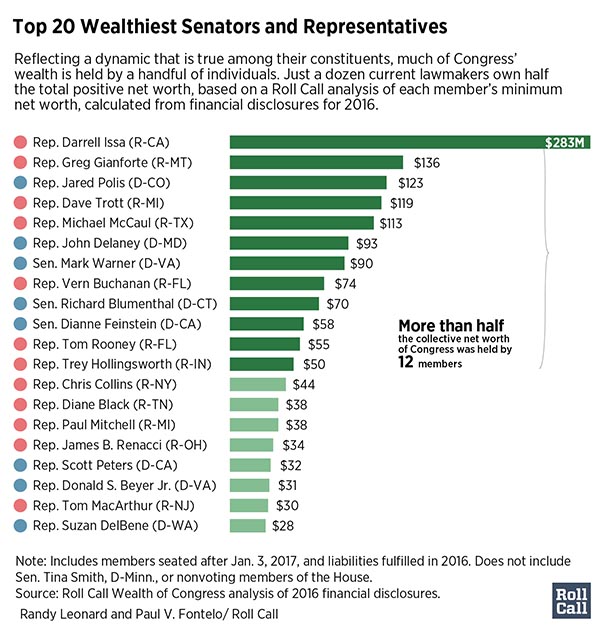
Again, note these are the minimum values. Everyone listed is worth at least the amount shown, but could be worth 5 times that or more. At the top end are 10 representatives and 3 senators worth over $43 million at least, which puts them in the 0.1%. Here is the full list. According to the list, at least 207 members of Congress are millionaires, but once again, the real number may be far larger because Roll Call used only the minimum numbers on the form. Also, only liquid assets are listed on the form. If a member has $10,000 in the bank but lives in a fully paid for $3 million house, his net worth is listed as $10,000. The conclusion is that the members of Congress are rich far beyond that of the people they represent. This makes many of them completely unaware of what life is like for millions of Americans, so it is no wonder that their decisions often reflect the wishes of rich people rather than poor people (and then there is the matter of what their donors want, but that is another story).
As a small aside, the much-maligned Debbie Wasserman Schultz, who ran the DNC during the 2016 election and who was accused by supporters of Bernie Sanders of putting her thumb on the scale for Hillary Clinton (worth about $18 million), is listed as the third-poorest member of Congress, with minimum assets of $100,000 and minimum liabilities of $1.3 million. (V)
Restaurant Kerfuffle May Have Saved Sanders' Job
A couple of weeks ago, it leaked that White House Press Secretary Sarah Huckabee Sanders might soon be on her way out the door. More recently, it leaked that Donald Trump had soured on Sanders, primarily because she failed to walk out on Michelle Wolf at the White House Press Correspondents Association dinner, and that he had begun giving Sanders "grades" on her performances each day. All of this adds up to "soon to be fired."
But then, of course, Sanders got kicked out of the Red Hen restaurant. And Donald Trump, who is incapable of ignoring even the smallest insult, and who also loves to enrage his base with any evidence of an evil, liberal conspiracy, jumped into the controversy with both feet. That makes Sanders something of a martyr. And Trump loves martyrs; he's been one himself for at least two years.
The upshot is that Sanders now has a lot more job security than she had just a week ago. In fact, she is now going to receive Secret Service protection. That has the feel of a "for show" move, since getting kicked out of a restaurant is not exactly a threat on someone's health and safety. Anyhow, it appears that the press will have Sanders to kick around for a while more. (Z)
Back to the main page