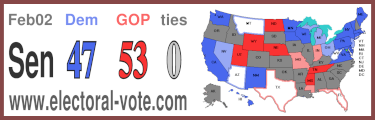
New Senate: DEM 49 GOP 51
New polls:
Dem pickups: (None)
GOP pickups: (None)
Previous | Next
Trump Tweets, Part I: Government Shutdown
After 18 months of President Donald Trump, it is hard to decide how much attention to give to his Twitter behavior. On one hand, it's a lot of the same stuff, over and over, and giving it attention...well, gives it attention. On the other hand, he is the president, it is the primary way he communicates with the American people, and there are clearly some days that are far outside the norm (even for him). Sunday was one of those days, as Trump unleashed a flurry of angry tweets that make clear he's feeling the pressure of Russiagate, Michael Cohen, the midterms, and the like.
Of Sunday's 11 tweets, this is the one getting the most attention:
I would be willing to “shut down” government if the Democrats do not give us the votes for Border Security, which includes the Wall! Must get rid of Lottery, Catch & Release etc. and finally go to system of Immigration based on MERIT! We need great people coming into our Country!
— Donald J. Trump (@realDonaldTrump) July 29, 2018
This represents yet another change of course for Trump. In past months, he has vaguely threatened to shut the government down unless he gets his wall, etc. Then, last week, he said he would not shut the government down prior to the midterms. Now, he's apparently back to favoring a shutdown.
With any other president, it would be safe to assume that some polling had been done to see how voters would respond to their proposition. With Trump, there is no polling, he's just shooting from the hip, as usual. Speaker Paul Ryan (R-WI) and Senate Majority Leader Mitch McConnell (R-KY) have already warned Trump that a shutdown would be disastrous for him and for the party, and that he should not even consider that course of action. Of course, they told him that on Friday, and he made his threat on Sunday, so he does not seem to care about their advice. After all, he's not on the ballot in November. That said, Trump has consistently shown that he's got lots of bark and very little bite. Besides the Chinese tariffs (which largely haven't kicked in yet, and so may prove another false alarm), he has backed down on every other threat like this that he's made as president. That means that this is presumably another tale "Told by an idiot, full of sound and fury. Signifying nothing" (with apologies to W. Shakespeare). (Z)
Trump Tweets, Part II: Robert Mueller
These days, Donald Trump rarely unleashes a full-blown Twitter tantrum without at least a few shots at Robert Mueller and his "witch hunt," generally including the same basic smears, falsehoods, and exaggerations designed to whip the base into a frenzy. So it was on Sunday, where Trump's outburst included several tweets like this one:
There is No Collusion! The Robert Mueller Rigged Witch Hunt, headed now by 17 (increased from 13, including an Obama White House lawyer) Angry Democrats, was started by a fraudulent Dossier, paid for by Crooked Hillary and the DNC. Therefore, the Witch Hunt is an illegal Scam!
— Donald J. Trump (@realDonaldTrump) July 29, 2018
After all, as scholars like Robert Jay Lifton have noted, the key to turning any falsehood into "the truth" is repetition.
With that said, Trump the reality TV star also instinctively knows he needs to keep it interesting so the audience doesn't tune out. Consequently, he did include something new in one of Sunday's anti-Mueller tweets:
Is Robert Mueller ever going to release his conflicts of interest with respect to President Trump, including the fact that we had a very nasty & contentious business relationship, I turned him down to head the FBI (one day before appointment as S.C.) & Comey is his close friend..
— Donald J. Trump (@realDonaldTrump) July 29, 2018
Trump has consistently claimed that Mueller is biased against him, but this is the first time he's laid out anything specific on that front.
The President is limited to 280 characters, and we are not, so let's explain each of his specific charges in more detail:
- Nasty and Contentious Business
Relationship: This is the most egregious part of the tweet. What
Trump is referring to here is that Mueller was a member of Trump's golf
club in Virginia 10 years ago, he felt he was overcharged, he argued
with the management, and he quit his membership. Technically a business
relationship, yes, but barely. And "nasty and contentious" is really
stretching things.
- Turned Down for FBI Head: It's true that
James Comey was fired as FBI director on May 9 of last year, that Robert
Mueller was interviewed by Trump for a second term as director sometime
soon thereafter, and that he was hired as special counsel on May 17. As
to everything else Trump alleges, only two people know the truth, but
there is a lot of gray area here. For example, it's unlikely that
Mueller wanted another 10 years as director after the 12 he had already
served, so the interview was likely for an interim appointment. It's
also unclear who was not too interested once the interview was over,
Mueller or Trump. What's improbable, however, is that Mueller was
rejected as FBI director and then hired as special counsel in the span
of 24 hours.
- Comey Is His Close Friend: Entirely
true.
- Jared Kushner's Law Firm: This didn't actually make it into Sunday's tweet, but Trump is also reportedly zoomed in on the fact that Mueller used to work for a law firm that represents Jared Kushner. This is true, though it's a little unclear how that would bias Mueller against Trump.
At a glance, Trump appears to be making a pretty good case, particularly if one does not look too carefully at the specifics of the claims. However, there are two big weaknesses in the President's argument. The first is that only a small number of people are qualified to do the job that Mueller is doing. The number of people like that who have zero connections to Trump, his businesses, and his administration, and zero connection to Trump's adversaries or any Democrat, and zero connection to the nation's major law firms is, well, zero.
The second, and more important, weakness is this: Trump has never made a case as to why Mueller's alleged biases would ever be relevant. The special prosecutor is collecting evidence, not passing judgment. And eventually that evidence will be made available to Congress, the general public, and the federal judiciary. One or more of the entities on that list will decide for themselves whether the evidence supports whatever conclusions Mueller might reach. Whether Mueller's analysis passes muster, or it doesn't, his own biases will be entirely beside the point. And it's worth noting that several federal judges have already decided that what the Special Counsel has produced thus far does indeed pass muster. (Z)
Trump Tweets, Part III: The Press
Just as a Trump Twitter tantrum almost always includes at least a couple of shots at Robert Mueller, so too do they almost always include at least a couple of shots at the media. That was particularly likely after a week when Trump made headlines for his anti-press activities. And so, his Sunday outburst included four tweets on the subject. Mostly it was his standard stuff, but there was also this:
When the media - driven insane by their Trump Derangement Syndrome - reveals internal deliberations of our government, it truly puts the lives of many, not just journalists, at risk! Very unpatriotic! Freedom of the press also comes with a responsibility to report the news...
— Donald J. Trump (@realDonaldTrump) July 29, 2018
In yesterday's post, we pointed out that most presidents who clamped down on the press did so to protect American soldiers in war zones, and not to protect their own self-image and their own delicate sensibilities. Perhaps someone made this same point to Trump. The problem is that it is very hard to imagine exactly what lives have been put at risk by reporters in the last 18 months, especially by revealing the "internal deliberations of our government". Perhaps Trump can provide specifics. And perhaps Sus scrofa domesticus will soon gain the power of flight.
There was another tweet on this front that also got a lot of attention:
Had a very good and interesting meeting at the White House with A.G. Sulzberger, Publisher of the New York Times. Spent much time talking about the vast amounts of Fake News being put out by the media & how that Fake News has morphed into phrase, “Enemy of the People.” Sad!
— Donald J. Trump (@realDonaldTrump) July 29, 2018
This meeting really did happen. However, the narrative that Trump proposes here—that he and Sulzberger were in agreement about how much "fake news" there is and how the press is an "enemy of the people"—is really beyond belief. After all, the NYT is Trump's second-favorite "fake news" target, behind only the Washington Post.
It took just minutes, in fact, for Sulzberger to issue a statement in which he said that Trump is lying through his teeth. According to the Times' publisher, the real purpose of their meeting was for him to warn the President that, "his [anti-press] language was not just divisive but increasingly dangerous." Sulzberger also said that, "I told him that although the phrase 'fake news' is untrue and harmful, I am far more concerned about his labeling journalists 'the enemy of the people.' I warned that this inflammatory language is contributing to a rise in threats against journalists and will lead to violence." So, the two men are giving accounts of their conversation that are polar opposites of each other. Readers will have to decide for themselves which person is telling the truth. (Z)
States Struggling with Election Security
Donald Trump has promised that the 2018 and 2020 elections will be properly secured, and he even held a meeting on Friday to discuss the matter with his underlings. Like all meetings, nothing much got done at this one, as the President said nothing about what was discussed, and has announced no strategy for delivering on his promises. Which means that election security has something in common with the Mexican wall, the infrastructure overhall, the "terrific" Obamacare replacement, and the rejuvenation of "beautiful, clean coal," among others.
The truth, of course, is that American election security is nothing less than a fiasco. Politico just published a survey of the matter, and their findings were...disheartening. To start, none of the 42 state governments that responded to the Politico's queries will be able to have new equipment in place for 2018. So, the midterm elections will be just as unsecure as the 2016 presidential elections were. Meanwhile, only 14 states and Washington, D.C. will use federal funds to upgrade their equipment by 2020, while another 7 will use state funds to do so. This means that as many as 29 states are likely to be as vulnerable in 2020 as they were in 2016. That includes several key swing states, like Ohio, Michigan, Wisconsin, and Arizona.
There are two basic problems that are slowing progress on this front. The smaller one is that some state officials don't want to be told what to do by the muckety-mucks in Washington. That can be overcome, though—free money from the federal government has a way of doing that. The bigger problem is that the budget provided by Congress (which was recently slashed) is simply not up to the task. That is to say, $380 million seems like a lot of money, but once it's divided up, it's actually not so much. There are, roughly speaking, about 120,000 polling places during a major election, and they require an average of three machines to record votes. Those machines cost about $3,000 each. The money Congress has coughed up equals about $3,150 per polling place. That's barely enough for one new machine, much less three of them, along with testing, and training, and backups in case a machine breaks, and so forth. If Congress wants to get serious, they need to be thinking in the $1-$2 billion range, not the $400 million range. Until that kind of appropriation happens, Donald Trump's promises aren't worth the pixels they're written on. (Z)
Johnson May Mount Senate Bid
One of New Mexico's Senate seats, the one held by Democrat Martin Heinrich, is up this year. At the moment, polls have Heinrich ahead of his Republican opponent Mark Rich by about 10 points (50% to 40%), with about 5% of respondents supporting Libertarian Aubrey Dunn and another 5% undecided. However, for unspecified reasons, Dunn may have to drop out. If so, former New Mexico governor and two-time Libertarian presidential candidate Gary Johnson might take Dunn's place on the ballot. But only, explained adviser Ron Nielson, if Johnson thinks he has a chance at victory. "He doesn't want to get into a race he can't win," Nielson said.
We've got news for the former governor: He's not going to win. Heinrich and Rich could be caught in bed together, along with a dead girl, a live boy, and a goat, and Johnson still wouldn't win. However, it's at least plausible he could play spoiler. Normally, libertarians steal more votes from Republicans than from Democrats. But Johnson's signature issue these days is pot legalization, which could plausibly attract some young voters, and thus could hurt Heinrich more than Rich. Not enough to kill a 10-point lead, but if the race tightens up, then maybe. So, Johnson is worth keeping half an eye on. (Z)
Ginsburg: Five More Years
Associate Justice of the Supreme Court Ruth Bader Ginsburg had a Q&A in New York this weekend, following the debut of "The Originalist," a play about her friend (and the yin to her ideological yang) Antonin Scalia. And she was asked the question that everyone has been wondering about: How much longer does she plan to serve? "I'm now 85," she said. "My senior colleague, Justice John Paul Stevens, he stepped down when he was 90, so I think I have about at least five more years."
That the Notorious RBG plans to hang on through Donald Trump's first term is news of the "dog bites man" sort—everyone already knew that. However, there are two things of interest here. First, she would presumably not be so ambitious if she had reason to believe her health—she's had cancer twice—would not hold up. She can't know for sure, of course, but this certainly seems to be a declaration that she's currently in good condition. The second thing she as communicating, as directly as she can without being gauche, is that it is unlikely she will manage to stay on the Court beyond 2024 (aka, almost 7 more years). In other words: "Attn: Democrats. Whoever is elected in 2020 is going to pick my replacement. I suggest you get to the polls." By then, Brett Kavanaugh, if he is confirmed, should have a couple of hundred decisions under his belt, so the direction of SCOTUS could well be a big issue in 2020 (and a potential winner for the blue team). (Z)
Avenatti Says Trump Should Take an Intelligence Test
When it comes to keeping his name in the headlines, Donald Trump may have found his match in Michael Avenatti, lawyer to Stormy Daniels (nee Stephanie Clifford). Avenatti's latest:
Why shouldn’t all presidential candidates have to take the Wonderlic or a similar test and have the results published? This should be required in 2020 for all (inc Mr. Trump). We deserve to know the intelligence level of the person who wants to be our president (a big factor)!
— Michael Avenatti (@MichaelAvenatti) July 28, 2018
Avenatti knows that Trump values his own (likely self-measured) high IQ greatly, and that he often demeans his opponents' low IQs.
It's not likely Trump will take the bait, but it's not impossible, since he would love to brag about his score on Twitter. If the President does think about it, he would be wise to think twice. It's very possible he has a high Emotional Intelligence, but it's not too likely he'd do well on a proper IQ test (which, incidentally, the Wonderlic is not). First, Trump does not generally convey an impression of high intelligence in his spoken and written expression, abstract reasoning, cultural literacy, etc. He used to, back in the 1980s, but not so much anymore. Second, IQ tests focus on many domains of intelligence, and the high scores go to those who do well in most or all of them. Even if we grant that Trump is very bright in some domains of intelligence (say, visual-spatial or interpersonal), it is improbable that he is strong in a wide variety of them.
All of this points to a respectable, but not stellar, result—something like 115. And if that was indeed his score, then every headline would be about how the "stable genius" isn't so much of a genius (which starts around an IQ of 140). And that would be "Sad!" (Z)
Back to the main page