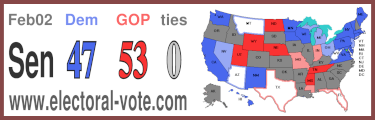
New Senate: DEM 49 GOP 51
New polls:
Dem pickups: (None)
GOP pickups: (None)
Previous | Next
Trump Wages War Against the Fourth Estate
It's no secret that Donald Trump does not like most of the media (Fox News, Breitbart, and InfoWars excepted). In the 18 months since becoming president, for example, he's sent 61 different tweets that included the phrase "fake news." Recently, however, the White House has dramatically increased its anti-press activities.
The most recent high-profile incident involves CNN correspondent Kaitlan Collins, who peppered Trump with a few questions that were tougher than he prefers, and then found herself banned from an open-media event in the Rose Garden later in the day. The move was so clearly beyond the pale that nearly all media organizations, including the President's beloved Fox News, insisted that Collins' access be restored. But despite this one high-profile victory for freedom of the press, the Trump administration has waged a fairly successful campaign against media that it deems to be unfriendly, from denying the credentials needed to cover the President's rallies, to holding infrequent press conferences, to limiting what the press can record, to making Trump available only to favored media outlets.
The administration's position, of course, is that all of this is...wait for it...fake news. "President Trump is the most accessible president in modern history," said White House Press Secretary Sarah Huckabee Sanders. "He has done almost three times as many question-and-answer sessions with reporters as his predecessor, and we continue to provide access to the press in a number of venues and formats every day." This is a laughable statement on a number of levels, particularly from an administration that is down to holding one White House press conference about every 10 days.
Even Trump's defenders in the media (read: Fox News) can't parrot Sanders' line with a straight face, so they have instead turned to Whataboutism, arguing that the President's actions are no worse than those of his predecessors. This is an inherently weak argument under the best of circumstances, since it is tantamount to arguing that two wrongs somehow make a right. Beyond that, however, it doesn't particularly stand up to scrutiny. There are four of Trump's predecessors that tend to be deployed in service of this argument; let's take a look at how well the parallel works:
- Abraham Lincoln: It is true that Lincoln
took more aggressive steps against the press than Trump has, up to and
including putting many dozens of newspaper editors in jail. However, one
should be very wary of drawing comparisons between the present and
events that took place 150 years ago. First of all, the press was in the
midst of an evolution back then, from opinion-based partisan organs to
news-based outlets. Journalistic ethics had not particularly developed
as yet, which meant that reporters were wont to do things like invent
stories out of whole cloth, or to print things that actively undermined
the war effort and that put lives at risk. So, there were some pretty
big differences between then and now. Further, Lincoln's actions were
backed by Congress (albeit sometimes after the fact). And, most
importantly, Lincoln did not target outlets that were personally hostile
to him. He was thick-skinned enough that he could take it. He targeted
outlets that he felt were actively undermining the Union war effort.
- Franklin D. Roosevelt: Like the Lincoln
administration, Roosevelt held office during a time of war. Instead of
jailing newspapermen, however, the Roosevelt administration chose to
exert strict control over the information that was transmitted from the
war front, with hundreds of military censors reviewing news reports and
photographs. Like Lincoln, Roosevelt did not censor those journalists
who offended him personally, but those who risked the lives of
Allied soldiers. And, like Lincoln, Roosevelt had the backing of
Congress. It is true that FDR had a few personal enmities with members
of the press corps, most obviously John O'Donnell of the New York
Daily News. However, Roosevelt did not try to take away O'Donnell's
credential or to otherwise silence him. Instead, he arranged for
O'Donnell to be awarded the
Iron Cross
as a form of wry protest.
- John F. Kennedy: Yet another wartime
president. Vietnam did not really heat up until about 10 months after
JFK's assassination, but American involvement in the Asian nation dated
back to the Eisenhower years. Kennedy was particularly incensed by the
New York Times' David Halberstam, and his reporting of the
budding conflict, and so tried (unsuccessfully) to get the reporter recalled.
As with Lincoln and FDR, it wasn't personal, it was
national security. And in defense of JFK, it later turned out that one
of Halberstam's main sources, Phạm Xuân Ẩn, was an
undercover North Vietnamese spy.
- Barack Obama: There is, of course, no offense that Trump can commit that his defenders won't accuse Obama of even worse. Obama did follow a path somewhat similar to Trump's, in that his administration openly challenged the coverage of an unfriendly outlet (Fox News). There was also a rumor that the Obama administration planned to ban Fox News from interviewing Treasury Dept. official Kenneth Feinberg. However, the rumor came from...Fox News, and has not been independently substantiated. In any case, the press corps rallied in response to the alleged plan, and it never came to fruition (if it ever existed in the first place).
In short, Trump and Obama can be compared in the same way that a .38 caliber bullet and a MOAB bomb can be compared. They are in the same ballpark, but the Trump administration has taken things to extremes that go well beyond anything Obama's administration ever did. Obama never tweeted about the press, did not make a habit of constant public insults against them, and—at most—took steps to limit the access of one outlet on one (trivial) occasion. Meanwhile, Trump is not a wartime president, and is concerned solely about attacks upon himself and his policies, not the security of the United States. So, the comparisons to Lincoln, FDR, and JFK don't hold water at all. (Z)
Judge Says Lawsuit Over Citizenship Question on Census Can Go Forward
The Trump administration would like to add a question to the 2020 census asking whether the respondent is a citizen or not. This would be the first time that question was asked since the census of 1960. Team Trump claims that this will better allow them to enforce the Voting Rights Act of 1965, a justification that makes no sense (and that is rooted in a piece of legislation to which the administration is openly hostile). Opponents of the plan, led by the ACLU, say that the real reason for the question is to cause undocumented immigrants, fearful of deportation, to avoid responding to the census at all. This would potentially have the effect of reducing the amount of federal dollars and Congressional representation for states with large numbers of undocumented immigrants (particularly California).
This week, federal judge Jesse Furman rejected the administration's request to dismiss the ACLU's lawsuit. His ruling said that while the federal government certainly has the right to determine the questions asked on the census, discriminatory intent is not acceptable, and that he thinks it is "plausible" that the administration specifically added the question so as to hurt undocumented immigrants (and the states in which they live). Not only will the case proceed, then, but so too will discovery, which could lead to some serious discomfort for members of the administration.
The person for whom the ruling was particularly bad news is not Donald Trump, but Secretary of Commerce Wilbur Ross. The census is conducted under the auspices of his department, and he has insisted repeatedly, including during sworn testimony he gave before Congress, that the citizenship question was prompted by a request from the Justice Department. It has already become clear, however, that Ross is lying. The truth is that he came up with the idea, then asked Justice to "suggest" it, and then claimed that it was the work of AG Jeff Sessions all along. The discovery process has already uncovered an e-mail from Ross, for example, that is dated May 2, 2017, and reads, "I am mystified why nothing have [sic] been done in response to my months old request that we include the citizenship question. Why not?" Since Ross was only confirmed on February 28, 2017, it means that the citizenship question was very nearly the first item on his agenda (and clearly did not come from Justice). It is not clear whether Trump administration members either don't know or don't care that lying to Congress is perjury, but this is the second time Ross has been caught red-handed, having already misled the House about having divested his holdings. If anyone in Washington decides to start enforcing the laws, the Secretary could be in big trouble. (Z)
The Problems with Trump's Collusion Story
Speaking of, well, lying, the Washington Post's Paul Waldman has written a very nice overview of the soft spots in the Trump narrative about collusion, and the infamous meeting in Trump Tower. In short, to buy what Trump is selling, you would have to believe that:
- Don Jr., who desperately craves Don Sr.'s approval, wouldn't have
told his father about the Trump Tower meeting.
- Neither Paul Manafort nor Jared Kushner would have bothered to tell
Trump about the meeting, either, despite the fact that it was important
enough to attract three of the campaign's highest-ranking officials.
- It's mere coincidence that between the e-mail to Don Jr. and the
Trump Tower meeting, Trump bragged about damaging information he was about to
reveal about Hillary, a promise that disappeared into the ether.
- The Trump team released a false statement to the public about the
Trump Tower meeting even though they hadn't done anything wrong.
- President Trump lied to the
public about crafting the false statement for no particular reason.
- Working with representatives of the Russian government to get dirt on your opponent is perfectly fine.
It's really worth reading the whole piece. In any event, when it's put this way, it is very hard to see how Trump will ultimately avoid getting exposed by Special Counsel Robert Mueller. (Z)
Who's Going to Win the Midterms? Television Broadcasters
This year's midterm elections are surely going to be the most expensive midterms ever. Already, over $1 billion has been spent on television advertising. That includes $400 million on Senate contests, $281 milllion on House contests, and $340 million on gubernatorial contests. Not all of the ads that have been paid for have actually aired, but something like 3/4 of them have. And most of the ads, of course, were for primary contests. Once the general election is underway, there will be another massive outlay of cash.
Thus far, considering all expenses, campaigns for federal office have already blown through $1.6 billion. When the various gubernatorial and statewide races are included, the total figure approaches $2.5 billion. That should double, give or take, to something approaching $5 billion by the time we reach November 6. That figure is far in excess of the past record-holder, the 2014 midterms, during which $3.8 billion was expended. Even adjusting for inflation, 2018 figures to break the record by $1 billion. (Z)
Some Bad News for the GOP, Part I: The Kochs
Given how much money the midterms are going to cost, the GOP is counting on the Koch brothers' network to pay a lot of the bills. Maybe they shouldn't. Although Team Koch plans to spend $400 million this cycle, they are quite unhappy with the administration and with Republicans in Congress. The Kochs are more than willing to support challengers to Republicans who displease them (and have already done so a dozen times this cycle). It's also possible that they might hold back some of the money they budgeted, another move they have made in the past (most recently 2016).
The complaints that the Kochs and their friends have, which were aired at their biennial confab this weekend, are largely predictable. They hate the tariffs, they hate the growing deficit, and they are not happy that the dreamers continue to twist in the wind. A new complaint, however, is that they don't approve of the "us vs. them" approach of the Trump administration. "The divisiveness of this White House is causing long-term damage," said Brian Hooks, president of The Charles Koch Foundation. "When in order to win on an issue, someone else has to lose, it makes it very difficult to unite and solve the problems of this country."
It's hard to see how any of these things are going to change, particularly at 1600 Pennsylvania Avenue. Trump is clearly committed to his tariffs (at least, the ones imposed on countries where the citizens are not white). The tax bill, which is the biggest outlay of cash Congress has made, is the GOP's only major legislative accomplishment since they took the reins of the whole government 18 months ago. And finally, anti-immigrant sentiment and divisiveness are Trump's stock in trade. So, either the Koch network is going to look for silver linings, or they're going to withdraw their money. They certainly aren't going to get the president they wish they could have. Which, ironically, is pretty much Barack Obama (minus Obamacare). (Z)
Some Bad News for the GOP, Part II: The Polls
NBC/Marist just conducted polls of Michigan, Minnesota, and Wisconsin and they are full of unhappy news for the Republican Party. Some of the highlights (or lowlights, depending on your perspective):
- On the generic Democrat vs. Republican congressional ballot,
Democrats are leading 49% to 36% in Michigan, 48% to 36% in Minnesota,
and 47% to 39% in Wisconsin.
- In terms of enthusiasm, 82% of Michigan Democrats, 80% of Minnesota
DFLs, and 78% of Wisconsin Democrats think the midterms are "very
important." That compares to 66%, 64%, and 76% of Republicans in the
three states, respectively.
- As to the Senate, Debbie Stabenow (D-MI) leads her potential GOP
opponents, John James and Sandy Pensler, by 18 points and 15 points,
respectively. Senator Tina Smith (DFL-MN) leads Republican Karin Housley
by 14 points (49%/35%). And Senator Tammy Baldwin (D-WI) is up 15 points
on likely Republican challenger Kevin Nicholson (54%/39%).
- For the governor's mansions, probable Democratic nominee Gretchen
Whitmer leads probable Republican nominee Bill Schuette in Michigan by 9 points.
In Minnesota, Gov. Tim Pawlenty (R) is likely to be renominated, and
then will enter the general election as an 8-10 point underdog against
whichever of the three DFL candidates emerge from the primary. In
Wisconsin, Gov. Scott Walker (R) trails his likely general election
opponent, Tony Evers, by 13 points.
- In Michigan, Donald Trump's approval is underwater by 18 points (35%
approve/53% disapprove); in Minnesota it's underwater by 14 (36%/50%),
and in Wisconsin it's also underwater by 18 (35%/53%).
- Also on the Trump front, 52% of Michiganders think Robert Mueller's investigation is fair, while only 30% think it's a witch hunt. In Minnesota, it's 56%/31%, and in Wisconsin it's 58%/28%.
In terms of 2018, then, the only happy news for the GOP is that their enthusiasm gap in Wisconsin is within the margin of error. Beyond that, however, they appear to be headed for three Senate defeats, three gubernatorial defeats (flipping two governor's mansions), and an overall bad night on November 6. Meanwhile, in 2020, Trump looks like he is going to have a tough hill to climb in the two of these states that he won; Michigan by just 10,704 votes, and Wisconsin by just 22,748 votes, respectively. (Z)
Trump Campaign Denies their Flags Are Made in China
Given Donald Trump's disdain for trade imbalances, not to mention his alleged patriotism, it would be somewhat hypocritical for him to do substantial business with the Chinese. It would be even more hypocritical for his campaign to do so. And yet, that is exactly what is happening. In particular, Chinese factories are cranking out tens of thousands of "Trump 2020 Keep America Great" flags right now in order to get them into the United States before the tariffs hit.
The Trump Campaign, of course, says the flags are not being made in China, but this is not true. Beyond the fact that Trump has a long history of using Chinese manufacturers, it is also the case that both suppliers in China and importers in the United States confirm what is going on. The more charitable explanation is that supply chains are complex things, and maybe Team Trump isn't clear where the flags are being made. The less charitable, and more likely, explanation is that they are lying, particularly since they don't have too many good options besides lying. We shall see if anything changes, especially once the tariffs take effect (Hint: probably not). (Z)
Back to the main page