Pres polls: (None)
Dem pickups: (None)
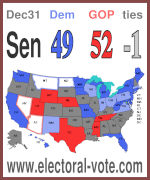
GOP pickups: FL IA MI OH PA WI
Previous | Next
The Senate Is Completely Broken
In the past, the Senate was a congenial place where senators of opposing parties could go out and have a drink together in the evening. It is no longer like that. It is more like open warfare. To start with, the approval of President Donald Trump's cabinet is going very slowly—slower that it has ever gone in modern times. Furthermore, the number of "no" votes is higher than ever. Minority Leader Chuck Schumer (D-NY) even voted against Elaine Chao for secretary of transportation even though she is completely qualified, having served as deputy secretary under George H. W. Bush. Schumer voted "no" simply to irritate Majority Leader Mitch McConnell (R-KY), who is married to Chao. When Democrats boycotted a Senate committee hearing to deprive Republicans of a quorum, Republicans changed the quorum rules so they could vote without any Democrats.
Although it has gotten really nasty, the worst is yet to come. Government funding runs out on April 28 and Democrats could filibuster bills needed to keep the government open. In the summer, the debt ceiling will be reached and McConnell will need Democratic votes to raise it. Another area where Democrats have leverage is the annual appropriation bills. Nevertheless, some senators are optimistic about the future. Sen. Tom Carper (D-DE) said: "This is a country that survived a civil war followed by the assassination of our president followed by the impeachment of the next president. We got through that, so the Senate will get through this." (V)
Republicans Denounce Trump for Defending Putin
Most Republicans don't like Russia at all and like Vladimir Putin even less. When Fox News' Bill O'Reilly interviewed Donald Trump for broadcast at the Super Bowl and pointed out that his friend Putin is a killer, Trump brushed it off, suggesting America was just as bad. That didn't sit well with Republican leaders in Congress. Mitch McConnell called Putin a "thug" on CNN yesterday. Sen. Marco Rubio (R-FL) said: "When has a Democratic political activists [sic] been poisoned by the GOP or vice versa?" Rubio was probably referring Putin's poisoning of Alexander Litvinenko and others. Sen. Ben Sasse (R-NE) said: "There is no moral equivalency between the United States of America, the greatest freedom loving nation in the history of the world, and the murderous thugs that are in Putin's defense of his cronyism." Trump likes to shake things up, but he keeps forgetting that he is going to need the votes of Senate Republicans down the road, and antagonizing them might not be a great strategy. (V)
McConnell: Congress Won't Get Involved with Trump Travel Ban
Mitch McConnell was on CNN's "State of the Union" on Sunday, and—inevitably—was asked about the Muslim travel ban. Specifically, whether Congress will pass a law if an executive order is found to be insufficient. His response, which was undoubtedly pre-scripted, was: "I don't know that that's necessary. I mean, the courts are going to decide whether the executive order the President issued is valid or not, and we all follow court orders."
Now, let's translate that into English: "We Republicans in Congress don't want to seem pro-Muslim, but we don't want to seem heartless, nor do we wish to violate the Constitution. Further, we are very angry that Trump did this without bringing us into the loop. So, he's on his own." In the end, Trump may or may not get the ruling he wants. But what he's definitely getting is a lesson in civics, with a particular emphasis on the division of power between the branches of government. (Z)
Tech Companies Attack Travel Ban
Although the Senate may not get involved in the travel ban, the big tech companies of Silicon Valley are not at all hesitant to jump into the fray. Yesterday, 97 big tech companies, including Apple, Facebook, Google, Microsoft, Uber, Dropbox, Pinterest, and Reddit filed a legal brief opposing the ban. The amicus brief was filed with the U.S. Court of Appeals for the 9th Circuit. That court is expected to rule on the ban within a week. The brief said that immigrants from all over the world help the companies recruit, hire, and retain some of the best people in the world.
It went on to note that immigrants or their children went on to found Apple, Kraft, Ford, GE, AT&T, Google, McDonald's, Boeing, and Disney. It also notes that many Nobel Prize winners have been immigrants. It is estimated that 37% of the workforce in Silicon Valley consists of immigrants.
Traditionally, Silicon Valley companies have not been politically active in the way, say, telecom companies or manufacturers have been. The Muslim ban may wake them up and get them involved, and not in a good way for the Trump administration. (V)
Trump Looms Large Over Super Bowl
We have made this point many times: Donald Trump inspires such emotion, both positive and negative, that politics is going to spill over to virtually every area of American life, over and over, for the next four years. That was clear yet again on Sunday, when the New England Patriots and Atlanta Falcons met for Super Bowl LI.
Technically, the presence of Trump was felt well before the game, given that he was interviewed on the same Fox airwaves that would carry the football broadcast later in the day. As the actual contest was getting underway, viewers were reminded that Vice President Mike Pence was in attendance, a guest of NFL owner Bob McNair. Pence was thus present to hear several female members of the cast of "Hamilton" (aka his nemeses) sing "America the Beautiful," with the lyric "crown thy good with brotherhood" changed to "crown thy good with sisterhood." The cameras did not capture the Veep's response to that particular flourish.
The game got underway shortly thereafter. And while Pence and the others in attendance did not see the commercials, the 100 million or so people watching at home certainly did, and so surely noted the distinctly anti-Trump undertones to many of them. There was, for example, the very first commercial, for Google, which began with a gay pride flag, and then proceeded to celebrate America's cultural diversity, squeezing in Americans of many different ethnicities (including some of obviously Middle Eastern extraction). Then, there was the Audi commercial that promoted equal wages for equal work, regardless of gender. That one was viewed online nearly 5 million times before the Super Bowl even began. There was also a Coke ad showing Americans of different races singing "America the Beautiful" in their native tongues. And then there was the AirBnB spot, which showed people of various stripes, while announcing that "the world is more beautiful the more you accept." Capping it off was an ad for Budweiser telling the story of founder Adolphus Busch, and how wrong it was that he faced hatred just because he was an immigrant. That one was unsubtle enough that it led to calls from many Trump supporters to boycott Budweiser. An even more controversial ad from privately held company 84 Lumber, was rejected by Fox. It depicts a Mexican mother and daughter traveling through Mexico and finally encountering the wall. But in the end, there is a big beautiful door they can enter through.
The halftime show was also carefully calculated. It featured Lady Gaga, who sang a medley of patriotic songs while backlit by a red, white, and blue light display (provided by drones). Thereafter she leapt down to the stage, danced with a noticeably diverse cast of dancers, and launched into several of her hits, most notably the LGBT anthem "Born This Way." The message: Straight, white, conservative men don't have a monopoly on patriotism.
Even the game on the field had political overtones. It was widely understood that Donald Trump was rooting for the Patriots, who are quarterbacked by a friend and supporter in Tom Brady, and coached by another friend and supporter in Bill Belichick. When the Atlanta Falcons opened up a seemingly insurmountable 21-0 lead, there was much schaudenfreude on the part of the nation's football-watching Democrats. After all, no team in Super Bowl history had managed to overcome as much as a 14-point deficit. But then, the Falcons starting playing not to lose, as opposed to playing to win. They made all manner of questionable tactical decisions, managed to blow their entire lead, and then were put away in overtime. The Falcons-Hillary Clinton parallels were obvious, inasmuch as both managed to convert a seemingly certain victory into a narrow defeat, and Twitter was full of bitterly ironic jokes, like "At least the Falcons won the popular vote" and "Russia has hacked the #SuperBowl."
So, there you have it. All Trump, all the time, for the next four years. Get used to it. (Z)
Republicans Are Already Undoing Obama's Legacy in Four Areas
The ban on people from seven Muslim-majority countries has so dominated the media that important actual policy shifts have gone almost unnoticed. Here is a brief rundown of these issues:
- Financial advice: The Obama administration announced the "fiduciary rule" last April and it was supposed to go into
effect soon. The Trump administration is starting the process to kill it. What the rule would have done is make it a legal requirement for banks, stock
brokers, and other financial service companies to put their clients' interest first, as opposed to their own profits. Opponents of the rule say
that people should be in charge of their own money and decide for themselves if they believe the advice they are being given.
- Gun control: An Obama-era rule is that if someone is so mentally incompetent as to require another person to manage his or
her Social Security, that person's name would be forwarded to the FBI so that the person can't just go out and buy a gun with no questions asked.
Republicans oppose the rule, saying it discriminates against some people who receive Social Security benefits.
- Environment: The Obama EPA created a regulation forbidding coal companies from dumping their toxic waste in rivers and
waterways. The House voted 228-194 to get rid of the rule and the Senate voted 54-45 to nix it. The Republicans' argument is that it would put
at least one-third of all coal miners out of work.
- Unions: Last week, House Republicans introduced national "right to work" legislation. If passed, workers at unionized plants would not have to join the union and pay dues, even as they reap the benefits of union contracts. Democrats and unions are wildly against the law and see it as a direct attack on unions and workers.
Trump has been in office only two weeks, and already significant pieces of Obama's legacy are being dismantled, mostly under the radar. Within a year, not much of it may be left. (V)
Bad News, Good News for Obamacare
The biggest piece of Barack Obama's legacy, of course, is his health care legislation. And this weekend brought some significant developments on that front. First, the bad news, at least from Obama's perspective. It looks like enrollments will be down compared to last year, by about 500,000 people. This means that insurers will be covering a smaller, sicker group of people, which could cause another rate hike in 2018, or another wave of companies dropping out of the program. All of this will fuel the GOP's argument that the program is collapsing.
Now the good news, again from Obama's perspective. On Sunday, during his interview with Bill O'Reilly, Donald Trump acknowledged that a replacement plan may not be rolled out until 2018. This tacitly acknowledges that Trump never had a "terrific" plan that he was just waiting reveal, and also that he was fibbing when he said he'd have a plan ready by the time HHS Secretary-designate Tom Price was approved. If Trump kicks the can down the road another year, that will mark roughly eight years that Republicans have been unable to come up with an Obamacare alternative. And in an election year, members of Congress are going to be particularly skittish about mucking about with people's insurance. So, Obamacare might not be on life support, after all. (Z)
Pence Will Lead the Vote-fraud Commission
In his remarks yesterday, Donald Trump said that he would put Vice President Mike Pence in charge of a commission to investigate the imaginary vote fraud that no state official believes happened. Trump has repeatedly said that there were millions of fraudulent votes last November, but has not produced any evidence of it. Numerous earlier investigations have shown that in-person voter fraud is virtually nonexistent. Mitch McConnell commented yesterday on the investigation, saying: "And I don;t think we ought to spend any federal money investigating that. I think the states can take a look at this issues." Pence is probably thinking: "I knew this job was not worth a bucket of warm piss when I took it, but this is such a waste of my time." (V)
Could Supreme Court Nominations Be Made Less Contentious?
Supreme Court nominations have been hugely bitter and partisan for years because the Supreme Court has become a mini-legislature, overruling Congress whenever it doesn't like the output of that body. It wasn't always this way. There is nothing in the Constitution giving the Supreme Court the power to throw out laws as unconstitutional and nothing in the writings of the founding fathers suggesting that power was implied. But one fine day in 1803, Chief Justice John Marshall decided to do that in Marbury v. Madison and it stuck.
Evidence that appointments have not always been contentious is that of Franklin Delano Roosevelt's nomination of James Byrnes, a Democratic senator from South Carolina who never even went to law school, although he learned law on his own and was admitted to the bar. Roosevelt nominated Byrnes on June 12, 1941, and the Senate confirmed him by a voice vote the same day. The Court was so unimportant in those days that Byrnes resigned after 15 months to take a minor job in Roosevelt's administration. It is hard to imagine Neil Gorsuch being confirmed by the Senate and then after 15 months resigning to run the National Labor Relations Board.
Is there any way to get back to the old days when Supreme Court nominations weren't so controversial, short of Congress' stripping the Supreme Court of the power to throw out laws it doesn't like? One way might be a constitutional amendment to limit the terms of the justices, perhaps like this:
- Section 1. Newly appointed justices to the Supreme Court shall serve a single term of 8 years.
- Section 2. Supreme Court nominees must be approved by at least 2/3 of the Senate.
- Section 3. Sitting Supreme Court justices who have served fewer than 8 years shall serve a maximum of 8 years.
- Section 4. Sitting Supreme Court justices who have already served at least 8 years at the time this amendment is ratified shall be replaced as follows: On February 1 of each odd-numbered year, the longest-serving justice shall step down.
By limiting the terms of the justices, Senate battles will be far less than those over nominees who might serve 40 years. By requiring a 2/3 majority for confirmation, nominations would become like tennis. On his first serve, the president would name a fire-breathing partisan to please his base. When said partisan got shot down on a straight party-line vote, the president would have to seriously consult with the minority party in the Senate to find a mutually acceptable candidate for his second shot. This would mean that future justices would be highly-respected centrists with no ideological axe to grind.
Phasing out the sitting justices by requiring an intervening Senate election before each forced retirement would probably be considered neutral by both parties since they wouldn't know in advance which one would control the Senate after the next Senate election. Also, it would prevent the president at the time of ratification from making multiple appointments.
Is this likely to happen? Probably not until a Republican president makes a nomination in February just after being inaugurated and a Democratic Senate refuses to hold hearings for 4 years as payback for the treatment of Merrick Garland. Then everyone would realize something has to change. (V)
SNL Skewers Spicer
"Saturday Night Live" has been on the air for nearly half a century. It is notoriously uneven, both within episodes, and from season to season. The show's strongest moments, however, come when the writers have good material to work with. And boy, do they have that these days.
This weekend, they took a break from hammering Donald Trump himself and turned their sights on White House Press Secretary Sean Spicer, played by actress Melissa McCarthy (with an appearance by Kate McKinnon as Secretary of Education-designate Betsy DeVos). It was, in short, devastating. "Spicer" apologized to himself on behalf of the White House Press Corps, and then promptly refused to accept the apology. He gobbled cinnamon gum, insisted that the Muslim ban isn't a ban to anyone but the press despite Trump himself calling it a ban, and declared that the administration's Holocaust Remembrance Day proclamation couldn't possibly have been anti-Semitic because it was written by someone who is "super Jewy." There was also consistent abuse of the reporters, including multiple verbal tirades, the use of a super soaker water gun, and repeated assaults with the press room podium. It's really worth watching in its entirety.
As SNL itself has demonstrated over years, as have the shows that it influenced, like "The Daily Show" and "The Colbert Report," this sort of lampooning absolutely has an effect on voters' minds. In fact, comedy can often penetrate in a way that the New York Times and CNN cannot. Which is why Donald Trump has worked so hard, without success, to get SNL to shut up. (Z)
Back to the main page