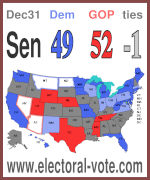
Pres polls: (None)
Dem pickups: (None)
GOP pickups: FL IA MI OH PA WI
Previous | Next
Trump Attacks "So-called" Judge
On Friday, federal judge James Robart granted a temporary restraining order blocking President Donald Trump's ban on travelers from seven majority-Muslim countries. Until there is a full hearing and decision (the DOJ has already filed its appeal; see below), federal employees are prohibited from stopping the entry into the U.S. of people from the banned countries. Within hours of Robart's decision, Trump lashed out at the judge, tweeting:
The opinion of this so-called judge, which essentially takes law-enforcement away from our country, is ridiculous and will be overturned!
— Donald J. Trump (@realDonaldTrump) February 4, 2017
While it is not unprecedented for Trump to insult a federal judge, it is certainly unpresidented and also unpresidential. During the campaign, Trump insulted Judge Gonzalo Curiel, calling the Indiana-born judge biased because he is of Mexican descent. Robart was born in Seattle, educated in Washington state, appointed to the federal bench in 2004 by George W. Bush, and confirmed by 99 senators.
Minority Leader Chuck Schumer (D-NY) responded to the tweet by saying that Trump shows nothing but disdain for an independent judiciary that doesn't always bend to his wishes. Consequently, one of the key topics on which Judge Neil Gorsuch will be grilled on during his Senate confirmation hearings for the Supreme Court will be his ability to be an independent check on the executive branch. (V)
Ninth Circuit Court Upholds Robart's Order
Just after midnight this morning, the U.S. Dept. of Justice filed an emergency appeal to the U.S. Court of Appeals for the Ninth Circuit in San Francisco. The appeal asked the court to stay Judge Robart's injunction that temporarily blocks the executive order banning people from seven majority-Muslim countries from entering the U.S. The court refused to grant an emergency stay. Instead it asked both sides of the case to file legal briefs for the court to study before making a definitive ruling.
The Dept. of Justice can follow the court's instructions or try to get the U.S. Supreme Court to issue a stay. The problem with the former approach is that the Ninth Circuit Court is extremely large, with 25 judges, 18 appointed by Democratic presidents and seven apppointed by Republican presidents, and four vacancies and quite liberal. The problem with the second approach is that the Supreme Court might refuse to take the case and even if it did, it could split 4-4 until the ninth seat is filled, which is likely to be weeks or months away. So for the time being, the Muslim ban will not be enforced.
Given that neither the Ninth Circuit Court nor the U.S. Supreme Court is likely to overturn Robart's ruling any time soon, Donald Trump has a problem on his hands: he can't have his way. Historically, he has not reacted well to being told "no" by anyone with power over him. As this case plays out, the results are completely unpredictable, ranging from the (unlikely) possibility of Robart's decision being overturned to it being made definitive, Trump's defying the courts, and the House impeaching him for that. (V)
Trump Using Obama as a Crutch
It's a commonplace phenomenon in American politics: New presidential administrations take credit for any early successes (regardless of how little they had to do with them) and blame failures on the previous administration. Barack Obama did it, George W. Bush did it before him, Bill Clinton before him, and so forth. Donald Trump, however, is taking the tendency to extremes.
In the former category, the most obvious example is the unemployment rate. During the campaign, monthly report after monthly report pegged the number at somewhere between 4.7% and 5%. Trump treated these figures with scorn. "Don't believe these phony numbers," Trump said. "The number is probably 28, 29, as high as 35. In fact, I even heard recently 42%." Now that he's in the White House, however, the numbers have suddenly become accurate. Press Secretary Sean Spicer bragged about the January jobs report, declaring that "Today's report reflects the consumer confidence that the Trump presidency has inspired." Similarly, Kellyanne Conway tweeted that, "jobs numbers already like POTUS."
In the latter category, most notable is the recent raid in Yemen. Approved personally by Trump, things did not go well. One Navy SEAL died and several others were injured. Immediately, Spicer claimed that the plan was concocted by the Obama administration and that Trump merely went along with it. That promptly caused several members of the Obama National Security Council to correct Spicer, noting that the plan was never presented to Obama, and that Trump was just trying to pass the buck.
For Obama (and for Bush, and Clinton, and so forth), this kind of behavior could only continue for so long. Is that true for Trump, though? His base tends to eat up any attack on Obama or Hillary Clinton, and also tends to accept uncritically any wild claims The Donald makes about himself and his accomplishments. It could well be that Trump can use these techniques for years without suffering any blowback from those who love him. Of course, that doesn't necessarily mean they will work on those who held their noses and voted for him. (Z)
Is Trump More Popular than the Polls Show?
The gold-standard for polling consists of live-interviewer polls done by respectable firms. In all of these polls since he took office, Donald Trump is deeply under water, with an approval rating rarely above 40%. However, in robopolls and Internet polls, Trump scores better. Internet polls from Reuters/Ipsos, Huffington Post/YouGov, and Politico/Morning Consult all show more support than opposition to Trump's executive orders. PPP, which runs automated phone polls, said support/opposition to the Muslim ban to be running at 49%/47%, whereas in live-interviewer polls it is 41%/49%.
During the campaign, the accuracy of the polls was called into question when Trump also did worse in polls where the respondent talked to a live human being than when the respondent pushed buttons on a telephone or typed on a computer keyboard or touch screen. The underlying idea is that some people support Trump but are unwilling to admit it to another person out of embarrassment. Unfortunately, there is no real way to tell which of the methods, if any, is the best. (V)
CNN to Conway: Thanks, but no Thanks
Vice President Mike Pence will appear on most of the morning news shows today, fielding questions about the Muslim ban and other developments this week. However, he was pointedly not available to appear on CNN's "State of the Union" with Jake Tapper. This follows right on the heels of reports that the Trump administration is boycotting CNN because the network is not fair, and does not help them promote their agenda.
In lieu of Pence, the White House offered to have spokeswoman Kellyanne Conway appear. CNN, either not interested in getting a second-tier staffer, or else weary of Conway's "alternate facts," declined. This, of course, will not improve the relationship between CNN and the Trump White House.
All of this is unprecedented. There have been presidents whose relationship with the media was less-than-cozy, but Trump is in his third week, and there's already a near-state of war between him and several media outlets. Neither side seems likely to back down and, indeed, neither side may be able to back down and still save face. Which would seem to suggest that the only possibility is that things are just going to get worse. (Z)
Congress Begins to Feel Left Out
In the first two weeks of his presidency, Donald Trump seems to be expanding the power of the executive branch and leaving the legislative branch out in the cold. The members of the latter are beginning to notice. In particular, when producing the executive order banning people from seven Muslim-majority countries, the leaders of Congress were not even informed of the plan, let alone asked for input. Rep. Elijah Cummings (D-MD) said: "Congress is beginning to wonder what is going on." Sen. Bill Nelson (D-FL) said: "Anytime you freeze out people like Gen. Kelly and Gen. Mattis, people who know how to fight ISIS, that's a bad thing."
Republicans aren't happy either. Sen. Bob Corker (R-TN) said of the ban that he was, "very surprised with the lack of clarity to how it impacted people." Speaker Paul Ryan (R-WI) said: "As you know, we weren't involved in this." These comments are fairly gentle for the moment, but if there is one thing that Democrats and Republicans in Congress agree on, it is that the executive branch encroaching on the powers of the legislative branch is not a good thing and that this should be, and will be, opposed. (V)
French Presidential Candidate Macron Welcomes Americans to France
Emmanuel Macron, who is running for president of France, gave a speech yesterday that seemed more aimed at Americans than French voters, in which he said:
In fact, I want to make a solemn call to all the researchers, academics, businesses who in the United States are battling obscurantism. I want everyone defending innovation, excellence in the United States to hear us and see us: You now have, and you will have from next May, a motherland—France.
He didn't name Donald Trump explicitly, but since "obscurantism" is opposition to the spread of knowledge, there was little doubt about his meaning: American researchers and entrepreneurs who can't stand Trump will be welcome in France if Macron is elected president in May. Polls show that if Macron beats Francois Fillon in the first election round on April 23, Macron will probably beat Marine Le Pen in the second round and become president of France. (V)
Stern Weighs in on Trump
It would be easy to dismiss Howard Stern as a potty-mouthed "shock jock." However, he is a keen observer of human nature, a skilled interviewer, and a long-time friend of Donald Trump. So, his opinion should carry some weight. Stern commented at length on the new president on Wednesday's program; here are the highlights of what he said:
- Being president is not going to be good for Trump's mental health.
- Trump wants badly to be loved, and in particular wants to be embraced by Hollywood.
He may pretend otherwise, but the criticism and ostracism really bother him.
- Trump was once a solid pro-Clinton Democrat, and strongly pro-choice. Stern
does not think he's changed his views; he's merely playing to his base.
- This whole thing began as a negotiating ploy to get more money out of NBC; nobody
was more surprised than Trump when it took off.
- He badly wants to stop being president.
We may never know for certain if Stern is right about these things, but there are few people in a better position to guess than he is. (Z)
Back to the main page