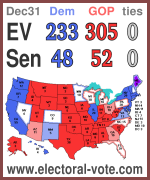
Pres polls: (None)
Dem pickups: (None)
GOP pickups: FL IA MI OH PA WI
Previous | Next
Trump Wins Michigan
The Michigan Board of Canvassers yesterday certified Donald Trump as the winner of Michigan's 16 electoral votes. He beat Hillary Clinton 2,279,543 votes (47.6%) to 2,268,839 (47.4%), a razor-thin margin of only 0.2%. Trump is the first Republican to carry Michigan since George H.W. Bush in 1988. Jill Stein is considering a formal request for a recount, which would cost about $800,000. She has until Wednesday to make her request. The chance that a recount will flip over 10,000 votes is basically zero, however. Thus the final tally in the Electoral College is almost certain to be 306 for Trump and 232 for Clinton, despite her lead of over 2.2 million votes nationally. (V)
Trump Picks Tom Price for HHS
Donald Trump has announced another cabinet selection, and it's very bad news for liberals: Rep. Tom Price (R-GA), who has been tapped for Secretary of Health and Human Services.
It is clear, at this point, that Trump himself has little-to-no idea of how to dismantle and replace Obamacare. Price, by contrast, does. Not only is he one of the loudest Obamacare critics in Congress, he was an orthopedic surgeon for 20 years. So, he has both a clear plan for what needs to be done and the credentials to sell that plan to skeptical colleagues. Price's ideas are actually very similar to those of Speaker Paul Ryan (R-WI); they both want to replace Obamacare with private health savings accounts, and Medicare with block grants and vouchers. The odds are very good that, assuming Price is approved, Trump will tell him to meet up with Ryan, come up with something "fantastic," and then The Donald will sign whatever it is. In the long term, the American people are likely to be very unhappy with some of the changes that are wrought, but in the short term it just became much more likely that the anti-Obamacare faction is going to get exactly what it wants. (Z)
Petraeus for Secretary of State?
A new name has emerged in the apparently-heated contest for the Secretaryship of State: David Petraeus. Petraeus' selling points are that he is a decorated general, and one who has earned the respect of both Democrats and Republicans. He's got foreign policy and diplomatic experience aplenty, thanks to his time as Director of the CIA and his various military commands. Further, he might be an acceptable compromise for the pro-Romney faction of the GOP (who want a grown-up doing the job) and the pro-Giuliani faction (who pretty much just want anyone who is not Mitt Romney). Donald Trump reportedly said he "was very impressed" after meeting with the General.
And now, the big, red, glaring problem: Petraeus lost his job at the CIA because he knowingly shared classified information with his biographer (Paula Broadwell, who was also his mistress at the time). As we have pointed out many times, including just two days ago, intent is what turns a mistake into a crime, and there was certainly intent here. Petraeus' punishment, beyond the loss of his post, was a $100,000 fine and two years' probation. The only reason he avoided jail was that Broadwell, unlike her paramour, actually can keep a secret, and did not divulge the information that she was given.
As we noted in the item from November 27, Trump's pick for National Security Adviser, Michael Flynn, has much the same black mark on his record. Well, he didn't share classified information with his lover (as far as we know), but he did share it with unapproved NATO allies. Flynn, however, doesn't have to pass muster with the U.S. Senate. The Secretary of State, by contrast, most certainly does. Could GOP Senators actually keep a straight face while approving a man who definitely and deliberately leaked classified information, just months after calling for investigations of/imprisonment for a Secretary of State who might have accidentally leaked classified information (but probably didn't)? And would those same GOP Senators be willing to shift uncomfortably in their seats for several days while Democrats asked probing questions about security clearances, and double-secret probation, and exactly how Petraeus would respond the first time Angela Merkel makes goo-goo eyes at him? Who knows, but we're getting dangerously close to C-SPAN becoming must-watch TV. (Z)
Trump Has Changed His Views on Various Issues Since the the Election
President-elect Donald Trump has backtracked on a number of his campaign promises already, and he is not even in office yet. CNN has collected some of his pronouncements on various subjects before and after the election for comparison purposes. Here is what it found:
| Before the election | After the election |
| I want a special prosecutor for Hillary Clinton | I don't want to hurt the Clintons |
| I will cancel the Paris accord | I have an open mind to it |
| Real change begins with repealing Obamacare | Obamacare will be amended or repealed |
| I will bring back waterboarding | Gen. Mathis said: "I've never found it to be useful" |
| The people of South Carolina are embarrassed by Nikki Haley | Nikki Haley will be ambassador to the United Nations |
| No media is more corrupt than the New York Times | The Times is, its a great, great American jewel |
Of course, Trump has changed his positions on so many subjects so many times already, that he could change them on these issues two or three more times before Inauguration Day. (V)
Trump May Not Be Able to Deport Undocumented Criminals
On the subject of changing his position, early in his campaign, Donald Trump said he would deport all 11 million undocumented immigrants. Later on he suggested that he would begin with those who were criminals and deal with the others later. But even deporting the criminals may not be possible. In many cases, the countries they came from are refusing to take them back. These countries include Cuba, China, Somalia, India, and Ghana. In 2001, the U.S. Supreme Court ruled that once an undocumented criminal has served his time, he must be released within 180 days, even if his home country doesn't want him back.
In a few cases, the U.S. has pressured small countries into taking a few of their own citizens back, but that kind of pressure would never work with large and powerful countries. India, for example, said it would take back its citizens provided the U.S. could provide proof that the people being deported were in fact Indian citizens. But since the people don't have any documents at all, doing so is essentially impossible. (V)
The Difficulties in "Draining the Swamp"
"Lobbyist," "Career Politician," and "Bureaucrat" are all four-letter words to many American voters, which is why Donald Trump has promised to strike back against all three; namely by imposing restrictions on former government employees' lobbying activities, establishing term limits for members of Congress, and freezing federal hiring. This is, in essence, his three-pronged plan for draining the swamp.
The problem, as a Los Angeles Times op-ed points out, is that it's not going to be quite that simple. Beyond the logistical and political hurdles that Trump's plan would have to overcome are two insurmountable facts. The first is that the lobbyists will have their say, whether it is under that title, or some other (consultant, adviser, vice-president of outreach, minister of information, whatever). There's simply too much at stake for groups like the AARP and NRA, and for industries like tech, agribusiness, oil, etc. The second is that modern-day legislation is very, very complex. These two things being true, then under present-day circumstances, the best bulwark against the lobbyists are experienced bureaucrats and politicians, who can match expertise with expertise, and maneuver with counter-maneuver. If the government's representatives (i.e. the politicians and bureaucrats) are weakened, then the lobbyists will simply expand their influence to fill the vacuum. Study after study has shown that in states with part-time legislatures and/or underfunded bureaucracies, private businesses get much more of what they want, because they end up being the ones who write the laws. After all, they're the only ones who have the necessary expertise and time.
The upshot is this: If draining the swamp is the goal, then the best available solution is to strengthen the bureaucracy and the political officeholders, so they are better able to serve as a counterbalance to the lobbyists. Unfortunately, while well supported with evidence, that doesn't make for a great pitch on the campaign trail. (Z)
Trump May Have a Problem When a Chinese Bank's Lease Expires
Trump Tower's biggest commercial tenant, the Industrial & Commercial Bank of China, Ltd., is owned by the Chinese government. Its lease runs out in Oct. 2019, before Donald Trump's first term ends. If the bank chooses to renew its lease, that could create a problem, since the Constitution forbids U.S. government officials from accepting gifts from foreign governments. If the bank pays the market rate for its lease (assuming that can even be determined), the deal is probably constitutional. But if the bank tries to curry favor with Trump in order to get him to agree to other things China wants by offering to pay above market rent, that would probably be unconstitutional. In any event, it is certainly a potential conflict of interest.
Currently the bank is paying $95.48 per month per square foot, already more than any other major tenant. However, since that price was set before Trump was in office, it is probably legal. If the new lease were also more than any other company was paying, it would definitely be a red flag. Sooner or later this issue is going to end up in the courts. (V)
AP Issues Guidelines for Reporters about the term "Alt-Right"
John Daniszewski, vice president for standards at the Associated Press, issued some guidelines for journalists about using the term "alt-right." He said the term is essentially a euphemism for what used to be called "racist," "neo-Nazi," or "white supremacist." He noted that many of these people prefer the term "alt-right" since it sounds better, but he cautioned journalists to avoid allowing such groups to invent a new terminology to confuse people about their actual beliefs. He also said journalists should report on their actions, history, and positions, as well as how others see them. (V)
Back to the main page