Pres polls: (None)
Dem pickups: (None)
GOP pickups: FL IA MI OH PA WI
Previous | Next
Senate Republicans Are Hesitant to Abolish the Filibuster
The only real power that Democrats will have in the coming two years or more is using the filibuster in the Senate to block Donald Trump's Supreme Court nominations and legislation. This being the case, many conservatives are champing at the bit to nuke the filibuster and then ram through Trump's complete program, with Rep. Roger Williams (R-TX) leading the charge.
The Republicans certainly could abolish the filibuster altogether if they want to, but they are unlikely to do so for two reasons. First, and most obvious, is that they know that some day they will be in the minority and that they will want this option to be available. Sen. Lamar Alexander (R-TN) led a task force on potential rule changes after which he said:
I think most Republicans understand that the Senate is not an institution to impose the majority's will on the country. It's the one institution in the country that's capable of developing consensus. The Obama administration found that when you try to cram things down people's throats in a partisan way they don't last.
Sen. Orrin Hatch (R-UT) also argued that the filibuster was one of the few tools the minority has. Sen. Bob Corker (R-TN), Sen. Jeff Flake (R-AZ), and several others agreed with Hatch. Each of these men knows that the if the filibuster is killed (after nearly 200 years of use), it's not coming back, and that they would be rendered a silent minority when that day comes, as it inevitably will.
The second reason that these GOP senators are leery of a change is less obvious, but it is essentially that they want to be filibustered. As Slate's Jim Newell points out, it is all good and well to pay lip service to draining the swamp, or tearing up Obamacare, or privatizing Medicaid. However, while many Representatives (including Roger Williams) answer to smaller, more ideologically pure constituencies, U.S. Senators have to answer to all of the voters in their home states. The rapid imposition of a far-right agenda could leave these Senators holding the bag if anything goes south, and they would run the risk of alienating moderate and independent voters. It is a rare state indeed where a Senator can achieve victory solely on the power of ultraconservative votes. Ergo, the filibuster serves as a moderating impulse that—as Newell puts it—protects Senators from themselves.
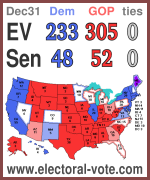
Ultimately, the key person in the battle to abolish the filibuster is Majority Leader Mitch McConnell (R-KY). While he is a conservative, he is also an institutionalist and does not want to damage the Senate. The first test will probably be Trump's nomination to fill the seat of the late Justice Antonin Scalia. If it is a moderate conservative with a strong track record of being impartial, the Democrats will probably accept it as the price of losing the election. But if it is a hard-right person or someone with less than impeccable credentials, Democrats will certainly filibuster the nominee and then McConnell will be on the spot. Later on, when actual legislation comes to the Senate, the Democrats are likely to filibuster bills they don't like, and McConnell will have to make a separate decision on whether legislation can be filibustered. All it will take is for three Republicans to join the 48 Democrats in blocking any move against the filibuster. Those 51 votes would be enough to prevent any rule changes, making it difficult for Trump to get any of his more draconian proposals through the Senate. (V & Z)
The Media Are Starting to Be Honest; Trump, Not So Much
Politico, which is by no means a left-wing publication, has a headline that reads: "Trump falsely claims millions voted illegally." This is big news. The news is not that Trump made up a totally bogus tweet. The news is that Politico, a mainstream publication, is willing call him a liar in so many words. That is new. In the past, publications would write: "Trump says millions voted illegally, Democrats deny this." Now Trump is starting to get fact checked in real time. If he continues tweeting and saying things that are completely false, like this tweet about illegals voting, he is going to have a rocky relationship with the media. And the more he attacks them, the more they are going to fight back.
And about that "illegal voters" claim, incidentally: It is nonsense. This "story," if it can be called that, began with a series of tweets from a self-identified voter-fraud "expert" named Gregg Phillips, who used Twitter to declare that, "We have verified more than three million votes cast by non-citizens. We are joining @TrueTheVote to initiate legal action." The story was quickly picked up by questionable news sites like infowars.com, and alt-right types like Milo Yiannopoulos. Phillips has thus far declined to provide any evidence whatsoever for his claims, which simply don't stand up to scrutiny. It would be nearly impossible for that many fraudulent votes to be cast, and it would be even more difficult to prove that this had happened, particularly since Phillips first made his claim before most states had certified their final tallies and released complete data. Further, Phillips has made these kinds of claims before and had them debunked.
Meanwhile, there is no question that Donald Trump had enormous success as a candidate with (1) wading into as many battles as possible, and (2) showing a reckless disregard for the truth. With the caveat that we are in uncharted territory here, it is hard to believe that he can continue in this way and have it work. The president historically has needed to have some level of moral authority—at key times, he needs to be able to connect and communicate with the American people, and to rally them to action. If President Trump keeps behaving like candidate Trump, he runs the risk of turning into the boy who cried wolf, of having people—even his supporters—begin to tune him out. A comparison to Richard Nixon may be instructive; like Trump, Tricky Dick was both dishonest and given over to score-settling. He kept those tendencies under wraps well enough to win one of the most crushing electoral victories in American history in 1972. However, within two years, almost the entire political establishment (and the entire country) had turned against him, as his true nature was laid bare for all to see and could no longer be ignored. The major difference, of course, is that Trump doesn't even try to hide his lies and his squabbling. So, if history is any guide at all, he could be headed for real trouble, except that he might get there about four years faster than Nixon did. (V & Z)
Trump Intends to Take a Hard Line with Cuba
It was vaguely possible that the death of Fidel Castro might give President-elect Trump wider latitude in dealing with Cuba, since he is the bugaboo that Cuban (and other Republican) voters care about the most. However, The Donald's lieutenants have already made clear that a change of plans is not in the cards, and that he intends to re-freeze that which Barack Obama had tried to thaw. Soon-to-be Chief of Staff Reince Priebus declared that the only thing that would alter Trump's approach would be massive (and highly unlikely) changes in Cuba: "Repression, open markets, freedom of religion, political prisoners: these things need to change in order to have open and free relationships, and that's what President-elect Trump believes, and that's where he's going to head." Campaign manager Kellyanne Conway, who does not yet have a job in the new administration but is still acting as spokesperson, echoed this: "To the extent that President Trump can open up new conversations with Cuba, it would have to be a very different Cuba."
In the end, this is all about politics. Even more specifically, it's about politics in Florida. There are a lot of voters who will reward Trump for taking a harsh stance on Cuba, and most of them are located in a key swing state. Meanwhile, there are fewer voters who will reward Trump for taking a soft stance (although farmers in the Midwest would like access to a new market, they are a bit less firm on the subject than anti-Castro Cuban Americans). So, the hard-liners will get what they want. In this way, Cuba is very much like Israel. A president who helps Israel can expect to rewarded handsomely, a president who tries to help the Palestinians—less so. (Z)
Arizona and Georgia Democrats Are Nervous About Direction of the Party
Although Donald Trump won Arizona and Georgia, Democrats there have the feeling these states could become swing states in the near future—but not if the party puts all of its efforts into winning back white voters in the Midwest. This is the dilemma the Democrats now face. Do they focus on Arizona, Georgia, North Carolina, and Florida, or on the Midwest?
The Democrats are undoubtedly going to have a series of autopsies on the campaign now to see what really happened. What happened in the Midwest is fairly clear, but the South is less so. The Democrats poured vast resources into North Carolina and lost by 4 points. They put nothing into Georgia and lost by only 5 points. Maybe they should have focused more on Georgia than on North Carolina. And in Florida, Trump won by only 1 point. If the Democrats can win North Carolina, Georgia, and Florida, all with large Latino and black populations, they don't need the states they lost in the Midwest. Expect many battles about strategy going forward. (V)
Maine Switches to Instant-Runoff Voting
The Great State of Maine changed its voting system two weeks ago as a result of Question 5, which passed. Starting now, in all elections, voters will be able to mark their first, second, and other choices for all offices. This will increase the number of protest votes and parties, but will not cause them be spoilers any more. For example, under this system, a disappointed supporter of Sen. Bernie Sanders (I-VT) could have marked Jill Stein as #1, to show his or her support for Stein. However, as a backup measure, the voter could also have marked Hillary Clinton as second choice, just in case Stein came in last. This system, known as instant-runoff voting or ranked-choice voting, is used in a few scattered cities in the country, but this is the first time an entire state has adopted it.
If this system had been in use in Michigan and Wisconsin, and the Stein voters had chosen Hillary Clinton as their second choice, Clinton would have carried those states. In general, when two somewhat similar candidates are on the ballot, they tend to split the vote. Instant-runoff voting prevents this split, so one doesn't act as a spoiler for the others. Maine is not exactly a swing state, but because it allocates its electoral votes by congressional district, Trump was able to win one electoral vote there. It will be interesting to see if any real swing states adopt a similar scheme now that the ice has been broken. (V)
Democrats' 2020 Field Is Taking Shape
Following Hillary Clinton's stunning defeat, there is a vacuum in the upper ranks of the Democratic Party. She's done running for office (presumably), as are Joe Biden (age) and Barack Obama (term-limited). Bernie Sanders might not admit it openly, but his days of running for the White House are surely over as well, since he would be 79 years, 133 days old on Inauguration Day in 2021. The very first time he sat down in the Oval Office, he would already be the oldest person ever to serve as president, leaving Ronald Reagan (who was 77 years, 349 days on his last day in office) in the dust.
In short, things are wide open. At the same time, Democrats want something and someone to cling to as they ride the next four years out. So, several names are already being bandied about:
- Sen. Cory Booker (NJ): He's young (47), brilliant,
and charismatic. Quite a few people will see him as the second coming of Barack
Obama, which means he has an excellent chance at the nomination if he wants it.
The problem is that Booker doesn't quite have Obama's political skills, and his
original Senate campaign underwhelmed. Further, if the Democrats decide they
want to re-connect with white, Midwestern working-class voters, a black coastal
elite may not be the ticket.
- Sen. Kirsten Gillibrand (NY): As we have noted, she has
already begun making fundraising calls to Hillary Clinton's network. She's a
great networker and fundraiser, though Republicans will have a fairly easy time
branding her as Hillary 2.0.
- Sen.-elect Kamala Harris (CA): Her service as
California's attorney general gives her a law-and-order background, plus she's
part black and part Asian, which will help with the Democrats' get out the vote
operations. On the other hand, like Booker and Gillibrand, she's yet another
coastal elite. Further, she ran a trouble-filled campaign for the Senate, and
won in large part because her opponent ran an even worse campaign.
- Gov. John Hickenlooper (CO): He's a moderate, he's
a white guy, he's a Westerner, he's from a swing state, and he's got a blue-collar
background (he owned a brewery before starting in politics). For a certain
segment of the Democratic Party, this is exactly the kind of back-to-basics
candidate that would be ideal. For other segments, like the Sanders crowd, he
would be a step backward.
- Sen. Amy Klobuchar (MN): She's got a solid
legislative record, and has been able to reach across the aisle to get things
done. Plus, she's from the Midwest. However, Minnesota is a fairly small state,
and Hubert Humphrey and Walter Mondale have both shown us how well Democratic
candidates from there do in presidential elections.
- First Lady Michelle Obama: She is many Democrats' "wish upon a star" candidate, as she has massive name recognition, is wildly popular, and is a gifted speaker. But she's evinced no interest in running thus far. Plus, would Republicans make hay out of her lack of experience in elective office, the way they did with her husband? Maybe not, since they seem to have conveniently forgotten about that concern this year. But would they complain endlessly about "dynasties" and "Obama 2.0"? You bet.
Needless to say, this is a very tentative list. A week is a lifetime in politics, and four years is an eternity. There remains all kinds of time for any or all of the above individuals to do something stupid that takes them out of the running. At the same time, there is also plenty of time for a surprise candidate to emerge. After all, at this point in 1988, nobody had ever heard of Bill Clinton, and at this point in 2012, Donald Trump was just an orange-haired reality TV star. So, don't place your bets quite yet (although, for what it's worth, Irish bookie PaddyPower has Michelle Obama as the favorite at 8-to-1, followed by Sens. Tim Kaine and Elizabeth Warren at 11-to-1, HUD Secretary Julian Castro at 12-to-1, Clinton at 14-to-1, and then Booker and Klobuchar at 16-to-1. Or you can go wild and let it ride on Chelsea Clinton, Kanye West, or George Clooney at 100-to-1.) (Z)
Don't Want to Do Business with Trump? There's an App for That
Donald Trump's business empire is a massive and complex spider web that has The Donald's fingers in many, many pies. There are quite a few Americans who would prefer not to enrich the President-elect with their hard-earned dollars, but aren't quite clear which entities he has an interest in (other than the ones that are Trump-branded, of course). Now, the Democratic Coalition Against Trump has developed an app that solves this dilemma. All a user has to do is open it up and search the name of a business. The app will check its database—250 entries and counting—and will reveal if that business has a Trump connection. Who knows, this could be yuge. (Z)
Back to the main page