Previous | Next | Senate races | Menu
New polls: AK AR MT NH OH
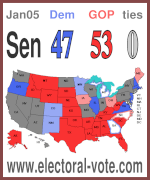
Dem pickups: AK IA KS ME NC OH TX
GOP pickups: (None)
Katie, We Hardly Knew Ye
Most readers will have heard the news by now, but newly minted White House Press Secretary Katie Zacharia is now former White House Press Secretary Katie Zacharia, as she was cashiered by Donald Trump yesterday.
Strike one, of course, was her disastrously bad performance in her first, and what proved to be her only, press conference with the White House press corps. By all accounts, Donald Trump was not initially bothered by it. He knows that this kind of thing is not easy, and that it takes some time to learn the ropes. However, he did what he does, and asked all of his various telephone buddies about it. The scathing reviews he heard from others might have caused him to alter his initial assessment.
Strike two, and three, was Zacharia's having claimed she was a lawyer when she is not. And when she got caught in her lie, she decided to give the whole nation an object lesson in "O! What a tangled web we weave, when first we practice to deceive." When it was pointed out she'd never been licensed to practice in the U.S., she claimed she took the bar in China. When it was then pointed out that was not possible, she said she'd misheard the question. Then she said that she did sit for the bar, but she didn't really intend to pass it, because she was too busy at the time planning for her wedding. She also claimed she had not lied, because she only referred to herself as a "lawyer" and not an "attorney." Or maybe it was an "attorney" and not a "lawyer." It's a bit of meaningless verbal sophistry that people who graduated law school but did not pass the bar engage in so as to obscure the truth about their credentials.
Trump does not have a problem with people lying, but they damn well better not lie to him. And they better not make him an unwitting participant in perpetuating those lies. The most obvious parallel is Michael Flynn, who lasted only 22 days as NSA because he duped members of the administration, most notably then-VP Mike Pence, into repeating his lies about not meeting with members of the Russian government. Zacharia might well have survived the disastrous first press conference, possibly by adopting the Stephanie Grisham technique of never, ever holding press conferences. But the lie about being a lawyer looked to be unsurvivable, and it was.
According to much of the media, the "big deal" here is that the White House will have no primary spokesperson for most or all of the time between now and the election. In fact, this is not a big deal at all. Trump effectively acts as his own White House Press Secretary. And if and when the Republicans get smacked at the polls in a couple of weeks, the lack of a White House Press Secretary between October 17 and November 3 will not be among the 50 most important reasons for their misfortune.
The real "big deal" here, such as it is, is that we have yet another reminder that this White House is sloppy, sloppy, sloppy. It is not difficult to confirm whether someone is actually a lawyer or not. And yet, nobody even bothered to take the 2 minutes to check before announcing Zacharia to the world. It's no wonder that so many members of the administration are unqualified, unprepared, corrupt, etc., because nobody bothers to look for red flags.
The other issue here is that everyone will now have to figure out exactly how long a Scaramucci is, and how long a Zacharia is. The former lasted for 10 days, which were spread across 11 calendar days. The latter lasted for 4 days, which were spread across 5 calendar days. So, a Zacharia is either 0.4 Scaramuccis, or else 0.454 Scaramuccis. We tend to take the view that 0.4 is more correct, but we suppose reasonable minds can disagree. (Z)
Saturday Q&A
For the last couple of Q&As, we've put the questions together as one group, rather than breaking them into categories. We kind of like that; it affords a bit more flexibility and a bit more flow. So, we're going to keep going with that.
The Reader Question of the Week will return next week.
And for those who are working on the headline theme, we'll add this hint: Think about Walt Whitman's most famous poem.
R.D. in Austin, TX, asks: With the reporting that has come out that the Star Shield used by Ukraine was throttled by someone in the White House, Space X, or both, is there real risk for Trump or other White House officials as well as Elon Musk and Space X for being literally guilty of a war crime by choosing to side with Russia and take away a key tool used by Ukraine to defend itself and go after Russian technical resources inside Russia such as data centers?
(Z) answers: The notion that someone is guilty of, and may be convicted of, war crimes sounds very impressive. That is why it is so common for people, particularly those who are very lefty or very righty, to deploy that charge. But be very clear: War crimes convictions are for losers.
We do not mean that in the Donald Trump sense (e.g., "Electric vehicles are for losers!"). We mean that the people who get put on trial for war crimes, and who get convicted, and who are actually punished are invariably people who ended up on the losing side of a war or other military action.
It is true that there are, for example, some participants in the Ukraine War who have been convicted of war crimes in absentia. But those convictions will just be an empty gesture unless one side or the other loses the war convincingly.
People in powerful countries—in other words, countries in a position to impose their will—simply do not get convicted of war crimes. Such nations simply are not willing to surrender a big chunk of their sovereignty to some sort of international tribunal. If any member of the Trump administration is going to pay any price for any misdeeds they might have committed, it will be at the hands of an American court, and under the auspices of American laws.
S.Y. in Skokie, IL, hometown of the first Sloth to become Attorney General of the United States, asks: I wrote in on this subject last week: $90 checks going out to voters. Some of your readers in blue states were getting them, but so far nothing in Illinois.
A friend from Milwaukee got a $1,000 check today with a letter addressed to his wife, signed by Donald Trump, saying she was getting a $500 rebate for Obamacare overcharges.
A check would be nice but I'm honestly curious as to why some people are getting these checks and some aren't. Wisconsin is a lot swingier than very blue Illinois, but you had Electoral-Vote.com readers in California who received $90 checks. Things are getting goofier by the day and I'm wondering if there's any criteria behind who gets the checks, how much, or is it what are the polls saying about where they live?(Z) answers: To qualify for the $500 checks, a person must have purchased health insurance through one of the federal exchanges without receiving any subsidies or any other federal assistance. There are 27 states (including Wisconsin) that use the federal exchanges. The remaining states (including Illinois, and also D.C.) run their own exchanges, and so residents there are not eligible for the $500.
To qualify for the $90, a person has to have a Medicare Part B policy and cannot be already receiving subsidies or income-based discounts.
It is certainly possible that the rules were designed in a manner so as to send money disproportionately to swing-state/red-state voters. But the administration is not directly making decisions based on people's registration or likely voting tendencies.
S.B. in Boston, MA, asks: You pointed out Sen. Susan Collins' (R-ME) inept reply to the question about a noted example where her independence mattered, but I'm surprised you (and especially Collins) didn't mention the famous John McCain thumbs-down ACA repeal vote.
Collins was on McCain's side there (and against Trump) and you can't get much more notable than that. In order for her vote to be provably "decisive," it has to be a vote where her side was against Trump and they won by exactly one vote. This, of course, means that every single defector was equally decisive (in that case, McCain, Collins and Sen. Lisa Murkowski, R-AK).
I wonder why she didn't mention this. Is it because it would have underscored how long it's been since she pushed back? Was there more to the question (maybe they wanted examples from Trump v2.0)? Was she afraid that reminding MAGA voters that she once voted against Dear Leader and won would cost her votes?(Z) answers: Don't discount the possibility that, under the lights, and on the clock, she just went with the first answer she could think of. It is also possible that you are right, and that she thought that reminding Mainers of her ACA vote would do more harm than good, or that it would look bad if the best example she could come up with was almost a decade old.
That said, if you asked us to guess, we would guess that she knows that the Iran War and Pete Hegseth are very unpopular in Maine, and she thought it would be a two-fer if she used that example.
A.G. in Scranton, PA, asks: Is Troy Jackson a fifth-generation logger? I heard that maybe he was...
(Z) answers: It's possible. We're not really sure. If he was, you certainly think he'd make a point of mentioning it on occasion, since that should theoretically be a selling point in a state like Maine.
J.C. in Oxford, England, UK, asks: I'm all for James Talarico (D) from thousands of miles away, not least because as a liberal Presbyterian and it's nice to have a prominent liberal Presbyterian be the face of Christian faith rather than whatever heresy the MAGA/Prosperity Gospel mashup is.
So, just a minor point, about how Talarico responded with "my team is Texas" and "people shouldn't vote for the best candidate not blindly for the party" during his town hall. There are surely hundreds if not thousands of elections in Texas next month.
If Ken Paxton (R) weren't too scared to debate, isn't this argument easily undercut with "That's a great point James—so, which Republicans are you supporting?"(Z) answers: "I've been pretty busy campaigning and then was ill, so I haven't had time to give the proper care and attention to every office yet. However, I am favorably impressed with John Messinger, who is of course running for Texas Court of Criminal Appeals Place 9."
J.B. in Radnor, PA, asks: Let's say James Talarico or another Democrat running statewide in an otherwise red state wins on Nov. 3. Could the officer responsible for certifying the election simply refuse to certify the lawful victor's win, claiming "Democratic fraud" or something like that? And if so, what would be the winner's recourse?
(Z) answers: That officer certainly could do so. And then the matter would end up in state or federal court within days (if not hours). And then the officer would have to present the evidence that is the basis for their decision. And if they were not able to do so, they would be ordered to issue the certification immediately. Any further obfuscation would rapidly result in civil and/or criminal penalties, along the lines of the woman in Kentucky who refused to grant marriage licenses to gay couples. Meanwhile, every state has some sort of alternate person with the power to certify elections; that person would step in and take care of business.
Recall that we already went through a version of this in 2020. A whole bunch of people filed 60+ suits trying to challenge the results of the presidential election in various places. And those suits quickly went nowhere because the plaintiffs could not back up their claims with evidence.
The reason there is a couple-month gap between elections and inaugurations is to give plenty of time to resolve issues, including potential nonsense like this.
J.L. in Los Angeles, CA, asks: Let's assume there is a blue tsunami in November, the Senate winds up 53-47 (or thereabouts) in favor of the blue team, and Democrat Mary Peltola is the new junior senator from Alaska. Republicans will, most likely, be in panic mode (as the Democrats were in 2010 after their "shellacking") heading into 2028... when the senior Alaska senator, Lisa Murkowski, is up next for reelection.
One assumes that, with such a deep Republican bench in the Last Frontier, Murkowski might well be challenged in the primary, possibly by one of the two Dan Sullivans (the one who might want his old job back). But the Democratic bench in Alaska is, as I understand it, more of a small stool... possibly just a short wooden box. What is the math for Murkowski, assuming a solid Democratic majority in the U.S. Senate in 2027, of switching party affiliations early in the term so that she can run on as a Democrat in 2028? Does taking the path less traveled by make sense for her, or is she safer just staying with the dogsled team that got her this far?(Z) answers: First, Murkowski would derive the greatest benefit from flipping when the Senate is closely divided, and her shift in parties would flip control of the upper chamber. She could extract a mountain of pork for Alaska in such a scenario.
Second, Murkowski has been in this situation in the past, and was not interested. There is no particular reason to think she would rethink that position.
Third, Alaska advances the top four finishers in its primary to the general. There is no need for Murkowski to game the system in the way you propose.
L.R. in Pittsburgh, PA, asks: Assume the election outcome is a Republican bloodbath: Democrats end up with 225+ seats in the House, and with 54+ seats in the Senate. What are the chances the Republican Party reacts by removing the current president well before the 2028 election, and how do you think they would go about it?
(Z) answers: Under current circumstances, the Republicans absolutely would not remove Donald Trump. MAGA is now the core of the Republican Party and removing Trump would trigger a GOP civil war that would cripple the party for numerous cycles.
That said, it is possible to imagine developments that would leave the Republicans in Congress with little option but to remove him. For example, if he defied a Congressional resolution to end the Iran War. Or if his mental state declined to the point where he clearly was not competent much of the time.
Should that come to pass, I imagine that the leaders of the GOP would look to the Nixon era for their playbook. They would make an agreement with the power-hungry J.D. Vance that he gets to be president in exchange for a pardon. Then they would send someone Trump is likely to believe, like Sen. Rick Scott (R-FL), to tell him that he is going to be impeached, convicted and removed, but that he also has an alternative: Resign, save face, and then get a pardon for any wrongdoing from Vance. Trump is somewhat in denial, at least publicly, but even he understands that he's got some legal exposure and that self-pardons are untried and might not fly.
R.H. in Macungie, PA, asks: I've seen some mail asking if the Democrats should eliminate the filibuster if they win the senate in November. I think it would be pointless since Trump would just veto anything meaningful that they might pass, unless the point would be to show people what might be accomplished if only the Democrats could get the Trifecta in 2028. Your thoughts?
(Z) answers: I think the Democrats are unlikely to eliminate the filibuster in one fell swoop, especially if they are out of power and can't take advantage anyhow.
I do think there is a real possibility that, if they regain control of the Senate, they create one carve-out just to make clear what they will do if they get the trifecta again. And the potential carve-outs that seem plausible are: (1) statehood bills are not subject to filibuster or (2) updates to the Judiciary Act are not subject to the filibuster.
R.C. in Des Moines, IA, asks: You wrote, "[W]e would not be surprised if the House Majority PAC and House Majority Forward used a little accounting trickery to make Q2 look bad/desperate, and then to make Q3 look like the Party's momentum is cresting." In addition to this theory, is it possible some of the people who donated in Q3, particularly the fat cats, were motivated by the polling showing a potential blue wave (and red undertow) and wanted to get their donations in so as to have some influence when the Democrats take over in Congress?
(Z) answers: Very possible. Rich people and corporations, many of whom donate on both sides of the aisle just to be safe, are very good at keeping their powder dry until the writing is very clearly on the wall.
L.J. in Pittsburgh, PA, asks: What is the empirical evidence (as opposed to campaign-staff wailing) that more money actually affects electoral outcomes? You and other political writers offer that equivalence as if it's obviously true, but is there real empirical evidence for that? Importantly, does it really matter in close races—what evidence would convince you that fundraising totals do or don't control the eventual outcome?
(Z) answers: It's a complicated question, and different studies reach different conclusions. That said, there is a universal consensus that money matters when one side spends a lot of it and the other side spends little. Also, in most races, money only affects things at the margins, but in a few (and it can be hard to predict which), it matters a lot. If you'd like to read a pretty good overview of the subject, there's one here.
J.M. in Southfield, MI, asks: Are you familiar with the organization OATH? Do you think it is an efficient and effective way to donate to Democratic candidates?
(Z) answers: OATH was founded in 2024, and its purpose is to apply advanced analytics to find where candidate/political donations will have maximal impact. Since they are small, and have been active for just one cycle (2026 is their second bite at the apple, obviously), they don't really have a track record. That said, their approach seems promising, and certainly isn't going to be noticeably worse than, say, donating to an organization that goes primarily on polls and gut feel. Can't hurt to give them a try.
J.M. in New York, NY, asks: So, if one happened to find oneself with an extra $90 and wanted to donate it to a worthy political candidate who might be considered a moderate Democrat or traditional liberal (i.e., a John F. Kennedy/Franklin D. Roosevelt/Sen. Jon Ossoff, D-GA, type), who would make a positive difference if elected and who might be in a tight race where that $90 would actually have an effect, where would be a good place for to one donate that money?
(Z) answers: Mary Peltola? Clearly moderate, tight race, small/low-population state where money goes much further than it does in, say, Texas.
Alternatively, take a look at OATH (see above). Or take a look at ModSquad PAC, which is run by Sen. Catherine Cortez Masto (D-NV), and was founded to promote the candidacies of moderate Democrats.
M.R. in Washington, DC, asks: Would it be good politics for Democrats to blunt GOP voter ID requirements by supporting legislation to require voter IDs, but coupling them with requirements that states make acceptable IDs free and easy to access?
(Z) answers: Well, I think this is where things are probably headed. The majority of Americans support voter ID laws, and Democrats might want to make this deal to get out from under the losing side of the issue, on terms that will minimize the amount of harm done to their base.
R.Y. in Knoxville, TN, asks: You wrote: "North Dakota: SoS Michael Howe (R) opposes voting rights for Native Americans and will likely get a 2nd term."
Is this something he opposes theoretically, or is he trying to do something about it?
This made me wonder if there could be attempts to restrict voting from anyone who holds a dual citizenship. My guess is most dual citizens lean left?(Z) answers: It is something he can potentially do something about, but not in the way you're thinking. The rights of dual citizens are clear, and no SoS or any other elected official is going to change that.
With Native Americans, the issue is often that they live on reservations in the middle of nowhere. So, steps can be taken to make it easier for them to submit their ballots—usually something like allowing an appointed member of the tribe, or someone acting on behalf of the tribal council, to collect the ballots. And, on the flip side, trying to disallow arrangements like this makes it harder for (some) Native Americans to vote.
And I am unaware of any statistics or studies that speak to the political leanings of dual citizens.
P.M. in Port Angeles, WA, asks: The recent disclosures concerning Kimberly Guilfoyle raise a question about Gavin Newsom's presidential aspirations: Is his association with her going to become an albatross round his neck? I suspect that it will be a potent source of oppo research for any presidential run he may undertake.
(Z) answers: They have been divorced for 20 years. At some point, a person is no longer responsible for what their ex does, or what their ex becomes. I think that point has long passed for Newsom, and that Guilfoyle is not even among his top 20 liabilities.
J.B. in Hutto, TX, asks: In military law, as has been pointed out many times in recent years, personnel are not obligated to follow orders they know to be illegal. The so-called "Nuremberg Defense"—i.e., a soldier did open fire on an unarmed civilian crowd, but only because their superior officer ordered them to do it—is not an admissible defense.
Does the same principle apply to federal law enforcement? For example, if ICE agents are ordered to shut down polling places in heavily Democratic neighborhoods and they follow their orders, would those agents individually be liable to criminal prosecution and/or civil penalties?(Z) answers: The legal basis is different—soldiers are governed by the Uniform Code of Military Justice, and ICE officers are governed by federal law—but the principle is the same: They are not allowed to obey illegal orders.
That said, the people giving the orders would be likely to muddy the waters. They might say: "There are unregistered voters trying to vote fraudulently, and they must be stopped." In that case, the ICE officers would probably not be liable, since they would be acting in a manner they believed to be legitimate, but based on false information. Someone WOULD be liable, though it might be tough to identify them and prosecute them.
J.D. in Rohnert Park, CA, asks: You wrote that some Republicans who lose their House seats in November might just pack it in and not show up for the interim session. If the Democrats have a majority of House members present, can they call for a vote and replace Speaker Mike Johnson (R-LA) with a Democrat?
(Z) answers: They can, but they won't. This would poison the waters with the Republicans even more than they are already poisoned, and would achieve nothing.
B.T. in Leakey, TX asks: Doesn't Montana provide for a runoff? All polls to date show none of the 3 candidates getting 50%, so if there IS a runoff, I think an "independent" senator coming from montana becomes a real possibility.
(Z) answers: Montana does not have runoffs. There have been a couple of attempts to make that change, via ballot initiative, but they were defeated big-time. As recently as 2012, a Montana senator was elected with a plurality (Jon Tester, 48.58%).
C.P. in Fairport, NY, asks: Your answer to N.G. in Shrewsbury made me wonder about this scenario: assume Roy Cooper (D) wins the 2026 Senate election for North Carolina, and further assume that in 2028 he announces that he is running for the other Senate seat for that state. Is this legal? Can a sitting senator run for the other seat in his state?
(Z) answers: It is legal. Only five states have resign-to-run laws, and North Carolina is not one of them (at least, not anymore). But Cooper would never do it, because voters hate, hate, hate these kinds of attempts to game the system.
D.K. in Vienna, Austria, asks: As an Austrian, I am forever grateful that the United States during the Second World War helped liberate us from the fascist Nazi dictatorship. At the same time, I find myself wondering what those many GI's—who, in that fight to defend freedom and democracy, were prepared to make, and made the ultimate sacrifice—would say about the fact that the current U.S. President is steering the United States toward cooperation with the fascist dictatorship Russia. I guess they must be rolling in their graves. What are your thoughts on this?
(Z) answers: There are still around 30,000 World War II veterans who are still alive. So, we don't really have to guess; we know that some of them like Trump, some of them abhor him, and some of them are too polite to share their opinion (though we have a good idea of what that opinion would be, if they did share it).
That said, if you could somehow poll the men and women who served in World War II, I suspect a sizable majority would not approve of Trump. In part, because of his embrace of fascist ideas. And in part because of the harm he's done to the nation they fought for.
D.S. in Chapel Hill, NC, asks: There is a good chance that, come January, the president, Speaker of the House, and Senate Majority Leader will all hail from the same state, New York. How many times before has a U.S. state held this sort of trifecta?
(Z) answers: Depending on how you define things, the answer is either "once" or... "once."
The Senate has only had majority leaders since the first decade of the 20th century, so there haven't been that many opportunities for this particular type of trifecta. Here are the two occasions where it did happen:
August 2, 1923 to November 9, 1924: President Calvin Coolidge, Senate Majority Leader Henry Cabot Lodge (R) and Speaker Frederick Gillett (R), all of Massachusetts.
January 3, 1955 to January 3, 1962: President Dwight D. Eisenhower, Senate Majority Leader Lyndon Baines Johnson (D) and Speaker Sam Rayburn (D), all of Texas.Either one, or the other, doesn't count, however, depending on how you define "home state." Coolidge was elected president as a resident of Massachusetts, but was actually born in Vermont. Eisenhower was born in Texas, but was elected as a resident of Kansas. At the moment, the trifecta that most aligns with Trump is the latter, since Trump was born in New York but was elected (the most recent time) as a resident of Florida.
F.S. in Cologne, Germany, asks: What are your feelings about the current NFL season?
(Z) answers: The least surprising good team is the San Francisco 49ers. Very well run organization, lots of talent, I'm not surprised they're one of the three remaining undefeated teams.
The most surprising good team is the Cleveland Browns. Whether they will continue to play well is a fair question, but I thought they would be 1-4 at best at this point. They are 3-2. I also did not expect the Vikings and the Giants to play as well as they have.
The least surprising bad team is the Miami Dolphins. That is a very badly run organization, with the result that a staggering 59% of their payroll this season is being spent on players who are not on the roster anymore. No wonder they are 0-5. The Titans' lack of wins is also not much of a surprise.
The most surprising bad team is the San Diego Chargers. They have so much talent, and yet haven't won a game. May be time to blow that roster up. The Houston Texans are also much, much worse than I thought they would be, which is unfortunate because I spent a high fantasy-league draft pick on their defense.
Beyond that, it is remarkable how many stupid penalties and time-management mistakes are committed by people who play football for a living. And I remain perpetually annoyed at how difficult the NFL makes it to watch the games I want to watch, even if I am willing to pay up.
J.C.P. in Tonbridge, England, UK, asks: I wanted to ask, gearing up for the midterms in a few weeks. What television coverage is most entertaining/exciting to watch, with the best analysis, and/or the best election result tracking?
I am planning on staying up and/or waking up early and would greatly appreciate your guys' input.(Z) answers: We usually divide up the cable news stations, so that each of us is tracking a different outlet. It is my poor fortune that I usually draw Fox, because (V) can't get it in Europe, and we can't exactly ask (L) to subject herself to that kind of torture. Given my druthers, I would pick CNN or PBS, since both have been doing this a long time, and know how to do it.
I don't know if you can get PBS on that side of the pond, so that may leave just CNN. If you do watch their coverage, just hope that the number-cruncher is John King, who knows what he's doing, and not Harry Enten, who is kind of useless.
If readers have additional comments/suggestions, send them to comments@electoral-vote.com and we'll run them tomorrow.
Today's Senate Polls
Seth Bodnar ("I") is at 37% in that poll of Montana. That's a lead. Further, 12% are undecided, and people are usually less willing to waste their vote in reality than when they are talking to a pollster. So, Alani Bankhead (D) will undoubtedly underperform her numbers. Meanwhile, Ohio and New Hampshire look better and better for the blue team. (Z)
| State | Democrat | D % | Republican | R % | Start | End | Pollster |
| Alaska | Mary Peltola | 48% | Dan Sullivan* | 47% | Oct 14 | Oct 15 | PPP |
| Arkansas | Hallie Shoffner | 41% | Tom Cotton* | 50% | Oct 10 | Oct 15 | Hendrix Coll. |
| Montana | Alani Bankhead | 13% | Kurt Alme | 35% | Oct 06 | Oct 08 | Concord POP |
| New Hampshire | Chris Pappas | 50% | John Sununu | 43% | Oct 08 | Oct 12 | NPA Polling |
| Ohio | Sherrod Brown | 48% | Jon Husted* | 42% | Sep 29 | Oct 09 | YouGov |
* Denotes incumbent
Previous | Next
Main page for smartphones