Previous | Next | Senate races | Menu
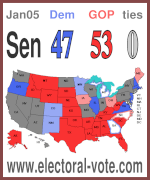
New polls: AK TX
Dem pickups: AK IA ME NC OH
GOP pickups: (None)
The Bond Market Is Not Happy
Actually, it is worse than that. The bond market is in turmoil, and that has political implications for November. Here is a quick primer. The federal government is spending far more money than it takes in via taxes, so it has to finance billions of dollars of spending by selling treasury bills, notes, and bonds, the difference between those being the time to maturity. Treasury bills are for a year or less and don't pay interest, so they are sold at a discount and pay face value at maturity. Notes (< 20 years) and bonds (≥ 20 years) pay a fixed (coupon) interest twice a year and are auctioned off. The interest rate is fixed for the entire term. Normally, they go for roughly face value. In all cases, the government effectively tries to set the interest rate, although if it is set too low, there may not be enough buyers and the auction fails.
Once these instruments are initially sold, investors can buy and sell them on the secondary market. There, investors set the effective interest rate. If investors try to sell old bonds that pay 2%, nobody will buy them at face value, so they have to be sold at a discount. If a $1,000 bond that matures in a year sells for $980, the buyer will make $200 in principal increase and $200 in coupon interest for an effective 4% yield. Thus the bond market, not the Fed or the Treasury, sets the effective interest rate on the secondary market. Nevertheless, the Fed keeps a close eye on the bond market before making its decisions.
Right now, the bond market is in bad shape, with bond prices dropping rapidly and thus effective interest rates (yields) rising. Those higher yields affect the public by driving the interest rates on credit cards, mortgages, car loans, and other loans up. Think of it this way: Why should a bank loan a home buyer money to buy a house at 4% if the bank can make 6% just buying government or corporate bonds with little risk? At the moment, the bond market is nervous due to wars in Iran and Ukraine, inflation fears, Donald Trump's nuttiness, and other factors, and the result is going to be that people will be paying higher interest rates soon. Right now, a 10-year treasury bond, which affects mortgage rates, has a yield of 4.80%, with virtually no risk if you hold it to maturity. A 5-year bond, which affects car loans, is at 4.55%. Needless to say, higher costs for borrowing money at a time when affordability is going to drive the midterms is not good news for the in-party, the Republicans.
The problem is also feeding on itself. With food, gas, and other prices high, people temporarily "manage" by borrowing the money to pay the rent and put food on the table. "Borrowing the money" can be using credit cards, taking a second mortgage, or some other construction, but all of them are seeing higher interest rates due to the bond market. So just when money is tight for many people, the cost of filling the gap with a loan is also going up. Most people don't understand the how the bond market works, but they do know they are being squeezed and it is getting worse. Unhappy people often express this at the ballot box by blaming the president and voting for the other party.
Treasury Secretary Scott Bessent is trying to drive bond prices back up (and yields down) by having the Treasury buy back some bonds. Fewer available bonds means the remaining ones are scarcer and their value goes up. But Bessent can't buy enough bonds to fight the bond market. The total value of outstanding federal bonds is $40 trillion. He can buy a few billion, no more. Unfortunately, there is not much else Bessent can do before the midterms (or after). Bond guru Ed Yardeni said of the bond market: "It's certainly a political problem. And Bessent's holding the hot potato." Trump can't solve the problem by firing Bessent. He is one of the few Cabinet officers who is actually qualified for his job. A replacement wouldn't do any better, though it might be interesting to see Secretary of Everything Marco Rubio try. (V)
Trump Has a Strategy: Outrun the Law
Donald Trump has a strategy he must have learned from the Internet: Move fast and break things. Trump knows from long experience that the courts are horribly slow, often taking many years to adjudicate anything. He is exploiting that to the hilt in many ways. Congress has the power to levy tariffs, but he just does it himself, begins collecting them, and it is a year or more before the courts get around to saying: "You can't do that." He destroys agencies Congress created and by the time the courts get around to deciding what to do, the agencies are gone.
The latest example is the ballroom. Trump has a 250-person crew working 20 hours a day, 7 days a week to complete the ballroom. The Supreme Court has ruled that one preservation group suing to block construction didn't have standing to sue, but it went out of its way to say that it hasn't ruled on the merits of the case. By the time it does rule, the construction may be (almost) complete. Suppose the justices rule that it is illegal. Then what? Will they order it torn down? Very unlikely. Will they fine or imprison Trump for breaking law? Impossible. He will simply have outrun the law—again. If the Court does eventually rule that he had no authority to tear down the East Wing in the first place, conceivably he could be subject to civil suits for damages after he leaves office. If the Court rules that a president can knock down part of the White House just because he wants to, that is practically an engraved invitation to the next Democratic president to knock down the ballroom.
This strategy seems to work for Trump, so expect more of it in the future. If Democrats take over Congress in January, Trump will know that he won't be able to get any of his pet projects through Congress, so he will probably double down on his strategy: Just do it, get sued, and try to finish the project before the courts rule he didn't have the authority to do it in the first place. In many cases, there is no practical way to undo it. For Trump, having the project completed, even if there is a piece of paper saying it wasn't allowed, is good enough. (V)
More on Mail-in Ballots
Yesterday, we noted that (V) and (Z) independently came to the conclusion that the Venezuela oil deal will fizzle and will almost certainly not make a noticeable change in gas prices soon and probably never—several days before the rest of the media world figured this out, too. We try to be fair and balanced, so how about an item where (V) and (Z) are a little further apart?
(Z) wrote an item about the midterms suggesting that the administration's incompetence would save the day for democracy, in part because the lower courts are upholding the rule of law. (V) is a little less sure of Trump and his minions obeying the courts and is a big fan of a remark often ascribed to Thomas Jefferson "Eternal vigilance is the price of liberty." But whether it was Jefferson or someone else, it was never more true than now.
Voting by mail is not new. It was used before the Civil War. But Donald Trump thinks it helps Democrats and is doing everything he can to block it, even though he votes by mail and some Republicans think mail-in voting is actually a net plus for Republicans, the party of older and rural voters. The latest skirmish in the voting wars is Donald Trump's XO ordering the USPS to refuse to deliver absentee ballots unless the voter is in a federal database that isn't even ready yet and which could not possibly constructed before early voting starts this month. Having the president order the USPS to reject properly franked mail that meets all USPS size, weight, and content requirements is unpresidented and almost certainly illegal.
Bolts Magazine asked readers to send in questions about this and now has published some answers. Considering the salience of the issue, here are the questions and summaries of the answers.
- What are the new USPS policies?: One new policy is not postmarking mail the day it is
deposited in a mailbox. It may first be shipped to a facility hundreds of miles away and postmarked there. This matters
for voters who mail in their ballot on Election Day, only to have it postmarked after Election Day and then rejected.
This is a real possibility, especially in rural areas. In the Aug. 4, 2026, primary in Washington State, 5% of the ballots in Yakima County were
rejected due to late postmarks (up from 1% in 2024).
A second change is due to the XO. A new USPS rule says the service will deliver ballots only to people on the federal list of approved voters. All the blue states have refused to share the voter lists with the feds. Given the complexity of this and the ever-changing voter lists, it is inconceivable that the federal lists would be complete and up to date. The feds will need substantial time to process the lists, which means voters who register after the lists are sent will not be on them, even if the registration is legal under state law. - Are the new rules legal?: Almost certainly not. Leah Aden of the NAACP legal defense fund
said "Federal statutes governing the USPS do not permit the agency to pick and choose who can vote by mail." State law
determines that. There have been two lawsuits so far, and while the rule has been blocked for the moment, U.S. District
Judge Indira Talwani is holding a hearing on them today. Once early voting starts, in some states in 2 weeks, the
legality of one set of rules for some states and a different set for other states will be contested.
- Are the new rules feasible?: Elections experts say the XO is illegal and many say even if
the Supreme Court upheld it today, it couldn't possibly be implemented on time. Such a complex system would need months
of trials and tests to make sure it worked correctly. Just to name one small point, every state, sometimes every county,
maintains its data in whatever format it wants. Converting this to some standardized federal format would take weeks,
maybe months, with many corner cases. Suppose the federal format for a name is John L. Smith but a state has a John L.
Smith, a John L. Smith Jr. and a John L. Smith III but the federal format doesn't recognize suffixes. Or someone's name
is Abdulrahman M. El-Sayed and the federal format doesn't allow hyphens in names. There is a long list of things that
could go wrong.
- What can voters do now?: As to the postmark, either mail in the ballot a week in advance
or request a postmark on the spot at a post office. As to the XO, voting early in person might be the best defense. At
the very least, keep informed of developments in the cases.
- What if you live overseas?: A federal law created a thing called a
Federal Write-In Absentee Ballot
(FWAB) that may be applicable in some cases. It can be mailed in before the absentee ballot is received. In some states
it can be faxed or e-mailed in.
- Who can even get a mail ballot?: It varies by state. There are three categories of
states: (1) all-mail-in states, (2) no-excuse states, and (3) excuse-only states. There are eight all-mail-in states, 29
no-excuse states, and 13 excuse-only states, mostly in the South. The acceptable excuses vary by state and may include
disabilities, being out of state on Election Day, and other reasons.
- What could states do in response?: States have no control over the USPS. Given enough
time to plan for it, states could contract ballot delivery out to UPS, FedEx, or other delivery services. They could
allow people to pick up their ballots in advance at their leisure. But these plans could not be done in 2026. Maybe in
2028, though. States do have some control over the returned ballots. Some state election officials go to the local post
office every day to pick up returned ballots, eliminating one kind of delay. Many states have drop boxes or locations
where ballots can be returned, completely bypassing the USPS.
- Do states with an all-mail voting system have a plan B?: These states do operate polling
places where ballots can be brought. They could be remodeled as polling places, but not at the last minute. They could
use private carriers, but again not at the last minute. This problem keeps election officials awake at 3 a.m.
- Can you print out your ballot at home?: California allows this. So does King County, WA.
Other counties could also investigate it if the USPS became a bottleneck. Scanning the home-printed ballots accurately
would be a bigger problem than with official ballots on heavy cardstock. New scanners might be needed. The security
aspects would have to be worked out, but the combination of print-your-own-ballot and bring-your-ballot-to-a-dropbox
would get the USPS out of the loop altogether;
- What is the justification of for these changes?: Donald Trump claims illegal aliens are voting in great numbers, but this is simply a lie. The reality is that he thinks Democrats use mail-in voting more than Republicans and that by banning the practice, it will disenfranchise more Democrats than Republicans. What he misses, though, is that Democrats tend to live in cities and could vote in person if forced to. Elderly rural Republicans far from the county seat might simply not be able to vote, especially if they lack transportation.
This story is far from over and may well run into 2028. If Democrats capture both chambers of Congress, they could put something in a must-pass bill about this—for example, banning this kind of monkey business by law. (V)
Trump Isn't the Only Player Trying to Rig the Midterms
As noted yesterday and above, Donald Trump is trying to disenfranchise as many Democrats as he can. But he is not the only one playing this game. Some states are doing it as well. That's federalism. Tarrant County, which includes Fort Worth, and is the third most populous county in Texas, after Harris County (Houston) and Dallas County (Dallas--did you expect San Antonio?) is also doing it. The stunt here is reducing the number of polling places form 316 in 2022 to 224 this year. The county's governing board made that decision on Tuesday. It was a 3-2 party-line vote, with Republicans voting for the cut and Democrats opposing it. There have been public hearings about this for months, with widespread public opposition.
The reason the Republicans gave is saving money. The real reason may be county demographics: 40% white, 31% Latino, 19% Black, and 7% Asian. Although Gov. Greg Abbott (R) won the county in the 2022 gubernatorial election, it was close, 51% to 47%, and the demographic trend is away from the Republicans. The board may be worried that in a blue wave, Democrats could win the county.
What is unsaid here is which polling places will be shut down. The board will undoubtedly do most of the closings in Black and brown areas, requiring Black and brown people to travel father to a polling place and wait longer in line to vote. Polling places served by local bus lines could be closed but those father out requiring a car to get to, could be spared.
This plan is complementary to the one above. In the above plan, the idea is to ban mail-in voting, forcing people to vote in person. This part of the plan is to make voting in person difficult in very carefully selected areas, naturally to maximize the Republican vote and minimize the Democratic vote. (V)
The Lame Duck Is Being Fattened for Christmas
Congress is very dysfunctional, but some things really need to be done. These include funding the government, paying for the war in Iran, replenishing all the munitions used up in the war, and variety of other "must-pass" items. The trouble is that many of them are controversial and Speaker Mike Johnson (R-LA) doesn't want to bring them up for votes before the midterms because Democrats will use the votes against House candidates.
So it is increasingly clear that there will have to be a lame-duck session of Congress after Nov. 3 to get this stuff done. But more and more items are being put off to be handled in a short lame-duck session in which members who have been defeated will still get to make major votes. If Democrats win the House, they may not be willing to make deals in November or December, and important items could be pushed into January.
There is the $1.5 trillion Donald Trump has asked for defense, but also aid for farmers. They are struggling with drought, tariffs, and fertilizer prices. Joe Biden's Inflation Reduction Act pumped the majority of its money into rural areas—and those areas rewarded the Democrats by overwhelmingly voting for Trump in 2024. Democrats might just decide that farmers aren't a priority anymore and that lowering tariffs and importing food from Brazil is better idea. While Republicans could pass some items using budget reconciliation, that is a time-consuming multi-step process and Democrats could slow it down. Other items (like regulating crypto) can be filibustered. If Democrats pick up 20+ House seats and control of the Senate, they are not going to be keen on giving the Republicans a last hurrah in December.
In short, although it depends to some extent on the election results, the lame-duck session is likely going to be a big mess. (V)
The Lindsay Graham Russia Sanctions Bill Is Stuck in the House
One of the causes the late Lindsey Graham believed in was punishing Russia for invading Ukraine. To honor him, the bill piling on more sanctions to hurt Russia was named the "Lindsey O. Graham Sanctioning Russia Act," and passed the Senate by a vote of 86-11. Usually, the only bills that pass by nearly 8:1 margins are those renaming post offices.
The bill went over to the House, where it is now stuck. GOP leaders said it would not be voted on this week, and gave no date when it might be voted on. Chair of the House Rules Committee Rep. Virginia Foxx (R-NC) said that the Committee met and no one brought it up. When ask whether it would pass the Committee, she said "I have no idea." Speaker Mike Johnson (R-LA) was noncommittal about its chances of passing the House.
There are several problems with the bill. One that is a big one for House Democrats is that the sanctions bill does not actually impose any sanctions. After all, why would a bill to sanction Russia actually list the sanctions? Instead, it gives the president the authority to impose sanctions. Some Democrats don't want to give Donald Trump any more power than he has already taken. It is also possible that Trump has let it be known that he doesn't want to get his buddy Vladimir angry with him, so forget the bill altogether. And there are Freedom Caucus members who are against everything as a general principle. So it is possible the bill will never get a vote. Not much of a memorial to Graham. (V)
El-Sayed Has a Hasan Piker Problem
Hasan Piker is a left-wing activist who is widely accused of being antisemitic in his Twitch streams and interviews. For example, Rep. Ritchie Torres (D-NY) wrote a letter to Amazon, which owns Twitch, that includes this paragraph:
Hasan Piker has emerged as the poster child for the post-October 7th outbreak of antisemitism in America. Mr. Piker has demonized Orthodox Jews as "inbred" and has dehumanized a Jewish man as a "bloodthirsty pig dog": the association of Jews with pigs and blood-thirst is textbook antisemitism. Mr. Piker has all but exposed himself as an apologist for the sexual violence and savage rapes of October 7th. "It doesn't matter if rape happened on October 7th. It doesn't change the dynamic for me," Mr. Piker declares before finally admitting that "Palestinian resistance" (his euphemism for terrorism) is not perfect."
Then it goes on from there, accusing Piker of supporting the Houthis and other terrorists and encouraging men to date-rape women on college campuses. Here is the entire letter.
Piker also said that Jewish Americans who support Israel have themselves to blame for any violence that may befall them. That sounds a lot like excusing it, maybe even encouraging violence.
One might think that politicians would steer clear of this guy. But Piker campaigned for Michigan Senate candidate Abdul El-Sayed (D) in the primary and despite pressure to disavow Piker, El-Sayed, who has also been accused of antisemitism, has refused to do so. This has rubbed some Michigan voters the wrong way, especially after a Hezbollah-inspired attack on the largest Jewish temple in Michigan earlier this year. El-Sayed wants those voters but also wants Piker's fans, so he is trying to walk a fine line here. He also doesn't want to come across as a flip-flopper. Still, he is being very careful not to denounce Piker. El-Sayed said that Piker is just a streamer from California who does not speak for his campaign. But he did invite Piker to Michigan to campaign for him. It looks like he wants the antisemitic vote but without saying he wants the antisemitic vote. It's tricky.
A recent poll from Michigan State University shows the problem: El-Sayed is underperforming the other top Democrat on the ballot. Democrat Jocelyn Benson, who is running for governor, is leading her Republican opponent by 10 points, 49% to 39%, while El-Sayed is leading his Republican opponent by only 4 points, 48% to 44%. Clearly there are an appreciable number of Democrats El-Sayed has not won over. There is also a generational issue here. Benson does best with older voters while El-Sayed does best with younger voters. But there are more older voters than younger ones, so the net result is a landslide for Benson and a close race for El-Sayed. (V)
Today's Senate Polls
Today we have the two biggest states. Also the two closest states. Although the name Alaska Survey Research is new, this is really Ivan Moore's polling company, which has been doing this for 30 years. Only the name is new (and all the attention, since the Alaska Senate race is very competitive). Alaska is tough to poll because it is so spread out and not well wired, so we are glad there is one pollster in Alaska who knows the ropes there.
There are two "ties" today. One of them stands out pretty clearly on the map. The other is Nebraska, where there has been only one poll (back in May), in which independent Dan Osborn was ahead). Since Osborn refuses to say which party he will caucus with if he wins, we are scoring that as a tie. We hope some Nebraska media outlets will sponsor more polls. This race could be competitive.
| State | Democrat | D % | Republican | R % | Start | End | Pollster |
| Alaska | Mary Peltola | 51% | Dan Sullivan* | 49% | Aug 20 | Aug 23 | AK Survey Research |
| Texas | James Talarico | 50% | Ken Paxton | 50% | Aug 24 | Aug 26 | Overton Insights |
* Denotes incumbent
Previous | Next
Main page for smartphones