Previous | Next | Senate races | Menu
New polls: MI NC OH
Dem pickups: AK IA KS ME NC OH TX
GOP pickups: (None)
Ossoff is Raising Money for OTHER Democrats
It is not uncommon for politicians to raise money for other candidates—but not when they themselves are up for reelection. After all, your own reelection takes priority. It does happen occasionally, though, under special circumstances. Most commonly, that happens when the politician is not on the ballot this year and is planning to retire rather than run again. See next item for an example.
On the other hand, Sen. Jon Ossoff (D-GA) is doing something very odd: He is raising money for other Georgia Democrats, especially Keisha Lance Bottoms, who is running for governor of Georgia, and the Georgia Democratic Party, which is in a better position to judge which other Georgia Democrats need help.
How come? We can think of six reasons:
- He is very confident and thinks his own reelection is a done deal and he doesn't need to advertise or campaign much
anymore, although joint appearances with other Democrats are a form of campaigning.
- He wants to create a Democratic Party machine in Georgia, a state critical to the Democrats' hopes in 2028 and
especially beyond, after the 2030 census.
- Working to help other Democrats brings in a lot of goodwill with the voters. Someone who works for the whole team is
positively viewed. Also, the opposite. Rep. Jasmine Crockett (D?-TX) lost the Senate primary to James Talarico and is
now endorsing and campaigning for other Texas Democrats—except Talarico. How do you say "sore loser" in Texan? You
can be sure this "omission" will come up in the primaries if she ever runs for public office again. By contrast,
candidates Ossoff is helping will surely remember his help later on.
- Bottoms is Black and if she wins, he hopes Black voters will remember who was there for her when she needed
help.
- Even if Bottoms wins, Ossoff may be seen as the leader of the Georgia Democratic Party. He will be viewed as an
experienced pol with a lot of clout and she will be seen as a rising star, but not the state party leader
yet.
- It is increasingly obvious that Ossoff is seriously contemplating a presidential run in 2028. In addition to the goodwill and visibility with Black voters—who will play an outsized role in the nomination if the Democrats get their druthers and South Carolina goes first (which is not certain yet because New Hampshire law says it must have the first primary)—having a Democratic governor who owes him one can't hurt in the 2028 primaries or general election.
In short, Ossoff is making the point that the Party can count on him and also doing what he needs to do to get a running start in 2028. (V)
Bernie Sanders Got Out His Checkbook
Sen. Bernie Sanders (I-VT) is not always seen as a team player. After all, he isn't even technically on the blue team. He is more on the green team, and some of the candidates he has supported in the primaries have not been the ones the Democratic leadership wanted. That was particularly the case in NYC House races where he backed a DSA candidate the leadership Did. Not. Want.
All may be forgiven now. He has a vast ($23 million) war chest and is starting to spend it, probably because he will be 89 in 2030 when he is next up and is unlikely to run then. So why not spend money now to help lefty candidates? This time, since it is the general election, he is not crossing the party leadership. While the pooh-bahs didn't want Abdul El-Sayed (and other DSA or DSA-adjacent candidates) to win their primaries, they very much want them to win their general-election battles, and having Sanders' money and help is very welcome. So the Democratic leadership is pleased as punch with both Ossoff and Sanders, even though their motivations are opposite (Ossoff is definitely running again and wants the goodwill while Sanders is probably not running again and wants his type of candidate to win as his last hurrah).
Besides El-Sayed, Sanders is helping Senate candidates Peggy Flanagan (MN) and Angie Nixon (FL) as well as Keith Ellison, who is running for reelection as Minnesota AG and undoubtedly has future plans for higher office some day. Not only is Sanders giving money to his favored candidates, he is also working on GOTV (get out the vote) campaigns for some of his candidates. This is especially important for candidates with little experience running high-profile statewide campaigns, something Sanders knows a lot about.
In addition to the money and GOTV efforts, Sanders, at 85, is a tireless campaigner and is out on the trail for House and Senate candidates he likes. For House candidates like Randy Villegas, running in CA-22 against David Valadao, and Aisha Wahab, who won the special election in CA-14 for the seat vacated by the disgraced Eric Swalwell, Sanders' presence at a rally is a huge draw the candidates could otherwise never get.
What Sanders is not doing is transferring money to the DSCC. That committee might spend it on James Talarico in Texas or Mary Peltola in Alaska. While Sanders certainly hopes they win (so the Democrats take the Senate), he is saving his firepower to help left-wing candidates, and neither Talarico nor Peltola is in that bin. An outsider might say Sanders would be most effective helping in deep-red states (like Texas and Alaska), rather than places like Minnesota, which Flanagan can probably win on her own, but that is not his plan. Giving money to Nixon in Florida strikes us as a couple of bridges too far for him, but would be a bigger feather in his cap than Yankee Doodle's if he can pull it off. In politics, sometimes you take risks. It comes with the territory.
Republicans are trying to make Sanders into a boogeyman, but that is not likely to work. After all, he is a straight old white guy and they don't demonize well. The voters don't associate straight old white guys with left-wing politics and his main pitches have been for doubling the minimum wage and making sure everyone has health care. There is actually plenty of support for those positions. (V)
Data Centers Are Front and Center in the Midterms
Somewhat surprisingly, data centers are now right up there with affordability as a top campaign issue. Polls show this, and spending confirms that the candidates have absorbed the message. A recent poll of the 37 most competitive House districts, sponsored by the Cook Political Report, shows that 85% of the voters in these districts have heard about data centers and half have heard a great deal about them. And they don't like what they have heard. Only 28% want one in their community and 63% are opposed, with 44% strongly opposed. Campaigning on something 44% of the voters strongly oppose is generally not seen as a smart strategy. Even among Republicans, a slight plurality (48% to 44%) opposes new construction. Among swing voters, it is much worse, 69% to 17% in opposition. The poll also showed that among swing voters, 64% are worried about the risks of AI whereas only 9% are excited about the opportunities presented by AI. Yet Donald Trump has actively supported more data centers. How's that for being tone-deaf?
Democrats get it (finally). They have spent $38 million on ads opposing data centers. What is especially interesting is the content of the ads. Sure, they take aim at electricity and water rates and the unsightliness of the data centers, but they go way beyond that. Many of the ads attack corporate greed, transactional politics, and the sheer bulldozing of community sentiment (typically when a town council approves a data center in return for a token gift to the local police or fire department and against the strong wishes of the residents as expressed in public hearings).
For example, in PA-08, an R+4 district represented by Rep. Rob Bresnahan (R-PA), challenger Paige Cognetti ran an ad saying: "Big companies have come before. Taken what they wanted and left us with their mess to clean up. Now it's data centers." PA-08 is coal country, so people there know a thing or two about business interests who make a mess and then pack up their things and go home. Cognetti's ad, and many others, are not about the price of electricity, but a direct attack on big (tech) companies, which have rarely been as unpopular as they are now. Very occasionally, it goes the other way, with Rep. Mike Lawler (R-NY), who is in a tough fight in his D+1 Hudson Valley district, attacking challenger Cait Conley's past work for an AI company.
Republicans know all this and want Trump to pipe down about data centers and AI, but he knows better than they do, so no dice. (V)
Midterm Waves for the Out Party Are Normal
Nate Silver's FLIPR model updates every day as new data come in. The biggest single factor in the model is the generic House poll. That has been on a steady march in a Democratic direction since March, probably due to the war in Iran, gas prices, diesel prices, data centers, Donald Trump's approval rating, and more. Here is the daily generic House poll over time:
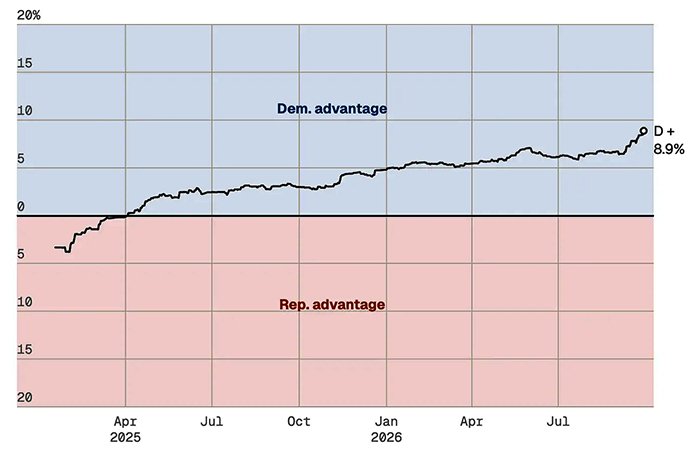
The current value is D+8.9. For the record, there are 87 Republican-held House districts between EVEN and R+8 (inclusive). This definitely does not mean that all of them will flip in November. Candidate quality, campaign quality, funding, local issues and more always play a role. Also, the vote distribution is important. Getting 65% of the vote in California doesn't win Ohio House seats. Still, if the popular vote for the House is close to 9 points in favor of the Democrats, many of these seats will be in play and there will be a strong blue wave—if nothing changes between now and Nov. 3.
Also in this vein, Larry Sabato's Crystal Ball yesterday shifted 11 more House races toward the Democrats. Most noteworthy are PA-07 (Ryan Mackenzie, R) and VA-02 (Jen Kiggans, R), which now lean toward the Democratic challenger. Also, in VA-01, Rep. Rob Wittman (R-VA) is now in a tossup race instead of one that favors him.
Now on to the Senate. Silver's model had the Senate at 50-50 as of Labor Day, but has since moved in favor of the Democrats. Look:
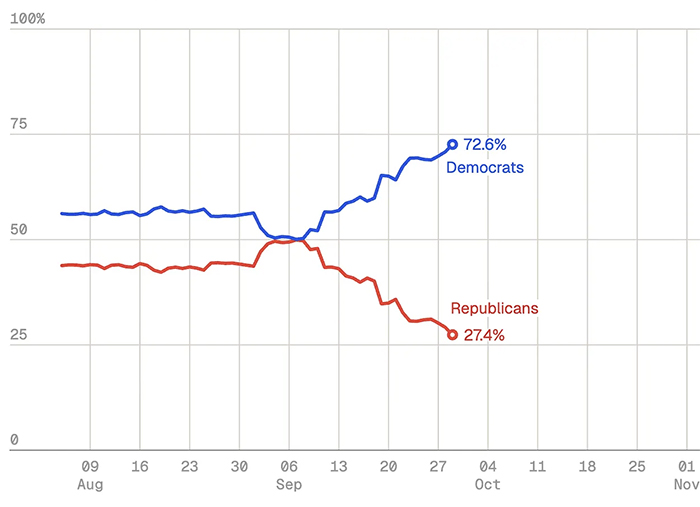
The Senate model is clearly reacting to the strong Democratic polling in Alaska, Iowa, Kansas, Maine, North Carolina, Ohio and Texas over the last month. Our (polling-based) model also has the Democrats taking the Senate, with one or two seats to spare, depending on whether Sen. John Fetterman (D?-PA) jumps ship.
Could Silver be way off? Sure, and 27% is better odds than getting "heads" twice in a row when flipping a coin. Also, the Decision Desk model has the chances of the Democrats taking the Senate at 54%.
Additionally, history shows that the "out" party generally (but not universally) does better than the president's party, with the number of Senate seats lost depending on how many the "in" party is defending. Here are the historical data:
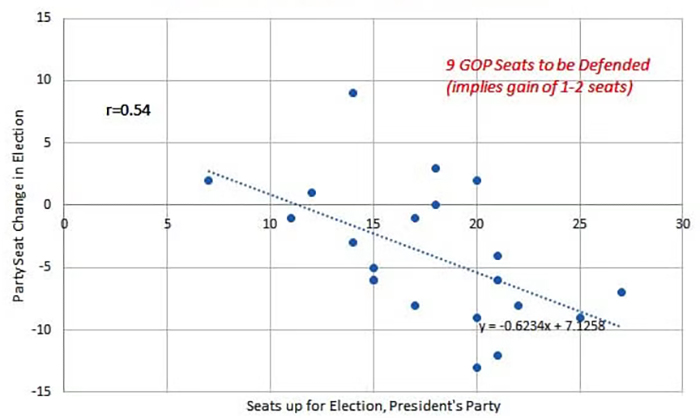
The correlation is looser here than for the House (where the president's party has lost seats in every midterm since World War II except 1998 and 2002). The Republicans are defending 22 Senate seats this cycle. From the regression line, that would project out to a loss of six seats for the Republicans. They have 53 now, so the historical norm would be for them to have 47 in January. We currently have them at 45 with two ties. But one of the ties is in Nebraska, which seems like a long shot to us. The other is Minnesota, which we expect Peggy Flanagan to win. That would put the Republicans at 46, close to the historical average loss. Still, in politics, a week is a long time and the election is over a month from today. (V)
Three Surprising Midterm Themes
The Wall Street Journal has a short item about three surprising themes we are seeing in the midterms. None of these were on the radar at the start of the summer:
- Ticket Splitting: For years now, everyone assumed ticket splitting had gone the way of
the dodo—dead and not coming back. But that conclusion now seems to be a bit hasty. In a number of states, the
races for senator and governor seem to be diverging. The most surprising one is Texas, where James Talarico has
maintained a consistent lead of a few points over Ken Paxton. At the same, the
Real Clear Politics average
has Gov. Greg Abbott (R-TX) leading Gina Hinojosa (D) by 2.3 points. That is not a Texas-size lead, but it does show
that some, and perhaps many, Texans are going to split their votes.
In Georgia, Sen. Jon Ossoff (D-GA) is crushing it, but in the race for governor, Rick Jackson (R) is ahead of Keisha Lance Bottoms by 0.7 points. That is a 10-point spread with the Senate race.
In New Hampshire, Rep. Chris Pappas (D-NH) is leading former senator John Sununu (R) by about 6 points. On the other hand, Gov. Kelly Ayotte (R-NH) is demolishing Cinde Warmington (D) by nearly 12 points. That is an 18-point spread.
In Ohio, it is not so extreme, but while Sherrod Brown is consistently ahead of Sen. Jon Husted (R-OH), Vivek Ramaswamy (R) is leading Amy Acton by about 1 point.
Of course, there are also states where both top races are heading the same way.
- Republicans Are Divided:
We are starting to see Republican candidates
separating
themselves from Donald Trump in a way that would have been political suicide just a few months ago. Just ask
soon-to-be-former Rep. Thomas Massie (R-KY).
Rep. Maria Elvira Salazar (R-FL) made a direct-to-camera ad directly criticizing Trump on account of his immigration policies. He lashed out at her, but she didn't back down. Sen. Susan Collins (R-ME) is more than concerned—she is actually angry—with Trump about his tariffs on Canadian products since that hits her state hard. Reps. Tom Barrett (R-MI), Warren Davidson (R-OH), Brian Fitzpatrick (R-PA) and Mariannette Miller-Meeks (R-IA) are angry with Trump about Iran and want the war there over. Rep. Ashley Hinson (R-IA) has attacked Trump's plan to import cheap beef, something Iowa ranchers are wildly opposed to. Sen. John Curtis (R-UT) wants Congress to investigate all of Donald Trump Jr.'s business dealings. Donald Trump Sr. is not so keen on that. Florida gubernatorial candidate Byron Donalds (R) has removed mentions of Trump's endorsement from his campaign literature. In the next month, if desperation sets in, there could be more.
- Democrats Are United: For once, Democrats are not in disarray. Moderates, liberals and progressives are all pulling in the same direction and trying to take over the House and Senate. All of them—except sore-loser Jasmine Crockett—are supporting Democrats up and down the line, even candidates they strongly opposed earlier in the year. It is an amazing sight to see. Enjoy it until Nov. 4, when the 2028 presidential race starts and everybody on the blue team will immediately be at everybody else's throat. But for the midterms, it is all roses and rainbows.
Not mentioned in the WSJ article is the rise of AI and data centers as big issues that no one saw coming. (V)
Everybody's Numbers Dropped
Donald Trump's midterm convention brainchild probably didn't have the effect it was supposed to have: helping Republicans, especially in Texas, where the convention was held. At least one Texas Republican, Ken Paxton, certainly doesn't think it did. Paxton was caught earlier this week on a hot mic saying: "So to be honest with you, the numbers—when we did that convention—it dropped our numbers. Everybody's numbers dropped. Right now, yeah, not good." This was in response to a question about whether the convention helped him.
Trump, of course, thinks different. His response to a question about the convention was: "I think the fact that we had such a successful convention really helped Ken Paxton. He was a big part of it." Pity Paxton doesn't think it was so great. The data suggest Paxton has the right of it. In the generic House poll (graph above), Democrats have expanded their lead since the convention. It wasn't supposed to work like that.
Part of the reason Paxton didn't gain anything from a convention in his home state is that during his speeches at the convention, Trump mocked Paxton multiple times. In fact, the President has continued to do that post convention. For example, Trump recently said: "Some people don't like the way he dresses, or some people don't like the way he interviews or talks." What is the point of denigrating your own candidate? How does this help the Republicans? Maybe Occam's razor applies here. Trump greatly values people who look good on television, and Paxton certainly does not. Maybe he doesn't like the fact that Paxton is even more corrupt than he is, and Trump wants to be the champion at everything. It makes no sense, but since when do Trump's (m)utterances make sense? (V)
Thune Tried to Throw a Lifeline to Jon Husted, but It Missed
Senate Majority Leader John Thune (R-SD) understands that the red team is in deep doodoo and is trying to rescue some of his endangered members. Yesterday, Thune forced a floor vote in the Senate on a bill concocted by Sen. Jon Husted (R-OH), who is trailing former senator Sherrod Brown in most recent polls. The bill would order state utility commissions to consider the effects of data centers on electricity rates. Democrats felt it was much too weak and just grandstanding. The bill failed 57-43, with four Democrats joining with all the Republicans. The bill previously passed the House but is now dead for this session of Congress. The net result is Husted cannot now crow about how he led the charge to lower electricity rates, which was the point of the whole exercise.
Republicans still want to do something to pretend they care about lowering prices, but they can't figure out what to do and the House has recessed until after the midterms. Sen. Josh Hawley (R-MO) wants to throw everything but the kitchen sink at the problem in the hope something works. He wants to cut the federal gas tax, ban diesel exports, cap the price of insulin, and more, but there is basically no time left and even the other Republicans don't agree on what to do. Thune was more realistic and said that nothing would help until the Strait of Hormuz is open again, but that is up to Iran, not the Senate, and Iran is not about to play ball. Time for supernegotiator Jared Kushner to find a phone booth, change uniforms, and get on it. What? There are no more phone booths? Oops. Very likely, Congress will do nothing between now and the midterms—and Republicans will suffer the consequences. (V)
Today's Senate Polls
The Democrats are ahead in Michigan and Ohio consistently. Unless something changes between now and Election Day, they are probably favored. North Carolina seems to be a done deal. Cooper is much beloved in North Carolina. Maybe in 2028, he could resign from the Senate and run against Sen. Ted Budd (R-NC). Then Gov. Josh Stein (D-NC) could nominate some prominent Democrat to Cooper's seat.
| State | Democrat | D % | Republican | R % | Start | End | Pollster |
| Michigan | Abdul El-Sayed | 50% | Mike Rogers | 49% | Sep 24 | Sep 28 | Beacon + Shaw |
| Michigan | Abdul El-Sayed | 51% | Mike Rogers | 44% | Sep 24 | Sep 27 | Marist Coll. |
| North Carolina | Roy Cooper | 48% | Michael Whatley | 37% | Sep 04 | Sep 15 | YouGov |
| Ohio | Sherrod Brown | 47% | Jon Husted* | 44% | Sep 23 | Sep 27 | Suffolk U. |
* Denotes incumbent
Previous | Next
Main page for smartphones