Previous | Next | Senate races | Menu
New polls:
Dem pickups: IA KS ME NC OH SC TX
GOP pickups: (None)
The End of an Era
Harold Wilson was wrong. He said: "A week is a long time in politics." The new slogan should be: "A day is a long time in politics." And what a day it was. If, back in January 2026, anyone had openly said: "Democrats will capture the House, the Senate, a majority of governorships, and will romp up and down the ballot in Texas," observers would have gotten on their phones to call for the men in white coats to come pick up a new patient.
Where to begin? Let us look at some of the themes and broader takeaways from what happened on Tuesday
- Shellacking: In 2010, Barack Obama was humbled by the
"shellacking"
his party took in the midterms. Donald Trump is never humble, but boy, oh boy was this a shellacking. Up and down the
line. The Senate, the House, governorships, statewide offices, state legislatures and more. It wasn't eking out a narrow
win in 10 competitive House districts. Democrats won nearly all the marbles everywhere in everything. And the few places
they lost, it was by inches (like the governorship of Florida and maybe the Senate races in Mississippi and Alaska,
depending how those end). One GOP operative said: "Richard fu**ing Hudson lost his seat." Rep. Richard Hudson (R-NC) is
chairman of the NRCC, the committee whose job is to win House seats for Republicans. He couldn't even hold his own R+8 district.
The chairs of the NRCC and DCCC are always people in seats so safe that they don't need to campaign so
they can spend all of their time raising money for other House members in their party who need help.
Cartoonists are having a field day today:

- Cults: It turns out that cults have a shelf life and when the cultist-in-chief falls, he
takes the whole cult down with him. Republicans are about to learn this the hard way. In 2028, they can offer more of
the same, but the voters don't want more of the same. But that is all the Republicans have. Going back to a kinder,
gentler George H.W. Bush party would be quite a trick. That isn't what the Republican Party stands for anymore. Does it stand
for anything? In 2020, the Republican Party
didn't even bother
writing a platform. It just said: "Whatever Donald Trump wants, that's what we want." That's not a political party.
That's a cult of personality. Does the institutional Republican Party actually stand for anything? It used to stand for
three things:
- Anticommunism
- Free trade
- Small government
Does it still? Well: (1) Trump loves Russia and Vladimir Putin, (2) he loves tariffs and hates free trade and (3) he supports government ownership of the means of production, which is the actual definition of communism. What Trump wants, the Republican Party wants. We don't envy the RNC members assigned the job of writing the 2028 Republican Party platform because the Party doesn't stand for anything anymore. Fixing that is going to be messy. - The Guardrails Held: On Saturday, we wrote about the
nine ways
Trump might try to subvert the elections. On Sunday, we wrote about how the
judiciary
and the
states
would try to stop him. In the end, the landslide, tsunami, avalanche, or whatever you want to call it was so great, even
Trump saw it was futile and didn't resist. He had no chance and even he knew it. Nevertheless, being vigilant was not a
luxury. Thomas Jefferson didn't say: "Eternal vigilance is the price of liberty," even though he knew that in his bones,
but it is just as true as if he had coined the phrase, which has an ancient history. The guardrails held this time, but maybe, just maybe, it is time to rebuild
them out of titanium wrapped in a shell of graphene for next time.
- Trump's Endorsements: Donald Trump's superpower used to be his power to wave his magic...
wand and bestow victory on candidates by endorsing them (See: Greg Abbott, Susan Collins, Darline Graham, Monica De La
Cruz, Ashley Hinson, Jon Husted, Roger Marshall, Max Miller, Ken Paxton and Vivek Ramaswamy). Oh wait. Maybe don't see
them. They all had that Trump stamp of approval. And they all lost, most of them big time. He also blessed Julia Letlow
and she almost lost. In some cases, such as Graham, Letlow, and Paxton, he personally recruited them and stuffed them
down the elephant's throat, with the elephant gagging the whole time. Do you think Republicans in the next 2 years will
be cowed when Trump threatens them with: "If you do that, I won't endorse you in 2028?" We don't.
- Holy Mills: There are many variants and many purported authors of the saying: "The mills
of God grind slow, but they grind exceeding fine." Boy is that true now. Trump, members of the administration, and
various corporate titans acted like they were undisputed masters of the universe and no one could challenge their might.
As Democrats take over the chairmanships of House and Senate committees, these people are going to suddenly discover the
meaning of the words "accountability" and "hubris." Even the ancient Greeks knew about the latter. It is not a new
concept. If the AG in 2029 happens to be a Democrat, are they ever going to understand that kryptonite is on sale at
Walmart for $1.99/lb.
- Trump's Coalition: Trump threw his coalition in the wood chipper. Maybe democracy isn't
as dead as the dodo, as some people thought. It was just hibernating for a while, got poked in the eye, didn't like that
one bit, and awoke in great fury. The unlikely coalition Trump assembled in 2024 has shattered into more pieces than
Pete Hegseth's precious globe. And it isn't going to be reassembled anytime soon, if ever. It took them a while, but the
voters he seduced in 2024 have discovered the hard way that the pig in a poke he sold them has trichinosis and a bad
attitude. They are heading for the hills.
Look:
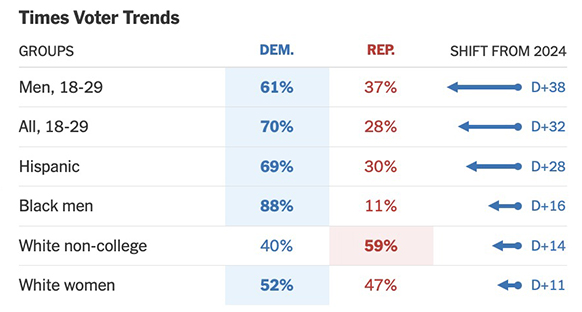
This could be the end of the Age of Trump. And it sure went with a bang, not a whimper.
- Hubris: Democrats read the wrong message into the midterms at their peril. They didn't
win. The other guys lost. There is a huge difference. People don't like the Democrats. Millions of people see them as
weak and woke and think they can't even tell the difference between a boy and a girl. They got more senators,
representatives, governors, and state legislators because the voters thought the other guys were corrupt and raised the
price of gas. That is not a winning formula for 2028.
If they get cocky, they will lose in 2028 because this was not a Democratic wave. It was an anti-incumbent wave. It was a throw-the-bums-out wave. Next time the Democrats could be the bums if they don't deliver—or at least make a convincing case that they tried hard to deliver but the Republicans blocked them at every turn. What the Democrats must resist is impeaching Trump right off the bat. That is not what the voters asked them to do. What they can do is use child psychology on him. Do things that the voters want but they know Trump hates and watch him react as they planned. For example, pass a bill rolling back all of Trump's tariffs and change all the laws giving the president emergency powers to requiring Senate confirmation to declare emergencies. When he vetoes the bill, loudly proclaim: "We tried to lower prices but Trump vetoed the plan. What we need is a Democratic president in 2028 who will sign the bill next time." Ditto with health care and prescription drugs. Pass bills giving huge subsidies for electric cars made in America powered by heavily subsidized American-made home solar panels to reduce transportation and electricity costs. Then exploit the expected vetoes to the hilt.
- Dummymandering: Until we have the final House map, we won't know for sure if the
Republicans drew gerrymanders or dummymanders in the eight states where they tried out their cartological skills.
However, some
initial evidence
shows there were at least some dummymanders in Alabama, Florida, and Texas. The idea was to draw maps where Republicans
had thin margins in many districts instead of solid margins in fewer districts. That would have worked in a D+3 House
election, but this one looks like a D+13 one. The "safe" districts were often packed with Latinos on the assumption they
were Republicans. Surprise. They aren't.
In Texas, the whole project backfired. The Republicans lost four of the five seats the new map was expected to deliver them and they lost two of their own to boot. In TX-23, Katy Padilla Stout (D) beat gun nut and YouTuber Brandon Herrera (R) and in TX-15, Tejano singer Bobby Pulido (D) crushed Rep. Monica De La Cruz (R-TX). The Texas legislature was expecting an 8D, 30R split. They got a 14D, 24R split. And if Democrats get the trifecta in Texas, they could redraw the map again or maybe even pass a law mandating an independent commission to draw both the federal and state maps. Wouldn't that be a kick in the [insert body part here]? But the trifecta is a long shot.
In Florida, there were eight Democrats in the 119th Congress. In January, there will be eight Democrats in the 120th Congress, for a net gain of zero. Florida Democratic Reps. Kathy Castor, Pia Dandiya, and Jared Moskowitz were put in Republican-leaning districts but they all were reelected (or, in Dandiya's case, elected) anyway. In North Carolina, Rep. Don Davis (D-NC) was put in a district that Trump would have won by 12 points, but Davis won anyway.
In Alabama, Rep. Shomari Figures (D-AL) was given an extremely hostile district—and he still won. These are not exactly dummymanders, but more neutimanders. The big dummy this time was Gov. Ron DeSantis (R-FL).
- Diversity: If there is anything that Donald Trump and Stephen Miller hate hate hate it is
diversity—that is people who don't exactly fit in Sarah Palin's idea of "real Americans." But it turns out these
"nonreal Americans" (which a mathematician might call "imaginary Americans") exist and even vote. And some of them
even win elections. And some women, perish the thought, are being elected to run entire states. Look at this list of
governors-elect:
Person State Party Milestone Amy Acton Ohio Democratic First Jewish governor in the Upper Midwest Xavier Becerra California Democratic First elected Latino governor of California Marsha Blackburn Tennessee Republican First female governor of Tennessee Keisha Lance Bottoms Georgia Democratic First Black female governor of any state David Crowley Wisconsin Democratic First Black governor of Wisconsin Byron Donalds Florida Republican First Black governor of Florida Aaron Ford Nevada Democratic First Black governor of Nevada Deb Haaland New Mexico Democratic First Native American woman governor of New Mexico, second overall Gina Hinojosa Texas Democratic First Latina Governor of Texas Amy Klobuchar Minnesota Democratic First female governor of Minnesota
And it doesn't end there. History was also made in Congress:
Person State Party Milestone Annie Andrews South Carolina Democratic First elected female senator from South Carolina Abdul El-Sayed Michigan Democratic First Muslim senator Peggy Flanagan Minnesota Democratic-Farmer-Labor First female Native American senator Hakeem Jeffries New York Democratic First Black speaker of the House (presumably) Chris Pappas New Hampshire Democratic First openly gay male senator
- Cultural Flop: As usual, Republicans tried to use the culture wars and name-calling in
many races—because that's all they had. It didn't work (except in a few ballot measures banning trans girls in girls
sports). Republicans called James Talarico (D) James Talafreako. They called Annie Andrews (D) Trannie Annie. It didn't
work. None of the culture wars stuff worked against candidates.
- Ideological War: The incipient ideological war within the Democratic Party is going to
stop. Yay! Right? Unfortunately for them, it will be replaced by a full-blown ideological war. Progressives will point
to Sens.-elect Abdul El-Sayed and Troy Jackson and say: "See, progressives can win!" Moderates will say: "Yeah, but
apparently not in Florida. Also, Roy Cooper, Adam Hamilton, and James Talarico are not exactly flaming liberals." In
state elections, there doesn't actually have to be a winner in this debate. It's nonbinary. For each state or district,
the candidate should be a good fit for that jurisdiction without worrying whether the candidate is a good fit for
other jurisdictions. For national elections, that trick doesn't work, but there is a different rule: Only
nominate candidates who are a good fit for states that together have at least 270 electoral votes. People making
proposals for candidates should come equipped with maps showing exactly where those 270 electoral votes will come from,
with some history-based evidence.
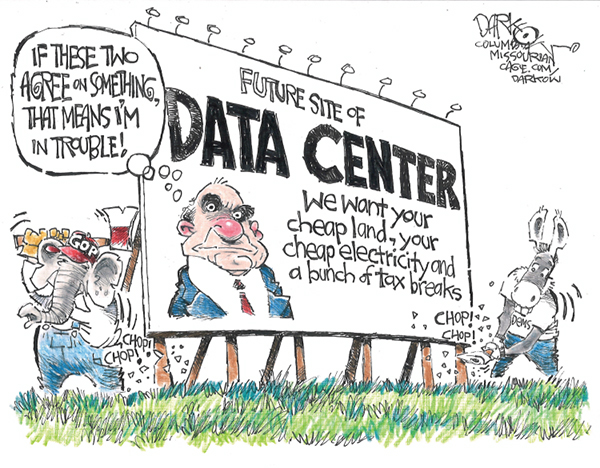
- Data Centers: The tech bros may not like it, but opposition to data centers (and AI) is
now a permanent fixture of campaigns. And it will be both parties targeting them, with the candidate opposing
them the most having the edge.
- Swinging Together: As we have pointed out many times, swing states often all (or nearly
all) go in the same direction in the end. In 2024, Trump won all seven swing states. This time the Democrats won
eight of the nine swing states, namely Georgia, Iowa, Maine, Michigan, North Carolina, Ohio, South Carolina, and Texas,
and might win the ninth one (Alaska) as well.
- The October Surprise: The famous October surprise was a bit late this year. It arrived on
Nov. 4. At the end of counting on Election Day, Scott Colom (D) was leading in the Mississippi Senate race by 28 votes.
We don't know how that one will end, since Mississippi does not have any laws discussing recounts. But the mere fact
that a Democrat—and a Black one at that—could get within shouting distance of a win, even if he ends up
losing by 1,000 votes (and he's actually leading right now by about 1,100 votes, with 98%
reporting), is a seismic shock. And Democrats won Senate seats all over the South, including Virginia, North Carolina,
South Carolina,
Georgia and Texas. They came quite close in Florida and Louisiana. They also won in Kansas, and their proxies came close
in Nebraska and Montana. Howard Dean famously had a 50-state strategy in which he believed that Democrats should
actively field and support candidates in every state. Now it is clear he was sort of right. With well-chosen candidates,
Democrats could run a plausible 40-state strategy. As Wayne Gretzky observed, you miss 100% of the shots you don't take.
This is a very important message. Also for the Republicans. Gov. Phil Scott (R-VT) got another term because he is a nice
guy and a good match for his state. Gov. Kelly Ayotte (R-NH) also got another term because she is a nice gal and a good match
for her state. There is a lesson here.
- 2032: Let's be visionary, skip 2028, and go right to the 2032 presidential election. The
Democrats' traditional strategy is to win the blue states and the blue-wall states of Wisconsin, Michigan, and
Pennsylvania. In 2028 that will work. In 2032, that will not work because the blue wall states will have lost so much
population to the South that the blue states plus the blue-wall states won't have 270 electoral votes combined after the
2030 census. This means to be viable in 2032 and beyond, Democrats must win in the South. The blue states plus
the blue-wall states plus Arizona will be enough, but that is hanging the Party's future on a very thin reed. But
Tuesday's results show that Democrats can win in the South with the right candidates, right platform and some
luck. It is not impossible, but it requires some serious thought about the direction of the Party going forward.
- Turtle was Right: Candidate quality matters. Ken Paxton was a horrible, terrible
candidate, as corrupt as the day is long, an awful fundraiser, a poor speaker, and he looks bad on television. Vivek
Ramaswamy has a tin ear and does not belong within a country mile of public service. He hates the very idea of serving
anyone other than himself. On the other hand, Annie Andrews and Amy Acton are extremely warm and sympathetic figures.
They are also decent human beings, which Paxton and Ramaswamy are definitely not. Voters eventually figured this out.
Amy Acton inadvertently demonstrated this in public during her victory speech. When someone in the audience fainted, Dr.
Acton stopped and went to help that person:
Can you imagine Ramaswamy even noticing that someone fainted, stopping, and asking: "Is there a doctor in the audience?" We can't. Acton is a candidate who suffered abuse as a child and had the most disgusting mud thrown at her during the campaign. And her first reaction when someone needed help was to go there personally and help. People notice that. And don't forget it. It tells them more about the candidate than 100 paid ads.
- Money: It matters, but only so much. If the candidate is fundamentally flawed, no amount
of money can save him or her. Ken Paxton and Vivek Ramaswamy discovered that the hard way. Elon Musk did too, but he
couldn't care less about half a billion dollars more or less. Richard Uihlein spent $150 million in Wisconsin and
Illinois and got nothing in return. Most of the other
Republican megadonors
also got roughly 0% return on their investments.
- Polling: Pollsters did a great job. They called the winners in most top races. And in the
few where they didn't (like the governor of Texas), it was usually saying it was too close to call rather than proudly
announcing that the wrong candidate would win. The aggregators also did a fine job. Nate Silver called all the key
Senate races correctly, except maybe Mississippi if Scott Colom ultimately wins. G. Elliot Morris gave the Democrats an
80% chance of winning the House and an 80% chance of winning the Senate. Our final map called every state already
decided right except South Carolina. We called Alaska for Mary Peltola (D) and Mississippi for Cindy Hyde-Smith (R) so
ultimately we will be batting between .914 (32/35) and .971 (34/35). Do you realize what kind of contract we could get
if we were baseball players? Eat our dust, Shohei Ohtani.
- Smart Crowds: How did the wisdom of the crowds do? In the poll of our readers, they said
the Democrats would get 54 seats in the Senate. Currently they have... 54 seats in the Senate, but two races haven't
been called yet. Political Wire's readers predicted 53 Senate seats for the blue team. The readers predicted 234 and 237
House seats for the Democrats, respectively, but the final numbers aren't in yet.
- The Easy Part: For the Democrats, winning was the easy part. Governing will be the hard
part. They achieved a Fetterproof majority in the Senate, something they didn't have in the Manchin-Sinema era. But it's
a big tent and getting all the donkeys pointed in the same direction will be a big challenge. Getting Abdul El-Sayed on
the same page as Adam Hamilton will be tricky and will limit what they can agree on. Getting anything past a Republican
filibuster will be trying and anything making it that far will be vetoed by Donald Trump. Other than trying to pass some
bills to show voters what the Democrats could do in 2029 if they get the trifecta, most of the next two years will be
doing investigations and holding hearings. Expect to hear the name of Rep. Robert Garcia (D-CA) quite a bit next year.
He will be chairman of the powerful House Oversight Committee, which can oversee just about anything the chairman wants
to oversee and Garcia wants to oversee roughly everything.
- Bright Spots for the GOP: Despite a dismal night, the Republicans did have a couple of
bright spots, mostly (naturally) in the Sunshine State. Byron Donalds was elected governor and Ashley Moody won an
election, something appointed senators (see Husted, Jon) have a decidedly mixed record at.
- Vance and Rubio: Poor J.D. He is in a terrible bind. He wants to be president more than anything in the whole world and Tuesday's elections throw a barrel of monkey wrenches into the gears of his campaign. If he sticks close to Trump in the next 2 years, in 2028 he will have to run with all of Trump's defects (mean, vindictive, hateful) without any of the charisma Trump's supporters see in him. And he will have to defend Trump's unpopular record. If he breaks openly with Trump, Trump will cut him to ribbons and endorse someone else. Marco Rubio is going to get saddled with the war in Iran whether he likes it or not. It is entirely possible that the 2028 Republican nominee could be someone other than these two, possibly Brian Kemp, Glenn Youngkin, Chris Sununu or some dark horse.
A long write-up but this won't be the last one. (V)
The Knives Are Out
Often after a devastating loss, a losing party performs an autopsy to see what went wrong so it can fix it next time. Will the RNC hire a political pathologist to do the surgery this week? Or next week? Or any week? Don't bet on it. No, the knives are out and everybody is about to stab everybody else in the back to solve the problem.
It is increasingly obvious to many Republicans, at least those in the Senate, that the core problem is Donald Trump.
His policies are extremely unpopular and his candidate choices were disastrous. But how do you tell a tyrant that the
best thing he could do for the party is to announce his resignation and go back to Florida to plan his presidential
library hotel and condo complex? Besides, he does not give a hoot about the future of the Republican Party. His only
hoots are for Donald J. Trump and how he can milk the office of president for every cent it is worth—and how he
can hide his ill-gotten gains from the team of forensic accountants a possible future Democratic AG might hire.
As the results started dribbling in Tuesday and then came in as a stream and finally as a torrent, Trump got into deflection mode. His first reaction was that the problem was that he wasn't on the ballot, so nobody voted. Whose fault was it that he wasn't on the ballot? After all, he could have resigned as president and run for governor of Florida.
Almost as quickly, top Republicans began pointing their fingers back at him. They said (truthfully) that he was the problem, on account of his wildly unpopular policies (wars, both shooting and trade), his choice of dreadful candidates, and his insistence of traveling all over the country to hold rallies, which energized Democrats much more than it energized Republicans.
J.D. Vance dared to speak the unspeakable. As early as Wednesday morning, he said the problem was the war in Iran and its consequences. He is surely going to try to subtly or maybe not so subtly suggest that he was against the war from the start and if Trump had listened to him, none of this would have happened, the country would not have wasted $50 billion and counting, the Strait of Hormuz would be open, and the Republicans would have won the midterms. But this analysis comes dangerously close to blaming the king directly. Kings don't like that. This one in particular.
Rep. Don Bacon (R-Blue Dot), who didn't run for reelection, said Trump's analysis is "nonsense." Then he said the quiet part out loud: "The No. 1 reason for Republicans' showing was the president's unpopularity." Second, according to Bacon, was the president's decision to back what he called "feeble candidates" in key Senate races. Of course he meant Ken Paxton, who is more malign than feeble, and Darline Graham, who is probably a nice and kind person, but not Senate material. Soon-to-be-no-longer-the-Majority-Leader John Thune (R-SD) skirted the issue of responsibility entirely and issued a brief 177-word statement praising Trump's successes in his second term.
Dick Wadhams, a long-time Republican consultant in Colorado, noted that most of the candidates who lost key Senate races in conservative states were recruited by or endorsed by the president. He said: "This was not a pro-Democratic vote. This was an anti-Trump vote." The Republican mayor of Oklahoma City, David Holt, said that his party was "morally and intellectually bankrupt." Then he went on to say: "I can't think of a midterm that is more directly tied to a single person and their utter failure."
This is not the end of the "autopsy." It will go on for quite a while, as more and more Republicans find their long-lost... spines and blame Trump directly in an attempt to salvage the future of the Republican Party, something Trump cares not a whit for. (V)
More Money Was Spent on This Midterm Than Any Other in History
The research organization OpenSecrets projects that $11.9 billion was spent on the 2026 midterms, the most ever. It cost $1.7 billion more than #2, 2022, after correcting for inflation. And what did that spending achieve, besides a lot of hate?
This record occurred due to highly motivated billionaires, corporations (remember, corporations are people), and a completely broken regulatory system. Direct corporate contributions were $654 million (excluding dark money) and Elon Musk's personal contributions were $446 million, an unparalleled amount for a single donor. Brendan Fischer of the Campaign Legal Center, a voting rights group, said while megadonors are not new, having one individual exert so much influence over an election is unheard of. He also said that the problem with all that money is not what happens on Election Day, but what happens afterwards. Many donors want something fairly specific from the government and buying your very own congressman or senator is a good start.
Direct corporate spending has skyrocketed since the 2010 Supreme Court Citizens United decision, which allowed corporations and unions to use their own funds for political purposes. Among the big corporate spenders are Coinbase, a crypto exchange; two sports bookies, DraftKings and FanDuel; tobacco company Altria (owner of Philip Morris); oil companies Chevron and Occidental Petroleum; health insurance giant UnitedHealth and private prison company GEO Group. Needless to say, these corporations are not donating millions of dollars to candidates to support good government. They have some very specific legislation and regulatory goals in mind. Guess where most of their contributions went? Yup, Donald Trump's private slush fund, MAGA Inc., which allows Trump to spend it as he wishes.
Another big problem with the campaigns is the role of AI. It is being used to generate photos of nonexistent events and videos that show candidates saying and doing things they never said or did. There is currently no federal law regulating (fake) AI-generated ads, or even a law requiring AI-generated ads to be disclosed as such. Voters are also turning to AI bots for information about the candidates, so the person or company training the bots can greatly influence what they learn and thus what they tell voters.
The Federal Election Commission is required to police campaign finance law, but it has not functioned since May 2025 because it does not have enough commissioners. Currently there are two Democratic commissioners but no Republicans. Donald Trump has nominated two Republicans, but the Senate has refused to take up their confirmations. The FEC has received hundreds of complaints about election law being violated, but without a quorum of four commissioners, it can't take any action, not even simple things like requiring influencers on social media to publicly state that they are paid pitchmen and pitchwomen and requiring fake AI-generated photos and ads to be labeled as such. It is completely impotent, and apparently some people prefer it that way. (V)
It Smells Musky Here
By spending almost half a billion dollars to support singularly obnoxious Republican candidates, particularly Ken Paxton and Vivek Ramaswamy, Elon Musk has now made himself public enemy #1 for the Democrats. They have some power in 2027 and may have a lot more in Jan. 2029, if history is any example. The president's party lost the White House in 2016, 2020, 2024, and usually does so when the peasants are angry.
In his victory speech, Sen.-elect James Talarico (D), who won his race by 12 points, specifically singled out Musk for attention. He said: "We just proved that all the money in the world is no match for the people of Texas. We just sent a message to every billionaire megadonor—every trillionaire megadonor." Musk made a weak joke saying his election-interfering space lasers had failed. He didn't specify what religious group put them up in heaven. Maybe he needs to ask Marjorie Taylor Greene for some help.
What Musk has to worry about now is that he moved himself and his SpaceX company to Starbase, TX, a new community he
created on the Gulf Coast, about 120 miles south of Corpus Christi, and only 2 miles from the Mexican border as the
crow rocket flies. He did that because he felt Texas was friendly to billionaires and trillionaires. He may have
an unpleasant surprise coming since the new governor, Gina Hinojosa, is a Democrat and so is the incoming Texas AG,
Nathan Johnson. One problem is that Musk already has advanced plans to build data centers in Texas and he is going to
run head-on into Hinojosa, who opposes data centers. Of course, he could pick up stakes and move to Cape Canaveral,
FL.
If a Democratic president in 2029 wants to take Musk down a peg or two, he or she could strip Musk of his U.S. citizenship and deport him. The motto could be: I support deporting immigrants who have committed crimes. Musk was admitted to the U.S. from his native South Africa on a student visa. Student visas ban working. He worked anyway, which is a violation of immigration law. Suppose the president just sent armed marshals to Musk's house with an order to seize his passport and put him on a plane to South Africa. Didn't ask the courts, just did it. There is a strong legal case. Eventually the Supreme Court would have to decide. Traditionally, the Court has given the president wide discretion on foreign policy and immigration. Would it in this case? Even if it didn't, that would set a precedent clipping a president's wings in the future, which might not be a bad thing. And Musk might be out of the country for years while this played out. During that time, the president might ask Congress to nationalize SpaceX, since ownership by a foreigner is a danger to national security. It might just send Musk a message that he is better off building cars and rockets—getting rich, but staying out of politics. In any case, by getting into politics and betting on the wrong horses big time, he has made himself a huge target for the Democrats. (V)
Trump May (or May Not) End Military Aid to Israel
On Tuesday, Donald Trump went on Fox and Friends to announce that he will cut off nearly $4 billion in annual military aid to Israel. Needless to say, making this announcement on Election Day is extremely strange.
There are some obvious complications here. First, Trump also said that he and Israeli PM Benjamin Netanyahu agreed to this months ago. That is surely a lie. It is inconceivable that Netanyahu would agree to an abrupt cutoff, although he has talked about gradually reducing Israel's dependence on the U.S. over a period of 10 years.
Second, even if Netanyahu did agree, why did Trump keep this a secret until Election Day?
Third, it is not up to Trump to decide. The appropriation was made by Congress. Presidents are not allowed to decide if they want to spend money Congress has appropriated. Not spending it is called impoundment and it has been illegal since Richard Nixon tried it and Congress passed the Impoundment Control Act of 1974 in response, making it illegal. That could be an article of impeachment down the road.
Fourth, the military-industrial complex won't be happy about this. The $4 billion is not shipped to Israel as boxes of the other kind of Benjamins. It is spent giving contracts to defense companies like Lockheed Martin and RTX (formerly Raytheon) that employ American workers in American factories to make missiles and other military gear that is then shipped to Israel. Abruptly ending the contracts midstream would result in many workers getting fired instantly. Some of them might not have cast their votes yet when he made the announcement.
Fifth, on the other hand, the country that would love this the most is Israel's sworn enemy: Iran. Does Trump have a secret deal with Iran in which he cuts off $4 billion in Israel's military help and in return, the Iranians buy $4 billion in Trump crypto?
Sixth, is he trying to affect domestic Israeli politics by weakening Netanyahu's standing with Israelis and making it even more difficult for him to put together a governing majority? What sense does that make?
So, why the announcement on Election Day? Trump is desperate, but if he thinks this decision will help Republicans, why didn't he make it last week? By the time he made it, probably 80 million people had already voted. And whose votes does he think he can buy with this decision? Jewish voters nationwide are not going to like it. Neither are evangelical Christians. Is he courting the Muslim vote? Did he want all the Muslims in Michigan to hasten themselves to the polls—where they will probably all vote for Abdul El-Sayed (D)?
Did Trump think he will get voters who support the DSA to vote Republican on account of this? If so, he is further gone than we thought. While DSA voters may cheer him on this one issue, they oppose him and the Republicans on everything else.
But maybe Trump is playing 3D chess here. Matt Duss, executive vice president for the Center for International Policy, suggested that what Trump really wants is to shift the money to a (controversial) legislative proposal to create a joint U.S.-Israel technology and military partnership. That way he can hide the money in the Defense Appropriations Bill, where it will get less attention.
Will the rout on Tuesday change this plan? We have no idea. Nothing Trump does makes any sense. (V)
What Will This Mean for the Supreme Court?
It is famously said: "Supreme Court justices read the newspapers." They now know Democrats got a huge mandate. Justice Samuel Alito has a choice to make now: Resign in November and hope for a quick nomination to replace him followed by an instant confirmation, or hang around for potentially 6 more years, something he doesn't want to do.
Alito previously said the election outcome would not affect his decision, but now it is abundantly clear that if he stays on past January, then he must stay at least 2 years, and in all likelihood 6 years and maybe 10 years to guarantee a Republican successor. He is 76 now and was not counting on a massive Democratic sweep which could probably mean Democratic control of the Senate for at least 6 years. The only potential Democratic loss in the Senate in 2028 is Sherrod Brown, who is merely filling in for former Ohio senator J.D. Vance until then. Two Republicans are potentially Democratic targets in 2028, Sen. Ron Johnson (R-WI) and Sen. Ted Budd (R-NC), so the Democrats are likely to hold the Senate at least until Jan. 2031. Also, although it is slightly morbid, Sen. Chuck Grassley (R-IA) is 93 and while he is very good at beating Democrats, he may not be so good at beating Father Time and the incoming governor, Rob Sand, is a Democrat.
This decision is surely weighing on Alito as he understands that no Supreme Court nomination Donald Trump makes after Jan. 3, 2027, will be confirmed by the Senate. This puts Alito in a real bind.
Also, the more pro-Trump decisions the Court makes in 2027 and 2028, the more the Democrats will be motivated to pack the court in 2029 if they get the trifecta. This puts the Court in a real bind: Give Trump what he wants for two years and risk having the Court be expanded to 13 or 15 justices in 2029. Or maybe worse, like a system of picking, say, nine appellate judges to serve on the Court for 2 years, with the current justices rotated to take their places in that time. Alternatively, the justices can do what they did during the FDR administration: Change the way they rule in order to forestall "reform" later on. (V)
Ruben Gallego Has Been Campaigning--for President--for Months
The 2028 Presidential race started months ago, and Sen. Ruben Gallego (D-AZ) is definitely interested in the job. He has been out on the campaign trail for months now, getting to know the voters and having them get to know him.
The Democratic primary will be crowded and reporters will be asking all the candidates a simple question: Why you? Candidates will need to differentiate themselves from the herd, and Gallego is already working on that. Latinos moved sharply to Trump in 2024 and so did macho young men. Democrats badly need to fix that in 2028. Gallego thinks he is the solution. He is a Latino who often holds town halls entirely in Spanish and he is a Marine Corps combat veteran, which certainly checks the "macho" box for young men. He was raised by a single mom and grew up in poverty (which will help with voters who have experienced poverty first hand), but later got a degree from Harvard (good for the college-educated suburban vote). He also looks good on television. In short, he has a lot going for him.
This year, Gallego has been stumping all over the country, especially for Latino candidates, in New Mexico, in Nevada, in Texas, and even in Florida. While he talks about prices and affordability, his real pitch is bigger than that. He says that Democrats want to restore the American Dream—that if you work hard and play by the rules, you can make it and have a good life. Last month, he released his economic plan to achieve that. It includes a $20/hr minimum wage (and $40 for overtime), mandating that companies offer sick leave and paid vacations, and more. It would be financed by higher taxes on millionaires and billionaires, a higher capital gains tax, and taxes on data centers and AI. Imagine a much-younger, Spanish-speaking Bernie who fought in Iraq.
Gallego also has a few problems. He was good friends with the disgraced Eric Swalwell. He is going to be asked: "What did you know and when did you know it?" He claims Swalwell never talked about the women he abused. Gallego has also been accused of sexual misconduct himself and also of campaign finance violations. The House Ethics Committee investigated and dismissed the complaint. That doesn't mean this won't come up again, however. Nevertheless, he is clearly serious about running and has some characteristics that do set him apart from the crowd. (V)
Previous | Next
Main page for smartphones