Previous | Next | Senate races | Menu
New polls:
Dem pickups: (None)
GOP pickups: (None)
TrumpWatch 2026, Part I: The Greatest Grift on Earth
Yesterday, Donald Trump's lawyers saw the writing on the wall and realized his and his kids' "lawsuit" against the IRS was going to be carefully investigated by the judge in the case, which would put his latest, greatest grift at risk. So, his lawyers filed a "notice" dismissing the fake case with prejudice (notice is in quotes, because it should be styled as a request to dismiss the case). Moments thereafter, Trump's former personal attorney, and current acting Attorney General Todd Blanche announced the official creation of a $1.776 (get it?) billion slush fund to be doled out by a committee appointed by Blanche. Supposedly, anyone who has felt they've been wronged by the Justice Department is eligible to receive some funds. But you should take that promise with several grains of salt.
Such flagrant and large-scale grift, and all in one fell swoop, has no real precedent in American history. Wherever Boss Tweed, the Teapot Dome guys and Spiro Agnew are right now, they're surely impressed. If you tried to put this into a movie, the audience wouldn't buy it. But you can't make this stuff up. Really. If you don't believe us, check the story at The New York Times, Forbes, Bloomberg, ABC News, CNBC, or Vox. They can't all be wrong. But if you don't trust any media outlet, then how about a press release from Rep. Jamie Raskin (D-MD), ranking member of the House Judiciary Committee? Here is the first paragraph of Raskin's statement:
Donald Trump is orchestrating a $1,700,000,000 fraud on the American taxpayer to line the pockets of his MAGA political allies, another installment in his ongoing effort to turn the federal government into a personal cash machine for his unpopular extremist movement. This is a massive and unprecedented presidential plunder of the American people. Worse still, this is only the beginning—a declaration that the prior payouts were just a down payment, and that he now intends to earmark billions more in taxpayer dollars for his political allies, sycophants and private militia of unemployed insurrectionists.
Nice that Raskin wrote the number out in full rather than writing $1.7B. Makes it look bigger. Raskin should have written $1,776,000,000.00 though, with the silly number tricks and the "cents."
Here is the backstory. Trump sued the IRS for $10,000,000,000.00 because IRS supposedly leaked his tax returns. He also filed a couple of other lawsuits against the government. The IRS had to respond to the lawsuits. Instead of saying: "Buzz off, see you in court," the agency, which is ultimately under Trump's control, said: "Let's make a deal. We will give you $1,776,000,000 ($1.776B) to settle all the lawsuits." So, Trump was effectively negotiating with himself, which may be the only way he can actually come out on top in a negotiation. Trump the defendant wanted the problem to go away so he offered Trump the plaintiff a great deal and Trump the plaintiff took it.
The nature of the deal is that Trump gets a giant slush fund run by a secret board Blanche appoints (but that Trump can fire) and which makes secret decisions about what happens to that money. One thing that seems likely is that the Jan. 6 rioters who tried to overthrow the government by force will get some of it. There were 1,600 of them. Suppose each one gets, say, $100,000. That would leave $1,540,000,000 in the slush fund for Trump to do whatever the wanted. Rioters happy, Trump happy, Raskin unhappy, but you can't please all the people all the time.
At the moment, some of the details are fuzzy, presumably intentionally so. Most obviously, it's not clear who can, and cannot, lay hands on the money. Reportedly, the "settlement agreement" bars Trump and his two sons (i.e., the parties to the now-dropped lawsuit) from claiming any portion of the fund. But the Trumps have spent their whole lives doing end runs around rules like this. For example, what if the secret committee decides that the Trump Organization has been damaged to the tune of $1.2 billion? Well, that payment would not go to the Trumps, technically, it would go to the "person" that is their S-Corp. And yet, the money would end up in their pockets, anyhow. Alternatively, this is also a president who has claimed that [THING X] is true of some amount of money, and then moved on to [THING Y] once attention died down. For example, does anyone know anymore where the ballroom donations went, or whether they will ever actually be used on this project? Or where all the inaugural celebration funds went? We certainly don't.
Will this scam work? Who knows? George Washington didn't try to rip off the government. Neither did John Adams, Thomas Jefferson or any other president until now. Could someone stop this? Well, there may be a few potential obstacles:
- The Courts: Trump filed his lawsuit in the Southern District of Florida and the judge, U.S.
District Judge Kathleen Williams, was skeptical that the lawsuit is
legit
and that the parties are "sufficiently adverse to one another." She asked six attorneys not associated with the case
to weigh in and they filed a brief that basically says the lawsuit is bogus and that Trump is effectively on
both sides of the case and is negotiating with himself. At the moment, Williams says that the dismissal has
stripped her of jurisdiction, and thus she has no remaining power to do anything here. However, the matter
could be brought back to life, very possibly by the next non-corrupt AG.
- The Law: Obviously, it's not illegal to sue the IRS, but the law is clear about what one
can sue for. Federal
law
allows suits against the IRS or a person who is not an employee for up to $1,000 per disclosure or "actual damages."
Aside from the conflict of interest and the fact that a party can't be on both sides of a lawsuit, there are additional
defenses that an agency would normally pursue: (1) the statute of limitations is 2 years from discovery of the leak;
Trump has railed against the release since it occurred in 2019, during his first administration, so the suit should have been
dismissed on that basis; (2) Charles Littlejohn, the contractor who's guilty of the leaks, is not an IRS employee, so the
suit should have been brought against Booz Allen (his employer) or Littlejohn; and (3) about those alleged damages,
Trump would be very hard pressed to prove any actual damages based on the leak, let alone $10 billion in damages. Former
IRS and Justice Department officials filed an amicus brief in the case making these arguments. The government
did not. And it's also illegal to promise not to audit a taxpayer or a business, which Trump was also angling for, and
which would be much more valuable to him than the slush fund. It's not clear if that concession is, or is not, in
the as-yet-unreleased settlement agreement.
Precedent here is also important. Trump is among about 150 ultra-rich people like Elon Musk, Jeff Bezos and Michael Bloomberg whose tax information Littlejohn released to some news outlets. Back in June 2024, the IRS settled a lawsuit by Ken Griffin, whose information was also leaked. Griffin had demanded $1,000 per unauthorized disclosure, the maximum allowed by law. He got an apology but no money after 18 months of litigation. - The Lawyers: If this "deal" actually goes through, the lawyers involved are in for a lot
of scrutiny. If there's any evidence of collusion or conflicts of interest—looking at you, Todd Blanche—the state
bars will be all over it. The communications between the lawyers on either side will be pored over with a fine-toothed
comb for evidence of kickbacks or other criminal conduct.
Trump wants something from Blanche: $1.776 billion. Blanche wants something from Trump: The job of AG. Let's make a deal?
- Trump's Family and Businesses: The Trump businesses, which were party to the now-dismissed
suit, are based in New York and Attorney General Letitia James has been very adept at holding them accountable for their
crimes. Here, there are a few avenues she could pursue under state law: fraud, misuse of public funds, misappropriation,
conspiracy to defraud New York taxpayers—and that's just off the top of our heads. Even if Trump can claim
immunity, which is a big "if" given that he sued in his personal capacity, his family and businesses
cannot.
- Congress: Assuming Republicans grow a spine (less plausible) or Democrats flip the House
in November (more plausible), they could launch investigations. If enough members agree there's a problem here, they
could impeach, or try to claw back the money.
Art. I, Sec. 9 of the Constitution includes this sentence:No Money shall be drawn from the Treasury, but in Consequence of Appropriations made by Law; and a regular Statement and Account of the Receipts and Expenditures of all public Money shall be published from time to time.
This would seem to say that Congress would have to appropriate the money. Would the votes be there? We doubt it, since any senator or representative voting for it would have to defend that vote until the cows come home. Could Trump just write a check for $1,776,000,000.00 and sign it and give it to his board to scan using the banking app the board uses? Needless to say, the audacity here is breathtaking and the legality questionable at best if Trump tries to take the money without a formal appropriation from Congress.
Another possibility is that Trump plans to pay this money out of the Judgment Fund—a permanent fund set up by Congress to pay monetary damages for certain claims without having to go back to Congress each time for the money. But if so, the statute that created the Judgment Fund doesn't allow payments for claims like the ones Trump brought. Which means that if this is Trump's plan, he would be breaking the law.
If Trump tries to pull this off without an appropriation, it is possible that a future AG would regard this as theft and could indict Trump for it. Of course, Trump is almost certain to pardon himself on the way out the door. But the AG could take the position that: (1) self-pardons are not valid and (2) a pardon can only be issued after someone has been convicted of a federal crime, and indict Trump anyway, saying: "Eventually the Supreme Court will have to decide if my position is correct." The AG could also request that the judge refuse bail because Trump is a flight risk. Further, since the theft would have taken place in D.C. the U.S. attorney for D.C. could indict Trump, in which case the pardon wouldn't matter since the president can pardon only crimes against the United States and this could be regarded as common theft or maybe fraud (writing a bad check or equivalent), which violates D.C laws.
One last observation. Actually, more like a question. Why on Earth would Trump try this before the midterms? Just the attempt is going to be an anchor around the neck of the GOP. And if he actually pulls it off, then the anchor will grow much, much larger. Democrats will use this, and the billion-dollar ballroom, and several other grifts, and note that somehow there's money for Trump and his cronies, but not for, say, healthcare for ordinary Americans. That's not only powerful stuff, it would also be political malpractice for the Democrats NOT to exploit it. Trump's not the sharpest tool in the shed, but his political instincts are usually pretty good. Isn't this something that could wait until, say, November 4, 2026?
We have absolutely no information that helps explain what is going on here, so all we can do is speculate. We have seven theories, some of them pretty far out there. After all, we are a full-service operation. Here are our theories, from most to least likely:
- The Judge: Perhaps Trump's lawyers have read the tea leaves and figured out that Williams
was on the cusp of dismissing the lawsuit. They might have re-filed, or they might have appealed, but they may have
concluded it was too difficult to stretch things out for roughly 6 more months. So, this could be a case of "We have to
get while the gettin's good."
- Blanche's Self-Interest: It appears that Blanche was the driving force behind this agreement.
His primary concern right now is getting appointed as the permanent AG. That will be a moot point by the time November
rolls around. So, if he wants to kiss the boss's ample posterior 1,776,000,000,000 times, he has to do it now. Compared
to how much Blanche cares about his own prospects, the fate of the Republican Party is but a grain of sand on the beach.
- The Money: The exact state of Trump's finances has always been something of a mystery,
though he certainly appeared to be in dire straits as of 2024, particularly given that he still owes $600 million or so
in the fraud and E. Jean Carroll cases. It seemed that his fortunes were saved by his various grifts, most obviously
Trump Media & Technology Group and the two bitcoin products. However, the TMTG stock and the bitcoins have both
fallen off a cliff, value-wise. If Trump did not cash out, or if he secured loans with stock/bitcoin that is now nearly
worthless, he could be dealing with a serious cash crunch right now, and he might not be able to wait until November for
an infusion of funds. And again, anyone corrupt enough to pull this "compensation fund" scam is corrupt enough to
redirect a bunch of the money to their own pocket, no matter what they have promised otherwise.
- The Emperor's Clothes: This whole thing stinks to high heaven, and surely there are many
unhappy Republicans in Congress right now, who know they are going to get hammered for this.
It would only take a few defectors in the House for Congress to go after Trump for this, and we can absolutely
envision a coalition of the Democrats, plus Rep. Thomas Massie (R-KY), plus a few other budget hawks/swing-district
Republicans getting a bill to the House floor via discharge, and sending it over to the Senate.
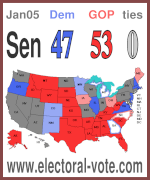
The Senate is a bigger problem because of the filibuster. Still, the members there don't want to be known as the defenders of the Trump slush fund. If you start with the 47 Democrats and independents, add in the Republicans who hate Trump and are leaving the Senate anyhow (Bill Cassidy, R-LA; Mitch McConnell; R-KY; Thom Tillis, R-NC), add in the Republicans who are moderates and tend to oppose this kind of self-dealing (Susan Collins, R-ME; John Curtis, R-UT, Lisa Murkowski, R-AK), add in the Republicans who are facing tough reelection battles and don't want to give their opponents a cudgel to yield (Jon Husted, R-OH; Pete Ricketts, R-NE; Dan Sullivan; R-AK) and then top it off with the maverick budget hawk Rand Paul (R-KY), you can see a dim, but real path to 60 votes in the Senate.
Anyhow, the closer that we get to the midterms, the less leverage Trump has to punish defectors, and the more that members who hope to keep their jobs will fear the wrath of the voters. So, Team Trump may have counted noses, and decided that right now is when the iron is hot, in terms of preventing Congress from getting involved. Mild support for this theory comes from the fact that the newly defeated and newly unencumbered Cassidy was furious yesterday, calling the $1.776 billion a "slush fund" that tramples all over Congress' power of the purse. - Trump Is Losing It: It is clear that Trump is not well, cognitively. How unwell is hard to
say, but he's certainly got issues. Meanwhile, he's also surrounded by yes men who are terrified of crossing him. It is
at least possible that if he gets fixated on "MONEY!", he can't be talked down, and can't be made to properly understood
that a longer timeline would be better.
- Trump Wants to Lose the Midterms: The previous entry on this list is a little on the
conspiratorial side, and the conspiratorial bent deepens even more fully moving forward. Anyhow, it could be conscious,
it could be subconscious, but perhaps Trump would be happier if the Republicans lost one or both houses of Congress in
November. Even when he's leading a trifecta, he gets very little done, anyhow. By contrast, if the Democrats control at
least one chamber of Congress, he can spend 2 years blaming them for everything under the sun. It won't work on all
voters, but it will get the base excited in a way that passing one or two substantive bills a year does
not.
- Trump Is Dying: Trump is about to undergo his fourth physical in the last year, and has shown other physical symptoms of... something he refuses to discuss. He could think he might be dying, or he could be actually dying. If so, well, it is unlikely that President Vance will sign off on a $1,776,000,000.00 fund whose board answers to the Estate of Donald John Trump. So, it may be necessary to get this done before it's too late.
Again, these are just our best guesses. And we acknowledge that some of them are pretty conspiratorial. But it's not like Trump hasn't given us reason to be suspicious of sinister things going on behind the scenes. Anyhow, if readers want to tell us we're out to lunch, or want to offer alternate theories as to why Trump would pursue something so impolitic just months before a crucial midterm election, the e-mail address is comments@electoral-vote.com.
We'll also say a couple of other things about the politics of this. First, the "1776" thing is just a little too precious. We don't think a single person will say "You know, I wasn't liking this idea, but it's patriotic, so OK!" However, we could imagine people who look at this and conclude that all of Trump's "patriotism" is just performative B.S., and that other "patriotic" projects, like the Arc de Trump, are actually scams.
Second, the terms by which the slush fund will operate are pretty broad, because they want to be able to pay out a lot of different kinds of cronies. But what happens if James Comey applies for some money? Or Letitia James? Or Sen. Mark Kelly (D-AZ)? The shadowy figures who are going to administer the fund won't pay those people, of course, and the Trump targets will be able to go on TV and/or file lawsuits that bring all kinds of attention to the fact that the whole thing is just self-dealing. That trio, joined by a few others, could give Trump & Co. several black eyes before this is all said and one.
You know this is Bad Stuff when the billionaire-friendly, Jeff-Bezos-owned Washington Post has an editorial attacking the deal. If it doesn't fly with billionaires, is it going to fly with average Americans?
And that brings us to the end of an item with a very rare contributors' signature. Can you tell which part was written by which person? If it helps, the word count is fairly even; around 33% each. If you'd like to check your guesses, click here. (V, L & Z)
TrumpWatch 2026, Part II: Days of Wine and Corruption
We've actually had this item on the "to do" list for a few weeks. If ever there is a day to run it, today's definitely that day.
Both the Republicans, led by Donald Trump, and the Democrats, led by no one, are trying to hammer out their midterm messaging. And both sides are getting pretty serious about the same issue, albeit a slightly different word for it on each side. To wit, the Democrats think that "corruption" is a potential winner, while Trump and the Republicans quite like "fraud."
We'll begin by talking about the Democrats' side of that, since they will have an embarrassment of riches to choose from. Here's a list of ten instances of corruption from Trump and other prominent Republicans. This is not an exhaustive list, by any means, and we are attempting to include both recent examples and particularly egregious examples (of course, some examples are both recent AND egregious):
- The Slush Fund: Ahem. See above.
- Insider Trading, Part I: A small handful of people have made quite a bit of money with
their eerily accurate predictions about oil futures. By that, we mean that they have made multiple trades that evinced
an awareness of an upcoming action or announcement from Trump. The Department of Justice is
investigating the trades,
though it's hard to see that going anywhere as long as Todd Blanche, or one of his ilk, is in charge.
- Insider Trading, Part II: Trump, or someone acting in Trump's name, has been very busy
investing
in both the stock and bonds markets. His brokerage accounts have made over 3,200 trades this year (aka about 680 per month, or
about 23 per day), totaling between $200 million and $750 million. There aren't too many reasons to make so many trades,
unless you have insider information about specific companies.
- Insider Trading, Part III: This might be the most egregious of the three insider-trading
behaviors we note here. As part of his many stock transactions, Trump bought Palantir stock. Then, he promptly
promoted Palantir
on his Ivan-Boesky-approved social media platform.
- TMTG and Trump Crypto: This isn't exactly insider trading, but it's in the same
neighborhood. Trump has, of course, used his office to promote his various investment schemes, including his failing
media company and his failing cryptocurrency. It's not clear how much money he's personally made from the rubes, and how
much his friends have made, but there are clearly several people in Trump's orbit who have made out like
bandits.
- Trump Products: Many of Trump's supporters don't have the wherewithal to invest in the
stock market and/or crypto, but he certainly doesn't want to leave them out of the grifting. So, he continues to sell
all kinds of tacky products in his online store—most obviously MAGA hats by the bushel, but also the Trump Bibles,
and the electric guitars, and the gold watches and just about anything else that Chinese factories can crank out. The
latest grifty product, which we have written about, is the Trump cell phone, which is apparently about to start
shipping. NBC News
laid hands on one
and reported that the phone works poorly, has the Truth Social app pre-installed, and that the flag graphic that appears on
the back has the wrong number of stripes (11, rather than 13).
- Trump Airport: In the item above, we note that when Trump makes a promise about his
self-dealing, he often conveniently "forgets" that promise once the news cycle has moved on. Well,
when the airport that serves West Palm Beach was renamed after Trump, and the Trump family trademarked the name "Donald
J. Trump International Airport," a spokesperson for the Trump Organization insisted that the trademark filing was just a
maneuver to keep anyone from profiting off the name, and that the President had no intention of monetizing the
trademark. And now... guess what? The President is
going to monetize the trademark.
His company will oversee all Trump-airport-branded merchandise to be sold at the airport, while also having exclusive rights
to sell Trump-airport-branded merchandise outside the airport.
- LIV Golf: LIV Golf, as we have noted, appears to be in the process of collapsing. However,
during the years it has soldiered on, it has hosted numerous events at Trump golf courses, wherein the soon-to-be-former
backer of the league, namely the Saudi government,
has written checks
of unknown size to the Trump Organization. This is on top of other emoluments-clause-abusing grifts, like First Son-in-Law
Jared Kushner working for the Saudis and managing billions in assets in exchange for a way-above-market advisory fee,
or the Qatari jet that will become Trump Force One.
- Friends in High Places, Part I: The EPA, of course, has air quality rules. And those rules apply to
all polluters... unless they are friends with Trump. In March, the President (or, more likely, someone acting on his instructions)
sent a bunch of e-mails
to EPA Administrator Lee Zeldin, telling Zeldin to waive air pollution rules for Trump's favored companies.
- Friends in High Places, Part II: It would not be surprising if Trump started selling pardons. In fact, the surprising thing would be if he did NOT sell pardons. The only real question is when "PARDONS 'R' US" might open for business. House Democrats think it already has, and are at work investigating at least a dozen pardons that appear suspicious.
Again, the blue team has a veritable smorgasbord of things to choose from here.
Of course, there is such a thing as "too much of a good thing." And the Democrats do have a history of tripping over their own feet, and failing to distill their message down to something manageable. Put another way, it is probably not wise to make hay out of all of these things. The savvy thing to do, in our view, would be to pick about three or four particularly bad grifts—the ones that really get voters hopping mad—and to hit on those over and over. All the better is if it can be boiled down into a pithy sound bite, like: "slush funds and airplanes and pardons for sale, oh my!" We are confident that the slush fund is Trump's biggest Achilles' heel on this front, and we assume that Democrats are focus grouping to see what other grifts particularly land with voters. If they are not, they should call up Sarah Longwell from The Bulwark, and let her figure it out.
When it comes to Republicans, and "fraud," the story is rather different. The general plan is to make broad and basically unsubstantiated claims of fraud against Democratic states, with "Fraud Czar" J.D. Vance taking the lead. These fraud claims will apparently focus on two things: fraud in the spending of federal money, and fraud in voting. The administration will publicize its claims, and show it's "serious," by withholding certain funds from certain blue states. For example, a $100 million+ Medicare payment to California has already been delayed.
So, which approach is going to work best? Obviously, at a glance, the Democrats would seem have the upper hand here, and then some. However, scary and non-specific things can sometimes be more effective than irritating and highly specific things. Further, the voters that Republicans are trying to reach tend to be far less concerned about evidence. If the White House says there's fraud, then there's fraud, as far as many of these folks are concerned.
That said, while we concede the Republican approach could work, particularly if the Democrats don't get their messaging ducks in a row, we see some serious problems with the plan. The first is that the punitive actions that the administration takes, to highlight its position, are going to hurt people. Those people are not going to be happy. And so, the shenanigans might actually backfire on the GOP, and cost them more votes than it gains them.
On top of that, it's hard to think of a worse point person for this crusade than J.D. Vance. People don't like him, people don't trust him, and he just can't "sell" the way Trump can, or even the way that, say, Marco Rubio can. There is, of course, time for someone else to take over, but the fact is that the Trump administration bench isn't very deep, especially since the half-dozen or so people that Trump really trusts either already have six jobs (Rubio) or are looney tunes (Pete Hegseth).
And finally, when we started planning this item, we could squint and see how the GOP approach just might work. But we think that the $1.776 billion slush fund brought that line of thinking to a conclusive end. The billion-dollar grift is going to be the bright sun in the universe of grift, outshining all else by many orders of magnitude. It's like this famous cartoon about notorious Gilded Age spoilsman Richard Croker:

All you have to do is replace "CROKER" with "TRUMP, $1.776 Billion."
In the end, the slush fund is just so egregious, and is such obvious self-dealing. Even if you believe California is committing fraud (beyond the usual level of Medicare fraud that every state deals with), nobody has suggested that Gov. Gavin Newsom (D-CA) is personally lining his own pockets. So we think, on corruption/fraud, it's going to be "advantage Democrats" for the rest of the cycle, and beyond. (Z)
TrumpWatch 2026, Part III: The Bush Line Is within Sight
Donald Trump's approval rating is going to have a big impact on the midterms, and also on his behavior. So, it's something we keep a close eye on, and it's time for another update. He got some poor numbers this week (and that, of course, is before the Declaration of Grift-dependence).
Let's start with the aggregators, from Trump's best net number to his worst:
| Aggregator | Approve | Disapprove | Net |
| RealClearPolling | 40% | 57% | -17% |
| Ballotpedia | 40% | 58% | -18% |
| DecisionDeskHQ | 40% | 58% | -18% |
| VoteHub | 39% | 59% | -20% |
| The Economist | 36% | 57% | -21% |
| The New York Times | 38% | 59% | -21% |
| Silver Bulletin | 38% | 59% | -21% |
| Race to the WH | 37% | 60% | -23% |
| CNN | 36% | 62% | -26% |
| Average | 38% | 59% | -21% |
The Bush line is 32%, and obviously Trump is not quite there in the aggregations. However, they tend to keep polls in their sample for a very long time, sometimes a year or more (our map algorithm keeps them for 7 days so it responds much faster to news). So, his decline will be slow, assuming it continues. And it is not good news for him that his best number is still "17 points underwater," especially since it comes from RCP, which has been known to deliberately exclude Republican-unfriendly polls from its database.
That's nine aggregators; now let's take a look at the nine most recent individual polls we can find, also listed from Trump's best net number to his worst:
| Pollster | Approve | Disapprove | Net |
| Rasmussen | 43% | 56% | -13% |
| TIPP Insights | 38% | 54% | -16% |
| FocalData | 37% | 55% | -18% |
| AtlasIntel | 40% | 60% | -20% |
| NYT/Siena | 37% | 59% | -22% |
| The Economist/YouGov | 36% | 58% | -22% |
| CBS News | 37% | 63% | -26% |
| Marist | 33% | 60% | -27% |
| Reuters | 31% | 66% | -35% |
| Average | 37% | 59% | -22% |
A much greater spread, as would be expected. That said, these numbers tell us that Trump looks to be slip-sliding a little bit and that, depending on your assumptions, be might already be close to the Bush line. He's probably not, but he could be. Another thing that we learn from this exercise is that Rasmussen still can't be trusted.
There's also some bad news that's not 100% evident from these numbers. To start, that is the highest disapproval he's ever gotten in a CNN poll. He also pulled the lowest approval he's gotten in a New York Times poll since the commencement of Trump v2.0.
But worst of all are the crosstabs. Trump doesn't have that many demographics left where he can bleed substantial support, since he's already lost the lion's share of many of the groups that helped elect him (e.g., Black and Latino men), and he never had many of the groups that hate him (e.g., college grads). One group where HE could bleed support, and he is bleeding support, is non-college white men. Aaron Blake, late of The Washington Post, and now of CNN has a piece observing that, on the whole, Trump's approval rating among noncollege white voters has dropped from 63% at the start of his current term to just 49% now.
These folks are not likely to vote Democratic (well, unless that Democrat is Graham Platner), but they could certainly stay home on Election Day. And if they do—and note, they've done it in the past when Trump was not on the ballot, even when he was much more popular than he is right now—it would be very bad news for the GOP, indeed.
And that is the latest on Trump's approval. We were going to do Political Bytes today, but we really try to keep each day's posting between 4,500 and 7,000 words, and this one is already at 7,200+. So, we'll wait until tomorrow. Here's a preview, though: Kash Patel is still crazy after all these months. (Z)
Previous | Next
Main page for smartphones