Previous | Next | Senate races | Menu
New polls:
Dem pickups: (None)
GOP pickups: (None)
Primary Season Is Back
After a multiweek drought in April, primary season is back with a vengeance in May. Indiana, Ohio, Nebraska, West Virginia, Louisiana, Alabama, Georgia, Idaho, Kentucky, Oregon and Pennsylvania will hold primaries this month. Some of them are bitterly contested.
If there is a theme here, it is "May is retribution month." Unlike many politicians, Donald Trump is carrying out some of his campaign promises. In particular, he promised retribution against everyone who has opposed him and sure enough, he is doing it. He has two tactics. For some opponents, he is using the so-called Department of Justice to indict and harass them. James Comey, Letitia James, John Bolton and others come to mind here. For politicians currently in office, his go-to mechanism is to endorse (or threaten to endorse) a primary opponent. In some cases, the threat alone was enough to get his target to give up and retire. Sen. Thom Tillis (R-NC) is a prominent example, although that may not work so well for the Republican Party if Democrat Roy Cooper wins the open seat.
May is the time when the rubber is going to hit the road on the endorsements and retribution. Four primaries to watch are Indiana (May 5), Louisiana (May 16), Georgia and Kentucky (both May 19). Tomorrow, Indiana holds its primary, so let's start there. Trump is furious with the Hoosier State because Republicans there refused to redistrict the congressional map to make sure that the two Democratic Congressmen, Frank Mrvan and Andrew Carson, were sent home. Mrvan's district is D+1, so he could possibly be defeated by an opponent just spending a lot of money in Gary, IN, and environs. Carson's district is in Indianapolis and is D+21, so that would require major surgery to the map.
Trump and his allies are going to the mat to defeat half a dozen Indiana state senators who voted against drawing a new map. State Senate races are usually pretty low profile and few people even know who their state senator is. The Club for Growth is spending $2 million to defeat them, nonetheless. One of the senators, Travis Holdman, said: "Retribution is not a Christian value." David McIntosh, head of the Club, replied: "Jesus was a wuss." OK, he didn't actually say that, although he was probably thinking that turning the other cheek is a pretty stupid defense strategy. McIntosh actually said: "If that senator had helped us pass redistricting we wouldn't need to." Depending on how many of the senators win, we will get a good idea of how powerful Trump's endorsement is. Of course, this cuts both ways. If most of them are renominated, that sends a message to other Republican politicians.
The other primaries tomorrow are in Ohio. The Senate race is pretty much set, with Sherrod Brown (D) against Sen. Jon Husted (R-OH). This will be a very competitive race in November. In the Democratic gubernatorial primary, Amy Acton is the only candidate. In the Republican gubernatorial primary, Vivek Ramaswamy is the heavy favorite. For attorney general, there are two Democrats running, former state Rep. Elliott Forhan and veteran lawyer John Kulewicz. There are contested races for some of the House seats, but the state is so gerrymandered that the only general election race that might be competitive is OH-09, where Marcy Kaptur is the only Democrat on the primary ballot. If you are interested in the other downballot primary races in Ohio, here is a list of the candidates.
Let's take a quick look for now at the other "retribution" races and ones where Trump has endorsed. In Louisiana, the senatorial primary will go forward on May 16, despite the House primaries being postponed, probably until July. The biggie here is the Republican U.S. Senate nomination, in which Trump is backing Rep. Julia Letlow (R-LA) against Sen. Bill Cassidy (R-LA). Cassidy's offenses were voting for Trump's conviction after he was impeached and asking Robert Kennedy Jr. actual questions during his Senate confirmation hearing. A third candidate, John Fleming, is also in the mix so there could be a runoff.
In Georgia, Trump is trying very hard to defeat SoS Brad Raffensperger (R), who is running for governor. Raffensperger's offense was failing to find 11,780 more votes for Trump in 2020. Trump is supporting Lt. Gov. Burt Jones (R-GA).
In Kentucky, the only race Trump really cares about is defeating Rep. Thomas Massie (R-KY). Massie has been a real pain for Trump and Trump is pulling out all the stops to defeat him. If Massie wins, he will be unstoppable in his criticism of Trump going forward. Trump has also endorsed fire-breathing right-winger Andy Barr for the seat of retiring Sen. Mitch McConnell (R-KY), but that is less important to the President. (V)
Trump Claims the War in Iran Is Over
Donald Trump's statement to Congress Friday that hostilities with Iran have terminated may have solved one problem but created a bigger one. On the one hand, a federal law, the War Powers Act, requires a president to get permission from Congress to fight a war for more than 60 days. By claiming the war is over, there is at least some ambiguity over whether the Act applies now.
On the other hand, while there is no more bombing, there is also no peace and the Strait of Hormuz is still closed. If Trump has taken future fighting off the table, why would Iran concede anything to Trump now? Without the threat of continued bombing, he has no leverage. Of course, the Iranians could assume he is lying and might start the bombing again, but then he would have to deal with Congress and the 60-day rule.
Trump is also trying to get out of this bind by claiming the War Powers Act (WPA) is unconstitutional. Of course, that is not his call. That would be up to the Supreme Court, which might indeed rule that any law that in any way prevented the president from doing whatever he wanted to do is de facto unconstitutional. On a different note, when Secretary of Defense Pete Hegseth testified before Congress, he didn't make any claim that the Act is unconstitutional. His argument is that since hostilities have stopped, the 60-day timer has stopped. It would be nice if everyone were on the same page.
However, although there is no bombing now, the U.S. is still actively blockading Iranian ports, which under international law is definitely an act of war. In that case, Trump still needs authorization from Congress to continue the naval blockade and it doesn't appear that he is even going to ask for it.
This could be a big deal because if the Democrats capture both the House and Senate, they are likely to impeach him. To do that, they have to charge him with something. Politically it has to be something Americans understand. A charge of: "He started a war without a declaration of war by Congress, and after 60 days continued it without authorization by Congress, in violation of federal law" is something that is both understandable and has majority support.
It is worth noting that if Trump does go to his six buddies on the Supreme Court to try to get the WPA declared unconstitutional, he's got an uphill climb. The Constitution very clearly grants Congress the power to decide whether or not the country goes to war. And while this Court will certainly stand on its head, sometimes, to get the results it wants, the six conservatives are not known to be war hawks. They care about protecting the "rights" of white people, rich people, and rich white people, but not so much about bombing Iran back to the Stone Age. So, Trump probably wouldn't find a receptive audience for his plainly unconstitutional argument.
Maybe someone in Trump's inner circle pointed this out to him. Late yesterday, Trump announced "Project Freedom," which would "guide" ships through the Strait of Hormuz, that is, run the Iranian blockade. This is a bet that Iran won't respond militarily by laying mines or using drones or "mosquito boats" to disable tankers. If Iran responds and the U.S. has a counterresponse, we are back to war and the 60-day limit. Maybe Trump has this all worked out in advance, but his whole life he has gotten away with bluffing. Why should this be any different? The Iranians may well decide to test Trump. After all, Iranians love a good TACO (if it is halal). (V)
Trump Is Running Out of Ways to Lower Gas Prices
Polls have shown that the increase in gas prices is forcing many people to alter their lifestyle. A WaPo-ABC News/Ipsos poll from last week shows that 44% of Americans are cutting down on driving, 42% are cutting household expenses, and 34% have changed vacation plans. Some people have done two or more of these. The gas price spike has not gone unnoticed. What's a president to do?
We have repeatedly noted that the president does not have a big green button on his desk labeled "Lower gas prices." However, he does have a few knobs he can twist that can help a little. Unfortunately for Donald Trump, he has already twisted most of them to the max. Here is what he has already done:
- Release Oil: The U.S. maintains a Strategic Petroleum Reserve for emergencies. The
current situation probably qualifies as an emergency, so Trump has authorized the release of 172 million barrels of the
400 million in the Reserve. Flooding the market should drive prices down somewhat. Maybe it has. We can't tell
what the average price of gas ($4.44 this morning) would have been without the release. It might have been higher.
- Waive the Jones Act: The Jones Act is actually Sec. 27 of the Merchant Marine Act of
1920. It requires that all seaborne shipping between U.S. ports be done in ships constructed in the U.S., and owned and
crewed by U.S. citizens or permanent residents. The idea is to protect the U.S. shipping industry. Trump has temporarily
waived the Act, so in theory a Panamanian-flagged ship could transport Texas crude from Houston to a refinery in New
Jersey. However, shipping contracts are usually long-term arrangements so it is unlikely many foreign shipping firms
will have ships lying around idle to grab the opportunity.
- Degrade the Environment: There are federal rules about how much ethanol can be blended
with gasoline. The blend varies by season. Trump has suspended the rules to temporarily allow a more polluting blend to
be used this summer.
- Lift Russian Sanctions: There are extensive sanctions on Russian oil and penalties for companies worldwide that traffic in it. Trump has lifted the sanctions temporarily, in the hopes that Russia will now flood the market with oil, which will force prices down. Of course, this will also help the Russian economy and help pay for the very expensive war in Ukraine that has dragged it down.
There aren't a lot of power tools left in Trump's toolbox. Among those that are unused so far are these:
- Reduce the Federal Gas Tax: The federal gas tax is 18.3¢/gal. on gasoline and
24.3¢/gal. on diesel fuel. Trump could try to suspend that, even though he has no legal authority to do so. If he
did, gas stations might decide to drop their prices only a little bit and keep the difference themselves. Another
problem here is that the gas tax money feeds the Highway Trust Fund, which pays for highway maintenance. The fund is
already in trouble due to more efficient cars, so cutting off the funding would mean less maintenance.
- Jawbone States on Their Gas Taxes: Trump could also try to talk states into cutting state
gas taxes while keeping the federal one intact. States are not likely to be enthusiastic about cutting off their revenue
source while the feds keep their source going full blast.
- Ban Oil Exports: Although the U.S. is roughly self-supporting in oil, a lot of oil is
imported and a lot of oil is exported. Not all oil is the same and the system is optimized for the lowest price. For
example, the U.S. imports heavy sour oil from Venezuela because some Gulf Coast refineries are set up to process it,
rather than the light sweet oil from Texas. Some of the Texas oil is exported to Japan. This may sound odd, but it makes
business sense to the oil companies. The oil companies have long-term contracts for exporting oil and are wildly against
breaking them for any reason lest their customers come to regard them as unreliable suppliers and seek more reliable
sources elsewhere.
In short, there aren't a lot more things Trump can do other than tell people that their wallets are lying and gas is actually very cheap. (V)
Trump Will Pull 5,000 Troops from Germany
Donald Trump has decided to pull 5,000 American troops to punish German Chancellor Friedrich Merz for not joining the war in Iran. This is the international version of indicting Trump's domestic enemies or endorsing their political opponents. The model is the same everywhere: Anyone who does not submit to Trump's will gets punished, only the mechanisms differ depending on who it is.
Lt. Gen. Mark Hertling (ret.) was the commander of the U.S. Army in Europe during the 2010s and actually understands the reasons the U.S. has troops in Europe and the consequences of removing them (on a whim, to punish a foreign leader). He wrote an opinion piece for The Bulwark, where he is a contributor, about Trump's move. The title is "The Last Time We Reduced Troops in Europe, a War Broke Out." That summarizes the piece very concisely. Here is a bit longer summary.
When Hertling was commander of U.S. forces in Europe in 2012, officials in the Obama administration ordered the removal of two brigades (7,000 soldiers) from Europe as a strategic move to pivot the Army's focus to Asia and a potential war over Taiwan. It was a well-thought-out, carefully prepared move. Hertling strongly disagreed with his superiors and advised them not to do it, but in the end, they decided to do it anyway and he obeyed orders and carried it out. Russian President Vladimir Putin took the withdrawal as a sign that the U.S. had little interest in Europe. On Feb. 20, 2014, the Russian army invaded Crimea and eastern Ukraine and still holds that territory. In 2022, Putin tried to take the rest of Ukraine, resulting in a war that has been going on for four years now and shows no sign of ending.
Hertling still blames himself for not making a better case to his superiors. And he thinks Trump's move will be an even bigger debacle, in part because the drawdown he (Hertling) managed was meticulously planned with strategic choices carefully evaluated. It took years of analysis, coordination with European governments, and consideration of military, political, legal and economic consequences. It was not done on one man's whim to try to force a foreign leader to bend to his will. This time there is no planning at all and no thought about the consequences. It is sort of like just deciding to bomb some country without thinking about any of the (easily predictable) consequences or having any endgame.
Hertling goes on to explain what the U.S. troops in Germany (and elsewhere in Europe) do. They are not sitting around eating schnitzel and drinking beer. Air Force units are constantly flying to practice rapid response across multiple fronts. Naval forces in Spain and Italy provide maritime security. The Marine Corps is constantly training for rapid deployment to various hot spots. Special Operations Forces are actively searching for terrorists. Cybersecurity personnel are working on passive and active security for command-and-control networks. Logistics personnel are making sure that equipment, fuel and supplies are maintained and ready for war where they might be needed. There are critical intelligence centers, logistics hubs and maintenance facilities in Germany that underpin global operations. Just ripping out 5,000 troops with no planning as to who is leaving and how the system will be readjusted will greatly degrade U.S. strategic power.
Of course, if the U.S. no longer aspires to being a world power and merely wants to be a regional bully pushing around weak countries in Latin America, maybe it doesn't matter. But if the bases and readiness in Europe are degraded, fighting a war in the Middle East will be exponentially more difficult. If Putin, once again emboldened by the withdrawal from Germany, decided to invade Saudi Arabia, Qatar, and the U.A.E. to seize their oil, the U.S.—without bases all over Europe—would be powerless to stop such an invasion. Then a (future) U.S. president wouldn't have any cards.
Hertling's main point is that the real purpose of U.S. troops in Europe is not so much to protect Europe, but to project U.S. power over a large part of the world and make fighting a war there possible if Congress and the president should decide it is necessary. Giving that up because the president is having a temper tantrum is unbelievably foolish and against U.S. interests.
Two top Republicans are very upset with Trump's move. Sen. Roger Wicker (R-MS), chairman of the Senate Armed Services Committee, and Rep. Mike Rogers (R-AL), chairman of the House Armed Services Committee, issued a joint statement beginning: "We are very concerned by the decision to withdraw a U.S. brigade from Germany." They go on to note that Europe is rapidly rearming and will spend more on defense, but pulling out U.S. troops before European defense has been fully ramped up is "sending the wrong signal to Vladimir Putin." This is exactly what Hertling said. Furthermore, the statement goes on to say that any drawdown needs to be carefully coordinated with Congress and the United States' allies. In other words, this is not something to be done in a fit of presidential pique because someone hurt his feefees. (V)
Tee Up More Gerrymandering
The Supreme Court's decision last week to gut the last bit of the Voting Rights Act is already having the exact effect that everyone expected: Southern states are redrawing the maps to create more Republican seats. Louisiana has to do it by order of the Court and so is already hard at work on whitening up their map.
It is a giant mess. Gov. Jeff Landry (R-LA) postponed the House primaries but let the other primaries go forward on May 16 as scheduled, with early voting already underway. Landry's goal is a House delegation with six white Republicans, instead of the current four white Republicans and two Black Democrats. Rep. Cleo Fields (D-LA), who represents LA-06 (including Baton Rouge) said: "If you tell me that I got to jump a certain height, I could probably do that. Tell me [if] I got to run a certain distance, I could probably do that too. But if you tell me I have to be white to serve in Congress from Louisiana, I can't do nothing about that."
Landry was immediately challenged in court since primary dates are set by state law and cannot be changed unilaterally by the governor. Also, voters are going to be very confused by a combination of two primaries and new districts, possibly with new candidates unknown in the district. Oh, and this is the first year partisan primaries are being used instead of the old jungle primaries
Louisiana may be first, but Alabama and Tennessee are not far behind. Both Gov. Kay Ivey (R-AL) and Gov. Bill Lee (R-TN) have called special sessions of their respective state legislatures for the purpose of drawing new maps that will eliminate the seats of the Black Democrats. Alabama has two, occupied by Reps. Shomari Figures (Montgomery) and Terri Sewell (Birmingham and Selma). The other five districts are R+27, R+23, R+33, R+15 and R+20, so there are plenty of Republicans available to dump into the two blue teamers' D+5 and D+13 districts.
There is a problem, however. Alabama is under court order to keep its current map until 2030, so state AG Steve Marshall (R) has asked the court for permission to change the map in light of the Supreme Court decision. Until that happens, the legislature can draw a new map once it is in session, but it can't pass it. The primary is scheduled for May 19 and the filing deadline is long past.
Tennessee has only one Democrat, Rep. Steve Cohen, who is white, so that gerrymander will be strictly political. His Memphis-based district is D+23, so a fairly radical change to the map will be needed to make it R+x. It is certainly doable, but the current representatives are not going to like being dumped in brand-new districts, even if they are deep red, because that could make them vulnerable to primary challenges from other Republicans—say, state senators or mayors who know the district better than they do.
These three states alone could yield five new Republican seats. In all three states, potential problems include: (1) getting the new map out before the primaries so candidates know where to file, (2) expected court challenges, which could slow the process down and (3) basing the new maps on the 2024 election results, which may be an anomaly. For other Southern states, it may be too difficult to change the maps right now, so they may wait until 2027 to change them for the 2028 elections.
And just like the 2026 round of gerrymandering, which may yield only a handful of seats for the Republicans, the 2028 round may also end up being less valuable than they are hoping. Remember, the Supreme Court has made it clear that while racial gerrymandering is not allowed, political gerrymandering is fine and dandy. California currently has 9 Republican representatives. That is likely to be 4-6 after the election. But if Gov. Gavin Newsom (D-CA) wants to impress primary voters in 2028 with how aggressive he is, he could ask the legislature for a political gerrymander eliminating most or all of the remaining Republican seats. Republicans would howl to the moon, but it wouldn't help. New York has seven Republican seats. It could try to eliminate most of them for 2028. Illinois has three Republican representatives. It could try to send one or two of them to the unemployment office. Colorado could provide up to four more, Maryland one more. Republicans could try to respond in Texas and maybe in a few other red states with a big blue city.
Voters absolutely hate this stuff. In 2028, Democrats could make getting rid of gerrymandering a campaign plank. It could be part of a section called "Preserving Democracy." There are various ways to get rid of gerrymandering. One way is to mandate an independent commission in every state, but care needs to be taken that they are really independent. The California system has carefully vetted ordinary citizens in the commissions.
A completely different way is for Congress to repeal the law requiring single-member districts. Instead, House elections could be statewide, with proportional representation. For example, if Democrats got 45% of the House vote in Texas, they would get 45% of the 38 seats = 17 seats. Most European countries use this system with minor variants, so there are plenty of examples out there to choose from. All of these schemes make the parties more central, which has both good points and bad points. It also means that smaller parties, like the Libertarian Party and the Green Party, would have a good chance of winning some House seats, for better or worse. (V)
Chuck Is Batting .750
Everybody seems to be dumping on Senate Minority Leader Chuck Schumer (D-NY) now because he cajoled Gov. Janet Mills (D-ME) into running for the Senate at 78 and she ran out of money and dropped out. See, for example NYT, Politico, and The Hill. Democrats up and down the line are crying in their beer.
In Schumer's defense, we would like to point out three other races where he got his favorite candidate. In North Carolina, another (former) governor, Roy Cooper, is leading in virtually every poll. In Alaska, Mary Peltola has a slight lead in the polls. In Ohio, Sherrod Brown is about 2 points behind, but any other candidate would be about 11 points behind (Donald Trump's margin in 2024). Brown still has a good chance against appointed senator Jon Husted (R-OH), who is embroiled in a major corruption scandal. That scandal will be on the front pages in Ohio in October when the crooked electricity company executives who bribed their way to rate increases (with Husted's help) go on trial. We'd say Schumer got three out of four right, for a .750 batting average that would make Ted Williams jealous.
Further, if not Mills, who should Schumer have backed? An unknown, unproven oysterman nobody had ever heard of with a Nazi tattoo and a long trail of "edgy" postings to social media? As it turns out, he is quite popular and could well win, but that certainly wasn't a sure thing last October.
So, who should Schumer have backed? Rep. Jared Golden (D-ME)? If he had backed Golden, progressives would have gone through the roof since Golden is practically a Republican. Maybe the other representative, Chellie Pingree (D-ME)? She is an actual Democrat, but she is 71 and known only in a small part of the state. Besides, Pingree ran against Collins in 2002 and lost by 17 points. Some random state senator? Probably worse. Without the benefit of 7 months hindsight, we don't see what else Schumer could have done back in October that made any sense then. If the Democrats take back the Senate on Nov. 4, people will be hailing Schumer as a political genius.
Even if that happens, though, Schumer's best days are behind him. He is up in 2028. It could be interesting. It is widely believed that Rep. Alexandria Ocasio-Cortez (D-NY) could challenge him in a primary. But it is possible that she won't be the only one. If John Bouvier Kennedy Schlossberg, Jack to his friends, is elected to the House by a wide margin, he might also decide to run for the Senate in 2028. His track record wouldn't be as long as hers, but he has the Kennedy magic and hair. (V)
Candidates Are Stuck Between Where the Voters Are and Where the Big Bucks Are
Big industries buying donating to politicians is nothing new, but there has been a recent change in where the
big money is coming from. Historically, companies in the banking, oil, media, telecom, pharmaceutical and
transportation industries were the biggest donors because government regulations heavily affected their businesses.
Consequently, owning a couple of congressmen was a good business decision.
Recently, two giant—and extremely unpopular—sectors have been added to the mix: crypto and AI. This puts candidates in a real bind. If they accept money from crypto and AI interests and carry their water, it turns off the voters. But if they refuse the money, it will probably go to a less scrupulous opponent.
Fairshake, a pro-crypto super PAC, has $171 million in its bank account as of the end of February. In 2024, Fairshake spent $40 million to defeat then-Sen. Sherrod Brown, a crypto opponent who sees crypto as a scam and favors tight regulation of the "industry." And Fairshake is not the only super PAC supporting pro-crypto candidates.
Leading the Future is a pro-AI super PAC that has initial commitments of $200 million. It wants to elect candidates who are gung ho on AI and defeat those who want to regulate it.
However, the voters don't like either crypto or AI. A 45% plurality of Americans say that crypto is too risky and 44% of Americans say that AI is developing too fast. Two-thirds support the government putting strict regulations on AI. The two are very different. Crypto is essentially a big Ponzi scheme since the underlying asset has no actual value, unlike a stock or bond. It is more like gold, except that gold has a tradition of thousands of years behind it and it also has some industrial value. AI is different. It actually works, and that is the problem. It threatens many jobs. Also, data centers are having a major impact on electricity and water prices. Here are poll results about people's views about crypto:
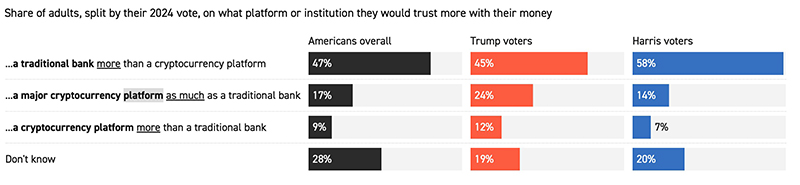
It is interesting that Trump voters are more trusting of crypto than Harris voters. The poll didn't ask why. It could be that Trump voters are comfortable participating in scams because Trump runs so many of them and they are used to it whereas the college-educated Harris voters see it for what it is: a bubble that could burst at any moment.
Now the poll results about AI:

Here again, the Trump voters are more positive on AI, actually evenly split. Harris voters are worried about it. It could be that blue-collar workers understand that AI could take away office jobs but don't realize that AI could also drive a bus. But it is true that, at least initially, more white-collar jobs are threatened by AI than blue-collar jobs.
So what is a candidate to do: take the money and alienate the voters, or refuse the money and have it used against you? We suspect that some candidates will take the money, not talk much about crypto or AI during the campaign, and after being elected, sponsor bills that the donors want. In other words, bamboozle the voters by campaigning for one thing but supporting the opposite after getting elected. Hiding your true intentions (or outright lying to the voters) is a time-honored tradition in politics. (V)
Alaska's Governor Vetoes Election Reform Bill
The Alaska legislature passed a major election reform bill last week. Among other provisions, it:
- allows voters to track their absentee ballot to be sure it was received and counted.
- allows voters to correct minor errors that would otherwise result in the ballot being rejected.
- provides postage-paid envelopes for absentee voters.
- permits ballots received up to 10 days after Election Day to be counted.
- orders the state to develop a cybersecurity program.
- makes tribal ID cards valid for identification to vote.
- makes it easier to remove inactive voters from the rolls.
- requires the state to release choices in ranked-choice elections at the precinct level.
- makes it possible to vote for write-in candidates for president.
- creates a rural community liaison position in the state election office.
- creates a new crime of election tampering.
Last Thursday, Gov. Mike Dunleavy (R-AK) vetoed the bill. He said it was too close to the election to make all the changes on time.
Chairman of the Alaska Senate Rules Committee Bill Wielechowski (D) opposed the veto and wrote in a response: "Governor Dunleavy has said, by his veto, that Alaska's elections are secure enough. Unfortunately, they are not, and even his supporters confirm that. Our voter rolls stood at 114% of the voting-age population in 2022. Ballots are being rejected over technical errors. Tampering with a voting machine is not explicitly a crime under current law. This bill addressed every one of those concerns." The vote in the legislature was close enough that an override is possible. (V)
Previous | Next
Main page for smartphones