Previous | Next | Senate races | Menu
New polls:
Dem pickups: (None)
GOP pickups: (None)
Debate on the SAVE Act Explodes--with Republicans against Republicans
The Senate voted 51-48 to start debate on the SAVE America Act, which really should be called the "Suppress the Vote Act." All Democrats opposed it, as did Sen. Lisa Murkowski (R-AK). Sen. Thom Tillis (R-NC) was traveling and missed the vote but opposes the bill. Sen. Mitch McConnell (R-KY) also opposes the bill but voted to start debate as a courtesy to Senate Majority Leader John Thune (R-SD). This preliminary vote suggests that a final vote could be close. The debate will certainly be spirited.
A vote is not expected for a while because Republicans are squabbling among themselves over the bill, which would require proof of citizenship to vote and other things that would make voting more difficult. It would also require states to share voting data with the federal government, which is unprecedented and possibly unconstitutional since the Constitution gives the states alone power to run elections. If the states are forced to share information, the federal government could then order states to remove voters it believes are not eligible to vote. Nothing in the Constitution grants it that power.
The debate could take a while because Republicans disagree on the procedure. Sen. Mike Lee (R-UT) wants a Jimmy Stewart-style talking filibuster to wear the Democrats out. Sen. Rick Scott (R-FL) wants to attach the bill to some other must-pass bill. Murkowski thinks the whole thing is grandstanding because no Democrats will ever vote for it and not even all Republicans.
Donald Trump wants the bill to ban almost all absentee voting. So do some House conservatives, who have vowed to block all legislation in the House until the Senate passes the bill. They have actually started, voting against bipartisan bills like one to provide some special funding for small businesses. However, senators do not take kindly to being given marching orders by House members.
Many Republican senators, especially those from rural states like Montana, depend on absentee votes from far-flung voters and are opposed to banning the practice. Some of them have floated the idea of "hardship exemptions," but only for voters from rural areas. Having laws apply only to certain areas could inspire future Democratic administrations to pass other laws that apply only to urban areas. Some Republicans see that danger and don't want to go down that road.
Another thing Trump wants in the bill is a provision that trans girls cannot compete in girls sports. Also a provision banning transgender care for minors. This has nothing to do with elections, of course. It is just red meat for the base. And including this just makes it harder to pass the bill. With Murkowski, Tillis and McConnell already against the bill, all it takes is one more Republican defection to kill debate. Throwing trans girls under the bus may not play well in blue states and Sen. Susan Collins (R-ME), who is up in a blue state in the fight of her life, might just be that fourth vote against the bill.
Almost all observers think the bill will fail in the end, so why is a weeks-long debate planned? When you come down to it, Thune needs to put on a big show to impress Trump that he tried hard but the votes weren't there. With any other president, Thune could have just said "the votes aren't there" and left it at that.
The ironic thing about the bill is that it may not be the silver bullet Trump is expecting and may not help the Republicans at all. We are starting to see articles digging into this, such as this one in The Washington Post and this one from Reuters.
The Act would not apply to actual voting, but only to registering. However, whenever people move they have to reregister. Also, many states scrap inactive voters who have missed two or more elections, so they have to register again to vote. These people would be affected. The Post study showed that in 54% of Republican-held House districts, over 5% of voters are inactive and would have to re-register. By contrast, only 36% of Democratic-held districts have that level of inactivity. .
To register—either after a move, becoming active again, or turning 18—a voter would have to show proof of citizenship, typically a passport, original birth certificate, or a naturalization certificate. One study showed that 7% of Republicans, 10% of Democrats, and 14% of independents don't have easy access to proof of citizenship. Advantage Republicans.
The study also showed that citizenship requirements affected men more than women, with 11% of men and 8% of women not having proof of citizenship. Men tend to be more Republican than women. Advantage Democrats.
One group of women who will be hard-hit are married women who have taken on their husband's last name. It has been estimated that about 70 million married women do not have a birth certificate that matches their current legal name. For them, an original birth certificate is not enough to vote. They also need official documentation showing the name change. Studies show that women in red states are more likely to take on their husband's name than women in blue states and thus more likely to be disenfranchised. Married women voted for Trump 52% to 47% while single women favored Harris 61% to 38%. But disenfranchising women in general works for the Republicans. It is hard to tell here. Advantage unknown.
If the bill passes, both parties will try to help their supporters acquire that proof. This is easier in cities than in rural areas. Going door to door asking: "Do you need help registering to vote?" is easier when the doors are close together. Also, rural voters may have long drives to election offices. Murkowski said that one-fifth of her constituents don't live on the road system and would have to fly to the election office (or go by dog sled). Advantage Democrats.
Related to that, if the bill were to pass, the 19 blue states the Democrats control could make getting a birth certificate easier by opening more offices where people can apply, lengthening the hours they are open including evenings, and/or reducing the fee. Blue cities in red states could try to do that but red state legislatures might ban that. Advantage mixed.
Affluent college-educated voters are more likely to travel internationally than dirt farmers and are thus more likely to have a valid passport. Fourteen of the seventeen states with the highest rates of people having passports voted for Kamala Harris. The dozen states with the lowest percentage of voters having passports all voted for Trump. These are largely rural states, where getting a passport would be more difficult than in urban states. Also, a passport costs $165 and the Trump-supporting rural states are poorer than the Harris-supporting urban states. Some eligible voters might decide voting isn't worth the money. Advantage Democrats.
Immigrants who have been naturalized are almost always proud of their naturalization and are very likely to have their naturalization certificate. Given how the administration is treating immigrants, this group is likely to skew Democratic, be motivated to vote, and have proof of citizenship. Advantage Democrats.
In short, it is very hard to see which party is hurt more by the bill, and it could be a wash. However, it seems likely that Democrats are in better shape to try to counter the effects by actively helping voters get the necessary documentation because their voters are heavily clustered. (V)
Can Trump Just Announce a Win and Leave Iran?
Donald Trump has already claimed that he won the war in Iran. So why doesn't he bring the troops home and organize a victory parade? The real reason is that he hasn't won. Yes, the U.S. military has flattened thousands of targets, but the Iranian regime is still intact and fighting back. As Yogi Berra put it: "It ain't over 'til it's over." Here are some of the reasons Trump can't take his marbles and go home quite yet:
- Hormuz: The Strait of Hormuz is closed and simply pulling all American troops out of the
region won't open it. Iran has to decide to do that for its own reasons. Right now, the closure gives it a lot of
leverage and it might not be willing to give that up, especially if it knows where all the mines are. In the worst case,
Iranian oil tankers could transit the Strait safely but those of other nations could not. There is no way to keep the Strait
open by military force since it is asymmetric warfare, with $50,000 drones against multimillion dollar ships—no
oil company will risk it until there is peace.
- The Supreme Leader: The Iranian government was decapitated by the killing of ayatollah Ali
Khamenei, but he was old and sick. He has been replaced by his son, who is much younger, more vigorous, and said to be
even more of a hardliner than dad. He is not likely to give Trump the unconditional surrender he wants. Also, the regime
is not popular with the people of Iran, but an ongoing war will produce a rally-round-the-flag effect in Iran so junior
probably wants to keep the war going, despite the destruction.
- Israel: Even if Trump calls it quits, what about Israel, whose goals aren't entirely
parallel to those of the U.S.? The U.S. doesn't want an ungovernable failed state in Iran. Israel could live with that
since failed states are not good at the difficult work of building nuclear weapons. But to end the war, Trump would not
only have to tell U.S. troops to stop bombing, but would have to get Israel to do so as well.
- No Narrative: The war has cost the lives of over a dozen U.S. soldiers and tens of
billions of dollars in taxpayer money. If Trump declares victory and orders the troops home, many people are going to
ask: "How are we better off now than in January, given that intelligence reports said that Iran was not threatening us?"
He'd better have a good answer.
- The Nuclear Question: One answer Trump could give is: "We did it to prevent Iran from
getting nuclear weapons." This answer runs into two problems. First, Trump claimed the strikes last year destroyed all
the weapons and uranium, so how come we had to do it again? Second, assuming Iran still has enriched uranium, how can
anyone stop it from building a bomb? If the goal was to prevent a bomb and they could still build one, how is that a
victory?
- No Regime Change: One of the many reasons Trump has given for attacking Iran is to
effectuate regime change. So far, all that has happened is that one ayatollah has been replaced by a younger, stronger,
and nastier one. Trump expected the people to rise up against the regime. It didn't happen and there is no reason to
think it will anytime soon. How is that a victory?
- Domestic Politics: The war is not popular at home and the more soldiers killed and the longer it goes on, the less popular it will be. The war is driving up gas prices and will stoke inflation. Trump could argue that the short-term pain is worth the long-term gain, but he is going to have to convince people that there is a long-term gain. He can't withdraw until he has made that case, lest the war be for naught, which is a tough sell to the voters.
For these reasons and others, it will be difficult for Trump to just pack up and go home. That will not solve his (political) problem. Oh, and it might bring the Epstein files back to the front pages. Of course, he could call up his buddy, Vladimir Putin, and say: "Vladimir, old friend. I invaded a country that I thought would crumple in a few days and it has not crumpled and keeps fighting back. You know how to handle this stuff. What should I do?" (V)
Diesel Fuel Hits $5/gallon
While it may seem odd for us to be writing about diesel and gas prices in the middle of a war, the political impact of the war most definitely runs though fuel prices. The higher they go, the more inflation there is, and most people know how inflation affected public opinion during the Biden administration and resulted in Donald Trump's second term.
While gas prices haven't hit $5/gal. (yet), diesel prices have, as of yesterday. However, the average gas price nationally is now at $3.89/gal. and rising by about 25¢/week. Gas prices hit consumers directly, but ultimately diesel prices are more important because most big trucks use diesel and if hauling stuff around the country and to stores gets more expensive, prices for almost everything will have to rise. It is just economics.
Nevertheless, people tend to notice gas prices first because they are so specific and confront them so regularly. Gas prices also hit Trump's base harder than they hit Democrats. People who live in Idaho or Wyoming are mostly Republicans and drive a lot—and long distances, at that. People who live in New York City or San Francisco are mostly Democrats and many of them don't even own a car. Instead they use public transit a lot. Fuel for buses is also going up, but due to regulation, bus companies can't raise their fares every week so the effect is hidden for the time being.
Gas prices vary around the country quite a bit simply due to the economics of the energy business. The cost of transporting the gas there, competition, the size of the market, and other factors play a role. Here is a map showing the average gas price (in $/gal.) for the states with key Senate elections this year, plus the expensive (western) states. The higher the price, the more it will hurt the Republicans. However, we don't think the effect will necessarily be large until prices pass $4/gal.
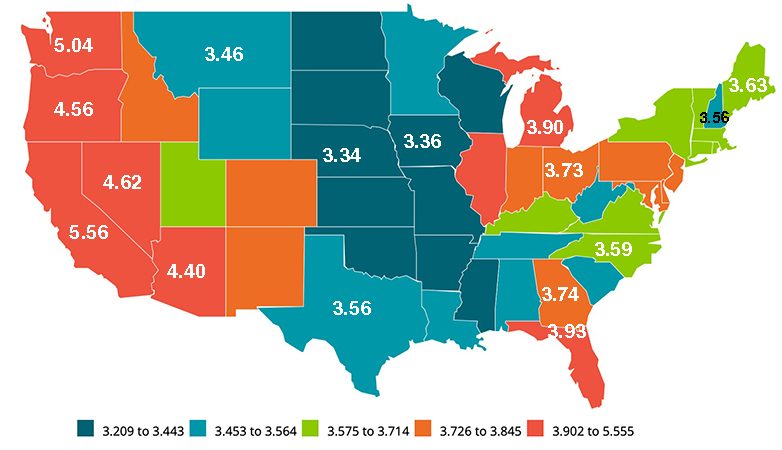
As you can see, in none of the states with an important Senate race has the average price hit $4/gal. yet. However, with prices currently rising 25¢/week, in another week or so, we could get there. Since only two of the states with a potentially competitive Senate race are above the national average of $3.89, you might be wondering how the math works. The answer is that gas in the far West is very expensive, so we included the average prices for five states in the West.
If comparative gas prices are your thing, if you go back as far as 2008, the lowest daily average since then was on Dec. 29, 2008 at $1.59/gal. and the highest was June 16, 2022 at $5.03/gal.
Despite current gas prices being nowhere near record levels, people are starting to notice. A new Yahoo/YouGov poll found that 66% of American adults disapprove of how Donald Trump is handling gas prices vs. 27% who approve. Overall on the cost of living, Trump is way down, with only 26% approving and 67% disapproving, a net 41 points under water. Also, 61% say inflation is getting worse and only 16% say it is getting better. That doesn't bode well for the Republicans in November. Still, Trump's overall approval is 38% (vs. 59% disapprove), a mere 21 points underwater. Why the big difference? Presumably due to much better approval in other areas, like immigration. (V)
The Senate Is a Millionaires Club
Almost three-quarters (73%) of sitting senators are worth over a million dollars, and some of them are worth way, way, over $1 million. Here are the top-ten richest senators by net wealth:
| Rank | Senator | State | Party | Net worth | Source of wealth |
| 1 | Jim Justice | West Virginia | Republican | $664 million | He inherited coal mines from his father. |
| 2 | Rick Scott | Florida | Republican | $515 million | He cofounded the nation's largest hospital corporation. |
| 3 | Pete Ricketts | Nebraska | Republican | $208 million | He worked for Ameritrade, which his father founded. |
| 4 | Mark Warner | Virginia | Democratic | $206 million | He made good investments in telecomm companies. |
| 5 | David McCormick | Pennsylvania | Republican | $173 million | He was CEO of a hedge fund. |
| 6 | Tim Sheehy | Montana | Republican | $161 million | He founded an aerial firefighting company. |
| 7 | Bernie Moreno | Ohio | Republican | $139 million | He started a chain of luxury car dealerships. |
| 8 | Ron Johnson | Wisconsin | Republican | $68 million | He was CEO of his brother-in-law's plastics manufacturer. |
| 9 | Markwayne Mullin | Oklahoma | Republican | $67 million | He worked at his family's plumbing business. |
| 10 | Mitch McConnell | Kentucky | Republican | $66 million | He inherited wealth and got a big gift from his wife's family. |
One thing we notice is that five of them (Scott, Warner, McCormick, Sheehy, and Moreno) founded or ran a sucessful company. They are good entrepreneurs. Maybe those skills helped them get elected to the Senate. The other five inherited the money. They are basically glorified trust babies. On the whole, Republican senators are wealthier than Democratic senators. The median for the Republican caucus is $5.7 million. For the Democrats it is $2.9 million. Poverty stricken they are not.
One might legitimately ask whether a group so far removed from the experiences of ordinary Americans should be writing the laws and setting the policies that affect the whole country. Over the whole country, only 7% of the people are millionaires. Sen. Chris Van Hollen (D-MD) said: "The Senate is packed with multimillionaires, and the fact is some of them have lost touch with the real world challenges faced by Americans all over the country. It is part of the reason that we have a tax system that favors people who make money off of money and penalizes those who earn a paycheck through hard work. We need to change that."
The senator who is furthest from his constituents financially is Justice. The median household net worth in West Virginia is $18,000. Unlike most senators, Justice does not live in D.C., Maryland, or Virginia. Despite all his money, he doesn't have a house in D.C. or those states. Instead he lives in Lewisburg, WV, and sometimes stays there for days at a time. When he is needed for a vote, he flies in on his private jet, which takes 40 minutes. Justice says that he stays in West Virginia much of the time to stay in close contact with his constituents so he can represent them better. In reality, he didn't really want to be a senator, was 72 when he ran, and did so only because the NRSC begged him to do so after Joe Manchin called it quits. He is not really interested in Senate work although he is on the Senate Energy Committee and tries to do what he can to support Big Coal.
It is a self-perpetuating cycle, in part because it costs millions of dollars to run for the Senate. People who don't have to work and who can toss $5 million of their own money into the pot without noticing that it is gone, clearly have a massive advantage over someone who works for a living.
It can be done, but is rare. There are about a dozen senators whose personal net worth is less than the median household net worth of their states.
Educationally, the Senate is also unrepresentative of the country. Every senator except Markwayne Mullin (R-OK) has at least a bachelor's degree and 82% have a graduate degree. Fifty-one have a J.D., five have an M.D., four have a Ph.D., and 22 have a master's. It is a pretty elite bunch in multiple ways. (V)
NRCC Names Members of the MAGA Majority Program
Each party has lists of the members of the House and Senate that it thinks are most vulnerable and who will be specifically targeted. The Republicans' list of candidates trying to knock off the weakest House Democrats used to be called the "Young guns." This year the list was renamed the MAGA Majority Program, but it is the same thing. Here is the list (asterisks denote that the PVI was before the midcycle redistricting):
| District | PVI | Incumbent | Challenger | Challenger's background |
| AZ-01 | R+1 | (Open) | Jay Feely (R) | Former NFL kicker |
| CA-13 | R+1* | Adam Gray (D) | Kevin Lincoln (R) | Former mayor of Stockton |
| IA-02 | R+4 | (Open) | Joe Mitchell (R) | Former state representative |
| ME-02 | R+4 | (Open) | Paul LePage (R) | Former governor of Maine |
| NC-01 | R+1* | Don Davis (D) | Laurie Buckhout (R) | Retired Army colonel |
| NY-03 | EVEN | Tom Suozzi (D) | Mike LiPetri (R) | Former state assemblyman |
| NY-19 | D+1 | Josh Riley (D) | Peter Oberacker (R) | State senator |
| TX-28 | R+2* | Henry Cuellar (D) | Tano Tijerina (R) | Webb County executive |
| TX-34 | EVEN* | Vicente Gonzalez (D) | Eric Flores (R) | Army veteran |
These will certainly be among the most competitive districts this fall. (V)
Is MAGA Split on Iran?
There have been several stories about the split in MAGA, but that may be overstated. A few high-profile MAGA stars, like Tucker Carlson, are upset about another forever war, but polls show that most Republican voters are still on board the S.S. Trump. The war in Iran is unpopular because Democrats and independents don't like it. However, for many Republicans, Donald John Trump is a God-King and they believe everything he says and support everything he does.
This is more of a description of a cult than a political party that has consistent principles that all leaders follow and most supporters want. Back in the days of St. Ronald of Reagan, the Republican party stood for individual liberty, free markets, free trade, and small government. Reagan acted in accordance with these principles. The Party was not a cult worshipping Reagan. This is why George H.W. Bush was able to win in 1988: He offered more of the same and that is what the voters wanted.
Now, MAGA is simply Trump. Whatever he wants is what they want. When he wanted no more wars, they wanted no more wars. When he wanted a new war or two, they wanted a new war or two. A lot of media coverage about MAGA is way off base because it assumes MAGA has some underlying ideology. It doesn't. It is just hero worship of Trump, no more, no less.
Here is a chart showing how MAGA Republicans and non-MAGA Republicans (what we sometimes call "normie Republicans") view Trump on various issues:
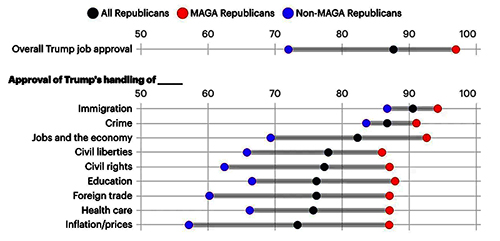
As you can see, except for immigration and crime, the non-MAGA Republicans are quite far from the MAGA Republicans on many issues. In effect, the MAGA Republicans are just saying: "We love Trump." The issues don't actually matter at all to them.
Now what about all the stories about the split in MAGA over Iran? A YouGov poll cited in the piece linked to above broke down support along two axes: MAGA and support for the war. Here is a graphic that reflects that breakdown.
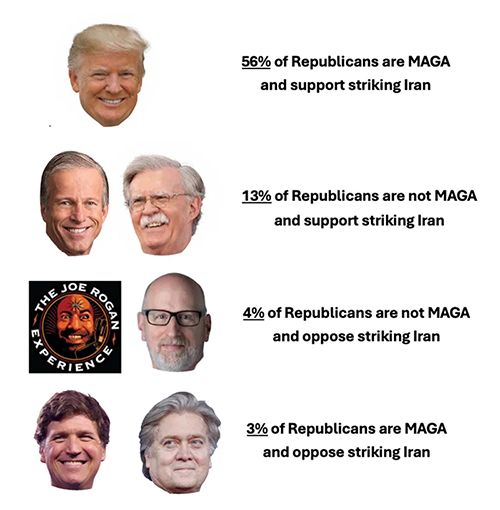
The media often get snookered by small but noisy groups. The anti-Iran group, led by Carlson, Steve Bannon, Joe Rogan and David French, are only around 7% of people calling themselves Republicans. But MAGA vs. non-MAGA makes a good story. Another example of the same misreading of a small but noisy group is young voters. To read the news, one gets the impression that the big issues for young Democrats are climate change, Palestine, and student loans. In actual polling, these rank 11, 14 and 15, respectively. But the groups that care about those issues are very good at getting attention and the media like a good show.
This MAGA = Trump view brings up an important issue: What happens when Trump is no longer on the ballot? He can't run for president again, although he could run for governor, the House, the Senate or sheriff of Palm Beach County (although the latter would be a bit of a letdown). This craziness also extends to people's personal finances, with 73% of MAGAs expecting their personal finances to improve in the next 5 years vs. 57% of non-MAGA Republicans. It is doubtful that there is any true economic basis for this discrepancy.
If MAGA = Trump, will anyone be able to hold MAGA together after Trump is gone? None of the other contenders seem like cult leaders. J.D. Vance wants to be a cult leader, but merely adopting the most recent of Trump's positions doesn't make it so, because MAGA is not about positions. It is about Trump, and Vance is not Trump. What Vance (and Marco Rubio) have going for them is that many Trump voters have been trained to hate the Democrats, so de facto their choices are the Republican nominee or not voting at all. Some may choose the latter, but there probably isn't much any Republican 2028 nominee can do about that since the Republican Party really isn't a party anymore. (V)
Arizona AG Files Criminal Charges against Prediction Market
Kalshi is a company that takes bets on political and other outcomes. You can bet on things from which party will win the House in 2026 to whom the Republicans will nominate for president in 2028 and much more. For example, if you think Gov. Gretchen Whitmer (D-MI) will be the Democratic nominee for vice president in 2028, you can place a bet on her for 11¢. If she gets the nomination, you win $1.00; if not, you lose your 11¢. Kalshi thinks of itself as a company selling futures contracts (like selling August hog futures on the Chicago Mercantile Exchange). Arizona AG Kris Mayes thinks of it as an illegal gambling operation and has charged it as such. Some pundits cite betting markets like Kalshi and Polymarket as an alternative source of information about election outcomes since people betting on them have real skin in the game.
When Kalshi started, it was not really on anyone's radar. Now people are betting $5 billion a week on Kalshi, Polymarket and others like them. For example, over $10 million has been bet on Kalshi on the Texas Senate runoff. That got Mayes' attention. The company denies all wrongdoing so there could be a trial coming up. We wonder if Kalshi will take bets on which side wins the trial. (V)
Previous | Next
Main page for smartphones