Previous | Next | Senate races | Menu
New polls:
Dem pickups: (None)
GOP pickups: (None)
Thune Confronts Trump on SAVE America Act: The Votes Aren't There
Donald Trump is turning the screws on Senate Majority Leader John Thune (R-SD) to either end the filibuster altogether or at least require a Jimmy Stewart-style talking filibuster, with Democrats maybe reading Macbeth, a fun play about a power-mad tyrant who meets his end at the hand of some guy not of woman born. Thune is firmly resisting and Trump is getting angrier by the day. What Trump really wants is to pass the SAVE America Act, which would require documentary proof of citizenship to vote, would ban most absentee voting, and would also implement more things meant to suppress the vote. Thune is taking a lot of flak for his stand, but is not budging. Trump has even said he will not sign any bill until the Act is on his desk, but Thune is unmovable.
It is not even clear if the SAVE America Act will really be that helpful to the Republicans in elections going forward. Trump has this mental model that the people who lack government ID are mostly poor Black voters in big cities who vote for Democrats. There really isn't a lot of data about that. It is estimated that 9% of eligible voters don't have proof of citizenship, but who they are is less sure. Trump's mental models aren't always on target. He thinks, for example, that Medicaid is for poor Black people in cities. That is true, but it also helps millions of poor whites in rural areas—his base.
A second problem for Trump if the Act does pass is that Democrats will be super motivated to run information campaigns and ground campaigns to help urban voters get birth certificates. They will explain to people what the process is, provide free rides to the offices that issue the documents, and collect money to pay the associated fees. This is much easier in densely packed cities than in rural areas. Also, blue states and cities will increase opening hours and remove obstacles to getting birth certificates while red ones probably will not. Trump does not realize that if the Act passes, there will be an instant and strong reaction to it that may end up neutralizing the effect or even backfiring on him.
Why is Thune so willing to stand up to Trump when almost no one else is? Thune is no firebreather, after all. There are four basic reasons and all of them are fairly prosaic. First, the votes simply aren't there. To institute any kind of change to the filibuster, he needs to get 50 senators and the veep on board. Apparently, he doesn't have 50 votes yet and doesn't expect to. Calling a vote and coming up short makes him look weak. That reduces his power. He doesn't want that just to please Trump.
Second, and more complicated, is 2029. Thune has been around the track a couple of times, can read polls, and knows there is a ferocious reaction to Donald Trump now. He probably has mentally conceded the House and is doing his best to save the Senate, even though that is far from a sure thing. But he plans to stay in the Senate after the 2028 election and knows that if he weakens or kills the filibuster, if the Democrats get the trifecta in 2028, they will ram through a large number of bills he really, really does not want, including bills on democracy, voting, redistricting, abortion, guns, and much more. He hopes that if he maintains the filibuster now, it will be harder for the Democrats to weaken or abolish it in 2029. His argument will be: "Look, folks, when we had the chance to abolish it and ram through stuff you hate, we didn't do it. So we are now asking for you to grant us the same mercy we granted you in 2026." It could work.
Third, while the filibuster is a tool of the minority, it also serves a useful purpose for the majority by allowing them to walk both sides of the street on controversial issues. For example, if a staunch anti-choice voter asks Thune (or any other Republican) why a bill to ban all abortions has not been brought to the floor of the Senate, then Thune (or that other Republican) can reply, "Gee, I sure would like to do that, but there's no point because no Democrats would vote for it, and so we'd never get to 60 votes." If the threshold for passage is 50, by contrast, then the 53 Republicans in the Senate all of a sudden have far less cover for punting on positions that a vocal minority cares passionately about, but that would be poisonous with the majority of the electorate.
Fourth, but minor, is that trying to reestablish the filibuster is a complicated legislative procedure that would allow the Democrats to effectively shut down the Senate for weeks, even though in the end, they would lose. It is not worth it to Thune to waste weeks for a bill that might not be all that useful after all.
One new development yesterday is that former Senate institutionalist John Cornyn (R-TX) decided to sell his soul in a desperate effort to get Trump's endorsement in the Senate runoff. Cornyn said: "Hell, my soul isn't worth much, really." OK, he didn't say that but he might as well have. For his whole time in the Senate, almost 24 years, he has supported the filibuster as a way to keep a narrow majority from ramming through controversial legislation. And since he has been in the minority many times, he knows how important that is. Now he desperately wants Trump's endorsement so he threw his long-standing principles in the bonfire and sided with Trump.
He is also stupider than we thought he was. He didn't have to do this. Trump didn't have any cards. Cornyn could have held fast and dared Trump to endorse AG Ken Paxton (R), a guy who has taken corruption to a whole new level. If Trump had done that, that would have made the seat a toss-up or worse. Trump might bluster, but he really doesn't want to lose the Senate, so in the end he would have had to endorse Cornyn anyway. By giving up his last shred of integrity, Cornyn has probably ensured his victory in the primary but at the price of now being a total phony. Democrat James Talarico could try to use this against Cornyn in the general election. Maybe that will work, but maybe not. Texans love phonies, if they are bold and brash enough about it. (V)
How Does It End?
There are three big questions about the war in Iran:
- Why did it start?
- When will it end?
- How will it end?
The most salient one is the third one. During the Iraq war, Gen. David Petraeus famously asked: "Tell me how this ends?" It was a good question then and still is.
Various media outlets are venturing guesses about how it ends. Here's one take from The New York Times:
- Regime Change: This is the most optimistic one. In it, there are mass uprisings all over
Iran against the regime and attempts to snuff the protests out are thwarted by missile and drone attacks on police,
army, and Revolutionary Guard bases and personnel. Airdropping firearms and other weapons to the people is also
conceivable. This is very unlikely, but in 1979, the Shah of Iran had an absolutely iron grip on power and the idea that
a bunch of bearded old men who time-traveled in from the 7th century could beat his police state was inconceivable, too.
- Regime modification: Also optimistic is that a (tacit) deal is made with the regime: They
can stay in power but have to give up their nuclear program and weapons that could threaten Israel and their Arab
neighbors. With enough destruction and punishment from the air, the ayatollahs might find the deal better than complete
extermination. This scenario is most likely if U.S. and allied forces can capture
Khark (Kharg) Island,
16 miles off the coast. It is the
terminal
for 90% of Iran's oil exports and the source of most of its income. Capturing it would require a naval blockade and
landing troops on the island. Risky, but not impossible.
- Chaos: Another possibility is that the regime holds on without any deal but is greatly
weakened and has to devote a lot of effort at keeping the country together, fighting off secessionist movements in
multiple provinces. There could also be leadership fights internally that sap the regime's strength.
- Failed State: This is the worst of all. Iran could become a failed state, with no centralized power and various militias fighting other militias and civil order breaking down. The model here is Libya, but on a much larger scale. This would invite foreign intervention, not all of it benign, and cause millions of refugees to flood neighboring countries. The wealthier ones might make it to the U.S. and request asylum.
Too pessimistic for you? How about NOTUS? They asked eight Middle East experts what they think Iran will look like in a year. Here are brief summaries of their guesses:
- Suzanne Maloney (The Brookings Institution): The regime will probably survive and be
less capable of projecting power beyond Iran's borders, even with closer relationships with Russia and China. However, it
will become more repressive and volatile at home to prevent a revolution. Ordinary Iranians will be poorer and more
bitter.
- Ivo Daalder (former U.S. ambassador to NATO): The clerics will be overthrown by the
Islamic Revolutionary Guard and the country will be run by an unforgiving secular military dictator. The upside is that
without Shiite ayatollahs running the show, Iran will be less toxic to the Sunni Arab countries in the neighborhood.
However, the new regime will be focused like a laser on building nuclear weapons to avoid another attack by foreign
powers like the current one.
- Mona Yacoubian (Center for Strategic and International Studies): There will be a rump
regime that is more nakedly militaristic than the current one. However, even though there will be an ayatollah as
Supreme Leader, the Revolutionary Guard will actually call all the shots. A free and democratic Iran is not in the
cards.
- Jamie Fly (Freedom House): A free and democratic Iran would be nice but that cannot be
achieved by bombing. It would require extremely good diplomacy and economic pressure. It is up to the Iranian people.
(In other words, Fly doesn't have a clue.)
- Kori Schake (American Enterprise Institute): The Revolutionary Guard will be firmly
entrenched and brutally repress the people. They have the guns and killed 30,000 people during the recent protests. They
will kill as many as needed to gain and keep power.
- Uzra Zeya (Human Rights First): You can't bomb a country into democracy. Unless the U.S.
changes its policies there is no hope for a free and democratic Iran.
- Kevan Harris (UCLA): The most likely outcome is a return to the status quo ante, but with
a degraded infrastructure. The war will make people more patriotic and less accepting of foreign intervention. This will
allow the regime to consolidate power.
- Linda Robinson (Council on Foreign Relations): The Iranian people will suffer from the physical and economic damage of the war. No one will come help them recover. It will push getting a stable and peaceful Middle East decades into the future.
Not a lot of seers see a peaceful and democratic Iran when this is over. Maybe the ayatollahs will continue to run the show, maybe the Revolutionary Guard will, but it won't be the people. Interestingly, no one thinks the Baby Shah, the exiled Reza Pahlavi, will have any role in the country's future, even though he is the only person who could possibly lead Iran into becoming a functioning democracy, albeit with him as the symbolic leader, like, say, King Charles III of the U.K.
One development no one mentioned is that Iran is now laying sea mines in the Strait of Hormuz. It is doubtful that they are carefully numbering each one and having it broadcast its GPS coordinates every few minutes. This means that when the military conflict is over, it will be necessary for minesweepers to find and neutralize them all. While the Strait is narrow, it isn't that narrow and it is 200-300' deep. If the minesweepers miss a few mines and some oil tanker gets blown to bits resulting in the mother of all oil spills, the results could be catastrophic for Iran and the whole world. (V)
Breakdown of Where Trump Is Losing Support
It is well known now that a critical part of Donald Trump's support in 2024 was from marginal voters who are not actually Republicans but who liked his macho style and his promise to beat grocery prices into submission with his bare hands. They are belatedly discovering that this is not happening. G. Elliott Morris has taken a look at which Trump voters are defecting the most. It is mostly young, nonwhite, lower-income voters, who have no business voting for Republicans at all since the GOP has nothing to offer them. At least Trump offers young, white lower-income voters something, namely barely disguised racism. Here is a statistical breakdown of which 2024-Trump voters are jumping ship:
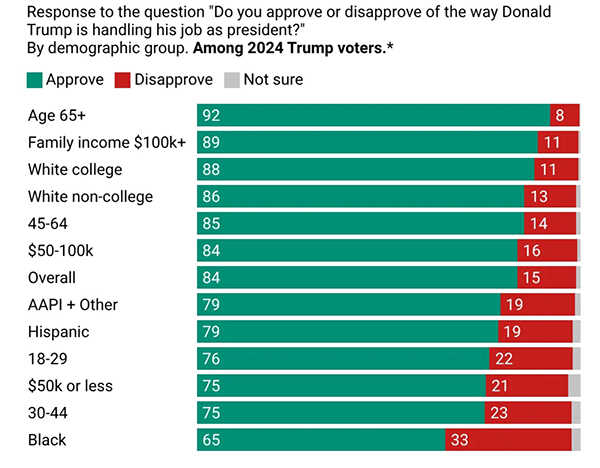
From the graphic above, it is clearly Black, Latino, and AAPI voters, age 18-44 voters, and under $50K voters who feel deceived and now disapprove of Trump. Will they vote for the Democrats in the midterms? That is not a given since they are marginal voters to start with.
The Democrats will have to pound on affordability and explain how they will pull it off. The reality, of course, is that they can't. Even with complete control of Congress, anything they do to lower costs will probably be vetoed by Trump, leading to a stalemate. Then the Democrats will get some of the blame in 2028 for not getting anything done. A pitch like: "Vote for us now so that if we capture the White House in 2028 we might be able to build more houses to lower housing costs and provide more health care subsidies" is probably pretty abstract and distant for most voters.
Some of this makes economic sense. Younger voters are feeling the poor job market more strongly than older voters with secure jobs. Poorer voters are feeling Trump's tariffs more strongly than people not living paycheck to paycheck. But for all voters, being lied to about prices dropping on Day 1 surely plays a role here. (V)
Trump May Back Rubio in 2028
All his life Donald Trump has done something out of Franklin D. Roosevelt's playbook: pit people against each other. For FDR, it was assigning a task to, say, the Department of the Interior and to the Department of Agriculture, and seeing which one got it done first (or better). For Trump, it is the succession: J.D. Vance or Marco Rubio? The very existence of a discussion about the succession means Trump understands he cannot have a third term, so he wants the next president to cement his legacy. He has been asking people around him for a preference and it is Rubio by a country mile. Vance acts like he is next in line, but he is an obnoxious opportunist without a lot of real friends.
Trump is very superficial and consumes a lot of news. Rubio has a real job (actually, several of them) and is in the news all the time, especially with conflicts all over the world, which is the secretary of state's natural bailiwick. Rubio is also NSA. In contrast, the veep has no real job unless: (1) the Senate is tied 50-50 or (2) the president assigns him something to actually do (which Trump hasn't). So Rubio can get on TV whenever he wants to by announcing that he is negotiating with someone about something.
Playing the two against each other doesn't mean Trump is about to endorse either one for president. That will have to wait until the 2028 race heats up, which won't be until the fall of 2027, when the first debates will be held. If both of them declare a run, Trump could watch the debates and decide which one looks better on the tube, and take it from there.
Many donors and Republican operatives prefer Rubio because he doesn't have the sharp edges Vance does. A Vance campaign would be a base-only campaign. He is Trump without any of the charisma that some independents like. He is straight-up nasty and will get roughly 0% of Democratic votes and few independent votes. Rubio is much softer and less abrasive. He can probably get some normie Republicans to vote for him in the primaries and independents to vote for him in the general election. He is certainly the stronger general-election candidate, assuming that foreign affairs don't go south now, with Trump heaping blame on him.
From Trump's point of view, there is a bit of a dilemma. Vance will try to continue his MAGA, America First policies. If Rubio wins, he will probably move to the middle and not be true MAGA at all. So Trump can either go with the guy who will continue his policies but is the weaker general election candidate or the guy who will march to his own drummer but is more electable. For this reason, we expect Trump to refrain from endorsing anyone until he has a better idea who is a stronger primary candidate and who is a stronger general-election candidate, and that won't be until late 2027. Both Vance and Rubio are smart enough to realize this, so they have to continue to act like buddies until the show really gets going in maybe 18 months.
Historically, sitting veeps rarely get elected as president. The last one to pull it off was George H.W. Bush. The last one to fail at it was Kamala Harris. The problem is that the veep is closely tied to the president, and only if the president is very popular does that work, and then not always. Bill Clinton had a 68% approval rating toward the end of his term but that wasn't enough to get Al Gore over the finish line. Vance is going to be joined at the hip with the unpopular Trump. Rubio, much less. Of course, if the world is in flames in 2 years, Rubio will get some of the blame that an outsider, say Gov. Brian Kemp (R-GA), will not. (V)
Epstein's Accountant Testified Yesterday
Richard Kahn, Jeffrey Epstein's long-time accountant, testified before the House Oversight Committee yesterday. Executive summary: He saw nothing, knew nothing and did nothing. He is as pure as a newborn lamb.
Kahn did admit that Epstein had an enormously complicated financial infrastructure, with corporations and bank accounts all over the place, but he said that this is very common among wealthy people and not a red flag at all. Kahn also arranged at least three sham marriages to obtain visas for some of Epstein's victims to get into the U.S. Apparently arranging sham marriages is also normal business for accountants to the wealthy.
Kahn did give the Committee some leads, though. He said that the five clients who paid Epstein the most were Les Wexner, Glenn Dubin, Steven Sinofsky, Leon Black and the Rothschilds, which is actually a family, not a person. The Committee is planning to hear from some of them. It is almost inconceivable that any of them will admit to anything. Saying you don't remember is technically perjury if you do remember, but it is impossible to prove in court. Actual prosecutors don't work like this—that is, asking the kingpins to testify first. They ask people much lower on the food chain, like secretaries, chauffeurs, pilots, butlers, cleaners and others who might have seen or heard things and collect that information and then confront the guys at the top with it. If any of the people who gave Epstein money did it because he was blackmailing them with DVDs of them doing illegal things, perjury is the least of their concerns, and claiming "not to remember" anything even skirts perjury charges.
There is not likely to be any accountability until there is a Democratic attorney general who appoints a special counsel with broad subpoena powers. If there is a good suspicion that some of the crimes were committed at Epstein's New York City mansion, then NY AG Letitia James could pick up the ball and run with it. However, it is likely that most—maybe all—of the "partying" took place on Epstein's private island, precisely to make sure no state attorney general had the power to investigate it.
Not all members of the Committee were convinced. Rep. James Walkinshaw (D-VA) said: "I do not find it credible that he had no knowledge of Jeffrey Epstein's crimes. If he was ignorant of Epstein's crimes, he was willfully ignorant of those crimes."
Next week, the committee will hear Epstein's lawyer, Darren Indyke. Together, Kahn and Indyke are the executors of Epstein's estate. Together, the two have earned millions for their work for Epstein. (V)
A DOGEy May Have Stolen Social Security Data
Back during the Day of the DOGE, a lot of people were worried that Elon Musk and his merry band of DOGEys (remember them?) would steal confidential data they got access to. Now a whistleblower is claiming that the fears were real and one of the DOGEys copied sensitive Social Security data onto a USB stick and is sharing that with his new employer, a government contractor. The allegation is serious enough that the Social Security Administration's inspector general is investigating the claim and has informed the top members of four congressional committees.
A reporter at The Washington Post spoke with the whistleblower and learned that a former software engineer who worked for the now-defunct DOGE had access to two key SS files, "Numident" and the "Master Death File." Together, they had records of 500 million living and dead Americans, including names, SS numbers, dates and places of birth, citizenship, race, and information about parents. Assuming each record is under 2 KB, the entire database would fit in under 1 TB. USB sticks with a capacity of 1 TB are commercially available for under $100, so stealing the entire database and putting it on a USB stick is certainly possible. According to the claim, the theft occurred in early January.
The engineer supposedly asked another colleague to help him, but the colleague refused because he knew copying the data was illegal. The thief didn't see that as a problem because he expected a presidential pardon if he was caught. After leaving government service, he foolishly bragged to others that he had the data and "God-level" security access to the SSA systems that no SSA employee had.
The SSA system is 60 million lines of COBOL that runs on IBM mainframes. And yes, mainframes are still here. The IBM z17 was introduced in June 2025, runs a virtual machine monitor (z/VM) on the bare metal, and can support thousands of virtual machines running either z/OS or Linux as guest operating systems. The z17 can run unmodified 1960s COBOL programs, just thousands of times faster than the old IBM System/360 could. A high-end z17 can process hundreds of thousands of transactions/sec.
Normally, access to the SSA database is extremely limited, but that good ol' security-conscious Supreme Court allowed Elon Musk and his merry band of hackers full access because, well, the president is like a king and if he says they can have it, then they can have it.
But it gets worse. Rep. Robert Garcia (D-CA), the ranking member of the House Oversight Committee, said: "Not only has an ex-DOGE bro been accused of running around with the Social Security information of every American on a flash drive, he also may have the ability to edit and manipulate data at the Social Security Administration at will. This is dangerous and outrageous, and Oversight Committee Democrats will fight for transparency and accountability." Good luck with that.
How might the data be misused? Since they contain citizenship information, a contractor hired to ferret out noncitizen voting could possibly change the citizenship status of people in carefully selected ZIP codes to "noncitizen" and then use the modified data to pressure states into removing these people from the voting rolls.
Is there any way to know how many copies of the USB stick have been made and where they are now? Uh, no.
Are Democrats aware of this situation? Yes. The ranking member of the Senate Finance Committee, Ron Wyden (D-OR), issued this statement yesterday: "These allegations describe one of the largest known data breaches in American history, perpetrated by Trump appointees for the explicit purpose of weaponizing Americans' sensitive personal data for political gain. There must be a full public accounting of this breach at Social Security, including justice for anyone who committed or enabled criminal theft of Americans' data." Will Senate Republicans join Wyden? Will the DoJ go after the perps? Will pigs fly? (V)
Three Senators Now Back Graham Platner over Janet Mills
Graham Platner, the oysterman who is running for the Senate in Maine, has picked up support from three senators who will be his colleagues if he wins the primary against Gov. Janet Mills (D-ME) and then defeats Sen. Susan Collins (R-ME). The three senators are Ruben Gallego (D-AZ), Martin Heinrich (D-NM) and Bernie Sanders (I-VT). Platner, 41, is arguing for generational change. Gallego is 46 and Heinrich is 54, so they agree. Sanders is a tad older at 84. If Sanders were serious about generational change, he wouldn't have run for another 6-year term in 2024. He will be 89 at the end of this term, if he makes it. If he doesn't, Gov. Phil Scott (R-VT) or his successor will get to appoint a new senator until a special election is held. Scott has said he would appoint an independent if he got the chance, but one has to assume it would not be a Bernie clone. Maybe a Joe Manchin clone. Running in 2024 was rolling the dice.
Platner is a progressive, well to the left of the moderate Mills. The most recent poll of the Maine primary has Platner up 46% to 39%. Platner also does well in the general election polls, leading Collins 44% to 40%. A Mills-Collins matchup is a tie at 44% each. Still, in all cases there are many voters who are undecided.
Platner has some baggage not involved with oysters. Among other things, he has said Black people don't tip, called some Reddit users re***ded, and said cops are bastards. He also implied that if a woman is raped, it is her own fault. (V)
Cindy Hyde-Smith Will Face Scott Colom in November Senate Race in Mississippi
Mississippi held its primary elections on Tuesday. The big news was that the old guy, Rep. Bennie Thompson (D-MS), beat the young guy, Evan Turnage, in the House primary in MS-02. But there were also Senate primaries. Sen. Cindy Hyde-Smith (R) was renominated, as expected. On the Democratic side, Scott Colom, a district attorney, got the nod.
What is interesting here is that Joe Biden nominated Colom to be a U.S. district court judge and Hyde-Smith did not turn in her blue slip, thus killing the nomination. It is a Senate tradition that if either senator from the state where a judge will work opposes the nominee, no vote is taken and the nomination is thus killed. Clearly there is no love lost between Hyde-Smith and Colom. For the record, Hyde-Smith is white and Colom is Black. Colom couldn't be that bad because the other Mississippi senator, Roger Wicker (R-MS), turned in his blue slip and had no objection to the appointment.
Does Colom have any chance? Maybe, but not a big one. About 38% of Mississippians are Black, the largest percentage of any state. If every Black voter pulls the lever for Colom and they are joined by 20% of the white voters, Colom could win. However, getting 20% of white Mississippi voters to vote for a Black man is asking a lot, and that assumes every eligible Black voter actually votes. The last time Mississippi sent a Democrat to the Senate, it was the arch-segregationist John Stennis in 1982. The only thing that might get Colom over the line is a deep recession combined with high inflation, which might make just enough voters angry with the Republicans to vote for a Democrat just to send a message. (V)
What Is the Republicans' Absolute Worst Case in the Senate Elections?
Just as a thought experiment, we decided to consider what the truly worst-case scenario would be for the Republicans in the Senate in November. To get the worst case, we would probably need all (or most) of these things:
- Gas is above $5/gal.
- Inflation has come roaring back.
- There is a deep recession with high unemployment.
- Donald Trump's approval rating is below the Bush line (32%).
- American troops are bogged down in a forever ground war in Iran.
- MAGA is having an open civil war.
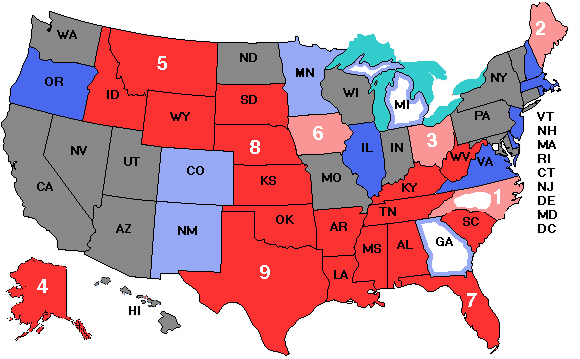
Needless to say, some of these things are individually unlikely and the combination of all (or most) of them is beyond unlikely. Still, there is a difference between winning Iowa (maybe) and winning Wyoming (not gonna happen). Here is our list of states that the GOP could lose under the worst-case conditions, numbered from most vulnerable (1) to least vulnerable (9). We cannot conceive of any plausible scenario in which any of the other red states are lost:
- North Carolina: This is probably the most vulnerable red state. It is an open-seat
election with a well-known and popular former governor, Roy Cooper, running against a Republican apparatchik, Michael
Whatley, that no one has ever heard of. Republicans will spend a fortune here, but negative ads against Cooper won't
work because people know him well and he has been vetted so many times in the past, there are not likely to be any
skeletons in his closet. Positive ads for Whatley will be tough because he has never done anything important or useful
for the people of North Carolina and as a newbie politician, he could fumble the ball. Also, the current North Carolina
governor, lieutenant governor, AG, and SoS are all Democrats, so Democrats can win in the Tar Heel State.
- Maine: Sen. Susan Collins (R-ME) should be really concerned this time. Maine is a blue
state and her personal popularity goes only so far in these very polarized times. The Democrats are having a nasty
primary and each of the contestants has some problems. For Gov. Janet Mills (D-ME) it is her age (78). For Graham
Platner, it is lack of any relevant experience, a Nazi tattoo on his chest (now covered), and many intemperate things he has posted to
social media over the years. Still, in a big blue wave, either of them could probably beat Collins (73).
- Ohio: Former three-term senator Sherrod Brown (D) is trying for a comeback against
appointed senator Jon Husted (R-OH). Appointed senators don't have a great track record and Brown is both a good fit for
Ohio and better known than his opponent. It is rare for a challenger to be better known (and probably better liked
personally) than an incumbent senator, but that is the case here. Trump will not be on the ticket in 2026, as he was in
2024, when Brown was defeated.
- Alaska: Alaska has a PVI of R+8 and Sen. Dan Sullivan (R-AK) has won two Senate races in
the Last Frontier. On the other hand, Mary Peltola has won statewide before (for the House), so she is well known and a
proven winner. Alaska is a cheap state to advertise in and she will have plenty of money from out of state. It would
take a serious blue wave for Peltola to win, but it is not impossible if there is one.
- Montana: Due to the decision by Sen. Steve Daines (R-MT) to retire and some fancy
footwork, the Republican candidate will be U.S. Attorney Kurt Alme, who is totally unknown in the state. If the
Democrats are smart, they won't support their own nominee at all, but will support independent Seth Bodnar, a West Point
graduate who fought with the famed 101st Airborne Division (the Screaming Eagles) and was later president of the
University of Montana. If he wins, he will probably caucus with the Democrats. His
campaign website
seems more compatible with Democratic positions than with Republican ones and
the website has a button to donate using ActBlue. Closet Republicans don't usually do that.
- Iowa: At a town hall, when Sen. Joni Ernst (R-IA) was asked about health care, she said
"We all are going to die." She was quickly dubbed "Joni Hearse" and dropped out, so it is an open-seat race. Iowa is red
but not that red (R+6) and it used to be a swing state. Rep. Ashley Hinson (R-IA) is the likely Republican nominee, but
she is known in only a quarter of the state. The Democrats have two strong candidates, state Rep. Josh Turek and state
Sen. Zach Wahls. Polling has Hinson ahead of both Turek and Wahls by 3 points, but in a big blue wave, 3 points is not
insurmountable.
- Florida: Florida used to be the mother of all swing states, but now it is red, although
not that red (R+5). This will probably be a steeper climb for the Democrats than Iowa despite the slightly better PVI
because the Republican, Sen. Ashley Moody (R-FL), is an incumbent. But, like Husted in Ohio, she was appointed to the
Senate (when Marco Rubio resigned to become secretary of state). As noted above, appointed senators don't have that great a track
record. The Democratic bench in Florida was pretty bare until Alexander Vindman jumped in. He was the whistleblower who
helped trigger Donald Trump's first impeachment, as a result of Trump trying to blackmail Volodymyr Zelenskyy into
investigating Hunter Biden. Democrats are going to shower him with money. His brother is Rep. Eugene Vindman (D-VA).
- Nebraska: Sen. Pete Ricketts (R-NE) was appointed in 2023 after Ben Sasse resigned, but
Ricketts won the special election in 2024 and is now seeking a full term. Democrats have decided not to field a
candidate at all, but are backing independent Dan Osborn, who ran against Sen. Deb Fischer (R-NE) and lost by 7 points.
He is more experienced now and will have plenty of backing. He is a Navy veteran and former union leader. He has the
same working-class vibe as Graham Platner in Maine. Nebraska is very red (R+13), but Osborn did better than expected
last time and Trump is not on the ballot this time. Also, Ricketts is very wealthy and his father, Joe Ricketts, is an
actual billionaire, so an anti-billionaire campaign could catch on. Last time Osborn faced someone (Fischer) who is
merely upper middle class. This time an anti-billionaire campaign could work.
- Texas: This one is tough and depends on who the Republican nominee is. We expect Trump to endorse John Cornyn. If Ken Paxton stays in the race, Republicans will have to spend another $100 million to get Cornyn over the finish line first. Trump could try to entice Paxton to drop out, but the only position he might accept is attorney general. Given how MAGA Paxton is, Trump just might fire Pam Bondi and appoint Paxton. Against Cornyn, James Talarico really doesn't have much of a chance. Against Paxton, he does. The only reason we even put Texas in this list is that there is a chance that Paxton is the GOP nominee.
In a normal, but good, year, Democrats could flip North Carolina and Maine. Going deeper into the list will require a substantial blue wave. In the absolute worst-case scenario for the Republicans, the Democrats could hold all their own states and flip nine states, to give them 56 seats. But don't bet on it. (V)
Trump and House Republicans Are Not on the Same Page about the Midterms
Donald Trump is at odds with House Republicans over the midterm strategy. He cares about things they don't care about and vice versa. His main thrust is disenfranchising Democrats by passing the SAVE America Act (see above). That is not likely to happen because the votes in the Senate are not there. The more he focuses on that, the less time he has for actually doing something to help Republicans.
Another thing he cares about a lot is banning absentee voting and restricting transgender rights. The former is opposed by many House members who depend on seniors to win because many seniors vote absentee. The latter is a distraction that has nothing to do with voting.
In contrast, Rep. Lisa McClain (R-MI), the House GOP conference chair, talked up tax cuts for families, energy independence, and Trump accounts for babies as real achievements Republicans should focus on. House Majority Leader Steve Scalise (R-LA) said that talking about affordability is the way to go. House Majority Whip Tom Emmer (R-MN) wants the midterms to be about how "working families are keeping more of their hard-earned money in their pockets" as a result of the tax cuts in the BBB. None of them even mention the SAVE America Act as a priority.
Another thing that Trump really cares about, but which no Republican House member (except maybe Speaker Mike Johnson, R-LA) cares about, is defeating Rep. Thomas Massie (R-KY) in a primary. Trump cares about this so much that he went to northern Kentucky yesterday to campaign for Massie's primary opponent, former Navy SEAL and local farmer Ed Gallrein. For Trump, getting rid of Massie is probably his #1 priority for the House. The seat is not in any danger since KY-04 is R+18, but it is not an especially Trumpy district. It contains well-off outer suburbs of Cincinnati across the Ohio River from Kentucky. The voters there are conservative, but not all that MAGA. It will be a real test of Trump's abilities to convince conservatives to dump a well-liked and long-term incumbent just because he (Trump) says so.
Massie is not hopeless and helpless. In a new ad, Massie points out that just after Trump locked up the Republican nomination in May 2016, Gallrein changed his party registration from Republican to independent in disgust. The ad shows images of Gallrein's voter registration records. To make it worse, as soon as Trump was no longer president in 2021, Gallrein changed his registration back to Republican again. That says something about what Gallrein thinks of Trump. Gallrein ran for the state Senate in 2024 as a Republican and lost the primary.
Massie claims that an internal poll shows him ahead by 17 points. That is possible because he is well known and Gallrein is not. Of course, Trump's appearance with Gallrein and a massive amount of money tossed into Gallrein's campaign could change that.
If Gallrein wins the primary, no Republican will ever dare challenge Trump again, except one planning to retire, so strong is his grip on the base. On the other hand, if Massie wins, especially if he wins big, many other Republicans will see that one can survive Trump's wrath and live to talk about it. The primary is May 19. (V)
Poll: California Wealth Tax Is Leading
Billionaires are not terribly popular right now, and California is ground zero for going after them. There is a ballot initiative that would impose a one-time tax of 5% on the wealth of the state's billionaires. Needless to say, the billionaires are opposing it with everything they have, which is—guess what—money. A recent poll, however, has the tax ahead 50% to 37%. The argument for it is that billionaires don't pay enough tax and the state can use the money to help people. The argument against it is that taxing billionaires will make them flee to the greener pastures of central Texas. There is still time for plenty of negative ads and they will come, believe us. Billionaires take this very seriously.
Democratic leaders are split. Gov. Gavin Newsom (D-CA) opposes the tax while Bernie Sanders supports it. OK, Sanders isn't technically a Democrat, but he caucuses with them. Rep. Ro Khanna (D-CA) represents Silicon Valley, where many billionaires live, and he supports the tax and he is an actual Democrat.
A big question is: Will this tax, or any wealth tax, cause billionaires to flee the state? First of all, the tax applies to anyone who was a resident of the state on Jan. 1, 2026, so moving now does not avoid the tax. Looking at future wealth taxes, while billionaires like to threaten to move and certainly have the ability to buy a nice house anywhere they want, will they really do it? In many cases, their friends and family and business associates are in California. Will they leave them all to save some tax money? And is that so bad? Do billionaires pay much in the way of income taxes? Many of them pay almost nothing because they take little salary and get stock options which they use as collateral to borrow money to live well on. Also, if high taxes are anathema to billionaires, why haven't they already left for Texas since California has higher taxes all across the board—income tax, capital gains taxes, and the whole lot. Also, for billionaires who own companies in Silicon Valley, being there is valuable because there is a whole ecosystem there not present in Texas or Florida, including suppliers, customers, partners, venture capitalists, start-up-friendly banks, and more. Are company owners really prepared to leave all that because Florida has lower taxes and warmer beaches, or are they just bluffing? Wealth taxes are common in Europe and not that many wealthy Europeans have moved to Texas.
Some people have argued that taxing the rich is fine, but this is the wrong tax. The focus should be on capital gains taxes and estate taxes. The latter is in fact a wealth tax rather than an income tax and it is less objectionable to many billionaires since they won't miss the money after it is collected. (V)
Previous | Next
Main page for smartphones