Previous | Next | Senate races | Menu
New polls:
Dem pickups: (None)
GOP pickups: (None)
Arizona Primary Is Tomorrow
Arizona has elections for governor/lieutenant governor (one ticket), attorney general, secretary of state, state treasurer, superintendent of public instruction, state mine inspector, and nine House seats this year. Gov. Katie Hobbs (D-AZ) is running for reelection and is unopposed in the Democratic primary. On the Republican side, there is a contest between extremely Trumpy (and Trump-endorsed) Rep. Andy Biggs (R-AZ) and Rep. David Schweikert (R-AZ), plus some minor and perennial candidates. Schweikert is conservative, but less Trumpy. His pitch is that he can win statewide because he has won an R+1 district seven times in a row. Biggs' district is R+10. If Biggs wins the GOP nomination, Hobbs is essentially home free. If Schweikert wins it, it could be a real horse race, although the horses might get overheated racing in the Arizona sun.
In the race for AG, incumbent Kris Mayes (D) is unopposed for the nomination and will probably face President of the Arizona Senate Warren Petersen (R). Mayes is the strong favorite. In the SoS race, incumbent Adrian Fontes (D) is unopposed for the nomination and is the favorite against either state Rep. Alexander Kolodin (R) or former chair of the Arizona Republican Party, Gina Swoboda (R).
State treasurer Kimberly Yee (R) is term-limited and running for superintendent of public instruction. There are competitive primaries in both parties. For details on this and the other statewide races, see this page.
Now on to the House, where there are potentially competitive races in AZ-01 (Scottsdale), AZ-04 (Tempe), and AZ-06 (Tucson). AZ-01 is the R+1 district from which Schweikert is retiring to run for governor. On the Democratic side, most of the Democratic establishment is behind Marlene Galán-Woods, a former TV anchor and widow of former (Republican) AG Grant Woods. They probably had interesting discussions at breakfast. Her main competitors are wealthy businessman Jonathan Treble, who thinks the seat is for sale, and former state representative Amish Shah. On the Republican side are former state Rep. Joseph Chaplik and former Arizona Cardinal Jay Feely and some others. Feely is leaning heavily into his past as a football player, because Republican voters tend to love football players, and is hoping they don't discover he was just a kicker. He has raised the most money and is leading Chaplik in the polling, but barely. Either one could win. The general election could go either way.
In AZ-04, incumbent Rep. Greg Stanton (D-AZ) has most of the Democratic establishment behind him but has a progressive challenger in Kai Newkirk. If Newkirk knocks off Stanton, it will be more evidence that 2026 could be the progressives' year. Physician Zuhdi Jasser is running unopposed for the Republican nomination. The district is D+4.
AZ-06 has a PVI of EVEN, so it will be very competitive. Both sides already have their candidate. Rep. Juan Ciscomani (R-AZ) is being challenged by JoAnna Mendoza, a single mom, gunnery sergeant, and former Marine Corps drill instructor. She is a walking poster child for being tough.
Biggs' district is R+10, so it will be filled by another Republican, almost certainly former Pinal County sheriff Mark Lamb. The other districts are all well outside “swing” range and are very unlikely to flip. (V)
New Lead in Epstein Case
It is sometimes hard to tell if the House Oversight Committee is trying to find out the truth about the many crimes Jeffrey Epstein and his buddies committed, or to hide them. Now something has popped up that chairman James Comer (R-KY) might deal with, and that a possible future Democratic chairman in January may aggressively pursue. If the current ranking member, Rep. Robert Garcia (D-CA), becomes chairman, he will undoubtedly pursue it to the max.
For many years, Epstein had an administrative assistant, Lesley Groff, who basically ran his life. She scheduled his meetings and travel, paid his victims in cash, and much more, while his focus was on preying on minors. Groff testified before Congress, under oath, on June 9. She stonewalled completely and said all she did was manage his calendar and his plane and knew nothing about what he was up to. She also said she had never met any of his victims. Here is the transcript of her testimony. Although it runs to 230 pages, she said nothing that was not already known. Despite working very closely with Epstein for almost 20 years, she saw nothing, heard nothing, did nothing. She was as pure as the driven snow.
Now the problem. Groff swore, under oath, that she never met any of Epstein's victims. Six Epstein survivors have now come forward and said Groff lied under oath because they clearly remember meeting with her. Lara Blume McGee, who was abused from 2001 to 2003, remembers meeting Groff twice at Epstein's NYC townhouse. Lisa Phillips said: "Of course I've met her in person." Sharlene Rochard said Groff knew very well she was a minor because she had Rochard's passport for planned international travel. One anonymous woman said that Groff filled in her application for a passport and certainly knew her date of birth. Another anonymous woman said she went to a private Catholic school and Groff saw her in her school uniform many times because Epstein liked to see girls in a school uniform. Groff surely knew that almost all high school girls, except some seniors, are minors.
Marina Lacerda remembered Groff personally handing her hundreds of dollars in cash in a long white envelope. Always in $100 bills; never in $20s, $10s or $5s; only in $100s. She also remembers Groff asking for new girls, what they looked like, where they were from, and how old they were.
In effect, the women are accusing Groff of perjury, a federal crime. As every prosecutor learns on Day 1 on the job, you first go after the little fish and make them squeal (or whatever fish do under pressure), then take it from there. Comer is asking the victims to sign formal affidavits in which they accuse Groff of lying under oath. Maybe he is hoping they will all refuse, but if they do sign, then what? He may try to punt, but a future Democratic chairman could refer Groff to the D.C. prosecutor for follow-up. Perjury is a D.C. crime as well as a federal one. If Groff is convicted, then she would be under a lot of pressure to sing like a fish (OK, a canary) to get a lighter sentence. She might name names of other perpetrators. After working closely with Epstein for almost 20 years, she probably knows a great deal and might be willing to blow the whistle to stay out of prison.
We imagine Comer will do his best to push all this under the rug, but that might not be so easy. The base cares a lot about Epstein and Groff probably knows as much about him as anyone not named Ghislaine Maxwell. The Democrats on the Committee are going to do everything they can to put the squeeze on Groff, and Comer may have a hard time fending them off, especially if some of the survivors sign affidavits stating their version of the story and it directly contradicts Groff's sworn testimony. (V)
Mullin Threatens States About Elections, Too
As we discussed Friday, Donald Trump's speech on Thursday was designed to sow doubts about elections, so he can claim any Democrat winning anywhere "won" due to fraud. It is an all-purpose, one-size-fits-all excuse for Republicans losing elections. Now it looks like this is not going to be a one-man show.
At a news conference Friday, Secretary of DHS Markwayne Mullin seconded the motion and threatened election officials with prison time if they didn't cough up records Trump wants—and has no legal basis for demanding. Mullin claimed—without any evidence—that there are 250,000 noncitizens on the voting rolls in California, New Jersey, Nevada and Pennsylvania. No mention of Florida or Texas, which are often the first stops for undocumented immigrants from South America and Mexico, respectively. Mullin demanded the voter rolls so they can be checked against a half-baked database of citizens the feds have compiled. Anyone not in the database is thus presumed to be a noncitizen. Mullin threatened to—illegally—cancel federal grants to states that refuse to comply. The blue states aren't going to comply and Mullin probably knows that. It is all an elaborate bit of kabuki theater to convince voters that election results can't be trusted. That way, when Republicans lose their seats in November, Trump can maybe try to say that the elections were not valid and the current office holders can just keep their jobs.
According to elections expert Rick Hasen, if the feds had actual evidence of people voting illegally, they would be indicted instantly. The penalty for voting illegally is up to 5 years in prison and a fine of up to $250,000. The lack of indictments means the feds have no specific evidence of anyone voting illegally. Also, Trump has fired dozens of cybersecurity officials. If he were truly worried about election integrity, he would not have fired any of them. Instead he would have hired more.
Mullin also said: "We're trying to make sure that American people can trust our voting system." This is ironic in the extreme, since what he is actually trying to do is foment distrust in the voting system. (V)
Third Reconciliation Bill Is Already on the Ropes
Donald Trump has ordered Congress to pass a third reconciliation bill with money for defense and the SAVE America Act. The House has a bill with a price tag of $95 billion ready to go. But senators have already said that even if it passes the House, in the Senate it is a nonstarter. Senate conservatives have said that unless the bill cuts spending by an equal amount, they are not interested in it. Sen. John Cornyn (R-TX) said: "I'm dubious about any reconciliation. I think the House is wishful thinking. Just talk to the appropriators over here. They don't like reconciliation because it bypasses appropriations. I'd be shocked if it's possible."
Sen. Thom Tillis (R-NC) doesn't like the idea of the SAVE America Act now. He thinks that making the states scramble to comply so close to an election will lead to chaos. He said: "If I see a reconciliation bill come from the House with another failed attempt to confuse this election, I will use every device I have available to slow down the wheels of government until people cop a clue and do the math." Sen. Bill Cassidy (R-LA), who no longer has to fear a primary, said: "Our national debt is a runaway train." That doesn't sound like a "yes" vote to us. Majority Leader John Thune (R-SD) said that if a bill comes over from the House, Democrats will propose one poison-pill amendment after another, forcing members to vote no on things that are actually very popular back home, such as restoring the cuts made to SNAP (food stamps) that the Big Beautiful Bill made. He doesn't want his members taking dozens of tough votes that will feature prominently in Democratic ads almost immediately.
Another complication is the fact that the chairman of the House Budget Committee, Rep. Jodey Arrington (R-TX), was busily conferring with the chairman of the Senate Budget Committee. Those discussions abruptly stopped because the Senate chairman, Lindsey Graham, suddenly died. The new chairman is Sen. Ron Johnson (R-WI), a budget hawk. He is not going to approve spending another $95 billion without spending cuts. Getting spending cuts approved is a time-consuming and laborious process because every federal program has its defenders and getting 51 votes is never easy. (V)
The Iran War Is an Incredible Gift--to China
When Donald Trump decided to attack Iran, he assumed there would be a loser and a winner in 4-6 weeks. The Iran War is now in its 21st week, the memorandum of understanding is in shambles, and there are increasingly many battles every day, with no end in sight. And Trump was wrong about there being one loser and one winner. There is one loser and two winners. The loser is the United States. The winners are Iran and China.
The U.S. is a loser because none of its war goals were achieved, including regime change and stopping Iran's efforts to build a nuclear weapon. In fact, it is now worse off because over a dozen American soldiers lost their lives in the war, the U.S. stockpile of munitions is greatly depleted, the war cost tens of billions of dollars, Iran has emerged as the dominant power in the region, and America's Arab allies are going to have to respect Iran now.
Iran is a winner because it has withstood the most powerful air attack in at least 80 years and survived. It also learned that it can hold the world hostage any time it wants to by closing the Strait of Hormuz. Before the war, it could only dream of closing the Strait and getting away with it. Now it knows it can. It has also learned that it can charge tolls for safe passage and get away with it, thus providing it with a vast amount of recurring money with which it can buy advanced Chinese weapons.
But the other big winner is China, for at least three reasons:
- America Is Weaker: China, which depends on oil from the Middle East for much of its
industry, has always seen American dominance of the region as a critical liability. America always had the power to get
its allies to turn off the spigot if times got tough. That power is now gone and it is China's ally, Iran, that is in
the driver's seat. Many of the countries in the region sense this and will draw closer to China to hedge their bets.
Trump doesn't realize it, but one of America's sources of power in the world is the role of the dollar in settling most
contracts. The U.S. alone doesn't have to worry about its exchange rate against the dollar. Iran is beginning to accept
payment in Chinese renminbi, which weakens the role of the dollar.
- The World Relies More on China: Europe and Asia see the handwriting on the wall and it
says: "Your oil supply hangs by a thread." Their response in both the short term and long term will be to wean
themselves from oil. That means solar panels, wind turbines, electric cars, and yes, a Green New Deal. That is both a
business bonanza for China, which makes all this stuff, and the creation of a new—Chinese—chokepoint. While
Iran can cut off the supply of oil, China can cut off the supply of rare earths, batteries, solar panels, electric cars
and more, and everyone understands this. Better not to awake the sleeping giant.
- China Is a more reliable business partner: China always drives a tough bargain on business deals, but once the deal has been signed, it always follows through and never reneges because Xi Jinping got up in the morning in a foul mood. Other countries know that with China, a deal is a deal. With Trump, they know that an hour after signing, he can have a fit of pique, unilaterally cancel the deal, and impose a punitive tariff on them because they refuse to obey his latest bleat. Xi doesn't do that. It is hard to do business with someone who doesn't keep his word and regards following through on signed contracts as a mere suggestion.
In the past 25 years, the U.S. has exhausted itself in three pointless ventures in the Middle East: Iraq, Afghanistan and Iran. China has simply built up its manufacturing capacity and constructed hundreds of dark factories, while America's manufacturing capacity has withered. And for Xi, the best part is that China's advance in the world has cost China nothing. It just minded its own business while the U.S. was busy destroying its own power. What a gift! (V)
New Trump Gambit on Immigration: Only Rich People Need Apply
Donald Trump is fundamentally a xenophobe. He hates all immigrants, especially nonwhite ones. That goes for legal immigrants as well as illegal ones, although there is a special exception for rich, white immigrants. Trump is trying to fight immigration and immigrants on many fronts, from physically locking down the border to sweeping up people in the U.S. illegally (or not) and deporting them.
Another front he is starting to work on is preventing people legally admitted from getting a green card—and thus becoming permanent residents. To do this, he is now proposing a rule requiring legal immigrants applying for a green card to post a $100,000 bond as part of the application process. It is not clear under what conditions, if any, the applicant would get the bond back. The obvious initial impact would be that any legal immigrant who doesn't have $100,000 lying around in spare change couldn't even apply for a green card. To Trump, effectively banning green cards, except for the very wealthy, is a feature, not a bug.
This is not the first time Trump tried to charge $100,000 for something immigration related. Round 1 was imposing a $100,000 fee for companies applying for an H-1B visa for a skilled worker, often in tech, finance, or medicine. Nominally, this was to protect American workers from losing jobs to immigrants from India and other countries who were willing to work for far less than the prevailing salary in their industry. In reality, Stephen Miller hates people with skin browner than his own, no matter what valuable skills they have, often skills acquired on someone else's dime. A federal judge shot this project down.
Yet another way Trump is trying to use money to curtail immigration is to require visitors from 50 African countries to post a $15,000 bond when applying for a visa. If the applicant later overstays the visa time limit or applies for a different kind of visa while in the U.S., the bond is forfeited. The applicant gets the bond back only if he or she leaves the country within the allotted time span. (V)
Democrats Are Dominating in Senate Fundraising
While the DNC is flailing badly, individual Democrats running for the Senate are doing pretty well. Sen. Jon Ossoff (D-GA) has raised 10x what Republican nominee Mike Collins did. In Texas, James Talarico (D) has raised $69 million, $26 million more than Ken Paxton (R). Talarico is also outpacing previous Texas Democrats like Colin Allred ($38 million in 2024) and Beto O'Rourke ($24 million in 2018). In Ohio, former senator Sherrod Brown (D) outraised Sen. Jon Husted (R-OH) by $10 million.
In some cases Democrats have outraised Republicans, but the Republicans have more money in the bank left over from previous campaigns. In Alaska, Mary Peltola (D) outraised Sen. Dan Sullivan (R-AK) by $5 million, but he has $8 million in the bank to her $7 million.
But the Republicans have a not-so-secret weapon. The RNC has $125 million in the bank while the DNC is broke. The NRSC has $10 million more than the DSCC. And then the biggie is MAGA Inc, which has $382 million on hand. But Donald Trump controls that one and he may or may not be willing to spend it on electing Republican senators. He might prefer using it as a giant slush fund for his own purposes. MAGA Inc.'s biggest donor is Elon Musk, who has ponied up $90 million this cycle by just looking under the cushions of his couch for loose coins.
In Maine, the situation is complicated. Graham Platner raised $9 million and spent $7 million of it, leaving $2 million in the bank. He can determine what he wants to do with it, if anything. Sen. Susan Collins (R-ME) has $11 million in the bank. Once her opponent is known, donations will come flooding in to the Democrat, though. (V)
Democratic Senate Nominee Is Dropping Out--That Is Good for the Democrats
One feature of modern politics is that many voters agree with most of the Democrats' policies but would never vote for a Democrat. This is because Fox News and the rest of the right-wing mediasphere have convinced them that Democrats are the spawn of the devil, without actually discussing policy issues, like whether turning your $7.25/hr wage into $15/hr would be good for you or whether raising the FICA contribution cap of $184,500 to $300,000 or $500,000 or more would protect Social Security for decades. This fact of life has some consequences this year.
In particular, two people who support most of the Democrats' policies are running for the Senate as independents. They are Dan Osborn in Nebraska and Seth Bodnar in Montana. The two are very different. Osborn is very working class. His father loaded cargo for the Union Pacific Railroad. His mother was a seamstress. After high school, he enlisted in the Navy and after his discharge worked as an industrial mechanic at a Kellogg's plant and as a union leader. He is now running for the Senate in Nebraska as an independent. He wants to raise the minimum wage, facilitate unionization, legalize marijuana, and guarantee the right to an abortion. He also wants to raise the Social Security cap and give people the right to repair objects they own. Of the people who support Donald Trump's One Big Beautiful Bill, he says they were sold a bill of goods. There is nothing there that Sen. Bernie Sanders (I-VT) would disagree with. But running as an independent triggers none of the "instant hate" that many voters would feel if he ran as a Democrat.
Bodnar is different. His parents were both educators. He graduated first in his class at West Point, was a Rhodes scholar at Oxford, served in the fabled 101st Airborne (the Screaming Eagles), taught economics as a professor at West Point, retired as a Lt. Colonel, and became president of the University of Montana. Not exactly working class. He is running for the open Montana Senate seat vacated at the last minute by Sen. Steve Daines (R-MT). On the advice of former senator Jon Tester, Bodnar is running as an independent. He wants to get housing prices down, protect the right to an abortion, fight tariffs and trade disruption, create jobs, ban congressional stock trading, overturn Citizens United, fix the immigration system to allow farmers to get the labor they need legally, and promote green energy. If he were running as a Democrat with that program, no one would scratch his or her head and say: "Democrat, my ass."
Now here is the actual news part of this item. Since there actually is a Democratic Party in both Nebraska and Montana, there were Senate primaries in both states. In Nebraska, Cindy Burbank won the Democratic nomination. She has just filed a formal request to drop off the ballot. The request has to be approved by the secretary of state and attorney general. If they approve, the race will be Sen. Pete Ricketts vs. Osborn. This would essentially be a Republican vs. a Democrat but without the toxic label. If they refuse to approve, she will go to court and make the argument that no one should be forced to run for an office (and potentially be elected to it) if they have changed their mind and no longer want the position. If the courts refuse, too, she could conceivably actually campaign and say: "I don't want to be a senator. Please vote for someone else." Odd, but possible. In a two-way contest, the most recent poll has Osborn beating Ricketts 47% to 42%. So if Burbank can get her name off the ballot, Osborn has more than a fighting chance.
In Montana, Air Force Lt. Col. Alani Bankhead (ret.) won the Democratic primary. She hasn't said whether she will drop out to help Bodnar. State law gives her until Aug. 10. In that case, the Montana Democratic Party is supposed to pick a replacement. However, a group of Montana lawyers who have looked at the law claims that the Party can't be forced to name a candidate if it doesn't have one. If a judge then ordered them to nominate someone, suppose they nominated the judge. If he refused, suppose they then nominated someone under 30 who doesn't live in Montana. Or maybe they could find some Democrat who would actively campaign on a platform of banning all abortions nationwide, reducing the minimum wage to $2/hr, eliminating income taxes on income above $1 million/year, repealing all restrictions on gun ownership, and amending the Constitution to allow Donald Trump to have a third, fourth, and fifth term. With enough PR, that candidate probably wouldn't get many Democratic votes but might get some low-information Republicans who weren't in on the joke to vote for him. The media would go hog wild. (V)
Six Election Prognosticators Prognosticate
With the elections now 3½ months away (how time flies), The New York Times asked six election experts to give their best guesses on how they will go. The experts are:
- Perry Bacon, staff writer at The New Republic
- Carlos Odio, founder of Equis Research, a firm that specializes in polling Latinos
- Patrick Ruffini, a pollster at Echelon Insights
- Nate Silver, famous election guru who now has his own newsletter, the Silver Bulletin
- Charlotte Swasey, author of the newsletter Medium Data
- Lynn Vavreck, professor of political science at UCLA
Each one gave a prediction of how many seats each party would have in each chamber of Congress in November. Here are the predictions:
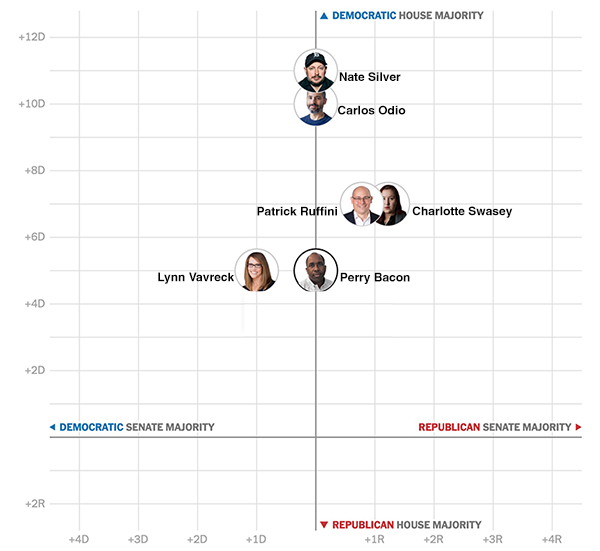
They all predict a House majority for the Democrats, in the range of 5-11 seats. This small number is because due to gerrymandering, there are almost no closely divided districts now. How big the Democratic majority is matters a lot, even though it takes only 218 votes to pass bills or impeach government officials. If the new size of The Squad is larger than the Democrats' margin, the Democrats could have a Freedom Caucus problem, with a tiny minority of the caucus holding the rest hostage.
Two of them gave the Republicans the Senate, one gave the Democrats the Senate, and three expect a tie. In the latter case, Sen. Lisa Murkowski (R-AK) will suddenly have a lot of power. She could also switch to being an independent to avoid Donald Trump threatening her with a primary in 2028.
Bacon says that polarization and partisanship rule. He doesn't think Democrats can win statewide in red states. For House races in competitive districts, the generic ballot is a good indicator and that is currently D+6. He is surprised that Ohio became so red while Michigan and Pennsylvania did not, so he doubts Sherrod Brown will get his old job back in Ohio.
Odio is not sure that all the marginal young voters who went for Trump in 2024 are going to show up for the Democrats. To get a Senate majority, Democrats need them in red states and they might not vote. Winning two red-state Senate seats would require a small miracle, in his view. He thinks a race to watch is TX-15, which is 75% Latino. If Latinos vote in 2026 as they did in 2018, Texas could shift to the left and Tejano singer Bobby Pulido could unseat Rep. Monica De La Cruz (R-TX) and the gerrymander could become a dummymander. But he is not so certain of this yet.
Ruffini thinks the new maps will definitely help the Republicans but not insulate them from a loss of the House. He is also watching gas prices closely. He thinks if it is below $3.50, the Republicans will do better than expected. The national average is now $3.97. He is keeping an eye on the Democratic primary in Michigan. If Abdul El-Sayed wins the primary and wins the general election, it will be proof that progressives can win in swing states. If he wins the primary and loses the general election, it will show that the left flew too close to the sun and possibly cost the Democrats the majority and the ability to block Trump's cabinet and judicial appointments. Boy, will there ever be recriminations if that happens.
Silver thinks that the Democrats' D+6 edge in the generic ballot could grow as pollsters switch from registered voters to likely voters (because Democratic enthusiasm is through the roof and most Democrats will show up and vote). He is also concerned about Maine. If Graham Platner decides to go home and pout that the Democrats stole his nomination from him, that could be just enough for Sen. Susan Collins (R-ME) to eke out a win. He is also keeping an eye on gas prices.
Swasey thinks a Democratic House is a done deal, but she thinks they will fall just short in the Senate. But she notes that polling is very patchy so far. She is also watching the Kansas gubernatorial primaries, which are a microcosm of the country.
Vavreck sees Trump's approval rating as key. If many Republicans have had it with him, they may stay home, and that could give the Democrats the Senate as well as the House. She is also paying attention to whether Gov. Josh Shapiro (D-PA) can flip four House seats (see below). If he can, he will get a boost for 2028. (V)
North Carolina Republicans Are Trying To Stop College Students and Black People From Voting
Now let's move on to election rigging. By Republicans, in North Carolina. Republicans on state and county election boards are running a precision two-pronged offense against Democrats voting. In Jackson, Pasquotank and Wake Counties, election officials closed voting sites on college campuses, making it more difficult and confusing for students to vote. College students skew heavily Democratic, so closing their voting sites could reduce the statewide count for Democrats.
In Pasquotank County, Sunday voting has been eliminated. The Republican officials who decided this know exactly what they were doing. Many Black churches organize "souls to the polls" events after church services on Sunday. The pastors tell people that they should vote right after services. Buses are chartered to take people to the polls right after services. White churches don't do this. By banning Sunday voting, this long-standing practice is killed off.
Note the precision the Republicans are using here. They have adopted rules that basically only target heavily Democratic groups. The mastermind behind the changes is state auditor Dave Boliek, who had Donald Trump's endorsement in 2024. He hired Dallas Woodhouse, the former executive director of the North Carolina Republican Party, to pressure county boards to make the changes. Woodhouse told county officials that if they did not comply with his directives Boliek would fire them.
Woodhouse also got county boards to reduce the hours for early voting. He claimed it was fair because some counties increased Saturday hours. Nice try, but synagogues don't do "souls to the polls." Only Black churches do that. Speaking of fairness, Woodhouse also got county boards to close polling sites in Black areas and open new ones in white areas. He knew exactly what he was hired to do. All this is part of a nationwide effort to rig elections in favor of Republicans. Oddly enough, when Donald Trump talks about rigged elections, he never seems to mention things that are actually happening on the ground. He prefers to talk about things going on only in his mind.
Gov. Josh Stein (D-NC) was furious about all this. He said: "It is clear that the auditor's staff person, who was the former executive director of the Republican Party, has been interfering with and directing local county boards of elections on how to shape their early voting plans, and that's just wrong." The governor can't do much about it, because the Republican-controlled state legislature took the authority to appoint members of the state election board from the governor and gave it to the state auditor—the only state where the auditor has power over elections.
This kind of gamesmanship happens for two reasons. First, elections are controlled by partisan politicians—usually the elected secretary of state, in North Carolina by the auditor (because the Republican-controlled legislature knew the SoS was a Democrat and the auditor was a Republican). Second, Republicans know they can get away with it because Democrats tend to be "good government" types and don't misuse their power when they have it. A state with a Democratic trifecta could pass a law stating that any county with fewer than [X] registered voters gets only one polling place, in the county seat. The claim could be that closing polling places in small towns with hardly any voters saves the taxpayers money. The real reason, of course, would be to make voting much more difficult for rural voters and thus hurt the Republicans. Democrats don't play this game. Maybe to get Republicans to stop this stuff, they will have to.
We can imagine at least two schemes for running fair elections. One is to have nonpartisan civil servants run them, the way it works in nearly all other democracies. Another way is to have a state election board with equal numbers of Democrats and Republicans. For example, the majority and minority leaders of each chamber of the legislature could select one board member. Then all decisions would have to be bipartisan. (V)
Josh Shapiro Has a Unique 2028 Strategy: Winning House Seats
It is no secret that Gov. Josh Shapiro (D-PA) is a very ambitious politician who is going to run for president in 2028. The field will be enormous, so each candidate will need something to set himself or herself apart from the crowd. Gov. Gavin Newsom (D-CA) will talk about how his mocking Donald Trump really gets under Trump's skin. Gov. Andy Beshear (D-KY) will talk about how southern Democratic governors have a good track record. Sen. Ruben Gallego (D-AZ) will talk about how he can win a key swing state and motivate Latinos nationwide. And so on.
So what is Shapiro's angle? He is thinking small... no, make that low. He is focusing on downballot races. Specifically, he is starting a program with $3 million in seed money to flip four U.S. House seats and also to give the Democrats the trifecta in Pennsylvania for the first time in 30 years. If he pulls it off, he can make a pitch in 2028 that he would have great coattails and pull in many Democrats running for federal and state office, helping the Party control Congress and state legislatures. It is an unusual strategy, but maybe he could pull it off.
Oh, and Shapiro also has to spend some time on his own reelection campaign. He is currently leading his opponent, state Treasurer Stacy Garrity, by 13 points. But not to worry, the governor is a fundraising powerhouse, having pulled in $50 million so far this cycle, and has 30x as much cash on hand as Garrity.
Shapiro's plan is to open 27 field offices around the Keystone State, staffed by 100 paid, full-time organizers. It will include targeted outreach to low-propensity Black, Latino, and Asian-American voters. For some races, he recruited candidates and helped clear the field for them.
Here are the four Republican U.S. House incumbents Shapiro is targeting, the PVIs of their districts, and the arguments he is going to use against them:
- Brian Fitzpatrick, D+1: He cast the deciding vote to advance Donald Trump's One Big Beautiful Bill.
- Ryan Mackenzie, R+1: He supported bombing Iran as early as 2024, and look where that got us.
- Scott Perry, R+3: He voted against healthcare subsidies and voted against efforts to make housing cheaper.
- Rob Bresnahan, R+4: He campaigned on banning stock trades but spends all his time trading stocks.
Shapiro calls his efforts "Rise Up Pennsylvania" and claims this big a concerted effort in the midterms is unprecedented in Pennsylvania. (V)
Previous | Next
Main page for smartphones