Previous | Next | Senate races | Menu
New polls:
Dem pickups: (None)
GOP pickups: (None)
Trump's Emoluments This Term Exceed a Billion Dollars
The Constitution bans the president from getting emoluments from any source, domestic or foreign, other than the presidential salary Congress has approved by law. What is an emolument, anyway? Dictionary.com says it is: "profit, salary, or fees from office or employment; compensation for services." "Profit from office" definitely falls in that category and Donald Trump has made over a billion dollars from crypto alone, according to his new financial disclosure report. For example, he netted $526 million from sales of (worthless) crypto tokens issued by World Liberty Financial LLC, a company his sons founded along with Steve Witkoff. U.A.E. royals bought 49% of the company in a murky deal that has not been fully disclosed.
Trump has also earned $77 million from his properties and licensing his name to developers. His actual non-real estate "businesses," which are actually all grifts, have done terribly. The best is Trump watches, which brought in $4.7 million, Trump Bibles, which generated $208,000, and Trump Sneakers and Fragrances, which got him another $67,634. If Trump Fragrances come from Trump Sneakers, we can understand why this has not been a big moneymaker.
Then there was the $400 million 747 Qatar gave Trump. It made its maiden voyage with him aboard yesterday. The destination: North Dakota. What better place to show off his new toy, where only two airports can handle 747s, making them a somewhat rare sight.
Recent presidents have put their assets in blind trusts upon assuming office. In Trump's case, not only has he not done that, his two oldest sons are continuing to run his business and make foreign deals in countries that are affected by U.S. policy in various areas. Trump could have hired a financial manager to sell his real estate and put the proceeds in mutual funds of various types and other investments without disclosing to him where they were invested so he wouldn't have known about conflicts of interest. But that is definitely not his style. Probably a constitutional amendment, one of many, is needed to fix this going forward.
When confronted, Trump lied and said his business dealings are those of a private company dealing with foreign private companies. But the meaning of "private company," in the various one-party and authoritarian states where he does business, is fuzzy at best, when the leader and his family and cronies own almost everything of value. What is clear is that countries that have been friendly to his business ventures have gotten U.S. government goodies that normal private businesses can't give. Vietnam got tariff relief. Qatar got access to advanced computer chips that Joe Biden banned them from having. Saudi Arabia got the latest U.S. fighter jets that it has desired for years. Trump also said he made his money due to the rising stock market. That is completely false. His assets are largely in crypto and real estate, not stocks. The market has not treated his flagship stock, DJT, well, as shown here:
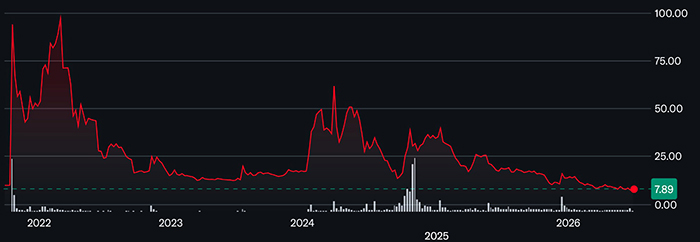
As you can see, DJT's predecessor, DWAC, opened at $94.20 on Oct 18, 2021, dropped down, then soared to $101.87 on Feb. 28, 2022 after Trump's Truth Social app rolled out on Apple's App Store. Yesterday DJT closed at $7.89, meaning anyone who bought it during the frenzy in Feb. 2022 has lost over 90% of their investment. Of course, Trump didn't lose anything since he didn't pay for the stock. He got it for free, so whatever little it is worth is still pure profit.
Trump will not be punished in any way while he is president for violating both the domestic and foreign emoluments clauses of the Constitution. What about afterwards? It is hard to say. The Supreme Court's grant of immunity is probably not germane here, since running businesses on the side and taking gifts from foreign powers is not part of the constitutional duties of a president. Also, as far as we know, there are no specific laws banning taking emoluments, so Trump can't be charged with violating one or more federal laws, because there aren't any relevant laws. Congress could pass some such laws, but they wouldn't apply to transactions done before they were passed. There might be grounds for civil suits, but who would have standing to sue?
Also noteworthy is that J.D. Vance pulled in over $7 million last year, from book royalties, investments, and his venture capital firm. This is the most wealthy executive duo in modern times. (V)
Trump Is Energizing Black Democrats
Donald Trump's many policies to help his "oppressed" white supporters has had an effect that has not been covered well by the (largely subservient) media. It has enraged and engaged Black voters around the country, especially in the South. Turnout in primaries has surged. Key Senate races in states with many Black voters, such as Georgia, Michigan, and North Carolina, as well as in competitive House districts, could be decided by a few percent and a huge Black turnout there could be crucial. Early voting in South Carolina surged to almost presidential-year numbers. The votes for Rep. Jim Clyburn (D-SC), for example, went up 50% relative to the last midterm election. This is the reason South Carolina ultimately decided not to redistrict the state. About a quarter of the total population of South Carolina is Black. In Georgia, it is 33%. In North Carolina is it 22%. Most Black voters in the South are Democrats, so a high turnout helps the blue team.
Republicans have dismissed the idea of high Black turnout as a fantasy. NRCC spokesman Reilly Richardson said: "Republicans will continue to dominate in South Carolina by remaining focused on the issues that matter to voters: lowering the cost of living, improving community safety, and securing the border." Gerrymandering may help Republicans in some House races, but it doesn't help in statewide races. Split Ticket, which builds election forecasting models, sees an 8-point Democratic lead now. Downballot, a data firm, says that Democrats have had a 13-point edge in over 100 special elections in 2025 and 2026. If that holds in November, even some "safe" Republican seats could fall.
What Democrats need to do now is keep Black voters engaged until November. This will take some investment and it is sometimes hard to convince Democratic leaders and donors to put money into the South. One way to do that is to field candidates in every race, something Democrats have rarely done. This year in South Carolina, for example, there is a Democrat on the ballot for every federal and state office. Those candidates will go around campaigning, and even if they don't win their race, they can get Black voters to the polls to vote in other races that may be closer. (V)
Judge Orders Trump to Unfreeze Funds for Hudson River Tunnel
One of Donald Trump's key governing techniques is to order (state) officials to do something and threaten to withhold congressionally appropriated funds if they refuse. Many have refused and have had funds blocked. This is called impoundment. It is forbidden in most cases by the 1974 Impoundment Control Act. The Act was passed by Congress because Richard Nixon also impounded funds and Congress didn't like it one bit.
One glaring case in particular is the $12 billion Congress appropriated for building a rail tunnel under the Hudson River, to connect New York with New Jersey. The existing tunnels and bridges are completely saturated and a new connection is badly needed. The River is actually quite shallow—around 40 feet in most places—so tunneling is more cost-effective than building a bridge.
Trump told the two governors to get rid of all DEI requirements and they refused. The result was Trump freezing all the funding for the tunnel. Nice fellow that he is, Trump made Senate Minority Leader Chuck Schumer (D-NY) an offer he could—and did—refuse: If Schumer would arrange for New York's Penn Station to be renamed Trump Station and Washington's Dulles Airport to be renamed Trump Airport, he would relent.
Instead, the states went to court over this because impoundment violates federal law. In February, U.S. District Judge Jeannette Vargas, a Joe Biden appointee, temporarily ordered Trump to release the funds until she could rule on the merits of the case. Now she has ruled that Trump's argument has no merit at all. Nothing in federal law allows the president to freeze congressionally appropriated funds just because a governor won't follow his orders, not to mention that impounding funds is nearly always illegal. Vargas' new order is permanent. Trump must now release all the funds and not freeze them again. Trump has lost a number of similar cases. Usually he grudgingly complies in the end and then moves on. If he flat-out refuses, it is not clear what would happen next. (V)
Farmers vs. MAHA
Axios has a scoop about a huge fight that erupted in the Oval Office last week. It had MAHA, backed by Secretary of HHS Robert Kennedy Jr. on one side, and farm lobbyists on the other. MAHA sees pesticides as making America sick (MASA?). Farmers see them as essential. Both sides see this fight as existential.
Kennedy was already on edge due to a Supreme Court ruling last week in favor of glyphosate (Roundup), a carcinogenic weed killer that does not have a warning on the label. Roundup is made by Monsanto, which is owned by Bayer, a giant German chemical company. Kennedy and his MAHA moms saw that as a giant setback. They wanted Trump to sign an XO to discourage the use of Roundup and encourage alternatives, including improving soil health and other organic means to control pests. Secretary of Agriculture Brooke Rollins was on Kennedy's side on this one.
Zippy Duvall, who is head of the American Farm Bureau Federation, a farmers' lobbying group, was dead set against the XO. His group represents 5 million farmers. He said the XO would cost farmers billions and they would turn against him if he signed it. The discussion got extremely heated. Trump does not want to lose MAHA moms but he also does not want to lose farmers, and the two groups are very adamant, paying close attention, and are opposing each other.
In the end, Trump went with Kennedy and Rollins and signed the XO. When asked about the meeting, everyone involved refused to comment.
Trump will now probably do what he usually does when one of his actions (e.g., tariffs) hits farmers hard: Bail them out with tens of billions of federal dollars. He doesn't bother to ask Congress, though. He just orders the Treasury to pay up and lets Congress figure it out later. In practice, Trump often refuses to spend money Congress has ordered him to spend (see above) and spends money Congress has not appropriated. This is not how the appropriations process is supposed to work. Congress is supposed to have the power of the purse. How quaint. (V)
New Polls Show Very Close Senate Races
The New York Times has commissioned its pollster, Siena College, to poll six of the most competitive Senate races. In all six cases, the candidates are known. Here are the results.
| State | Democrat | Dem. Pct. | Republican | GOP Pct. | Net |
| North Carolina | Roy Cooper | 50% | Michael Whatley | 43% | D+7 |
| Maine | Graham Platner | 49% | Susan Collins | 47% | D+2 |
| Texas | James Talarico | 47% | Ken Paxton | 47% | EVEN |
| Alaska | Mary Peltola | 45% | Dan Sullivan | 47% | R+2 |
| Iowa | Josh Turek | 46% | Ashley Hinson | 48% | R+2 |
| Ohio | Sherrod Brown | 47% | Jon Husted | 50% | R+3 |
Except for North Carolina, all of the races are within the margin of error. Democrats need to hold all of their own seats and flip four Republican seats to take over the Senate. Democrats have tough defensive races in Georgia, Michigan and New Hampshire, and offensive races in half a dozen other states. It will be a tall order for the blue team. On the other hand, usually most of the close races in different states go the same way. They are not really statistically independent. If the wind is blowing strongly one way, most of the races tend to go the same way.
Important races that were not polled in this round are Georgia, Michigan, Montana, Nebraska and New Hampshire. By the fall, no doubt all the pollsters will be looking at them, too. (V)
The Top Democratic House Targets
The two major parties, and some outside groups, compile lists of seats they want to flip. One such group, which works to flip Republican seats, is swingleft.org. It has a list of targeted seats. Democrats who want to help capture the House or Senate but don't know where to give to get maximum bang for their buck can donate to them and they will divide the funds appropriately among these seats. The site has lists of targets for the House, Senate, and governor. Below are its House targets. For the other targets, check the site, but if you have been following us for a few months, you already know. The site also helps people who want to do door-to-door canvassing on the ground get started:
| District | PVI | Incumbent | Location |
| AZ-01 | R+1 | Open; was David Schweikert (R) | Scottsdale and North Phoenix |
| AZ-06 | EVEN | Juan Ciscomani (R) | Southeast AZ: parts of Tucson, Casa Grande |
| CA-22 | Was R+1 | David Valadao (R) | Central Valley: parts of Bakersfield, Hanford |
| CA-48 | Was R+7 | Open; was Darrell Issa (R) | Inland San Diego County: Poway, Temecula |
| CO-08 | EVEN | Gabe Evans (R) | North Denver suburbs, Greeley |
| IA-01 | R+4 | Mariannette Miller-Meeks (R) | Southeast IA: Davenport, Iowa City |
| IA-03 | R+2 | Zach Nunn (R) | South central IA: Des Moines, Ottumwa |
| MI-07 | EVEN | Tom Barrett (R) | Central MI: Lansing, Howell |
| MI-10 | R+3 | Open; was John James (R) | Macomb County: Warren, Sterling Heights |
| NE-02 | D+3 | Open; was Don Bacon (R) | Omaha and suburbs |
| NJ-07 | EVEN | Thomas Kean Jr. (R) | North central NJ: Westfield, Bridgewater, Hunterdon County |
| NY-17 | D+1 | Mike Lawler (R) | Hudson Valley: Rockland County, Peekskill, Cold Spring |
| PA-07 | R+1 | Ryan MacKenzie (R) | Lehigh Valley: Allentown, Bethlehem, Easton |
| PA-08 | R+4 | Rob Bresnahan (R) | Northeast PA: Scranton, Wilkes-Barre, East Stroudsburg |
| PA-10 | R+3 | Scott Perry (R) | Central PA: Harrisburg, York, Carlisle |
| VA-02 | EVEN | Jen Kiggans (R) | Tidewater: Virginia Beach, Suffolk, Eastern Shore |
| WI-03 | R+3 | Derrick Van Orden (R) | West WI: La Crosse, Eau Claire, Stevens Point |
A similar site, with a longer list of targets (some of which are going to be tougher), is movement.vote. If you want to take more risks and go after some long shots as well, check them out. One nice touch with them is they give the 2024 vote margin and percentage margin for the targeted House districts.
We searched for similar groups on the Republican side. We know about WinRed, which is a commercial, for-profit, firm that processes donations to Republicans, but isn't involved in strategy about where the biggest impact will be. If anyone knows of a Republican analog to swingleft.org or movement.vote that publishes a list of soft Democratic targets, please let us know at comments@electoral-vote.com. (V)
What Tom Kean Didn't Do
Rep. Tom Kean (R-NJ) was absent from the House for 4 months and missed 140 votes. Last week, he came back and announced that he'd had depression and went to a hospital for treatment. He gave a short speech in the House chamber at a time when almost no one was present and that was it. Case closed.
But maybe not. There are many unanswered questions. Among them are these:
- Why didn't he announce the reason for his absence much earlier?
- Is he fully cured now?
- If not, does he need medicine or other treatment and how will that affect his duties as a representative?
- Also, if not, what is his prognosis? Will he ever be cured? Will there be relapses?
- Are party leaders supporting him for reelection?
- How tough will reelection be in an affluent suburban EVEN district?
- What do the voters think about his disappearance and reappearance 4 months later with barely an explanation?
Kean has argued that he has a right to privacy, like anyone else. Not everyone agrees. When you run for public office, your bosses, the voters, also have rights, like knowing if their employee is up to doing his job.
Kean's general election opponent, Rebecca Bennett (D), has a lot of similarities with the governor of New Jersey, Gov. Mikie Sherrill (D-NJ) (whose real name is also Rebecca, not Mikie). Like the governor, Bennett spent years in the Navy as a helicopter pilot. She reached the rank of lieutenant, which is the same O-3 paygrade as an Army captain. Bennett is already pointing out that she is 39 and Kean is 57 and that she is a veteran and Kean is not. He is a lifelong politician. She is also pointing out that she did well in a male-dominated military specialty.
Although most Republicans want to pin a medal for bravery on Kean for admitting that he suffered from depression, not all do. Rep. Lauren Boebert (R-CO), not always the most tactful member of Congress, said: "Who gets to take four months off of work because they're sad?" She also declined to endorse him. She noted that the good people of NJ-07 had 4 months with no representative. She called that "taxation without representation." Remember, she's a frontier gal who used to own a gun-themed restaurant called the Shooter's Grill in Rifle, CO. Cowboys don't get to take off 4 months because they are feeling sad, is her view.
An unanswered question is whether Kean can now mount a vigorous campaign against a young Navy veteran who has proven her stuff in the military as well as in the business world. After her discharge, Bennett worked as a healthcare executive for several companies, from startups to Fortune 50 companies. Democrats smell victory here and Bennett will have plenty of funding. Republicans might smell defeat and just concede this one to use the money in more winnable races.
There is, by the way, at least one other thing that Kean did not do. And he did not do it at least four times. That would be voting for paid sick leave for workers who suffer catastrophic health problems. According to a report from The Lever, Kean twice voted against sick leave when he was serving in the New Jersey legislature. When he moved to Washington, he remained consistent, and voted against sick leave at least two more times. The headline of the piece, which seems on point to us, is "Sick Leave For Me, Not For Thee." (V)
Republicans Will Hold a National Convention in September
On Tuesday, Donald Trump announced that the Republicans will hold a midterm convention September 9-10 in Dallas. He thinks people will want to watch Republican politicians saying "Democrats bad" for a couple of days. He even called it a rally. He will undoubtedly be the star performer. We doubt that even Fox will broadcast it gavel to gavel.
Modern national conventions have little drama. There was a time when the presidential and vice presidential nominees were really selected at the convention, which made them exciting. Then there was a time when at least the veep was chosen at the convention. Now both of them are known days or weeks in advance. This convention will have no drama at all and some Trump supporters might watch when he is scheduled to speak, but probably not when other politicians are speaking. Does anyone want to watch Sen. Jon Husted (R-OH), Ken Paxton, or Michael Whatley? Does anyone even know who Michael Whatley is? Wasn't he the Lord of the Dance? House candidates are probably going to get even fewer viewers.
Democrats did consider holding their own convention, but didn't think it was worth it. Besides, the DNC is broke while the RNC has so much money it doesn't know what to do with it. So why not hold a pointless convention that no one will watch except diehard MAGA fans who are going to vote for you anyway, no matter what?
Actually, though, the convention is not risk-free for the GOP. There is little chance that anything that is done or is said will increase Republican vote totals in the elections. Again, the viewers are going to be hardcore MAGA and not low-interest voters who might become energized for the midterms. Meanwhile, you're going to have a lot of people, from Trump on down, peacocking because they have a TV audience. There's every chance that one or more people could say something that will not play well with voters. It could be something racist or sexist, but it could also be something (probably from Trump himself) about the economy that amounts to "I really don't care." He's said several such things in just the last couple of weeks, and the odds go up the more he feels the imminent pressure of a blue wave. (V)
Carlson/Greene 2028?
Former Rep. Marjorie Taylor Greene left the Republican Party after leaving Congress this year. Now she is teasing creating a new party. She has admitted it would be difficult to get a new party on the ballot in most states, but she might be willing to try.
Another big-name right-winger who has left the Republican Party is Tucker Carlson. Both he and Greene are furious with Donald Trump for starting a war of choice in Iran and then losing it. Greene is also furious with Trump for cozying up to Jeffrey Epstein. She has been a strong supporter of Epstein's victims and has said she will never apologize for that.
Could Greene and Carlson get together and form a new party and run as a ticket on it in 2028? On paper, at least, that makes more sense than real estate developer Donald Trump running for president in 2016. Both are very well-known on the right and Greene has actually been elected to public office. If they ran as a ticket, they would home in on being America Firsters. Maybe the party could even be called something along those lines. They would oppose forever wars abroad and focus on making life better for ordinary working Americans. They would also oppose Israel and maybe even dabble in outright antisemitism. Carlson has come pretty close to that and Greene has blamed forest fires in the West on Jewish space lasers. They could say that Trump has strayed from the true MAGA way and they are the redemption.
With positions like those, they could draw support from both the left and right, so it is not clear which major party they would hurt more. That said, if you had to bet money, you'd have to bet they'd take more votes from Republicans than from Democrats. (V)
Announcement That Alito Is Retiring Proved False--for Now
On Tuesday, NPR's long-time Supreme Court reporter, Nina Totenberg, reported that Justice Samuel Alito was retiring. No one was shocked. Many people expected it. Only it wasn't true. Very embarrassed, Totenberg soon retracted her scoop. She then wrote and published an abject apology. Of course, if he does retire in July, she will look prophetic.
Many people have speculated that Alito will indeed retire this year because he knows that Donald Trump will then appoint a younger version of himself and the Senate will quickly confirm him. That window might close on Jan. 3, 2027, when a potential Democratic Senate would never confirm any Trump nominee in hopes that a Democrat will be elected president in 2028.
Strategic resignations, like Alito's would be, usually come in June or July, to give the new nominee time to clear the Senate before the Court's term starts on Oct. 1. Alito could yet make an announcement in July, although the window for getting a confirmation would be smaller since the Senate is usually not in session much of August.
Another (riskier) strategy could be for Alito to make no announcement until after the midterms. If Republicans hold the Senate, there is no need for him to retire until 2028. He seems to enjoy his work supporting the Republican Party in every way he can. Then he could hang on until July 2028, retire, and still be sure of getting a conservative successor. In this plan, if Democrats win the Senate on Nov. 3, Alito could make an announcement in mid-November that he is retiring for a newly discovered "health problem." Then there could be a lame-duck session of the Senate in December to confirm Trump's new nominee. That is a bit risky because there wouldn't be a lot of time to get the job done and Democrats would stall as best they can, even though they couldn't filibuster. They could certainly yell to the moon how partisan this is and use that in their 2028 campaigns.
Clarence Thomas is in a completely different situation. He is already the second-longest serving justice in history. He is 78. If he hangs on until 2028, and there is no reason to believe he can't do that, he will become the longest-serving justice in history. Take that, libs. Of course, he would then run the risk of not being replaced by a conservative in 2028 if the Democrats control the Senate then. But Thomas is not really a dyed-in-the-wool Republican the way Alito is. He is just a man with a very big chip on his shoulder and is only looking out for himself. We would be surprised if Alito was still on the Court on Dec. 31 if Democrats win the Senate and would be surprised if Thomas retired this year under any circumstances. (V)
Kamala Harris Is Now Courting Pro-Palestinian Activists
Kamala Harris, who never really stopped her presidential campaign after losing in 2024, has taken note of the wins by anti-Israel candidates in NYC and now Colorado. In true politician style, Harris, who has long supported Israel, seems to have chucked her previous positions in the recycling bin and is now test driving a switch to the other side. Her actions suggest that her thinking is something along the lines of, "Well, if that's what the voters want me to believe, it behooves me to believe it."
Harris called NYC Mayor Zohran Mamdani last week and has scheduled a meeting with him. She has also met with Abbas Alawieh, a cofounder of the Uncommitted Movement, who is running for a seat in the Michigan state Senate. She has also met with James Zogby, a member of the DNC and long-time Palestinian activist, and other leaders in the pro-Palestinian movement.
Some Palestinian activists don't trust her, though. They see that this is just a political move to help her presidential campaign and she hasn't had a change of heart and doesn't mean it at all. They are also well aware that her husband is Jewish and switching sides might gain her some votes but would also lose her pro-Israel votes, not to mention branding her as an opportunistic flip-flopper, which no one likes.
Harris is often among the frontrunners in polls, but that is merely because she is well-known nationally and people like Sen. Ruben Gallego (D-AZ) and Gov. Josh Shapiro (D-PA) are not. Once things get going, that will change quickly and she will take fire from all sides. Some candidates will say: "Why back a known loser?" Others will say: "The voters want someone new and exciting, not an old retread." Still others will point out that women are 0 for 2 in presidential elections and 2028 is too important to run another experiment to see if they strike out.
Harris' policy record is mixed. She ran as a progressive in 2020 and was wiped out almost immediately. Then, when the Democratic nomination was dumped in her lap in 2024, without her having to lift a finger to get it, she became a moderate. She will be 64 on Inauguration Day 2029. Is this the person the Democrats who voted for three DSA candidates in NYC and two in Colorado are waiting for? Switching sides on the Middle East might impress them for a minute, but most of them are unlikely to believe she really means it. That said, desperate candidates use desperate measures. There will be so many candidates in 2028 that Democrats won't have to settle for second or third best, and few people believe that what the country is hungering for now is an older Black woman whose positions keep changing. (V)
Judge Shoots Down USPS Plan to Refuse to Deliver Ballots in Blue States
Donald Trump has ordered the USPS to refuse to deliver election ballots in states that won't turn over lists of voters to him (so he can remove Democrats from the approved list). All of the blue states have refused to do so. Postmaster General David Steiner said that he would comply with Trump's order, even though he didn't have to. He apparently just thought it would be a cool thing to do.
Yesterday, a federal judge shot down Steiner's plan. U.S. District Judge Emmet Sullivan issued a ruling blocking it nationwide. Previously, a judge in Boston had blocked it, but only for two dozen states. Now it holds for the whole country.
If the USPS rule had held, it would give the federal government an unprecedented role in running elections, something the Constitution grants exclusively to the states.
Sullivan's order is based on a lawsuit the NAACP brought against the USPS in 2020 due to a policy that slowed mail delivery as the election approached. Due to the COVID pandemic, many more people were using mail-in ballots than previously. The lawsuit was aimed at preventing the USPS from slowing down the mail at a critical time. The NAACP and USPS settled the lawsuit with an agreement. Sullivan ruled that the agreement is still binding and the proposed USPS rule would violate it. The last word here has probably not yet been said. (V)
Never Forget: The Last Voyage of the Walter Q. Gresham
Today, we hear from B.C. in Walpole, ME:
In the mid-1950s, my father bought a Penguin, a dinghy with a single sail and simple rigging. A solo sailor could handle it; a pilot plus a crew of one could race it; and on summer days with light breezes, our family of six sailed together: I sat aft with Dad; my mother and older sister sat on either side of the centerboard trunk, with baby sister on one lap and little brother on the other.
But there were clues that this was not my father's first boat. In my boyhood, the back of my closet held naval uniforms that I knew must have been Dad's. He had Brazilian coins on his dresser. He got mail from the U.S. Coast Guard Academy. To view a solar eclipse one summer, he produced a sextant. We'd never seen it before. Only as an adult, did I learn that during World War II, he had made port from New York to Scotland, Brazil to the Bay of Fundy, New Orleans to New Guinea.
After Pearl Harbor, anticipating being drafted, my father volunteered for the Merchant Marine. What was he thinking? Did he know the Merchant Marine had the highest casualty rate of any branch of the service? Had my dad, who grew up in Memphis, TN, ever actually seen the ocean before he enlisted?
Yet the efficient War Department turned that landlubber into a ship's officer—in just ninety days!
Enjoying entirely at U.S. government expense his first voyage on the open ocean, my father sailed aboard the Walter Q. Gresham on its maiden voyage. Leaving from Pass Christian, MS, the Gresham sailed to Cuba to pick up a load of sugar, and then to New York City to pick up the rest of the crew and tons of powdered milk. She then joined Convoy HX-229 as ship number 21 of 42, headed for England.
A bit before that, on the other side of the Atlantic, Hans-Hartwig Trojer, a young German a bit older than Dad, had volunteered for his country's unterseeboot service. After training, Captain Trojer participated in five North Atlantic patrols between May 1942 and September 1943, sinking 22 enemy ships.
During the third week of March, 1943, Captain Trojer's Type VII-C U-221 and ten other German submarines comprising Wolfpack Dränger located Dad's convoy and began systematically attacking it, ultimately sinking half of its 42 vessels.
When the convoy came under attack, my dad and his brave shipmates leapt into action: Being mostly between the ages of 17 and 21, they formed a pool and took bets on the day and the hour the Gresham would get her torpedo.
At 2:55 pm on the 18th of March, the U-221 fired two torpedoes at the Gresham. Both hit. The first blew off the ship's screw, leaving her helpless. The second, striking the port side just aft of cargo hold number 5, was the kill shot: The Gresham and its 9,000 ton cargo sank in 15 minutes. Of the crew of 70 men, 42 survived.
My father survived and went on to have me, among others, but it was a close call: As they were leaving their rapidly sinking mothership, one of the davits on his lifeboat jammed and the boat flipped over.
The next part of the story should be: "Tumbling from the lifeboat, the sailors fell into the North Atlantic." Which is approximately what happened, but with a complication. The second torpedo had opened a gaping hole in the side of the ship near the location of their lifeboat. When the seawater hit the cargo, the milk powder reconstituted, mixed with the sugar, and was sucked back out by the swell. My father and his shipmates fell from their lifeboat into the Largest Milkshake Man Has Ever Made.
Convoy ships were not allowed to stop for any reason. After 3 hours in a small boat in March in the North Atlantic, Dad and his shipmates saw a ship. A Canadian vessel picked up their lifeboat and took the crew to Scotland.
Six months later, in September 1943, British aircraft spotted Captain Trojer's U-221 and bombarded her; she sank with all hands on board.
Today, we remember the sinking of the Walter Q. Gresham and the rescue of my father. I have taken my wife to what used to be the Rexall Drug Store on Main Street here in Damariscotta, ME. Now part of a Reny's store, it still has the original soda fountain and the World War II- era booth, stools, and counter. We are sitting in the booth, and we have just ordered large milkshakes.
Ten days after this photograph was taken, the Gresham was torpedoed on her maiden voyage:

Thanks, B.C. (Z)
Previous | Next
Main page for smartphones