Previous | Next | Senate races | Menu
New polls:
Dem pickups: (None)
GOP pickups: (None)
The Don-roe Doctrine
No rest for the wicked, it would seem. We thought that, given the holidays, the administration (and its acolytes in Congress) might give it a short rest. Not so much, as it turns out. We felt we could hold off on, say, the Jack Smith testimony, or the two vetoes, but an invasion of a foreign country is too much to ignore. With a tip of the hat to Airplane, we pass along an observation from reader A.G. in Scranton, PA: "Looks like you picked the wrong 5 days to recharge... and to give up coke and hookers."
It's a big, complicated story, so we're going to deal with it in pieces:
What Happened?
Anyone who has been living in any domicile other than a cave knows that Venezuela has been something of an obsession for Trump and/or his team for the last several months. The administration has, of course, sunk numerous civilian fishing boats, based on no-evidence-offered claims that the boats were running drugs. And even if the boats were running drugs, there are numerous legal issues that come into play, like: (1) It's not legal for U.S. ships to go after boats whose destination is not the U.S.; (2) It's not legal to open fire on civilians without giving them the opportunity to surrender and (3) It's certainly not legal to fire again, when there are civilians in the water, and the boat has been destroyed. This latter action has been described as a "double tap," which is certainly a very pleasant way to say "We killed people who survived our first attack, and who were absolutely no threat, in cold blood."
In addition to the fishing boats, there was also the seizure of a Venezuelan oil tanker. On one hand, this action was at least backed by a federal judge's order, which is about as much "permission" as the Trump administration ever bothers with. On the other hand, the seizure was largely based on the legal precept of "might makes right," and a bit of vague hand-waving about Venezuela violating sanctions against Iran. It is also worth noting that the U.S. (under all presidents, to be clear) tends to be delighted to honor international law when it serves American interests, while ignoring such law when it's less convenient to do so.
In addition to these actual violent acts, the administration has also been telegraphing its likely intent to invade Venezuela itself. There has been much talk about what a terrible, awful man Venezuelan President Nicolás Maduro is, and much talk about how Venezuela is somehow the epicenter of the drug trafficking responsible for the United States' addiction problems. There has also been some amount of posturing centered on how it's not really important for the White House to have permission from ANYONE, whether Congress or an international body, before a land invasion of that nation.
What we know now is that the administration has been working on an invasion plan for several months. There was much watching of Maduro, to learn his patterns and tendencies. And then, after Donald Trump gave approval for the invasion (on or around Christmas Day), there was some amount of waiting until the stars were properly aligned for "Operation Absolute Resolve" to commence. On Friday night, roughly 150 aircraft of various types were launched from 20 different bases. There was some amount of resistance, but not a lot, and U.S. military and law enforcement personnel were able to grab Maduro and his wife before they could escape to a safe room. Trump watched the whole thing on a TV screen at Mar-a-Lago.
The world largely became aware of the operation after it was over, when Trump got on Truth Social, the official social media platform for warmongers, and bragged:
The United States of America has successfully carried out a large scale strike against Venezuela and its leader, President Nicolas Maduro, who has been, along with his wife, captured and flown out of the Country. This operation was done in conjunction with U.S. Law Enforcement. Details to follow. There will be a News Conference today at 11 A.M., at Mar-a-Lago. Thank you for your attention to this matter! President DONALD J. TRUMP
Initially, the administration implied that the attack was bloodless, and no harm was done to any Americans. Downplaying casualties is a game as old as war itself, of course; the truth here is that at least one U.S. helicopter was struck by opposition fire (though it still remained airborne), and some number of U.S. soldiers were injured and hospitalized (it's unclear if they were on the helicopter, or were elsewhere). Reportedly, those soldiers are not seriously injured and are in stable condition. Though, given the aforementioned tendency to downplay casualties, it might be wise to take a wait-and-see approach to that particular "fact" for at least a few days.
Maduro and his wife entered American airspace sometime early Saturday morning, and were in New York by Saturday afternoon. Maduro is in a cell in Brooklyn—his wife's location is currently a mystery—at the Metropolitan Detention Center. That is one of the few federal facilities suited to this kind of high-security defendant, and is also where Luigi Mangione, Joaquin "El Chapo" Guzman and—wait for it—Ghislaine Maxwell were held.
That the case is going to be prosecuted in New York City means the matter is being handled by U.S. Attorney for the Southern District of New York Jay Clayton. That is not a name that has come up in the headlines very often, since Clayton is not a fawning lackey like, say, Alina Habba. That said, he was tapped for this post because he's a finance guy (and former SEC Chair), and SDNY deals with a lot of white-collar cases. Prosecuting an alleged drug-dealing foreign leader is not exactly in his wheelhouse. It is also worth noting that Clayton's appointment as U.S. Attorney got bogged down in the Senate, but the judges of SDNY voted to keep him on. To us, that says something like, "He's not great for this post, but he's not as bad as some of Trump's other U.S. attorneys."
Breaking the Law
This story is only about 36 hours old, and it's rapidly developing, of course. However, let's now pause to discuss three impressions that we have already formed, and our reasons for having formed them.
The first impression, which is hardly unique to us, is that this whole action was of dubious legality. Now, most of the left/center news outlets, and most of the left/center politicians are using the word "illegal," but we think that doesn't quite capture the necessary nuance. There are two pretty big questions of international law, and one of domestic law, that the arrest of Maduro raises. The White House has a lot of lawyers, and those lawyers are paid to come up with arguments in support of whatever the administration does. So, when it comes to all three of these questions, the White House does have an argument. And, although that argument is weak—and it's weak in all three cases, in our view—it's also more likely than not that the administration's views will carry the day.
The first question of international law is whether or not it was legal for the U.S. to invade Venezuela in the first place. As we note above, the federal government has a long history, under presidents of both parties, of ignoring international law when it is not convenient. That said, the U.S. is a signatory of the U.N. Charter, and generally tries to abide by that particular document. And the U.N. Charter says, in so many words, "You can't go to war against another country without U.N. approval, unless it is an act of self-defense."
The Trump administration is well aware of this, and so is arguing, and has argued, that the drugs flowing through Venezuela are killing Americans, and therefore attacking fishing boats/invading Venezuela are inherently acts of self-defense. This is an understanding of "self-defense" that would boggle the minds of the folks who drew up the U.N. Charter, as they clearly understood "self-defense" to mean "military invasion." And if the Trump administration's version of "self-defense" holds water, then the "self-defense" restriction means nothing, since every nation does SOME things that plausibly harm every other nation—drug trafficking, tariffs, diseases that spread, etc. That said, who is going to hold Trump responsible for a fantastical interpretation of "self-defense"? The U.S. is too powerful to be dictated to by the international community, and Congress certainly isn't going to say "boo."
The second question of international law is whether or not it was legal for the U.S. to grab Maduro and his wife. If he is a head-of-state, then he and his wife have diplomatic immunity, and their detention is illegal. The Trump administration has taken the position that Maduro was not duly elected, that he seized power by fiat, and that he is therefore not the legal head of state. Maduro has been in power since 2013, and the Barack Obama, Joe Biden and Trump administrations have all chosen not to formally recognize him, for these reasons.
With that said, there is a sizable number of world leaders whose legal claim to power is problematic. Consequently, the general guideline used in international law is that if a person is acting as the effective head of government, they are the head of government, even if their means of achieving power was questionable or illegal. Maduro was most certainly acting as the effective head of government for Venezuela, and has been doing so for over a decade. That includes nearly 8 years since the extremely corrupt election of 2018, which Maduro only "won" because he understood that it's not the people who vote that count, it's the people who count the votes. (This is an observation commonly, but inaccurately, attributed to Joseph Stalin.)
When Maduro presents his case in court, his attorneys will certainly, very early in the proceedings, raise this issue and demand their client's immediate release. The problem here is that federal judges are not especially qualified to determine who is, and is not, a legal head of government. That's more in the area of... the State Department. When the U.S. seized Manuel Noriega in 1990, his attorneys made the same argument. And the judges back then chose to defer to the George H.W. Bush administration, concluding that the executive branch is more situated to make this determination than the judicial branch is. It is likely that the same will happen this time. Of course, that gives Trump (or any future president) the power to grab any head of state they want; all the White House has to say is, "In our expert opinion, we've decided his/her/their claim to power is not legitimate."
Finally, the question of domestic law involves Congress—i.e., the part of the federal government that is actually granted the power to declare war by the Constitution. When the Constitution was written, war was a relatively slow-moving affair, and it would have been difficult for a foreign adversary to launch a meaningful assault on the United States without telegraphing it well in advance (which is a big part of the reason that no foreign adversary actually did so between 1815 and 1941).
In the modern era, hostiles can make their moves rather more quickly. And so, an awful lot of authority to act unilaterally has been delegated to the president. The War Powers Resolution of 1973 requires the White House to notify Congress, within 48 hours, of any steps taken that involve the U.S. in hostilities. In addition, a series of laws adopted since 1973 require the president to notify eight key members of Congress (aka the "Gang of Eight"—the leaders of the two parties in each chamber, plus the chair and ranking member of each of the two Intelligence committees) BEFORE any action is taken. On top of all this, any military action taken has to be broadly acceptable under American law; commonly, since World War II, this question has been addressed by Congress approving an authorization of the use of military force.
Clearly, there has been no authorization of the use of military force for Venezuela. That's not fatal, necessarily, but there are also legitimate questions about the legality of attacking a country/leader based on shaky claims about drug trafficking. The administration has already decreed that Article II of the Constitution allows the president to protect America, and Americans, from "imminent" attack.
Here we have yet another situation where the argument effectively renders the limitation meaningless. If all the White House has to do is say, in its judgment, violent action against the U.S./its citizens was "imminent," then every presidential administration will somehow discover that every person/country it wants to attack is planning an "imminent" attack against the U.S. The notion that Venezuela was on the cusp of "imminent" violence against the U.S. is particularly laughable; they are vastly outclassed by America in terms of economic and military might, and if the Venezuelan government had ANY options in this area, why wouldn't it have utilized them after the other infringements on Venezuelan sovereignty in the last couple of months?
As to notifying Congress, the White House let the cat out of the bag within hours of the operation, primarily because Trump couldn't hold back any longer, and wanted to commence bragging. So, the War Powers Act has been satisfied. What was NOT satisfied was the requirement to notify the Gang of Eight. Yesterday, Secretary of State Marco Rubio explained that, gosh darn it, that just wasn't possible: "This is not the kind of mission that you can do congressional notification on. It was a trigger-based mission in which conditions had to be met night after night." One cannot take that explanation seriously; the Gang of Eight could certainly have been advised, at least in a broad sense, of what was being planned. And if it's a situation where "we don't know if the attack will be tomorrow or 3 months from now," it would have been entirely plausible to check in with them every couple of weeks to say "Yeah, no action yet, but that plan we discussed is still in the works."
Of course, Trump and his team will not be held accountable for any of this. Name any U.S. president, ever, who's actually been held accountable for overly vigorous use of war-related powers. And then consider that this Congress is unusually content to let this president do whatever the hell he wants. Heck, we already know that the requirement to notify the Gang of Eight won't be enforced. Before bombing Iran, the White House contacted half of the Gang of Eight (the Republicans) and not the other half. There was no sanction for that, not even a meaningless resolution of censure. Why would this time be any different?
The executive summary here is that the administration is doing what it always does, and what Trump himself has always done, and has managed to find and exploit the gray areas of the law. And Team Trump's legal arguments, while shaky, are likely to be good enough to allow the administration to get away with it, and will also effectively neuter the relevant laws for future presidents, making it even easier for future chief executives to use the military with impunity, domestic and international law be damned.
War Games
Moving along, the second impression we have is that this operation was brilliantly successful from a tactical standpoint, and was utterly incompetent from a strategic standpoint.
One can hardly dispute the tactical brilliance that was on display on Friday night. The U.S. government launched a massively complicated operation, managed to identify and extract the targets of the mission, and did so with (apparently) no loss of American life (about 40 Venezuelan citizens died), and minimal loss of blood and/or treasure. That is the dream outcome, and stands in distinct contrast to things like the Bay of Pigs or Operation Eagle Claw. Whoever did the planning should be commended.
From a strategic perspective—that is to say, using the engagement to advance overall goals—the administration appears to have screwed up very badly, with signs of gross incompetence already evident in abundance. To start with, most authoritarians are not one-person shows, and rely on a core team to maintain themselves in power. This is particularly true with Maduro. His "right-hand man" is Diosdado Cabello, who is officially minister of the interior, and is also the Venezuelan version of a Russian oligarch. Maduro's "muscle" is General Vladimir Padrino Lopez, who is the head of the Venezuelan military.
Both of these men are, of course, still in Venezuela, and still in office. One very possible outcome is that one of them assumes power. If so, then that is not a meaningful change from Maduro. A second very possible outcome is that Venezuela descends into civil war; possibly anti-Maduro forces (who see Edmundo González as the legal president) vs. pro-Maduro forces, or maybe Cabello vs. Lopez, or maybe anti-Maduro forces vs. Cabello vs. Lopez, or maybe some other combination. Whether Trump's goals are humanitarian (unlikely) or something less noble (vastly more likely), they will not be well-served by Maduro v2.0, and they definitely will not be well-served by the nation being plunged into a civil war.
At the moment, the leader of Venezuela is—apparently—Executive Vice President Delcy Rodríguez. We say "apparently" because it's not clear she has actually taken the oath of office yet. In fact, it's not even clear where she is; some sources say "Caracas," and others say "Moscow." Still, according to the terms of the Venezuelan constitution, power is supposed to devolve upon her.
And that brings us to more incompetence. Trump has said that his administration is in touch with Rodríguez, and that everyone is working together to stabilize the Venezuelan government, with her as leader. The first problem here is that if Maduro's claim to power is invalid, then the VP he appointed (in 2018) is also illegitimate. The second problem here is that nobody seems to have told Rodríguez that she is working with the U.S., as she has already appeared on Venezuelan state TV channel TeleSUR, denounced the capture of Maduro, and decreed "We demand the fast release of [...] the president of all Venezuelan men and women, and of the first lady of the republic, Dr. Cilia Flores."
It is well within the realm of possibility that the administration's strategic failings are due to... not actually having a strategy at all. Yesterday, Trump conducted an interview with The New York Post in which he made clear that, when it comes to "American boots (or more likely, Chinese boots with American feet in them) on the ground" in Venezuela, that "if the vice president does what we want, we won't have to do that." And yet, Trump also told reporters that, "We're not afraid of boots on the ground. We had boots on the ground last night at a very high level, actually, we're not afraid of it. We don't mind saying it, but we're going to make sure that that country is run properly." It seems to us that questions like: (1) "Is Rodríguez actually working with us?" and (2) "Are we expecting to send U.S. troops to occupy Venezuela?" should have had clear answers BEFORE an invasion was approved.
The third impression we have dovetails with the second, namely that this is yet another example of little boys playing soldier... with real human beings. To start, everyone's seen the famous picture of Barack Obama and members of his team watching the mission that ended with the death of Osama bin Laden:
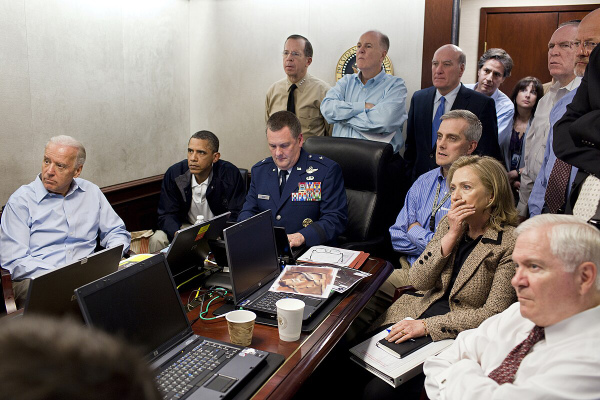
It's evident that someone in Trump's orbit, very likely Trump himself, decided that a similar "action" shot would be wanted. So, they threw up some black curtains at Mar-a-Lago, and got some of the "team" together, and got this shot:
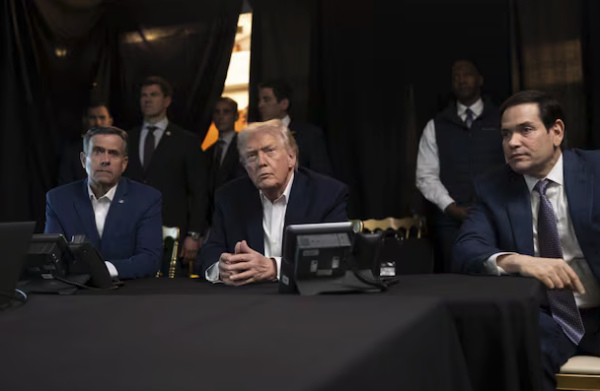
The curtains are a little amateur-hourish, but you gotta make do, we suppose. However, there are also other shots from the same session, like this one:
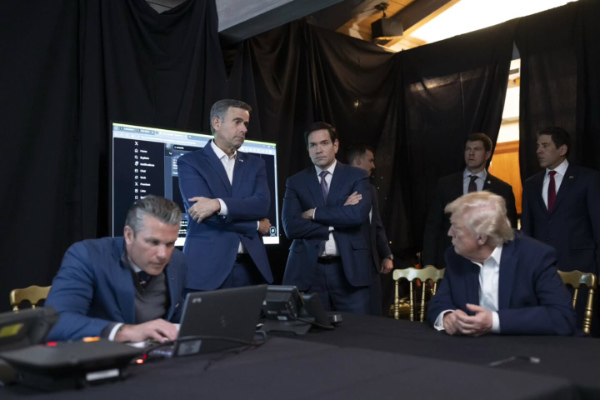
It's not too hard to pick up on two things in this image. The first, if you look on the table, is that the phone is not actually connected to anything. It's clearly a prop, which removes any doubt that this whole thing was hastily staged. The second, if you look at the screen that is projecting whatever Pete Hegseth loads up, is that the main thing they were doing with their computer equipment was... reading/sending tweets.
And on that subject, there was a fair bit of social-media peacocking in the last 36 hours. For example, the official White House Twitter account sent out a video of Maduro daring the U.S. government to come and get him, along with the comment "If you don't know, now you know." The video also includes footage of Trump striding down a hall of some sort, backed by the song "Hypnotize" by the Notorious B.I.G.—a man who was shot to death as retribution for an act of violence against his "enemy."
Trump re-posted the MaduroNotorious B.I.G. video on his much-lower-traffic social media platform, and also posted this footage of "highlights" from the attack on Venezuela. This video is backed by the song "Fortunate Son" by Creedence Clearwater Revival. That is a song that has a very upbeat, patriotic tone, but is actually about how poor kids got sent to serve in Vietnam, while rich kids used connections to get out of serving. For Donald Trump, of all people, to post a braggadocious video of a military strike with THAT song is today's reminder that irony is dead.
Rubio and Hegseth also got in on the peacocking during their various press conferences. For example, Rubio puffed up his chest and repeated the "If you don't know, now you know" line, while also warning Cuba they should be "very concerned." Hegseth, for his part, bragged that Maduro "effed around and found out." The only thing we are surprised about is that nobody ripped their shirt open and started pounding on their chest. And by "nobody," we mean "Hegseth."
Why? (Administration Explanation)
The "official" reason for all of this intervention in Venezuela is to combat drug trafficking. A couple of months ago, Trump and his underlings tried to specifically connect that nation to fentanyl. Since Venezuela has virtually nothing to do with the fentanyl that finds its way into the U.S., there was much eye-rolling. So, the administration has moved on to blaming Venezuela for trafficking cocaine. That's at least factually correct, in that Venezuela does produce and traffic a lot of cocaine.
However, just because the nation is responsible for producing lots of cocaine does not mean its leader is responsible for producing lots of cocaine. Trump has spent years trying to make the argument that Maduro actually leads the notorious drug cartel Tren de Aragua (TdA). But last year, Trump's own intelligence staffers determined that he does not, in fact, control TdA.
The federal indictment of Maduro has now been made public, and while it repeats the claims about TdA and other drug-trafficking activities, the evidence appears to be very thin. It's possible there are more cards that will eventually be laid on the table, but at the moment there's a lot of supposition and presumption and not a lot of the kind of stuff needed for a conviction. It certainly gives the overall impression that the drug trafficking is just a pretense.
It's also a little hard to accept that Trump actually cares about drug-trafficking foreign leaders. The former president of Honduras, Juan Orlando Hernández, was arrested, charged, and convicted of drug trafficking by the U.S. in 2022 (after being arrested by Honduran authorities, and then extradited to the U.S.). Among the wave of pardons that Trump handed out last year was one for Hernandez, who was otherwise looking at 45 years in prison. Although Trump explained the pardon as a corrective for a "witch hunt" conducted by the Biden administration, the attorney who secured the conviction was Emil Bove, who went on to be Trump's personal lawyer. And, in any case, it's hard to reconcile "pardon for Latin American leader convicted of drug trafficking" with "I'm very, very, very concerned with drug trafficking by Latin American leaders, so much so it was worth launching a military strike."
Incidentally, Maduro's case has been assigned to U.S. District Judge Alvin Hellerstein, an appointee of Bill Clinton who presided over Trump's unsuccessful efforts to move his state criminal conviction in Manhattan to federal court, who ruled against Trump's efforts to deport Venezuelans under the terms of the Alien Enemies Act, and who also allowed former Trump fixer Michael Cohen to complete his prison sentence at home due to COVID-19, over opposition from the Trump v1.0 administration. In other words, Trump and this "liberal judge" have a history, and that might come up on Truth Social, once or twice, depending on how the Maduro trial goes.
Trump has spoken of one other justification for the invasion, and it's one that gets much closer to being in the realm of truth, in our view—and it might also be a case of "saying the quiet part out loud." That other justification is... oil. Venezuela has a lot of it, and Trump wants it. At his press conference yesterday, Trump said, "The oil business in Venezuela has been a bust, a total bust, for a long period of time. They were pumping almost nothing by comparison to what they could have been. We're going to have our very large United States oil companies, the biggest anywhere in the world, go in, spend billions of dollars, fix the badly broken infrastructure, the oil infrastructure, and start making money for the country."
We are hardly experts in foreign oil production, but we strongly suspect magical thinking on Trump's part here. First of all, whenever Trump starts talking about how incompetent [X] has been, and how he can easily do better, he's pretty much always wrong, and has no idea what he's talking about. Further, he continues to entertain fantasies that there is a large, untapped demand for oil out there that is just waiting to be exploited. Given the global shift in the direction of electric vehicles, natural gas, and renewable energy, he's likely wrong about that, too.
We also sense he's doing what he so often does, and spending the same money six different times. It's not at all clear to us how much money might be produced by mucking around in Venezuela's oil production, or whether the U.S. would be able to get away with laying claim to some/most/all of that oil. Whatever the case may be, Trump is already talking about using the anticipated funds to pay for rebuilding Venezuela, and for covering the costs of all U.S. military activity in that country, and to enrich the U.S. in some currently unspecific fashion. Surely it's only a matter of time until he announces that every soldier, or every American kid under the age of six, or both, will be receiving a "Venezuela dividend."
Incidentally, in addition to the black gold, Trump might also want access to Venezuela's actual gold. That nation has a lot of it, thanks to their oil sales (which, again, are quite substantial, despite Trump's claims to the contrary).
Why? (Actual Explanation)
The official explanations for the United States' war on Venezuela are somewhere between "not credible" and "surely not the full story." That leaves us to try to divine what the rest of the story might be. Here are some theories; please note that we're trying to be as thorough as we can, so some of this is pretty speculative:
- Ego: A little over a week ago,
we wrote
that an enormous portion of Trump's policymaking is driven by selfish personal goals, particularly ego, grift and
revenge.
There is certainly a possible "ego" explanation for this weekend's invasion. Beyond the apparent love that Trump and his underlings have for playing soldier, and showing how very tough they are, Trump is very clearly doing what lame-duck presidents do, and thinking about legacy. And there appears to be a particular urgency that we don't usually see in Year 5/6. Maybe that is because Trump is incapable of thinking medium- or long-term. Maybe it's because he's worried about being constrained by a Democratic-led House as of January 3, 2027. Maybe he thinks (or knows) he's dying.
In any case, remaking the United States' relationship with the world and with Latin America would certainly be a legacy item. Whether it would be a positive legacy item is a different question, and one that Trump would not be likely to concern himself with. It would be even more of a legacy if he's able to make the change from "Monroe Doctrine" to "Don-roe Doctrine" stick—which he's trying to do; keep reading. - Grift: There's also a potential grifty explanation for what's going on here. Two of them,
actually. If Trump really does manage to turn over some portion of Venezuela's (nationalized) oil supply to American
firms, surely they would be expected to pay generously for the favor. His super PAC currently has $300 million in the
bank, which is a record. Further donations to the PAC would be one way to "thank" the President. Buying large amounts of
Trump cryptocurrency would be another.
Or, in a considerably more specific, and considerably less speculative, possibility, there is a holding company called Blue Water Acquisition Corporation (BWAC). Recently, it tried (and failed) to acquire the U.S. assets of Citgo Petroleum, which is majority-owned by Venezuelan interests. Even more recently, Devin Nunes and other high-ranking officers of the Trump Media and Technology group assumed leadership of BWAC. There is no direct evidence, as yet, of anything untoward. But you do have a bunch of people who are deeply entwined with Trump's business interests, and who are now also deeply entwined with a company that is trying to do business with a Venezuelan oil company. All of this is certainly enough to make us a bit... queasy.
And as long as we're at it, let's mention a smaller-scale (possible) grift. On Friday, someone created what looks to be a brand-new account on the futures market Polymarket, and bet $30,000 that Maduro would be driven from power. A few hours later, Maduro WAS driven from power, and that bettor collected a tidy $436,759.61 profit for 3 minutes of work, and about 6 hours of keeping their $30,000 tied up. It sure has the appearance of someone who had inside information. We doubt it was Trump, because he usually doesn't operate at the six-figure level, preferring that his grifts start at a minimum of seven figures. On the other hand, he loves money so much he's hawking Bibles, crappy guitars and collectible coins, so... maybe. - Revenge: There's also a revenge possibility. Actually, once again, there's two of them.
Trump has hated Maduro in particular, and Venezuela in general, for a long time. The Donald does not like the fact that
Maduro has thumbed his nose at Trump numerous times (see above, about the "come and get me" video, for example). Further, as part of
the 2020 election conspiracy theorizing, Trump blames Venezuela for corrupting (some?) American voting machines. Oh, and
Maduro and nearly all of the other people in Venezuela are brown (and a lot of them have tried to immigrate to the
U.S.). So, there's a bee or two in Trump's bonnet here.
The other possibility is ridiculous enough that we wouldn't even bother to suggest it... if it wasn't Trump. He is really, really, really unhappy that he did not win the 2025 Nobel Peace Prize, which was announced on October 10. Instead, it went to a Venezuelan—Maduro opponent María Corina Machado. One cannot help but notice that the attacks on the fishing boats began around that time, and also that Trump made a point of insulting Machado for being "weak" yesterday. And he has such a need for validation that, you know, maybe he might vent his rage in this way. The one thing we're sure about is that 2026 Nobel Peace Prize is even further out of reach after this weekend.
- Wagging the Dog: We've now written this at least a hundred times, but there are certainly
some current issues where Trump would like a distraction, with Jeffrey Epstein, inflation and bad news about insurance
prices probably occupying the top three spots on the list. A war against Venezuela could be an attempt to create that
distraction (though, if so, we doubt it will work).
- War Powers: Similarly, a "war," even if it's not declared, or even authorized by Congress,
would theoretically unlock powers that Trump has been trying to use, primarily to eject immigrants that the
administration wants to eject from the United States. More conspiratorial folks take it further, and say that what he
really wants to do is create a justification for suspending the 2026 elections. These arguments are not likely to fly,
but what matters isn't whether they will work, but whether Trump THINKS they will work.
- Rubio: Finally, it's not a secret that Trump can be manipulated by members of his staff into doing things that they want done. OMB Director Russell Vought has had an undue influence on fiscal policy (and the creation of DOGE, in particular); Senior Adviser Stephen Miller has had an undue influence on immigration policy. It's at least possible that one of the drivers of "Trump's" Venezuela policy is actually one of his underlings. And, if so, the obvious candidate is Marco Rubio. He's been wanting to impose American authority on Latin America in general, and Cuba in particular (see below), for a long time. Now, he might be pulling strings to achieve his goals.
It could be all of these. It could be none of these. But we think it's most likely that it's some of these.
Geopolitics
Given the flopping around we've seen in the last 36 hours, we really don't know if the Trump administration appreciates quite how much it's bitten off here. As we note above, Trump apparently has very big plans for Venezuela's oil reserves. He also said yesterday that the U.S. will "run" Venezuela until such time that it can hand off the reins to a new government. Readers may recall how long such "short-term" commitments lasted in places like The Philippines (48 years), Iraq (8) and Afghanistan (20).
And if a potential quagmire in Venezuela is not enough, there are some indications that this weekend's invasion is just the first step in a much bigger geopolitical plan. It's long been the case that Trump thinks the U.S. should control the Americas, Russia should control Europe and China should control Asia. We're not sure who is supposed to get Africa and Australia, but in any event, seizing Venezuela could be a big step toward trying to formalize these spheres of influence. There's even whispering on the Internet that Trump and Vladimir Putin have a handshake deal that the U.S. "gets" Venezuela's oil and Russia "gets" Iran's oil.
This would be consistent with a revival of what Trump is, again, trying to christen the "Don-roe" doctrine. But that framing, in addition to implying that America will no longer concern itself with European affairs, also implies that the U.S. will once again start mucking around in Latin America. And indeed, in addition to Rubio's thinly veiled threats against the current leadership of Cuba, Trump himself hinted yesterday that Mexico and/or Colombia might be next.
Trump is a world-class ignoramus when it comes to history, so he undoubtedly doesn't know anything about the Monroe Doctrine. When James Monroe first announced the new policy, its primary purpose was American security. He (and the actual author of the policy, then-Secretary of State John Quincy Adams) did not particularly care about America's right to interfere in Latin American affairs. What they cared about was the powers of Europe staying the heck out of the Western Hemisphere, since such involvement was a threat to the U.S. For about a century, the U.S. wasn't actually able to enforce the policy, but the U.K. and France basically honored it anyhow, as stability in Latin America also served their goals.
Eventually, the temptation to screw around in Latin American affairs became too great, and Theodore Roosevelt embraced what became known as the Roosevelt Corollary, which said that the Monroe Doctrine also entitles the U.S. to intervene in the Americas, as the U.S. sees fit. That was politically acceptable in those times, but the world entered its post-imperial era right around the time TR died in 1919. And beyond the fact that mucking around in other countries became politically problematic, it is also the case that U.S. interventions in Latin America tended to work out badly, usually replacing a bad leader with a worse one. So, Teddy's cousin Franklin tacitly distanced the U.S. from the Monroe Doctrine, and in particular the Roosevelt Corollary, an arrangement that became somewhat more formal with the creation of the U.N. under Harry S. Truman (the occasional Bay of Pigs or invasion of Panama notwithstanding).
What it boils down to is this: (1) The U.S. is not very good at nation-building, on the whole; (2) the U.S. is even worse at nation-building in Latin America; (3) these two statements would be true regardless of who is in the White House, but they are doubly or triply true with the clown show that's running things in Washington right now and (4) if the Trump administration gets involved in two or three nation-building projects at once, then the situation will get even worse, and the progression of badness will likely be more geometric than arithmetic.
And that's not all. The administration has just made very clear that it's not concerned with the guardrails that theoretically limit the use of military power. Is it possible that, in addition to screwing around in Latin America, there might be an invasion of Greenland in the future? Yeah, it is. Or, how about an invasion of Iran? It could happen, especially since Trump has been threatening that nation on his social media platform this week. Is North Korea out of the question? South Africa? Possibly even Canada? The leaders of those nations can't afford to assume, anymore, that it's impossible. And so, the world's going to get a bit more tense, and a bit more U.S.-averse. Maybe more than a bit.
Domestic Politics
It's remarkable that we haven't made this point, at least in this way, so far, but here it finally is: Maduro is a bad guy, who does lots of unpleasant things, and who kept power in a manner that is almost certainly fraudulent. At the same time, this weekend's invasion was legally dubious, and may be the start of a new chapter in American imperialism and nation-building. Those chapters usually have unhappy endings.
These things being the case, opinion on the invasion does not break down cleanly along partisan (or other ideological) lines. Some people think it was unquestionably worth it to get rid of Maduro. Others say the ends cannot justify the means. Many are between those two extremes. For example, among current Democratic members of Congress, Rep. Debbie Wasserman-Schulz (FL) was generally supportive of the attack, while Senate Minority Leader Chuck Schumer (NY) condemned it. Among Republican apostates, Adam Kinzinger is a thumbs up, but Rep. Marjorie Taylor Greene (R-GA) is a thumbs down. On the newspaper front, The New York Times' editorial board slammed the invasion as "illegal and unwise," while The Washington Post's (new-look) board called it "a major victory for American interests." Among the nations of the world, most leaders were critical of the Trump administration, including the leaders of Russia. On the other hand, French President Emmanuel Macron was laudatory, and German Chancellor Friedrich Merz was fairly positive, as well.
The point here is that it's a little hard to predict exactly how this will play out, politically. That said, we do have a few suspicions. The first is that we very seriously doubt there will be a "rally 'round the flag" effect. Consider the three most famous examples of that effect from the last century—Pearl Harbor, the Persian Gulf War and 9/11. In two of those cases, the U.S. was directly attacked (on its own soil), and in the third, the U.S. and a coalition of nations was riding to the rescue of a small, defenseless nation (Kuwait). That kind of positive momentum/moral certainty does not exist here. Oh, and even when there IS a rally 'round the flag effect, the effect usually dissipates. See the presidential election of 1992, or the midterm elections of 1942.
Second, it is already clear that this is no Pearl Harbor or invasion of Kuwait or 9/11; being critical of the government's military actions in Venezuela is not instant political suicide. You can tell, because the Senate is moving forward with an already-planned vote to strip Trump's authority to make war in... Venezuela. Can you imagine Congress, in December 1941, saying "Sorry. Gotta leave the Japanese alone!" or in September 2001 declaring "You know, we just can't be blaming Afghanistan for our problems?"
Third, and finally, the American people hate, hate, hate quagmires. And since Korea, and Vietnam (in particular), and the Iraq War and Afghanistan, they are particularly mindful of, and on the watch for, them. So, if this Venezuela situation turns into a mess, or if it turns into a mess and leads to additional messes in, say, Cuba and Colombia, it will not go well for the administration, we would imagine.
What it amounts to is that we can see a lot of ways that this thing goes south for the White House, to the detriment of the President and his party. It is very hard, given what we know right now, to see how it works out well, or somehow serves to improve the GOP's chances in 2026.
There you have it. And how was your New Year's? (Z, V, and A)
P.S.: On Tuesday, we will run some reader comments about this situation. If you have 'em, please send 'em to comments@electoral-vote.com.
Previous | Next
Main page for smartphones