Previous | Next | Senate races | Menu
New polls:
Dem pickups: (None)
GOP pickups: (None)
Bondi Goes Full-Bore Attack Mode in Her House Hearing
The House Judiciary Committee heard AG Pam Bondi yesterday. And boy, it heard a lot. She was at her combative best. But so were the House members. It was a festival of accusations, lies and denials that ran for 5 hours.
Rep. Thomas Massie (R-KY) was the first Republican to light into Bondi. He asked her about the redactions in the Epstein files she released, which include redactions of the names of Epstein's clients (which are not allowed by the law Massie co-sponsored) and the absence of redactions for some victims' names (which are required by that law). He asked her "Who's responsible?" She replied saying that he was a failed politician and a hypocrite. Then she said: "Within 40 minutes, Wexner's name was added back in." Massie responded: "Within 40 minutes of me catching you red-handed." Massie also said "This is bigger than Watergate. This cover-up spans decades and you are responsible for this portion of it."
But there was more to come. Eleven of Epstein's victims were invited to the hearing. They were sitting just behind Bondi. Rep. Pramila Jayapal (D-WA) accused Bondi of shielding Epstein's associates, rather than the victims. Jayapal then asked the 11 victims to stand if they wished and raise their hand if they had been unable to meet with officials from the DoJ. All of them stood and raised their hands. Then Jayapal asked Bondi to turn around and apologize to them. Bondi began by trying to blame Merrick Garland, but Jayapal cut her off and said: "This is not about anybody that came before you. It is about you taking responsibility for your Department of Justice and the harm that it has done to the survivors who are standing right behind you and are waiting for you to turn to them and apologize." Needless to say, Bondi did no such thing. Instead, she said she "wasn't going to get into the gutter with these theatrics." This page has a video of the women standing and raising their hands.
Bondi also had a shouting match with Rep. Jerry Nadler (D-NY). Nadler wanted to know how many of Epstein's co-conspirators she had indicted. Bondi said: "I'm going to answer the question the way I want to answer the question. Chairman Jordan, I'm not going to get in the gutter with these people." Not exactly an answer. Hint: The correct answer to Nadler's question is "zero." This video gives a flavor of how the hearing went:
Bondi also went on the offensive, on occasion. For example, she called Rep. Jamie Raskin (D-MD) a "washed-up lawyer" and said Rep. Hank Johnson (D-GA), who has been in Congress for 20 years, lacked experience.
In short, Bondi was as combative as could be. The only person she fawned over was Donald J. Trump. She did this because she knows that if the Democrats take the House, she will probably be the second official impeached (after DHS Secretary Kristi Noem) and wants Big Daddy to protect her. He probably won't, but she doesn't know this. (V)
Suppose DHS Shuts Down, What Happens Then?
Tomorrow is Friday the 13th. Bad luck for DHS unless there is a last-minute deal to kick the can down the road. Otherwise, most of it will shut down at the stroke of midnight. It should be noted that ICE is not fully affected by the DHS appropriation since it got some funding from the BBB. Still, in a long enough shutdown, it would have to stop paying some workers. Since the Democratic base hates ICE, a deal is unlikely. What happens if the funding runs out?
The full impact of a DHS shutdown wouldn't be felt immediately, but it would be if the shutdown lasted long enough. TSA personnel at airports will continue to get paid until sometime in March. After that, no pay until it is over. Once TSA workers are no longer being paid, some will stop working for TSA and find temporary jobs elsewhere. This will result in chaos at airports. If TSA screening stops completely at airports, the pain will be very intense, not only for travelers, but also for many companies that use air cargo (because many passenger flights also carry a fair amount of cargo in the hold). This cargo includes perishable goods, like fruits and vegetables, as well as U.S. mail.
FEMA has $7 billion in its account that could be used for small-to-medium disasters. But payments for previous disasters would slow to a trickle and eventually stop. The Coast Guard would also be hit, but its operations in support of the military would not be affected.
An agency that would take a big hit is the Cybersecurity and Infrastructure Security Agency. Trump decreed that only about one-third of its workers are essential. Foreign attacks on domestic infrastructure could spike.
Secretary of Homeland Security Kristi Noem could use accounting tricks to try to paper over holes in the budget for a while. However, eventually the pain will kick in if the shutdown goes on long enough.
Once the pain hits a certain level, which might take a month or more, the pressure on Congress to "fix" it will become unbearable. However, Democrats see this as their one and only opportunity to rein in ICE (even though ICE will still be funded) and the base will be furious if they cave. On the other hand, Senate Majority Leader John Thune (R-SD) no longer sees legislating as part of his job description, so the Democrats will have to negotiate with Donald Trump directly, and he is unlikely to budge. Also, as Democrats know but would never, ever say out loud, if air traffic stopped for a month or two, that would wreak havoc with the economy in many, many ways. And a lot of voters think: "When the economy goes south, it is the president's fault." Democrats could probably live with that. (V)
Trump's Coalition Is Fracturing
Although the coalition that put Donald Trump in power is more homogeneous than the Democrats' coalition, it still has internal constituencies that are not always on the same page. Some of them are angry with Trump for a variety of reasons and some are seriously disillusioned with what they have seen (or not seen) of Trump v2.0 so far. Here are some of them:
- Crypto Fans: Many in the crypto "industry" were expecting the golden age for crypto,
bringing in far more loot than even the Nigerian Prince scam "industry." They saw the $TRUMP coin bring in massive
profits for TRUMP, but very little for the other
rubesinvestors. Part of that was due to a massivebribeinvestment by the UAE royal family, which wants access to advanced AI chips. Then Bitcoin dropped from about $125,000 per coin in October to about $70,000 now. People who bought in at $125,000, thinking the sky was the limit, may not be so happy now. Onerubeinvestor wrote: "When Trump said we wouldn't have to pay taxes on crypto gains, I didn't realize he was removing the gains."
- Populist Podcasters: One of Trump's greatest assets in 2024 was the support of
male-oriented populist podcasters like Joe Rogan, Theo Von, Shawn Ryan, Andrew Schulz and the Nelk Boys. Some of them
are starting to sour on Trump. Many of them want all the unredacted Epstein files out there. It hasn't happened. When
they start sharing their disappointments on air, that is going to influence millions of young, male, Trump voters.
- Minorities: Many Black and Latino voters pulled the lever for Trump because he promised
to make prices go down and that was what they wanted most. Of course, prices have not gone down. After a year, they have
noticed and are rethinking who they support. Combined with the ICE raids, Trump's support with Latinos has cratered
since the election.
- Farmers: Many farmers are hurting badly as a result of Trump's tariffs and the reactions
to them. Trump doled out $12 billion in government welfare to them, but for many, that is too little, too late. Also,
farmers are an independent lot and don't like being on government welfare, even when they desperately need it. They
would rather that Trump not shut down their markets so they can earn their money selling agricultural products.
- Antiabortionists: The fanatics were dreaming during the campaign. They thought Trump was
with them. In reality, he couldn't care less about abortion, since if he or his rich cronies ever get a woman pregnant,
they can just fly her to Canada or Europe to get an abortion. He even said abortion should be left to the states. This
is not what they want. They want it banned nationwide, with no loopholes.
- Iran Hawks: They were overjoyed when there were protests all over Iran and for a moment, it looked like the regime might fall. Trump announced that he was with the protesters, but when push came to shove, it was TACO time.
All in all, Trump has displeased many of the people who voted for him in 2024. That is showing up in a lower approval rating. It won't be easy for him to win back all the groups. (V)
Legal Issues in 2026 That Will Shape Democracy
There are at least seven major legal cases coming up this year that will determine whether democracy can survive in America. Here is a brief rundown:
- The Voting Rights Act: The VRA is on its last legs. The Republican appointees on the
Supreme Court hate it and they now have a vehicle to put it out of its misery. The case is Louisiana v. Callais.
Technically, it concerns the legality of Louisiana's current House districts, but it could be the death knell for what
little bit is left of the VRA. When a lower court used the VRA to order Louisiana to draw a new map with two
majority-minority districts, a group of white voters sued, claiming the VRA effectively endorsed racial discrimination
and thus was unconstitutional. The plaintiffs want the VRA abolished. Chief Justice John Roberts once famously said:
"The way to end racial discrimination is to stop discriminating based on race." He is likely to find five other justices
to go on this trip together (including one Black one, and that is not Ketanji Brown Jackson). If that happens, a dozen
Southern states will immediately redraw their maps to eliminate one or more majority-Black districts in their states,
all of which are occupied by Democrats. The main question here is when the ruling comes. If it is March, it could still
affect the 2026 elections. If it is in June, it will be too late for that and the new maps won't kick in until 2028.
This could determine which party controls the House in 2027 and 2028.
- Private Enforcement: The VRA does more than ban racial gerrymandering. In fact, for the
first few decades of its existence, no one thought it applied to congressional districts at all.
It was more about ending Jim Crow practices.
While the government
has often brought lawsuits based on the VRA, so have private parties. In a bombshell decision in 2023, the U.S. Court of
Appeals for the 8th Circuit ruled that private parties have no standing to bring VRA cases. If that decision is upheld,
even if the Court does not gut the VRA itself (above), if only the government can bring lawsuits under it and the
government has no interest in doing so, the law is de facto a dead letter, even if it remains on the books.
- Grace: In 15 states, absentee ballots postmarked by Election Day but arriving up to
roughly a week later are valid and must be counted. The RNC wants to stop this and require states to shred all ballots
arriving after the polls close on Election Day. This would mostly affect low-information absentee voters (who don't
understand they must mail their ballot at least a week before an Election Day), and they skew Democratic. If the Court rules for the
RNC, that will help the Republicans. However, only a small number of ballots will be affected and states can have
massive information campaigns telling voters to get their ballots in the mail before Oct. 15 and if they can't, to
personally bring them to a drop box or election office on or before Election Day. Also, this ruling would apply only to
federal elections. Ballots for governor and state offices would still be accepted during the grace period.
- Direct Democracy: Republicans hate referenda and other forms of direct democracy because
they allow the voters to bypass carefully gerrymandered state legislatures and pass their own laws and constitutional
amendments. So the GOP wants to make it harder to collect enough signatures to get on the ballot and to raise the
threshold for passing those initiatives that do make it. Some state constitutions, especially in the West, enshrine
direct democracy, but Republicans are hoping the Court will declare the constitutions unconstitutional.
- Midcycle Redistricting: There has been a flurry of redistricting this cycle. In each
state that has done it, there have been lawsuits. The Supreme Court has been forced to wade in on these. In particular,
in Missouri, the legislature drew a new map that gave the Republicans an extra seat, but pro-democracy forces are
collecting signatures to force a referendum on the new map. State officials are discarding thousands of signatures and
doing everything they can do to kill the referendum. Gov. Ron DeSantis (R-FL) is champing at the bit to redraw Florida's
map, even though Florida's Constitution bans partisan gerrymandering. In New York and Wisconsin, lawsuits have been
filed asking the Court to toss out the existing maps and force new ones to be redrawn.
- Noncitizen Voting in Local Elections: Some local jurisdictions allow noncitizens to vote
for mayor and city council. Federal law bans noncitizens from voting in federal elections, but federal law cannot
dictate how states and localities run state and local elections. The U.S. Constitution does not put any restrictions on
how states run internal elections. Nevertheless, Republicans don't want noncitizens in the country, let alone voting in
any elections. There are multiple cases pending on the subject.
- Nationalizing Elections: Donald Trump has decided he wants to nationalize elections. He has also issued XOs on many election topics from requiring proof of citizenship to vote to ordering changes to how absentee voting is done. Remember, XOs are instructions to the federal bureaucracy. They are not binding orders to the states. Nothing in the Constitution gives the president any authority whatsoever over elections, but Trump doesn't care about that and he hopes the Court doesn't either.
If all these cases are decided 6-3 in favor of the Republicans, it will be a huge victory for them. However, if Democrats can use their losses here as an argument for "Supreme Court reform," it could energize their voters in November. (V)
We Have Met the Enemy and He Is Us
Could Donald Trump be a secret Democratic asset trying to help them win the Senate? It sometimes looks like it. Consider these observations:
- Trump drove Sen. Thom Tillis (R-NC) out of the Senate, resulting in a likely Democratic pickup.
- He said Sen. Susan Collins (R-ME) should never be elected again, which could produce another pickup.
- He encouraged and supported a primary opponent for Sen. Bill Cassidy (R-LA).
- He hasn't come to the aid of embattled Sen. John Cornyn (R-TX), who needs it badly.
In short, Trump's priorities seem to be getting people to praise him and vote the way he wants them to vote, regardless of the impact that has on the composition of the next Senate. Republican leaders in the Senate are tearing their hair out over this lack of focus on holding the upper chamber. Strictly from a personal viewpoint (which is the only one Trump knows), he should be worried about the Senate because if the Democrats capture both chambers of Congress, most of his appointments will be blocked in 2027 and 2028 and he could be impeached and there could be an extensive televised trial in the Senate. On the other hand, the ratings would reach to the moon, maybe even better than Bad Bunny's, which might make it worthwhile for Trump.
The consequence of Trump getting rid of incumbents, dissing some candidates, and withholding support where it is needed is that a number of Senate races will be harder and more expensive than need be. Even though Republicans have a lot of money already, having to waste a lot in places like Texas means there is less to spend in swing states. Some senators are starting to see Trump as more of an enemy than as the leader of their party. (V)
Do the Democrats Have a Long-Term Chance to Hold the Senate?
America is gradually adopting a weird mix of a presidential system and a parliamentary system with the worst features of both and the best features of neither. More and more, all that matters in races, especially for the Senate, is that little (D) or (R) after the candidate's name. In most states, people are voting for the party and the actual candidate doesn't matter. It takes a truly horrible candidate to upset the applecart (Yes, Herschel Walker, we mean you). For the Senate, this has real implications that Democrats need to come to grips with.
There are 25 states that voted for Donald Trump three times. They have 50 senators. All 50 of them are Republicans, as in 50-0—a shutout. There are 19 states that voted against Trump three times. They have 38 senators. 37 of them are Democrats. The only exception is Sen. Susan Collins (R-ME) and there is a good chance she will be history come Jan. 3, 2027, for another shutout. There are six states that split and didn't go the same way all three times in 2016, 2020, and 2024. They have 12 senators. Ten of these are Democrats and two are Republicans. Here is the map:
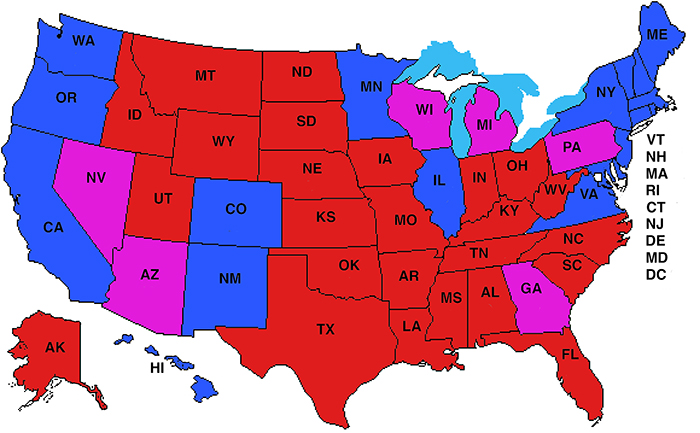
For the Democrats, even if they knock off Collins and eventually pick up the two Republican Senate seats in the swing states, namely the ones occupied by Sens. Ron Johnson (R-WI) and Dave McCormick (R-PA), that gets them to 38 + 12 = 50, best case. With a Democratic vice president, they then barely have control of the Senate, but counting on having all the Senate seats in all the swing states is hardly an enduring majority. To have permanent control of the Senate, they need to win Senate seats in Triple-Trump states, and do it consistently.
Their best shot is turning North Carolina purple. Roy Cooper has a good chance of winning in 2026 and the Democrats might be able to knock off Sen. Ted Budd (R-NC) in 2028 if they can find a good candidate for the Senate and a stellar candidate for president. Then the map would be 24 red states (48 Republican senators), 19 blue states (38 Democratic senators) and 7 swing states with 14 Democratic senators. Still, counting on having all the swing state senators all the time is not a very good bet.
Fundamentally, the Senate is a gerrymander of the entire country.
To get permanent control of the Senate, Democrats have to do much better. Their options include:
- Convert more swing states to permanent blue states.
- Establish solid Democratic senators in red states.
- Add more blue states to the union.
- Split a deep-blue state into two deep-blue states.
First, what about turning swing states blue? Virginia used to be a deep red state. Now it is a light-blue state. It elects Republican governors once in a while, especially when the Democratic candidate is a sleazeball, but now the Democrats hold the trifecta there, all the statewide partisan elected officers are Democrats, and both senators are Democrats. It flipped completely. Democrats could possibly convert all six purple states in the map above to blue states and maybe even North Carolina as well. Then there would be 25 red states and 25 blue states. That would hardly be enduring control, but it would be a lot better than starting in a hole.
Second, it is not impossible for Democrats to thrive in red states with the right candidate. On Jan. 3, 2017, when the 115th Senate convened, there were eight Democrats from red states. They were Sherrod Brown (D-OH), Joe Donnelly (D-IN), Heidi Heitkamp (D-ND), Doug Jones (D-AL), Joe Manchin (D-WV), Claire McCaskill (D-MO), Bill Nelson (D-FL) and Jon Tester (D-MT). All of them were blue dogs and most were populists, but that's what it takes to win in red states. It is not impossible but it takes some separation from the national party and a strong focus on winning white working-class men (e.g., being pro-union, talking a lot about jobs and wages, and staying as far as possible from culture-war issues). In practice, this is going to mean being pro-gun, anti-abortion, and anti-transgirls in girls sports. But they can be pro-union, pro-$15/minimum-wage, pro-same-sex-marriage, pro-Medicare-for-all, pro-environment, and pro Democratic judges. For a candidate in Iowa or Ohio who says "I'd rather be right than be a senator," well, he or she is probably going to be right but won't be a senator and the Democrats won't have a lasting Senate majority.
As to adding blue states to the union, D.C. is a no-brainer and Puerto Rico is next. Puerto Rico is not reliably blue, but Donald Trump may have done enough to offend Latinos that it is blue enough. Four more Democratic senators would really come in handy sometimes. "The chair recognizes Sen. Bad Bunny (D-PR)?"
Splitting a state is more far out, but California is the obvious candidate. The culture of Northern California is sufficiently different from that of Southern California that two states would make sense. After all, there are two Carolinas and two Dakotas. If the split was 20 million in each state, they would rank fourth and fifth, after Texas, Florida, and New York. Might this set up a "splitting war," like the redistricting war? Probably not. Texans tend to identify as Texans, not Northern Texans or Southern Texans. They also love it that Texas is the biggest of the lower 48 and would be loathe to give that up. If Florida split north-south, there is no guarantee that South Florida would always elect Republican senators.
As an aside, there is also one more structural change that would help the Democrats: expand the House. This wouldn't affect the Senate, but would affect the Electoral College. When the size of the House was set to 435 in 1929, each member represented 280,000 people. Now that is 760,000. Suppose the number of members in the House were raised to 1,000—still much smaller than China's 2,980-member National Peoples' Congress and only somewhat larger than the E.U.'s 720-member parliament. Then California would go from 52 House members to 120 House members and from 54 electoral votes to 122 electoral votes. Wyoming would get two House members and four electoral votes. Then the ratio of California:Wyoming in electoral votes would go from the current 54:3 (18.0) to 122:4 (30.5), which is closer to the population ratio of 69:1. Such a change would dilute the electoral power of the thinly populated red states, although it would not affect the Senate. Needless to say, the smaller states would not like this, although they would benefit from better service from their representatives, which would be the Democrats' argument. On the other hand, ambitious state representatives and state senators looking for a promotion might be wildly enthusiastic about it and this could influence public opinion. Changing the size of the House does not need a constitutional amendment, just a new federal law.
All in all, if Democrats want to establish permanent control of the Senate, they have their work cut out for them, but they also have options. (V)
The Race for Governor of California Is Already Crowded and Getting More So
Governor of California is probably the second-most powerful elected position an American politician can aspire to. Not surprisingly, when the position becomes open, quite a few folks see themselves as a future governor. It doesn't hurt that reelection to a second term is nearly guaranteed; every California governor since World War II who has tried for a second term has gotten it. This year, there is an open-seat election for governor of California, and not surprisingly, there is a large herd of politicians (and a couple of non-politicians) gunning for it. Here is the list of major candidates so far (alphabetically):
Democrats- Xavier Becerra: Former California AG and former U.S. Secretary of HHS
- Matt Mahan: Mayor of San Jose
- Katie Porter: Former U.S. Representative
- Tom Steyer: Billionaire investor and failed 2020 presidential candidate
- Eric Swalwell: U.S. Representative
- Tony Thurmond: California Superintendent of Public Instruction
- Antonio Villaraigosa: Former assembly speaker and former mayor of Los Angeles
- Betty Yee: Former state treasurer
- Chad Bianco: Riverside County Sheriff
- Steve Hilton: Political commentator
With all these high-powered candidates, it's pretty wide open. In California's crazy top-two election system, all candidates run in the primary and the top two finishers advance to the general election. This system can be manipulated by a candidate with a lot of money, as now-Sen. Adam Schiff did in 2024. Absent his ratf**king, he might have had to face Katie Porter in the general election and he could have lost that. However, he wisely spent a fortune running ads saying that the Republican in the race, Steve Garvey, was too conservative for California. These ads attracted Republicans to vote in large numbers and Garvey finished second, and then Schiff faced off against him and slaughtered him in November. There was nothing Porter could do to stop this.
Will money play a big role in the gubernatorial race? It might. Mahan, a moderate Democrat, is the favorite of the big tech bosses. He jumped in last week and already raised $7 million directly and another $3 million via a super PAC. What makes a mere mayor so attractive to the tech bosses? He opposes the proposed one-time net wealth tax aimed at Californians worth upwards of $1 billion. By European standards, this is extremely modest, with a number of countries having annual wealth taxes that cut in at a much lower level than $1 billion, usually below $1 million.
In many polls so far, "undecided" is the big winner, at 25-35%. So far, it has mostly been a name recognition contest. In one recent poll, Bianco was first at 15% and Hilton was second at 14%. If this holds (very unlikely) then the general election would be between two Republicans in a state that is overwhelmingly Democratic. This shows how stupid the election law is. Alaska—yes, that thinly populated state where polar bears roam wild—has a far better system, in which the top four finishers in the all-party primary meet in November for a ranked-choice election. Most other states are happy with partisan primaries, with Democrats picking the Democratic candidate and Republicans picking the Republican candidate.
There is plenty of time for money to talk—as it usually does. It is a wide-open race so far. The primary is June 2. (V)
Tech Firms Are Spending Big on the Midterms to Defend AI
Tech firms and their executives are definitely throwing their money around in order to influence politics. As noted above, Matt Mahan is their choice for governor of California, but there is more going on. All the big tech companies are spending hundreds of billions on AI. Unfortunately, to their dismay, people hate it for at least three reasons: privacy, job loss, and its effect on their electricity bills. Needless to say, the companies don't want to spend hundreds of billions to develop a product that the people (through their elected representatives) then regulate, restrict, or even ban. Something had to be done.
Leading the fight here is Palantir, the brainchild of conservative activist and immigrant Peter Thiel and controversial venture capitalist Joe Lonsdale. Thiel is close to J.D. Vance (in the same way that Edgar Bergen was "close" to Charlie McCarthy). Basically, Palantir is a gigantic surveillance company that sucks up everything it can find about Americans and others, analyzes the data using AI, and sells the results to anyone who wants to buy it. Among other customers are ICE, the CIA, the DoD, the LAPD and more. The shadowy company does not publish complete customer lists, though.
Palantir, OpenAI, and other AI companies have already pledged $100 million to help elect pro-AI candidates and defeat anti-AI candidates. What the AI industry wants is a weak federal law regulating AI along with a ban on states having stricter laws. A federal law might ban the use of AI for instructing people on how to construct nuclear, biological, or chemical weapons and leave it at that with all the other dangers (privacy, jobs, electricity usage) left unaddressed. Donald Trump and Sen. Ted Cruz (R-TX) are big supporters of that. A Gallup poll last year showed that 80% of Americans want a lot more regulation than that.
Many politicians want to allow their states to pass more restrictive laws if they want to. AI is a hot topic in Democratic primaries. When it came out that Rep. Raja Krishnamoorthi (D-IL), who is running for the Senate, has taken a piddling $29,000 from a Palantir executive, he immediately donated it to a migrants' group. Other Democrats have followed suit. Like polonium, Palantir money is extremely radioactive, even in tiny doses.
Reed Showalter (D), who is running for Congress in IL-07, said: "I have yet to see AI solve cancer, and I would love to see it right now. The consequences have largely been increased costs for electricity and water and a medium-term decrease in employment and wages for the people in both the district, the state, and the country."
Even Ron DeSantis is not in favor of letting the AI companies run amok. He said: "Let's not try to act like some type of fake videos or fake songs are going to deliver us to some kind of utopia." He supports a state "Citizen Bill of Rights for AI," which includes privacy protections, national security restrictions, and regulations for data center construction. When Krishnamoorthi, vice chair of the Congressional Equality Caucus, and DeSantis are on the same page about something (restricting AI) it shows that the topic is catching on and could be a factor in some races this year and beyond. (V)
National Governors Association Has Canceled its Annual White House Meeting
In the past, the National Governors Association, whose members are the 50 state and 5 territorial governors, met with the president in D.C. in the winter to exchange thoughts on policy. It has always been bipartisan and relatively nonpolitical. Not anymore. This year, Donald Trump invited only the Republican governors, since he regards the Democratic governors and their states as his enemies. In response, the chairman of the NGA, Gov. Kevin Stitt (R-OK), announced that the winter meeting with the president has been canceled. He said: "Because NGA's mission is to represent all 55 governors, the Association is no longer serving as the facilitator for that event, and it is no longer included in our official program." He added that Trump's decision to exclude the Democratic governors runs counter to everything the NGA is trying to achieve, so he does not want the organization to take part in a distraction from its mission.
Karoline Leavitt put it differently. She said about the White House: "It's the people's house. It's also the president's home, so he can invite whomever he wants to dinners and events here at the White House." Maybe the real problem is that there was no place to hold the dinner, since the East Wing of the White House is gone with the wind.
Update: Late yesterday, TACO. The meeting will happen after all, with all 55 governors. There seems to be a pattern here. When there is real pushback to something Trump says or does, he is the one who caves. (V)
Another Sector Begins to Fold Rather than Incur Trump's Wrath
Donald Trump has already gotten media companies, law firms, universities and newspapers to grovel at his feet. Looks like he has opened a new front in the grovel wars. The Gallup Organization will measure presidential approval no longer, even though it is pretty good at it and there is plenty of demand for its product. What's the problem? Gallup measured Donald Trump's approval at 47% last February and 37% in December. Trump. Did. Not. Like. This. So how could Gallup avoid the presidential wrath but still keep some measure of believability (which fudging the data would not do)? Stop taking approval polls altogether. Bingo. Problem solved. Stick with commercial customers who want to know which color packaging their customers prefer.
A spokesman for Gallup said: "This change is part of a broader, ongoing effort to align all of Gallup's public work with its mission." What exactly is its mission? What made George Gallup famous was his ability to measure public sentiment, especially on political issues. What happened to that mission? (V)
Previous | Next
Main page for smartphones