Previous | Next | Senate races | Menu
New polls: MI NC
Dem pickups: AK ME NC OH
GOP pickups: (None)
We know that many of our readers also read Taegan Goddard's Political Wire. What you may not have known is that his son has combined politics with tech and created an online game, Yea or Nay, in which you are asked to guess how five senators voted on various bills in the past (and no cheating by asking Google). It sounds interesting. It has attracted 100,000 players in the first week. Take a look.
Trump Is Not Batting 1.000
Donald Trump's real power is that he can destroy a Republican politician's career by endorsing an opponent. That scares the heebie jeebies out of Republican politicians. However, although Trump's batting average is very high, it is not 1.000. Sometimes his endorsees lose, or see the writing on the wall and decide to retire instead of losing. As we move into the ambulatory-challenged waterfowl period of his presidency, his power is going to wane. Here is a list of Trump endorsees from this year who did not win their election:
| State | Office | Candidate | Result |
| |
|||
| Montana | Senate | Steve Daines | Retired |
| Oklahoma | Senate | Markwayne Mullin | Was appointed Secretary of DHS |
| South Carolina | Senate | Lindsey Graham | Died |
| Wyoming | Senate | Cynthia Lummis | Retired |
| |
|||
| California | CA-48 | Darrell Issa | Retired |
| Florida | FL-07 | Cory Mills | Lost primary |
| Florida | FL-11 | Daniel Webster | Retired |
| Florida | FL-16 | Vern Buchanan | Retired |
| Florida | FL-19 | Catalina Lauf | Lost primary |
| Georgia | GA-11 | Barry Loudermilk | Retired |
| Michigan | MI-08 | Amir Hassan | Lost primary |
| Montana | MT-01 | Ryan Zinke | Retired |
| Nevada | NV-02 | Mark Amodei | Retired |
| North Carolina | NC-11 | Chuck Edwards | Forced retirement due to scandal |
| Oklahoma | OK-01 | Jackson Lahmeyer | Lost primary |
| Texas | TX-19 | Jodey Arrington | Retired |
| Texas | TX-22 | Troy Nehls | Retired |
| Texas | TX-23 | Tony Gonzales | Retired |
| Utah | UT-04 | Burgess Owens | Retired |
| |
|||
| Georgia | Governor | Burt Jones | Lost primary runoff |
| Iowa | Governor | Randy Feenstra | Lost primary |
| Minnesota | Governor | Mike Lindell | Lost primary |
| South Carolina | Governor | Pamela Evette | Lost primary runoff |
| Wyoming | Governor | Megan Degenfelder | Lost primary |
| |
|||
| Texas | Agriculture Commissioner | Sid Miller | Lost primary |
| |
|||
| Indiana | State SD-38 | Brenda Wilson | Lost primary |
| North Carolina | State SD-26 | Phil Berger | Lost primary |
| Florida | State HD-87 | Jon Maples | Lost special general election |
| Indiana | State HD-45 | Bruce Borders | Lost primary |
Some of the retirees called it quits for personal reasons (age, health, etc.) but some also saw that Trump's endorsement alone isn't always enough and preferred to go out gracefully rather than spending another year begging for money, campaigning, and then being sent packing by the voters. You can be sure other Republican politicians are taking note that just getting Trump's endorsement is not a guarantee for success, while not getting it is not sure political death. We can expect more resistance to his demands after the midterms, especially on issues where Trump wants something that the politician's constituents do not want. (V)
Trump's Corruption Could Be a Sleeper Issue for the Democrats
Donald Trump's corruption is obvious to anyone paying attention. The problem is that most voters don't pay much attention to politics, at least not until the elections draw close. Nevertheless, gradually, the word is getting out that Trump is using the presidency not to help Americans, but to help himself get rich.
Evidence that people are starting to pay attention is a new Reuters/Ipsos poll that shows that they are catching on. One question was: "Do Trump's businesses influence his decisions as president?" Here are the results:
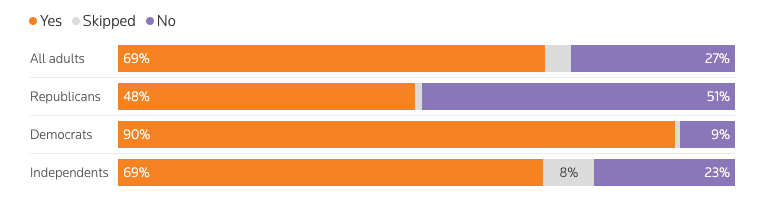
Two things are noteworthy here. First, almost 70% of independents think that Trump's own financial interests affect how he operates as president. Second, even almost half of Republicans also think that.
Trump has also discovered that cryptocurrency can be a big money maker. First, selling $TRUMP coins to the
rubes his supporters is a nice grift. But even better is that foreign governments who want some policy changed, or
criminals who want to avoid prison, can buy lots of Trump crypto and possibly get away with the de facto bribe. The bribery laws were
never designed for this. In the old days, corrupt businessman [X] gave corrupt politician [Y] a suitcase full of $100
notes in return for a specific favor. The concept that the corrupt businessman would buy a load of "product" that cost
the corrupt politician nothing to produce didn't exist.
The closest anyone has come to what Trump is doing—and it is not very close—is then-House speaker Jim Wright (D) putting together a collection of his old speeches in the form of a book and negotiating an unheard-of 55% royalty rate and then getting people who wanted a favor to buy, say, 1000 copies to distribute to customers or others. But even then, there was an actual product (the book). Nevertheless, when this came out, it was a scandal and House Democrats forced Wright to resign as speaker. The book cost $5.95, so someone buying 1,000 copies was handing Wright $3,273 in royalties. But this was big enough for the Democrats to dump Wright. Trump is taking in billions of dollars in crypto sales (with no actual product) and nary a peep from Senate Republicans. Still, the voters don't like what Trump is doing. The poll asked: "Is it appropriate for Trump and his family to earn money from cryptocurrency?" Here are the results for that:
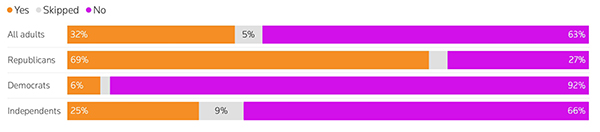
Again, by a margin of more than 2 to 1, independents don't think it is appropriate for Trump to be making money on crypto. If Ipsos had asked: "Is it appropriate for Trump to earn money from building hotels and golf courses?" there might have been more support, since that is a normal business deal. The crypto is so scuzzy that it comes very close to a straight bribe in sheep's clothing (not that sheep need to wear clothes).
For the Democrats this information is valuable and they are starting to exploit it. The message is that Trump is spending his time as president taking bribes and getting rich off billionaires and has no interest in the fact that you are barely making it, what with high food, gas, and other prices. It is the contrast here that is potentially an issue. He is raking in billions and you are struggling and he doesn't give a hoot. Bill Clinton famously said: "I feel your pain." Maybe he did, maybe he didn't, but that is at least the right thing to say. Trump is saying: "You have no pain. Just shut up."
For a campaign theme to work, the public has to be receptive to it already. For example, if the Democrats were to say: "Trump spends too much time playing golf and not enough time presidenting" it wouldn't work because not a lot of people think the problem with Trump is that he plays too much golf. But harping on his corruption is likely to work because people already believe that and bringing it up a lot reinforces an underlying belief. (V)
Greg Abbott Could Be Done in--by Electricity
Texas does not have term limits, so Gov. Greg Abbott (R-TX) is running for a fourth term. No Texas governor has ever won four terms, although a few other states have had four-term governors. Texas is a red state and he might get it, but his biggest problem isn't his opponent, Gina Hinojosa (D), but electricity—and in two ways.
First is electricity-hungry data centers, especially in rural areas. People don't want them for several reasons, among which is the fear that they will hog all the power and drive up electricity prices. They also fear that building a data center in a rural county will change the nature of the county and their way of life by bringing in traffic, outsiders, and other interferences.
Second is the grid. Texas' electricity grid is notoriously fragile. Abbott has proposed spending $33 billion to provide enough transmission capacity for the data centers. People in rural counties don't want the state to spend $33 billion of their hard-earned tax money to provide a facility to make it possible to put in data centers they strongly oppose. Abbott is taking a lot of flak for the plan to spend so much state money for something people not only don't want but actively oppose. Shawn Nanny, a Republican county commissioner in West Texas, said the data centers and power lines are the "straws that broke the camel's back." He said that long-time conservatives are now thinking the unthinkable: voting for a Democrat. This is how badly they want to get rid of Abbott.
Texas hasn't elected a Democrat as governor in over 35 years, but the combination of a governor who is perceived as honest, but doing things people don't want, and a Senate candidate, Ken Paxton, who is perceived as an out-and-out corrupt politician of the worst kind, is a bad pairing for the GOP. This is extra impactful because Hinojosa has been a constant corruption watchdog in the Texas state House and U.S. Senate candidate James Talarico is about as non-woke as a Democrat can be. Distrust of both Republicans on top of the ticket and no active dislike for either of the top two Democrats might just do the trick in a blue wave.
Suzanne Bellsynder, who was one of Abbott's field directors in 2014, and who now runs the Texas Rural Reporter website said: "It feels like an attack on a culture, a way of life, because now I think rural Texas is feeling like 'Okay, now they want us, but don't want our culture—they want our resources.'" A recent article on the website is entitled: "We Like Our Rural Way of Life, Thank You Very Much." It rails against changes to rural areas the folks in Austin have dreamed up for rural residents—without asking them for their opinion on the subject.
Every cycle, Democrats come up with a couple of strong candidates, raise truckloads of money, and still fall short. But maybe, with two unpopular Republicans and two popular Democrats on top of the ticket and an unpopular president and an affordability crisis, this might just be the election where Democrats break the jinx. Maybe. Or maybe Lucy will pull that damn football away, once again. (V)
Epstein is Still with Us
Well, not Jeffrey himself. Almost everyone agrees he died in a prison cell, although not everyone agrees on whether it was a suicide or a homicide or some other kind of cide. While Donald Trump started a war in Iran in part to deflect attention from Epstein's crimes (and his own involvement in them) and then keeps doing other things (e.g. tariffs on Canada) to deflect attention from how badly that war is going, the Epstein investigation keeps plodding along.
In particular, one person in the spotlight is billionaire Leon Black. He paid Epstein $170 million for "tax advice." That is simply unbelievable. A top-rate tax lawyer at an elite firm might bill $4,000/hour. Suppose the lawyer worked full-time for 6 months on a tax plan for Black (which is inconceivable because the top tax lawyers do this all the time and don't have to spend 1,000 hours for a new client; they already know where the Cayman Islands are), then he would bill $4 million for his services. Not $170 million. Nobody pays $170 million for tax planning when a senior partner at a top firm will do it for way under $4 million. The payment was for something very different and House Oversight Committee Chairman James Comer (R-KY) wants to find out exactly what it was.
The specific issue at hand that is bugging Comer is that when he testified before Comer's panel, Black refused to answer the congressman's questions. He claimed he signed an NDA not to talk about his dealings with the women he met at Epstein's place. Comer's view is that Congress' authority to compel testimony from witnesses overrides civil NDAs. Comer is now threatening to hold Black in contempt of Congress if he doesn't answer questions and produce the documents Comer wants to see. Comer has said: "If Mr. Black refuses to provide the Committee with responsive documents or refuses to appear for his scheduled deposition on September 3, 2026, the Committee will use all tools at its disposal, including contempt." We will know within 2 weeks if Black shows up.
Black might try to stall, but he has to be careful not to drag this out too long. If the Democrats win the House, then on Jan. 3, 2027, Rep. Robert Garcia (D-CA) will probably become chairman of the Oversight Committee. Garcia is much more motivated and much more aggressive than Comer and will let Black have it with both barrels. He could be the key to getting an answer, under oath, to the questions: "Why did you really pay Epstein $170 million? Was he blackmailing you (and others) for something? What?"
In any event, much as Trump would like to have everyone forget about Epstein, the drama goes on. (V)
Why the Polling in Wisconsin Was So Wrong
Yesterday we had an item on why the polls for the Wisconsin gubernatorial election were so far off. As noted yesterday, one of the polls was completely fake, just made up. But there were other polls by legitimate pollsters, that also showed progressive Democrat Francesca Hong way, way ahead. G. Elliott Morris wanted to find out why the legitimate polls were so far off, so he made a deal with pollster State Navigate. The deal was they would give him all their internal data to analyze to find out what they did wrong (something they very much wanted to know). In return, instead of asking for money, he wanted permission to publish his report on his blog, which it granted and he did. Here it is, but be warned it is quite technical.
First, a bit of background. After the 2000 election fiasco in Florida, Congress passed the HAVA (Help America Vote Act). Among its other provisions, it requires states to maintain a proper database of voters, informally called the voter list. What is in the voter list varies by state, but often contains the voter's name, address, date and place of birth, race, gender (identity), precinct, party affiliation, telephone number, e-mail address, Social Security number, driver's license number, voter number, father's name, mother's name, maiden name, political donations, elections voted in, and sometimes more. All states sell their voter lists. Sometimes any legitimate entity can buy them (e.g., political campaigns, pollsters, etc.), sometimes anyone can buy them but only for specific purposes set out in law, sometimes there are more restrictions, and sometimes there are no restrictions at all. Here is a map showing how different states deal with these lists:
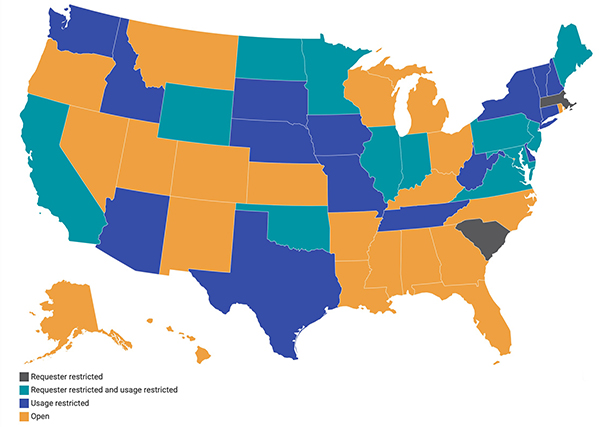
Prices vary from free (e.g., Florida) to $12,500 (Wisconsin). Most states charge less than $1,000.
The first thing Morris learned was how the poll was done. Pollsters rarely use random-digit dialing anymore because nobody answers the phone for unknown callers anymore. What State Navigate did was bite the bullet and buy the Wisconsin voter list. This gave it a list of every registered voter in the state. Then it made a random sample of the actual registered voters and contacted enough of them to get a statistically significant number to agree to take the survey. It did a survey in July and then contacted the same voters in August. This is very significant because then they knew how many individual voters changed their mind in that month, which gave them useful information about trends.
The first good thing about working with a voter list is you know for sure that everyone is a registered voter in the state being polled. With any other method of collecting respondents, you have to trust them when they say they are a registered voter. The sample State Navigate got didn't conform to their model of the electorate. It never does, though, so they corrected it in many ways, based on the voter list data and their own demographic questions at the end. If they wanted a sample with 22% Catholics and they got a sample with 19% Catholics, they counted each Catholic as 22/19 = 1.158 people. Likewise for all the other demographic characteristics they cared (and asked) about. With these corrections, they got a sample that matched what they thought the electorate would be—that is, the right number of Catholics, college graduates, progressives, old people, poor people, Black people, rural voters, and so on for every category.
Based on the raw data, the corrections, the polling results, and the election results, Morris determined that there were three sources of error, from largest to smallest:
- Bad Demographics: The July poll had Hong at 44% and David Crowley at 15%, a 29-point
lead. The August poll had Hong ahead 44% to 22%, a 22-point lead. Five days later, Crowley won by half a point.
Being off by more than 20 points is a massive error,
even by primary standards, where the absolute value of the polling error is 13 points. Morris verified all the math to
make sure there wasn't a bug in the software's arithmetic. There wasn't. The problem was elsewhere.
The model was wrong. Based on the exit polls of previous elections, State Navigate assumed that 9% of the voters would be 18-29. The voter file showed only 2% in this range. The July poll sample showed 17% under 30—more than 8x more than their share of actual registered voters. The July sample had 17% as actual Democratic Socialists and 43% as progressive. This is way more than the 2016 exit poll showed (25% progressives). State Navigate corrected for the very skewed sample, but not enough. It is very possible that every young socialist contacted was excited to spend hours discussing politics with the pollster whereas older moderates were more hit or miss, depending on how busy they were.
State Navigate knew about the discrepancy, and while counting a voter as 1.158 voters is fine, counting a voter as 0.118 of a voter (in other words, taking that 17% and shrinking it down to 2%) is a huge correction. It is almost like making up numbers, and honest pollsters are hesitant to make such enormous corrections. So, State Navigate didn't. When Morris actually made the corrections, his corrected version of the poll was off by only 3 points. He thinks the bad sample gave Hong 5-10 extra points.
- Late Movement: The difference between the July and August polls was a hint that the
voters were changing their minds. With candidates dropping like flies, it is not surprising that there was real
movement. Comparing the August poll to the July one, the Hong-Crowley margin fell 7 points in 10 days. Crowley was
picking up support from the candidates no longer running and the undecideds were deciding. They went 40% to Crowley, 20%
to Hong, and 40% to the minor candidates. It is almost certain that this movement continued until Primary Day. So a
second source of error above the bad sample and insufficient correction was genuine change in how people were going to
vote that was missed
because there were too few polls close to the election.
Late movement away from her cost Hong 6-10 points.
- Non-response: It is hard to get a good measure of how the people who were contacted and refused to answer voted. You could ask them, but given that they won't respond, that won't work. What Morris did was change the demographics by fudging correction factors to force the poll to predict the exact election outcome, so as to see how the demographics changed. What he discovered is that the mix that predicted the correct results had more Crowley voters across demographic categories. His conclusion is that Crowley voters were more likely to refuse to be polled than the super enthusiastic Hong voters who were bursting at the seams to explain to the world why Hong was so great. Morris thinks non-response overweighted Hong by 2-5 points.
So there you have the anatomy of a polling fail. Morris' feedback to State Navigate was to be leery of a sample that contradicts the voter list too much. He also advised doing a sensitivity analysis. That consists changing some parameters up and down and seeing what it does to the results. If small changes in some parameters (e.g., the number of 18-29 year olds in the assumed electorate) changes the results a lot, be very wary. If small changes to all the parameters don't change the result much, you can be more confident in the results. All in all, an interesting study. (V)
It Is Not 2018--It Is 2006
Many pundits are comparing the 2026 midterms to Donald Trump's first midterm election, in 2018. Jessica Taylor at The Cook Political Report thinks that is the wrong benchmark. She thinks it should be 2006 (note: paywall).
In that year, Democrats were also facing a bad map, George W. Bush was engaged in an unpopular war in the Middle East, and the economy was in poor shape. Toward the end, Democrats began smelling victory in red states, something not on the table at the start of the cycle. In the end, Democrats flipped Montana, Missouri, Ohio, Virginia, Pennsylvania and Rhode Island, beating incumbent Republicans in all six of them. This time, four of the most contentious races are open seats, where a Republican retired (voluntarily or otherwise). They are Iowa, Montana, North Carolina, and Texas. Winning an open-seat race is always easier than beating a well-known, entrenched incumbent.
The main lesson from 2006 is that when the president is unpopular, the opposition party can make deep inroads in states that favor the president, even if that seems unlikely a priori. In Montana, Bush carried the state by 20 points in 2004, but Jon Tester (D) knocked off three-term Sen. Conrad Burns (R) by 1 point. In Ohio, which Bush won by 2 points, Sherrod Brown (D) crushed two-term Sen. Mike DeWine (R) by 12 points. Democrats in all but Rhode Island overperformed their baselines by 9 to 21 points. That's about what it will take this year. (V)
Rodent Reproduction Is Going Wild
This year has seen a veritable bonanza of primary meddling, mysterious super PACs, straw candidates, and all manner of political shenanigans and dirty tricks. With so few competitive House districts and the Senate hinging on half a dozen races, all these things could matter. Here are just a few of them:
- Green Party: The Green Party is suing to get Andrew Tupone off their ballot line in
PA-07, saying he was a registered Republican until February and has not been nominated by their party. Tupone is
spouting typical Green Party slogans now, even though the Green Party didn't want to run a candidate in PA-07 for fear
of hurting Bob Brooks (D)'s effort to unseat Rep. Ryan Mackenzie (R-PA). Tupone just filed and no one else did, so he
got the GP's ballot position.
The lesson here is that a (minor) party should always have a loyalist file to run. If need be, the loyalist can drop out
5 minutes before the deadline.
This prevents some opponent from getting the nomination
by noticing that no one else has filed and then filing.
- Seeing Double: We have written about the two Dan Sullivans (Dans Sullivan?) several times
recently. Although Teacher Dan Sullivan denies that he filed just to suck votes from Sen. Dan Sullivan (R-AK), we have
our doubts. Maybe he was confused and thought the incumbent was Sarah Palin.
- Late Dropouts: The formally nominated Democrats in Idaho, Nebraska, and South Dakota have
all dropped out, clearing the way for independents whose platforms match those of typical moderate Democrats but without
that toxic (D) after their names. In Montana, which is the Democrats' best hope for an independent to win, Alani
Bankhead (D) has been very stubborn and refused to drop out. We suspect she sees the real enemy as the moderate
Democrats, not the Republicans, and wants to teach them a lesson.
- 4:55 Switcheroos: Sen. Steve Daines (R-MT) and Rep. Chuy Garcia (D-IL) withdrew from
their reelection race 5 minutes before the filing deadline, to ensure that their carefully selected preferred candidate
would be the only one to file, and so the only one running and thus would not face a primary.
- Primary Meddling: FEC filings showed that new Republican-aligned super PACs with names
like Lead Left PAC, Real Change PAC, and Progressive Champions PAC suddenly appeared out of nowhere to support
scandal-ridden or weak Democrats in an attempt to saddle the Democratic Party with candidates who couldn't win a general
election.
- AIPAC: The group, which supports Israel, knows it is not popular with Democrats. So it has created some super PACs with other names to support its preferred candidates. Its ads never even mention Israel. They talk about kitchen table issues. AIPAC has also funneled money to existing, well-established Democratic groups, like the Democratic Women's Caucus, as conduits for money untainted by AIPAC.
These are just a few of the dirty tricks this cycle. There are probably more that simply haven't been exposed. (V)
Today's Senate Polls
There is a new poll from Susquehanna putting Abdul El-Sayed ahead in Michigan. Today's map has the Democrats at 51 Senate seats. This is the formula for Democrats to win the Senate, although some barely blue state and Texas could swap. But keep in mind it is early in the season and the polls are varying wildly. We have Michigan at El-Sayed +2 by averaging two recent polls that were Rogers +4 and El-Sayed +7. It is not possible that both polls are correct. Buyer beware. Things are going to change a lot in the fall.
| State | Democrat | D % | Republican | R % | Start | End | Pollster |
| Michigan | Abdul El-Sayed | 46% | Mike Rogers | 39% | Aug 11 | Aug 17 | Susquehanna |
| North Carolina | Roy Cooper | 52% | Michael Whatley | 39% | Aug 09 | Aug 10 | Harper Poll of NC |
* Denotes incumbent
Previous | Next
Main page for smartphones