Previous | Next | Senate races | Menu
New polls:
Dem pickups: (None)
GOP pickups: (None)
Election Preview
Lots of primary elections tomorrow. Good. Let's look at them in roughly the order of most interesting to least interesting.
- Wisconsin: Wisconsin is the mother of all swing states, so it always gets special
attention (except in 2016, when Hillary Clinton took it for granted and didn't bother showing up). Proof of Wisconsin's
ability to swing is easy to find. Just look at its senators: the very left-wing (lesbian) Tammy Baldwin (D-WI) and the
very right-wing and very wealthy (north of $50M) businessman Ron Johnson (R-WI). No state can match this for diversity.
Wisconsin doesn't have a Senate election this year, but political junkies in the Badger State have plenty to keep them
sustained. The
race for governor
has been wild and woolly ever since Gov. Tony Evers (D-WI) decided he didn't want a third term, even though Wisconsin
law allows that.
After Evers called it quits, his #2, Lt. Gov. Sara Rodriguez (D-WI), jumped in. So did former Lt. Gov Mandela Barnes (D), Milwaukee County Executive David Crowley, Assemblywoman Francesca Hong, and a handful of bit players. When Crowley discovered that he was the only one who wanted him to be governor, he dropped out, suspending his campaign on July 8. When Rodriguez discovered that her campaign manager had been cooking the books and the financial cupboard was bare, she was forced to drop out on July 17. When the Democratic powers-that-be panicked after Rodriguez left the race because they were scared to death that the Democratic Socialist Hong would win the primary and lose the general election, they convinced Crowley to un-drop out, which he did. Then Barnes took one for the team by dropping out on July 30 to avoid splitting the non-DSA vote (and to avoid scrutiny of his past behavior regarding female staffers).
All this maneuvering left Hong and Crowley and a couple of minor candidates. Polls have Hong up by over 20 points. It will not be a surprise if she gets the nomination, but the battle for governor will be the most important test of the leftward march of the Democrats this year, even more than the Senate election in Michigan. In the end, we expect Michigan Democrats who don't like Abdul El-Sayed to hold their collective noses and vote for him because control of the Senate is so important. Hong doesn't have that advantage, plus state-level issues don't entirely align with federal issues, which is why some states that would never dream of electing a senator of a particular party will sometimes elect a governor from that same party (think Kansas or Kentucky or Vermont). El-Sayed will be getting money from all over the country because Democrats nationwide care about that race. Not many people outside Wisconsin care who the governor of Wisconsin is. The Republican candidate will be Rep. Tom Tiffany (R-WI), who has Donald Trump's blessing and full endorsement. Whether that is a pro or a con in Wisconsin, a purple state with many farmers, is an excellent question.
Hong is a young (37) woman of color whose parents immigrated from South Korea. She attended UW Madison and studied Spanish and journalism but dropped out and became a dishwasher and later a line cook at a restaurant. She is definitely working class and very lefty. She was married to Matt Morris, but they divorced and she is a single mom now. Tiffany is an older (68), white right-winger who got a degree in agricultural economics and later ran a small oil company before he got into politics. The two are polar opposites. Hong will inherit all of Baldwin's supporters. Tiffany will inherit all of Johnson's supporters. The state's undecided voters will have to make the call. Assuming Hong gets the nomination, the general election will be a real barnburner.
Some of the House races are competitive. In WI-01 (PVI R+2), incumbent Rep. Bryan Steil (R) will probably face nurse Mitchell Berman, who has the most money and many endorsements. This one could flip. In WI-03 (R+3), incumbent Rep. Derrick Van Orden (R) will face either former president of the Eau Claire city council Emily Berge or else Rebecca Cooke, who is making her third try at unseating Van Orden. WI-07 (R+11) is Tiffany's open seat. There is a spirited Republican primary there, with Secretary of Transportation Sean Duffy's son-in-law Michael Alfonso, PR pro Jessi Ebben, and former chairman of the Marathon County Republican Party Kevin Hermening.
There are new maps for the state legislature chambers and Democrats have a shot at flipping the state legislature. If Hong is elected governor, but the Republicans control the legislature, she will be stymied at every turn.
- Minnesota: Sen. Tina Smith (DFL) is not seeking reelection. Her open Senate seat has become a
battleground.
On the Democratic side, Lt. Gov. Peggy Flanagan is facing off against Rep. Angie Craig. This is a toughie for Democrats,
who love them some identity politics. Flanagan is an enrolled member of the Ojibwe Nation (and you thought the Flanagans
were all Irish?). Craig is a lesbian, originally from (not-especially-neighboring) Arkansas. She is the first openly gay
mother elected to Congress. Something for everyone.
Flanagan is leftier than Craig and has been endorsed by Sens. Bernie Sanders (I-VT), Elizabeth Warren (D-MA) and Jeff Merkley (D-OR); and Reps. Pramila Jayapal (D-WA), Ro Khanna (D-CA) and Ilhan Omar (DFL-MN), among others. Craig has been endorsed by Sens. Tammy Baldwin (D-WI), Ruben Gallego (D-AZ) and Andy Kim (D-NJ); and Reps. Hakeem Jeffries (D-NY), Nancy Pelosi (D-CA) and Sarah McBride (D-DE), among others. The most recent poll, from SurveyUSA ending Aug. 4, has Craig ahead 42% to 40%. So, toss-up.
The only House district that is really competitive is MN-02 (D+3), Craig's district in the Twin Cities' southern suburbs. DFL-ers are former state Sen. Matt Little, state Sen. Matt Klein (which means "little" in German, Dutch, Afrikaans, and Yiddish—take that, you Sullivans in Alaska), and state Rep. Kaela Berg. Little and Klein have raised big money, Berg has raised little money.
- South Carolina:
The death of Lindsey Graham forced a very quick emergency Republican
primary
in South Carolina. It will be held tomorrow. Graham's sister, Darline Graham Nordone, hastily renamed Darline Graham,
was appointed to the vacant seat and is running for a full term. She has Donald Trump's endorsement, even though nobody
really knows what she believes. Plenty of time to figure that out after she is elected. Her opponents are Reps. Ralph
Norman and Russell Fry, famed Appalachian Trail hiker Mark Sanford, businessman Mark Lynch, and a few others. Polls show
Graham way ahead, but not close to 50%, so there will be a runoff. A reminder of recent history: The Trump-backed Lt.
Gov. Pamela Evette (R) came in first in the regular gubernatorial primary, then lost the runoff when the supporters of
the other candidates consolidated behind AG Alan Wilson. Whoever wins the Senate runoff, which will take place in 2
weeks, will face pediatrician Annie Andrews. Pretty good chance South Carolina will get its first elected female senator
on Jan. 3, 2027.
- Connecticut: In CT-01 (D+12), folksy Rep. John Larson (D-CT) has come under fire for his
age. He would turn 80 during another term. Some Democrats think enough is enough. Generational change is the
big issue
here, with three younger Democrats challenging Larson. They are Hartford Mayor Luke Bronin, state Rep. Jillian
Gilchrest, and Hartford School Board member Ruth Fortune. All three are moderates, so this is not a DSA vs.
establishment race. It is just about age. Bronin is the best known of the three. However, it's first-past-the-post here.
If the "youth" vote splits, Larson could survive. Ranked choice voting, anyone?
- Vermont: No Senate election here, but Gov. Phil Scott (R-VT) wants another 2-year term.
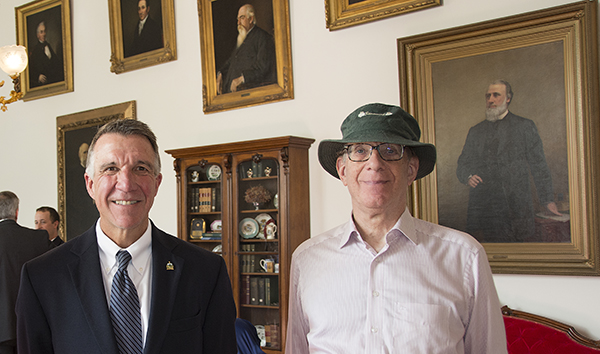
He will almost certainly get it. Fun fact: One time when (V) was on vacation in Vermont, he visited the state Capitol as
a tourist. Scott was giving a press conference about what the state was doing about cybersecurity. After the questions,
(V) went over to him and introduced himself as a professor with a fair amount of expertise in cybersecurity. Scott was
instantly interested. After some discussion of the issues at hand, Scott said he didn't trust any of the consultants he
had and was (V) at the University of Vermont and would he like to be hired as a special adviser to the governor? (V)
admitted he wasn't and declined the offer, but did get a photo with the governor:
Scott seemed like a good public servant whose priority was doing things to help the people of his state, which is probably why he is the most popular governor in the country with an approval/disapproval of 74/19. The Democrats vying to replace him are economist Amanda Janoo and former lobbyist Aly Richards. Polls have Janoo a bit ahead.
- Alabama: There are gubernatorial and senatorial races in Alabama this year, but those primaries are over. There will be special primary elections in AL-01, AL-02, AL_06, and AL-07 as a result of a Supreme Court decision giving the Republicans the map they wanted. It changed the boundaries of these four districts. Democrats aren't even bothering to contest AL-01 or AL-02. AL-07 is the state's one remaining majority-minority district, currently represented by Terri Sewell (D). Four Democrats are running in AL-06 because it is the only one a Democrat could possibly flip.
Hawaii held primary elections on Saturday. Gov. Josh Green (D-HI) was renominated easily. The Republicans managed to
find a candidate, Gary Cordery, who will be crushed in November. More interesting was the primary in HI-01 (Honolulu).
An older (73) blue-dog moderate, Rep. Ed Case (D-HI), was challenged by a younger (42) leftist, Jarrett Keohokalole. Have
you seen this movie before? Well, as usual, the young guy won, surprise, the old guy won in a 24-point landslide.
Maybe it is a little early to say that young progressives are taking over the Democratic Party. As they say, as NYC
goes, so goes... Wisconsin? In HI-02, Rep. Jill Tokuda (D) had four challengers and still got 92% of the vote. In November,
the Democrats will win all the marbles, as usual. (V)
Profiles in Cowardice: Senate Confirms Todd Blanche as AG
Some senators are not that bright (yes, Alabama and Wyoming, we are looking at you), but now that Markwayne Mullin has moved on to bigger and better things, all of them have at least a 4-year college degree and most have a graduate degree (22 Masters, 47 J.D.s, 4 M.D.s, and 4 Ph.D.s). As a group, they are not stupid. They all know that Todd Blanche is completely unfit to be AG, yet on Saturday he was confirmed 50-49. Every Democrat voted against confirmation, as did Sens. Susan Collins (R-ME)—whose Senate election would have been torpedoed by an "aye" vote—and Lisa Murkowski (R-AK), the only Republican senator with a spine. Sen. Mitch McConnell (R-KY) was indisposed and did not vote. It would have been interesting if Sen. Rand Paul (R-KY) had voted "nay" and they had to roll McConnell into the Senate to get the 50th vote, so J.D. Vance could break the tie. Blanche was too much even for Sen. John Fetterman (D?-PA), who voted with all the Democrats to reject Blanche.
What strikes us as the most noteworthy aspects of this whole business are:
- The enormous sway Donald Trump still holds over all Republican politicians.
- The extreme cowardice of Republican Sens. Bill Cassidy (LA), John Cornyn (TX), and Thom Tillis (NC).
None of those three senators will be returning next year on account of Trump forcing them out, one way or another. He can no longer threaten to primary them. Now they have power over him, rather than vice-versa. Cornyn and Tillis pretended to care about the giant $2 billion slush fund Trump wants and made a big show about making Blanche pretend he won't allow it. But Trump really wants this, so he will tell Blanche that unless he caves immediately, he will be dumped, just like Sally Yates, Jeff Sessions and Pam Bondi. Blanche will obey and cave immediately. Cornyn and Tillis know this very well, but still couldn't summon the courage to simply vote "nay." So great is Trump's power. Cornyn served 7 years on the Texas Supreme Court, 4 years as Texas AG and 24 years as a senator. He knows very well how the justice system is supposed to work. If Tillis didn't know, Cornyn could have told him.
Cassidy is a doctor. He took an oath that said: "First, do no harm." It didn't say "First, do no harm to your patients, but boy oh boy can you harm anyone who is not your patient to the max, even the entire country." Cassidy "defended" his vote by saying: "Mr. Blanche showed poor judgment in approving the anti-weaponization slush fund and exempting the president from IRS audits. No American should be unfairly targeted by the law, but no American should be above the law." Just so you are not confused, this is why Cassidy voted to confirm Blanche, not an explanation of why he voted to reject him. He also defended his vote by effectively saying if Blanche is shot down, maybe the next nominee will be even worse. The Senator apparently didn't consider the possibility of rejecting that one, and the one after, and the one after that until there was one who was fit for the job.
Murkowski, in contrast, voted "nay" and let Blanche have it with both barrels. She said: "The country needs an Attorney General who will check the worst impulses of this administration. I hope Mr. Blanche is able to achieve that, if confirmed, but I simply do not have confidence that will be the case." She also noted that the slush fund is off the table only until Blanche is confirmed. She has no illusions that it is really dead. She also criticized the DOJ for the deal giving Trump and his children immunity for past actions, including failure to pay taxes.
As to Collins, once again she has cast a "principled" vote that was not actually decisive. Funny how it works out that way for her so often. There is much scuttlebutt that Cassidy was going to be a "nay," but that he took a bullet for Collins so that she could be a "nay" instead. If this is true, we think it does not reflect well on either of them.
Needless to say, once Blanche was confirmed, Democrats were beyond furious. Sen. Adam Schiff (D-CA), who graduated cum laude from the Harvard Law School, said: "The problem with confirming Todd Blanche is that he has never been able to shed his role as criminal defense lawyer for Donald Trump. He just can't do it. He does not represent the American people now. He will never represent the American people. He will never do what's best for the American people. He will only do what's best for Donald Trump, and you cannot leave someone like that as the nation's number one law enforcement official."
If you don't mind us mixing some metaphors, this kabuki theater is a tale told by an idiot, full of sound and fury, signifying nothing. Blanche was already acting AG and could have stayed that way until either Jan. 20, 2029, or the first time he didn't instantly obey Trump's orders, whichever came first. In terms of power, this confirmation changes nothing. But Blanche coveted the title of attorney general, and Trump delivered to a grateful Blanche, who will now deliver for an ungrateful Trump, justice be damned. (V)
Senate Approves Bill to Sanction Russia
Sometimes you achieve more in death than in life. John F. Kennedy was not able to get the Civil Rights Act or Voting Rights Act passed in his life, despite trying hard to do so. But after he died and there was great sympathy for him, Lyndon Johnson used that sympathy to help get them through. Lindsey Graham tried very hard to get a bill that would put punishing sanctions on Russia through the Senate to no avail. But now that he is gone, the 61-page bill was renamed for him and it passed the Senate 86-11 on Friday. Every Republican except Sen. Rand Paul (KY) voted for the bill. Sen. Bernie Sanders (I-VT) and nine (mostly) progressive Democrats—namely Lisa Blunt Rochester (DE), Maggie Hassan (NH), Mazie Hirono (HI), Ed Markey (MA), Jon Ossoff (GA), Alex Padilla (CA), Elizabeth Warren (MA), Peter Welch (VT) and Ron Wyden (OR)—voted against it. They voted against the bill because it authorizes the president to impose tariffs to enforce the sanctions and they think Trump already has too much power to impose tariffs and doesn't need more. He can impose sanctions with the power he already has.
What the bill doesn't do is levy tariffs. It authorizes the president to impose tariffs up to 100% on the top five purchasers of Russian oil, forcing those countries to decide whether buying Russian oil or selling products in the U.S. is more important. But it doesn't force the president to do anything.
It also puts Trump on the spot. His buddy, Vladimir Putin, is not going to like the bill and will surely instruct Trump not to levy tariffs on countries that purchase Russian oil. What will Trump do? Note that one of the biggest customers of Russian oil is China, which will not take tariffs lying down. It could ban the export of rare earths and other items important for U.S. industry in retaliation for tariffs. Then what would Trump do? If he is afraid to stand up to Russia and China, then what's the point of the bill?
In any event, the bill first has to go to the House for a vote, though it is expected to pass. (V)
The Economy Is Losing Jobs
Poll after poll has shown that what people care about most is the economy. When jobs are plentiful, affordability gets the most attention, but if jobs start getting scarce, that will get right up with affordability. Gas going up by $1 is a pain, but worrying about losing your job is even worse. On Friday, the Department of Labor reported that the economy shrunk by 23,000 jobs last month. Economists had expected it to grow by 83,000 jobs, not shrink. The Dept. also revised the statistics for May and June down by 100,000 jobs. Donald Trump had bragged about how great the economy is, in part based on these numbers. The jobless rate is now 4.1%.
If the economy keeps shrinking over the next 3 months while prices keep rising, that could be a double whammy for the Republicans in November, as Democrats will naturally blame the in-party for mismanaging the economy.
On the other hand, an economy losing jobs is clearly not overheated, which will take some pressure off the Fed to raise interest rates to slow it down. Donald Trump is wildly against interest rate increases.
The economy is a big complicated machine, with lots of moving parts. While economists care about these things, the average voter cares about two things: prices, and whether his or her job is secure. And neither of these is looking good right now. (V)
Appeals Court Says Trump Can't Hold His Balls in the White House
Construction moves a lot faster than the courts. The East Wing of the White House is long gone and Donald Trump's ballroom is rising in its stead—for the moment. Look:

Now the courts are catching up. In a 2-1 ruling from the U.S. Court of Appeals for D.C., the judges ordered construction on the ballroom to stop. However, it may continue for 2 weeks to give the Supreme Court a chance to take the case. If the Supreme Court takes no action for 2 weeks, construction must stop. The appellate judges wrote: "Each President is a temporary tenant, not the owner, of the White House and cannot fundamentally reshape it without congressional approval." Trump didn't get (or even ask for) congressional approval. The judges in the majority are Patricia Millett, a Barack Obama appointee, and Bradley Garcia, a Joe Biden appointee. Dissenting was Neomi Rao, a Trump appointee.
In his brief, Trump had argued that the ballroom was needed for national security reasons, including being used for weapons to counter attacking drones. The majority opinion didn't accept that a ballroom was the only way to protect the president from drone attacks. The opinion said: "National security arguments are not an automatic-get-out-of-law card."
The current cost of the ballroom is estimated to be $400 million, but could go higher. Trump promised that it would be paid for by private donors. Nevertheless, he asked Congress to pony up the $400 million, which it has so far refused to do. (V)
Today's the Day for Max Miller
Rep. Max Miller (R-OH) has a decision to make—today. Three women—including his ex-wife, the daughter of Sen. Bernie Moreno (R-OH)—have accused him of domestic violence. House Republicans want him to drop his reelection bid—and ideally resign from Congress right now. They don't like the contrast with Graham Platner, whom Democrats hounded until he dropped out of the Maine Senate race. If Miller stays in, Democrats are going to be saying: "When one of our guys misbehaves, we force him out. When one of yours does, you cover up for him." Violence against women is probably not a selling point in the midterms—at least not with Democrats and most independents.
Here's the problem. The deadline for dropping out is today. If Miller fails to withdraw from the race by 4 p.m. today, his name will appear on the ballot, even if he drops out later. This will give Democrats a big target. Sen. Jon Husted (R-OH), who is in a tough race of his own, has now called on Miller to drop out and resign from Congress.
So far, Miller has resisted. He went on a media tour defending himself and denying all the accusations. However, he struggled with simple questions like whether he has used illegal drugs, and if so, when. The district is a working-class R+5 district in northeastern Ohio and the Democrats have the ideal opponent for Miller, a 47-year-old iron worker named Brian Poindexter. He does not believe in a "vote for me because he sucks" strategy. He said: "I never got in this race to run because Max Miller is terrible in his personal life. I got in it to run because of policies that hurt us." Poindexter is a hard-hat progressive.
Poindexter has talked about friends who were pushed into a financial crisis by one emergency like a blown engine or a surgery. They have had to start GoFundMe campaigns to try to survive. They are tired of a system where they are working hard and can't afford a decent life. Poindexter has been motivated by Bernie Sanders and James Talarico. But he said he was not carrying the flag for the Democratic Party. He is carrying it for workers. Naturally, Miller has called him a socialist. It isn't working though. A recent poll has Poindexter ahead of Miller by 5 points even though Trump carried the district by 11 points in 2024.
If Miller is still in tomorrow and later drops out, the Republican county chairs in OH-07 would pick a new candidate, but Miller's name would still be the one on the ballot. Former Rep. Jim Renacci (R) and state Rep. Mike Dovilla (R) have expressed interest in taking Miller's place. (V)
Alito Has a Gambling Problem
Supreme Court Justice Samuel Alito is a big gambler. No, he doesn't go to the racetrack and bet on the ponies, or go to Las Vegas to play cards. He is betting the farm that the Democrats don't capture the Senate on Nov. 3. Specifically, he told The Wall Street Journal that he is going to serve another year (or more) on the Court. If he stays one more year and the Democrats capture the Senate, then it is very unlikely Donald Trump could get a replacement confirmed. And unlike most federal agencies, Trump cannot appoint an acting justice for 120 days.
A Democratic Congress under Trump could suddenly begin acting like, well, an independent branch of the government. For example, the Senate's constitutional duty is to "advise and consent." Everyone seems to forget the "advise" part. Suppose the Senate handed Trump a list of five possible names he could nominate, with a sticky note attached reading: "If you pick one of these, we will consent; otherwise, we will not." That would give the Democrats cover to keep the seat open until at least Jan. 20, 2029.
Alito is the most partisan justice and would never tolerate being replaced by a Democratic president, but his window of resigning and being replaced by Trump may end on Jan. 3, 2027. After that, there is no guarantee. And if a Democrat is elected president in 2028, Alito will have to stay on until at least Jan. 20, 2033, or heaven forbid, Jan. 20, 2037. Alito is currently 76, so he probably has a few more years in him, but not getting out while the getting is good makes it uncertain whether he will be replaced by another Republican. He served together with Ruth Bader Ginsburg for 14 years, but he is apparently not a quick study. Of course, if the Democrats capture the Senate, he could still resign in December and have his replacement be confirmed in a lame duck session of the Senate. That would look extremely partisan, but Alito has given up all pretenses of being an umpire who just calls balls and strikes depending on the pitch. When a Republican is president, he calls only balls. When a Democrat is president, he calls only strikes.
Justice Clarence Thomas hasn't resigned in the window of opportunity either, but he almost certainly has other fish to fry. If he makes it until May 20, 2028, he will be the longest serving Supreme Court justice ever. That'll show the libs. Of course, that too is a gamble, since Donald Trump (or maybe J.D. Vance) will be president at the end of the Court's term in late June 2028. But the Democrats could possibly control the Senate then, even if they don't get to 51 seats on Nov. 3. For example, Rob Sand (D) is a slight favorite to be elected governor of Iowa and Sen. Chuck Grassley (R-IA) will be almost 95 then.
But Thomas is different from Alito. He doesn't care much about the Republican Party. He cares only about Clarence Thomas. Losing a seat on the Court wouldn't bother him the way it would bother Alito. (V)
Trump Wants to Kill NATO but He May Not Like What Comes Next
Donald Trump's strategy on everything his whole life has been divide and conquer. He splits his opposition apart and then wears down each one individually. He probably thinks he can break up NATO and then bargain one-on-one with each country and force his will on each one. What he isn't counting on is regional alliances that form as a counterweight. While Europe hasn't formed its own defense organization (yet), if Trump pulls out of NATO, it almost certainly will.
But somewhat surprisingly, the first regional alliance that may confront Trump is not in Europe, but in the Muslim world. Three important Sunni Muslim countries have just signed a defense pact without Trump having anything to say about it. The three countries are Saudi Arabia, Turkey, and Pakistan. Here is the signing ceremony performed by Pakistan's Prime Minister Shehbaz Sharif, Saudi Arabia's Crown Prince Mohammed bin Salman, and Turkey's President Recep Tayyip Erdoğan:
Each member of the trio brings something valuable to the deal. Pakistan has nuclear weapons, Saudi Arabia has more money than Croesus and Turkey has the second-biggest standing army in Europe. This is a formidable team.
This story has flown a bit under the radar, but anything involving war and peace in the Middle East clearly has potential to affect U.S. politics. For starters, Saudi Arabia no longer has to count on the U.S. for its defense. If Iran were to attack the Kingdom, the large, modern, and well-equipped Turkish army would be there for the Kingdom of Saud, backed up by an implicit threat from Pakistan to go nuclear if things began looking bad. That won't make the U.S. irrelevant in the Middle East, but it does reduce its power. If Trump were to give MbS an order he didn't like and MbS disregarded it, Trump might say: "I won't defend you anymore." MbS can now reply: "My friends will."
Fundamentally, the agreement says that an attack on one of them is an attack on all of them. The agreement also strengthens military cooperation among the three countries in other ways. Among these is work on a maritime defense coalition. Turkey is also a major producer of military equipment, which the other two countries could start buying instead of U.S. equipment. Clearly this pact is aimed at Iran, but it is also a warning to the U.S. that it is not the only game in town anymore.
It is also a model for the E.U. If Trump pulls out of NATO, the members (which include Turkey) could also form a new defense pact. Japan, South Korea and other countries in Asia could also agree to form defense pacts. There could end up being half a dozen or more of them, the result of which would be a greatly reduced role for the U.S. in the world, something the next president would not be able to put back together. Trump would then have succeeded in his goal in changing the U.S. from a dominant world power to just another regional bully. That genie is not going back into the bottle. (V)
Previous | Next
Main page for smartphones