Previous | Next | Senate races | Menu
New polls:
Dem pickups: (None)
GOP pickups: (None)
The Tennessee Primaries Are Today
Tennessee is holding its primaries today. The 1796 state Constitution says primaries must be the first Thursday in August. Historians say there was no rationale for that. Maybe they decided it had to be on a day that started with "T," as in Tennessee, and they flipped a coin and Thursday won. Hawaii also shuns Tuesdays. Its primary is this Saturday.
There are not likely to be many surprises. Sen. Bill Hagerty (R-TN) is running unopposed for the GOP nomination. Five Democrats, four of them Black, are on the ballot for the blue team's Senate nomination. One of them will win the primary and then be crushed in the general election. There will also be eight independents on the November ballot. It is amazing so many people are running against Hagerty since none of them have a snowball's chance in Hell of beating him.
A couple of House races are competitive. Rep. John Rose (R-TN) in TN-06 is running for governor, so there is a competitive primary with four candidates vying for the Republican nomination. TN-09 is a brand-new district, completely redrawn to get rid of Rep. Steve Cohen (D-TN). It looks nothing like the old district and Cohen isn't even bothering to run. No Democrat could possibly win it. On the Republican side of that primary there are four candidates, including state Rep. Todd Warner and state Sen. Brent Taylor. Taylor has Donald Trump's endorsement and has raised the most money by far, so he is almost certain to be the new representative from TN-09.
More interesting is the gubernatorial election, in which Sen. Marsha Blackburn (R-TN) is facing off against John Rose and state Rep. Monty Fritts. The Republican establishment is behind Blackburn and she is leading in the polls. The Mississippi born-and-bred Blackburn came in 4th in a high school beauty pageant and ran an event-management company after graduating from Mississippi State University. She hasn't done much else of note until she won an election to the Tennessee Senate in 1998. She is not the sharpest knife in the drawer, but definitely the most conservative. If she is elected governor, her goal will probably be to make Tennessee into North Mississippi. Though note she still won't be the dumbest member of the National Governors Association, as Alabama inaugurates its governors on the same day as Tennessee does, so Blackburn will take over the big chair in her state at very nearly the same time that Sen. Tommy Tuberville (R-AL) takes over the big chair in his. (V)
Nate Silver's Take on Michigan
After being dumped by ABC News, Nate Silver set up his own blog. He claims to have 316,000 subscribers of whom 20,000 are paying $95/year for full access. He says he is making a lot more money than when he worked at The New York Times or ABC News. More power to him. He is still building election models that include many parameters. In any event, he is definitely still in the game.
At 4 a.m. Wednesday morning, he posted these thoughts on the Michigan Democratic Senate primary, even though it was not quite finished then. Since then El-Sayed has universally been declared the winner by 15,000 votes (1.0%). Silver now refers to El-Sayed as AES. Do all lefties now go by three letters? Poor Bernie. He doesn't have a middle name. Maybe BxS? At least it is better than Senator BS. Plus, "Senator BS" would be disrespectful to the memory of the late senator from SC.
- A Win Is a Win: If Abdul El-Sayed wins, he wins. A win by 10,000 votes isn't as
impressive as a win by 100,000 votes, but it is a progressive win in a purple state. That is much more impressive than
winning a primary in a D+32 district in NYC.
- Expectations I: The polls said AES was going to win by 10-20 points. In the end, it is
going to be 1-2 points. Those little zeroes do matter. Going into the general election, voters are going to see that as
close to a loss. If the polls had showed him behind by 10 points and he won by 1-2 points, it would be seen as a huge
upset win. The idea of measuring an election by how well the candidate did compared to expectations says more about the
expectations than the candidate. In his case, the polls that had him way ahead were his own internal polls. It was
political malpractice to release them. It was also stupid to believe them, since at the end, he got very cocky and
stopped campaigning. That won't work against Republican Mike Rogers. He has a lot to learn about running a campaign.
- Expectations II: If this had been a presidential primary (and if El-Sayed wins the
general election, surely some people will start touting AOC/AES 2028), hugely missing expectations in the first primary
would be close to fatal. The media would just about write him off as having no momentum at all. In a Senate primary with
no runoff and no more voting for 3 months, by November, the narrow win will mostly be forgotten. Still, this win will
not be the morale booster for progressives that blowing Haley Stevens out of the water would have been.
- Second-Guessing It: A tiny win will encourage the Democratic establishment to rationalize
this. They will say: "If only Mallory McMorrow had endorsed Stevens she would have won." "If only AIPAC had stayed out
of it Stevens would have won." "If only..." Instead of thinking "we have a real problem," they will be thinking a minor
tweak will fix everything. It won't.
- Not All Rainbows and Unicorns for the Left: Progressives are clearly on the move, but not
everywhere and for everyone. Rep. Wesley Bell (D-MO) trounced Cori Bush in a D+29 district in St. Louis. Rep Marie Gluesenkamp Perez (D-WA)
triumphed in an R+2 district around Vancouver, WA. Roy Cooper is crushing it in North Carolina. Being a progressive
isn't a magic formula that wins everywhere. It works only in limited circumstances. It is not an export product.
- Coping: The Democratic establishment will cope with AES' win by saying Stevens was a poor
candidate and that emphasizing her pro-Israel views was a poor move in a state with twice as many Muslims as Jews. Same
as Janet Mills being a bad candidate in Maine. The establishment will tell itself: "Turtle's Law applies here, too:
Candidate quality matters."
- Prediction Markets Suck: Prediction markets had AES at about 98% chance of winning.
That's a massive failure. For a candidate that barely made it, the prediction should have been 55% or 60%, not 98%. He
was not a shoo-in. Prediction markets tend to overvalue long shots. Bettors saw (AES' own internal) polls and all
thought: "He's in like Flynn." He wasn't. This isn't the first massive failure for the prediction markets. None of the
bettors, for example,
thought
Robert Prevost had even a distant shot at becoming pope.
- Primaries Are Tough to Poll: Presidential primary polls since 2000 have an average error
of 9 points. Primaries are tough to poll, especially for races other than president. Sometimes they nail it, but
sometimes not so much.
- Polling Was Especially Weird This Time: Early on in this race, McMorrow
pressured
a small media outlet not to publish a poll showing that she was behind. Later, AES falsely accused another pollster of being
funded by AIPAC. Some of the pollsters in Michigan were of low caliber. This led to "herding." When one (not very
professional) pollster shows some candidate running away with it, the second pollster sees that and thinks: "Something
must be wrong with our methodology." So they begin fudging with weights and more to get their poll to line up with the
first one. Then the third pollster sees those two and begins fiddling with the weights and more to get closer to the
first two. In the end, they are all wrong.
- Stevens Is an Odd Duck: Stevens' support is largely rural white and urban Black voters, a
strange mix of people relatively hard to get to take surveys. This undercounted her real support. AES did well among
young voters in the polls because they are really good at broadcasting their views and telling pollsters about them in
great detail. But they are lousy at actually turning out to vote in primaries. Enthusiastic voters don't get extra votes
for their enthusiasm, especially if they skip voting in the election since they think it is a done deal.
- Democrats Are Not Moving Left: One of the reasons Democrats appear to be moving to the left is that moderate Democrats are leaving the Party and becoming independents. The result is that the center of gravity of what remains of the Democratic Party is moving left, but the electorate is not changing. This has real implications for the general election because the people who quit the Democratic Party because it has become too woke still get to vote in the general election. Winning a large share of a small population in the primary is not necessarily a good indicator of what will happen in November.
Maybe AES will take all this to heart and tack sharply to the center for the general election. But maybe he won't and will rely on the unproven theory that people on the left and the right want change so the electorate is split change/no change rather than left/right and will continue in the general election as he was in the primary and not move to the center, as political experts advise. If he does that and is wrong and loses and Michigan costs Democrats control of the Senate, progressives will be on the receiving end of a lot of flak after November 3. He will be the poster child for progressives losing a winnable election all through 2027 and 2028. It won't be pretty. (V)
G. Elliott Morris' Model Slightly Favors Democrats to Win the Senate
After Nate Silver left FiveThirtyEight, he was replaced by another young statistician, G. Elliott Morris. When ABC News killed FiveThirtyEight altogether, Morris struck out on his own with a blog, Strength in Numbers, that does data-based political analysis. What is with all these weirdos writing blogs about polls and politics? Anyhow, Silver has a bit of competition now. Both are good statisticians and model makers, so it will be interesting to see if their models align in the fall. Morris also partners with Mary Radcliffe and Katie Marriner at another data-driven political website, FiftyPlusOne. Sometimes Morris cross-posts an item to both blogs, but mostly they are different.
Morris is now out with his first random simulation model. If you are a computer simulation nerd and really into Bayesian model stacks, here are the details about how Morris' model works. Silver's model will be out next week. Morris' model is really four models in one:
- What the polls say.
- What the historical fundamentals say (e.g., the "out" party in midterms, the economy, presidential approval, etc.).
- What the professional handicappers say (Charlie Cook, Nathan Gonzales, Larry Sabato, etc.).
- An ensemble model that combines these three models, taking into account how well they predict past elections.
Morris has built four separate models in the past. Each time he left an employer, he couldn't take his old model with him (for copyright reasons), so he had to start all over again each time. This has the advantage that sometimes he realized he did something wrong in a model and wasn't stuck with it because he was forced to start from scratch each time. It is very common in the software world that some company has a piece of ancient software that works but is flawed. Often they decide that it is too difficult to redo it from scratch so they just keep using it. Much software written for the IBM 360 series in the 1960s (in COBOL) is still being used because the companies have long since lost the source code and don't even know which version of COBOL the software was written in. To accommodate these (many) customers, IBM keeps coming out with new versions of the 360 (the zSeries) that are binary compatible with the original 360, but more than 1000x faster and much cheaper and smaller. Morris turned his misfortune into an advantage by being forced to redo his model repeatedly, but with 20-20 hindsight each time.
Anyhow, here are his simulations of the House and Senate at present:
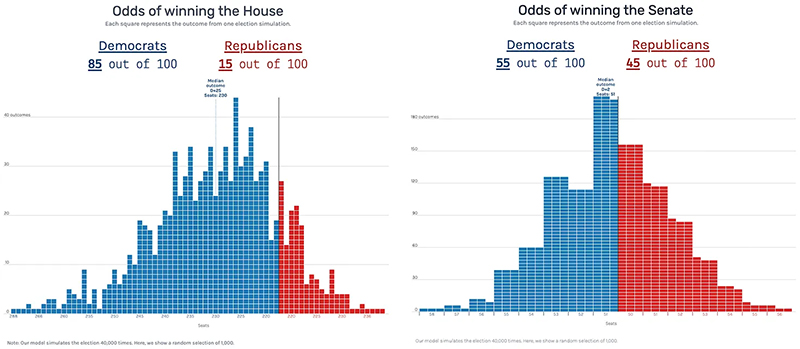
These are the results of 40,000 probability-based simulations. In 85% of the runs, the Democrats controlled the House. In 55% of the runs, they controlled the Senate. The odds of winning both are 50-50, a true tossup. One of the most important factors is the national popular vote (NPV) for Congress. If Democrats win by less than 4%, they are unlikely to win either chamber. In the 4-7% range, they will probably win the House and lose the Senate. If they win the NPV by at least 7 points, they will probably win both. Currently they are roughly at D+8 in the generic House poll, which is a rough predictor of the NPV. Of course, each (Senate) election has its own quirks due to the candidates' campaigns, mistakes, scandals, funding and so on that models can't fully capture. Morris is going to run the model regularly going forward as new Senate polling comes in, the fundamentals (e.g., Donald Trump's approval) change, and the handicappers change their predictions based on all the many factors they consider. The idea is to factor as much available information as possible into the models. The tricky part is to figure out how to weight each piece. (V)
Bank Closed Hundreds of Trump's Accounts on Account of Money Laundering
We mentioned this as a Political Byte earlier this week, but the story has developed to the point that it's worth taking a closer look. In 2021, Capital One Bank closed 385 bank accounts owned by Donald Trump and his companies. When Trump sued the bank, the bank responded that it did this to comply with laws banning money laundering, although the bank was careful not to directly accuse Trump of anything. Instead, the bank said: "The closures were the result of months of analysis and a careful review by Capital One's Anti Money Laundering (AML) team in accordance with bank policies and regulatory guidance." In other words, the accounts were being used for money laundering, but the bank couldn't pinpoint who was using Trump's accounts. Maybe it was a hacker or the money laundering fairy.
For what it is worth, Donald Trump Jr. once said: "In terms of high-end product influx into the US, Russians make up a pretty disproportionate cross-section of a lot of our assets." It is well known that Russian oligarchs skim money from the companies they control and move billions through banks in tax havens like Cyprus, the British Virgin Islands, and the Cayman Islands. Shell companies then use these funds to buy luxury real estate, sometimes in actual cash. A standard briefcase can easily hold $1 million in benjamins. A large suitcase can hold 50,000 bills worth $5 million total. U.S. currency weighs exactly 1 gram per bill, so such a suitcase would weigh 50 kg (110 pounds). Flying with four such suitcases would not work at all on commercial airlines, so it is better to use your own plane when transporting $20 million in cold, hard cash. Once an oligarch owns a fancy condo, he can sell it openly and deposit the proceeds in a normal bank account. Then the money can be used for other purposes and if anyone asks where the money came from, the answer is: "I sold my luxury condo."
Why did Capital One close Trump's accounts? Maybe it was related to the bank being fined $390 million just months earlier for not having effective anti-money laundering detection and enforcement. That might have been the trigger to start looking very carefully at accounts with unusual transactions involving large amounts of money. The bank did not disclose that it had closed Trump's accounts until Trump sued the bank. Then it had to respond in court. If Trump hadn't sued, only he and the bank would have known about this and not the general public (and a future Democratic AG). JPMorgan Chase also closed Trump's accounts and he sued it as well, so they also disclosed the closures in court.
Both banks deny the closures were for political reasons. They say they do this for legal reasons or to protect their reputations when necessary, but not for political reasons.
On August 7, 2025, Trump signed an XO 14331 whining about how conservatives have been debanked. It goes on to ban banks from debanking someone due to "reputational risks." In other words, a bank can now close someone's account only when it has hard evidence that the account was used to commit a crime. For example, if a bank's software flags an account because massive amounts of cash are being deposited regularly (a common sign of money laundering), the bank can no longer defend itself by saying keeping this account would hurt its reputation. After all, a well-run hamburger stand in a good location might take in millions in cash every week. The XO goes on to say that the bank regulators are instructed to examine cases where someone has been debanked, and if it was due to political reasons, to fine or otherwise discipline the banks. In a narrow sense, this is a legitimate XO: It gives instructions to federal bureaucrats how to interpret some regulation(s). In contrast, XOs cannot order state election officials to do anything or contradict the U.S. Constitution. (V)
Maryland Passes a Bill to Enable a Democratic Shutout
Democrats control seven of the eight House seats in Maryland. But given the fact that the Republicans are trying to squeeze every bit of juice out of the orange, Marylanders have decided they want MD-01—the seat of Andy Harris (R-MD) on the Eastern Shore—as well. For technical reasons, they couldn't do this in 2026, so they are starting the process to draw a map for 2028 that will shut out the Republicans altogether. Shutouts are not unusual. Twenty-one states have them, including the six states with only one representative, which are automatic shutouts.
On Tuesday, the Maryland House passed H.B. 2100 and sent it over to the state Senate. Yesterday the state Senate also approved it. Under Maryland law, the governor's signature is not needed for constitutional amendments. The governor also has no veto power over constitutional amendments proposed by the legislature. Republicans are sure to challenge the bill in court, however.
Now the measure will be put on the Nov. ballot this year. The measure does not create the gerrymander. It gives the legislature the power to draw a new map now, so in January it will get to work and Harris will be out of a job in Jan. 2029.
It is very likely New York will also draw a new map for 2028 and California may draw an even more aggressive map. We are heading toward a model where every state with a trifecta shuts the other party out. There are 9 states without a trifecta, so they will have (somewhat) competitive elections. These states, at least at the moment, are AK, AZ, KS, MI, MN, NV, NC, PA and WI. After the November elections, it is possible that Democrats get the trifecta in AZ, MN, NV, and PA. Wisconsin is a long shot for Democrats. Republicans might get it in Kansas. In the worst case, it could be Alaska (which has a strange coalition government) and North Carolina as the only states with mixed government. House elections are becoming the Electoral College: it's all or nothing.
The voters absolutely hate this kind of stuff. This means that if the Democrats get the national trifecta in 2029, they might be able to pass a law ending gerrymandering in one form or another. Republican politicians might not object if they see California and New York wiping out all their seats and they know the voters really want this nonsense to stop. (V)
DCCC Expands the Map
Chair Suzan DelBene of the DCCC has expanded her target list for 2026. She added a dozen red districts that Donald Trump won by double digits in 2024. The lady definitely likes to roll the bones. Here are the new targets:
| District | Incumbent | Trump '24 margin | PVI |
| CO-03 | Jeff Hurd | 9.7% | R+5 |
| NY-01 | Nick LaLota | 10.0% | R+4 |
| NE-01 | Mike Flood | 13.0% | R+6 |
| NV-02 | Open (Amodei) | 13.9% | R+7 |
| TX-23 | Vacant | 14.8% | R+7 |
| FL-12 | Gus Bilirakis | 15.3% | R+17 |
| AR-02 | French Hill | 15.5% | R+8 |
| NC-09 | Richard Hudson | 15.9% | R+8 |
| IN-05 | Victoria Spartz | 16.8% | R+8 |
| CO-04 | Lauren Boebert | 18.3% | R+9 |
| NY-21 | Open (Stefanik) | 20.7% | R+10 |
| TN-09 | Open (Cohen) | 21.1% | R+9 |
Remember, this is not just a wish list. It means she is going to spend money in these quite red districts. Given a finite amount of money, this means less money for EVEN to R+3 districts. She must be very confident that the easier districts won't take much money. Maybe she has seen polling showing her earlier targets already going down, so she feels free to go after much more difficult targets, even though that means less money for the purple-red districts. If she guesses right, she will be the GOAT of the Democratic Party. If she guesses wrong and some of the Democrats in the EVEN to R+3 districts lose, she will be the goat of the Democratic Party.
One cautionary tale here comes from 2016. Hillary Clinton spent time campaigning in Arizona, which was a red state then. This was an audacious move. But she didn't bother to campaign in Wisconsin at all, assuming it was in the bag. The bag had a hole, though, and Wisconsin fell out.
It is also possible that DelBene doesn't really think she can knock off, say, Lauren Boebert. She might just be playing mind games with Richard Hudson, who is chair of the NRCC. By suggesting that she is going to spend money to go after this dirty dozen, that could trick him into wasting money to defend seats that she really isn't going to target. On the other hand, he could be thinking "She is trying to trick me, I'm not going to fall for it" and not spend money there, only to later discover that she did go after those seats aggressively. Of course, a huge amount depends on how much money falls to the ground when DelBene shakes the money tree. Unlike the hapless Ken Martin at the DNC, DelBene is pretty good at this. She ran the DCCC in the 2023-2024 cycle and snagged $320 million. That is more than the DSCC ($276M), the NRSC ($297M), and the NRCC ($255M). This is why she got a second term running the DCCC: She's good at it. And Democrats are even more fired up now than in 2024. Also, all the news about the disaster at the DNC probably isn't going to dampen Democratic enthusiasm. It will simply redirect donations to the DCCC, the DSCC, and individual candidates.
DelBene probably saw the generic House poll from CNN/SSRS. Generic Democrat beats a generic Republican by 8 points. If that is still true when voting starts, then R+5, R+6 and maybe even R+7 districts are worthwhile targets, depending on how good the Democrat is and how bad the Republican is. Flipping an R+8 district with an 8-point lead is touch and go, but not out of the question. It is a gamble. Of course, if the Democrats' lead in the generic poll grows to 9 or 10 points, then Katie bar the door. There are 80 House districts held by Republicans that are R+9 or bluer. If the generic poll grows to D+10, many of those will be swept away easily and all of them will be competitive. (V)
Democrat Quits Race, Thus Improving Odds for the Democrats
On Monday we had an item about the four Senate elections where there is a serious independent candidate—basically, a Democrat in sheep's clothing (organic wool, of course). In three of the states—Idaho, Nebraska, and now South Dakota—the official Democratic candidate has dropped out. This paves the way for independent candidates who are likely to caucus with the Democrats, but don't have the toxic (D) label.
The most recent Democrat to see the writing on the wall is Julian Beaulion in South Dakota, who had no chance whatsoever against Sen. Mike Rounds (R-SD). Independent Brian Bengs has a steep uphill climb, but probably will do better than Beaulion would have. The problem is that many, many voters think the Democrats want to open the border to all comers, abolish the police, and allow schools to turn boys into girls without even informing their parents. The vast majority of Democrats do not support the first two and no Democrat supports the third one, but that simply doesn't matter. Voters heard it on Fox "News" and that is all that does matter. Some Republican voters agree with the Democrats on specific issues, especially corruption, health care, inflation, protecting Social Security, universal pre-K education, the economy, caring for veterans, and more. If 20% of Republicans in a state will vote for an independent they agree with on the issues and half the independents do, too, along with all the Democrats, it could be possible for a clever independent who simply refuses to talk about all the hot-button issues to win in a red state. The real problem for Democrats is not all the issues (although some are deadly) but that the Democratic label has become so poisonous in red states.
This said, in the one state where the independent has by far the best chance—Montana—the Democrat has not dropped out, even though her chances in a three-way race are essentially zero. Alani Bankhead (D) has until Aug. 10 to drop out, but it appears she will hang on (unless God sends her a message this weekend), thus guaranteeing that Kurt Alme (R) will be elected to the Senate. She is against the Iran war, against Israel, against data centers, against ICE, against AI companies, and for foreign aid, for rural hospitals, for LGBTQ+ rights, for tribal nations, and for Congress taking back the power to declare war. The whole nine yards. There is nothing in her platform Bernie would disagree with. Only by running, she is guaranteeing that the next senator from Montana will be for the first list and against the second list. The independent in the race, Seth Bodnar, whose positions closely mirror those of a generic Democrat, stands a much better chance of beating Alme. Is Bankhead stupid? No, she has a B.A. from Penn State and a Masters from Troy University. But she is as stubborn as a donkey. That's why she is a Democrat, of course. In a three-way race, ranked choice voting is really needed, but in Montana, it is first-past-the-fence-post. Many candidates like her see the Democratic Party as the real enemy, not the Republicans. She may believe that candidates like her may not be able to make the Democrats win but they can make the Democrats lose, thus making it possible to hold them hostage.
Will the DSCC do oppo research on her and try to run a scorched earth campaign against her if they can find some dirt? It is not their style, even if this is a winnable race if they can make her toxic with Democrats as well as Republicans. In retrospect, the DSCC probably knew about Bodnar's plans well in advance because it was former senator Jon Tester who advised him to run as an independent, not a Democrat. The DSCC could have put up and financed a straw man or straw woman in the Democratic primary, someone they knew would drop out at the end. But they think politics is beanbag. (V)
Who Will Be the Next Bernie?
There has been endless discussion in the media about the question: "After Trump, what?" but less about "After Bernie, what?" Sen. Bernie Sanders (I-VT) is the unquestioned leader of Team Lefty. He has run for president twice and has millions of supporters. He is also 84. Will he run for reelection in 2030, when he is 88? It's possible. Strom Thurmond was 93 when he won his final election, but at that point, he barely knew what the Senate was. Bernie is too committed to his movement to let that happen. He will throw in the towel when he realizes he can't lead anymore. So our guess is that he probably won't run in 2030, especially if the governor of Vermont is a Republican. Sooner or later, someone else is going to have to carry the baton.
Sen. Elizabeth Warren (D-MA) might be a suitable replacement as the leader of the movement, were it not for her age. She is 77. Also, she isn't as fiery as he is and isn't as good at working crowds into a frenzy. Her strength is actually legislating. If the Democrats get the trifecta in 2029, she will be too busy writing bills to have time to run a movement.
Nevertheless, the succession struggle is already on. The main contestants are Reps. Ro Khanna (D-CA) and Alexandria Ocasio-Cortez (D-NY). They have different strategies. Khanna goes everywhere. He never stands still. If any Democrat, anywhere, wants him, he goes there and does his best working crowds, raising money, whatever is needed. He has won a lot of friends that way. Every Democrat knows they can count on him. This also gives him many contacts for an expected potential 2028 presidential run.
AOC is different. She doesn't do that. She is also more selective about endorsements, even for progressive candidates. Like Donald Trump, she cares about her batting average. Some progressives find her too cautious. Her caution kept her from endorsing Graham Platner, something Khanna wholeheartedly did and now regrets. Both of them supported Abdul El-Sayed, but in different ways. Khanna helped El-Sayed raise money. AOC actually stumped with the candidate.
If Khanna runs for president in 2028 (likely) and AOC does not (because she decided to run for the Senate), that does not automatically make him the next Bernie, especially if the original Bernie is very much alive and active.
Insiders say that Sanders and AOC share a deep personal bond. They have held rallies together many times and they clearly like each other a lot. It is more than ideology. They are now also working together on legislation addressing AI. They want to slow down the construction of data centers. That is a very smart issue to own as the majority of voters in both parties want that. It is going to be a big issue in 2026 and an even bigger one in 2028.
Khanna's big issue is getting all the Epstein files out there and helping the victims. Neither Sanders nor AOC have been leading that battle.
Most people close to Sanders think AOC is the heir apparent. It's more than just policy. It is also who he thinks can rouse crowds. AOC has proven she can do that. Also, Democrats want change and a 36-year-old woman of color is a bigger change than a 49-year-old man, even if he is also a person of color.
Also, this is a situation in which money could play a role, but it cuts both ways. Khanna and his wife have a net worth of about $233 million, making him one of the wealthiest members of Congress and the second wealthiest from California, after Darrell Issa, whose $282 million fortune came from those annoying car alarms. Khanna's money comes from his wife's father, Monte Ahuja, who is a wealthy automotive parts executive. This money could allow Khanna to self-fund early 2028 primaries. On the other hand, many Democrats will have a lot of trouble trusting a guy worth north of $200 million to take on the billionaires. In contrast, AOC's net worth is $49,000. She is proletariat-adjacent. No one doubts her willingness to tackle the billionaire problem. (V)
Christian Ministers Are Running for Office--as Democrats
Wannabe U.S. Senator from Texas James Talarico may be onto something. A number of Protestant ministers are running for public office this year—as Democrats. It is not a flood, but Democrats are coming to realize that white Christians may be gettable with Bible-quoting candidates who actually understand Jesus' teachings and are on His side. Turns out He didn't spend his time railing about who should play on which high school soccer team—possibly because soccer wasn't going to be properly invented until 1863 (although mobs kicked skulls around earlier than that).
Case in point: Sarah Trone Garriott, who is running for Congress in IA-03, an R+2 district, against Rep. Zach Nunn (R-IA). She is an ordained Lutheran pastor and state senator. She says: "Politics is just about how we live together, and so is faith."
Garriott isn't the only minister running for Congress in Iowa. Presbyterian minister Lindsay James is running in IA-02, the open district Rep. Ashley Hinson (R-IA) is vacating to run for the Senate.
In the recent past, Democrats just ceded religious white voters to the Republicans, but if Talarico, Garriott, and James win (or even come very close), that could really change things. Some on the religious right are just right wingers who use religion as a cover, even though much of what they want violates everything Jesus preached about. They don't care because, for them, politics trumps religion. But that is not everyone. Remember, most white evangelicals avoided politics like the plague until Jerry Falwell launched the Moral Majority in 1979. As late as 1976, half of all evangelicals voted for one of their own in Jimmy Carter.
There are two ordained ministers in the Senate: Baptist ministers Raphael Warnock (D-GA) and James Lankford (R-OK). Warnock likes to say: "You can't pray with your neighbor and then prey on your neighbor." There are three ordained ministers in the House: Methodist minister Emanuel Cleaver (D-MO), Baptist pastor Mark Harris (R-NC), and Protestant pastor Tim Walberg (R-MI). (V)
Previous | Next
Main page for smartphones