Previous | Next
DeSantis Could Meet His Waterloo Tonight
Waterloo is a small city of 67,000 located 90 miles northeast of Des Moines. Here it is on the map:
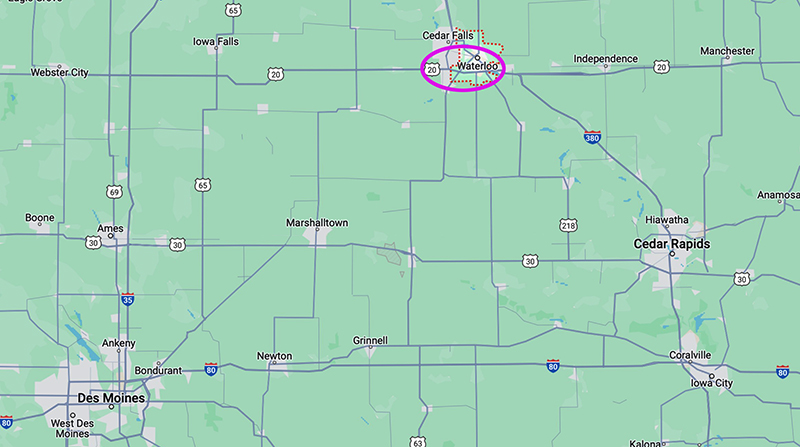
Gov. Ron DeSantis (R-FL) has been there, as he has visited all of Iowa's 99 counties and Waterloo is the most populous city in Black Hawk County. Unfortunately for him, it is also one of the bluest counties in the state and has been so for decades. So his visit was quick and pro forma, just to check a box on the way to somewhere more promising. But tonight he is likely to meet the other Waterloo—you know, the place in Belgium that Napoleon visited on June 18, 1815, and was later quite sorry he did, since that was the end of the line for him.
Everyone was waiting for Ann Selzer to release her final poll of tonight's Iowa caucuses. She is considered the best Iowa pollster in the business, but even she gets it wrong sometimes. And the very cold temperatures expected for tonight could also impact turnout (and her prediction). On the other hand, the expected blizzard doesn't seem to have materialized, with the forecast now being for very cold temperatures (ca. -6F) but no blizzard for most of the state.
Here are her results: Donald Trump 48%, Nikki Haley 20%, and Ron DeSantis 16%. If Trump gets 48%, that will be the highest score for a non-incumbent Republican ever. Even more important is that Selzer has DeSantis in third place.
According to Rich Lowry, the editor of the National Review and a guy well steeped in Republican politics, unless DeSantis stuns everyone tonight with a powerful second-place finish (assuming Iowa can count the caucus votes correctly, something the state is not especially good at) DeSantis is done. You can stick a fork in him. If he can't win a state jam-packed with evangelicals—whose leader, Bob Vander Plaats, supports him, as does the state's governor, Kim Reynolds (R)—how is he going to do next week in New Hampshire, a state full of crusty Yankees who don't like him and whose governor, Chris Sununu, has endorsed Nikki Haley? It's do or die for Ron tonight. Maybe the cold weather will keep the Haley voters home, but they tend to be affluent suburbanites who understand the stakes, so maybe not.
The path is important. If Haley comes in second to Donald Trump tonight, she will have the Big Mo going into New Hampshire, a state where she is already nipping at Trump's heels. A bit more momentum courtesy of Iowa could put her over the top in the Granite State. Aforementioned crusty Yankees just love telling those Iowa evangelicals, uh, nope. As in, nope to Sen. Ted Cruz (R-TX) in 2016, nope to Rick Santorum in 2012, and nope to Mike Huckabee in 2008, despite their respective wins in Iowa. In none of those years did the winner of the Iowa caucus win New Hampshire. In fact, in all three of those years, the winner of New Hampshire, not the winner of Iowa, went on to win the Republican presidential nomination. New Hampshire is a good bellwether whereas Iowa is a terrible one. Sorry, Iowans.
If DeSantis does poorly tonight, his prospects in New Hampshire next week are lousy, his prospects in the Nevada caucuses on Feb. 8 are very poor and his prospects in the South Carolina primary on Feb. 24 are truly dreadful, assuming he is still in the race then. DeSantis hasn't campaigned much in Nevada and Trump leads him there by 65 points. A recent Emerson poll there has Trump at 73% and DeSantis at 8%. For some reason, the pollsters forgot to ask about Haley. Silly of them. South Carolina is Haley's own state and she is sure to come in second. It's do or die in Iowa for DeSantis. Lowry thinks that if DeSantis does really poorly in Iowa tonight, he'll drop out before the end of the week. (V)
Hogan Endorses Haley
Former Maryland governor Larry Hogan has endorsed Nikki Haley on the eve of the Iowa caucuses. He said she would be the strongest Republican candidate in the general election.
Endorsements rarely matter much. It is unlikely that a single Iowa voter who was planning to vote for Donald Trump or Ron DeSantis tonight will now switch to Haley on account of Hogan's endorsement. Most of them probably won't even know he endorsed Haley. Nevertheless, we think this could be important news. Hogan was recently associated with the No Labels group but left last week. Some people have been interpreting his departure from an administrative position there as a sign that he might be their candidate. Endorsing Haley could be a sign that he is not going to be their candidate, since he is supporting someone else.
But maybe if Trump is later the nominee, Hogan could say: "I supported Haley but she didn't make it. I don't want Trump to be president, so I guess I have to run myself to stop him." On the other hand, he is probably aware that the kind of voter who might be attracted to No Labels is a traditional Republican who hates Trump and absent an alternative would grudgingly vote for Joe Biden. Thus by running, he would actually help Trump. Could someone who hates Trump and is actively supporting a different Republican for the GOP nomination turn around and then do something to help elect Trump? It seems unlikely to us, but who knows. Draw your own conclusions from this endorsement. We can't make a lot of sense out of it other than he really wants Haley to be the Republican nominee and will not do anything that later de facto helps Trump. But we aren't even sure if we believe this. If Hogan really wants to help Haley, he should have endorsed her months ago. It's all very strange.
Also on the Haley front, the candidate said yesterday that she is not interested in being anyone's running mate. Just before the voting starts, that is a good thing to say. But sometimes things change later on and folks who say that sometimes reconsider. (V)
Johnson is Now Fighting a Two-Front War
Speaker Mike Johnson (R-LA) may soon wonder why he took his thankless job. Democrats hate him but so do many of his fellow Republicans. What's a guy to do? First, he just reiterated that he plans to stick to the funding agreement he recently made with the Democrats, which was only marginally different from the one former speaker Kevin McCarthy made with Joe Biden last year. If it passes, the government won't shut down. The Freedom Caucus members have gone bananas over this agreement because it includes almost none of their priorities. Rep. Scott Perry (R-PA) said: "We would like to see much lower numbers—obviously, we're bankrupting the country. And we would like to see the border made an issue in this. Actual border security, not just laws that are going to be ignored." Perry and others have urged Johnson to rip up the agreement and start all over. The Speaker has refused to do that, in large part because there is no time left. Funding for part of the government runs out on Friday. Also, many other House Republicans, especially those in swing districts, do not want a shutdown because they know they will get blamed for it.
Time to kick the can down the road again, as usual? Johnson is starting to talk about it. Maybe he thinks all the problems will vanish when the snow melts. We're not convinced delay is going to solve them. It is possible that he can pull off another delay—although the Freedom Caucus members are very strongly opposed to that. But when that delay has run out, then what? Delaying doesn't change any of the underlying dynamics.
In order to get the funding bill passed, Johnson needs to get a lot of Democratic votes. This is where the second front comes in. He can't be sure of those votes because he is fighting with the Democrats on aid to Ukraine. Johnson wants to keep aid to Ukraine as a hostage unless the Democrats agree to tough measures on the Mexican border. These include building a 900-mile wall on the border and a reimplementation of Donald Trump's policy of making would-be immigrants remain in Mexico while their cases are being heard (which can take years). Democrats are strongly opposed to wasting billions of dollars on a wall that is good for photo-ops but little else because they have been tipped off about Mexico's new technology for dealing with annoying walls. The Mexicans are calling it "ladders." When asked about the Republicans' plans for the border, Rep. Juan Vargas (D-CA) said: "That's a non-starter for me, and I think for most of us." Rep. Raúl Grijalva (D-AZ), the ranking Democrat on the Homeland Security Committee, said: "I don't think it is realistic."
Johnson is in a bind. If he insists on the border measures, the Democrats won't vote for his budget deal and he doesn't have enough Republican votes to pass it without them. Then the government will shut down and the Democrats will yell: "You have the majority. It is your responsibility to get keep the government functioning." If he gives in to the Democrats and brings the Ukraine funding bill to a vote, it will pass with mostly Democratic votes and a handful of Republican votes, in which case he might face a motion to vacate the chair. This is the situation McCarthy found himself in before he was fired. In the next week, we are (probably) going to find out what kind of stuff Johnson is made of. Unless he punts and we don't find out for another month or two. At some point he has to make a decision. This can't go on forever.
However, Democrats are also looking at another option. Joe Biden is examining the possibility of having $300 billion in Russian assets in the G7 and E.U. countries seized and diverting them to help Ukraine. Other countries would have to agree and Congress would have to pass a law allowing this for Russian assets in the U.S., but it wouldn't be spending U.S. taxpayers' money, so it might have a greater chance of getting the three Republican votes needed if the bill came up for a vote. (V)
Breaking News: The 2020 Election Is Over
In the weeks after the 2020 election that he lost, Donald Trump told his supporters that the election was "a long way from over." He filed lawsuits hither and yon, telling state and federal courts that he was suing in his capacity as a political candidate, not as an incumbent president. Now he has changed his tune and is saying the exact opposite. He now claims the election was over and he filed the lawsuits in his capacity as president trying to oversee fair elections. Hint: It's not the president's job to oversee elections; elections are run by the states.
The problem here is that this new position directly contradicts numerous legal filings made in 2020 in which he said he was filing as a candidate. Even after the votes had been counted and certified, Trump continued to file lawsuits claiming he was a candidate.
At the moment, Trump is engaged in a legal battle claiming, as Nixon did, "when the president does it, it is not illegal." He is trying to stop the federal trial scheduled for March 4 in its tracks by claiming that riling up the mob at the Capitol was an official act of the sitting president and thus not a crime. But in the 2020 filings, he claimed that and related acts were simply him as a candidate fighting for his rights as a candidate.
This inconsistency has not gone unnoticed. In a December ruling, the U.S. Court of Appeals for D.C. noted that all the court cases Trump started in 2020 relating to the election results were done in his capacity as a candidate, not as the incumbent president. This would mean his claim to immunity and the request to throw out the federal case are both invalid. To bolster his sudden revelation that the 2020 election is over, last week he posted a video to his failing boutique social media site claiming that by Jan. 6, 2021, "The election was long over. I wasn't campaigning. I was just doing my job. I am entitled to immunity."
It is now convenient that the Trump fighting the election results in 2020 was President Trump, not candidate Trump. Unfortunately, his own lawyers didn't see it that way. For example, John Eastman has produced an unsigned engagement letter written by the campaign and dated Dec. 5, 2020, which characterized Eastman's legal services as work for Trump the candidate, not Trump the president. The letter drafted by the campaign contains the sentence: "This client relationship includes President Donald J. Trump in his capacity as a candidate for elected office." If this is true, Trump's efforts to block the election results were not part of his job as president, he is not immune, and he will have to stand trial on March 4.
Oral arguments were held last week, but the paper trail is not encouraging. The judges now have to determine if everything Trump did to stay in power after the election was part of his job as president or was part of his effort as a candidate, and whether that finding also determines his immunity from prosecution. Recent attempts to switch his position are not likely to fool the judges. A decision is expected very soon. (V)
Does Trump Own the Legal System?
What happened in Room 300 of the New York County Courthouse last Thursday has completely upended 2½ centuries of legal tradition in the United States. Normally, defendants do not get to bully judges and the legal system and get away with it. The most vulnerable person in the room, Donald Trump, was dominating the process and getting away with it—at least for the time being. Trump savaged the judge, the court, and NY Attorney General Letitia James. Judge Arthur Engoron pleaded with him to stop ranting, but Trump kept on going. Any other defendant who pulled that sh** would be given an invitation he couldn't refuse to spend the evening (and a few more) at lovely Rikers Island. But Engoron didn't want to risk giving Trump a basis to win an appeal, so he just bit his tongue and put up with it.
While this case is new, for 50 years Trump has used and abused the legal system to his advantage. Legal battles for him are not a cost of doing business, they are how he does business. He has used the courts for both offense and defense, thousands of times, over the decades. The courts have become his primary business tool and the entire legal system has no way to stop him. He has become a master at managing the law, rather than the law managing him.
Rep. Eric Swalwell (D-CA), a former prosecutor and Trump impeachment manager, said: "There's probably no single person in America who is more, I would say, knowledgeable and experienced in our legal system—as both a plaintiff and as a defendant—than Donald Trump." Trump's experience managing the legal system goes back to at least 1973, when the federal government sued Trump and his father, Fred Trump, for racial discrimination in renting the apartments they owned in Queens. He learned from the notorious Roy Cohn how to manipulate the system's near sacrosanct protections for the rights of defendants and rules for due process to his advantage. In reality, the system depends as much on good faith on the part of all parties rather than rigid rules. Trump realized early on that he didn't have to operate in good faith and how that could help him.
Conservative former appellate judge J. Michael Luttig recently said: "He has attacked the judicial system, our system of justice and the rule of law his entire life. And this to him is the grande finale." Paul Rosenzweig, an assistant secretary of DHS during George W. Bush's administration, said the election isn't a referendum on Joe Biden or Donald Trump. It is "a referendum on the rule of law." But maybe it is too late. Democracy can't function if half the country doesn't believe in it any more. What if Trump is convicted and wins anyway?
Trump learned well from his mentor, Cohn, the top attorney for the red-baiting Sen. Joe McCarthy. Cohn didn't pay his bills. He didn't pay taxes. He won cases by delays, evasions, and lies. Like Trump, he was indicted four times, but for bribery, extortion, obstruction of justice, and filing false reports. He delayed and delayed and delayed more and was never once convicted. He was a bully and a scoundrel. All he did was attack, attack, attack. Trump marveled as he got away with everything; he learned the ropes from Cohn.
In the 1980s, Trump bought a team in the United States Football League and sued the NFL. He sued the architecture critic of the Chicago Tribune. He sued New York businessmen Jules and Eddie Trump for daring to be called Trumps, even though they were richer than he was. That case went on for 5 years. Trump bought a building on Central Park South to turn it into a fancy condo building, but first he had to get rid of the tenants in rent-controlled apartments. He sued one tenant for not paying his rent even though he had. He turned off the hot water and heat. He allowed homeless people to live in vacant apartments and put up tin windows on empty apartments to make the building look shabby so the tenants would leave. The tenants sued him, so he countersued, calling the tenants racketeers. He sued their lawyers, so they had to hire lawyers. Trump saw the way to beat these people was not on the merits of the case because there were no merits. He waged his battle in The New York Post before he even went to court. He eventually prevailed because his opponents gave up due to the cost of all his lawsuits.
After Trump bought Mar-a-Lago, he sued Palm Beach County because planes from Palm Beach Airport (which was there before he bought the property) were disturbing his rest. The County sued him back. At the time, commission chairman Ken Foster said: "I think it's ridiculous Mr. Trump has taken on the taxpayers of Palm Beach County, thinking his pockets are deeper than ours." That is exactly what Trump was thinking. He thought the County would conclude changing the flight patterns in and out of the airport would be easier and cheaper than years of litigation. He knew he could just wear them down. And he was right. Not only did the County change the flight patterns, but it also gave him a cheap 30-year lease on the land that his golf course now occupies.
Trump has also sued authors of books critical of him. In 2013, when then-NY AG Eric Schneiderman sued Trump University for bilking its students, he countersued Schneiderman for $100 million. And much more. He's been doing this for 50 years. Read the article linked to above if you want more details. Many more details.
Jim Zirin, author of Plaintiff in Chief: A Portrait of Donald Trump in 3,500 Lawsuits, said: "He learned that the evidence can be irrelevant, the law doesn't matter, and the government's mission doesn't matter. You could use the law to bend circumstances to your will." Zirin also said the greatest danger is not a Muslim ban or tax breaks for the rich or disengaging from NATO. He said: "The greatest danger is his undermining the rule of law. Given 50 years of winning this way, is it surprising that Trump attacked a judge who could fine him $370 million or more, ban his company from operating in New York State, and force him to dump all his properties there at fire-sale prices? That is how he has operated his whole life and it has always worked. Why change now?" (V)
Did Trump Dodge All the Bullets?
From the above item, you can see that Donald Trump uses the courts as a key business tool. Court cases are not something to be avoided. They are an important part of how he does business. His strategy is not to use the facts and not to use the law but to manipulate the system. The key to his success is simply delaying all cases indefinitely hoping to either wear down his opponents until they give up or in some cases drag things out so long that maybe he gets lucky and then grabs the luck and runs with it.
With this in mind, let's look at the four criminal cases where he has been indicted. How's that working out? Please keep in mind, Trump is not trying to win these cases in the conventional sense. He is trying to delay the trials until after the election, pardon himself in the federal cases and intimidate the prosecutors into backing down in the state cases. From most serious to least serious, here we go.
- Jan. 6 Insurrection Case in D.C.: Special Prosecutor Jack Smith is brilliant at what he
does and has the facts, the evidence, and the law on his side. So is Trump in trouble here? Maybe. Trump has gone full
Nixon and said: "When the president does it, it is not illegal." At the appeals court oral arguments last week, when his
lawyer was asked: "If the president orders a political opponent assassinated and then resigns before the House can
impeach him, does he get off scot free?" The lawyer said: "Yes." The three judges did not seem impressed and we wouldn't
be surprised if they rendered a verdict as early as this week stating that ex-presidents are not "immune" to prosecution. Trump
will likely respond to that by either asking for an en banc hearing at the appeals court or appealing to the Supreme
Court. The Supreme Court could delay the oral hearings for months due to its busy schedule and by the time it upheld the
appeals court, it could be the fall and then a trial of the Republican presidential candidate in the heart of election
season would be unseemly, so it would probably get delayed until December. If Trump were to win the election, he would
pardon himself and escape punishment. Of course, it is also possible that John Roberts has finally had enough of Trump,
schedules the case quickly, and rules "No, ex-presidents are not immune from prosecution."
- Documents Case at Mar-a-Lago: Trump lucked out here and got a judge, Aileen Cannon, who
is in the tank for him. It has probably occurred to Cannon that if she delays the case until after the election, Trump
will probably actually be grateful. He's not grateful much, but this is a real biggie. She might well be dreaming of an
appointment to the U.S. Court of Appeals for the Eleventh Circuit if a vacancy comes up during a Trump administration. In
fact, we wouldn't even be surprised if some intermediary whom Trump knows well and trusts whispered that in her ear.
- RICO Case in Georgia: Fulton County D.A. Fani Willis is very smart and possibly
simultaneously stupid beyond all belief. She has a really strong case against Trump, Rudy Giuliani, and some lesser
lights. She has the facts and evidence and the law on her side. She was assigned a judge who appears to be honest and
serious. Oh, and in Georgia state courts, cases can be televised if the judge approves and Judge Scott McAfee frequently
allows his cases to be televised. So Trump is toast, right?
Maybe not. Fulton County has the largest staff of any judicial circuit in Georgia, stocked with experienced prosecutors on the payroll. The RICO case Willis has brought is complicated, but she and her staff have handled big RICO cases before. Now one of Trump's co-defendants in the case, Michael Roman, has filed a request to have Willis taken off the case because he claims she hired her boyfriend, Nathan Wade, as lead prosecutor and paid him nearly $700,000 in billable hours for his work on the case. The day after Willis hired Wade, he filed for divorce from his wife of 24 years. The divorce case has been exceedingly acrimonious and Wade may have violated a court order in the divorce case.
Wade is a member of the Georgia bar but he is not a prosecutor and Willis' office has plenty of experienced prosecutors. Hiring an outside prosecutor is not unheard of, but hiring an inexperienced one when the office has plenty of experienced ones on staff is unusual. If Willis is indeed having an affair with Wade, it will be tough for her to continue as prosecutor. Then either another prosecutor from her office would take over, or Georgia AG Christopher Carr (R) could take over himself. In any event, Willis' replacement would certainly delay the trial from August to after the election. What is worrying here is that Willis did not instantly denounce the allegation by saying that she does not and has never had a romantic relationship with Wade. She said she will reply to the allegations in court filings. Maybe this is just smoke and there is no fire, but we would have been happier if she had publicly refuted the allegations immediately, or better yet, sued Roman for defamation. If it is not already part of the standard law school curriculum, this might be a good time to add a bit about prosecutors not hiring their boyfriend/girlfriend to work for them on major cases, even if they are really, really, really good (which Wade is not). If the allegations are true and Willis is removed, Trump might even do the unthinkable and go to church to thank Jesus for getting him out of a real jam here.
- Hush Money Case in New York: This is the case about Trump paying Stormy Daniels and Karen McDougal money to keep quiet about their 1-night and 9-month affairs, respectively. There is nothing illegal about buying the exclusive rights to someone's story. The problem is that Trump reported it falsely, violating New York State law about business records. If Trump's campaign had simply "hired" them as "consultants" and paid them as such from campaign funds, it would have been perfectly legal. Trump's lawyers are going to emphasize that buying their silence was perfectly legal and paying them from the wrong pot of money was a simple bookkeeping mistake. There is a good chance that at least one juror is not going to think that making an otherwise legal payment from the wrong bank account is such a big deal, state law or no state law. This is by far the weakest of the cases against Trump. Also, two of the lawyers for Trump on the case, Todd Blanche and Susan Necheles, are smart enough to know how to appeal to the jury, law or no law. The third one, Joe Tacopina, is there to bluster about the case on TV, not in the courtroom. Even if Trump is convicted in this case before the election, we suspect that everyone will just write it off as a minor bookkeeping mistake.
If all the stars align right, Trump might well get away with it on all four criminal cases. It's not a given, but it could happen, especially if the Supreme Court takes its time to decide if Trump has more immunity than someone who has had six COVID shots.
The one case where Trump is in deep doodoo is the civil case filed by NY AG Letitia James. Judge Arthur Engoron has already decided that he is liable for defrauding banks and insurance companies. All that is left is for him to decide on how many additional counts he's guilty and then the fine. James is asking for $370 million. Engoron could go with that or throw in another $130 million for punitive damages, rounding it off to half a billion. Or whatever else he wants. Trump will appeal, but this is clearly a state case and there is a good chance that the U.S. Supreme Court will say: "This case is about New York State commercial law and we'll leave that to the New York Court of Appeals to handle." While Engoron can't send Trump to prison, he could whack him with a fine that will really hurt. And unlike the two Georgia poll workers who are never going to get the $148 million Rudy Giuliani now owes them, New York State has the power to seize one or more of Trump's buildings and auction them off. Just imagine how Trump would foam at the mouth at a potential video showing workmen removing the "Trump Tower" sign and replacing it with a "New York State Tower" sign after Engoron seizes it for auction or sale. (V)
Schiff Belongs to the Democratic Wing of the Democratic Party after All
Of the three serious candidates running for Dianne Feinstein's old Senate seat, Rep. Adam Schiff (D-CA) is considered to be the most moderate. In California, that is not a feature. He is now trying to fix that problem. He is running on a platform that should delight progressives up and down the state: getting rid of the filibuster, expanding the Supreme Court, abolishing the Electoral College, ending gerrymandering, making voting easier, allowing ex-felons to vote, universal vote-by-mail, and creating an enforceable code of ethics for the Supreme Court. Schiff said of his new platform: "I think our democracy is at more grave risk now than ever. And it's clear that the issue is going to be front and center—and needs to be front and center—on the national stage."
Schiff is not alone in rolling out a platform ahead of the March 5 all-party primary, but it is far more ambitious than his opponents' platforms. Rep. Katie Porter wants to shake up the Senate by banning earmarks and prohibiting trading in individual stocks by members and their families. That's small potatoes compared to eliminating the Electoral College. Rep. Barbara Lee (D-CA) has touted her support for a ceasefire between Israel and Hamas. While that may get her some votes from young progressives, that is not exactly a formula for safeguarding American democracy.
This is not Schiff's first attempt at shoring up democracy. In 2020, he sponsored the "Protecting Our Democracy Act," which would bolster Congress' ability to enforce subpoenas, limit the presidential pardon power, and strengthen whistleblower protections. It passed the House in 2021, but stalled in the Senate. This led him to conclude that bigger changes are needed, hence his new platform.
Eliminating the filibuster might not be the best way to attract Democratic votes right now since there is a substantial chance the Democrats will be in the minority in the Senate in 2025, in which case the filibuster might come in handy, especially if the Republicans capture the House and presidency.
Current polling has Schiff ahead, with the two women and Republican Steve Garvey in close contention for the second slot in the November general election. Schiff also has far more campaign money than any of his rivals. He has $32 million. Porter has $12 million, and Lee has $1 million. Schiff and Porter are now starting major ad campaigns in the Bay Area, focusing on women. This weekend, the Los Angeles Times, California's biggest newspaper, endorsed Schiff. The paper said that he stands above the others for his fierce leadership but also his willingness to be a team player when that is needed. (V)
More Decisions about the Fourteenth Amendment
On Friday, the Oregon Supreme Court declined to take up a case where the plaintiff, a group called Free Speech for People, wanted to take Donald Trump off the primary ballot based on the Fourteenth Amendment. The court said it was waiting for the U.S. Supreme Court to rule on the case first. Since the high Court has agreed to take the case, other state supreme courts are also likely to wait as well. There is no point in jumping the gun until it becomes clear what that pesky Fourteenth Amendment actually means.
There has been a patchwork of cases so far, with Trump being disqualified in Colorado and Maine and approved in Arizona, California, Michigan, and Minnesota. To avoid a complete mess, the U.S. Supreme Court had to take the case. It could yet rule that every state can make its own decision, but that seems unlikely to us. More likely than letting each state decide is a "yes, he can run" or "no, he can't run." This is not a case the Supreme Court really wants, so it may try to weasel out of a decision on the merits by finding some technical grounds on which to get rid of all the lawsuits without having to decide whether Trump is an insurrectionist.
In New Mexico, a federal judge has dismissed a lawsuit from one John Anthony Castro, who claimed he was running for president and who wanted Donald Trump removed from the ballot per the Fourteenth Amendment. By claiming he was running for president, Castro had a plausible claim to being injured by Trump being on the ballot and thus getting standing to sue. The judge didn't buy it. He said Castro showed no evidence of running a campaign for the Republican presidential nomination. He hasn't filed to run, raised money, or done the things actual candidates do. Sorry, if you want to get the standing to sue that a candidate would have, you have to be an actual candidate, so no dice. Where is Pat Paulsen when you need him? (V)
Eleven States Will Elect a Governor This Year
With all the attention focused on the presidential race, the Senate contests, and control of the House, the 11 gubernatorial elections aren't getting much love. In a way, they deserve to, even though only two are really competitive. With the federal government perpetually paralyzed and unable to govern, more and more responsibility is devolving to the states, so governors are actually important figures, more so than most senators. They actually have to run a state and get results, not just yell slogans and hide under their desks from time to time.
Eleven states will hold gubernatorial elections this year. That's not as many as the 36 that do it in midterm years, but still enough that it is worth paying some attention to them. Charlie Cook took a look recently, and this is a summary of what he had to say. Here is the map showing the 11 states where, along with Puerto Rico, and American Samoa, gubernatorial elections will be held in 2024.
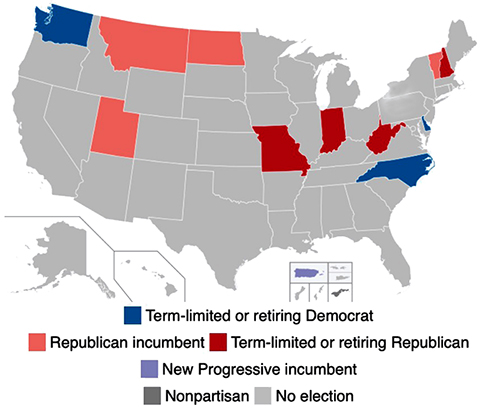
- Delaware: Gov. John Carney (D-DE) is term-limited, so his sidekick, Lt. Gov. Bethany
Hall-Long (D-DE) is running for a promotion. However, New Castle County Executive Matt Meyer (D) is also running for the
Democratic nomination. Carney has, not surprisingly, endorsed his #2, so she is the favorite to become the second female
chief executive in the state. The first was Ruth Minner, who was elected in 2000 and again in 2004. The Republicans will
probably find some sacrificial lamb to run, but in very blue Delaware, it won't matter who it is.
- Indiana: Gov. Eric Holcomb is term-limited so he is not running for reelection. Sen. Mike
Braun (R-IN) decided he wants a job where he can actually do something, so he is running for governor instead of for
reelection to the Senate. Although Braun has won a statewide election (in 2018 for the Senate), he is no shoo-in since
the sitting lieutenant governor, Suzanne Crouch (R-IN), is also running. Braun is probably better known than Crouch and
is wealthy enough to self-fund his campaign. He is probably the favorite. The only Democrat to file so far is actually a
Republican, Jennifer McCormick, the former superintendent of public instruction. She has no chance in deep red Indiana.
- Missouri: Also here, the governor, Mike Parson, is term-limited. Again, not surprisingly
the lieutenant governor—in this case, Mike Kehoe (R-MO)—wants the top job. However, he will first have to
beat Missouri Secretary of State Jay Ashcroft (R), son of former governor John Ashcroft, in the Republican primary. The
Ashcroft name is well known in Missouri, so Jay is probably the favorite to follow Dad to the governor's mansion.
The minority leader of the state House,
Crystal Quade (D), is the Democratic nominee. She is only 38 and the first person in her immediate family to graduate
from high school. She later graduated from college, worked for then-senator Claire McCaskill, and got elected to
the Missouri House in 2016. She has been reelected ever since, most recently in 2022 with 3,968 votes (that's total
votes, not her margin). In other words, Missouri House races don't get a lot of votes. Her opponent got only 3,075
votes. She should have stayed in the state House as she has basically no chance of moving up to the governor's mansion.
- Montana: Gov. Greg Gianforte (R-MT) is not term-limited and is running for reelection.
His approval rating is 49%, with 22% disapproving. No major Democrat has even filed yet, although there is still time.
We assume Gianforte will be reelected easily. A big question, however, is whether his presence on the ballot will hurt
Sen. Jon Tester (D-MT), whose seat the Democrats desperately need to hold.
- New Hampshire: Finally, we come to a real horse race. Gov. Chris Sununu (R-NH) simply
decided it's time to do something else and is not running for another 2-year term, despite the near certainty that he
would win. Two big-name Republicans want to succeed him, former state AG and U.S. senator Kelly Ayotte and former state
Senate President Chuck Morse. On the Democratic side, former Manchester Mayor Joyce Craig is facing Cinde Warmington, one
of the five members of the New Hampshire Executive Council, a New Hampshire institution. Since three of the major
candidates are women, there is a roughly 75% chance the next governor will be a woman. But in New Hampshire, that is not
a big deal, as Sens. Jeanne Shaheen (D-NH) and Maggie Hassan (D-NH) were formerly governors as well. We also assume that
whoever wins the governor's mansion will run for the Senate when Shaheen (76) retires. It's a local tradition.
- North Carolina: This one is not only competitive, but also messy. Gov. Roy Cooper (D-NC)
is term-limited and his #2, Lt. Gov. Mark Robinson (R-NC), a Black fire-breathing Trumpist, wants a promotion. However,
Robinson will first have to beat wealthy trial lawyer Bill Graham (R) in the primary. The Democratic nominee will be AG Josh
Stein. If Robinson wins the primary, it will be one helluva race, with a Black Trumpist running against a mild-mannered
Democrat. It might just be enough to get Senate Minority Leader Mitch McConnell (R-KY) to start muttering "candidate
quality, candidate quality" under his breath again, even though this is not a Senate race. If Stein wins, it wouldn't be
the first time a mildly liberal Jewish AG named Josh S. beat a crazy Trumpist for governor in that general neck of the
woods (Josh Shapiro did it in Pennsylvania in 2022 against Doug Mastriano).
- North Dakota: Gov. Doug Burgum (R-ND) is so disappointed that nobody except Mrs. Burgum
wants him to be president that he is taking his marbles and going home. He could have run for reelection and bought the
office again, but who really wants to be governor of North Dakota, anyhow? There is still time for Burgum to change his
mind though. Yesterday Burgum endorsed Trump, so maybe he is angling for a cabinet post in a Trump administration. So
far, pretty much nobody in either party has filed to run for governor.
- Utah: Gov. Spencer Cox (R-UT) is running for reelection. Brian King, the former minority
leader of the state House, is a lock for the Democratic nomination. It won't matter though. Cox will be reelected easily.
- Vermont: Gov. Phil Scott (R-VT) is the most popular governor in the country, with an 84%
approval rating. Vermont doesn't have term limits, so he can continue being governor until the cows come home, after
delivering all their milk to Ben & Jerry's ice cream plant in Waterbury, VT. Scott hasn't made a decision on
running, though. He is a former stock car racer and if he decides he prefers racing to running, Lt. Gov. David Zuckerman
(D-VT) is a shoo-in to replace him.
- Washington: Gov. Jay Inslee (D-WA) is the longest-serving governor in the country, having
held the job since Jan. 2013. He ran for president in 2020 and got nowhere. He is 72 and neither of the state's U.S.
Senate seats is open, so he decided enough is enough and is retiring from politics. No Republican has been elected
governor of Washington since 1985, the third-longest gubernatorial streak in the country after South Dakota and Utah,
which have had Republican governors since forever. Washington AG Bob Ferguson (D) is not the only Democrat running, but
certainly the best known. The Republicans found a serious candidate in former U.S. representative Dave Reichert. Still,
the state is very blue and Ferguson is the favorite.
- West Virginia: Gov. Jim Justice (R-WV) is about to become Sen. Jim Justice (R-WV), so West
Virginia needs a new governor. The state is so red that whoever wins the Republican primary can go on vacation until the
inauguration and not lose a vote. Not surprisingly, a number of ambitious Republicans have signed up, including AG
Patrick Morrisey, WV Secretary of State Mac Warner, and Moore Capito, son of Sen. Shelley Moore Capito (R-WV) and
grandson of former governor and felon Arch Moore. Polling puts Morrisey way ahead, but many voters are undecided.
In short, New Hampshire and North Carolina are competitive and the others may change governor but not party (unless Phil Scott decides to retire). (V)
E. Jean Carroll Wants to Prevent Trump Disrupting His Defamation Trial
After a jury ordered Donald Trump to pay E. Jean Carroll $5 million for calling her a liar, the first thing he did was to again call her a liar. She added these comments to her pending lawsuit for comments he made in 2019 and the judge ruled in her favor from the bench. The trial starting tomorrow is not about whether he defamed her again—Judge Lewis Kaplan has already decided that he did. It is about how much he will have to pay her for the additional defamation. The decision about damages will be made by a jury, not the judge.
After Trump's outburst in Judge Arthur Engoron's courtroom last week, where he attacked the judge, the court, and the judicial system, Carroll wants to prevent another such outburst if Trump chooses to address the jury. Consequently, she has asked Kaplan to prevent Trump from relitigating the case. She wants the judge to stop Trump if he claims he is not a liar or that he did not sexually assault Carroll in a Manhattan department store in the 1990s.
Carroll's lawyer, Roberta Kaplan (who is not related to the judge), warned the judge that Trump may try to use his testimony to score political points, rather than address the matter of how much damage Carroll has suffered as a result of his defamation. She wants the judge to warn him that any attempt to turn the courtroom into a political rally will be met with court-imposed sanctions. (V)
Back to the main page