Previous | Next | Senate page
New polls: (None)
Dem pickups: AZ GA MI PA WI
GOP pickups: (None)
Biden Addresses (a Small Bit of) Congress
Last night, Joe Biden delivered his first joint address to Congress (watch it here, or read it here). In many ways, it was very much like any other presidential address. In other ways, not so much.
One of the most obvious "out of the ordinary" elements was the crowd. It was 20% the size of a normal crowd, with each individual sitting so far from anyone else that, if you did not know better, you would think they had all contracted leprosy. Everyone was masked, of course, and instead of handshakes, there were fist bumps. In short, it was a germophobe's dream.
Biden ultimately spoke for about 75 minutes, which is about par for these sorts of addresses. He's never going to be Abraham Lincoln or John F. Kennedy, of course, but he does prepare meticulously, and he has been at this for half a century, so he is pretty good at it. On a scale of 0 to 10, where 0 is Sen. Marco Rubio's water-sipping SOTU response or Donald Trump's awful COVID-19 Oval Office address, and 10 is "I have a dream" or "Tear down that wall," Biden's speech was a solid 7. It was entirely presidential, and occasionally excellent. The President tripped over his tongue a few times, most notably promising his plan would create "billions of jobs" rather than millions, but no more than (V) or (Z), both of us experienced public speakers, would have over the course of an hour and a quarter.
We decided the best way to break it down would be to look at the 13 lines that most stuck out to us. Why 13? We like to stare Lady Luck in the face and laugh maniacally. These are given in the order they were delivered:
- "Anyway, thank you all, Madam Speaker, Madam Vice President. No president has ever said those
words from this podium. No president ever said those words and it is about time."
Comment: Regardless of how good or bad the speech was, it would have been historic, as this is the first time that the top two people in the line of succession are women, and so the first time that both people on the dais (besides the President) were women. Biden thought he should lead with that, which seems like a good idea to us. Also, while he certainly patted himself on the back a few times, Biden pretty obviously tried to recognize the accomplishments and contributions of others throughout the address, as he is doing here. That sets up an obvious contrast to his predecessor, who tended to focus only on his own contributions and accomplishments. - "America is rising, choosing hope over fear, truth over lies, and light over darkness."
Comment: Soaring rhetoric is more a Barack Obama thing than a Biden thing, but it doesn't hurt to take one or two shots at it. This reads as a pretty clear reference to Franklin D. Roosevelt's First Inaugural: "We have nothing to fear, but fear itself." This was not the only time that FDR came to mind during the speech. - "When I was sworn in on January 20, less than 1% of seniors in America were fully vaccinated
against COVID-19. 100 days later, 70% of seniors over 65 are protected. Senior deaths from COVID-19 are down 80% since
January."
Comment: Here is some of the aforementioned back-patting. This is one of the best items on Biden's presidential résumé, so it's not surprising he basically led with it. It may also have occurred to him that senior citizens tend to vote reliably, and are rather more likely to tune into a presidential speech than, say, Millennials are. - "What else have we done those first 100 days? Kept our commitment, Democrats and Republicans, of
sending $1,400 rescue checks to 80% of Americans."
Comment: Another example of Biden giving credit where credit is due—and even where it's not due. We would say it is generous for him to include Republicans here, since 0.0% of them voted for the COVID-19 relief bill that authorized those $1,400 payments. Still, the President wanted to put it out there that he would still like to reach across the aisle—something he alluded to several times—and showing a little generosity is helpful on that front. - "A grandmother in Virginia who told me she immediately took her granddaughter to the eye doctor,
something she said she put off for months because she did not have the money. From my—one of the defining images
at least from my perspective is cars lined up for miles, and not people who just barely can afford those cars, nice
cars, waiting for food to be put in their trunk. I didn't think I would ever see that in America. All of this is
true—through no fault of their own, these people are in this position."
Comment: Biden may not do soaring rhetoric, but he does do empathy pretty well, perhaps as well as any president since Bill Clinton. This was one example of that, among several. - "The economy created more than 1,300,000 new jobs in 100 days, more jobs—more jobs in the
first hundred days than any president on record. The International Monetary Fund says our economy will grow at the rate
of more than 6% this year. That will be the fastest pace of economic growth in this country in four decades."
Comment: On one hand, this is a bit disingenuous, since the economy was in such a big hole when Biden took the oath of office, and was going to have a pretty big bounce back regardless of who might be occupying the Oval Office. On the other hand, Donald Trump made a bunch of claims like this, and they helped him politically, so why not follow suit? It makes for a great soundbite. And Biden's claim is at least a little stronger than Trump's was, by virtue of the $1.9 trillion COVID-19 bill. - "I am asking the vice president to lead this effort if she would because I know it will get
done."
Comment: This is reference to the "American Families Plan," which had its formal unveiling last night. It's a debutante no more. Nobody in the gallery, or in the media, knew this was coming. Hopefully Harris did; if she was surprised, she didn't show it. In any event, clearly Biden is making her a full partner in governance; she's now handling the border situation and the new spending bill. All Biden has to do is put "solve the opioid crisis" or "bring peace to the Middle East" on her plate, and she'll be even busier than Jared Kushner. - "For too long we failed to use the most important word when it comes to meeting the climate
crisis, jobs. Jobs, jobs ... So folks, there is no reason why Americans—American workers can't lead the world in
the production of electric vehicles and batteries. There is no reason. The American Jobs Plan is going to create
billions of good paying jobs, jobs Americans can raise a family on. As my dad would say—all the investments in the
American Jobs Plan will be guided by one principle. Buy American."
Comment: This is another occasion where we thought of FDR, who was a master of political messaging. Framing climate change as a global catastrophe, as folks like AOC and Bernie are wont to do, is entirely reasonable, but largely impresses only those voters who are already on board with Green New Deal-type programs. Framing things in terms of economic benefits and job creation is a much more plausible way of winning over voters who are not already on board. Also, this passage, along with several specific references to the importance of unions scattered throughout the speech, make clear that Biden is not giving up on blue-collar workers yet, and is not ready to concede them to the Republican Party. - "Secretary Lincoln would tell you I spent a lot of time with President Xi Jinping, spent over 24
hours in private discussion with him. When he called to congratulate me we had a two-hour discussion. He is deadly
earnest. About becoming the most significant and consequential nation in the world. He and others, autocrats, think that
democracy can't compete in the 21st century with autocracies. It takes too long to get consensus. To win that
competition of the future, in my view, we also need to make a once-in-a-generation investment in our families and our
children."
Comment: The threat(s) posed by China came up several times during the address. Indeed, listening to Biden speak, you might think they were even more of a danger to the U.S. than Canada. In any case, beyond being a legitimate policy concern, this is also one of the few areas where Democrats and Republicans have some amount of common ground. So, something might actually be done without benefit of parliamentary trickery.
Also, did you know that Abraham Lincoln had a Secretary Biden who told him not to go to the theater, and Joe Biden had a Secretary Lincoln who told him not to go to Dallas? Or maybe we're confusing Biden with some other president. (And yes, we know he actually said "Secretary Blinken," but "Secretary Lincoln" was how it was rendered in the official, pre-edited, transcription, and we thought that was amusing.) - "I will not impose any tax increase on anyone making less than $400,000, but it's time for
corporate America and the wealthiest 1% to begin to pay their fair share. Just their fair share."
Comment: Here Biden responds to what might be the most ubiquitous attack lodged against him, namely that he's a socialist who plans to tax the living daylights out of everyone. You will notice that "make the rich pay their fair share" is basically the polar opposite of trickle-down economics. And this passage was from a lengthy portion of the speech in which the President essentially ripped the Republican economic program to shreds. - "There is no wall high enough to keep the virus out. And our own vaccine supply as it grows to
meet our needs, and we are meeting them, will become an arsenal for vaccines—we will become an arsenal of vaccines
for other countries just as America is an arsenal of democracy for the world."
Comment: Another FDR sighting! That said, the former president whose fingerprints are really all over this paragraph is Donald Trump. Biden never mentioned his immediate predecessor by name, but the references here to the ineffectiveness of walls and to international cooperation (rather than "America First") were clear pokes in Donald Trump's eyes. - "I know they want to help meet this moment as well. My fellow Americans, we have to come together
to rebuild trust between law enforcement and the people they serve. To root out systemic racism in our criminal justice
system and enact police reform in George Floyd's name that has passed the House already. I know Republicans have their
own ideas and are engaged in productive discussions with Democrats in the Senate. We need to work together to find a
consensus but let us get it done next month by the first anniversary of George Floyd's death."
Comment: It was at this point that Biden transitioned into checklist mode, giving a little bit of attention to each of the issues that he simply has to mention. In order, it was George Floyd/anti-Black racism/police misconduct, anti-Asian racism/the COVID-19 Hate Crimes Act, the LGBTQ Equality Act, reauthorizing the Violence Against Women Act, gun violence/gun control, immigration, the John Lewis Voting Rights Act, and God. - "Folks, as I've told every world leader I've ever met with over the years: It is never, ever,
ever been a good bet to bet against America, and it still isn't. We're the United States of America. There's not a
single thing, nothing, nothing beyond our capacity. We can do whatever we set our minds to if we do it together. So
let's begin to get together. God bless you all, and may God protect our troops. Thank you for your patience."
Comment: This was the closing passage of the speech, and another tip of the cap to working together and to unity. That said, you will notice that he doesn't specifically mention Republican officeholders here, as he did in other places in the address. One gets the sense that his definition of "unity" might be evolving into "let's get as much of the American public behind the Biden program as possible, and not worry too much about Republicans in Congress because they are a lost cause." If the polls are to be believed, the President is having some success in achieving this sort of "unity."
So, the overarching themes of the speech were: (1) kumbayah; (2) I'm doing pretty well, and feel free to think of me as FDR's doppelgänger; (3) I'm the anti-Trump; (4) let's recognize every major part of the Democratic coalition; and (5) watch out for China.
The task of delivering the (15-minute-or-so) Republican response was given to Sen. Tim Scott of South Carolina (watch it here, or read it here). Scott is not a great public speaker; he tends to lean rightward, like he's standing on a ramp, and it's a bit distracting:
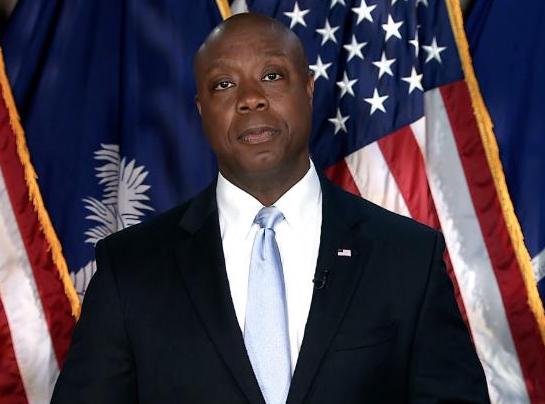
We checked other Scott speeches, and he always does this. He also has an odd cadence, one that brings to mind NPR, or maybe an infomercial. Anyhow, on our scale of 0-10, it was about a 4. Below average, but not painfully so.
Scott began his remarks by explaining that he was not there to point fingers. Then, he spent the next 14 minutes pointing fingers. Among his main arguments (which we will paraphrase, as they are hard to capture in quote form):
- Joe Biden and the Democrats don't care about unity; the GOP is the party of compromise and of
reaching across the aisle, as indicated by the five COVID-19 relief bills passed while Donald Trump was
president.
Comment: Of course, this assertion by Scott ignores that: (1) those bills began in the Democratic-controlled House; (2) Trump often signed the bills only after much kicking and screaming; and (3) the Republicans worked with the Democrats on almost nothing besides occasional COVID relief and renaming post offices. - Biden has botched the pandemic, primarily because he did not open schools quickly enough. It's
the Republican Party that solved COVID-19, thanks to Operation Warp Speed.
Comment: Obviously, there are a few grains of truth here, but coupled with enough spin to make weapons-grade uranium. - The Republicans want to conquer racism, while the Democrats want to perpetuate it, since it's a
great wedge issue for them.
Comment: Readers can judge for themselves how on-target this is. We will note, however, that Scott also said: "Hear me clearly: America is not a racist country." This raises the question of exactly what the Republicans are conquering, then.
In short, Scott's speech was about 95% red meat for the base; there was little to nothing there that could be expected to impress anyone who is sitting on the fence when it comes to Biden. This seems a waste of an opportunity to us; it is not that often that a politician is handed a ready-made national audience. On the other hand, we've never managed to get ourselves elected to the U.S. Senate, so maybe Scott knows better than we do.
So, there you have it. Tomorrow, we'll do a rundown of other commentators' response to Biden's address. But for now, having run through the 13 lines that stood out to us, we have a mirror to break, a ladder to walk under, and a salt shaker to knock over. Also, has anybody seen any black cats? (Z)
Redistricting Revisited
On Monday, we had an item on the census and redistricting, and on Tuesday we had another one. But since the topic is so important—it will play a role in determining which party controls the House for the next 10 years—we have another one today. This one is based on this article from Larry Sabato's Crystal Ball. Each of our three items looks at the issue slightly differently and contains somewhat different information.
To start with, the changes this time (and previous times) aren't so big. But over time, they really add up. The map below on the left shows the changes between 1960 and 2020. The one on the right shows the changes between 2010 and 2020.
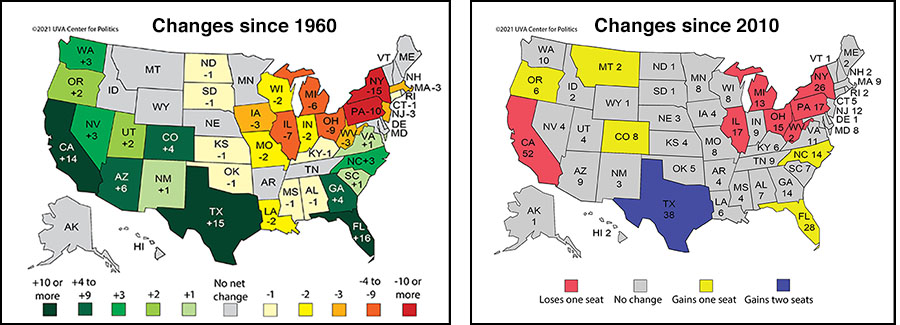
In the map at the left, the enormous population shift from the North to the South is clear. New York, Pennsylvania, Ohio, Michigan, and Illinois together lost 47 seats from 1960 to 2020. California, Arizona, Texas, Georgia, and Florida picked up 55 seats in the same period. Without that shift, the Republican Party would be completely powerless now. The only Northern states to pick up seats are Oregon and Washington. The only Southern states to lose multiple seats are Louisiana (and Missouri, if you count that as the South, which Missourians do not). The map on the right is a continuation of the long-term trend.
The change in political power is gigantic. However, it comes with a little footnote. Yes, the states in the South are gaining power, but only because they are gaining people from the North. And those people tend to bring their political views with them, rather than chucking them in the dumpster before getting in the car and driving south. The consequence is that Virginia is now a solidly blue state, and North Carolina, Georgia, and Arizona are purple states. If the GOP permanently loses the three latter states (as it has Virginia), it is game over at the national level.
And now the Crystal Ball's take on the new census and its likely effects. The main focus is on reapportionment, rather than other changes the state legislatures may make while they are at it. Our best guess was that reapportionment would either be a wash, or might shift a couple of seats in the Democrats' direction. The Crystal Ball thinks things look a bit better for the Republicans; here's a rundown of their breakdown:
West Virginia currently has 3 R seats and will have 2 R seats, so we start at -1 R. Democrats control the redistricting process in Illinois, so the lost seat will come out of the GOP's hide, going from 13D + 5R to 13D + 4R. Score is now -2 R.
New York has a nonpartisan commission but Democrats have a supermajority in the legislature and can override it. Count on them doing that. The part of the state that has lost population is upstate, where there are Republican seats. The monkey business will probably be there. Score is now -3 R.
Republicans have the trifecta in Ohio, but a 2018 ballot initiative put some limits on what they can do. Rep. Tim Ryan (D-OH) is giving up his seat to run for the Senate (something we overlooked on Monday). This is probably a tacit acknowledgment that the Republicans are going to gobble up his seat. Score is now -1 D, -3 R.
Michigan has a nonpartisan commission that will draw the map and Pennsylvania has divided government. Anything can happen. The best guess is that both parties lose a seat, bringing us to -2 D, -4 R.
California also is losing a seat (for the first time since it became a state in 1850). According to Redistricting & You, some of the Democratic districts in Los Angeles are underpopulated, so there goes a Democratic seat. Now we are at -3 D, -4 R.
Now onto the winners. Florida gains a seat and Texas gains two. In both states, the Republicans have the trifecta and will use it to the max. A 2010 voter initiative in Florida banned partisan gerrymandering. Needless to say, the Republican legislature is going to completely ignore that and gerrymander the hell out of the map. Maybe the state Supreme Court will tear the map up based on the voter initiative, but since all seven justices are Republican appointees, including three appointed by Gov. Ron DeSantis (R-FL), don't count on it. Texas will do what they can to make sure both new seats are Republican. The good news in North Carolina is that the governor is a Democrat. The bad news is that the legislature took away his veto power over maps. Score for the winning states is 0 D, +4 R.
Again, so far we are looking only at the new seats. Rep. Filemon Vela (D, TX-34) is retiring and you can bet the Republicans will redraw it to make it at least competitive, if not Republican. But that is a different story.
Colorado has a nonpartisan commission, but the state is trending Democratic. The commission is likely to see this and give the Democrats the new seat, making it +1 D, +4 R. If it were up to us, we think rectangular states ought to have an even number of districts to make for nicer maps. Republicans would probably be on board with with giving Colorado 8 seats and Wyoming 2 seats. Rep. Liz Cheney (R-WY) could sponsor the bill.
Montana used to have two districts, but lost one in 1990. Now it is getting it back. There is a nonpartisan commission, but the state is very red, so a fair map will put the populous western one-third of the state in a red district and the less populous eastern two-thirds in another red district. Now we have +1 D, +5 R.
Oregon should be an easy win for the Democrats, but it is not. They gave up the power to draw the map in return for ending the legislative filibuster. A nonpartisan commission will draw the map. Currently the map is 4 D + 1 R, but it will be hard to make this into 5 D + 1 R, even if the commission tried, which it won't. There aren't any Republicans in Portland, but there are plenty out in Bend. Count this as a Republican pickup, making the score +1 D, +6 R.
Now we fire up our calculator app to add up the pieces. We have -3 D, -4 R for the losing states and +1 D, +6 R for the winners. Doing the math we get -2 D, +2 R. So the Ball's best guess is a net shift of two seats to the Republicans. But again, once the mapmakers get going, they are going to do more than deal with the added and removed seats. Also, legislatures in states with no net gain or loss, like Arizona, may try to win more districts for the controlling party by moving the boundaries of existing districts. Since far more big states with partisan mapmaking are controlled by the Republicans than the Democrats, the net result is likely to be different from the above analysis.
We brought this up before, but it is worth repeating. Sometimes the Republicans tend to get too greedy and it backfires. Just as an example, imagine that some state has eight districts and 6 million people, evenly divided between the parties. This describes Wisconsin pretty well. If the Republicans are drawing the map, they could make seven districts with 350,000 Democrats and 400,000 Republicans. The remaining 550,000 Democrats and 200,000 Republicans go in the eighth district. So the Republicans win seven of the eight seats in an evenly divided state? Maybe not. The Republican edge in the seven districts is only 53% to 47%. The Republicans could lose any (or maybe all) of them. If they hadn't been so greedy and had decided to have six districts with 500,000 Republicans and 250,000 Democrats, they would win them all easily and not bother to run candidates in the other two. Don't underestimate the greed factor.
Also, how precincts went with Donald Trump on the ballot may not hold when Trump is not on the ballot. Should the mapmakers use the 2020 data or the 2018 data? We don't know, but neither do they. (V)
MacDonough Has Become K Street's New Star
Back in the Cold War days, there were people known as Kremlinologists who were supposedly good at figuring out what the Kremlin was going to do next. There seem to be fewer of them now, since at the moment Kremlin = Vladimir Putin, and he tends to play his cards close to his vest. On the other hand, a new kind of "ologist" is much in demand these days: MacDonoughologists. We guarantee you that is the first time that word has ever appeared in "print." These are people who believe they can figure out what Senate Parliamentarian Elizabeth MacDonough will allow in reconciliation bills and what will end up as Byrd droppings. Since (almost) no Republican is going to vote for any of the bills the Democrats want to pass, the budget reconciliation process is going to be pushed to the limit. So, lobbyists want to know what they should be pushing for. If a company wants something or other, but the resident MacDonoughologist says: "Nope, Elizabeth is not going to buy that," then they will have to change their strategy.
It turns out that people who understand the arcana of the budget reconciliation process are few and far between. But knowing the rules backward and forward is necessary to be able to predict how the parliamentarian will rule, since she most certainly does understand all of them and bases her rulings on them.
One lobbying firm, ACG Advocacy, held a briefing on the reconciliation process just days after the Democrats won the two Senate runoffs in Georgia, knowing that reconciliation was going to be the new method of governing. About 150 people showed up for the briefing. Other lobbyists have spoken with MacDonough to get a better grasp of the process and how she thinks.
Some (probably most) Republican lobbyists expect the Democrats to really push the envelope. The blue team didn't do that so much on the COVID-19 relief package, but a much more aggressive approach to the infrastructure bill and the American families plan is expected. The lobbying on those bills will be intense. Everyone on K Street knows this. Jeff Forbes, a former Democratic Senate staffer, said: "Everyone's working on it. It's sucking up all the oxygen in D.C."
The Senate has passed only five bills this session. The new normal for legislating is to bundle everything—up to and including the kitchen sink—into massive bills and then ram them through using the reconciliation process. This was also the case when the Republicans held power. When a bill is 800, 1,000 or 1,500 pages, it is very easy for a well-connected lobbyist to get some senator to sneak in a paragraph somewhere that benefits the lobbyist's client enormously without anyone even noticing. But MacDonough and her staff read every word of every bill, so knowledge of what is going to set off red flags for her has become crucial to the lobbying process.
The bottom line is that lobbying is different now. In the old days, a lobbyist merely had to bribe a senator to get something that would benefit his or her client into a big bill, preferably in the dark of night. Now the lobbyist has to also consider how MacDonough will react to it since she reads the bills far more closely than do any of the senators.
Aaron Belkin, director of "Take Back the Court," said: "Reconciliation is a subjective, capricious process disguised as an objective policy-making mechanism." His group wants Biden to pack all the courts by adding hundreds of new judges. He argues that since all the judges will have to be paid and will need clerks, office space, and courtrooms, this will cost the government money and thus can be done by reconciliation. The truth is that he is right. Almost everything that costs the government money is thus technically allowed. Taken to the limit, renaming the "John Smith Post Office of Podunk" out in the middle of nowhere to the "John Q. Smith Post Office of Podunk" is going to require a new sign—and that costs money. But will MacDonough buy that? That is the big question these days. (V)
Two Key Biden Judicial Nominees Testify
With all the $2-trillion bills floating around, the Senate has hardly had time to confirm any of Joe Biden's judicial nominees. Yesterday the Senate Judiciary Committee heard testimony from two high-profile nominees. Both are Black women. The star of the show was D.C. District Judge Ketanji Brown Jackson. She is up for a promotion to the U.S. Court of Appeals for D.C., the nation's second most important court (#1, of course, is The People's Court). Judicial appointments can't be filibustered, so Jackson is certain to be approved. During the campaign, Biden said that his first Supreme Court appointment would be a Black woman. Virtually everyone in D.C. expects that to be Jackson, when and if he gets the opportunity. The promotion to the appeals court is just to make it look good. If Justice Stephen Breyer was simply waiting for her to be confirmed before announcing his retirement, that could come before the end of this term.
The other judge to testify was Candace Jackson-Akiwumi, a lawyer who has been nominated to be on the Chicago-based U.S. Court of Appeals for the Seventh Circuit, which covers Wisconsin, Illinois, and Indiana. If confirmed, which is almost a certainty, Jackson-Akiwuni would be a rarity on the appeals courts: a criminal defense lawyer, and a Black woman at that. Many judges are former prosecutors and tend to have a natural tendency to side with the prosecution in cases. Jackson-Akiwumi will add diversity to the Seventh Circuit—in a way. In other ways, she is pretty standard issue including being the holder of two Ivy League degrees. She has a bachelors degree from Princeton and a J.D. from the Yale Law School. She was personally recruited by Judiciary Chairman Dick Durbin (D-IL). When the chairman of the Judiciary Committee personally recruits someone to be a judge, it is a pretty safe bet the Committee (and the rest of the Senate) will confirm the nominee. (V)
Feds Search Giuliani's Apartment
Federal agents searched Rudy Giuliani's apartment and office yesterday. It is unusual for agents to search a lawyer's premises. Getting a warrant to search a lawyer, which the investigators had, would require folks at the very top of the Justice Dept. to approve it, probably either the deputy AG, Lisa Monaco, or her predecessor. A federal judge would also have to be persuaded, of course.
Needless to say, no one at the Justice Dept. is talking about what they were looking for. Possibly it relates to Giuliani's lobbying activities in Ukraine, which likely violate the Logan Act. The Feds seized his electronic devices and will no doubt try to break into them—assuming Giuliani was savvy enough to turn on encryption. However, with him, you never know. Maybe he didn't even set a password.
Manhattan prosecutors have been interested in Giuliani since early 2019. They have also indicted two of his associates, Lev Parnas and Igor Fruman, both of whom have pleaded not guilty. Of course, it is possible that either or both have ratted on Giuliani to save their own necks.
And this isn't Giuliani's only legal problem. The Fulton County (GA) D.A., Fani Willis, who is looking at whether Donald Trump tried to intimidate the Georgia secretary of state into changing votes, is also looking at Giuliani's role in the election. In particular, he made statements to the Georgia legislature that may have been false. Lying to the state legislature is a crime in Georgia.
On the civil front, Dominion Voting Systems has sued Giuliani for defaming the company by claiming its machines changed votes from Trump to Biden last year. The company wants him to pay $1.3 billion in damages. So Giuliani had a good run for a while, but now with criminal investigations ongoing in two states and a giant defamation lawsuit in progress, he is going to be busy for a while. Good thing he is a lawyer, and will surely be able to handle all of this easily. (V)
Fed Will Keep Interest Rates Near Zero
At a news conference yesterday, Fed Chairman Jerome Powell said that he would keep interest rates close to zero for the time being. On the whole, this is good news for the Democrats. Low interest rates mean consumers won't pay much interest on car loans, mortgages, credit card debt, and many other forms of debt. Happy consumers = happy voters. Businesses will be able to borrow cheaply to build new plants and buy new equipment, which will create new jobs. All of this makes the economy grow, which is clearly going to be the Democrats' main focus for the next 2 years.
In Europe, interest rates are below zero. They are negative. This means consumers have to pay banks to hold the money in their checking and savings accounts. The negativity also holds for businesses. If a business applies for a loan of, say, 1 million euros, the bank gives it 1,005,000 euros but the business has to pay back only 1 million euros. The other 5,000 euros is a present from the bank, one far better than a calendar or a free toaster. It's a crazy world. The main group of people who don't like this are seniors who have saved a lot of money from years of hard work and now have to pay the bank to hold their money.
A second effect of Powell's decision that will help the Democrats is that, with interest rates on savings accounts and T-bills at or close to zero, people are going to respond by putting money into the stock market, thus driving it up. This benefits primarily rich people, but also people with stocks in their IRAs and 401(k) retirement plans. They will be happy to see the value go up and will be skeptical when the Republicans tell them that the economy is going to Hell in a handbasket.
Potentially, a zero interest rate could stoke inflation. However, Powell doesn't think that is likely to be a problem in the near term. He said he is more concerned about getting back to full employment. If he can pull that off with monetary policy (combined with all of Joe Biden's spending plans), that will also help the Democrats in 2022. (V)
Poll: Americans Approve of Biden
Another poll shows that a majority of Americans approve of the way Joe Biden is doing his job. This poll is consistent with earlier ones. The new CNN/SSRS poll shows that 97% of Democrats, 65% of independents, and 30% of Republicans think Biden is doing a good job. Among all American adults, 53% approve of Biden and 43% disapprove. In these ultra-partisan times, that is about the best any president could do.
The poll also tested nine specific issues. Biden is above water on seven of them:
- COVID-19: 66% approve, 31% disapprove (+35)
- The environment: 54% approve, 38% disapprove (+16)
- Racial justice: 54% approve, 39% disapprove (+15)
- Commander-in-chief: 52% approve, 41% disapprove (+11)
- The economy: 51% approve, 42% disapprove (+9)
- Taxes: 50% approve, 43% disapprove (+7)
- Foreign affairs: 48% approve, 41% disapprove (+7)
- Guns: 40% approve, 51% disapprove (-11)
- Immigration: 41% approve, 53% disapprove (-12)
All in all, it is pretty good. Immigration is so intractable that no policy by any president could possibly get a majority. As to guns, small and sensible restrictions on gun ownership, such as not letting convicted felons out on parole buy them, might get a bare majority, but this area is one that Biden has studiously avoided (well, until his speech last night). He clearly thinks the key to his success will be bread-and-butter economic policy issues.
Another area where Biden does well is keeping his promises. Roughly 59% think he is doing so and 36% say he is not. Additionally, 53% say his priorities are right, vs. 43% who say they are wrong.
The poll also asked about Kamala Harris. She is doing slightly better than Biden, with 53% approval and only 38% disapproval. (V)
Kelly and Warnock Are Bellwethers
Sens. Mark Kelly (D-AZ) and Raphael Warnock (D-GA) are about as different as people can be: A moderate white former astronaut and a progressive Black guy whose connections go even higher than astronauts go. But they are probably the bellwethers who will tell if the Democrats will control the Senate in 2023. Much of Joe Biden's agenda depends on them, so everyone is watching them very closely.
The conventional wisdom is that if they win their elections next year, the Democratic incumbents in Nevada, Colorado, and New Hampshire are probably safe. Sen. Mike Braun (R-IN) said: "You couldn't have a better test" of GOP viability than Kelly and Warnock's races. He also worried about Arizona becoming a blue state like New Mexico and Colorado and Georgia being in play all the time going forward. Braun is not sure what the Republicans will do in the long run if that happens.
So far, both senators are doing well. They are both raising money at eye-popping rates and neither one has drawn a serious opponent yet. Kelly's biggest worry was that term-limited Gov. Doug Ducey (R-AZ) would challenge him. But now Ducey has said he won't run. Most likely, Ducey knows that if he did, Donald Trump would try to rally the troops to defeat him, and the Governor doesn't have the stomach for that. The only other really high-profile Republican in Arizona is former senator Martha McSally, and she has already lost two Senate races, so maybe she isn't the best candidate. Well, actually, there is also Kelli Ward, but she's to the right of Attila the Hun, and has also lost two Senate races, not even making it past the primary either time.
In Georgia, Doug Collins took himself out of the running, so former senator Kelly Loeffler might decide to run. But everyone in Georgia is waiting for former football star Herschel Walker to make up his mind. Meanwhile, Warnock keeps raising money. In fact, both Warnock's and Kelly's fundraising operations are more like what you see in presidential campaigns, rather than Senate campaigns.
Other Republican senators are worried that if the economy takes off, it will make people happy with having Democrats in charge and this will help Warnock and Kelly, along with the others. But there is little they can do to stop the Democrats if they decide to goose the economy using the budget reconciliation process, which seems likely. And both are good fits for their states. Arizona is full of retired military personnel and Kelly was a Navy pilot before he became an astronaut, so they like him. Warnock is a likeable guy and a prodigious campaigner who will have all the money he needs in a state that is 30% Black. Republicans don't have candidates in either state and are plenty worried at this point. (V)
Budd's Bid
Another key state where Republicans don't have a killer candidate is North Carolina. Yesterday a potential savior threw his hate in the ring. Oops, we meant his hat in the ring. It's Rep. Ted Budd (R-NC). He is a Trump favorite who bills himself as a "liberal agenda crusher." In case anyone needed a graphic demonstration of that, his announcement video featured a monster truck jumping over a bunch of cars labeled "liberal agenda." It also mentions Dr. Seuss and how the Senate is the last line of defense against turning America into a "woke Socialist wasteland." In the video, he also notes that he owns a gun shop.
That kind of campaign is fine and dandy in the Republican primary, but North Carolina is a purple state. Since 1986, the class III seat that is up next year has been filled by James Broyhill (R), Terry Sanford (D), Lauch Faircloth (R), John Edwards (D), and Richard Burr (R). Only Burr served multiple terms and he is retiring next year. Since Jesse Helms retired, the other seat has been held by Elizabeth Dole (R), Kay Hagan (D), and Thom Tillis (R). Tillis was reelected last year, but if the guy whom he beat had better zipper management, Tillis might well have lost. Also, Barack Obama carried the state in 2008 and the current governor is a Democrat who has been elected twice. So North Carolina, which Trump won in 2020 by only 1.34%, is definitely in play. Worse yet for the Republicans, is that people are flooding into the Research Triangle area from out of state, and they are disproportionately Democrats. In other words, a fire-breathing Trumpist like Budd just might not be the right person to carry the GOP banner in the general election.
In an important sense, North Carolina is like Georgia. In both states everyone is waiting for a potentially field-clearing big-name Republican to make a decision about running. In Georgia, it is Herschel Walker. In North Carolina, it is Lara Trump. But the longer they wait, the less field clearing they will be able to do. The Club for Growth already endorsed Budd, who voted against certifying the electoral votes for Arizona and Pennsylvania. That could be enough to get him a following that sticks with him even if Trump enters the race.
And Budd is not the only announced GOP candidate. Former representative Mark Walker is in, as well as the Republicans' nightmare candidate, disgraced former governor Pat McCrory. This means there will probably be at least a three-way primary (without Trump) or a four-way primary (with Trump). And it will be a nasty one. That sort of primary is never good for a party. And there is plenty of time for more candidates to show up. The filing deadline is in December and the primary is March 8, 2022.
On the other hand, the Democrats don't have an A-list candidate either. There are four B-list candidates already in the contest: Jeff Jackson, Erica Smith, Richard Watkins, and Cheri Beasley. So they, too, could have a nasty primary. The Democrats' strongest candidate, by far, is Gov. Roy Cooper (D-NC), but he has said he won't run because the lieutenant governor is a Republican and Cooper does not want to inflict total Republican control on the state for 2 years if he is elected to the Senate. (V)
Previous | Next
Main page for smartphones
Main page for tablets and computers