Previous | Next
An Im-Peachy Day in Washington
On Monday, approximately 100% of the oxygen was sucked up by Whistleblowergate. On Tuesday, it may not have been 100%, but it was 85% or 90%. So, get ready for another long item, as Speaker Nancy Pelosi (D-CA) announced, on behalf of her caucus, that they will formally begin an impeachment investigation.
So, What Has Changed?
Depending on how you look at it, nothing has really changed. The Democrats were looking into various instances of possible Donald Trump malfeasance, which carried with them the possibility of impeachment, and that will continue. Pelosi made clear on Tuesday that six different committees—Judiciary, Intelligence, Oversight and Reform, Foreign Affairs, Financial Services, and Ways and Means—would keep working along the lines they've been pursuing for months.
On the other hand, everything has changed. The House Democratic Caucus has unified behind a course of action that has the word "impeachment" in it. "The President must be held accountable. No one is above the law," Pelosi declared, while accusing Trump of "betrayal of his oath of office." Pick your cliché: House Democrats have poked the bull in the eye, they have crossed the Rubicon River, they have drawn a line in the sand. This is going to be the dominant issue in national politics for months, at the very least, and most likely right up until Nov. 3, 2020.
Pelosi recognizes that she's in tricky political territory. On one hand, the revelations about Trump and Ukraine pushed most of her caucus (the latest count is 186-49) over to the side of an impeachment inquiry, and essentially forced her hand. On the other hand, some Blue Dog Democrats aren't sold as yet, nor are all of the Democratic Senators. This is why the Speaker chose the most restrained course available to her, as opposed to committing to an actual impeachment vote. That allows her to walk a fine line for now. However, she also knows that much of the Democratic base has been champing at the bit for this, and they are not going to be satisfied with, "Well, we looked, but we didn't find anything." So, Pelosi also took great pains on Tuesday to point out that the facts of the Ukraine situation that are already known likely constitute enough to justify impeachment.
The fact that there is no longer any ambiguity about whether or not the House Democrats are really pursuing impeachment will strengthen their hands in court. This sort of inquiry is clearly within their purview, as outlined in Article I of the Constitution. And, like any prosecuting attorney, the House is granted very broad latitude when gathering evidence. So, it's going to be even harder for the administration to stonewall, a fact that will be true not only when it comes to phone conversations with Ukraine, but also obstruction of the Russiagate probe, and tax returns, and the like.
Trump's Response
You may want to sit down for this, because it's a shocker. Trump has decided that this whole impeachment business is...wait for it...a "witch hunt." Here is one of the five times he referred to it in that manner on Tuesday:
Such an important day at the United Nations, so much work and so much success, and the Democrats purposely had to ruin and demean it with more breaking news Witch Hunt garbage. So bad for our Country!
— Donald J. Trump (@realDonaldTrump) September 24, 2019
In short, he's not happy. And just wait until he learns that Hillary Clinton announced yesterday that she now supports impeachment.
Trump also promised on Tuesday to publicly release the transcript of his telephone call with Ukrainian president Volodymyr Zelensky, and to hand over to Congress the whistleblower complaint that started this all. Obviously, if the administration actually follows through on these promises (never a sure thing), it represents a 180-degree turn from their previous efforts to keep the materials secret.
When (and if) the materials are actually released, there would appear to be three basic possibilities:
- The materials completely exonerate Trump: This seems very unlikely
since, if there really was unequivocal proof of Trump's innocence, he would have put it out there
days ago. At the very least, even if he wanted to argue national security concerns, he would have shared
it with Congress. At this point, Trump's muddied the waters so much, both with his behavior in this
situation, and overall, that even if the materials appear to exonerate him, a sizable portion of the
electorate simply isn't going to believe it and will conclude that the releases have been doctored.
After all, Nixon did it with the Watergate tapes, so why wouldn't Trump do it with the
Whistleblowergate transcript? If this is indeed his plan, he would be wise to avoid the use of a
Sharpie while "editing."
- The materials are ambiguous: This is far and away the likeliest
scenario. When it comes to the transcript, Trump would really have to be a screw-up to overtly
announce "foreign aid for Biden dirt" to Zelensky. The Donald may not be quite the master of the art
of the deal he pretends to be, but even he knows about plausible deniability. As to the
whistleblower, there are indications that he or she was not a firsthand witness to the problematic
exchange(s), and was only made aware of them through channels. Assuming that all of this proves to
be basically correct, then there will be enough uncertainty for Trump to proclaim his innocence (and
for his base to believe it), and at the same time there will be enough incriminating stuff for his
opponents to proclaim his guilt (and for their base to believe it).
- The materials confirm Trump's guilt: This also seems unlikely, since Trump has shown himself to be more than willing to suffer the consequences that come from sitting on damaging information (think: tax returns). That said, the Senate voted unanimously on Tuesday to demand the whistleblower complaint. It is at least possible that Team Trump decided that there was no way of avoiding the release of the complaint and the transcript, no matter how damaging they are, and that the plan is to take the medicine and then spend the next few weeks or months gaslighting. After all, the Mueller report is quite damning for Trump, and yet he spun it (with great success, among the base) as an exoneration.
Not helping Trump's case that he's being completely transparent, and has nothing to hide, he offered up yet another explanation for why the foreign aid to Ukraine was delayed. Previously, it was: (1) "interagency process," or (2) taking time to figure out if Zelensky is pro-Russian or pro-Western, or (3) concern that Zelensky is corrupt. The new explanation is that Trump was unhappy that other Western nations are not ponying up their share of Ukrainian aid, and that he was waiting until they did so. Stay tuned for explanation #5, which should be coming sometime around noon today, if the pattern holds.
And speaking of the base, Trump realizes that no matter what happens here, he needs to paint himself as the victim, and needs also to frame this as an us-versus-them existential crisis. He's already at work on that. Beyond the "witch hunt" tweets and a bunch of other complaining on Twitter, his campaign is already using this to raise funds, asking supporters to join the "Official Impeachment Defense Task Force." It would appear that the bar for qualifying as a member of the Official Impeachment Defense Task Force is pretty high, as it involves having at least $5 you're willing to give to Trump 2020.
The GOP's Response
As noted above, the Senate—including Senate Majority Leader Mitch McConnell (R-KY) and his 52 red friends—voted on Tuesday to insist that Trump turn over the whistleblower complaint. Maybe McConnell & Co. were showing some sense of civic duty, or maybe they were positioning themselves to exit the S.S. Trump should this particular iceberg prove fatal. Whatever the case may be, the vote came before Pelosi announced the Democrats' plans.
Once the Speaker had held forth, the GOP quickly began to close ranks around the President. House Minority Leader Kevin McCarthy (R-CA) slammed Pelosi and said that the 2016 presidential election has already been decided, and the Democrats are just trying to re-litigate it. Rep. Lance Gooden (R-TX) decided he might as well get some free publicity, and introduced a resolution to remove House Judiciary Committee Chairman Jerrold Nadler (D-NY) from his post. One assumes that Gooden is aware which party is in the majority in his chamber, and that it's not the Republicans.
Most significantly, the Republican members of the Senate declared that if any articles of impeachment reach their chamber, they will be stamped out very quickly. As civil servants, that seems a little premature, since they don't yet have all the facts. As politicians, that also seems a little premature, since they don't really know how the public will react to all of this. If public support for Trump craters, as happened very quickly with Richard Nixon in the summer of 1974, it is likely that the GOP senators' inclination to dispose of this without even holding a trial will fade away.
Should Trump Be Worried?
There is no question that Trump needed something to run on in 2020, and he didn't really have anything. Or, more accurately, everything he tried wasn't working out so well. Now, he can wield impeachment like a sledgehammer to beat the Democrats over the head and to rally his base.
However, that is the silver lining for him in a development that is otherwise full of rain clouds. Trump is deeply exposed in this Ukraine situation, beginning with potential bribery, influence peddling, corruption, and other high crimes and misdemeanors that stem from the original phone call(s). Then, learning nothing from the Mueller situation, he tried to keep everything secret from Congress, thus exposing himself to obstruction charges. The Speaker is absolutely correct when she says that regardless of what we learn today (or in the future), the available evidence is already very damning.
On top of that, while Trump is a master of publicity, the Democrats are no dummies in this area, either. They are going to air his dirty laundry on the front pages, and the politics websites, and the news programs, for months and months. Reportedly, the whistleblower wants to testify before the House. If that comes to pass, the audience that tunes in to watch the greatest day of political drama in the last 50 years will be so big it will make the audience for Brett Kavanaugh look like a Trump inaugural crowd. Undoubtedly, the whistleblower would be under marching orders to stonewall, just like Corey Lewandowski did. However, if that person was interested in following such orders, they would presumably not be whistle blowing (much less testifying) in the first place. Further, that person, whoever they may be, does not need Trump's endorsement for a Senate run, and also would have significant legal protections against retribution. So if they do appear, the smart money says they spill their guts.
Incidentally, Nate Silver has advice on how the Democrats should handle this, which boils down to this: KISS (Keep it simple, stupid). He suggests that, the public's attention span being what it is, and Trump's ability to muddy the waters being what it is, the Democrats should have a laser focus on Ukraine and on establishing a clear chain of events that adds up to corrupt behavior. Of course, this is not Pelosi's (or Nadler's) first rodeo, and they know this. After all, they were both there when Bill Clinton basically got impeached over something as inconsequential as a cigar (in a manner of speaking). That said, the blue team now has much greater political and (as noted above) legal cover to look under rocks for anything and everything they can find. Further, the impeachment train has now left the station. So, even if Whistleblowergate proves to be a dud, Trump is hardly out of the woods, and is still likely to get impeached over something. Again, the Democratic base is simply not going to be happy with "well, we tried!"
And speaking of political cover for the Democrats, there is already one poll out, from YouGov, that assesses how people feel about a Ukraine-related impeachment. Here it is, graphically:
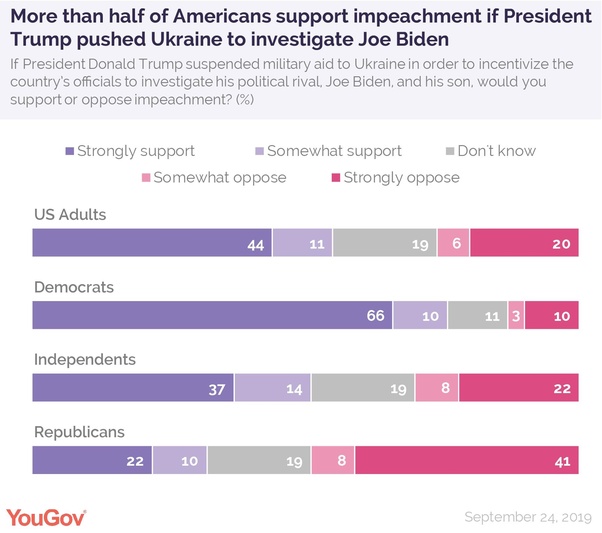
That's 76% of Democrats, 55% of U.S. adults overall, 51% of independents, and even 32% of Republicans who support impeachment, either strongly or somewhat, if the allegations against Trump are sustained. This is not a good starting point, public opinion-wise, for the President.
Meanwhile, as all of this is going on, Trump is not going to be able to get anything else done. Not that he intends to try; in his pique over Tuesday's announcement, he made clear that he's not interested in working with anyone who would dare to consider impeaching him. So, it looks like business in Washington will pretty much grind to a halt, which will mean that the attention paid to impeachment and the Ukraine will be even greater. No wonder, despite his public displays of confidence, White House insiders report that Trump is filled with anxiety over the new hole he's dug for himself. (Z)
Trump Distractions Aren't Very Distracting
Everyone knows, at this point, that one of the most well-worn pages in the Trump playbook is the one where he distracts attention from some sort of damaging story by saying or tweeting something outrageous. On Monday, for example, he griped, during a joint press conference with Pakistani Prime Minister Imran Khan, that he "would get a Nobel Prize for a lot of things, if they give it out fairly, which they don't." This presidential whine was primarily greeted by two kinds of stories: (1) those that observe that someone actually has to advance the cause of peace to win a Nobel, and (2) those that observe that Nobel Laureate Barack Obama retains ownership of the permanent space he occupies in Trump's head.
Tuesday's distraction came in the form of this sarcastic tweet, aimed at anti-global warming activist Greta Thunberg, who delivered a decidedly-not-happy speech before the UN on Monday:
She seems like a very happy young girl looking forward to a bright and wonderful future. So nice to see! https://t.co/1tQG6QcVKO
— Donald J. Trump (@realDonaldTrump) September 24, 2019
Thunberg is 16, and pretty much all the coverage has centered on one observation: that Trump, holder of the most powerful job and the biggest platform in the world, is no longer satisfied with taking cheap shots at adults, and has moved on to targeting people who aren't even old enough to vote.
On one level, Trump succeeded, getting some attention with his antics. On the other hand, the careful reader will note that the lead item in today's posting is about the possibility of impeachment. That was also true yesterday, and it's true for every politics-centered website and news channel in the land. So, the distraction play isn't exactly working, is it? (Z)
Democratic Debates Lurch Forward
While much of the country's attention has been focused on Donald Trump's phone call(s) to Ukraine, there have been some developments on the Democratic debate front. To start, Rep. Tulsi Gabbard (D-HI) has qualified for the fourth presidential debate, by virtue of a new poll (see below) putting her at 2% in New Hampshire. That means that 12 candidates have qualified, which will effectively force the DNC to split the event over two nights (although DNC chair Tom Perez says no official decision will be made until October 1). Assuming that the blue team determines that there's no way to squeeze 12 people onto one stage and into one night (even if it is three hours long), then there will be a debate on October 16, in addition to the already-set October 15.
Meanwhile, the DNC also announced what it will take to qualify for the fifth debate, once again slightly ratcheting up the minimum standards for making the stage. Candidates will have to clear 3% in four DNC-approved polls, or 5% in two DNC-approved polls of the early voting states (Iowa, New Hampshire, Nevada or South Carolina), and will also have to receive donations from 165,000 unique donors, including at least 600 unique donors in 20 different states, territories, or the District of Columbia.
The new standards will do relatively little to cull the field. The folks who did not make the fourth debate won't make the fifth debate, of course. But of the dozen who did qualify, Joe Biden, Sens. Elizabeth Warren (D-MA), Bernie Sanders (I-VT), Kamala Harris (D-CA), and Cory Booker (D-NJ), Mayor Pete Buttigieg (D-South Bend), Beto O'Rourke, and Andrew Yang are already in, while Sen. Amy Klobuchar (DFL-MN) is likely to make it (by virtue of the 5% in two early states requirement), and Julián Castro and Gabbard are on the bubble. Only Tom Steyer is in real danger of being cut, though some candidates (like Booker) may cut themselves by dropping out of the race prior to the fifth debate.
There have been a number of pieces criticizing the DNC's approach to the debates this year, including one in Politico and another in The Atlantic. The format has forced the candidates to focus intently on fundraising, which not only means they spend less time meeting with voters, but also that they are sucking up precious dollars that might otherwise go to other races (House, state legislatures, etc.). Meanwhile, the basic reality that candidates who do not make the debate cut are basically eliminated means that money and name recognition are being vastly overweighted. And finally, the debates themselves are often not so useful, since the stage is cluttered with non-serious candidates who want to talk about issues of concern only to Northern Ohio, or how the Democrats should really be Republicans lite, or dark auras. The upshot, per the Atlantic's headline, is "The Democratic Debates Aren't Pleasing Anyone."
Obviously, the point of all of these machinations was to avoid a repeat of the 2016 Democratic race, where a segment of the Party was left alienated because they felt they had been cheated, but also to avoid a repeat of the 2016 Republican race, where a whole gaggle of candidates spent months beating each other up, paving the way for the nomination of Donald Trump. It would seem, however, that all that Perez has done is trade in one set of downsides for another. One wonders if the Democrats would not have been better off scheduling the first debate after the four early caucus/primary states, and making clear that the stage would be open to anyone with at least one delegate. Oh well, undoubtedly the blue team will have a whole new approach in place by 2024 or 2028, whenever it is next relevant. (Z)
The State of the State Polls
There have been a number of state-level polls of the Democratic race in the last few days, of New Hampshire (Monmouth), Nevada (USA Today/Suffolk), New Jersey(Monmouth), and (another) of Iowa (Iowa State University). Here's everyone who polled above 1% in any of the four:
| Candidate | |
|
|
|
| Joe Biden | 25% | 23% | 26% | 16% |
| Elizabeth Warren | 27% | 19% | 20% | 24% |
| Bernie Sanders | 12% | 14% | 18% | 16% |
| Pete Buttigieg | 10% | 3% | 6% | 13% |
| Kamala Harris | 3% | 4% | 6% | 5% |
| Tulsi Gabbard | 2% | 1% | 2% | 4% |
| Andrew Yang | 2% | 3% | 1% | 3% |
| Cory Booker | 2% | 2% | 9% | 2% |
| Amy Klobuchar | 2% | 0% | 1% | 3% |
| Tom Steyer | 2% | 3% | 0% | 2% |
| Beto O'Rourke | 1% | 1% | 0% | 2% |
This is good news for Elizabeth Warren, who is leading in two of the polls, and is nipping at Joe Biden's heels in the other two. The surge is real.
On the other hand, it's not-so-good news for most of the rest of the field. To wit:
- Ann Selzer was right: Biden's at risk in Iowa, which should be his wheelhouse.
- Bernie Sanders is now regularly in third place behind Warren, in both state and national polls.
- Harris is all-in on Iowa, but it appears that most of the support that Biden bleeds goes to Warren, not her.
- Andrew Yang is showing little ability to break out beyond his small-but-loyal core of support.
- If Booker can pull only 9% in his home state, how can he win nationwide?
- Tom Steyer has spent a lot of money in Iowa and Nevada and gotten limited returns.
- Beto O'Rourke barely made the table, by virtue of a single 2% showing. He needs to rethink that "no Senate run" announcement.
The numbers aren't bad for Pete Buttigieg, but he's just treading water, and at this point it's hard to see what sequence of events would allow him to move from the second tier to the first. Meanwhile, Tulsi Gabbard is probably happy today, because she punched another debate ticket. But she's in a very bad position, long-term, as her wonky base of support is made up of outsider Democrats, some crossover Republicans, and some Republican troublemakers who merely want to stick the blue team with a weak candidate. There's little room for that to grow. (Z)
Bevin Hires New Campaign Manager
Gov. Matt Bevin (R-KY) is the least popular governor in America (32% approve, 56% disapprove), and is just six weeks away from an election in which he will try to keep his job by defeating state AG Andy Beshear (D). On Tuesday, the Governor decided to shake up his campaign, demoting previous campaign manager Davis Paine to the #2 spot, and placing GOP strategist Michael Antonopoulos in charge.
There hasn't been a lot of polling of the race, although the two most recent polls (both done in August) gave Beshear a comfortable lead (48% to 39%, in each case). Further, a campaign does not change its leadership less than two months before an election unless it knows that it's got serious troubles. Though a red state in presidential and U.S. Senate elections, most of the time, Kentucky does elect Democratic governors pretty regularly. Further, as AG, Beshear has obviously won statewide elections before. So, Bevin could well be on his way out.
If Bevin does lose, and in a non-presidential year no less, that will send a pretty clear message to Democrats in Kentucky and nationwide that they can definitely win big elections in the Bluegrass State. That is not a lesson that Mitch McConnell would like Democrats to learn, since he'll be taking his turn at trying to keep his job in 2020. So, the returns in Kentucky on Nov. 5 bear watching. (Z)
Back to the main page