Previous | Next
Happy Thanksgiving to everyone!
Are Trump and Giuliani Turning on Each Other?
It would appear that Bill O'Reilly, his career ruined by his serial sexual harassment, is trying to get back in the game. To that end, he managed to land a presidential interview ahead of Donald Trump's latest rally appearance. And during that interview, Trump made headlines, as he declared that he never told Rudy Giuliani to deal with Ukrainian president Volodymyr Zelensky on his behalf.
This is, of course, patently absurd. That statement is contradicted by virtually all of the 17 people who testified before the House on the Ukraine mess. It's also contradicted by the transcript of Trump's phone call to Zelensky, released by his own staff. During that little chat, the President specifically mentioned deploying Giuliani three different times. For example:
I heard you had a prosecutor who was very good and he was shut down and that's really unfair. A lot of people are talking about that, the way they shut your very good prosecutor down and you had some very bad people involved. Mr. Giuliani is a highly respected man. He was the mayor of New York City, a great mayor, and I would like him to call you. I will ask him to call you along with the Attorney General. Rudy very much knows what's happening and he is a very capable guy. If you could speak to him that would be great.
Unless Trump is willing to accuse his own staff of promulgating fake news, and fake news that it just so happened to take the President nearly two months to notice, then he was lying through his teeth to O'Reilly.
It is not news, of course, when Donald Trump lies. However, this comes awfully close to throwing Giuliani under the bus. It's not easy to get busted for violation of the Logan Act, but if Giuliani was acting without presidential assent, that would make him a private citizen conducting diplomacy on behalf of the U.S. government, which is pretty much a textbook Logan Act violation.
Meanwhile, we also notice a few other things (in no particular order):
- Giuliani is getting more than a little toxic. There are his bizarre and often self-defeating media appearances,
of course. On top of that, as friends and associates of his keep getting implicated and indicted, America's (former) Mayor is being
pulled
deeper into the muck. The general consensus is that Giuliani is more likely to be indicted himself
than he is to avoid prosecution.
- As Richard Nixon got more and more desperate in 1973-74, he betrayed more and more people, eventually including some
of his closest associates, in a desperate attempt to save himself (more below). It would not be unlike Trump for him to
do the same.
- A fair bit of dirt about Giuliani has leaked this week, like the story about him trying to collect a paycheck
from Yuri Lutsenko (see below). Someone interested in hurting Giuliani has to be leaking these things.
- Earlier this week, Giuliani told a crowd that he has plenty of "insurance" to use against Trump if the President throws him "under the bus." He then said he was "joking," but it had the feel of a joke that's not really a joke, along the lines of, "Wouldn't it be funny if you gave me $200 and then I didn't beat you up? Ha, ha!"
It's possible that this is just the usual Trump/Giuliani shooting-from-the-hip style. It's also possible that they are coordinating all of this, in service of some goal known only to them. But it certainly looks like the relationship is fraying, and that two hot-headed fellows who are used to using the media to intimidate and threaten opponents are engaging in a rather public chest-thumping contest. And, at very least, Trump's utter shamelessness when it comes to saying things about Ukraine that are demonstrably untrue reminds us of why his lawyers will never, ever allow him to testify in open court. (Z)
Giuliani Was Also Doing Business in Ukraine
It shouldn't be surprising in the end, but Rudy Giuliani didn't go to Ukraine just to help Donald Trump, he also went to help Rudy Giuliani. In particular, while he was working with Ukraine's former (and corrupt) prosecutor Yuri Lutsenko to dig up dirt on the Bidens, Giuliani also tried to get a $200,000 contract to represent Lutsenko. Lutsenko was convicted of embezzlement and abuse of his office in 2010 and spent 2 years in prison for it.
From Lutsenko's point of view, having Giuliani on his team would give him direct access to Donald Trump and other top U.S. officials. The contract was drawn up in January and went through several revisions. One of them had top Republican lawyers Victoria Toensing and Joe diGenova also playing a role and being well compensated for it.
The contract was never executed and the payments never made because in May, the New York Times published a story stating that Toensing was planning to go to Kyiv with Giuliani to get the Ukrainians to investigate the Bidens. Apparently being in the spotlight didn't appeal to them so the trip was never made and the contract never signed.
In other Giuliani news, the former New York City mayor has now acknowledged that he did indeed meet with a lawyer for Ukrainian oligarch Dmitry Firtash, something he had previously denied. In October, Giuliani told CNN: "I have nothing to do with Firtash." Various reports have linked Firtash to Russian organized crime. When asked to explain the discrepancy between his new admission and what he said in October, Giuliani made a reference to material often found on the ground behind a horse.
What Giuliani and Firtash's lawyer talked about is not known. Certainly digging up dirt on the Bidens was probably on the agenda. But given Giuliani's interest in selling access to Trump, that might not have been the only topic of discussion. Firtash is fighting extradition to the U.S. where he has been charged with bribery, so it is at least possible that topic might have come up, too. (V)
Poll: Support for Impeachment Is Holding Steady
We mentioned this in passing yesterday, but it bears a little closer examination. A new CNN/SSRS poll taken Nov. 21-24 (thus after all the pubic hearings on impeachment), shows no change in the public support for impeaching Donald Trump. The percentage has gone up since early this year, but is now holding steady at about half the country. Here are the numbers:
| Dates | Impeach | No | Don't know |
| Nov. 21-24 | 50% | 43% | 6% |
| Oct. 17-20 | 50% | 43% | 7% |
| Sep. 24-29 | 47% | 45% | 8% |
| May 28-31 | 41% | 54% | 5% |
| Apr. 25-28 | 37% | 59% | 4% |
| Mar. 14-17 | 36% | 59% | 5% |
Suffice it to say, that with only half the country supporting impeachment, the Senate is not going to convict Trump when he goes on trial. Probably it would take 60% support, at the very least, to convince most Republican senators that a conviction is in their own personal interest. The numbers could change, however, if insiders close to Trump are forced to testify at the trial and say things that damage him. That's particularly true if he and Rudy Giuliani turn on each other (see above).
If we look at the demographics of the poll, women, nonwhites, and college graduates strongly favor impeaching and removing Trump (61%, 65%, and 59%, respectively). Trump's greatest supporters are white noncollege voters, with only 36% wanting to see him get tossed out. When asked whether Trump abused his power, the results are roughly the same. In short, Trump's base is sticking with him for the time being, and the people who never liked him still don't. (V)
Warren Is Slipping in Iowa
Sen. Elizabeth Warren (D-MA) was doing great in Iowa a month ago, but she is starting to slip in the Hawkeye State now. We saw this phenomenon in the 2016 Republican primary, where one candidate after another would rise and then fall back. As Warren is falling in Iowa, Mayor Pete Buttigieg (D-South Bend) is rising. Part of Warren's problem is her embrace of Medicare for All, which many Iowans think will mean higher taxes for them. She presented a plan a few weeks ago showing how it would be paid for (in large part by forcing employers who now pay their employees' health insurance premiums to contribute that money to the government to pay for Medicare for All). But not everyone has heard her explanation and of those who have, not everyone believes it. In politics, timing is everything, and she may have peaked too early.
Part of Warren's problem is that when she was temporarily the frontrunner, she started to get a lot more attention and as people looked more closely at her, they found things they didn't like so much. But it is also true that she hasn't advertised in Iowa in weeks, while Buttigieg has flooded the airwaves with $2 million worth of ads attacking her plans for Medicare for All, saying that he doesn't want to dictate people's health-care choices. He is also embarking on an 8-day, 18-county trip across Iowa.
But even Buttigieg may be peaking too early. The Iowa caucuses are more than 2 months away and a lot can change in 2 months. One candidate who is trying to carefully control when she peaks is Sen. Amy Klobuchar (DFL-MN). While other candidates are winding down their campaigns (due to lack of funds), she has managed her resources carefully and is now starting to increase her presence in Iowa (and New Hampshire). She recently doubled her staff in these two key states in order to try to peak closer to the actual voting. Her plan is clearly to wait until people start looking more closely at Buttigieg and finding things they don't like, then she can make her move, ideally in January. Of course, that means in terms of timing, she has a plan similar to Michael Bloomberg (except he is not campaigning in the early states). Time will tell if either of them can pull it off and, as an adjunct, whether money or federal elective experience matters more when it comes to primary voters. (V)
Some Voters Want Divided Government
Many Democrats are giddy over their 2020 prospects due to the blue wave in 2018 that netted the Democrats 40 House seats (although it also cost them 2 Senate seats). The New York Times' data whiz Nate Cohn and Claire Cain Miller have done some digging on that and have concluded that it is a bit early for the Democrats to break out the champagne. What they learned is that the party not occupying the White House often wins in the midterms because voters want to check the ambitions of the president. In other words, divided government and deadlock are seen as features, not bugs. Put in other terms, some of the voters who voted for Trump in 2016 and a Democrat for the House in 2018 are likely to vote for Trump again in 2020.
Also a factor here is that in the midterms, local issues often played a role, with the Democrat promising something at the local level, such as better care for veterans or dealing with opioids. Issues like that favor the Democrats, but don't play much of a role in national elections.
What is even more surprising is that 7% of the people who voted for Hillary Clinton in 2016 approve of Trump now. Some of them voted for Clinton because they didn't think Trump had the experience to be president. Now they think he does. When asked why, some of them said the Democrats used to be the party of the working man, now they are not. It is certainly true that many, if not most, affluent professionals and most minorities are Democrats, and the Party is oriented toward them and not so much toward white working-class voters. At least, that is what the blue-collar folks think (and see the next item). (V)
Everything is Closing in Rural Areas
Axios has a story on how banks are closing in rural areas. To people who live in cities and do their banking online, bank closures in rural Texas are not a big deal, but to the people who live there, they are a very big deal. In the not-too-distant past, people in small towns and rural areas could go to a local bank to get a farm loan or a mortgage to tide them over until their harvest was in. They could speak to a local banker who understood their situation and was willing to try to help them. Now in many counties, there is no bank or local banker. Assuming they have a decent and reliable Internet connection—which is not the case in many rural areas—they can do their banking with a large bank online. But if they need a loan in the spring to buy seeds with a promise to repay it in November, they are at the mercy of an algorithm that almost certainly does not understand their needs and will probably reject their application because the bank is much more focused on the financial needs of people who live in cities and suburbs. Thus, rural people are increasingly out of luck.
Banking isn't the only area where people in rural areas are out of luck. Hospitals in rural areas are closing right and left. Over 100 have closed since 2010 and more are closing every week. Doctors in rural areas are getting older and retiring and are not being replaced by younger ones. Telemedicine helps a little bit in rural areas where there is a good infrastructure for it, but those places are few and far between. Telemedicine requires high-bandwidth Internet so the remote doctor can have a good look at the suspicious growth on the patient's face to decide if it warrants driving 100 miles to get a biopsy. Many rural areas have 56-kbps dial-up phone lines, not broadband.
Now onto schools. Guess what? They are closing in rural areas, because once children get to be 18 or 20, they head off to cities to find work. So, there are fewer children, hence fewer schools. This means long drives to schools every day for kids, which puts a burden on the parents to drop them off and pick them up, making it harder to hold down a job.
We could go on and on, but there is a pattern here. Life is shutting down in rural areas and the people are angry. Many of them feel the politicians in D.C. have forgotten them, and they certainly feel that the Democrats are busy wooing college-educated women in affluent suburbs and not them. This may explain why a lot of them view Donald Trump as their man, since he promised to shake up the system. So far, he has done basically nothing for them, but neither have the Democrats. At least he talks the talk, even if he doesn't walk the walk. If the Democrats want to win back rural areas, they are going to have to show up and explain how they are going to help. Actually, it isn't even that hard, because the root cause of rural decline is not the government's fault, but largely the fault of big banks, big hospital corporations, and other big companies that don't see much profit in rural areas, so they are pulling out. But Democrats aren't even showing up to make their case.
Just in case you have forgotten what you learned in your fifth grade social studies class, rural areas were once strongly Democratic, as the electoral-college maps below show.
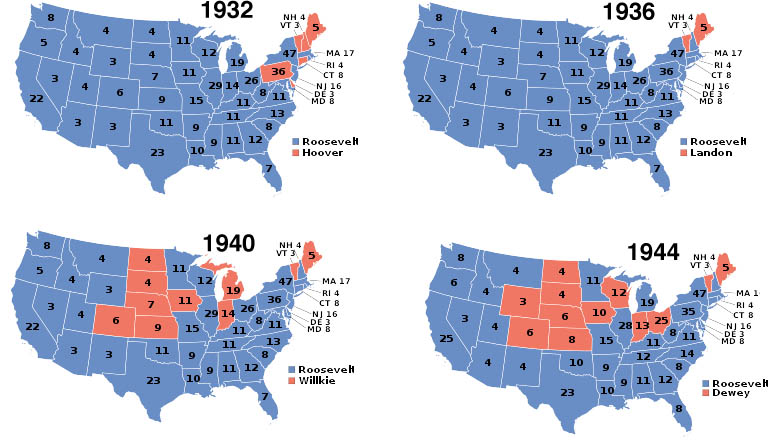
Note that Idaho, Montana, Texas, and the entire South were once Democratic strongholds and continued that way until Eisenhower swept the country—except the South—in 1952. It wasn't until 1964 (after Lyndon Johnson signed the Civil Rights Act in July 1964) that the South went Republican. If nothing else, this brief electoral history should show that in politics nothing is permanent. (V)
Moderators for December Debate Named
The sixth Democratic primary debate will be held at Loyola Marymount University in Los Angeles on Dec. 19, just 6 days before Christmas. In case anyone was planning to watch, the moderators have now been named. They are PBS' Judy Woodruff, Amna Nawaz, and Yamiche Alcindor, and Politico's Tim Alberta.
To qualify for the debate, a candidate needs 200,000 unique donors and either 4% in four national polls or 6% in two of the early states. So far, six candidates have qualified: Joe Biden, Pete Buttigieg, and Sens. Kamala Harris (D-CA), Amy Klobuchar, Elizabeth Warren, and Bernie Sanders (I-VT). Candidates have 2 more weeks to qualify. Sen. Cory Booker (D-NJ) has reached 200,000 donors, but hasn't met the polling requirements. All the others have steeper hills to climb.
If no more candidates qualify, DNC Chairman Tom Perez will have achieved his goal of narrowing the field without putting his thumb on the scale. The thresholds have been slowly raised over time and candidates have fallen by the wayside. Any candidate who doesn't make the December debate is history, with one possible exception: Michael Bloomberg. He isn't taking donations, so he can't possibly qualify, but with a $30 million ad buy in one week, he is trying to make himself a household name, even though he won't be on stage for any of the debates. (V)
North Carolina Senate Race Could Break Spending Records--Again
North Carolina combines two qualities that make its Senate races special. First, it is sort of purplish in the sense that since 2000, two Democrats and three Republicans have won Senate races there. Second, it has an unusually large number of expensive media markets. Combined, this makes for very expensive Senate elections. In 2014, the battle between then-senator Kay Hagan (D) and now-senator Thom Tillis (R) cost $124 million, a new record at the time. A few other races have topped that since, notably the 2018 Florida Senate race, which cost $213 million.
It already looks like 2020 will be another doozy in the Tar Heel State, as Tillis tries for a second term. Two national conservative groups that supported Tillis in 2014 are already on the air backing him again. The Koch brothers' network, Americans for Prosperity, is also getting involved. Since it dislikes Donald Trump intensely, it is going to invest heavily in keeping the Senate Republican, just in case a Democrat is elected president. The network is capable of spending hundreds of millions of dollars in 2020, much of it on perhaps a half dozen Senate races.
Another factor that will drive up the overall cost is that Tillis is facing a primary from wealthy businessman Garland Tucker, and that is going to be very expensive as well, since Tucker can, and will, spend his own money freely. Tucker's pitch is that he loves Trump more than Tillis does. In the Republican primary, that could be worth something but in the general election, not so much. Could Tucker beat him? It's possible. With a 33% approval rating, Tillis is the least-popular incumbent senator.
The Democrats don't have a candidate yet. Three people who are expected to run are state senators Erica Smith and Cal Cunningham, and Mecklenburg Commissioner Trevor Fuller. That is going to be an expensive race too. No matter who wins it, Tom Steyer has pledged to spend $4.5 million on the Senate and House races in North Carolina. In short, this is a good time to buy a television station in North Carolina. (V)
William Ruckelshaus Dies
With all the news about the impeachment, the Watergate scandal is often referred to. Not many people came out of that with shining reputations, but one of them who did was William Ruckelshaus. When Richard Nixon decided that the heat was too much, he ordered Attorney General Elliot Richardson to fire special prosecutor Archibald Cox. Richardson refused and resigned instead. That made his deputy, Ruckelshaus, the acting attorney general. So Nixon then ordered Ruckelshaus to fire Cox. He also refused, and resigned. This became known as the Saturday Night Massacre. Ruckelshaus died yesterday at 87.
After getting a "no" from Ruckelshaus, Nixon asked the next-highest ranking person at the Justice Dept., Solicitor General Robert Bork, to wield the hatchet, which Bork did. A week later, polls showed for the first time that a plurality of Americans wanted Nixon impeached. Bork was later nominated to the Supreme Court by Ronald Reagan, but he was rejected by the Senate, in part due to his decision to fire Cox.
In the Ukrainegate saga, no official as high as an acting attorney general has resigned rather than do something illegal that the president told him to do. Maybe all the pooh-bahs think everything is going to work out just fine for them, but history suggests otherwise. (V)
I Am Not a Crook: A Look at History's Most Scandalous Scandals, Part III
Our examination of historical scandals continues today. If you wish to read any of the previous entries:
- Scandals, Part I: The XYZ Affair, the Caning of Charles Sumner, Crédit Mobilier
- Scandals, Part II: The Petticoat Affair
Today's entry includes another Grant-era scandal, as well as our first non-American scandal (though one that did attract global attention).
- The Whiskey Ring, 1872-75 ("Ukrainekey Ring"): In the movie The Shawshank Redemption,
primary protagonist Andy Dufresne is an honest banker who is wrongfully convicted of murder, and in prison is compelled
to assist the corrupt warden as he executes all manner of unsavory and illegal financial schemes. "The funny thing is,
on the outside, I was an honest man, straight as an arrow," he observes. "I had to come to prison to be a crook."
A similar sort of dynamic played out multiple times during the presidency of Ulysses S. Grant. Being a military man who had primarily military men as friends and associates, Grant drew liberally from the ranks of the U.S. army as he staffed his presidential administration. The President eventually learned the hard way (and often with great reluctance) that even the most honest soldiers, once they got into politics, sometimes became crooks. That is what happened with the Whiskey Ring, which in many ways was the first "modern" political scandal.
During the Civil War, Gen. John McDonald commanded cavalry troops, and then served as an aide to Grant. When Grant was elected to the White House, he promptly appointed McDonald as Supervisor of Internal Revenue. That meant that McDonald was quite familiar with the federal government's procedures for bookkeeping and revenue collection, including weaknesses that might be exploited. He took that knowledge with him when Grant deployed him to Missouri in 1871. The President was preparing for his reelection bid, but his administration was already beset by a number of scandals, and so he was facing a serious challenge from the left. McDonald's assignment was to shore up the president's support in what was then a key swing state.
On his arrival in Missouri, it did not take long for McDonald to decide upon a corrupt course of action. That state was not only a major producer of its own commodities, it was also a major depot for commodities from other states that were headed south- or westward. And the particular commodity that was ripe for exploitation was whiskey, which was then being taxed at the rate of 70 cents/gallon (equivalent to a little less than $15/gallon today). There was a lot of whiskey flowing back then (no pun intended), it was poorly regulated, and that is a pretty hefty tax. McDonald very efficiently set up a network of distillers, shippers, tax collectors, and the like to participate in his scheme. The basic arrangement was that some whiskey (actually, quite a lot of whiskey) would be produced "off the books," would be taxed at a rate of only 35 cents/gallon, and would be stamped as "tax paid." This cut costs for the folks who were in the whiskey business and, since the transactions were off the books, the tax collectors could pocket all of the "tax" money charged on these barrels of whiskey.
McDonald's original plan, aided and abetted by other GOP operatives, was to take the money they were skimming and to put it in a slush fund to be used for political purposes (most obviously, to pay reporters to give favorable coverage to the Grant campaign). There was some of that done, but the amount of money rolling in was so great that the various participants also started filling their own pockets. In the span of one year, from November 1871 to November 1872, nine people (including McDonald) enriched themselves to the tune of $45,000 to $60,000 each (roughly $950,000 to $1,200,000 today). Grant was reelected, of course, but by then the participants were not especially concerned about politics. And once the need for pretense was gone, the matter became a wholly criminal enterprise. Eventually, the total take exceeded more than $1.5 million annually (roughly $31.5 million today).
McDonald and his confederates eventually came to believe that the Whiskey Ring was invulnerable, the logic being that everyone with knowledge of the scheme was also a participant, and thus was exposed to criminal liability if they dared say anything. Unfortunately for them, Secretary of the Treasury Benjamin Bristow—who, as a native Kentuckian, knew a few things about the production of whiskey—sensed that something was rotten in the state of Missouri. He organized a massive undercover scheme to unmask the Ring, executing what would now be called a "sting" (though that term was not coined until 100 years later). This culminated in a series of surprise raids on May 10, 1875, that broke the Whiskey Ring and resulted in a staggering 238 indictments and 110 convictions. McDonald, for his part, was sentenced to 18 months' hard labor.
Although Grant did not know about, or profit from, the Whiskey Ring, he knew that this scandal was as big as any that had beset his administration, and that he needed to take strong action. At the same time, he was personally wounded by the indictment of General Orville E. Babcock, another honest-soldier-turned-dishonest-politician, who was then serving as the President's personal secretary. To protect both himself and Babcock, Grant appointed the first ever special prosecutor in American history (General John Brooks Henderson), and also became the first sitting president to give testimony in a court trial. Ultimately, Grant's reputation and Babcock's bacon were both saved (despite the latter being unquestionably crooked). Meanwhile, when he got out of prison, McDonald authored the first-ever political scandal tell-all, titled Secrets of the Great Whiskey Ring, And Eighteen Months in the Penitentiary. Undoubtedly, he would also have appeared on Dancing with the Stars, had that been an option in 1877.
In his lifetime, Grant didn't suffer too much damage due to all of the scandals that beset his administration, and he died a great hero to the majority of Americans, with hundreds of thousands of them participating in his funeral procession in 1885. After he was gone, however, his enemies (Southerners, Democrats, and Southern Democrats) used the scandals to besmirch his reputation as president (partly fair) and as a general (not fair). He once ranked with Washington and Lincoln in the pantheon of great American heroes, but today he barely registers. At Gettysburg, the Civil War battlefield that attracts over a million tourists a year, the three best-selling t-shirts feature, respectively, Confederate generals Robert E. Lee, Thomas J. "Stonewall" Jackson, and Nathan Bedford Forrest, despite the fact that two of those three men were not present for that battle (and one of them, Jackson, was already dead by then). They don't sell Ulysses S. Grant t-shirts at all, because nobody wants to buy them. - The Dreyfus Affair, 1894-1906 ("Ukrainefus Affair"):
The historian Eric Hobsbawm, who died just a few years ago, spent much of his career writing three histories of Europe,
entitled The Age of Revolution: Europe 1789–1848, The Age of Capital: 1848–1875, and The Age of
Empire: 1875–1914. The central organizing concept for the series was what Hobsbawm called the
"long 19th century."
He believed that the mathematical bookends of the century (1801-1901) were not instructive, and that the narrative
really starts in 1789 (French Revolution) and ends in 1914 (outbreak of World War I). During that period, as Hobsbawm
documented across over 1,000 pages, the old world disappeared, to be replaced by a fundamentally different modern order.
That included the collapse of most European monarchies, the rise of factories, labor unrest, colonialism, large-scale immigrations,
broad technological change, and the emergence of modern-style warfare. Unsurprisingly, it was a time of much tension and violence.
One of the byproducts of all this change was the emergence of a new, and particularly virulent, strain of anti-Semitism. For many centuries, if not millennia, Jews had been persecuted on the basis of their religion. But by the mid-to-late nineteenth century, Europeans—on the whole—were not quite so fanatical about theology as they once had been. Consequently, "the Jews believe different things about God than we do" was not quite enough to get people's blood boiling. Thus emerged what is known as racial anti-Semitism; the core notion here is "the Jews are a different race than we are, and their foremost loyalty is to that race, not to the country in which they reside." The most famous expression of this new way of thinking, at least during the long 19th century, was the 1903 propaganda work The Protocols of the Elders of Zion, which purports to be the minutes of a late 19th-century meeting at which Jewish leaders discussed their plans for world domination. The most violent expression of this new way of thinking during the long 19th century was surely the pogroms that took place in Russia between 1881 and 1906, resulting in much harm done to the Jewish population there, including several thousand deaths.
In the late 1800s and early 1900s, as the long nineteenth century moved toward its denouement, France was at the center of all of these changes. They were the first to get rid of their monarchy, but then they brought it back, got rid of it again, brought it back again, and got rid of it again. By the 1870s, the French Third Republic had emerged. The governments of the Third Republic were highly polarized and were nearly overthrown several times. They had enormous difficulty coping with the military challenges of that era (particularly the Franco-Prussian War), the ongoing tensions between laborers and management, the effects of large-scale immigration to France (including many Jews), and the effects of urbanization, among other issues. To a large extent, broad agreement on the value of colonization and on the importance of maintaining France's colonial possessions in Africa and Asia was the unifying issue that kept everything from flying apart at the seams.
This is stage on which the tragedy of Alfred Dreyfus played out. Dreyfus was a career soldier who had attended the best French military schools and had risen to a position on the French army's general staff. However, there were also three "strikes" against him that would ultimately dictate his fate: (1) he was Jewish, (2) he was from a wealthy family, and (3) he came from an area along the border of France—Alsace-Lorraine—that had changed hands several times over the centuries, and that had been ceded to Germany while Dreyfus was a teenager. There was thus a dual basis for questioning his loyalties, as many of his contemporaries saw it: his Jewish heritage, and his "German" roots. So, when French intelligence figured out that someone on the general staff was funneling information to the German government, suspicion quickly fell on Dreyfus, and he was arrested on October 15, 1894. Thus began the Dreyfus Affair.
Dreyfus' court martial was nothing short of a sham. He was convicted on the basis of two things: (1) a note to the Germans found in a trash can, which was definitely by the spy, but was written in handwriting that did not match Dreyfus', and (2) the testimony of a French officer who said he had information pointing to Dreyfus' guilt but that he couldn't actually share it because to do so would reveal military secrets. Dreyfus was convicted, and in a shameful demonstration meant to appease the masses, he was marched through the streets of Paris, and his insignia of rank was physically ripped off his uniform. Just in case there was any question about the underlying dynamics here, the crowd chanted "Death to Judas, death to the Jew." Dreyfus responded: "I swear that I am innocent. I remain worthy of serving in the Army. Long live France! Long live the Army!" He was then sent to the notorious prison Devil's Island, a.k.a. the French answer to Alcatraz, to serve a life sentence.
It was while Dreyfus was in lockup that the already thin case against him completely collapsed. Another incriminating note, written in the same handwriting, was found in another trash can. Inasmuch as Dreyfus was imprisoned nearly 5,000 miles away, it was rather unlikely that he wrote it. Eventually, the new chief of French military intelligence, Lieutenant Colonel Georges Picquart, figured out that the real traitor was Major Ferdinand Walsin Esterhazy, who had motivation to sell secrets to the Germans because he was deeply in debt. So, Dreyfus was brought back to France and given a second trial in 1899. By this time, the case was a national and international sensation, and attracted vast attention, with very loud voices speaking up on both sides. Among the loudest advocates for Dreyfus was Émile Zola, popular author and liberal activist, who wrote a forceful and widely reprinted defense of Dreyfus entitled "J'Accuse." Unfortunately, the army and the always-shaky French government could not afford the loss of face that would come from admitting that the conviction was bogus. Further, Dreyfus was still Jewish and Esterhazy was not. So, the second trial resulted in a second conviction, while Esterhazy was quietly exonerated and sent to a faraway posting in Africa. Zola, for his trouble, was convicted of libel and had to flee to England.
The French president at that time, Émile Loubet, did not believe in Dreyfus' guilt, and feared that if an obviously innocent man were to be returned to his cell at the horrific Devil's Island, he would become a martyr and a cause celebré. So, Loubet offered a partial pardon just days after the trial, in which Dreyfus was freed from prison, but had to accept house arrest in France. Well aware of the horrors that awaited him if he returned to prison, Dreyfus took the deal, but remarked, "The government of the Republic has given me back my freedom. It is nothing for me without my honor." The house arrest finally ended in 1906, and Dreyfus retired from the French army in 1907. He was called back into service during World War I, however, and served with distinction, rising to the rank of lieutenant colonel.
Dreyfus died in 1935; the French Third Republic collapsed 5 years later. In 1995, the French government (by then, the French Fifth Republic) finally exonerated Dreyfus fully, and cleared his name. Meanwhile, one of the journalists who covered the Dreyfus Affair was Theodor Herzl, who took from it the conclusion that Jews would never be fully accepted by the nations of Europe, and that they needed their own nation. He was inspired to write Der Judenstaat, the founding document of political Zionism, a movement that led to the creation of the modern nation of Israel in 1947. (Z)
That brings us to six scandals in total. Next in line are Teapot Dome and Payola, which will undoubtedly mark the first time ever that those two rather dissimilar subjects have been written about side by side.
Back to the main page