Pres polls: (None)
Dem pickups: (None)
GOP pickups: (None)
Previous | Next
Iran Pokes Trump in the Eye; Trump Blinks
Donald Trump's foreign policy is a mystery to most people, including—very possibly—Trump himself. Decisions are made without much consideration of how they make sense in the context of what came before, or of what will come next. And the President, regardless of his insistence to the contrary, has shown no particular talent for negotiating or deal-making. To the extent that he has a "philosophy," it's "bluster, and then back down." James Monroe had a doctrine you might have heard about, Theodore Roosevelt was a "big stick" kinda guy, Woodrow Wilson preferred "moral diplomacy," and Theodore's cousin Franklin was a "good neighbor." Trump, by contrast, is a paper tiger.
The problem is that governments who are not so friendly to the United States are watching closely, and are generally run by people who are better at this than Trump is. That includes Iran, whose leaders are furious that Trump has canceled the Obama-era nuclear deal and slapped them with sanctions. They have taken stock of the situation, and noted the following:
- In terms of domestic politics, Trump cannot afford to start a war with Iran
- Also in terms of domestic politics, tension in the Middle East = more expensive oil = bad news for Trump
- In terms of foreign politics, Trump has no hope of building international consensus for a war with Iran
- Whenever someone stands up to him, Trump backs down (see Putin, Vladimir; bin Salman, Mohammad)
- Sometimes, he not only backs down, he actually tries to sell the enemy's version of events (e.g., "Russia says they didn't interfere in the election," "Kim Jong-Un definitely isn't testing nukes anymore," etc.)
Consequently, the Iranians have decided to make some mischief in the past couple of weeks. Here are the things they've done that are known (there may be others that remain secret):
- Earlier this month, they supplied missiles to Houthi rebels in Yemen, who used them to attack a Saudi airport
- Last week, they (according to U.S. Central Intelligence) attacked two oil tankers in the Strait of Hormuz
- Also last week, they announced they were going to exceed the uranium limits from the Obama-era nuclear deal
- And yesterday, they shot down an American drone
This would appear to be a dangerous game for the Iranians to play. After all, Trump made his feelings on this subject very clear just five weeks ago:
If Iran wants to fight, that will be the official end of Iran. Never threaten the United States again!
— Donald J. Trump (@realDonaldTrump) May 19, 2019
On top of that, the Iranians downed the drone knowing full well that the U.S. had deployed additional troops to the Middle East and that plans for a military strike of some sort were in full swing.
So, what did Trump do? Yet again, he blinked, calling off a strike that he'd already approved. He waited long enough that ships were in position, planes were in the air, and missiles were already targeted when the order to stand down came through. Not only that but, also once again, he got right to work peddling the enemy's version of events, and said that, "I think probably Iran made a mistake. I would imagine it was a general or somebody that made a mistake in shooting that drone down."
So, what is Iran thinking here? Well, the sanctions have somewhat destabilized the country and made the populace unhappy. In a country that overthrows its government almost as often as the French do, that has made President Hassan Rouhani and his administration nervous. Poking the bear—well, actually, the eagle—thus serves a useful political purpose. Beyond that, by pushing their luck (without going too far), the Iranians are putting pressure on the Trump administration to return to the bargaining table, and possibly to lift some or all of the sanctions.
Meanwhile, what will Team Trump do next? What we wrote at the top is true: even they don't know. NSA John Bolton, who might well be a reincarnated avatar of Gen. Curtis "bomb them back to the stone age" LeMay, wants to hit Iran hard. Trump, for the reasons outlined above, is leery. Secretary of State Mike Pompeo, incoming acting Secretary of Defense Mark Esper, and Vice President Mike Pence are all somewhere in the middle. All five have an active role in the discussions. And so, it's possible that Thursday's aborted mission will move forward, sometime this weekend or next week. Or, a scaled-down version could be ordered. But if we are to guess based on past experience, well, then the odds are that Iran has nothing to worry about. (Z)
Senate Pushes Back on Saudi Arms Deal
Iran is not the only Middle Eastern country giving Donald Trump a headache. Saudi Arabia, as you may have heard, is led by a murderer. Everyone already suspected that, and a U.N. report released earlier this week confirms it; investigators said that Mohammad bin Salman should be held criminally liable for the killing of Jamal Khashoggi.
Donald Trump, of course, is not so bothered by murderers. After all, he is the fellow who bragged about being able to get away with killing someone on Fifth Avenue. The President's concern becomes even fainter when big bucks are on the line. So, he is eager to proceed with the planned sale of $8 billion in arms to bin Salman and the Saudis. There are quite a few folks in the United States who think it's problematic to be in business with an unrepentant murderer, especially when that business is selling instruments of violence. And so, (some) Senate Republicans decided to vacate Trump's hip pocket on Thursday, and to pass several measures aimed at blocking the sale.
It was not a major rebellion against the President, as the vote on two of the measures was 53-45, while the vote on the third was 51-45. All the Democrats and Independents in the Senate voted for all three measures, while Sens. Susan Collins (R-ME), Lindsey Graham (R-SC), Mike Lee (R-UT), Jerry Moran (R-KS), Lisa Murkowski (R-AK), Rand Paul (R-KY) and Todd Young (R-IN) voted for at least one of them. Trump, of course, will veto all three, and bin Salman will get his tanks and bombs and guns. However, every time GOP members of Congress push back against Trump, particularly as the 2020 election looms, it raises the question of whether the tipping point might be nearing. After all, Dick Nixon enjoyed solid GOP support in the Senate, right up until he didn't anymore. (Z)
Hicks Transcript Is Out
In theory, it was supposed to take 48 hours for the House Judiciary Committee to produce a transcript of Hope Hicks' closed-door testimony from Wednesday. However, she didn't say very much, and the full two days was not necessary. So, the transcript is already out.
In total, it's 273 very repetitive pages that nobody wants to actually read. So, here are the major takeaways:
- Hicks conceded that she had told falsehoods on Donald Trump's behalf, but said she limited herself to
"white lies." Of course, another word for "white lies" is "lies."
- White House lawyers objected to just about every question Hicks was asked.
- Presumably emboldened by the lawyers, Hicks refused to answer 155 different questions.
- On those infrequent occasions when she did answer a question, it was often with a non-answer. For example, when asked if Trump told people to lie during the campaign, she said, "Not that I can recall." That's generally witness-speak for, "I don't want to say 'yes' and get my friend/ally/relative in trouble, but I also don't want to say 'no' and perjure myself."
Following Hicks' master class in stonewalling, the ball is in the court of Committee Chair Jerrold Nadler (D-NY) to decide if he wants to talk to her again, this time backed with a court order compelling her testimony. (Z)
Roy Moore Is In
The writing was on the wall. Or, maybe it was on the pages of a teenager's high school yearbook. Either way, all signs pointed to Roy Moore announcing another Senate run on Thursday, and he did exactly that. "Can I win? Yes, I can win. Not only can I, they know I can. That's why there is such opposition," he declared.
Moore is right, he certainly could win. He barely lost to Sen. Doug Jones (D-AL) in 2017, and if he gets the Republican nomination in 2020, he can count on lots of GOP voters showing up to the polls to pull the lever for Donald Trump. This is one reason that party leadership loathes him; for at least 6 years, they would be stuck with a member of their caucus who is a credibly accused child molester, and is also a loose cannon who says very impolitic things. He would be on Fox News (and platforms even further to the right) every week, making lots of the wrong kind of headlines. The other reason party leadership loathes him is that he could lose. He might be the only Republican in the state who could win the primary election and then lose the general.
These things being the case, the GOP pooh-bahs are already hard at work trying to defeat him. First of all, they are going to rip him to shreds anytime they have the chance. Sen. Martha McSally (R-AZ), who faces a tough reelection campaign in 2020, gave a preview on Thursday, observing that, "This place [Washington] has enough creepy old men." Other senators, including John Thune (R-SD), Cory Gardner (R-CO), and Mitch McConnell (R-KY) also took potshots. Beyond that, the National Republican Senatorial Committee (NRSC) is going to try to recruit a superstar to challenge Moore. Someone like, say, former senator Jeff Sessions. And whomever the NRSC is, or is not, able to recruit, they are going to lavish the most promising non-Moore candidate with money and other forms of support. This, of course, will cause Moore to double down on the shooting from the hip, so it's going to be an incredibly brutal primary.
If Moore does survive to the general, all of the nasty remarks from his fellow Republicans—like the "creepy old men" remark—will make a triumphant return in Doug Jones' campaign ads. It will also be interesting to see what Donald Trump does—Republicans are already pressing him to repudiate Moore—and if Trump's actions have an effect. After all, the President tried to derail Moore in 2017's primary and failed, and then tried to get him elected in the general, and failed again. In any case, this race is going to make a heck of a lot more headlines than your average Senate race. (Z)
Biden Steps In It, Again
Joe Biden would like you to know that he can work with anyone. "I will reach across the aisle" is a central theme of his campaign, second only to "I'm the most electable Democrat, because I can get the Obama-Trump voters back." To make this point, he talked this week about his productive relationship (many years ago) with former Mississippi senator James O. Eastland, a man who frequently declared black people to be an "inferior race." "He never called me 'boy,' he always called me 'son,'" recalled Biden. The Democratic frontrunner also made the same basic point using former Georgia senator Herman Talmadge, who led the opposition to Brown v. Board and spent much of his career trying to find ways to re-segregate schools.
"Joe Biden can work with difficult people" is one possible message here. However, another one is, "Joe Biden has no problem working with bigots." And yet another is, "Joe Biden doesn't really understand what it's like to be a victim of racism." That "boy" anecdote was particularly clumsy in this regard. It brings to mind the episode of "All in the Family" in which a black repairman objects to Archie Bunker calling him "boy," pointing out that he's a man and expects to be treated as such. "I'm a man too, but I don't go around making a point of it," says Archie. "You never had to make a point of it," says the repairman. Point being, the fact that Eastland treated Biden respectfully and did not call him "boy," tells us only one thing for certain: That Biden is not black. The former veep clearly doesn't grasp that, and so for him to tell that particular story was yet another patented Joe Biden gaffe.
Since Biden stepped in it, he's been taking flak from many of his competitors (Bill de Blasio, Kamala Harris, Cory Booker, Elizabeth Warren), and from other Democrats as well. He called Booker, who has been the loudest critic, to clear the air, but it did not go well. Biden has also categorically refused to apologize for the statements, saying he stands by them, and the basic point he was trying to make.
There are actually quite a few takeaways from this story. The first, which we should probably make into a macro, is that Biden makes a lot of needless mistakes, particularly for a guy that has been in politics for half a century. The second is that Biden, like Donald Trump, rarely admits to errors. That may make him seem "strong" to some voters, but it will be a turnoff to others. The third is that Biden is kind of out of step with the modern Democratic Party. And the fourth is that, because of his service and friendship with Barack Obama, he's concluded that he's got the black vote in the bag, and need not worry overmuch about their concerns and sensitivities. Thus far, the polls back him up on that, though at least one black pundit thinks Uncle Joe is playing with fire. (Z)
It's Summer, and That Means Fish Fry Day
Rep. Jim Clyburn (D-SC), the highest-ranking black politician in the country by virtue of his position as house majority whip, will hold his annual fish fry today and tomorrow in Columbia, SC. Clyburn is ready: he has ordered 4,400 pounds of fish and 6,400 slices of bread, which would seem to suggest that every fish sandwich will have 1.4 pounds of fish on it. Clyburn started the tradition three decades ago as a way to thank his campaign workers who couldn't afford to go to the official South Carolina Democratic Party dinner, with its $250 ticket price. Now thousands of people show up with Clyburn's encouragement.
Since South Carolina is one of the four early voting states and 60% of South Carolina's Democrats are black, Democratic presidential candidates flock to it like bears going after honey. Clyburn will politely introduce each one and give them a little time to speak. Then they can mingle with the crowd and try out their pitches to see how black voters react to their views on health care, education, climate change, impeachment, etc.
Clyburn hasn't endorsed any candidate yet, and probably won't for a while, if at all. As the #3 Democrat in the House, he is about as establishment as they come. Furthermore, he is close to Joe Biden, so if he eventually came out in favor of the former vice president, very few people would be surprised (he's been defending Biden's remarks about James Eastland and Herman Talmadge; see above). In addition, black voters, especially rural ones, are not nearly as liberal as urban white millennials, so he probably doesn't want to endorse someone his constituents don't especially like. He is surely aware that in 2016, Hillary Clinton got 73% of the vote in the South Carolina primary to Bernie Sanders' 26%. While endorsements mean less and less these days, Clyburn is a revered figure among the state's black population and his choice still carries a lot of weight, especially with older black voters.
A recent Post and Courier poll of the Palmetto State has Biden way ahead, as he is nationally. Here are the results for the candidates above 1%:
| Candidate | Pct. |
| Joe Biden | 37% |
| Elizabeth Warren | 17% |
| Pete Buttigieg | 11% |
| Kamala Harris | 9% |
| Bernie Sanders | 9% |
| Cory Booker | 5% |
| Beto O'Rourke | 4% |
| Andrew Yang | 3% |
Here again we see that Sen. Elizabeth Warren's (D-MA) surge is no fluke, as she is the clear second choice here, as in other polls. What is especially noteworthy is that Sen. Kamala Harris (D-CA) is tied for 4th place and Sen. Cory Booker (D-NJ) is in 6th place. If Booker gets 5% of the vote and comes in 6th in a state where 60% of the primary electorate is black, it is hard to see him lasting even another week. Harris, on the other hand, gets a second chance as California votes three days after South Carolina. If she does very well there, South Carolina will be soon forgotten. (V)
RNC Raises $14.6 Million in May
Both parties' national committees are raising money as fast as they can. The RNC announced its May haul yesterday. It took in $14.6 million, which is very good more than a year before the election. For 2019, the RNC has brought in the phenomenal total of $76 million. It ended May with $37 million cash on hand. A million dollars of the money it spent went to Parscale Strategy, the firm owned by Donald Trump's campaign manager Brad Parscale. This is perfectly legal, but having the money donors gave to the RNC to elect Republicans end up in the personal bank account of Trump's campaign manager looks a bit sleazy.
The DNC has not released its May totals yet, but so far this year the RNC has outraised the DNC by a large amount.
Also, historically, the RNC has outraised the DNC, as shown by this graph from
Open Secrets:
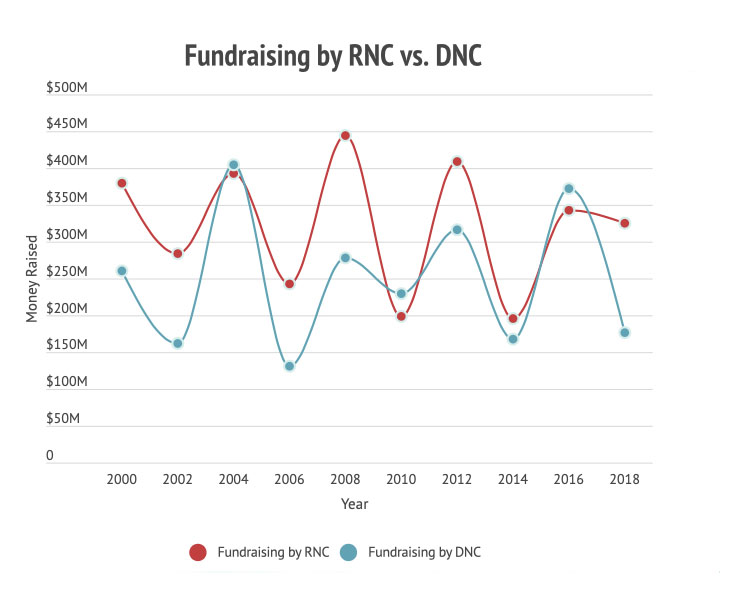
Come next year, Ronna Romney McDaniel, the chairwoman of the RNC, is going to have a problem. Trump will no doubt ask her to spend almost everything she's got to help him get reelected. But she has other constituents as well. In particular, with Roy Moore's entry into the Senate race, Doug Jones just got a shot in the arm, and the GOP's chances of holding the Senate just went down a little. Consequently, McDaniel might want to spend big on Senate races in tough states, especially Arizona, Colorado, North Carolina, and Maine, which could put her in conflict with Trump. Now, as it turns out, she has an uncle who is actually a member of the Senate. He could defend her in public if she decided to make holding the Senate a priority. However, aforementioned uncle, who shall here remain nameless, is something of a coward and is unlikely to stand up and say that holding the Senate is even more important than holding the White House, even though that is probably actually the case. (V)
DCCC Outraises NRCC in May
While the RNC is beating the DNC, at the congressional level, the Democrats are doing better. The DCCC raised $8.9 million in May, vs. the NRCC's haul of $4.8 million. However, the NRCC has more cash on hand ($20.5 million vs. $17.1 million)
The DCCC, whose job is electing Democrats to the House, is run by Rep. Cheri Bustos (D-IL), a moderate Democrat who is making a strong pitch that the only way the Democrats can keep the House and maybe add to their majority is by appealing to moderate voters. She, herself, represents IL-17, a district Donald Trump won in 2016. Nevertheless, her margin of victory was over 20 points. After the Democrats picked up several seats in conservative Orange County, CA, in 2018, she is making Texas her biggest target in 2020.
Democratic Presidential Candidate Update: Mayor Pete Buttigieg (D-South Bend)
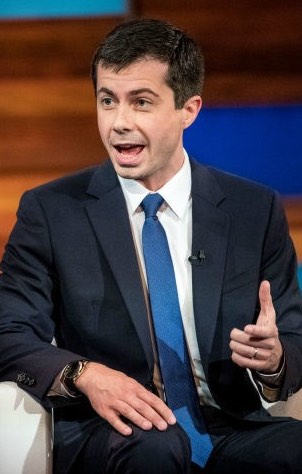
He's had the roughest week of his campaign so far, and that means lots of headlines. So, Pete Buttigieg is up. Here is our original profile of him.
- Where Have They Been Recently?: Buttigieg is in South Carolina this weekend;
one wonders if that is a coincidence or a last-second change, given the next item on this list.
Otherwise, he's spent about a third of his time in New Hampshire, and about two-thirds in Iowa. His
campaign does not appear to have heard of Nevada, on the other hand. He was also briefly in Washington, D.C.
last week, where he
joined in
on an anti-Trump rally outside the White House.
- Recent News: Joe Biden isn't the only candidate who had a tough time
with black voters this week. Buttigieg, who already had issues on that front because of his firing
of South Bend's black police chief a couple of years ago, had to rush home and deal with the fallout
after a white police officer shot and killed a black suspect under questionable circumstances.
Things might be clearer, except that the officer's body camera was off, meaning there is no
recording of the incident. Buttigieg
responded
to the situation by ordering that police cameras be turned on during all interactions with suspects,
and by giving more than one speech about "striving to reach out to community members." Not
everyone was satisfied with the response, though, and the whole thing served to bring renewed attention to
one of Buttigieg's biggest areas of weakness.
- Offbeat News: Most presidents and presidential candidates have a group
of trusted advisors they lean on, and some of these are so well known they even have a name. Andrew
Jackson had his kitchen cabinet, for example, while Franklin D. Roosevelt had the Brain Trust. For
Buttigieg, it's five friends from his time at Harvard that call themselves
The Order of the Kong,
after the
Chinese restaurant
in Harvard Square where they used to meet to eat and talk politics.
- Finances: He reported a little over $7 million in Q1, and we already
know he pulled in another $7 million in April. He's also been pushing his donors hard, in order to put
up a big, shiny number, so expect his Q2 total (which will be announced in a couple of weeks) to be
gaudy.
- Polls: He's averaging 7.1% across all major polls, which is enough to
secure him a Democratic debate seat for a good long time. His best result so far is a 10%, in an
Economist/YouGov
poll earlier this month.
- What Did We Guess His Signature Issue Would Be?: Urban renewal.
- What Appears to Be His Signature Issue Now?: He does not seem to have
one. When asked, he will generally explain his take on a particular issue, and very lucidly.
However, he has not committed to a central theme that we can detect. The
"issues"
page of his website mentions no actual issues, and has 108 words' worth of politician-speak, like
"It's time to reclaim the values that drive our policy decisions" and "It's not just about winning
an election; it's about winning an era."
- Strengths for the Democratic Primaries: (1) Wow, is he good at raising
money; (2) He may be the most skilled user of social media among the members of the Democratic field
(at worst, he's top three); and (3) This could come down to him and three septuagenarians, and if
so, he could get a lot of votes from people who want someone at or near their age or who worry about
someone being in the White House into their 80s.
- Weaknesses for the Democratic Primaries: (1) He's a wonky mix of yins
and yangs—gay and religious, Midwestern and progressive, young and pro-military—and
while that may allow him to claim votes from all of those interest groups, it might also serve to
turn all of them off; (2) His problems with black voters (who also happen to be the least pro-LGBTQ
segment of the Party) are not going away; and (3) His lack of specific policy proposals appears to
be out of step with this year's Democratic electorate.
- Buttigieg on Trump: "Whenever someone discussing Democratic strategy
says 'but [bad idea] seems to work well for Trump,' remind them how consistently and deeply
unpopular this presidency is with the American people." (1/13/19)
- Trump on Buttigieg: "Hard to believe that @FoxNews is wasting airtime
on Mayor Pete, as Chris Wallace likes to call him. Fox is moving more and more to the losing (wrong)
side in covering the Dems. They got dumped from the Democrats boring debates, and they just want in.
They forgot the people who got them there. Chris Wallace said, 'I actually think, whether you like
his opinions or not, that Mayor Pete has a lot of substance...fascinating biography.' Gee, he never
speaks well of me—I like Mike Wallace better...and Alfred E. Newman will never be President!"
(5/19/19)
- The Bottom Line: Buttigieg is not one of the frontrunners right now, but he's in the position a candidate can make a move from if and when one of the frontrunners falters. That's not a bad place to be for someone who was essentially unknown six months ago.
You can access the list of candidate profiles by clicking on the 2020 Dem candidates link in the menu to the left of the map. (Z)
Back to the main page