Previous | Next
Intelligence Committee Will Circulate Draft Report Today
The House Intelligence Committee is expected to circulate a draft report on its impeachment hearings today. Members will get 24 hours to read the document. Tomorrow, the committee will vote on whether to send it to the Judiciary Committee for action. The vote is expected to be strictly along party lines, with every Democrat approving and every Republican opposing.
Assuming the report is sent to the Judiciary Committee—and the odds of that happening are north of 99.99%—they will have to decide what to do with it. After this week's scheduled hearings, Judiciary is expected to hold one more hearing, sometime in mid-December, to present its case against the president. Then it will have to decide whether to draw up articles of impeachment. The smart money is betting that it will. One article will probably be abuse of power. However, some Democrats want additional articles, such as obstruction of justice. No one really knows yet how many articles will be drawn up, but the odds are very high there will be at least one. (V)
Ranking Republican on Judiciary Committee Wants Schiff to Testify
Rep. Doug Collins (R-GA), the ranking member of the House Judiciary Committee, told Fox News' Chris Wallace yesterday that he wants Rep. Adam Schiff (D-CA) to testify before the committee. Collins and other Republicans believe Schiff has been running a kangaroo court. They would love to make the Judiciary Committee hearings about Schiff and his alleged misdeeds rather than about Trump and his alleged misdeeds. As of yesterday, Collins hadn't seen the report Schiff is writing, but he has a strong hunch that it will not be terribly favorable to Trump, and so he decided it is better to be playing offense than defense. There is no chance whatsoever that Judiciary Committee Chair Jerrold Nadler (D-NY) will make Schiff testify.
Collins isn't the only Republican trying to save Trump. Rep. Tom McClintock (R-CA) made the case on ABC yesterday for having Trump's lawyers take part in the Judiciary proceedings. Rep. Andy Biggs (R-AZ) told Fox News' Mike Emanuel: "I don't think things have been done the way they've been done in the past." Sen. John Kennedy (R-LA) argued that both Russia and Ukraine meddled in the 2016 election. Note that none of these Republicans are saying that Trump is innocent. They are merely trying to change the subject to something other than his guilt or innocence.
Late Sunday, the White House announced that neither the President nor his lawyers will be participating in the first round of hearings held by the Judiciary Committee. Here is the official explanation from White House counsel Pat Cipollone:
We cannot fairly be expected to participate in a hearing while the witnesses are yet to be named and while it remains unclear whether the Judiciary Committee will afford the President a fair process through additional hearings. More importantly, an invitation to an academic discussion with law professors does not begin to provide the President with any semblance of a fair process. Accordingly, under the current circumstances, we do not intend to participate in your Wednesday hearing.
This, of course, has nothing to do with what's really going on. There is zero chance that Trump himself will appear, since he would almost certainly say something detrimental to his own case. If his lawyers showed up, however, they could join with House Republicans in trying to gum up the works and to undermine the whole process. On the other hand, showing up would also give legitimacy to the proceedings, and would allow the Democrats to claim the President got a fair hearing. Clearly, Team Trump decided that they will allow the GOP members on the committee to tote their water. Undoubtedly, Reps. Jim Jordan (R-OH) and Matt Gaetz (R-FL) will take a leading role in the defense of Trump, though they will undoubtedly be assisted by McClintock, Louie Gohmert (R-TX), and a few others. Cipollone has reserved the right to participate in future hearings, presumably as insurance in case Jordan, Gaetz, et al. don't do a good enough job. (V & Z)
Biden Will Crisscross Iowa for 8 Days
Joe Biden is starting to realize that a poor showing in Iowa could lead to a poor showing in New Hampshire and possibly a poor showing everywhere else, and he is determined to prevent that. Consequently, on Saturday he began an 8-day, 800-mile "no malarkey" bus trip across Iowa to meet the voters. At one time, Biden had a commanding lead in the Hawkeye State, but he is now fighting off three other candidates, Sens. Elizabeth Warren (D-MA) and Bernie Sanders (I-VT), and Mayor Pete Buttigieg (D-South Bend), for the top spot.
Biden has much less money in the bank than the other candidates, so a bus trip makes sense. It's cheap and Iowa voters like to meet the candidates personally. In rural Iowa, he plans to talk about agriculture, health care, education, and climate change. The trip started in Council Bluffs and will move across the northern half of the state from west to east. The trip will end in Cedar Rapids.
A number of the stops are scripted and corny (no Iowa pun intended), but that's who he is. For example, on Saturday he brought some doughnuts to a fire station. That could be considered a gaffe. After all, police officers are considered bigger doughnut consumers than firefighters. (V)
Booker is Desperate for Donors
Sen. Cory Booker (D-NJ) needs more donors to qualify for the December debate, so he went on "Face the Nation" to beg for money, saying literally: "If you want me in this race, if you want my voice and message—which is resonating—then I need help." Actually, it is not resonating at all. His favorable rating is at 35% and his unfavorable rating is at 43%. His Real Clear Politics polling average is 1.8%. That puts him in ninth place. If he doesn't make the debate, he will probably be forced to drop out. (V)
Candidates on the Cusp
Cory Booker isn't the only candidate trying to make the December debate. At least three other candidates are close to making the cut, but aren't there yet. Andrew Yang surprisingly raised $750,000 from 18,000 donors on Nov. 30, without any special event or plea on national television. He is now over the donor hump, but needs another poll to qualify. Rep. Tulsi Gabbard (D-HI) also passed the donor threshold and also needs one more poll to qualify. Billionaire Tom Steyer has made the polling threshold, but needs more donors. It is just possible that even the people who support him don't want to give money to a billionaire.
So far six candidates have qualified. If Yang, Gabbard, and Steyer make it, there will be nine on the stage when the next debate happens. (V)
Joe Sestak, We Hardly Knew Ye
While the third-tier Democratic candidates try desperately to make the next debate stage, a fourth-tier (or maybe fifth-tier?) candidate has decided to throw in the towel. Former Pennsylvania representative Joe Sestak figured out that it's quite difficult to win with approximately 0.0% of the vote, and issued a statement announcing his withdrawal from the race.
Sestak's main selling points were his successful military career (he would have been the highest-ranking naval officer, and the only admiral, to serve as president, had he won) and his willingness to do the hard work of retail campaigning, often staging "walks" where he would trudge across a city, a county, or a whole state over the course of days/weeks, pressing the flesh with voters. The problem is that while his approach worked for his races for the House, it did not scale well in two races for the Senate, and it definitely did not scale as he waged a late-to-the-party presidential bid. Not only did he fail to make any debate cut, he raised virtually no money, and never got above 1% in any poll.
The departure of Sestak and Wayne Messam from the race leaves Sen. Michael Bennet (D-CO) and Gov. Steve Bullock (D-MT) as the two longest shots left in the Democratic field, if you only count candidates that pollsters actually ask about. Each is averaging 0.4% in national polls. If you count candidates that pollsters no longer bother to ask about, then the longest shots left are former representative John Delaney and author and faith healer Marianne Williamson. (Z)
Disinformation Will Run Rampant in 2020
Tech companies are paying a bit of attention to the spread of disinformation and trolls, but the steps they have taken will barely make a dent in the flood of intentionally fake news, especially on social media. One expert, Paul Barrett of New York University, expects the majority of disinformation in 2020 to come from American, not Russian, sources. Some candidates and parties have already figured out that there is almost no downside to posting completely fake stories because the chances of getting caught are low and the libel laws make it hard for anyone to do anything about it even if they do get caught. So why not dream up some juicy scandal about your opponent? Some people are bound to believe it.
The tech companies can't be expected to figure out where the line is between routine mudslinging and stuff that is beyond the pale. If someone claims online to have been sexually assaulted by a candidate, is Facebook required (or even allowed) to conduct its own investigation to see if the statement is true? And when the source of a contentious posting is an American, tech companies can't use such markers as IP address or bad grammar to try to weed them out.
In addition, all the bad actors have learned from 2016 what works, what doesn't, and what is least likely to trap you. That means the attacks will only get more sophisticated over time. For example, a candidate or party can post a statement that has a kernel of truth to it, but is very misleading at best, or contains a mix of truths, half-truths, and lies. For example, consider these statements:
- Hunter Biden worked for a corrupt company in Ukraine
- When he was vice president, Joe Biden tried to get the prosecutor general of Ukraine fired
Both statements are true, but give the impression that Joe tried to get rid of the prosecutor general so the company his son worked for wouldn't be prosecuted. Actually, Biden was following U.S. policy, and worked to replace a corrupt prosecutor general who refused to go after corrupt companies with one who would. Should Facebook or Twitter censor a post that contained the above (true) statements? Where should they draw the line? It is hard to imagine a human censor making the right call all the time (whatever the right call may be) and inconceivable that an algorithm could do it. So take everything you read on social media with a barrel of salt. (V)
Adam Schiff's Star Is Rising
House Intelligence Committee Chairman Adam Schiff is a mild-mannered, self-effacing vegetarian, but on account of his role running the impeachment hearings, his star is rising. No matter what happens in the Senate trial, many California Democrats see a bright future for the 59-year-old representative.
Speaker Nancy Pelosi (D-CA) has said that she will not run for speaker in January 2023, so House Democrats will need a new leader, either as speaker or minority leader, depending on whether they are in the majority or minority. The Democratic bench is a bit long in the tooth. The current majority leader, Steny Hoyer (D-MD), will be 83 when Pelosi steps down. The Democratic whip, Jim Clyburn (D-SC), will be only 82 then, but that is still on the elderly side. Some Democrats see Schiff as the next speaker.
On the other hand, the Senate is also a possibility for Schiff. Sen. Dianne Feinstein (D-CA) will be 91 when her term ends in January 2025. Unless she is hoping to break the record of former senator Strom Thurmond, and serve until she is 100, she is likely to retire, so Schiff could run for her seat in 2024.
But a California Senate seat might come up earlier. If a Democrat is elected president in 2020, the seat of Sen. Kamala Harris (D-CA) may become vacant. This could happen if (1) she is elected president or, (2) she is elected vice president, or (3) she is appointed to the cabinet, with the AG position being the most likely slot for her since she was once AG of California.
Finally, the big one. If Donald Trump is either convicted or forced to resign, Democrats will regard Schiff as a giant killer and will urge him to run for president. It is too late for 2020, but depending on who wins next year, 2024 or 2028 are possibilities for him.
Schiff is playing his cards close to his vest and not talking about any future plans. Nevertheless, he is using his newfound fame to make friends. In the 2016 election cycle, he donated only $13,500 to fellow House Democrats. In 2018, he donated $537,000 to Democratic House candidates. In 2020, it is sure to be much more. He has already raised $4.4 million this cycle and has $6.8 million in the bank. Since his CA-28 district is D+26, he doesn't even have to bother campaigning, let alone spend money on television ads. So he has a rather large pot of money to distribute to people needing some campaign cash right now. Some day he may want to call those chits in. (V)
The Youngest Potential Voters Are Not Interested in Voting
During the Vietnam War, men from 18 to 21 were drafted to go fight and, in some cases, die for their country, but they had no say in electing the officials who could order them to do this. Among the many protests of that era was one demanding that the voting age be aligned with the draft age. Many people agreed, and it took only 3 months for the 26th Amendment to be ratified by 38 states, the 38th one occurring on July 1, 1971. That amendment lowered the voting age to 18 nationwide.
It's not clear why they bothered, since 18-19 year olds have only scant interest in voting. In 2018, the turnout among 18-19 year olds was a mere 23%, with it being as low as 13% in a number of states (e.g., Arkansas and Oklahoma). But even in urban New York state it was only 16%. Here is a map of turnout by state:
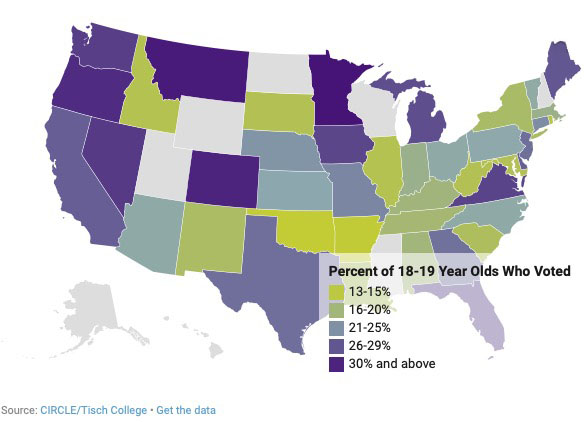
Across all age groups, turnout was 50% in 2018, also not so great, but better than 23%. And this despite many bitterly fought races and strong polarization nationally.
There are various steps that can be taken to improve turnout among young people generally. Making registration easier is one. Eliminating photo ID laws is a second. Preregistering 16 and 17 year olds is a third. None of these are likely to happen if Republicans have their say, because they know young people skew Democratic, so the fewer of them that vote, the better for the GOP. (V)
Poll: Republican Voters Think that Trump Is a Better Leader than Abraham Lincoln
An Economist/YouGov poll just released shows that 53% of Republicans believe that Donald Trump is a better president than Abraham Lincoln. Among Democrats, 94% prefer Abe to the Donald. Interestingly, 10% of black voters think Trump is better. Possibly some of them may not have been paying sufficient attention in school when the subject of who freed the slaves was being discussed.
The poll asked many other questions. For example, people were asked if they had a very or somewhat favorable view of various public figures, including Rudy Giuliani (31%), Rep. Adam Schiff (30%), Secretary of State Mike Pompeo (29%), AG William Barr (28%), Rep. Devin Nunes (23%), and Acting Chief of Staff Mick Mulvaney (17%). A poll in which Rudy Giuliani is the most popular guy in town is, at the very least, surprising.
YouGov also asked about the honesty of the various witnesses who testified before Congress on impeachment. The most watched witnesses were Gordon Sondland (62%), Fiona Hill (55%), and Marie Yovanovitch (53%). When asked if they were at least more true than not true, the scores were Sondland (46%), Hill (44%), and Yovanovitch (40%). Relatively few people felt that any of the witnesses were lying, but most people didn't see many of the witnesses testify. (V)
I Am Not a Crook: A Look at History's Most Scandalous Scandals, Part IV
Time for some more scandals! If you wish to read any of the previous entries in this series:
- Scandals, Part I: The XYZ Affair, the Caning of Charles Sumner, Crédit Mobilier
- Scandals, Part II: The Petticoat Affair
- Scandals, Part III: The Whiskey Ring, the Dreyfus Affair
We start today with a scandal that may just have a few rather significant modern-day implications.
- Teapot Dome, 1921-23 ("Ukrainepot Dome"): "I have no trouble with my enemies. I can take
care of my enemies in a fight. But my friends, my goddamned friends, they're the ones who keep me walking the floor at
nights!" President Warren Harding once said that to Kansas newspaperman William Allen White, and clearly knew what
he was talking about, since it was his "friends" in the cabinet who made the Harding administration one of the most
corrupt in U.S. history, while permanently (and partly unfairly) sullying the President's reputation.
Teapot Dome was a good old-fashioned example of pure American graft. On the political side of things, the central figure was Secretary of the Interior Albert Bacon Fall. In the early 20th century, the United States Navy transitioned from coal-powered to oil-powered ships, and the federal government set aside substantial oil reserves to make sure those ships had the fuel they needed. In 1921, Harding transferred the responsibility for overseeing those reserves from the Department of the Navy to the Department of the Interior. Not a good decision, as it turns out.
Under the terms of the Mineral Leasing Act of 1920, the Secretary was empowered to grant drilling leases to private corporations. Further, and critically, he was allowed to accept no-bid contracts. How Congress did not see the potential for wrongdoing here will forever remain a mystery, but it quickly occurred to Fall that there was lots of money to be skimmed. He gave drilling contracts to oil barons Harry F. Sinclair and Edward L. Doheny at well below market rates. In exchange, Fall received gifts and cash valued at about $400,000 in 1920s money ($6 million today), as well as an interest-free $100,000 loan ($1.5 million today) from Doheny.
If Fall had kept his good (and ill-gotten) fortune to himself for a year or two, he might well have gotten away with it. But like the Wild West cowboy who just robbed the bank, Fall felt the need to flaunt his wealth. He moved into a much nicer house, started wearing very expensive clothes, and bought a fancy car. A nice trick for someone with a salary of $7,500 a year ($90,000 today). Eventually, several members of the U.S. Senate were alerted that something fishy was going on, and Sen. Thomas J. Walsh (D-MT) oversaw a two-year investigation. Fall worked very hard to cover his tracks, and engaged in various forms of skullduggery that would inspire future crooked politicians, like sending goons to break into senatorial offices in search of dirt.
Ultimately, the unrelenting Walsh won the chess game. It was actually the $100,000 loan that did Fall in, since—in contrast to the gifts and cash—it involved a promissory note, and thus a paper trail. Fall went on trial in 1924, and was sentenced to a year in jail. He thus became the first cabinet official in U.S. history to do time. Sinclair got six months, while Doheny was acquitted. Clearly, Doheny had a better lawyer.
Teapot Dome had a number of long-term implications. Doheny's story became the basis for Upton Sinclair's exposé Oil!, which in turn became the basis for the movie There Will Be Blood. Meanwhile, although Harding did not know about the scam, his errors helped facilitate it. Although quite popular when he died suddenly in 1923, his reputation took a major hit once the corruption saw the light of day, and has never recovered. More significantly, in an effort to forestall future malfeasance of the sort that Fall engaged in, Congress passed a law that allowed them to see the tax returns of any American. On top of that, in 1927—as part of the investigation into Fall's accomplices in the executive branch—they were victorious in the Supreme Court case McGrain v. Daugherty, which affirmed for the first time that Congress has the power to compel testimony. We're not sure if Congress' right to demand tax returns and/or testimony ever came up after Teapot Dome, though. Someone should look into that. - Payola, 1959-62 ("Ukraineola Scandal"): Let's start with a brief thought exercise. Imagine
someone you know who is at least 65 years old. Do you think that person knows what a
tramp stamp
is? What
YOLO
means? What you are suggesting when you tell someone to
keep it 100?
What you are proposing if you ask someone it they would like to come over to your place and
Netflix and chill?
The odds are pretty good that the average senior citizen today would not understand all (or even most) of these. Keep
that in mind, it will soon be relevant.
Today, with only very rare exceptions, rock and roll is not only uncontroversial, it's downright tame. You might hear a Chuck Berry song on an elevator, or an Elvis Presley song in your dentist's office, or a Little Richard song while shopping for ice cream at the grocery store. But it was not always so. When the genre first emerged in the late 1940s or early 1950s, it made certain people quite unhappy. Mostly older white people. They did not care for the rebellious messaging associated with rock music, nor the sexually charged dancing. And they particularly did not care for the fact that nearly all early rock music (which, at that point, was called "rhythm and blues") was created by black musicians. The white folks called it "race music." If major department stores (particularly in the South) had tried to stock Chuck Berry's or Little Richard's or Fats Domino's records, many white customers would have been outraged. And so, rock records by black artists were not for sale in most department stores in the 1950s. And since shopping malls, anchored by these department stores, were the new thing (Southdale, the first modern shopping mall, opened in Minnesota in 1956), that meant that a major retail channel was not available to black artists.
The controversy surrounding rock music, and the undercurrent of racism therein, would play a rather sizable role in the career of Alan Freed, who was one of America's most popular disc jockeys after World War II. Though a white man, Freed recognized at the start of the 1950s that this new music was going to be the next big thing. He also knew that if he tried to sell commercials to his white advertisers on "Alan Freed's Rhythm and Blues Hour," they would turn up their noses and say, "Isn't that race music?" So, as a relatively hip fellow, he drew on his knowledge of youth slang. He was aware that, following the success of blues singer Trixie Smith's 1923 hit "My Man Rocks Me with One Steady Roll," "rock and roll" had been adopted by young black listeners as slang for "sex," and that young white listeners eventually became aware of the term as well. So, Freed named his rhythm-and-blues-based show "Moon Dog's Rock and Roll House Party." He recognized that his old, white advertisers would largely be unaware of the meaning (remember "Netflix and chill" from the opening paragraph), while his youthful potential listeners would be intrigued by a show that, to them, essentially read as "Moon Dog's Sex Party." Obviously, the name stuck. Meanwhile, Freed also held dance parties where—brace yourself—white and black kids sometimes danced together. We hope you were near your fainting couch when you read that part.
It was not long before major record labels like Capitol and Parlophone recognized the commercial potential of this "rock and roll" that kids were listening to, and they wanted in on the profits. But again, record stores weren't willing to carry rock songs by black artists. The big labels couldn't use the same dodge that Freed had, so they came up with a different idea. After a black artist released a new song, invariably on a tiny label with limited market clout like Chess or Sun, the big label would hire a white artist—most commonly Pat Boone—to perform a cover version (entirely legal under American copyright law). For example, here is Little Richard, performing "Tutti Frutti":
And here is Pat Boone, performing his white cover of "Tutti Frutti":
Boone's version is grossly inferior, to the point of being unlistenable. However, it had the backing of a major record label, and was sold in department stores. Little Richard's version did not, and was not. And so Boone's version sold far more copies.
This arrangement was naturally very aggravating to black rock and roll artists, and to the tiny and cash-strapped record labels that were recording them. Little Richard fought back by making sure that his next song ("Good Golly Miss Molly") was so fast and so high-pitched, Boone could not possibly cover it. However, that was not viable for most artists. And so, they came up with a different workaround. They approached black-friendly DJs, most notably Alan Freed and Dick Clark, and proposed a deal that went something like this: "We will give you the first copies of records by black artists, along with some money. In exchange, you agree to play the records at least 20 times, and after each play you encourage your audience to special order a copy if they liked it."
The appeal of this approach to the black artists and their record labels was obvious, as they got some very effective and low-cost advertising (usually, the cash consideration was only $50 or $100) that actually had a chance of selling some records. Sears or Newberry's might not stock Chuck Berry records, but they'd certainly accommodate an order from a customer. For DJs, they got first access to the best and latest music, and also a little pocket money on top. Win-win, right? Yes, although the pay-for-play arrangement did leave one key player out of the loop, namely the major record labels. And inasmuch as the major labels were very well-heeled, they had money for lawyers and political influence. So, they went to Congress to complain that DJs were taking money to play records, and were not disclosing that fact. In 1959, the Subcommittee on Legislative Oversight, fresh off its popular and successful investigation into the quiz show scandals, announced that it would look into the matter. Thus began the Payola Scandal.
There was little question about the facts of what had happened, and relatively little dispute about whether or not laws had been broken, as the activities of Freed, Clark, etc. were clearly outside the rules laid out by the Communications Act of 1934. The politicians' major goal, entering into an election year, was to do a little bit of virtue signalling. Raising a ruckus about payola sent several messages to voters, some of them more admirable ("I'm anti-corruption!"), some of them less so ("I'll stand up to those uppity blacks!"). Even President Dwight D. Eisenhower got into the act, despite being term-limited, and said that getting to the bottom of things was a question of "public morality."
In the end, some laws were passed that made it harder for people in the radio business to take bribes, though those laws were not especially effective. There was a "new payola" scandal in the 1980s, and even today, record labels are very good at staying within the letter of the law while committing gross violations against its spirit. Freed, for his part, got to be a sacrificial lamb. He refused to cooperate with the investigation, and was compelled to plead guilty to two counts of commercial bribery. Though he received a suspended sentence, his radio career was effectively ended, and he plunged deeper into alcoholism, dying at the young age of 43 in 1965. Several other DJs were similarly punished. Dick Clark, however, got off scot-free, as he agreed to "name names" of other DJs he knew to have taken pay for play.
The same factors that led to the Payola Scandal also meant there was an opening in the 1950s for a person with more talent than Pat Boone, but far less pigment in his skin than Fats Domino or Little Richard. As the record producer Sam Phillips put it, "If I could find a white man with the negro sound and the negro feel, I would make a billion dollars." Phillips found his man, of course, in the person of one Elvis Presley. If things had been different, we would probably know Chuck Berry as the "king" of modern rhythm and blues. But thanks to the racism of the 1950s, the music is called rock and roll, and Elvis is its king.
Tomorrow's scandals: The Bay of Pigs Invasion and the Chappaquiddick Incident. (Z)
Back to the main page