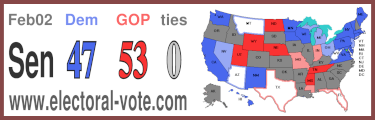
New Senate: DEM 49 GOP 51
New polls:
Dem pickups: (None)
GOP pickups: (None)
Previous | Next
Cohen Tapes Plot Thickens
It may be the weekend, but—like Pinkerton detectives—scandals never sleep. And so it is that there were a number of different developments on the Cohen tapes front on Saturday. First, it was reported by several outlets that the court-appointed referee had declared the recordings to be privileged material, meaning they theoretically should never have seen the light of day. However, shortly after this came to light, Donald Trump's legal team waived privilege. Shortly after that, the President slammed Cohen on Twitter:
Inconceivable that the government would break into a lawyer’s office (early in the morning) - almost unheard of. Even more inconceivable that a lawyer would tape a client - totally unheard of & perhaps illegal. The good news is that your favorite President did nothing wrong!
— Donald J. Trump (@realDonaldTrump) July 21, 2018
If your head is spinning from all the zigs and zags, you're not the only one.
There are many moving parts here, and much confusion as to what is going on. Further adding to the drama is that the existence of the Cohen recordings was almost certainly leaked to the New York Times by Team Trump. Why would they do that (and then waive privilege, and then belly-ache about the whole situation)? One possibility is that the recordings, as Trump lawyer Rudy Giuliani claims, are exculpatory and somehow demonstrate Trump's innocence. The problems with this thesis are: (1) Trump denied any knowledge of any payments to any of his paramours; it's hard to imagine that a recording of him discussing such payments would support his story, and (2) If the recordings are actually helpful to the President, then why would he make a point of blasting Cohen for making them?
A second possibility is that Team Trump, awash in negative feedback over the Russia situation, was looking for a distraction. The existence of the recordings was likely to become public knowledge anyhow; leaking it on the President's timeline may have allowed them to change the narrative a bit. Of course, if this theory is correct, it does not explain why the Donald waived privilege so quickly. Further, if this was indeed the plan, it did not work very well (see multiple items below).
A third possibility, and the one that seems to fit the facts best, is that the President and his legal team concluded that the content of the tapes would eventually become public and/or admissible, and they wanted to get out ahead of the story. It is true that the referee declared the recordings to be privileged, but in the long run, that might not have done Trump all that much good. First of all, there is no privilege in the court of public opinion, and even if the recordings did not see the light of day in court, they likely would have shown up on the front page of the Times or the Washington Post. Second, a government attorney (or Cohen himself) might have argued that privilege should be waived and that the recordings should be admissible. There are actually two possible bases for that argument. The first is that Cohen was not actually acting as Trump's lawyer, but instead as his employee/fixer/whatever, such that privilege does not apply. This is an interpretation that Trump's own words would support, since he himself insisted Cohen was not his lawyer back when Stormygate first broke. The second basis is called the crime-fraud exception, which is one of the rare circumstances in which privilege is automatically waived. To borrow nolo.com's explanation, the crime-fraud exception applies if:
- the client was in the process of committing or intended to commit a crime or fraudulent act, and
- the client communicated with the lawyer with intent to further the crime or fraud, or to cover it up.
This could very well describe exactly what is contained within the recordings: Trump was discussing what would be an illegal campaign contribution, and how it would be handled so as to cover it up.
The third explanation certainly seems to fit the facts—the original leak, the waiving of privilege followed by an attack on Cohen—most cleanly. Of course, now that privilege has been waived, it means we may eventually find out what the truth really is. (Z)
Did Trump Give Away Crimea?
The administration of Vladimir Putin is making some very interesting (and entirely plausible) claims about exactly what was discussed/agreed to during Monday's summit. The latest development, which came to light late Friday, is that the Russian government is claiming that Donald Trump tentatively agreed to a course of action that would "resolve" the Crimea question once and for all. The plan, in short, would be to let the people of Crimea (and possibly other Ukrainian states) vote on which country they want to be part of. The Russians have allegedly been holding off on a formal announcement in order to give Trump time to consider the plan and decide if he's actually on board.
There are a number of reasons that this story is well within the realm of possibility. First, Trump would be delighted to claim that he "resolved" the Crimea situation when Barack Obama could not, even if the "resolution" involves giving away the whole store. Second, this would explain why Team Trump has been so tight-lipped about what was discussed on Monday. If the President decides to embrace the plan, the response is going to be explosive. Third, this sort of scheme is classic Putin. He has no intention of giving up Crimea, of course; all he wants is to make the annexation look "legitimate" so that the nations of the world will leave him alone and stop sanctioning his country. If the proposed election goes forward, it would surely be a sham, much like the "elections" in 2014 in which 96% of "voters" in Donetsk and Luhansk said they wanted to leave Ukraine and join Russia.
In any case, the Trump administration's silence about what was discussed on Monday has grown both deafening and very aggravating. So much so that members of Congress on both sides of the aisle are insisting that the White House fess up about what agreements were made. The problem is that the Republicans who are speaking most loudly—Sens. Jeff Flake (R-AZ) and Bob Corker (R-TN)—are leaving office in six months, and are in the White House dog house. Quite a few other Republicans are privately aggravated, and worried about how this will affect America's relationship with her allies, but they are—as usual—largely unwilling to speak up. (Z)
Congress Won't Talk to Trump's Interpreter
There is exactly one American (besides the President himself) who heard Donald Trump's conversation with Vladimir Putin, and that is interpreter Marina Gross. In theory, if the members of Congress really want to know what was discussed, they could subpoena her. However, while interpreters are often hired as freelancers, she is actually a career State Dept. employee. So, Trump would probably try to invoke executive privilege. And, in any case, GOP leaders in Congress announced this week that they are unwilling to pursue this line of inquiry, presumably fearing the consequences of a direct challenge to the President.
This still leaves open the possibility that, at some point, Special Counsel Robert Mueller may decide he wants to talk to Gross. He is unconcerned about irritating the President, and because he works for the Justice Dept., executive privilege does not apply (this is why Dick Nixon had to fire Archibald Cox when the Watergate tapes came to light). There is an ethical expectation among interpreters that they will keep their clients' secrets but, unlike attorney-client privilege, it has no basis in law. And it's the sort of thing that tends to fall quickly by the wayside when the alternative is a few nights (or weeks, or months) in jail for contempt of court. (Z)
Does GOP Have an Alger Hiss Problem?
It's been almost exactly 70 years since the Alger Hiss scandal first hit. Hiss was a likely Russian operative who managed to pretty deeply infiltrate the U.S. government and the Democratic Party, working for the State Department and the United Nations. He was outed by newspaper editor and former Communist Party member Whittaker Chambers, who became a hero to American conservatives. Meanwhile, the failure of Harry S. Truman and other Democrats to promptly condemn and distance themselves from Hiss inflicted enormous damage on the Democratic Party and for decades gave currency to the charge that the Democrats were "soft on Communism."
In a very interesting piece for Politico, Bill Scher argues that the GOP now has its very own Alger Hiss problem in the form of accused Russian operative Mariia Butina (whose return to Russia, by the way, is being demanded by Vlad Putin). Like Hiss, Butina serves as evidence that Russia was not just manipulating one person, but instead that they targeted an entire political party. Further, she gives a "face" to Russiagate in the same way that Hiss gave a "face" to the Red Scare, which is powerful stuff.
There is, however, one big difference between Hiss and Butina. Because Hiss was a significant colleague and functionary, the Democrats of the late 1940s were loath to turn against him. Butina, on the other hand, is fairly small potatoes, and no Republican will have much trouble condemning her. When it comes to this dimension of the Hiss story, as Scher observes, the better parallel is actually...Donald Trump. And thus, Scher concludes, GOP politicians currently face a very tough choice. They can follow the lead of Truman, et al., and remain silent about Trump's interactions with Russia. That is an approach that likely prioritizes short-term gain at the expense of long-term pain. Or, they can think long term and consider what will be left of the Republican Party and what it will stand for (if anything) after Trump leaves the scene. (Z)
Is Will Hurd the New Whittaker Chambers?
Rep. Will Hurd (R-TX) is very conservative. However, as a former CIA officer, he is also willing to speak truth to power. And to that end, he penned an unflinching op-ed for the New York Times on Friday under the headline "Trump Is Being Manipulated by Putin. What Should We Do?"
Hurd probably shouldn't be expecting a presidential endorsement in his reelection campaign, as he pulls no punches. For example:
The president's failure to defend the United States intelligence community's unanimous conclusions of Russian meddling in the 2016 election and condemn Russian covert counterinfluence campaigns and his standing idle on the world stage while a Russian dictator spouted lies confused many but should concern all Americans. By playing into Vladimir Putin's hands, the leader of the free world actively participated in a Russian disinformation campaign that legitimized Russian denial and weakened the credibility of the United States to both our friends and foes abroad.
Of course, given that Hurd's district (TX-23) is R+1, and has been described as "the only true swing district" in Texas, he may be better off without a Trump endorsement.
So, is there a chance that this is the GOP's Whittaker Chambers moment (see above)? Maybe so, though it's worth noting that Chambers' outing of Alger Hiss took place in 1948, but Hiss was not convicted (of perjury) until 1950, and McCarthyism (and later Jennerism) lingered on well into the 1950s. So, it could be a while until we know the answer to that question. (Z)
FBI (Sort of) Releases Carter Page Warrant Applications
There has been much pressure on the FBI to release the paperwork in which they asked a FISA court to allow them to surveil Trump campaign aide Carter Page. A lot of Republicans wanted to see the applications because they felt they would prove that the basis for the FBI's surveillance was inappropriate and/or that the whole thing was politically motivated. A lot of Democrats wanted to see the applications because they felt they would prove the exact opposite. A lot of watchdog groups wanted to see the applications because they like transparency.
On Saturday, in response to a Freedom of Information Act request, the FBI finally gave up the goods. Well, sort of. The PDF that they released is so heavily redacted that something like 75% of it is unreadable. The parts that are readable (not to mention the 412-page length) suggest that the warrants were handled in a professional and appropriate manner, and that claims to the contrary are not rooted in fact. However, given the extent of the redactions, as well as how invested various partisans are in their version of events, Saturday's release is not likely to change many minds. (Z)
Tariffs Will Have Predictable Effects, Starting at the Worst Possible Time for the GOP
It tends to take economists a while to crunch all the numbers, but now various think tanks have started issuing reports on what will happen if Donald Trump sticks to his guns, tariff-wise, and it isn't going to be pretty.
In the short-term, prices will start to climb, profits will start to fall, and unemployment will start to creep back up. The impacts will be felt in some sectors of the economy more than others; for example, a can of Coke might cost a few cents more, while the price of the average new car might rise as much as $6,000. These effects will become palpable in just a manner of months, meaning that they will definitely be felt by the midterms. "We're already hearing complaints now from companies, so by the time we get to the midterms, you're going to be hearing governors, mayors, Congress complaining about jobs, about cost increases, about problems," said Carlos Gutierrez, who served as Secretary of Commerce under George W. Bush.
In the medium- and long-term, things are going to get even uglier. The nonpartisan Tax Foundation, in its report, says that the tariffs will reduce U.S. GDP by 0.47% (about $118 billion) and will lead to the loss of 364,000 jobs. The International Monetary Fund, meanwhile, says that global output would drop by $400 billion. There is also a near-universal consensus that the U.S. economy would enter a recession, and possibly even a depression.
So will Trump, as someone famous for changing policies and positions on a dime, sometimes several times in one day, really stick to his guns? It certainly looks that way. While he has been inconsistent on most issues throughout his life (including which political party he belongs to), he has been obsessed with the United States' trade deficit for at least four decades. Further, his rhetoric in the past few months, and especially the past few weeks, has made clear that he understands the consequences of a trade war, and he is fine with them. It's also worth noting that even if Trump does change his mind at this point, it's likely too late. Some businesses are going to be leery of committing to new trade deals, for fear that their legs will get knocked out from under them, while others are going to stick with plans to move operations abroad as a hedge against retaliatory tariffs. So, the die has probably already been cast. (Z)
Back to the main page