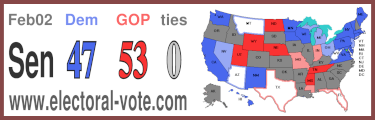
New Senate: DEM 49 GOP 51
New polls:
Dem pickups: (None)
GOP pickups: (None)
Previous | Next
Americans March in Protest of Trump's Immigration Policies
Donald Trump is very good at ginning up his base. However, he is also quite good at doing the same for his opposition. We got our latest demonstration of that on Saturday, when hundreds of thousands of people took to the streets to protest the President's immigration policies, particularly his decision (since reversed) to separate families at the border. There's no precise count of how many people participated, of course, but the total number of marches nationwide numbered greater than 700, and included huge demonstrations in New York, D.C., Chicago, Los Angeles, and Seattle, among other cities.
Trump is at his resort in Bedminster, NJ, this weekend getting in a rare golf outing. However, there is no question that he took note of the protests, as his Twitter feed was jam-packed on Saturday with tweets about ICE, immigration, and so forth. That included this one:
I never pushed the Republicans in the House to vote for the Immigration Bill, either GOODLATTE 1 or 2, because it could never have gotten enough Democrats as long as there is the 60 vote threshold. I released many prior to the vote knowing we need more Republicans to win in Nov.
— Donald J. Trump (@realDonaldTrump) June 30, 2018
This would seem to be at odds with, among other things, this tweet, that is just 30 or so tweets earlier in his timeline:
HOUSE REPUBLICANS SHOULD PASS THE STRONG BUT FAIR IMMIGRATION BILL, KNOWN AS GOODLATTE II, IN THEIR AFTERNOON VOTE TODAY, EVEN THOUGH THE DEMS WONÕT LET IT PASS IN THE SENATE. PASSAGE WILL SHOW THAT WE WANT STRONG BORDERS & SECURITY WHILE THE DEMS WANT OPEN BORDERS = CRIME. WIN!
— Donald J. Trump (@realDonaldTrump) June 27, 2018
In other words, Trump's falsehoods are getting so ham-fisted that it isn't even necessary to check Politifact to debunk them anymore.
In any event, it is 127 days until the midterms. By all evidences, enthusiasm among the Democratic base remains very high, setting the stage for what should be the most interesting non-presidential election in a very long time. (Z)
Canada's Trudeau Playing Ketchup
Today, Canadian prime minister Justin Trudeau is going to fire back in Canada's emerging trade war with the United States, hitting $12.6 billion in American goods, most visibly Heinz ketchup, with tariffs. Trudeau, who may have learned a thing or two from his dad about showmanship, will commemorate the new tariffs by visiting Canadian tomato fields and then a food processing plant on Sunday.
Needless to say, ketchup is not on the level of oil or steel when it comes to moving the economic needle. Nonetheless, it presents an interesting case study of some of the side effects a trade war might have. To start, French's ketchup, though owned by an American conglomerate, does much of its production in Canada. The company has been aggressively positioning itself as that nation's condiment brand of choice, up to and including incorporating a maple leaf into its packaging:

Further, there is an ongoing push up north encouraging consumers to purchase Canadian-made goods, including French's ketchup:

Heinz is going to have a hard time competing with that, particularly if the price of their goods is affected by an import tariff. One thing they can do, however, is start producing condiments in Canada. In particular, the company's factory in Fremont, Ohio, is less than 100 miles from the border. If they make that move, then over a thousand American jobs would vanish, just like that. And while Donald Trump can end a trade war with a stroke of his pen, once that factory is gone, it's not coming back. (Z)
Trump Asks Saudis to Produce More Oil
It is clear, at this point, that there is very little Donald Trump can do that will cause the base to turn against him. Sexist and racist statements, petulant behavior, shady economic dealings, insults directed at war heroes, thousands upon thousands of lies—it's all good with them. By all indications, his only Achilles' heel is the economy. If the base starts to feel the effect of his policies in their pocketbooks, that just might hurt him.
Trump seems to know this. Or, at very least, he seems to know that extremely high gas prices right before the midterms will not be helpful. There isn't a whole lot that any president can do about that problem, but Trump is trying, at least. On Saturday, he called his friend, King Salman bin Abdulaziz Al Saud, and asked him to boost oil production by as much as 2,000,000 barrels a day.
The President is already bragging about the call:
Just spoke to King Salman of Saudi Arabia and explained to him that, because of the turmoil & disfunction in Iran and Venezuela, I am asking that Saudi Arabia increase oil production, maybe up to 2,000,000 barrels, to make up the difference...Prices to high! He has agreed!
— Donald J. Trump (@realDonaldTrump) June 30, 2018
As with so many things, however, Trump may be putting the cart before the horse. First of all, it is unclear exactly how truthful Salman's words were. If he really said, "I agree, gas prices are too high!" then he was talking out of both sides of his mouth, since high gas prices are what makes his country's (and his family's) economic engine run. And even if the King was being honest, well, an extra 2 million barrels a day is a tall order on top of the 11 million a day Saudi Arabia already produces—experts are not clear that they have that much additional capacity. Further, the United States uses about 22 million barrels of oil a day during the summer. So, even if Salman was telling the truth, and even if he's able to crank out an extra 2 million barrels a day, and even if all of those 2 million barrels go to the United States, it may not move the needle all that much. At the moment, the average price of a gallon of gas is $2.85. Exactly one year ago on this date, it was $2.24. So, even if the Saudis are willing and able to put a dent in that, it is likely that the U.S. is still headed for a summer of unusually high gas prices. (Z)
Gringa Wins in Little Havana
Special elections for county commissioner normally rank right up there with special elections for dogcatcher in terms of national impact, but one held in Miami-Dade County this week may be a bit different. Miami politics have long been dominated by Cuban Americans, who are overwhelmingly Republican. In a state as closely divided as Florida, they often make the difference, even in statewide elections. This week, Ohio native Eileen Higgins, who is so clearly not Latina that she calls herself "La Gringa," won 53% of the vote in a special election runoff for county commissioner in a heavily Latino district of Miami that includes all the Little Havana area. And she beat the wife of the Cuban-American former incumbent (who resigned to run for Congress) and who had held the seat for 20 years.
The Republican Party was fully behind Republican Zoraida Barreiro, including Sen. Marco Rubio (R-FL) and Miami Mayor Carlos Gimenez. They also raised money for her. Her husband even transferred $95,000 from his campaign account to his wife's campaign account. All of this was in vain. You may have noticed all the fuss made last week by the upset win of Alexandria Ocasio-Cortez, a young Latina who beat an older white man in a very heavily Latino district in New York. That story was really "dog bites woman" (Latina wins in heavily Latino district). The Florida story is "woman bites dog" (Anglo beats Latina in heavily Latino district).
Democratic pollster Fernand Amandi described the race by saying: "This is a transformational election. This is an election where you had an unknown defeat two of the titular Cuban dynasties in local politics. And it wasn't even close." Part of Higgins' win might be a backlash against Donald Trump, since her husband, Bruno Barreiro, supported Trump. But it could also be a harbinger of change in South Florida. While there are still plenty of Cuban Americans there, the younger generation is not nearly so virulently anti-Communist as the older one, which is dying off. Also, while Florida's Latino population is growing, many of the new arrivals are from Puerto Rico, Nicaragua, Guatemala, and other countries and their votes aren't driven by a hatred of Fidel Castro, the way the older Cuban Americans' votes are.
Republican officials fear that at least three House seats currently occupied by Cuban American Republicans could be in play now. These are FL-25, occupied by Rep. Mario Diaz Balart (R-FL), FL-26, occupied by Rep. Carlos Curbelo (R-FL), and FL-27, occupied by Rep. Ileana Ros-Lehtinen (R-FL). Ros-Lehtinen is not running for reelection and her district is D+5, so that is probably a lost cause for the GOP, but if the dynamic that played out in Higgins' surprising upset win also holds in November, the Democrats could flip three Florida House seats. (V)
This Week's Swamp Creature: Wilbur Ross
These days, we're learning a little bit about what it was like to live in the Gilded Age. Back then, muckraking journalists like Mark Twain, Lincoln Steffens, Upton Sinclair, Charles Edward Russell, Ida M. Tarbell and others turned up new dirt on America's political and business leaders on a weekly basis. So it is with the Trump administration, where it seems we can rarely go more than a few days without something scandalous coming to light about one functionary or another. The latest member of the administration to be in the spotlight: Secretary of Commerce Wilbur Ross.
When Ross was before the Senate, he secured confirmation fairly easily, on vote of 72 to 27. As a businessman with decades of experience and billions in assets, he clearly knows a little something about commerce, and so seemed eminently qualified for his job. Since then, however, some troubling issues have come to light. Like, for example, his undisclosed ties to Russia. Or the $1.3 billion or so in net worth that seems to have vanished into thin air. And now, Forbes magazine—which is hardly a bastion of left-wing activism—has conducted an investigation of Ross's finances, and discovered even more troubling news.
The gist of Forbes' conclusions is that when Ross promised to divest himself of all of his assets, and then claimed he had finished doing so, he was lying. Much of his portfolio was placed in the hands of his children, which—as the Trumps have shown us—does not eliminate conflicts of interest. Consequently, Ross was doing official business with China, Russia, and other countries while in a position to benefit financially from those dealings. These things are dubious, but they don't appear to be illegal. What is illegal, however, is that Ross personally retained millions of dollars worth of stock in his former employer, Invesco, and in other companies after providing a sworn statement to Congress that his divestment was complete. Lying to Congress is, of course, a felony.
It also gets worse (at least, potentially). After Ross was contacted by the New York Times about the story they were writing about his ties to the Russian corporation Navigator Holdings, the Secretary promptly shorted shares of stock in the company. His "insight" netted him between $100,000 and $250,000. Sens. Elizabeth Warren (D-MA) and Richard Blumenthal (D-CT), and Rep. Elijah Cummings (D-MD) have already sent a letter to SEC Commissioner Jay Clayton to ask him to look into possible insider trading. Whether the Trump appointee will do so is anyone's guess, but insider trading is another felony, of course. And either way, the number of Trump cabinet members who have managed to remain scandal-free gets smaller and smaller. (Z)
Eight Days until Trump Picks Kennedy's Replacement
Even after making time for some golf, Saturday was a busy Twitter day for Donald Trump. When he wasn't kvetching about immigration (6 tweets), or bragging about the economy (3), or promoting projects by his friends in the media (also 3), he was talking about the Supreme Court. That included this tweet:
I will be making my choice for Justice of the United States Supreme Court on the first Monday after the July 4th Holiday, July 9th!
— Donald J. Trump (@realDonaldTrump) June 30, 2018
The early favorite appears to be Brett Kavanaugh, who currently sits on the U.S. Court of Appeals for the District of Columbia Circuit. The Judge's primary selling points are as follows:
- He is white and male
- The base likes him
- Because he's a 12-year federal judge, nobody can say he's unqualified (unlike, say, Ronny Jackson)
- He is strongly on record in support of the notion that sitting presidents are too busy to be bothered with things like lawsuits and depositions.
One can imagine which of these selling points has particularly piqued Trump's interest. In any case, we will know who the pick is next Monday. (Z)
Can the Democrats Do Anything about the New SCOTUS Justice?
In a word: No. Given the anger over Merrick Garland, and a general move by the Democratic base in the direction of being more assertive, a whole bunch of ideas for doing something to affect the process have been floating around since Associate Justice Anthony Kennedy retired. Here are the three most promising ones, along with an explanation of why they won't work:
- Appeal to Donald Trump to Pick a Moderate: Sen.
Heidi Heitkamp (D-ND), who is undoubtedly closer with Trump than any other
Democrat in the Senate (and even some of the Republicans) tried this very
approach. In a statement, she said, "I told the president that he has a chance
to unite the country by nominating a true non-ideological jurist who could gain
strong support from senators on both sides of the aisle, rather than create more
divisions."
- Why it Won't Work: Divisions are Trump's stock in
trade. He cares about his base, and only about his base. The man who is
compiling a list of possible nominees for Trump is
Leonard Leo,
a right-winger who views Antonin Scalia as his personal hero. All of these
things make clear that the nominee isn't going to be a centrist. The only
question is whether Trump laughed in Heitkamp's face, or he waited until she was
gone.
- Band Together with One or More Moderate
Republicans: The notion here is that 49 Democrats plus one or two
Republicans would be enough to hold the line.
- Why it Won't Work: Ok, if the pick is an
ultra-right winger, it might work. But beyond that, Sens. Susan Collins (R-ME)
and Lisa Murkowski (R-AK) are loyal partisans when it comes to judicial votes.
Sens. Jeff Flake (R-AZ) and Bob Corker (R-TN) have already made clear that their
opposition to Trump does not extend to voting on his judicial nominees (or to
voting on anything else he wants, it would appear). Sen. John McCain (R-AZ) is
not in Washington, and may never be again. Meanwhile, it is unlikely that all of
the red state Democrats are going to be willing to be on the front lines of
something like this.
- Deny Quorum: Vox's Gregory Koger, taking note of
the aforementioned absence of McCain, wrote an interesting column a few days
before Kennedy retired. He
notes
that if all 49 Democrats refuse to show up for work, then there will be only 50
people present. That is not the "majority" the Constitution calls for, and thus
would bring Senate business to a halt.
- Why it Won't Work: Given the timing of his column, Koger was not specifically suggesting this as a way of keeping the SCOTUS seat empty, but instead as a means of making some noise and gumming up the works. Nonetheless, some folks have seized upon it as the Democrats' answer to Senate Majority Leader Mitch McConnell's (R-KY) chicanery. The problem here is that McConnell knows a few things about parliamentary tricks himself. The first thing he would do is go to Senate parliamentarian Elizabeth MacDonough and ask her to rule that 50 Senators plus the vice president does constitute a quorum. She would almost certainly agree, since the vice president is the presiding officer of the Senate. If she did not, then McConnell would place a call to McCain, and would tell him that he either needs to get himself to Washington for a day, or he needs to bow to the inevitable and resign so that someone can be seated in his place. Failing that, McConnell would come up with something else, like having the Capitol police forcibly escort one or more Democrats to the Senate chamber.
So, unless Trump's pick is monumentally problematic, the new justice will be approved promptly. All the Democrats can do is look to 2020, and hope that is the starting point for a change in their SCOTUS fortunes. (Z)
Democrats Turn to Vets to Turn the House
The most significant initiative of the Democratic Party right now is their red-to-blue program, wherein both the DNC and DCCC are giving extensive support to candidates who have a chance to capture House districts currently held by Republicans. And anyone who examines a list of the red-to-blue candidates can't help noticing that (in addition to the high number of women) a sizable portion of them are veterans.
There are at least four reasons that the Party thinks this approach is a winner:
- It will blunt GOP attacks that the Democrats are weak on national defense
- Veterans will appeal to moderate Republicans and independent voters
- The U.S. is in an era of non-traditional, "break the mold" candidates
- It worked the last time the Democrats reclaimed the House, back in 2006
We're just over four months from finding out if it works again. If so, it certainly gives a boost to the presidential chances of veterans-turned-candidates like Jason Kander of Missouri. (Z)
Back to the main page