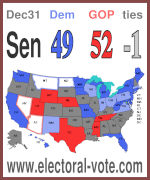
Pres polls: (None)
Dem pickups: (None)
GOP pickups: FL IA MI OH PA WI
Previous | Next
Trump Signs Executive Order to Repeal Much of Obama's Work on Climate Change
Saying that he was ending a "crushing attack" on the U.S. economy, yesterday President Donald Trump signed a sweeping executive order that ends Barack Obama's efforts to deal with climate change. Trump said has was going to end the war on coal, adding:
We're going to have clean coal. Really clean coal. Together we will create millions of good American jobs, also so many energy jobs, and really lead to unbelievable prosperity.
Energy experts do not believe such a thing as "clean coal" exists. As to the jobs, the thing killing the coal industry is not federal regulation, it is the fact that natural gas obtained from fracking is less expensive, so electric power plants are switching to natural gas because it is not only cleaner, but also cheaper. Trump's executive order will do nothing to change the relative prices of coal and gas. According to government data, the new rules might increase coal production by 5 million tons a year out of 800 million tons. Furthermore, not all areas will benefit from the order. In particular, Appalachia is unlikely to benefit from the new rules because the kind of mining done there is very labor intensive, and so is very expensive, exacerbating the already-existing profitability issue.
Trump's order calls for the EPA to rewrite rules making it easier for utilities to get permission to build new coal-fired plants. However, it is unlikely that many new coal-fired plants will be built because the utility executives know that a future Democratic administration could put the rules back in place, causing them huge losses. It also does not help that it is cheaper to build a brand-new wind, solar, or natural gas plant than it is to operate an already-existing coal plant. In fact, the most recent major coal project, Mississippi's Kemper County carbon-capturing coal plant, has been a financial boondoggle. It was scheduled to cost $3 billion and be online by 2014, but it's actually cost over $7 billion, and still isn't operational.
Trump hasn't yet decided whether to pull out of the Paris climate agreement. While his backers in the fossil fuel industry would love to see that, Ivanka Trump and her husband, Jared Kushner, are against doing that on account of the damage that would do to relations with key allies. (V)
Border Wall Funding Will Be Put on Hold
Sen. Roy Blunt (R-MO), a senior member of the Senate Appropriations Committee, said yesterday that funding for a wall on the Mexican border would not be in the 2017 budget. He didn't rule out a supplemental bill later in the year, though. Blunt and other lawmakers are concerned about that fact that government funding will expire on April 28, potentially forcing a government shutdown if the new budget is not approved. Democrats have threatened to filibuster the budget if it contains funding for the wall, and Blunt wants to avoid that fight now. The wall funding could be included in a supplemental military spending bill later on.
How much the wall will cost is not known at this point. Sen. Claire McCaskill (D-MO) said that the Trump administration's request for $2.6 billion to build 75 miles of wall projects out to $67 billion for the entire 1,827-mile wall. Furthermore, she noted that the final price tag is likely to be much higher, since nearly all the land at the border is private and would have to be acquired from private landowners. The $2.6 billion request just covers construction costs, not land-acquisition costs. Also noteworthy is that most of the border that is not currently fenced is in Texas, where the border is mountainous territory with few roads, making construction much more difficult and expensive than in the flat deserts of Arizona and New Mexico. (V)
Nelson Will Filibuster Gorsuch
Political observers have been watching closely to see how Democratic senators in states Donald Trump won will vote on the confirmation of Neil Gorsuch to the Supreme Court. Sen. Bill Nelson (D-FL), who expects a tough fight against Gov. Rick Scott (R-FL) in 2018, has now made his position clear: He will filibuster Gorsuch. The reason is the pressure he is getting from the Democratic base, which is threatening to primary him if he supports Gorsuch.
Nelson is a centrist and a decade ago he wouldn't have done this. In fact, in 2006, he voted for cloture to end the filibuster of Judge Samuel Alito's nomination to the Supreme Court. He also voted to approve Gorsuch to the 10th Circuit Court. But times have changed and many Democrats want to take a page from the tea party's playbook. No mater what the question is, the answer is "no."
Nelson has been elected five times statewide in Florida. He is pretty good at reading the tea leaves, and if he thinks that nailing down his base is more important that wooing moderates, there is a fairly good chance he knows what he is doing. We will soon hear how Democrats in even redder states, like North Dakota, Indiana, and Missouri will vote on Gorsuch.
Senate Minority Leader Chuck Schumer (D-NY) has called for a filibuster of Gorsuch as payback for the Republicans' refusing to give Merrick Garland a hearing, let alone an up-or-down vote. All this puts Majority Leader Mitch McConnell (R-KY) in a bind. He could try to abolish the filibuster for Supreme Court nominees, but it is not clear if he has the votes for that. Furthermore, as the Democrats discovered this year, their abolishing the filibuster for cabinet nominees and lower-court judges when Obama was president has come back to bite them. McConnell knows that tables could be turned some day, so he has to think very carefully about abolishing the filibuster now. (V)
"Trump Bump" Turning into "Trump Slump"
In the days and weeks following Donald Trump's election, and particularly his inauguration, the stock market boomed, as investors were looking forward to a world without regulation. The President, of course, was happy to take credit for the surging Dow Jones and NASDAQ, even though he pooh-poohed the exact same indicators when they rose under Barack Obama.
Now, Trump may be returning to his position that the Dow Jones, etc. don't matter, because things aren't looking so rosy any more. Following the AHCA debacle, investors have grown skittish about the ability of Trump and the GOP to deliver on their promises. They are likely also aware that the bull market, now in its ninth year, can last only so long. And so, they're turning bearish. The Dow dropped eight days in a row (before rebounding on Tuesday). That eight-day streak was a first since 2011, and means the index is likely to have its worst month since January 2016. Thus far, the correction is not too terribly significant—it's down only 2% overall—but it is certainly possible that this is just a prologue to further declines. (Z)
Manafort May Have Laundered Money in New York Real Estate
Donald Trump's former campaign manager, Paul Manafort, has engaged in transactions using a bank in Cyprus that is commonly used by Russian billionaires to do money laundering. Now it appears that Manafort has done some suspicious transactions in the New York real estate market as well. Between 2006 and 2013, Manafort bought three homes in New York City for cash, using shell companies as the legal owners. Then he borrowed about $12 million against those homes. None of this is illegal, but the pattern of buying real estate for cash and then borrowing against the properties to get "clean money" is how money launderers often work. A federal agent who was asked about these transactions said they were "worth looking into." The key question, of course, is where the cash came from that he used to buy the properties in the first place. Manafort has a long history of working for foreign dictators of one kind or another, but it has never been clear exactly what he did for them.
One of Manafort's homes is unit 43-G in Trump Tower. A message written by Manafort's adult daughter, Jessica, became public in April 2016. It read: "Dad and Trump are literally living in the same building and mom says they go up and down all day long hanging and plotting together"
Another oddity in all this is that he bought one of his homes, in Brooklyn, for $3 million but got a $6.8 million mortgage on it. Zillow says it is worth $4.5 to $5 million. It is unusual for a bank to give a mortgage that greatly exceeds the value of the property, so something strange is going on here. When asked about this, Manafort said that the loan amount was based on what the property would be worth after renovation, but according to the New York City Department of Buildings, no permits are outstanding for work on Manafort's properties. (V)
Congress Wipes Out Internet Privacy
During the Obama administration, the FCC forbade Internet providers from collecting and selling personal information from their customers. Last week, the Senate voted 50 to 48 to overturn that rule and yesterday the House concurred in a largely party-line vote, 215 to 205. Donald Trump is expected to sign the measure.
Internet providers know exactly which web pages their customers look at and how long they look. If a customer checks out some disease, insurance companies and employers might be willing to pay handsomely for that information. If a customer is investigating bankruptcy laws, financial institutions will pay good money for that data, and so on.
There are ways for people to protect themselves, such as using a virtual private network (VPN) in which all traffic from the user to the VPN is encrypted, so the Internet provider can't tell what the user is doing. There are free VPNs available, but they all come with restrictions. Paid VPNs are easy to use and have no restrictions, but they typically cost $50 to $100 per year. If you search for "virtual private network," you will discover dozens of companies that offer VPN services. VPNs are also widely used to defeat attempts by companies to restrict certain content to specific geographic locations. (V)
Perez Cleans House at DNC
The Democratic National Committee has a problem: Progressives perceive it to be a corrupted tool of party elites. There's a lot of truth to that; whether or not it's corrupt is open to debate, but it's pretty much the tool of party elites by definition. Not helping matters is that, while newly-elected chair Tom Perez and his vanquished foe Rep. Keith Ellison (D-MN) are in sync on nearly all issues, Perez was perceived as the candidate of "insiders" and Ellison the candidate of "outsiders." So, Perez' victory did not please the Sanders and Warren crowd.
Now, it's incumbent upon Perez to try to heal the rifts in the party, and to do what he can to clean up the DNC's image. He took the first step in that direction this week, requesting the resignations of all members of the DNC Staff. This is actually par for the course; what's unusual is that it's being done so...loudly. Clearly, Perez is trying to signal to disaffected progressives that there is a new sheriff in town. Other big changes are surely coming; in particular, the superdelegates are not likely to survive to 2020. (Z)
Cohn: Clinton Did Not Lose Due to Poor Turnout
Now that we're four months out, much more extensive data about last year's presidential election is available. The New York Times' numbers guru, Nate Cohn, has crunched the data. His conclusion is that Hillary Clinton was not doomed by anemic Democratic turnout.
Cohn starts by observing that turnout wasn't great for Clinton, who—unsurprisingly—was not as successful as Barack Obama at getting black voters to the polls. However, it also wasn't great for Trump, either. Clinton struggled slightly more than Trump in this area, and given the razor-thin margin of victory in the three Midwestern states that flipped the election, that might have been enough. But maybe not, and poor Democratic turnout was certainly not the major story of the night.
So what was the major story? Cohn's analysis suggests that Trump was actually successful at flipping Democratic voters. More specifically, white, working-class voters who went for Obama in 2012. By all indications, Clinton won about 80% of the white, working-class Obama voters in the swing states, and Trump won 20%. That's a very good showing for Trump, and was more than enough to provide his margin of victory. Now, the Democrats will have to decide if they think they can get those people back, or if they want try to replace them with minority voters.
It should be noted, however, that other analyses have come to a different conclusion. This analysis in the Washington Post shows that Clinton was badly hurt by Democrats who stayed home. FiveThirtyEight also came to the conclusion that it was Democrats didn't vote that cost Clinton the election. (Z & V)
Trump Won't Throw Out First Pitch of MLB Season
On April 14, 1910, President William Howard Taft threw out the first pitch of the major league baseball season, as the Washington Senators did battle against the Philadelphia Athletics. Since that time, the ceremonial first pitch has been a presidential tradition, from Taft all the way through Barack Obama. Even the guy in a wheelchair participated (nine times!). It doesn't happen every season, but it does happen with every president, eventually. In particular, most have seized upon the first available opportunity of their presidencies (with Ronald Reagan and Jimmy Carter the exceptions). Now, it seems the tradition may skip a president. The Washington Nationals invited Donald Trump to throw out the first pitch in their Monday season-opener against the Miami Marlins, but the President—claiming scheduling conflicts—has declined the invitation.
This explanation seems a little implausible, given that nobody at the White House could explain exactly what the scheduling conflicts are. That being the case, what's going on here? One possibility is that Trump is worried he will embarrass himself by throwing a lousy pitch. That's unlikely, however. There have been some real stinkers over the years—FDR once hit a television camera, for example, and Barack Obama's was also a train wreck. It's unlikely Trump would do worse, especially since he was once a talented enough ballplayer to be scouted by the Philadelphia Phillies and the Boston Red Sox.
So, if the problem is not the pitch itself, then what is it? Well, 96% of Washington, D.C. residents voted against Trump who, as we noted yesterday, currently sports a 36% approval rating. It is a near-certainty, as the White House staff surely knows, that The Donald would be booed, loudly and at length. This will not do for someone who prefers to surround himself only with sycophants—at rallies, for example. There is still time for Trump to resume the tradition, of course—this year's All-Star game or World Series, next year's opening day—but it will likely require that the approval rating go up a fair bit, and that he find a venue that's a bit more friendly (too bad for him that he missed out on very conservative San Diego, site of the 2016 All-Star Game). Alternatively, he could take the mound on Monday, and ask that Paul Ryan act as his catcher. Then Trump can just say the boos were for the Speaker. (Z)
Back to the main page